Wind	
  energy	
  – challenges	
  
Ewa	
  Lazarczyk	
  Carlson
ewalazarczyk@ru.is
1
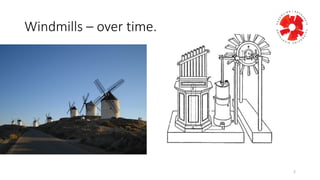
Windmills	
  – over	
  time…	
  
2
Windmills	
  – over	
  time…	
  
3
Windmills	
  – over	
  time…	
  
4
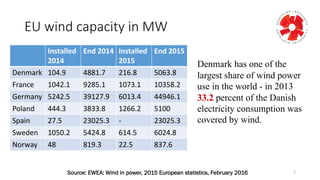
EU	
  wind	
  capacity	
  in	
  MW
Installed	
  
2014
End	
  2014 Installed	
  
2015
End	
  2015
Denmark 104.9 4881.7 216.8 5063.8
France 1042.1 9285.1 1073.1 10358.2
Germany 5242.5 39127.9 6013.4 44946.1
Poland 444.3 3833.8 1266.2 5100
Spain 27.5 23025.3 -­‐ 23025.3
Sweden 1050.2 5424.8 614.5 6024.8
Norway 48 819.3 22.5 837.6
Source: EWEA: Wind in power, 2015 European statistics, February 2016
Denmark has one of the
largest share of wind power
use in the world - in 2013
33.2 percent of the Danish
electricity consumption was
covered by wind.
5
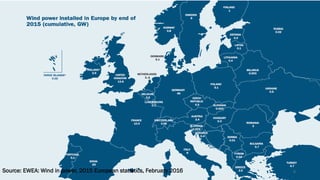
Source: EWEA: Wind in power, 2015 European statistics, February 2016 6
Current	
  statistics
• In	
  2015	
  across	
  the	
  28	
  EU	
  member	
  states,	
  wind	
  accounted	
  for:
• 44%	
  of	
  all	
  new	
  power	
  installations,	
  
• connecting	
  a	
  total	
  of	
  12.8GW	
  to	
  the	
  grid
• 9,766MW	
  in	
  onshore	
  and	
  3,034MW	
  offshore.	
  
• The	
  volume	
  of	
  new	
  installations	
  was	
  6.3%	
  higher	
  as	
  compared	
  with	
  2014.
• Total	
  wind	
  capacity	
  in	
  Europe	
  now	
  stands	
  at	
  142GW	
  and	
  covers	
  11.4%	
  of	
  
Europe’s	
  electricity	
  needs.	
  (2016,	
  EWEA)
7
European	
  targets
• 2020	
  renewable	
  energy	
  targets
• The	
  EU's	
  Renewable	
  energy	
  directive	
  sets	
  a	
  binding	
  target	
  of	
  20%	
  final	
  
energy	
  consumption	
  from	
  renewable	
  sources	
  by	
  2020.	
  To	
  achieve	
  
this,	
  EU	
  countries	
  have	
  committed	
  to	
  reaching	
  their	
  own	
  national	
  
renewables	
  targets	
  ranging	
  from	
  10%	
  in	
  Malta	
  to	
  49%	
  in	
  Sweden.	
  
https://ec.europa.eu/energy/en/topics/renewable-­‐energy 8
Wind	
  energy	
  – challenges	
  
• “Merit	
  order	
  effect”
• Increased	
  price	
  volatility
• Increased	
  wear	
  and	
  tear
• Balancing	
  issues
• Towards	
  the	
  European	
  Balancing	
  Market
• “[…]	
  a	
  cross	
  border	
  balancing	
  market	
  will	
  help	
  to	
  counteract	
  the	
  effects	
  of	
  
intermittent	
  generation	
  and	
  allow	
  the	
  integration	
  of	
  more	
  renewable	
  energy	
  
sources”.	
  
9
10
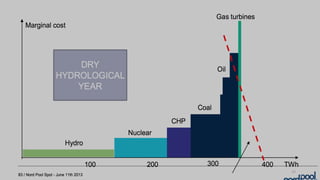
“Merit	
  order	
  effect”
• Price-­‐reduction	
  effect	
  of	
  wind	
  power	
  due	
  to	
  displacing	
  of	
  expensive	
  
generation	
  with	
  cheap	
  wind.
• Demonstrated	
  for	
  Spain	
  (Gil	
  et	
  al.	
  2012),	
  Germany	
  (Ketterer 2014),	
  
Denmark	
  (Jacobsen	
  and	
  Zvingilaite 2010),	
  California	
  (Woo	
  et	
  al.	
  2016)	
  and	
  
many	
  others
• Adverse	
  effect	
  on	
  conventional	
  power	
  plants	
  -­‐>	
  capacity	
  markets
-­‐>	
  weaker	
  investment	
  incentive	
  for	
  CCGT	
  plants	
  (Steggals et	
  al.	
  
2011)
• Lower	
  income	
  for	
  renewable	
  generation	
  -­‐>	
  the	
  relative	
  market	
  value	
  of	
  
renewables	
  decreases	
  with	
  higher	
  intermittent	
  shares	
  (all	
  else	
  being	
  equal)	
  
(Hirth 2013)	
  (their	
  income	
  per	
  generated	
  unit	
  of	
  electricity	
  relative	
  to	
  the	
  
average	
  market	
  price	
  decreases)
http://www.nasdaqomx.com/digitalAssets/86/86050_npspotjune112013.pdf
11
Increased	
  price	
  volatility
• Residual	
  load	
  is	
  usually	
  more	
  volatile	
  than	
  the	
  demand	
  alone	
  (Green	
  
and	
  Vasilakos 2010)
• With	
  a	
  sufficiently	
  large	
  share	
  of	
  wind	
  generation,	
  hourly	
  wind	
  output	
  
volatility	
  would	
  have	
  a	
  strong	
  influence	
  over	
  wholesale	
  spot	
  prices.	
  
(G&V)
• Negative	
  prices	
  are	
  supposed	
  to	
  incentivize	
  the	
  restructuring	
  of	
  the	
  
power	
  system:	
  inflexible	
  plants	
  pay	
  for	
  producing	
  while	
  demand	
  
storage	
  and	
  demand	
  management	
  could	
  bring	
  benefits
12
Increased	
  wear	
  and	
  tear
• The	
  frequent	
  start-­‐ups	
  and	
  shut-­‐downs	
  put	
  a	
  strain	
  on	
  conventional	
  	
  
generators	
  -­‐-­‐>	
  frequent	
  failures	
  or	
  increased	
  needs	
  for	
  maintenance	
  
compared	
  to	
  when	
  wind	
  power	
  is	
  not	
  part	
  of	
  the	
  energy	
  mix	
  (Troy	
  et	
  al.,	
  
2010;	
  Troy,	
  2011;).	
  
• The	
  cost	
  of	
  operating	
  the	
  power	
  system	
  as	
  a	
  whole	
  increases	
  already	
  at	
  the	
  
10%	
  of	
  wind	
  power	
  penetration	
  (Georgilakis 2008).	
  
• It	
  is	
  increasingly	
  difficult	
  to	
  put	
  one	
  number	
  on	
  the	
  costs	
  related	
  with	
  
frequent	
  start-­‐ups	
  and	
  shut-­‐downs	
  of	
  the	
  conventional	
  power	
  plants.	
  
• for	
  e.g.	
  a	
  gas	
  unit	
  has	
  been	
  found	
  to	
  range	
  from	
  $300	
  to	
  $80,000	
  in	
  the	
  operation	
  
and	
  maintenance	
  costs
• “(…)	
  uncertainty	
  surrounding	
  cycling	
  cots	
  can	
  lead	
  to	
  these	
  costs	
  being	
  
under-­‐estimated	
  by	
  generators,	
  which	
  in	
  turn	
  can	
  lead	
  to	
  increased	
  
cycling”	
  (Troy	
  2011).	
  
13
Balancing	
  
• Imbalances	
  due	
  to	
  intermittent	
  power	
  increase,	
  so	
  number	
  of	
  
unscheduled	
  flows	
  rises
• Currently	
  TSOs	
  are	
  starting	
  up	
  the	
  process	
  of	
  defining	
  the	
  rules	
  of	
  
cooperation.
• Network	
  codes	
  on	
  balancing	
  and	
  reserves	
  have	
  recently	
  been	
  
developed	
  by	
  ENTSO-­‐E
European network of transmission
system operators for electricity 14
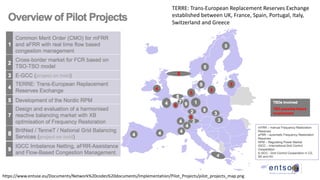
https://www.entsoe.eu/Documents/Network%20codes%20documents/Implementation/Pilot_Projects/pilot_projects_map.png
TERRE:	
  Trans-­‐European	
  Replacement	
  Reserves	
  Exchange	
  
established	
  between	
  UK,	
  France,	
  Spain,	
  Portugal,	
  Italy,	
  
Switzerland	
  and	
  Greece
15
Cooperative	
  balancing	
  
• Exchange	
  of	
  reserves	
  allows	
  for	
  cost	
  arbitrage	
  
• Makes	
  it	
  possible	
  to	
  procure	
  part	
  of	
  the	
  required	
  level	
  of	
  reserves	
  in	
  adjacent	
  
zone/area	
  but	
  these	
  reserves	
  are	
  exclusively	
  for	
  one	
  TSO	
  -­‐ they	
  cannot	
  
contribute	
  to	
  meeting	
  another	
  TSO’s	
  required	
  level	
  of	
  reserves.	
  
• Expensive	
  reserves	
  can	
  be	
  substituted	
  for	
  cheaper
• Reserves	
  sharing	
  allows	
  both	
  cost	
  arbitrage	
  and	
  variance	
  reducing	
  
pooling	
  of	
  reserve	
  needs
• Allows	
  multiple	
  TSOs	
  to	
  take	
  into	
  account	
  the	
  same	
  reserves	
  to	
  meet	
  their	
  
reserve	
  requirements	
  resulting	
  from	
  reserve	
  dimensioning.
• Less	
  reserve	
  capacity	
  is	
  needed
• Expensive	
  reserves	
  can	
  be	
  substituted	
  for	
  cheaper
16
Thank	
  you.
17
Literature
• Woo	
  C.K.,	
  Moorse.	
  J,	
  Schneiderman B.,	
  Ho.	
  T.,	
  Olson,	
  A.,	
  Alagappan.	
  L,	
  Chawla.	
  K.,	
  Toyama.	
  N.,	
  
Zarnikau.	
  J.,	
  	
  Merit-­‐order	
  effects	
  of	
  renewable	
  energy	
  and	
  price	
  divergence	
  in	
  California’s	
  day-­‐
ahead	
  and	
  real-­‐time	
  electricity	
  markets.	
  Energy	
  Policy,	
  V	
  92,	
  May,	
  2016,	
  pp.	
  299	
  – 312.	
  
• Nicolosi,	
  M.,	
  Wind	
  power	
  integration	
  and	
  power	
  system	
  flexibility–An	
  empirical	
  analysis	
  of	
  
extreme	
  events	
  in	
  Germany	
  under	
  the	
  new	
  negative	
  price	
  regime,	
  Energy	
  Policy.	
  3.	
  2010.	
  pp.	
  7257	
  
– 7268.	
  
• Steggals,	
  W.,	
  Gross.	
  R.,	
  Heptonstall,	
  P.	
  Winds	
  of	
  change:	
  How	
  high	
  wind	
  penetrations	
  will	
  affect	
  
investment	
  incentives	
  in	
  the	
  GB	
  electricity	
  sector.	
  Energy	
  Policy,	
  39,	
  2011,	
  pp.	
  1389	
  – 1396.	
  
• Baldursson,	
  F.	
  M.,	
  Lazarczyk,	
  E.,	
  Ovaere,	
  M.,	
  &	
  Proost,	
  S.	
  2016a.	
  Cross-­‐border	
  Exchange	
  and	
  
Sharing	
  of	
  Generation	
  Reserve	
  Capacity.	
  IAEE	
  Energy	
  Forum.	
  July.
• Baldursson,	
  F.	
  M.,	
  Lazarczyk,	
  E.,	
  Ovaere,	
  M.,	
  &	
  Proost,	
  S.	
  2016b.	
  Multi-­‐TSO	
  system	
  reliability:	
  
Cross-­‐border	
  balancing.	
  IEEE	
  International	
  Energy	
  Conference	
  (ENERGYCON).
• Fogelberg,	
  S.,	
  Lazarczyk,	
  E.,	
  2015,	
  Wind	
  Power	
  Volatility	
  and	
  the	
  Impact	
  on	
  Failure	
  Rates	
  in	
  the	
  
Nordic	
  Electricity	
  Market,	
  IFN	
  Working	
  Paper	
  1065.	
  
18
Literature
• Hirth,	
  L.,	
  2013.	
  The	
  market	
  value	
  of	
  renewables:	
  the	
  effect	
  of	
  solar	
  and	
  wind	
  power	
  variability	
  on	
  their	
  relative	
  price.	
  Energy	
  
Economics.	
  38.	
  pp.	
  218	
  – 236.	
  
• Gil	
  H.A.,	
  Gomez-­‐Quiles,	
  C.,	
  Riquelme,	
  J.,	
  	
  2012,	
  Large	
  scale	
  wind	
  power	
  integration	
  and	
  wholesale	
  electricity	
  trading	
  benefits:	
  
Estimation	
  via	
  ex	
  post	
  approach	
  Energy	
  Policy	
  41.	
  pp.	
  849	
  – 859.	
  
• Ketterer 2014,	
  The	
  impact	
  of	
  wind	
  power	
  generation	
  on	
  the	
  electricity	
  price	
  in	
  Germany.	
  Energy	
  Economics.	
  44.	
  pp.	
  270	
  – 280.	
  	
  
• Jacobsen	
  and	
  Zvingilaite,	
  2010,	
  	
  Reducing	
  the	
  market	
  impact	
  of	
  large	
  shares	
  of	
  intermittent	
  energy	
  in	
  Denmark.	
  Energy	
  Policy.	
  
38(7).	
  3304-­‐ 3413.	
  
• Georgilakis,	
  P.S.	
  (2008).	
  “Technical	
  challenges	
  associated	
  with	
  the	
  integration	
  of	
  wind	
  power	
  into	
  power	
  systems.”	
  Renewable	
  and	
  
Sustainable	
  Energy	
  Reviews	
  12,	
  pp.	
  852-­‐863.
• Kumar,	
  N.,	
  Besuner,	
  P.,	
  Lefton.	
  S.,	
  Agan,	
  D.	
  and	
  D.	
  Hilleman	
  (2012).	
  “Power	
  plant	
  cycling	
  costs.”	
  NREL.	
  Accessed	
  on	
  April	
  13th	
  2015	
  
from	
  http://www.osti.gov/scitech/biblio/1046269
• Troy,	
  N.,	
  Denny,	
  E.	
  and	
  M.	
  O’Malley	
  (2010).	
  “Base-­‐load	
  cycling	
  on	
  a	
  system	
  with	
  significant	
  wind	
  penetration.”	
  IEEE	
  Transactions	
  on	
  
power	
  systems 25,	
  pp.	
  1088-­‐1097
• Troy,	
  N.	
  (2011).	
  Generator	
  cycling	
  due	
  to	
  high	
  penetrations	
  of	
  wind	
  power. Doctoral	
  Thesis,	
  School	
  of	
  Electrical,	
  Electronic	
  and	
  
Communications	
  Engineering,	
  University	
  College	
  Dublin,	
  Ireland.
• Kumar,	
  N.,	
  Besuner,	
  P.,	
  Lefton.	
  S.,	
  Agan,	
  D.	
  and	
  D.	
  Hilleman	
  (2012).	
  “Power	
  plant	
  cycling	
  costs.”	
  NREL.	
  Accessed	
  on	
  April	
  13th	
  2015	
  
from	
  http://www.osti.gov/scitech/biblio/1046269
• Green,	
  R.,	
  Vasilakos,	
  N.,	
  2010,	
  Market	
  behaviour with	
  large	
  amounts	
  of	
  intermittent	
  generation.	
  Energy	
  Policy.	
  38.	
  pp.	
  3211	
  – 3220.	
  
19
Sources	
  for	
  images
• https://en.wikipedia.org/wiki/Windmill
• http://www.lehuaparker.com/2014/06/18/tilting-­‐at-­‐windmills/
• https://en.wikipedia.org/wiki/History_of_wind_power#Antiquity
20

Wind energy – challenges

  • 1.
    Wind  energy  –challenges   Ewa  Lazarczyk  Carlson ewalazarczyk@ru.is 1
  • 2.
    Windmills  – over  time…   2
  • 3.
    Windmills  – over  time…   3
  • 4.
    Windmills  – over  time…   4
  • 5.
    EU  wind  capacity  in  MW Installed   2014 End  2014 Installed   2015 End  2015 Denmark 104.9 4881.7 216.8 5063.8 France 1042.1 9285.1 1073.1 10358.2 Germany 5242.5 39127.9 6013.4 44946.1 Poland 444.3 3833.8 1266.2 5100 Spain 27.5 23025.3 -­‐ 23025.3 Sweden 1050.2 5424.8 614.5 6024.8 Norway 48 819.3 22.5 837.6 Source: EWEA: Wind in power, 2015 European statistics, February 2016 Denmark has one of the largest share of wind power use in the world - in 2013 33.2 percent of the Danish electricity consumption was covered by wind. 5
  • 6.
    Source: EWEA: Windin power, 2015 European statistics, February 2016 6
  • 7.
    Current  statistics • In  2015  across  the  28  EU  member  states,  wind  accounted  for: • 44%  of  all  new  power  installations,   • connecting  a  total  of  12.8GW  to  the  grid • 9,766MW  in  onshore  and  3,034MW  offshore.   • The  volume  of  new  installations  was  6.3%  higher  as  compared  with  2014. • Total  wind  capacity  in  Europe  now  stands  at  142GW  and  covers  11.4%  of   Europe’s  electricity  needs.  (2016,  EWEA) 7
  • 8.
    European  targets • 2020  renewable  energy  targets • The  EU's  Renewable  energy  directive  sets  a  binding  target  of  20%  final   energy  consumption  from  renewable  sources  by  2020.  To  achieve   this,  EU  countries  have  committed  to  reaching  their  own  national   renewables  targets  ranging  from  10%  in  Malta  to  49%  in  Sweden.   https://ec.europa.eu/energy/en/topics/renewable-­‐energy 8
  • 9.
    Wind  energy  –challenges   • “Merit  order  effect” • Increased  price  volatility • Increased  wear  and  tear • Balancing  issues • Towards  the  European  Balancing  Market • “[…]  a  cross  border  balancing  market  will  help  to  counteract  the  effects  of   intermittent  generation  and  allow  the  integration  of  more  renewable  energy   sources”.   9
  • 10.
  • 11.
    “Merit  order  effect” •Price-­‐reduction  effect  of  wind  power  due  to  displacing  of  expensive   generation  with  cheap  wind. • Demonstrated  for  Spain  (Gil  et  al.  2012),  Germany  (Ketterer 2014),   Denmark  (Jacobsen  and  Zvingilaite 2010),  California  (Woo  et  al.  2016)  and   many  others • Adverse  effect  on  conventional  power  plants  -­‐>  capacity  markets -­‐>  weaker  investment  incentive  for  CCGT  plants  (Steggals et  al.   2011) • Lower  income  for  renewable  generation  -­‐>  the  relative  market  value  of   renewables  decreases  with  higher  intermittent  shares  (all  else  being  equal)   (Hirth 2013)  (their  income  per  generated  unit  of  electricity  relative  to  the   average  market  price  decreases) http://www.nasdaqomx.com/digitalAssets/86/86050_npspotjune112013.pdf 11
  • 12.
    Increased  price  volatility •Residual  load  is  usually  more  volatile  than  the  demand  alone  (Green   and  Vasilakos 2010) • With  a  sufficiently  large  share  of  wind  generation,  hourly  wind  output   volatility  would  have  a  strong  influence  over  wholesale  spot  prices.   (G&V) • Negative  prices  are  supposed  to  incentivize  the  restructuring  of  the   power  system:  inflexible  plants  pay  for  producing  while  demand   storage  and  demand  management  could  bring  benefits 12
  • 13.
    Increased  wear  and  tear • The  frequent  start-­‐ups  and  shut-­‐downs  put  a  strain  on  conventional     generators  -­‐-­‐>  frequent  failures  or  increased  needs  for  maintenance   compared  to  when  wind  power  is  not  part  of  the  energy  mix  (Troy  et  al.,   2010;  Troy,  2011;).   • The  cost  of  operating  the  power  system  as  a  whole  increases  already  at  the   10%  of  wind  power  penetration  (Georgilakis 2008).   • It  is  increasingly  difficult  to  put  one  number  on  the  costs  related  with   frequent  start-­‐ups  and  shut-­‐downs  of  the  conventional  power  plants.   • for  e.g.  a  gas  unit  has  been  found  to  range  from  $300  to  $80,000  in  the  operation   and  maintenance  costs • “(…)  uncertainty  surrounding  cycling  cots  can  lead  to  these  costs  being   under-­‐estimated  by  generators,  which  in  turn  can  lead  to  increased   cycling”  (Troy  2011).   13
  • 14.
    Balancing   • Imbalances  due  to  intermittent  power  increase,  so  number  of   unscheduled  flows  rises • Currently  TSOs  are  starting  up  the  process  of  defining  the  rules  of   cooperation. • Network  codes  on  balancing  and  reserves  have  recently  been   developed  by  ENTSO-­‐E European network of transmission system operators for electricity 14
  • 15.
    https://www.entsoe.eu/Documents/Network%20codes%20documents/Implementation/Pilot_Projects/pilot_projects_map.png TERRE:  Trans-­‐European  Replacement  Reserves  Exchange   established  between  UK,  France,  Spain,  Portugal,  Italy,   Switzerland  and  Greece 15
  • 16.
    Cooperative  balancing   •Exchange  of  reserves  allows  for  cost  arbitrage   • Makes  it  possible  to  procure  part  of  the  required  level  of  reserves  in  adjacent   zone/area  but  these  reserves  are  exclusively  for  one  TSO  -­‐ they  cannot   contribute  to  meeting  another  TSO’s  required  level  of  reserves.   • Expensive  reserves  can  be  substituted  for  cheaper • Reserves  sharing  allows  both  cost  arbitrage  and  variance  reducing   pooling  of  reserve  needs • Allows  multiple  TSOs  to  take  into  account  the  same  reserves  to  meet  their   reserve  requirements  resulting  from  reserve  dimensioning. • Less  reserve  capacity  is  needed • Expensive  reserves  can  be  substituted  for  cheaper 16
  • 17.
  • 18.
    Literature • Woo  C.K.,  Moorse.  J,  Schneiderman B.,  Ho.  T.,  Olson,  A.,  Alagappan.  L,  Chawla.  K.,  Toyama.  N.,   Zarnikau.  J.,    Merit-­‐order  effects  of  renewable  energy  and  price  divergence  in  California’s  day-­‐ ahead  and  real-­‐time  electricity  markets.  Energy  Policy,  V  92,  May,  2016,  pp.  299  – 312.   • Nicolosi,  M.,  Wind  power  integration  and  power  system  flexibility–An  empirical  analysis  of   extreme  events  in  Germany  under  the  new  negative  price  regime,  Energy  Policy.  3.  2010.  pp.  7257   – 7268.   • Steggals,  W.,  Gross.  R.,  Heptonstall,  P.  Winds  of  change:  How  high  wind  penetrations  will  affect   investment  incentives  in  the  GB  electricity  sector.  Energy  Policy,  39,  2011,  pp.  1389  – 1396.   • Baldursson,  F.  M.,  Lazarczyk,  E.,  Ovaere,  M.,  &  Proost,  S.  2016a.  Cross-­‐border  Exchange  and   Sharing  of  Generation  Reserve  Capacity.  IAEE  Energy  Forum.  July. • Baldursson,  F.  M.,  Lazarczyk,  E.,  Ovaere,  M.,  &  Proost,  S.  2016b.  Multi-­‐TSO  system  reliability:   Cross-­‐border  balancing.  IEEE  International  Energy  Conference  (ENERGYCON). • Fogelberg,  S.,  Lazarczyk,  E.,  2015,  Wind  Power  Volatility  and  the  Impact  on  Failure  Rates  in  the   Nordic  Electricity  Market,  IFN  Working  Paper  1065.   18
  • 19.
    Literature • Hirth,  L.,  2013.  The  market  value  of  renewables:  the  effect  of  solar  and  wind  power  variability  on  their  relative  price.  Energy   Economics.  38.  pp.  218  – 236.   • Gil  H.A.,  Gomez-­‐Quiles,  C.,  Riquelme,  J.,    2012,  Large  scale  wind  power  integration  and  wholesale  electricity  trading  benefits:   Estimation  via  ex  post  approach  Energy  Policy  41.  pp.  849  – 859.   • Ketterer 2014,  The  impact  of  wind  power  generation  on  the  electricity  price  in  Germany.  Energy  Economics.  44.  pp.  270  – 280.     • Jacobsen  and  Zvingilaite,  2010,    Reducing  the  market  impact  of  large  shares  of  intermittent  energy  in  Denmark.  Energy  Policy.   38(7).  3304-­‐ 3413.   • Georgilakis,  P.S.  (2008).  “Technical  challenges  associated  with  the  integration  of  wind  power  into  power  systems.”  Renewable  and   Sustainable  Energy  Reviews  12,  pp.  852-­‐863. • Kumar,  N.,  Besuner,  P.,  Lefton.  S.,  Agan,  D.  and  D.  Hilleman  (2012).  “Power  plant  cycling  costs.”  NREL.  Accessed  on  April  13th  2015   from  http://www.osti.gov/scitech/biblio/1046269 • Troy,  N.,  Denny,  E.  and  M.  O’Malley  (2010).  “Base-­‐load  cycling  on  a  system  with  significant  wind  penetration.”  IEEE  Transactions  on   power  systems 25,  pp.  1088-­‐1097 • Troy,  N.  (2011).  Generator  cycling  due  to  high  penetrations  of  wind  power. Doctoral  Thesis,  School  of  Electrical,  Electronic  and   Communications  Engineering,  University  College  Dublin,  Ireland. • Kumar,  N.,  Besuner,  P.,  Lefton.  S.,  Agan,  D.  and  D.  Hilleman  (2012).  “Power  plant  cycling  costs.”  NREL.  Accessed  on  April  13th  2015   from  http://www.osti.gov/scitech/biblio/1046269 • Green,  R.,  Vasilakos,  N.,  2010,  Market  behaviour with  large  amounts  of  intermittent  generation.  Energy  Policy.  38.  pp.  3211  – 3220.   19
  • 20.
    Sources  for  images •https://en.wikipedia.org/wiki/Windmill • http://www.lehuaparker.com/2014/06/18/tilting-­‐at-­‐windmills/ • https://en.wikipedia.org/wiki/History_of_wind_power#Antiquity 20