Challenges in partnering on major research
platforms and facilities


                                      William L. Miller, Ph.D.
                          AAAS Science and Technology Policy Fellow
                                        National Science Foundation


                                                    Used with permission
Scope

         • High cost and complexity of major projects
           have drive partnering between U.S. agencies
           and with international entities.

          How do partner processes and practices
           align? (Start with agencies)

          What are the challenges and best practices
           for partnering?


PMC2010: Partnering challenges on large projects    W. Miller   2
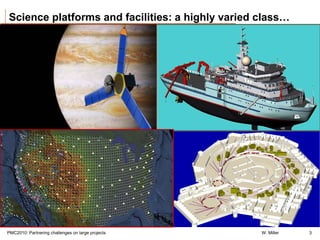
Science platforms and facilities: a highly varied class…


PMC2010: Partnering challenges on large projects   W. Miller   3
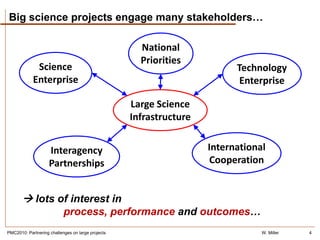
Big science projects engage many stakeholders…

                                                     National
                                                     Priorities
             Science                                                      Technology
            Enterprise                                                     Enterprise

                                                   Large Science
                                                   Infrastructure


                    Interagency                                     International
                    Partnerships                                     Cooperation


        lots of interest in
                           process, performance and outcomes…
PMC2010: Partnering challenges on large projects                                W. Miller   4
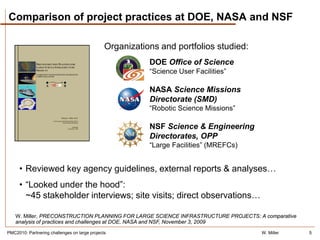
Comparison of project practices at DOE, NASA and NSF

                                               Organizations and portfolios studied:
                                                          DOE Office of Science
                                                          “Science User Facilities”

                                                          NASA Science Missions
                                                          Directorate (SMD)
                                                          “Robotic Science Missions”

                                                          NSF Science & Engineering
                                                          Directorates, OPP
                                                          “Large Facilities” (MREFCs)


     • Reviewed key agency guidelines, external reports & analyses…
     • “Looked under the hood”:
       ~45 stakeholder interviews; site visits; direct observations…

    W. Miller, PRECONSTRUCTION PLANNING FOR LARGE SCIENCE INFRASTRUCTURE PROJECTS: A comparative
    analysis of practices and challenges at DOE, NASA and NSF, November 3, 2009
PMC2010: Partnering challenges on large projects                                        W. Miller   5
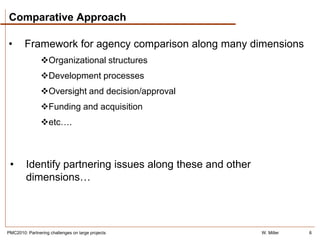
Comparative Approach

•       Framework for agency comparison along many dimensions
                Organizational structures
                Development processes
                Oversight and decision/approval
                Funding and acquisition
                etc….


 •       Identify partnering issues along these and other
         dimensions…


PMC2010: Partnering challenges on large projects            W. Miller   6
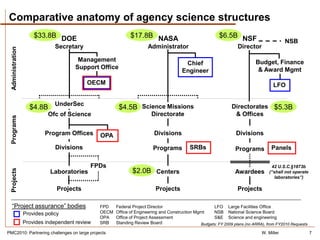
Comparative anatomy of agency science structures
                       $33.8B DOE                              $17.8B NASA                                 $6.5B NSF
                                                                                                                                            NSB
                                Secretary                              Administrator                                Director
  Administration


                                        Management                                                                           Budget, Finance
                                                                                         Chief
                                       Support Office                                                                         & Award Mgmt
                                                                                        Engineer
                                            OECM                                                                                      LFO


                     $4.8B UnderSec                      $4.5B Science Missions                                  Directorates $5.3B
                             Ofc of Science                              Directorate                              & Offices
  Programs


                            Program Offices      OPA                      Divisions                                Divisions

                                Divisions                                 Programs          SRBs                   Programs          Panels

                                             FPDs                                                                                    42 U.S.C.§1873b
  Projects


                              Laboratories                      $2.0B Centers                                      Awardees         (“shall not operate
                                                                                                                                       laboratories”)

                                 Projects                                  Projects                                 Projects

   “Project assurance” bodies                    FPD    Federal Project Director                       LFO Large Facilities Office
                   Provides policy               OECM   Office of Engineering and Construction Mgmt    NSB National Science Board
                                                 OPA    Office of Project Assessment                   S&E Science and engineering
                   Provides independent review   SRB    Standing Review Board                    Budgets: FY 2009 plans (no ARRA), from FY2010 Requests

PMC2010: Partnering challenges on large projects                                                                                W. Miller                 7
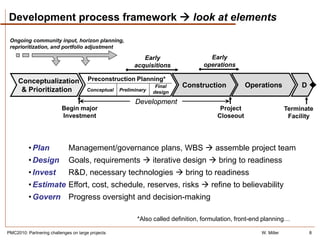
Development process framework  look at elements

 Ongoing community input, horizon planning,
 reprioritization, and portfolio adjustment

                                                            Early                   Early
                                                         acquisitions             operations

     Conceptualization                 Preconstruction Planning*
                                                                  Final   Construction            Operations             D
      & Prioritization                Conceptual   Preliminary   design

                                                         Development
                          Begin major                                                   Project                     Terminate
                          Investment                                                   Closeout                      Facility


          • Plan             Management/governance plans, WBS  assemble project team
          • Design           Goals, requirements  iterative design  bring to readiness
          • Invest           R&D, necessary technologies  bring to readiness
          • Estimate Effort, cost, schedule, reserves, risks  refine to believability
          • Govern           Progress oversight and decision-making

                                                          *Also called definition, formulation, front-end planning…

PMC2010: Partnering challenges on large projects                                                        W. Miller            8
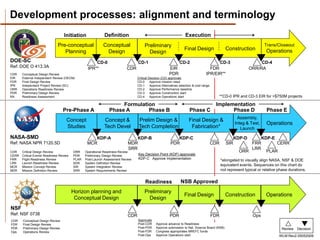
Development processes: alignment and terminology
                                    Initiation                Definition                                             Execution
                                Pre-conceptual               Conceptual                Preliminary                                                                       Trans/Closeout
                                                                                                                    Final Design                  Construction            Operations
                                   Planning                   Design                     Design
 DOE-SC                                                CD-0                       CD-1                          CD-2                            CD-3                  CD-4
 Ref: DOE O 413.3A                                 IPR**                    CDR                          EIR                          FDR                        ORR/RA
 CDR    Conceptual Design Review                                                                         PDR                        IPR/EIR**
 EIR    External Independent Review (OECM)                                        Critical Decision (CD) approvals
 FDR    Final Design Review                                                       CD-0      Approve mission need
 IPR    Independent Project Review (SC)                                           CD-1      Approve Alternatives selection & cost range
 ORR    Operations Readiness Review                                               CD-2      Approve Performance baseline
 PDR    Preliminary Design Review                                                 CD-3      Approve Construction start
 RA     Readiness Assessment                                                      CD-4      Approve Operations start                        **CD-0 IPR and CD-3 EIR for >$750M projects

                                                                      Formulation                                                          Implementation
                                    Pre-Phase A                  Phase A       Phase B                                  Phase C                  Phase D                  Phase E
                                                                                                                                                          Assembly,
                                      Concept                 Concept &           Prelim Design &                      Final Design &
                                                                                                                                                         Integ & Test,    Operations
                                      Studies                 Tech Devel          Tech Completion                       Fabrication*                        Launch

 NASA-SMD                                             KDP-A                     KDP-B                        KDP-C                                       KDP-D     KDP-E
 Ref: NASA NPR 7120.5D                             MCR                      MDR                           PDR                             CDR      SIR         FRR       CERR
                                                                            SRR                                                                                LRR
 CDR    Critical Design Review             ORR    Operational Readiness Review                                                                             ORR       PLAR
 CERR   Critical Events Readiness Review   PDR    Preliminary Design Review       Key Decision Point (KDP) approvals
 FRR    Flight Readiness Review            PLAR   Post-Launch Assessment Review   KDP-C Approve Implementation                                  *elongated to visually align NASA, NSF & DOE
 LRR    Launch Readiness Review            SDR    System Definition Review
 MCR    Mission Concept Review             SIR    System Integration Review
                                                                                                                                                equivalent events. Sequences on this chart do
 MDR    Mission Definition Review          SRR    System Requirements Review                                                                    not represent typical or relative phase durations.


                                                                                       Readiness                 NSB Approved
                                           Horizon planning and                        Preliminary
                                                                                                                    Final Design                  Construction            Operations
                                            Conceptual Design                            Design
 NSF
 Ref: NSF 0738                                                              CDR                          PDR                              FDR                     Ops
 CDR    Conceptual Design Review                                                  Approvals
 FDR    Final Design Review                                                       Post-CDR     Approve advance to Readiness
 PDR    Preliminary Design Review                                                 Post-PDR     Approve submission to Nat. Science Board (NSB)                                      Review   Decision
                                                                                  Post-FDR     Congress appropriates MREFC funds
W.MillerOperations Review & Sponsor Processes
 Ops
PMC2010:Big Projectschallenges on large projects
         - Partnering                                                             Post-Ops     Approve Operations start
                                                                                                                                                                 ProjSci Oct 22, 2009
                                                                                                                                                                      W. Miller                      9
                                                                                                                                                                                  WLM Rev2.05052009
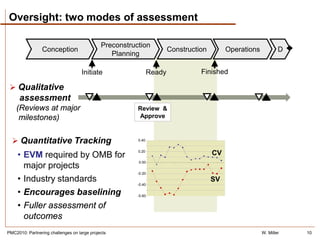
Oversight: two modes of assessment

                                             Preconstruction
                 Conception                                             Construction        Operations           D
                                                Planning

                                    Initiate                    Ready             Finished

  Qualitative
     assessment
    (Reviews at major                                   Review &
     milestones)                                        Approve


   Quantitative Tracking                               0.40


     • EVM required by OMB for
                                                        0.20
                                                                                       CV
                                                        0.00
       major projects
                                                        -0.20
     • Industry standards                               -0.40
                                                                                       SV
     • Encourages baselining                            -0.60


     • Fuller assessment of
       outcomes
PMC2010: Partnering challenges on large projects                                                         W. Miller   10
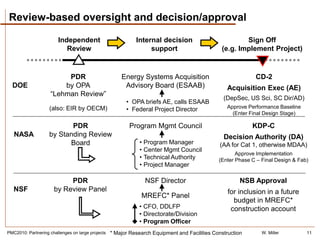
Review-based oversight and decision/approval

                        Independent                          Internal decision                          Sign Off
                           Review                                 support                       (e.g. Implement Project)


                          PDR                          Energy Systems Acquisition                            CD-2
  DOE                    by OPA                         Advisory Board (ESAAB)                    Acquisition Exec (AE)
                     “Lehman Review”
                                                                                                 (DepSec, US Sci, SC Dir/AD)
                                                         • OPA briefs AE, calls ESAAB
                    (also: EIR by OECM)                                                           Approve Performance Baseline
                                                         • Federal Project Director
                                                                                                    (Enter Final Design Stage)

                           PDR                            Program Mgmt Council                              KDP-C
   NASA             by Standing Review                                                           Decision Authority (DA)
                          Board                                • Program Manager               (AA for Cat 1, otherwise MDAA)
                                                               • Center Mgmt Council
                                                                                                      Approve Implementation
                                                               • Technical Authority           (Enter Phase C – Final Design & Fab)
                                                               • Project Manager

                           PDR                                   NSF Director                           NSB Approval
   NSF                by Review Panel                                                              for inclusion in a future
                                                               MREFC* Panel
                                                                                                     budget in MREFC*
                                                              • CFO, DDLFP                          construction account
                                                              • Directorate/Division
                                                              • Program Officer
PMC2010: Partnering challenges on large projects   * Major Research Equipment and Facilities Construction       W. Miller         11
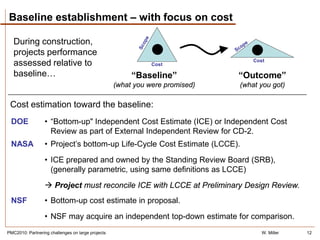
Baseline establishment – with focus on cost

   During construction,
   projects performance
                                                                                  Cost
   assessed relative to                                       Cost

   baseline…                                            “Baseline”            “Outcome”
                                                   (what you were promised)   (what you got)

 Cost estimation toward the baseline:
 DOE              • “Bottom-up" Independent Cost Estimate (ICE) or Independent Cost
                    Review as part of External Independent Review for CD-2.
 NASA             • Project’s bottom-up Life-Cycle Cost Estimate (LCCE).
                  • ICE prepared and owned by the Standing Review Board (SRB),
                    (generally parametric, using same definitions as LCCE)
                   Project must reconcile ICE with LCCE at Preliminary Design Review.
 NSF              • Bottom-up cost estimate in proposal.
                  • NSF may acquire an independent top-down estimate for comparison.
PMC2010: Partnering challenges on large projects                                     W. Miller   12
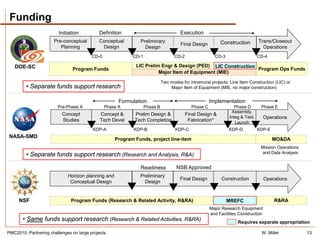
Funding
                         Initiation         Definition                               Execution
                      Pre-conceptual        Conceptual        Preliminary                                 Construction         Trans/Closeout
                                                                                      Final Design
                         Planning            Design             Design                                                           Operations
                                         CD-0              CD-1                   CD-2                 CD-3                    CD-4

   DOE-SC                                                   LIC Prelim Engr & Design (PED) LIC Construction
                               Program Funds                                                                Program Ops Funds
                                                                      Major Item of Equipment (MIE)

                                                                            Two modes for intramural projects: Line Item Construction (LIC) or
         • Separate funds support research                                      Major Item of Equipment (MIE, no major construction)


                                                      Formulation                                    Implementation
                        Pre-Phase A             Phase A           Phase B                  Phase C                Phase D       Phase E
                                                                                                                Assembly,
                          Concept            Concept &      Prelim Design &              Final Design &
                                                                                                               Integ & Test,       Operations
                          Studies            Tech Devel     Tech Completion               Fabrication*            Launch
                                         KDP-A             KDP-B                   KDP-C                      KDP-D            KDP-E
NASA-SMD                                            Program Funds, project line-item                                                   MO&DA
                                                                                                                                Mission Operations
                                                                                                                                 and Data Analysis
         • Separate funds support research (Research and Analysis, R&A)

                                                              Readiness             NSB Approved
                             Horizon planning and             Preliminary
                                                                                     Final Design          Construction            Operations
                              Conceptual Design                 Design


     NSF                       Program Funds (Research & Related Activity, R&RA)                              MREFC                    R&RA
                                                                                                     Major Research Equipment
                                                                                                     and Facilities Construction
       • Same funds support research (Research & Related Activities, R&RA)                                         Requires separate appropriation

PMC2010: Partnering challenges on large projects                                                                                W. Miller            13
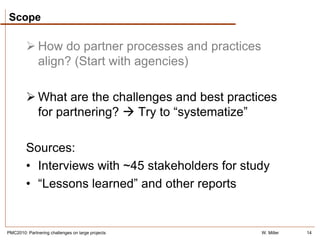
Scope

          How do partner processes and practices
           align? (Start with agencies)

          What are the challenges and best practices
           for partnering?  Try to “systematize”

         Sources:
         • Interviews with ~45 stakeholders for study
         • “Lessons learned” and other reports


PMC2010: Partnering challenges on large projects    W. Miller   14
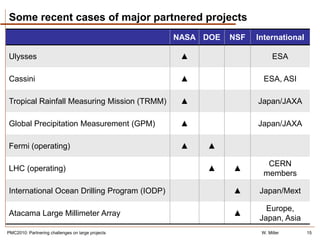
Some recent cases of major partnered projects
                                                   NASA DOE   NSF   International

Ulysses                                             ▲                     ESA

Cassini                                             ▲                 ESA, ASI

Tropical Rainfall Measuring Mission (TRMM)          ▲               Japan/JAXA

Global Precipitation Measurement (GPM)              ▲               Japan/JAXA

Fermi (operating)                                   ▲   ▲

                                                                      CERN
LHC (operating)                                         ▲     ▲
                                                                     members

International Ocean Drilling Program (IODP)                   ▲     Japan/Mext

                                                                      Europe,
Atacama Large Millimeter Array                                ▲
                                                                    Japan, Asia
PMC2010: Partnering challenges on large projects                     W. Miller      15
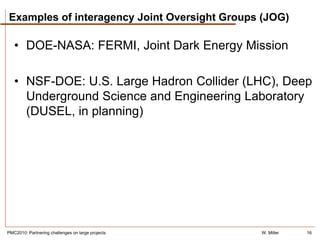
Examples of interagency Joint Oversight Groups (JOG)

   • DOE-NASA: FERMI, Joint Dark Energy Mission

   • NSF-DOE: U.S. Large Hadron Collider (LHC), Deep
     Underground Science and Engineering Laboratory
     (DUSEL, in planning)


PMC2010: Partnering challenges on large projects   W. Miller   16
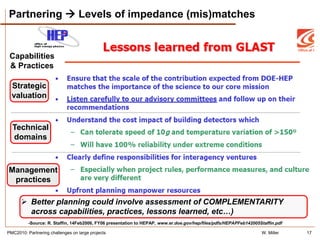
Partnering  Levels of impedance (mis)matches


 Capabilities
 & Practices

  Strategic
  valuation


  Technical
  domains


Management
 practices

       Better planning could involve assessment of COMPLEMENTARITY
        across capabilities, practices, lessons learned, etc…)
          -Source: R. Staffin, 14Feb2006, FY06 presentation to HEPAP, www.er.doe.gov/hep/files/pdfs/HEPAPFeb142005Staffin.pdf

PMC2010: Partnering challenges on large projects                                                                   W. Miller    17
Challenges: Strategic Management Technical

• Valuation. How highly does each partner prioritize the
  project – and how much is it willing to spend based on that
  priority? What does it expect as an outcome (science, jobs,
  prestige) and when? Where does it fit in the partner's national
  plan?

• Goals and roles. Are the overall goals and specific
  objectives shared? Does each partner want a leadership or
  participatory role? How committed are the commitments?

• Approval and allocation. Which hoops does each partner
  have to jump through to obtain funding and approval? What
  are the pressures? What is the funding source and cycle?
  How long does prioritization and approval typically take?

PMC2010: Partnering challenges on large projects      W. Miller   18
Challenges: Strategic Management Technical

• Role of project management. Is project management valued? Are
  managers well chosen, given sufficient authority? Who do they report to?

• Project definition and baselining. How are requirements, risks and
  baseline elements defined, documented and managed? Change control?
  How much emphasis placed on system I&T and operations planning?

• Budgeting. Can be large differences in costing – e.g. labor cost inclusion
  in project budgets. Can funds be used early, carried-over? Contribution
  approach (in kind, etc.)? How are contingency and reserve handled?

• Oversight. Partners may not perform reviews with the same rigor or
  frequency. Identified problems may be addressed with less urgency.
  What systems do partners use for tracking and quantifying performance?

• Cultural differences. Sense of urgency to obtain desired outcome?
  Consequences of (and solutions adopted for) cost overruns, late
  development, poor performance, outright failure?


PMC2010: Partnering challenges on large projects               W. Miller   19
Challenges: Strategic Management Technical

• Complementarity. Synergies among partners in technical
  know-how relative to requirements of the project? Is at least
  one partner strong in each area? What are the gaps?

• Design process. What approaches are employed by each
  partner? How are software and IT systems developed?

• Systems engineering. To what degree is systems
  engineering valued by each partner? Is each partner familiar
  with establishing interfaces? With I&T planning?

• HR. How do partners obtain their skill contributions – via
  contractors, in-house staff, exchanges of personnel from
  member academic institutions…? Workforce stablity?

PMC2010: Partnering challenges on large projects      W. Miller   20
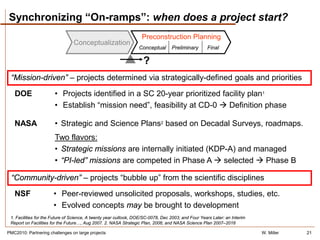
Synchronizing “On-ramps”: when does a project start?
                                                                   Preconstruction Planning
                                 Conceptualization
                                                                  Conceptual      Preliminary       Final

                                                                    ?
 “Mission-driven” – projects determined via strategically-defined goals and priorities

   DOE                 • Projects identified in a SC 20-year prioritized facility plan1
                       • Establish “mission need”, feasibility at CD-0  Definition phase

   NASA                • Strategic and Science Plans2 based on Decadal Surveys, roadmaps.
                       Two flavors:
                       • Strategic missions are internally initiated (KDP-A) and managed
                       • “PI-led” missions are competed in Phase A  selected  Phase B

 “Community-driven” – projects “bubble up” from the scientific disciplines
   NSF                • Peer-reviewed unsolicited proposals, workshops, studies, etc.
                      • Evolved concepts may be brought to development
 1. Facilities for the Future of Science, A twenty year outlook, DOE/SC-0078, Dec 2003; and Four Years Later: an Interim
 Report on Facilities for the Future…, Aug 2007. 2. NASA Strategic Plan, 2006; and NASA Science Plan 2007–2016

PMC2010: Partnering challenges on large projects                                                                           W. Miller   21
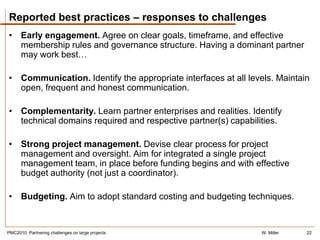
Reported best practices – responses to challenges
• Early engagement. Agree on clear goals, timeframe, and effective
  membership rules and governance structure. Having a dominant partner
  may work best…

• Communication. Identify the appropriate interfaces at all levels. Maintain
  open, frequent and honest communication.

• Complementarity. Learn partner enterprises and realities. Identify
  technical domains required and respective partner(s) capabilities.

• Strong project management. Devise clear process for project
  management and oversight. Aim for integrated a single project
  management team, in place before funding begins and with effective
  budget authority (not just a coordinator).

• Budgeting. Aim to adopt standard costing and budgeting techniques.


PMC2010: Partnering challenges on large projects               W. Miller   22
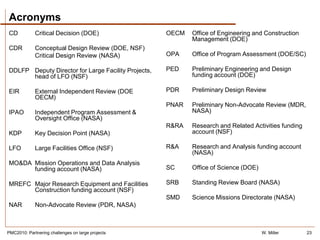
Acronyms
CD           Critical Decision (DOE)                 OECM   Office of Engineering and Construction
                                                            Management (DOE)
CDR          Conceptual Design Review (DOE, NSF)
             Critical Design Review (NASA)           OPA    Office of Program Assessment (DOE/SC)

DDLFP Deputy Director for Large Facility Projects,   PED    Preliminary Engineering and Design
      head of LFO (NSF)                                     funding account (DOE)

EIR          External Independent Review (DOE        PDR    Preliminary Design Review
             OECM)
                                                     PNAR   Preliminary Non-Advocate Review (MDR,
IPAO         Independent Program Assessment &               NASA)
             Oversight Office (NASA)
                                                     R&RA   Research and Related Activities funding
KDP          Key Decision Point (NASA)                      account (NSF)

LFO          Large Facilities Office (NSF)           R&A    Research and Analysis funding account
                                                            (NASA)
MO&DA Mission Operations and Data Analysis
      funding account (NASA)                         SC     Office of Science (DOE)

MREFC Major Research Equipment and Facilities        SRB    Standing Review Board (NASA)
      Construction funding account (NSF)
                                                     SMD    Science Missions Directorate (NASA)
NAR          Non-Advocate Review (PDR, NASA)


PMC2010: Partnering challenges on large projects                                      W. Miller       23

William.miller.pmc2010

  • 1.
    Challenges in partneringon major research platforms and facilities William L. Miller, Ph.D. AAAS Science and Technology Policy Fellow National Science Foundation Used with permission
  • 2.
    Scope • High cost and complexity of major projects have drive partnering between U.S. agencies and with international entities.  How do partner processes and practices align? (Start with agencies)  What are the challenges and best practices for partnering? PMC2010: Partnering challenges on large projects W. Miller 2
  • 3.
    Science platforms andfacilities: a highly varied class… PMC2010: Partnering challenges on large projects W. Miller 3
  • 4.
    Big science projectsengage many stakeholders… National Priorities Science Technology Enterprise Enterprise Large Science Infrastructure Interagency International Partnerships Cooperation  lots of interest in process, performance and outcomes… PMC2010: Partnering challenges on large projects W. Miller 4
  • 5.
    Comparison of projectpractices at DOE, NASA and NSF Organizations and portfolios studied: DOE Office of Science “Science User Facilities” NASA Science Missions Directorate (SMD) “Robotic Science Missions” NSF Science & Engineering Directorates, OPP “Large Facilities” (MREFCs) • Reviewed key agency guidelines, external reports & analyses… • “Looked under the hood”: ~45 stakeholder interviews; site visits; direct observations… W. Miller, PRECONSTRUCTION PLANNING FOR LARGE SCIENCE INFRASTRUCTURE PROJECTS: A comparative analysis of practices and challenges at DOE, NASA and NSF, November 3, 2009 PMC2010: Partnering challenges on large projects W. Miller 5
  • 6.
    Comparative Approach • Framework for agency comparison along many dimensions Organizational structures Development processes Oversight and decision/approval Funding and acquisition etc…. • Identify partnering issues along these and other dimensions… PMC2010: Partnering challenges on large projects W. Miller 6
  • 7.
    Comparative anatomy ofagency science structures $33.8B DOE $17.8B NASA $6.5B NSF NSB Secretary Administrator Director Administration Management Budget, Finance Chief Support Office & Award Mgmt Engineer OECM LFO $4.8B UnderSec $4.5B Science Missions Directorates $5.3B Ofc of Science Directorate & Offices Programs Program Offices OPA Divisions Divisions Divisions Programs SRBs Programs Panels FPDs 42 U.S.C.§1873b Projects Laboratories $2.0B Centers Awardees (“shall not operate laboratories”) Projects Projects Projects “Project assurance” bodies FPD Federal Project Director LFO Large Facilities Office Provides policy OECM Office of Engineering and Construction Mgmt NSB National Science Board OPA Office of Project Assessment S&E Science and engineering Provides independent review SRB Standing Review Board Budgets: FY 2009 plans (no ARRA), from FY2010 Requests PMC2010: Partnering challenges on large projects W. Miller 7
  • 8.
    Development process framework look at elements Ongoing community input, horizon planning, reprioritization, and portfolio adjustment Early Early acquisitions operations Conceptualization Preconstruction Planning* Final Construction Operations D & Prioritization Conceptual Preliminary design Development Begin major Project Terminate Investment Closeout Facility • Plan Management/governance plans, WBS  assemble project team • Design Goals, requirements  iterative design  bring to readiness • Invest R&D, necessary technologies  bring to readiness • Estimate Effort, cost, schedule, reserves, risks  refine to believability • Govern Progress oversight and decision-making *Also called definition, formulation, front-end planning… PMC2010: Partnering challenges on large projects W. Miller 8
  • 9.
    Development processes: alignmentand terminology Initiation Definition Execution Pre-conceptual Conceptual Preliminary Trans/Closeout Final Design Construction Operations Planning Design Design DOE-SC CD-0 CD-1 CD-2 CD-3 CD-4 Ref: DOE O 413.3A IPR** CDR EIR FDR ORR/RA CDR Conceptual Design Review PDR IPR/EIR** EIR External Independent Review (OECM) Critical Decision (CD) approvals FDR Final Design Review CD-0 Approve mission need IPR Independent Project Review (SC) CD-1 Approve Alternatives selection & cost range ORR Operations Readiness Review CD-2 Approve Performance baseline PDR Preliminary Design Review CD-3 Approve Construction start RA Readiness Assessment CD-4 Approve Operations start **CD-0 IPR and CD-3 EIR for >$750M projects Formulation Implementation Pre-Phase A Phase A Phase B Phase C Phase D Phase E Assembly, Concept Concept & Prelim Design & Final Design & Integ & Test, Operations Studies Tech Devel Tech Completion Fabrication* Launch NASA-SMD KDP-A KDP-B KDP-C KDP-D KDP-E Ref: NASA NPR 7120.5D MCR MDR PDR CDR SIR FRR CERR SRR LRR CDR Critical Design Review ORR Operational Readiness Review ORR PLAR CERR Critical Events Readiness Review PDR Preliminary Design Review Key Decision Point (KDP) approvals FRR Flight Readiness Review PLAR Post-Launch Assessment Review KDP-C Approve Implementation *elongated to visually align NASA, NSF & DOE LRR Launch Readiness Review SDR System Definition Review MCR Mission Concept Review SIR System Integration Review equivalent events. Sequences on this chart do MDR Mission Definition Review SRR System Requirements Review not represent typical or relative phase durations. Readiness NSB Approved Horizon planning and Preliminary Final Design Construction Operations Conceptual Design Design NSF Ref: NSF 0738 CDR PDR FDR Ops CDR Conceptual Design Review Approvals FDR Final Design Review Post-CDR Approve advance to Readiness PDR Preliminary Design Review Post-PDR Approve submission to Nat. Science Board (NSB) Review Decision Post-FDR Congress appropriates MREFC funds W.MillerOperations Review & Sponsor Processes Ops PMC2010:Big Projectschallenges on large projects - Partnering Post-Ops Approve Operations start ProjSci Oct 22, 2009 W. Miller 9 WLM Rev2.05052009
  • 10.
    Oversight: two modesof assessment Preconstruction Conception Construction Operations D Planning Initiate Ready Finished  Qualitative assessment (Reviews at major Review & milestones) Approve  Quantitative Tracking 0.40 • EVM required by OMB for 0.20 CV 0.00 major projects -0.20 • Industry standards -0.40 SV • Encourages baselining -0.60 • Fuller assessment of outcomes PMC2010: Partnering challenges on large projects W. Miller 10
  • 11.
    Review-based oversight anddecision/approval Independent Internal decision Sign Off Review support (e.g. Implement Project) PDR Energy Systems Acquisition CD-2 DOE by OPA Advisory Board (ESAAB) Acquisition Exec (AE) “Lehman Review” (DepSec, US Sci, SC Dir/AD) • OPA briefs AE, calls ESAAB (also: EIR by OECM) Approve Performance Baseline • Federal Project Director (Enter Final Design Stage) PDR Program Mgmt Council KDP-C NASA by Standing Review Decision Authority (DA) Board • Program Manager (AA for Cat 1, otherwise MDAA) • Center Mgmt Council Approve Implementation • Technical Authority (Enter Phase C – Final Design & Fab) • Project Manager PDR NSF Director NSB Approval NSF by Review Panel for inclusion in a future MREFC* Panel budget in MREFC* • CFO, DDLFP construction account • Directorate/Division • Program Officer PMC2010: Partnering challenges on large projects * Major Research Equipment and Facilities Construction W. Miller 11
  • 12.
    Baseline establishment –with focus on cost During construction, projects performance Cost assessed relative to Cost baseline… “Baseline” “Outcome” (what you were promised) (what you got) Cost estimation toward the baseline: DOE • “Bottom-up" Independent Cost Estimate (ICE) or Independent Cost Review as part of External Independent Review for CD-2. NASA • Project’s bottom-up Life-Cycle Cost Estimate (LCCE). • ICE prepared and owned by the Standing Review Board (SRB), (generally parametric, using same definitions as LCCE)  Project must reconcile ICE with LCCE at Preliminary Design Review. NSF • Bottom-up cost estimate in proposal. • NSF may acquire an independent top-down estimate for comparison. PMC2010: Partnering challenges on large projects W. Miller 12
  • 13.
    Funding Initiation Definition Execution Pre-conceptual Conceptual Preliminary Construction Trans/Closeout Final Design Planning Design Design Operations CD-0 CD-1 CD-2 CD-3 CD-4 DOE-SC LIC Prelim Engr & Design (PED) LIC Construction Program Funds Program Ops Funds Major Item of Equipment (MIE) Two modes for intramural projects: Line Item Construction (LIC) or • Separate funds support research Major Item of Equipment (MIE, no major construction) Formulation Implementation Pre-Phase A Phase A Phase B Phase C Phase D Phase E Assembly, Concept Concept & Prelim Design & Final Design & Integ & Test, Operations Studies Tech Devel Tech Completion Fabrication* Launch KDP-A KDP-B KDP-C KDP-D KDP-E NASA-SMD Program Funds, project line-item MO&DA Mission Operations and Data Analysis • Separate funds support research (Research and Analysis, R&A) Readiness NSB Approved Horizon planning and Preliminary Final Design Construction Operations Conceptual Design Design NSF Program Funds (Research & Related Activity, R&RA) MREFC R&RA Major Research Equipment and Facilities Construction • Same funds support research (Research & Related Activities, R&RA) Requires separate appropriation PMC2010: Partnering challenges on large projects W. Miller 13
  • 14.
    Scope  How do partner processes and practices align? (Start with agencies)  What are the challenges and best practices for partnering?  Try to “systematize” Sources: • Interviews with ~45 stakeholders for study • “Lessons learned” and other reports PMC2010: Partnering challenges on large projects W. Miller 14
  • 15.
    Some recent casesof major partnered projects NASA DOE NSF International Ulysses ▲ ESA Cassini ▲ ESA, ASI Tropical Rainfall Measuring Mission (TRMM) ▲ Japan/JAXA Global Precipitation Measurement (GPM) ▲ Japan/JAXA Fermi (operating) ▲ ▲ CERN LHC (operating) ▲ ▲ members International Ocean Drilling Program (IODP) ▲ Japan/Mext Europe, Atacama Large Millimeter Array ▲ Japan, Asia PMC2010: Partnering challenges on large projects W. Miller 15
  • 16.
    Examples of interagencyJoint Oversight Groups (JOG) • DOE-NASA: FERMI, Joint Dark Energy Mission • NSF-DOE: U.S. Large Hadron Collider (LHC), Deep Underground Science and Engineering Laboratory (DUSEL, in planning) PMC2010: Partnering challenges on large projects W. Miller 16
  • 17.
    Partnering  Levelsof impedance (mis)matches Capabilities & Practices Strategic valuation Technical domains Management practices  Better planning could involve assessment of COMPLEMENTARITY across capabilities, practices, lessons learned, etc…) -Source: R. Staffin, 14Feb2006, FY06 presentation to HEPAP, www.er.doe.gov/hep/files/pdfs/HEPAPFeb142005Staffin.pdf PMC2010: Partnering challenges on large projects W. Miller 17
  • 18.
    Challenges: Strategic ManagementTechnical • Valuation. How highly does each partner prioritize the project – and how much is it willing to spend based on that priority? What does it expect as an outcome (science, jobs, prestige) and when? Where does it fit in the partner's national plan? • Goals and roles. Are the overall goals and specific objectives shared? Does each partner want a leadership or participatory role? How committed are the commitments? • Approval and allocation. Which hoops does each partner have to jump through to obtain funding and approval? What are the pressures? What is the funding source and cycle? How long does prioritization and approval typically take? PMC2010: Partnering challenges on large projects W. Miller 18
  • 19.
    Challenges: Strategic ManagementTechnical • Role of project management. Is project management valued? Are managers well chosen, given sufficient authority? Who do they report to? • Project definition and baselining. How are requirements, risks and baseline elements defined, documented and managed? Change control? How much emphasis placed on system I&T and operations planning? • Budgeting. Can be large differences in costing – e.g. labor cost inclusion in project budgets. Can funds be used early, carried-over? Contribution approach (in kind, etc.)? How are contingency and reserve handled? • Oversight. Partners may not perform reviews with the same rigor or frequency. Identified problems may be addressed with less urgency. What systems do partners use for tracking and quantifying performance? • Cultural differences. Sense of urgency to obtain desired outcome? Consequences of (and solutions adopted for) cost overruns, late development, poor performance, outright failure? PMC2010: Partnering challenges on large projects W. Miller 19
  • 20.
    Challenges: Strategic ManagementTechnical • Complementarity. Synergies among partners in technical know-how relative to requirements of the project? Is at least one partner strong in each area? What are the gaps? • Design process. What approaches are employed by each partner? How are software and IT systems developed? • Systems engineering. To what degree is systems engineering valued by each partner? Is each partner familiar with establishing interfaces? With I&T planning? • HR. How do partners obtain their skill contributions – via contractors, in-house staff, exchanges of personnel from member academic institutions…? Workforce stablity? PMC2010: Partnering challenges on large projects W. Miller 20
  • 21.
    Synchronizing “On-ramps”: whendoes a project start? Preconstruction Planning Conceptualization Conceptual Preliminary Final ? “Mission-driven” – projects determined via strategically-defined goals and priorities DOE • Projects identified in a SC 20-year prioritized facility plan1 • Establish “mission need”, feasibility at CD-0  Definition phase NASA • Strategic and Science Plans2 based on Decadal Surveys, roadmaps. Two flavors: • Strategic missions are internally initiated (KDP-A) and managed • “PI-led” missions are competed in Phase A  selected  Phase B “Community-driven” – projects “bubble up” from the scientific disciplines NSF • Peer-reviewed unsolicited proposals, workshops, studies, etc. • Evolved concepts may be brought to development 1. Facilities for the Future of Science, A twenty year outlook, DOE/SC-0078, Dec 2003; and Four Years Later: an Interim Report on Facilities for the Future…, Aug 2007. 2. NASA Strategic Plan, 2006; and NASA Science Plan 2007–2016 PMC2010: Partnering challenges on large projects W. Miller 21
  • 22.
    Reported best practices– responses to challenges • Early engagement. Agree on clear goals, timeframe, and effective membership rules and governance structure. Having a dominant partner may work best… • Communication. Identify the appropriate interfaces at all levels. Maintain open, frequent and honest communication. • Complementarity. Learn partner enterprises and realities. Identify technical domains required and respective partner(s) capabilities. • Strong project management. Devise clear process for project management and oversight. Aim for integrated a single project management team, in place before funding begins and with effective budget authority (not just a coordinator). • Budgeting. Aim to adopt standard costing and budgeting techniques. PMC2010: Partnering challenges on large projects W. Miller 22
  • 23.
    Acronyms CD Critical Decision (DOE) OECM Office of Engineering and Construction Management (DOE) CDR Conceptual Design Review (DOE, NSF) Critical Design Review (NASA) OPA Office of Program Assessment (DOE/SC) DDLFP Deputy Director for Large Facility Projects, PED Preliminary Engineering and Design head of LFO (NSF) funding account (DOE) EIR External Independent Review (DOE PDR Preliminary Design Review OECM) PNAR Preliminary Non-Advocate Review (MDR, IPAO Independent Program Assessment & NASA) Oversight Office (NASA) R&RA Research and Related Activities funding KDP Key Decision Point (NASA) account (NSF) LFO Large Facilities Office (NSF) R&A Research and Analysis funding account (NASA) MO&DA Mission Operations and Data Analysis funding account (NASA) SC Office of Science (DOE) MREFC Major Research Equipment and Facilities SRB Standing Review Board (NASA) Construction funding account (NSF) SMD Science Missions Directorate (NASA) NAR Non-Advocate Review (PDR, NASA) PMC2010: Partnering challenges on large projects W. Miller 23