Introduction to SCOR
Supply Chain Operations Reference
Model
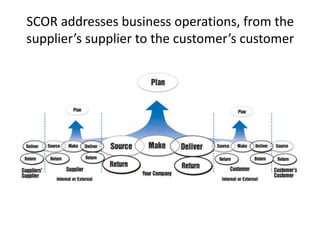
SCOR addresses business operations, from the
supplier’s supplier to the customer’s customer
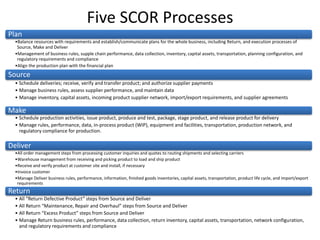
Five SCOR Processes
Plan
•Balance resources with requirements and establish/communicate plans for the whole business, including Return, and execution processes of
Source, Make and Deliver
•Management of business rules, supple chain performance, data collection, inventory, capital assets, transportation, planning configuration, and
regulatory requirements and compliance
•Align the production plan with the financial plan
Source
• Schedule deliveries; receive, verify and transfer product; and authorize supplier payments
• Manage business rules, assess supplier performance, and maintain data
• Manage inventory, capital assets, incoming product supplier network, import/export requirements, and supplier agreements
Make
• Schedule production activities, issue product, produce and test, package, stage product, and release product for delivery
• Manage rules, performance, data, in-process product (WIP), equipment and facilities, transportation, production network, and
regulatory compliance for production.
Deliver
•All order management steps from processing customer inquiries and quotes to routing shipments and selecting carriers
•Warehouse management from receiving and picking product to load and ship product
•Receive and verify product at customer site and install, if necessary
•Invoice customer
•Manage Deliver business rules, performance, information, finished goods inventories, capital assets, transportation, product life cycle, and import/export
requirements
Return
• All “Return Defective Product” steps from Source and Deliver
• All Return “Maintenance, Repair and Overhaul” steps from Source and Deliver
• All Return “Excess Product” steps from Source and Deliver
• Manage Return business rules, performance, data collection, return inventory, capital assets, transportation, network configuration,
and regulatory requirements and compliance
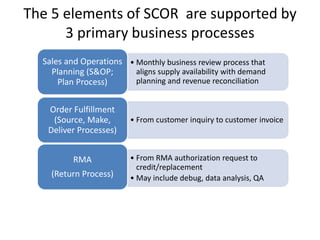
The 5 elements of SCOR are supported by
3 primary business processes
• Monthly business review process that
aligns supply availability with demand
planning and revenue reconciliation
Sales and Operations
Planning (S&OP;
Plan Process)
• From customer inquiry to customer invoice
Order Fulfillment
(Source, Make,
Deliver Processes)
• From RMA authorization request to
credit/replacement
• May include debug, data analysis, QA
RMA
(Return Process)
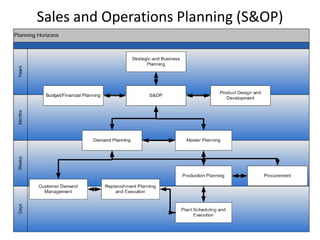
Sales and Operations Planning (S&OP)
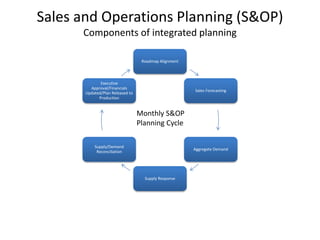
Components of integrated planning
Roadmap Alignment
Sales Forecasting
Aggregate Demand
Supply Response
Supply/Demand
Reconciliation
Executive
Approval/Financials
Updated/Plan Released to
Production
Monthly S&OP
Planning Cycle
Sales and Operations Planning (S&OP)
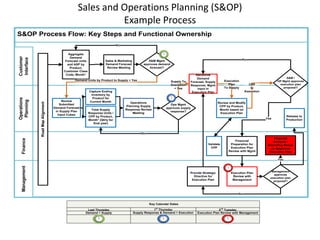
Example Process
S&OP Process Flow: Key Steps and Functional Ownership
ManagementFinance
Operations
Planning
Customer
Interface
Capture Ending
Inventory by
Product for
Current Month
Aggregate
Demand
Forecast units
and ASP by
Product,
Customer Class
Code, Month*
S&M Mgmt
approves demand
forecast?
Sales & Marketing
Demand Forecast
Review Meeting
Review
Submitted
Demand Forecast
in Supply Plan
Input Cubes
Demand Units by Product to Supply < Yes
Total Supply
Response Units /
CPP by Product,
Month* (Qtrly for
final year)
No
Reconcile
Demand
Forecast, Supply
Response, Mgmt
input in
Execution Plan
Provide Strategic
Directive for
Execution Plan
Review and Modify
CPP by Product,
Month based on
Execution Plan
Execution
Plan
To Supply
No
S&M /
OP Mgmt approves
execution plan
proposal?
Financial
Preparation for
Execution Plan
Review with Mgmt
Yes
Execution Plan
Review with
Management
Management
approves
execution plan
proposal?
No
Financial
Analysis /
Reporting Based
on Approved
Execution Plan
Yes
Supply To
Execution
< Yes
CPP
to
Execution
1st
Thursday 2nd
TuesdayLast Thursday
Key Calendar Dates
Execution Plan Review with ManagementDemand > Supply Supply Response & Demand > Execution
Operations
Planning Supply
Response Review
Meeting
Ops Mgmt
approves supply
response?
No
RoadMapAlignment
Validate
CPP
Release to
Production
Sales and Operations Planning (S&OP)
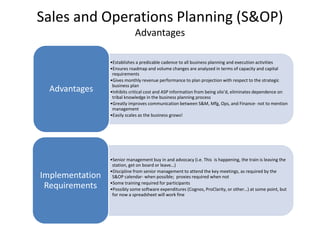
Advantages
•Establishes a predicable cadence to all business planning and execution activities
•Ensures roadmap and volume changes are analyzed in terms of capacity and capital
requirements
•Gives monthly revenue performance to plan projection with respect to the strategic
business plan
•Inhibits critical cost and ASP information from being silo’d, eliminates dependence on
tribal knowledge in the business planning process
•Greatly improves communication between S&M, Mfg, Ops, and Finance- not to mention
management
•Easily scales as the business grows!
Advantages
•Senior management buy in and advocacy (i.e. This is happening, the train is leaving the
station, get on board or leave…)
•Discipline from senior management to attend the key meetings, as required by the
S&OP calendar- when possible; proxies required when not
•Some training required for participants
•Possibly some software expenditures (Cognos, ProClarity, or other…) at some point, but
for now a spreadsheet will work fine
Implementation
Requirements
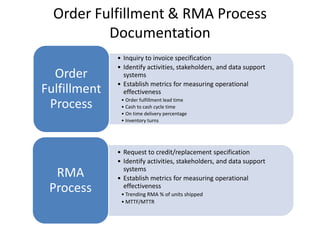
Order Fulfillment & RMA Process
Documentation
• Inquiry to invoice specification
• Identify activities, stakeholders, and data support
systems
• Establish metrics for measuring operational
effectiveness
• Order fulfillment lead time
• Cash to cash cycle time
• On time delivery percentage
• Inventory turns
Order
Fulfillment
Process
• Request to credit/replacement specification
• Identify activities, stakeholders, and data support
systems
• Establish metrics for measuring operational
effectiveness
• Trending RMA % of units shipped
• MTTF/MTTR
RMA
Process

Generalized SCOR Implementation

  • 1.
    Introduction to SCOR SupplyChain Operations Reference Model
  • 2.
    SCOR addresses businessoperations, from the supplier’s supplier to the customer’s customer
  • 3.
    Five SCOR Processes Plan •Balanceresources with requirements and establish/communicate plans for the whole business, including Return, and execution processes of Source, Make and Deliver •Management of business rules, supple chain performance, data collection, inventory, capital assets, transportation, planning configuration, and regulatory requirements and compliance •Align the production plan with the financial plan Source • Schedule deliveries; receive, verify and transfer product; and authorize supplier payments • Manage business rules, assess supplier performance, and maintain data • Manage inventory, capital assets, incoming product supplier network, import/export requirements, and supplier agreements Make • Schedule production activities, issue product, produce and test, package, stage product, and release product for delivery • Manage rules, performance, data, in-process product (WIP), equipment and facilities, transportation, production network, and regulatory compliance for production. Deliver •All order management steps from processing customer inquiries and quotes to routing shipments and selecting carriers •Warehouse management from receiving and picking product to load and ship product •Receive and verify product at customer site and install, if necessary •Invoice customer •Manage Deliver business rules, performance, information, finished goods inventories, capital assets, transportation, product life cycle, and import/export requirements Return • All “Return Defective Product” steps from Source and Deliver • All Return “Maintenance, Repair and Overhaul” steps from Source and Deliver • All Return “Excess Product” steps from Source and Deliver • Manage Return business rules, performance, data collection, return inventory, capital assets, transportation, network configuration, and regulatory requirements and compliance
  • 4.
    The 5 elementsof SCOR are supported by 3 primary business processes • Monthly business review process that aligns supply availability with demand planning and revenue reconciliation Sales and Operations Planning (S&OP; Plan Process) • From customer inquiry to customer invoice Order Fulfillment (Source, Make, Deliver Processes) • From RMA authorization request to credit/replacement • May include debug, data analysis, QA RMA (Return Process)
  • 5.
    Sales and OperationsPlanning (S&OP)
  • 6.
    Sales and OperationsPlanning (S&OP) Components of integrated planning Roadmap Alignment Sales Forecasting Aggregate Demand Supply Response Supply/Demand Reconciliation Executive Approval/Financials Updated/Plan Released to Production Monthly S&OP Planning Cycle
  • 7.
    Sales and OperationsPlanning (S&OP) Example Process S&OP Process Flow: Key Steps and Functional Ownership ManagementFinance Operations Planning Customer Interface Capture Ending Inventory by Product for Current Month Aggregate Demand Forecast units and ASP by Product, Customer Class Code, Month* S&M Mgmt approves demand forecast? Sales & Marketing Demand Forecast Review Meeting Review Submitted Demand Forecast in Supply Plan Input Cubes Demand Units by Product to Supply < Yes Total Supply Response Units / CPP by Product, Month* (Qtrly for final year) No Reconcile Demand Forecast, Supply Response, Mgmt input in Execution Plan Provide Strategic Directive for Execution Plan Review and Modify CPP by Product, Month based on Execution Plan Execution Plan To Supply No S&M / OP Mgmt approves execution plan proposal? Financial Preparation for Execution Plan Review with Mgmt Yes Execution Plan Review with Management Management approves execution plan proposal? No Financial Analysis / Reporting Based on Approved Execution Plan Yes Supply To Execution < Yes CPP to Execution 1st Thursday 2nd TuesdayLast Thursday Key Calendar Dates Execution Plan Review with ManagementDemand > Supply Supply Response & Demand > Execution Operations Planning Supply Response Review Meeting Ops Mgmt approves supply response? No RoadMapAlignment Validate CPP Release to Production
  • 8.
    Sales and OperationsPlanning (S&OP) Advantages •Establishes a predicable cadence to all business planning and execution activities •Ensures roadmap and volume changes are analyzed in terms of capacity and capital requirements •Gives monthly revenue performance to plan projection with respect to the strategic business plan •Inhibits critical cost and ASP information from being silo’d, eliminates dependence on tribal knowledge in the business planning process •Greatly improves communication between S&M, Mfg, Ops, and Finance- not to mention management •Easily scales as the business grows! Advantages •Senior management buy in and advocacy (i.e. This is happening, the train is leaving the station, get on board or leave…) •Discipline from senior management to attend the key meetings, as required by the S&OP calendar- when possible; proxies required when not •Some training required for participants •Possibly some software expenditures (Cognos, ProClarity, or other…) at some point, but for now a spreadsheet will work fine Implementation Requirements
  • 9.
    Order Fulfillment &RMA Process Documentation • Inquiry to invoice specification • Identify activities, stakeholders, and data support systems • Establish metrics for measuring operational effectiveness • Order fulfillment lead time • Cash to cash cycle time • On time delivery percentage • Inventory turns Order Fulfillment Process • Request to credit/replacement specification • Identify activities, stakeholders, and data support systems • Establish metrics for measuring operational effectiveness • Trending RMA % of units shipped • MTTF/MTTR RMA Process