Managing Demand in Supply Chain:
The Business Process Modeling Approach
June 5, 2015 - Chania, Greece
Gayialis S.P, Ponis S.T , Panayiotou N.A., Tatsiopoulos I.P.
National Technical University of Athens, School of Mechanical Engineering,
Sector of Industrial Management and Operational Research
Presenter: Dr. Sotiris P. Gayialis, Teaching and Research Associate
Presentation Outline
2
Outcomes and Further Research
Business Process Models
Methodological Approach
Contemporary Supply Chains
Supply Chain and Reference Models
Gayialis S.P. - NTUA
Questions
Contemporary Supply Chains
3
In contemporary supply chains a large number of
partner companies participate and interact.
Complexity in supply chain networks often leads to
high cost structures which directly affect the
participating enterprises and the efficiency of the
whole network.
These costs often arise from poorly management of
demand and its uncertainty which leads to ineffective
inventory management in all supply chain levels.
Gayialis S.P. - NTUA
Contemporary Supply Chains
4
Problems in supply chain processes which increase
uncertainty:
 Demand variability
 Decisions based on local optimization criteria rather than
global
 Poor information sharing about demand and materials
sourcing
 Plethora of risks (operational, economic, environmental)
Reference models can assist efforts in solving these
problems
Gayialis S.P. - NTUA
Supply Chain and Reference Models
5
SCM is the integration of key business processes across
the supply chain for the purpose of creating value for
customers and stakeholders.
The importance of business processes in supply chain
highlights the role of process modeling
Reference models are reusable models which:
 Can be used as standards in order to design or redesign
business processes.
 Can enable rapid instantiation of specific supply chain
configurations.
There are no Reference Models for demand
management in supply chain
Gayialis S.P. - NTUA
ODYSSEUS Research Project
6
“A Holistic Approach for Managing Variability in
Contemporary Global Supply Chain Networks”
Studies the phenomenon of uncertainty in supply
chain, identifies the physical points of its creation,
analyzes its causes, and evaluates its negative effects
on supply chain performance.
Explores solutions to the problems of managing
demand variability and other risks.
Uses a business process reference model to integrate:
 Supply chain business processes design and redesign
 Supply chain variability management and risk management
 Supply chain coordination and collaboration
Gayialis S.P. - NTUA
http://odysseus.simor.ntua.gr
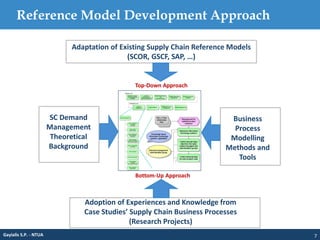
Reference Model Development Approach
7Gayialis S.P. - NTUA
Adaptation of Existing Supply Chain Reference Models
(SCOR, GSCF, SAP, …)
Adoption of Experiences and Knowledge from
Case Studies’ Supply Chain Business Processes
(Research Projects)
SC Demand
Management
Theoretical
Background
Business
Process
Modelling
Methods and
Tools
Top-Down Approach
Bottom-Up Approach
Top Down Approach
8
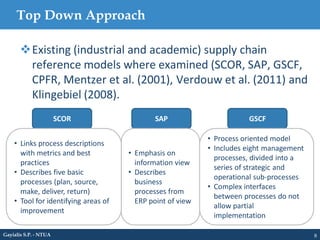
Existing (industrial and academic) supply chain
reference models where examined (SCOR, SAP, GSCF,
CPFR, Mentzer et al. (2001), Verdouw et al. (2011) and
Klingebiel (2008).
Gayialis S.P. - NTUA
SCOR SAP GSCF
• Links process descriptions
with metrics and best
practices
• Describes five basic
processes (plan, source,
make, deliver, return)
• Tool for identifying areas of
improvement
• Emphasis on
information view
• Describes
business
processes from
ERP point of view
• Process oriented model
• Includes eight management
processes, divided into a
series of strategic and
operational sub-processes
• Complex interfaces
between processes do not
allow partial
implementation
Bottom Up Approach
9
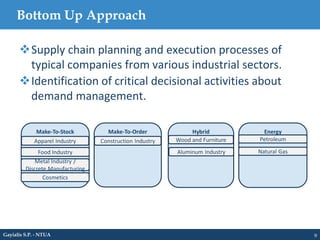
Supply chain planning and execution processes of
typical companies from various industrial sectors.
Identification of critical decisional activities about
demand management.
Gayialis S.P. - NTUA
Make-To-Stock
Apparel Industry
Food Industry
Metal Industry /
Discrete Manufacturing
Cosmetics
Make-To-Order
Construction Industry
Hybrid
Wood and Furniture
Aluminum Industry
Energy
Petroleum
Natural Gas
Supply Chain Reference Model Characteristics
10Gayialis S.P. - NTUA
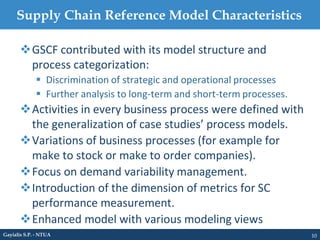
GSCF contributed with its model structure and
process categorization:
 Discrimination of strategic and operational processes
 Further analysis to long-term and short-term processes.
Activities in every business process were defined with
the generalization of case studies’ process models.
Variations of business processes (for example for
make to stock or make to order companies).
Focus on demand variability management.
Introduction of the dimension of metrics for SC
performance measurement.
Enhanced model with various modeling views
Nine Business Processes Categories
11Gayialis S.P. - NTUA
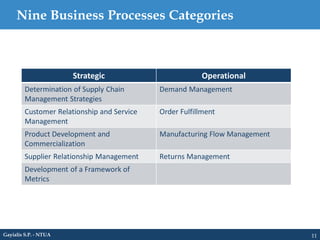
Strategic Operational
Determination of Supply Chain
Management Strategies
Demand Management
Customer Relationship and Service
Management
Order Fulfillment
Product Development and
Commercialization
Manufacturing Flow Management
Supplier Relationship Management Returns Management
Development of a Framework of
Metrics
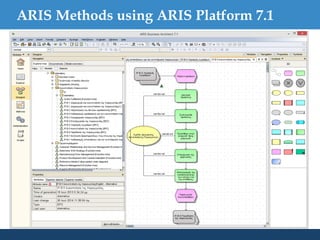
ARIS Methods using ARIS Platform 7.1
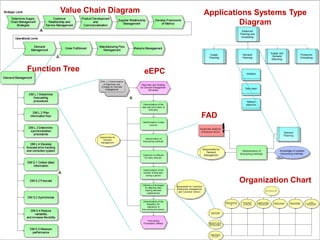
Samples of ModelsSamples of ModelsSamples of Models
13Gayialis S.P. - NTUA
Applications Systems Type
Diagram
FAD
Organization Chart
eEPCFunction Tree
Value Chain Diagram
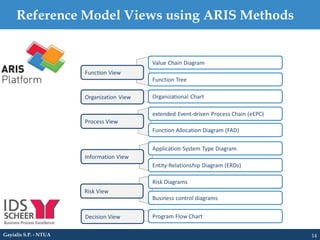
Reference Model Views using ARIS Methods
14Gayialis S.P. - NTUA
Process View
extended Event-driven Process Chain (eEPC)
Function View
Decision View
Risk View
Value Chain Diagram
Function Tree
Function Allocation Diagram (FAD)
Risk Diagrams
Application System Type Diagram
Entity-Relationship Diagram (ERDs)
Program Flow Chart
Organization View Organizational Chart
Information View
Business control diagrams
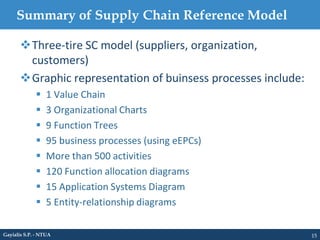
Summary of Supply Chain Reference Model
15Gayialis S.P. - NTUA
Three-tire SC model (suppliers, organization,
customers)
Graphic representation of buinsess processes include:
 1 Value Chain
 3 Organizational Charts
 9 Function Trees
 95 business processes (using eEPCs)
 More than 500 activities
 120 Function allocation diagrams
 15 Application Systems Diagram
 5 Entity-relationship diagrams
Reference Model Enhancement
16Gayialis S.P. - NTUA
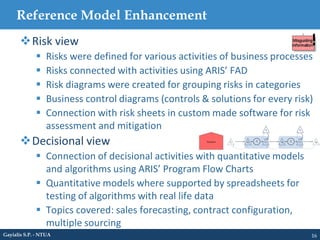
Risk view
 Risks were defined for various activities of business processes
 Risks connected with activities using ARIS’ FAD
 Risk diagrams were created for grouping risks in categories
 Business control diagrams (controls & solutions for every risk)
 Connection with risk sheets in custom made software for risk
assessment and mitigation
Decisional view
 Connection of decisional activities with quantitative models
and algorithms using ARIS’ Program Flow Charts
 Quantitative models where supported by spreadsheets for
testing of algorithms with real life data
 Topics covered: sales forecasting, contract configuration,
multiple sourcing
Reference Model Instantiation
17Gayialis S.P. - NTUA
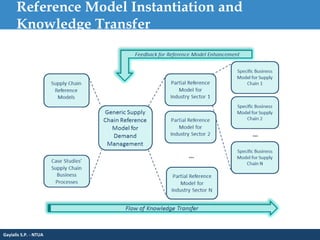
A generic supply chain model focused on demand
management was created, providing the appropriate
models and tools in a holistic way.
Instantiation of the reference model to partial models
for different industry sectors (for example: wood and
furniture, metal forming industry / discrete
manufacturing, process industry, etc.)
Partial reference models can be specialized to
particular models of specific supply chains. Hence, the
reference model can be used by organizations as a
useful toolset for effective demand management.
Reference Model Instantiation and
Knowledge Transfer
Gayialis S.P. - NTUA
Thank you for your Attention
Gayialis S.P. - NTUA
The research efforts described in this paper are part of the research project “A Holistic Approach for Managing Variability
in Contemporary Global Supply Chain Networks” in research action: “Thales - Support of the interdisciplinary and/or
inter-institutional research and innovation”, which is implemented under the Operational Programme: Education and
Lifelong Learning, NSRF 2007-2013 and is co-funded by European Union (European Social Fund) and Greek Government.

Managing Demand in Supply Chain: The Business Process Modeling Approach

  • 1.
    Managing Demand inSupply Chain: The Business Process Modeling Approach June 5, 2015 - Chania, Greece Gayialis S.P, Ponis S.T , Panayiotou N.A., Tatsiopoulos I.P. National Technical University of Athens, School of Mechanical Engineering, Sector of Industrial Management and Operational Research Presenter: Dr. Sotiris P. Gayialis, Teaching and Research Associate
  • 2.
    Presentation Outline 2 Outcomes andFurther Research Business Process Models Methodological Approach Contemporary Supply Chains Supply Chain and Reference Models Gayialis S.P. - NTUA Questions
  • 3.
    Contemporary Supply Chains 3 Incontemporary supply chains a large number of partner companies participate and interact. Complexity in supply chain networks often leads to high cost structures which directly affect the participating enterprises and the efficiency of the whole network. These costs often arise from poorly management of demand and its uncertainty which leads to ineffective inventory management in all supply chain levels. Gayialis S.P. - NTUA
  • 4.
    Contemporary Supply Chains 4 Problemsin supply chain processes which increase uncertainty:  Demand variability  Decisions based on local optimization criteria rather than global  Poor information sharing about demand and materials sourcing  Plethora of risks (operational, economic, environmental) Reference models can assist efforts in solving these problems Gayialis S.P. - NTUA
  • 5.
    Supply Chain andReference Models 5 SCM is the integration of key business processes across the supply chain for the purpose of creating value for customers and stakeholders. The importance of business processes in supply chain highlights the role of process modeling Reference models are reusable models which:  Can be used as standards in order to design or redesign business processes.  Can enable rapid instantiation of specific supply chain configurations. There are no Reference Models for demand management in supply chain Gayialis S.P. - NTUA
  • 6.
    ODYSSEUS Research Project 6 “AHolistic Approach for Managing Variability in Contemporary Global Supply Chain Networks” Studies the phenomenon of uncertainty in supply chain, identifies the physical points of its creation, analyzes its causes, and evaluates its negative effects on supply chain performance. Explores solutions to the problems of managing demand variability and other risks. Uses a business process reference model to integrate:  Supply chain business processes design and redesign  Supply chain variability management and risk management  Supply chain coordination and collaboration Gayialis S.P. - NTUA http://odysseus.simor.ntua.gr
  • 7.
    Reference Model DevelopmentApproach 7Gayialis S.P. - NTUA Adaptation of Existing Supply Chain Reference Models (SCOR, GSCF, SAP, …) Adoption of Experiences and Knowledge from Case Studies’ Supply Chain Business Processes (Research Projects) SC Demand Management Theoretical Background Business Process Modelling Methods and Tools Top-Down Approach Bottom-Up Approach
  • 8.
    Top Down Approach 8 Existing(industrial and academic) supply chain reference models where examined (SCOR, SAP, GSCF, CPFR, Mentzer et al. (2001), Verdouw et al. (2011) and Klingebiel (2008). Gayialis S.P. - NTUA SCOR SAP GSCF • Links process descriptions with metrics and best practices • Describes five basic processes (plan, source, make, deliver, return) • Tool for identifying areas of improvement • Emphasis on information view • Describes business processes from ERP point of view • Process oriented model • Includes eight management processes, divided into a series of strategic and operational sub-processes • Complex interfaces between processes do not allow partial implementation
  • 9.
    Bottom Up Approach 9 Supplychain planning and execution processes of typical companies from various industrial sectors. Identification of critical decisional activities about demand management. Gayialis S.P. - NTUA Make-To-Stock Apparel Industry Food Industry Metal Industry / Discrete Manufacturing Cosmetics Make-To-Order Construction Industry Hybrid Wood and Furniture Aluminum Industry Energy Petroleum Natural Gas
  • 10.
    Supply Chain ReferenceModel Characteristics 10Gayialis S.P. - NTUA GSCF contributed with its model structure and process categorization:  Discrimination of strategic and operational processes  Further analysis to long-term and short-term processes. Activities in every business process were defined with the generalization of case studies’ process models. Variations of business processes (for example for make to stock or make to order companies). Focus on demand variability management. Introduction of the dimension of metrics for SC performance measurement. Enhanced model with various modeling views
  • 11.
    Nine Business ProcessesCategories 11Gayialis S.P. - NTUA Strategic Operational Determination of Supply Chain Management Strategies Demand Management Customer Relationship and Service Management Order Fulfillment Product Development and Commercialization Manufacturing Flow Management Supplier Relationship Management Returns Management Development of a Framework of Metrics
  • 12.
    ARIS Methods usingARIS Platform 7.1
  • 13.
    Samples of ModelsSamplesof ModelsSamples of Models 13Gayialis S.P. - NTUA Applications Systems Type Diagram FAD Organization Chart eEPCFunction Tree Value Chain Diagram
  • 14.
    Reference Model Viewsusing ARIS Methods 14Gayialis S.P. - NTUA Process View extended Event-driven Process Chain (eEPC) Function View Decision View Risk View Value Chain Diagram Function Tree Function Allocation Diagram (FAD) Risk Diagrams Application System Type Diagram Entity-Relationship Diagram (ERDs) Program Flow Chart Organization View Organizational Chart Information View Business control diagrams
  • 15.
    Summary of SupplyChain Reference Model 15Gayialis S.P. - NTUA Three-tire SC model (suppliers, organization, customers) Graphic representation of buinsess processes include:  1 Value Chain  3 Organizational Charts  9 Function Trees  95 business processes (using eEPCs)  More than 500 activities  120 Function allocation diagrams  15 Application Systems Diagram  5 Entity-relationship diagrams
  • 16.
    Reference Model Enhancement 16GayialisS.P. - NTUA Risk view  Risks were defined for various activities of business processes  Risks connected with activities using ARIS’ FAD  Risk diagrams were created for grouping risks in categories  Business control diagrams (controls & solutions for every risk)  Connection with risk sheets in custom made software for risk assessment and mitigation Decisional view  Connection of decisional activities with quantitative models and algorithms using ARIS’ Program Flow Charts  Quantitative models where supported by spreadsheets for testing of algorithms with real life data  Topics covered: sales forecasting, contract configuration, multiple sourcing
  • 17.
    Reference Model Instantiation 17GayialisS.P. - NTUA A generic supply chain model focused on demand management was created, providing the appropriate models and tools in a holistic way. Instantiation of the reference model to partial models for different industry sectors (for example: wood and furniture, metal forming industry / discrete manufacturing, process industry, etc.) Partial reference models can be specialized to particular models of specific supply chains. Hence, the reference model can be used by organizations as a useful toolset for effective demand management.
  • 18.
    Reference Model Instantiationand Knowledge Transfer Gayialis S.P. - NTUA
  • 19.
    Thank you foryour Attention Gayialis S.P. - NTUA The research efforts described in this paper are part of the research project “A Holistic Approach for Managing Variability in Contemporary Global Supply Chain Networks” in research action: “Thales - Support of the interdisciplinary and/or inter-institutional research and innovation”, which is implemented under the Operational Programme: Education and Lifelong Learning, NSRF 2007-2013 and is co-funded by European Union (European Social Fund) and Greek Government.