Restructuring Demand ManagementExecutive PresentationFor the Food and Beverage IndustrySteve Lewin14 September 2009
The ChallengeDemand Management is a critical component of the Supply Chain Management process.Annual Business PlanningLong Range ProcurementMerchandising PlanningAccount ManagementMarketing PlanningMonthly REPlanning ProcessesDemand ForecastingOrder Mgmt.Supply Chain ManagementDistribution Center OperationsDistribution Network DesignCustomer Service Inventory Mgmt.Production PlanningTransportation PlanningPurchasingSound Demand Management is fundamental to business planning and the efficient operation of downstream supply chain processes, and central to achieving the objectives of lowest landed product cost and a high level of customer service.
The Supply Chain is being viewed today as a series of interconnected business processesDistribution Center OperationsDistribution Network DesignInventory Mgmt./DRPProduction Planning/MPSOrder Mgmt.Supply Chain Service RequirementsDemand ForecastingTransportationPurchasingCustomerSupplierSupply ManagementSell Through MgmtDemandMgmtDemandFulfillmentEstablish InventoryPlan and Select SourcesSupplierCustomerSourcingCreate and Plan Customer Relationships
Converging Forces Create New Business ProblemsCompetitive ForcesBest PracticesCUSTOMERRETAILERCONSUMERDSDSUPPLY CHAINPRIVATE  LABELPRICING /PROMOTIONSQR/VELOCITYCOSTNEW SERVICE OFFERINGSCYCLE TIMEECRNEW VENDOR ALLIANCESSERVICENON-STOPCATEGORY EXCLUSIVITYCONVENIENCETECHNOLOGYGLOBAL EXPANSIONECONOMIC GAINVMI/CRNEW ITEM INTRO/PROMOElements ofCompetitionxxxxx5
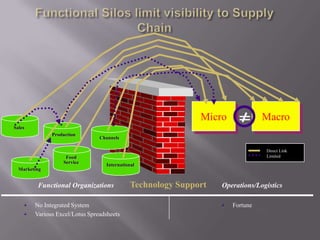
Functional Silos limit visibility to Supply ChainSalesProductionChannelsFood ServiceInternationalMarketingMicroMacro=Direct LinkLimitedTechnology SupportOperations/LogisticsFunctional OrganizationsNo Integrated System
Various Excel/Lotus Spreadsheets
FortuneMigration Plan To Forecasting Excellence= Current State= Future StateLevel 1	                            Level 2	                         Level 3PeopleProcessesTechnology-•Forecast accuracy is monitored and problem areas identified•Forecast responsibility is better defined and is prepared centrallyForecasting process receives input from major customers on a monthly or quarterly basis.
Single Forecast
Integrated statistical forecast based on historical sales•Remote access and update to forecast capability •Forecast accuracy is not monitored •Forecast responsibility is not  well defined and is prepared Ad hocForecasting process receives little or no input from stakeholders
Numerous nonintegrated Forecast
Statistical forecast non-integrated•Spreadsheet based monthly reporting of forecastsForecast accuracy monitored and input owners accountable for resultsForecast responsibility is well defined and primarily the responsibility of the input ownersForecasting process includes involvement from all stakeholders such as customers, distributors etc.•Integrated set of coordinated ForecastsIntegrated statistical forecast based on historical and predictive factors•Full “what if” planning
Potential Future Vision - Demand Management GroupExecutiveMarketingSalesProcessPeopleABP~MicroMacroDisciplineOperationsBusiness TeamsTechnologyFinanceMIDOutput: Single Operational Forecast
Forecast AccuracyMeasurement/AccountabilityHigher Expected Forecast AccuracySector Plan/Brand/YearABPBU Plan/Brand/QuarterBusiness Team CDT Plan/Brand/MonthIncreasing Organization/ Product/Period DetailRegional/MarketShipping Orbit/UPC/WeekDistribution CenterCustomer Account/UPC/DaySKU/Customer or StoreLower Expected Forecast Accuracy
Core ProcessesInterfaces to ProcessesKey StakeholdersWhat’s IncludedMacro ForecastCore ProcessesInterfaces to ProcessesKey StakeholdersLong-Term Capacity, Purchasing, and Logistics Planning
Sales Planning
Cost of Sales Projection

Demand Management - Food and Beverage

  • 1.
    Restructuring Demand ManagementExecutivePresentationFor the Food and Beverage IndustrySteve Lewin14 September 2009
  • 2.
    The ChallengeDemand Managementis a critical component of the Supply Chain Management process.Annual Business PlanningLong Range ProcurementMerchandising PlanningAccount ManagementMarketing PlanningMonthly REPlanning ProcessesDemand ForecastingOrder Mgmt.Supply Chain ManagementDistribution Center OperationsDistribution Network DesignCustomer Service Inventory Mgmt.Production PlanningTransportation PlanningPurchasingSound Demand Management is fundamental to business planning and the efficient operation of downstream supply chain processes, and central to achieving the objectives of lowest landed product cost and a high level of customer service.
  • 3.
    The Supply Chainis being viewed today as a series of interconnected business processesDistribution Center OperationsDistribution Network DesignInventory Mgmt./DRPProduction Planning/MPSOrder Mgmt.Supply Chain Service RequirementsDemand ForecastingTransportationPurchasingCustomerSupplierSupply ManagementSell Through MgmtDemandMgmtDemandFulfillmentEstablish InventoryPlan and Select SourcesSupplierCustomerSourcingCreate and Plan Customer Relationships
  • 4.
    Converging Forces CreateNew Business ProblemsCompetitive ForcesBest PracticesCUSTOMERRETAILERCONSUMERDSDSUPPLY CHAINPRIVATE LABELPRICING /PROMOTIONSQR/VELOCITYCOSTNEW SERVICE OFFERINGSCYCLE TIMEECRNEW VENDOR ALLIANCESSERVICENON-STOPCATEGORY EXCLUSIVITYCONVENIENCETECHNOLOGYGLOBAL EXPANSIONECONOMIC GAINVMI/CRNEW ITEM INTRO/PROMOElements ofCompetitionxxxxx5
  • 5.
    Functional Silos limitvisibility to Supply ChainSalesProductionChannelsFood ServiceInternationalMarketingMicroMacro=Direct LinkLimitedTechnology SupportOperations/LogisticsFunctional OrganizationsNo Integrated System
  • 6.
  • 7.
    FortuneMigration Plan ToForecasting Excellence= Current State= Future StateLevel 1 Level 2 Level 3PeopleProcessesTechnology-•Forecast accuracy is monitored and problem areas identified•Forecast responsibility is better defined and is prepared centrallyForecasting process receives input from major customers on a monthly or quarterly basis.
  • 8.
  • 9.
    Integrated statistical forecastbased on historical sales•Remote access and update to forecast capability •Forecast accuracy is not monitored •Forecast responsibility is not well defined and is prepared Ad hocForecasting process receives little or no input from stakeholders
  • 10.
  • 11.
    Statistical forecast non-integrated•Spreadsheetbased monthly reporting of forecastsForecast accuracy monitored and input owners accountable for resultsForecast responsibility is well defined and primarily the responsibility of the input ownersForecasting process includes involvement from all stakeholders such as customers, distributors etc.•Integrated set of coordinated ForecastsIntegrated statistical forecast based on historical and predictive factors•Full “what if” planning
  • 12.
    Potential Future Vision- Demand Management GroupExecutiveMarketingSalesProcessPeopleABP~MicroMacroDisciplineOperationsBusiness TeamsTechnologyFinanceMIDOutput: Single Operational Forecast
  • 13.
    Forecast AccuracyMeasurement/AccountabilityHigher ExpectedForecast AccuracySector Plan/Brand/YearABPBU Plan/Brand/QuarterBusiness Team CDT Plan/Brand/MonthIncreasing Organization/ Product/Period DetailRegional/MarketShipping Orbit/UPC/WeekDistribution CenterCustomer Account/UPC/DaySKU/Customer or StoreLower Expected Forecast Accuracy
  • 14.
    Core ProcessesInterfaces toProcessesKey StakeholdersWhat’s IncludedMacro ForecastCore ProcessesInterfaces to ProcessesKey StakeholdersLong-Term Capacity, Purchasing, and Logistics Planning
  • 15.
  • 16.
    Cost of SalesProjection