
Muhd Hafizi Idris, Mohd Rafi Adzman, Mohammad Faridun Naim
Tajuddin & Ahmad Zaidi Abdullah
Wide Area Fault Location for Power
Transmission Network using Reactance Based
Method
Centre of Excellence for Renewable Energy (CERE)
School of Electrical Systems Engineering
Universiti Malaysia Perlis
Introduction
• Fault location is very important in power system.
• Fault in power system must be located as fast as possible.
• Wide area fault location method is the newest method which can act as
backup to current fault location methods.
• Using this method, utility workers can get the fault location information
from their office or from the central location.
• It is introduced due to the advance in communication, smart grid,
substation automation and intelligent electronic device (IED).
Introduction
• In wide area implementations, synchrophasors or PMU (phasor
measurement unit) are put at several specific and strategic locations in
the networks.
• The data given by PMU are voltage and current phasors, the frequency
and rate of change of frequency (ROCOF).
• The data from many PMUs are sent to a data centre (PDC) where the data
then recorded and processed for various applications.
• All the data must be synchronized to a common clock time using Global
Positioning System (GPS).
Literature Review
• Fault location methods:
– One-terminal methods
– Two-terminal methods
– Wide-area methods
• One terminal methods:
- use measurement from one
end only
- Use many assumptions
- Many unknown parameters.
- Lowest accuracy
• Two-terminal methods:
-use measurement from both
ends.
-Reduce many assumptions.
-Better accuracy than one-terminal
method.
-Require communication channel
• Wide-area methods;
-Newest method.
-data from various
PMU/synchrophasor locations
-Data sent to a data centre or PDC
Literature Review
• Some wide-area methods:
References Methods
[19]-[22] Impedance based
[23]-[27] Travelling wave
[28] Fuzzy clustering analysis
[29] Fault model
[25], [30] Wavelet transform
Scopes of Research
• Preliminary results
• Wide-area
• Impedance based method – reactance
• Rules based system.
• IEEE 5 bus system.
• Phase to phase faults.
• PMU buses: 1, 2 & 4.
Reactance Based Method
• Derived from simple impedance based method:
• Only consider the imaginary part of simple impedance based
algorithms.
• More accurate than simple impedance based method.
• Reduce the effects of fault resistance where fault impedance
is resistive in nature.
Simple impedance
based method
Reactance Based Method
• Phase-to-phase fault was chosen in this research.
• From simple impedance based method;
• Expanded in trigonometric function;
• Impedance magnitude;
Reactance Based Method
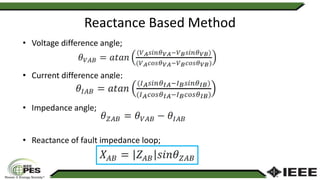
• Voltage difference angle;
• Current difference angle;
• Impedance angle;
• Reactance of fault impedance loop;
Methodologies
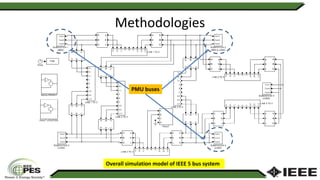
Overall simulation model of IEEE 5 bus system
PMU buses
Methodologies
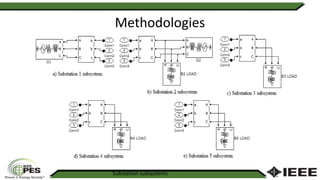
Substation subsystems
Methodologies
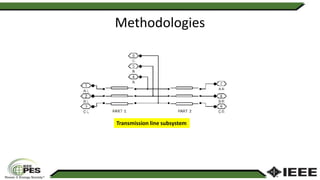
Transmission line subsystem
Methodologies
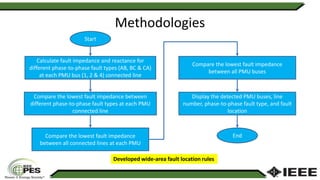
Start
Calculate fault impedance and reactance for
different phase-to-phase fault types (AB, BC & CA)
at each PMU bus (1, 2 & 4) connected line
Compare the lowest fault impedance between
different phase-to-phase fault types at each PMU
connected line
Compare the lowest fault impedance
between all connected lines at each PMU
Compare the lowest fault impedance
between all PMU buses
Display the detected PMU buses, line
number, phase-to-phase fault type, and fault
location
End
Developed wide-area fault location rules
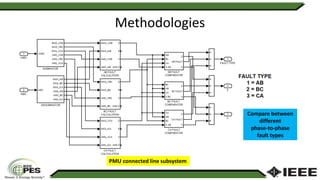
Methodologies
PMU connected line subsystem
Compare between
different
phase-to-phase
fault types
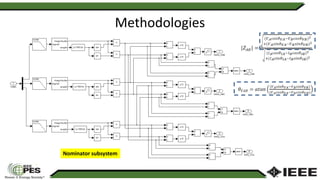
Methodologies
Nominator subsystem
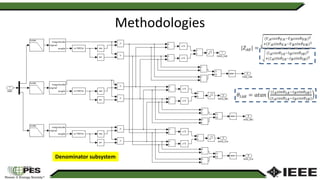
Methodologies
Denominator subsystem
Methodologies
AB fault calculation subsystem
Methodologies
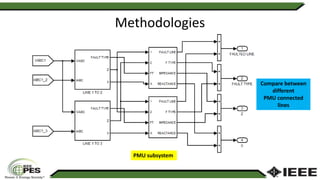
PMU subsystem
Compare between
different
PMU connected
lines
Methodologies
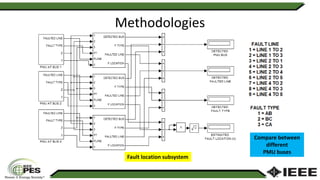
Fault location subsystem
Compare between
different
PMU buses
Simulation Results
• Faults have been located at different transmission lines with different
phase to phase fault types, fault locations and fault resistances.
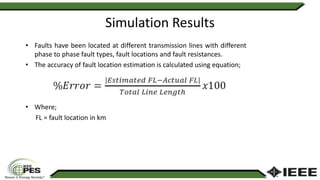
• The accuracy of fault location estimation is calculated using equation;
• Where;
FL = fault location in km
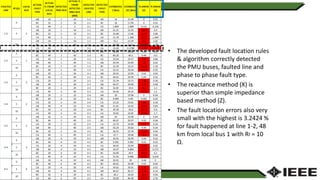
• The developed fault location rules
& algorithm correctly detected
the PMU buses, faulted line and
phase to phase fault type.
• The reactance method (X) is
superior than simple impedance
based method (Z).
• The fault location errors also very
small with the highest is 3.2424 %
for fault happened at line 1-2, 48
km from local bus 1 with Rf = 10
Ω.
Simulation Results
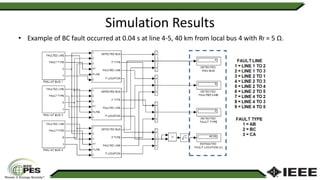
• Example of BC fault occurred at 0.04 s at line 4-5, 40 km from local bus 4 with Rf = 5 Ω.
Simulation Results
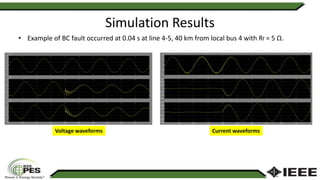
• Example of BC fault occurred at 0.04 s at line 4-5, 40 km from local bus 4 with Rf = 5 Ω.
Voltage waveforms Current waveforms
Future Works
• For a higher number of bus system, there will be many transmission line which are not
directly connected to PMU buses because complexity will increase when higher number
of PMU is used.
• Because these lines are not directly connected to PMU buses, many factors will influence
fault location accuracy such as infeed current, load current and other power system
parameters.
• In the future works, higher number of buses will be modeled and the accuracy of simple
reactance based algorithm with combination of the developed rules will be determined.
• Other techniques such as using voltage magnitude, current magnitude, current direction
and other methods will be combined with this method to increase the accuracy of
overall fault location detection and estimation.
Conclusion
• The research on wide area fault location using reactance based method which
combined with a rule based system has been successfully conducted.
• The methods can be used to estimate wide-area fault location for different fault
types, faulted lines, fault locations and fault resistances.
• By using reactance based method, the effects of fault resistance which is significant in
simple impedance based method ca be reduced.

Wide Area Fault Location for Power Transmission Network using Reactance Based Method

  • 1.
    Muhd Hafizi Idris,Mohd Rafi Adzman, Mohammad Faridun Naim Tajuddin & Ahmad Zaidi Abdullah Wide Area Fault Location for Power Transmission Network using Reactance Based Method Centre of Excellence for Renewable Energy (CERE) School of Electrical Systems Engineering Universiti Malaysia Perlis
  • 2.
    Introduction • Fault locationis very important in power system. • Fault in power system must be located as fast as possible. • Wide area fault location method is the newest method which can act as backup to current fault location methods. • Using this method, utility workers can get the fault location information from their office or from the central location. • It is introduced due to the advance in communication, smart grid, substation automation and intelligent electronic device (IED).
  • 3.
    Introduction • In widearea implementations, synchrophasors or PMU (phasor measurement unit) are put at several specific and strategic locations in the networks. • The data given by PMU are voltage and current phasors, the frequency and rate of change of frequency (ROCOF). • The data from many PMUs are sent to a data centre (PDC) where the data then recorded and processed for various applications. • All the data must be synchronized to a common clock time using Global Positioning System (GPS).
  • 4.
    Literature Review • Faultlocation methods: – One-terminal methods – Two-terminal methods – Wide-area methods • One terminal methods: - use measurement from one end only - Use many assumptions - Many unknown parameters. - Lowest accuracy • Two-terminal methods: -use measurement from both ends. -Reduce many assumptions. -Better accuracy than one-terminal method. -Require communication channel • Wide-area methods; -Newest method. -data from various PMU/synchrophasor locations -Data sent to a data centre or PDC
  • 5.
    Literature Review • Somewide-area methods: References Methods [19]-[22] Impedance based [23]-[27] Travelling wave [28] Fuzzy clustering analysis [29] Fault model [25], [30] Wavelet transform
  • 6.
    Scopes of Research •Preliminary results • Wide-area • Impedance based method – reactance • Rules based system. • IEEE 5 bus system. • Phase to phase faults. • PMU buses: 1, 2 & 4.
  • 7.
    Reactance Based Method •Derived from simple impedance based method: • Only consider the imaginary part of simple impedance based algorithms. • More accurate than simple impedance based method. • Reduce the effects of fault resistance where fault impedance is resistive in nature. Simple impedance based method
  • 8.
    Reactance Based Method •Phase-to-phase fault was chosen in this research. • From simple impedance based method; • Expanded in trigonometric function; • Impedance magnitude;
  • 9.
    Reactance Based Method •Voltage difference angle; • Current difference angle; • Impedance angle; • Reactance of fault impedance loop;
  • 10.
    Methodologies Overall simulation modelof IEEE 5 bus system PMU buses
  • 11.
  • 12.
  • 13.
    Methodologies Start Calculate fault impedanceand reactance for different phase-to-phase fault types (AB, BC & CA) at each PMU bus (1, 2 & 4) connected line Compare the lowest fault impedance between different phase-to-phase fault types at each PMU connected line Compare the lowest fault impedance between all connected lines at each PMU Compare the lowest fault impedance between all PMU buses Display the detected PMU buses, line number, phase-to-phase fault type, and fault location End Developed wide-area fault location rules
  • 14.
    Methodologies PMU connected linesubsystem Compare between different phase-to-phase fault types
  • 15.
  • 16.
  • 17.
  • 18.
  • 19.
  • 20.
    Simulation Results • Faultshave been located at different transmission lines with different phase to phase fault types, fault locations and fault resistances. • The accuracy of fault location estimation is calculated using equation; • Where; FL = fault location in km
  • 21.
    • The developedfault location rules & algorithm correctly detected the PMU buses, faulted line and phase to phase fault type. • The reactance method (X) is superior than simple impedance based method (Z). • The fault location errors also very small with the highest is 3.2424 % for fault happened at line 1-2, 48 km from local bus 1 with Rf = 10 Ω.
  • 22.
    Simulation Results • Exampleof BC fault occurred at 0.04 s at line 4-5, 40 km from local bus 4 with Rf = 5 Ω.
  • 23.
    Simulation Results • Exampleof BC fault occurred at 0.04 s at line 4-5, 40 km from local bus 4 with Rf = 5 Ω. Voltage waveforms Current waveforms
  • 24.
    Future Works • Fora higher number of bus system, there will be many transmission line which are not directly connected to PMU buses because complexity will increase when higher number of PMU is used. • Because these lines are not directly connected to PMU buses, many factors will influence fault location accuracy such as infeed current, load current and other power system parameters. • In the future works, higher number of buses will be modeled and the accuracy of simple reactance based algorithm with combination of the developed rules will be determined. • Other techniques such as using voltage magnitude, current magnitude, current direction and other methods will be combined with this method to increase the accuracy of overall fault location detection and estimation.
  • 25.
    Conclusion • The researchon wide area fault location using reactance based method which combined with a rule based system has been successfully conducted. • The methods can be used to estimate wide-area fault location for different fault types, faulted lines, fault locations and fault resistances. • By using reactance based method, the effects of fault resistance which is significant in simple impedance based method ca be reduced.