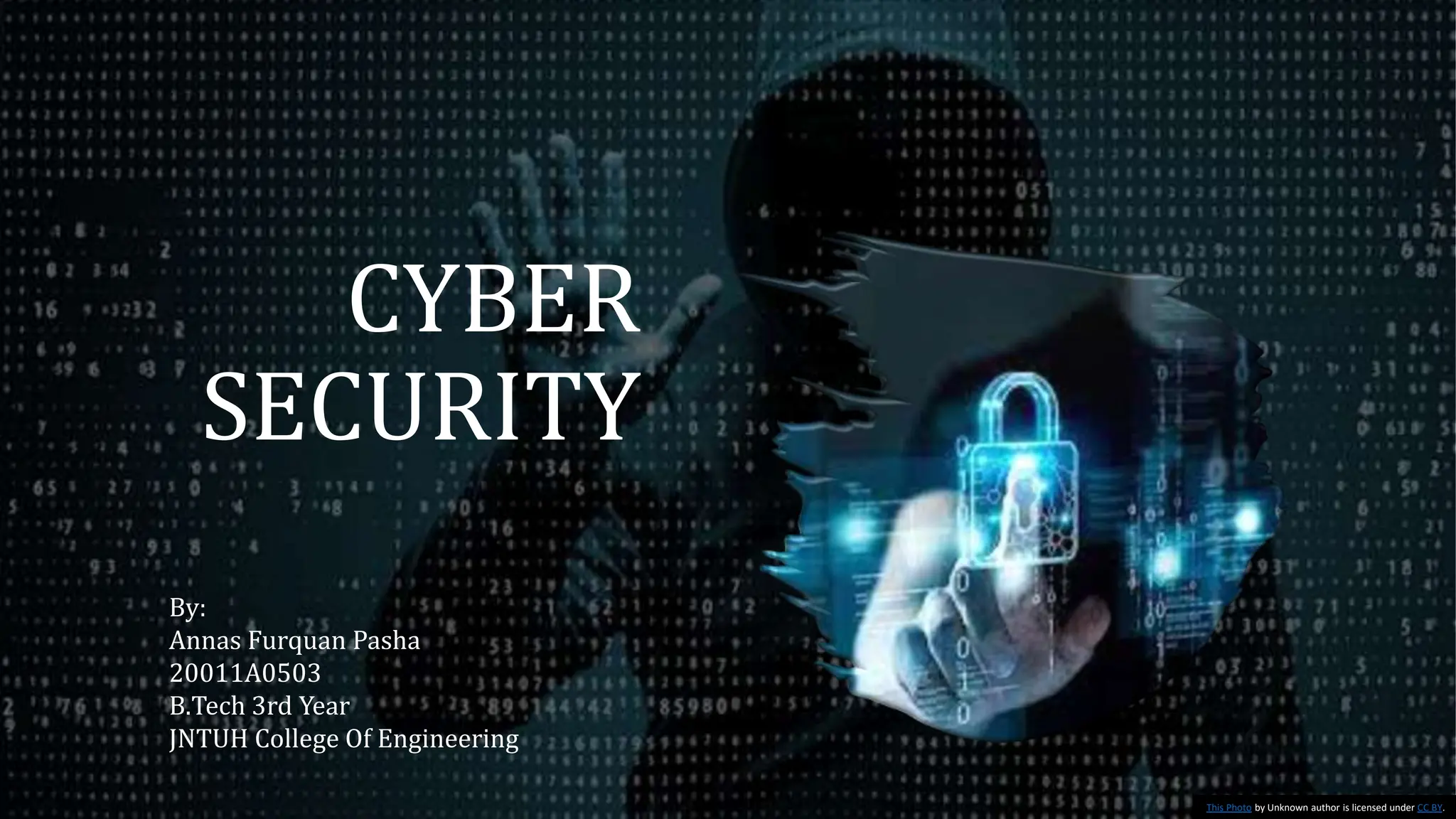
CYBER
SECURITY
This Photo by Unknown author is licensed under CC BY.
By:
Annas Furquan Pasha
20011A0503
B.Tech 3rd Year
JNTUH College Of Engineering
What is Cyber Security?
• Cyber security is the practice of defending
computers, servers, mobile devices, electronic
systems, networks, and data from malicious
attacks.
• It's also known as information technology
security or electronic information security.
This Photo by Unknown author is licensed under CC BY-NC.
This Photo by Unknown author is licensed under CC BY-SA-NC.
• The global cyber threat continues to evolve at a rapid
pace, with a rising number of data breaches each year. A
report by RiskBased Security revealed that a shocking
7.9 billion records have been exposed by data breaches
in the first nine months of 2019 alone. This figure is
more than double (112%) the number of
records exposed in the same period in 2018.
• With the scale of the cyber threat set to continue to
rise, the International Data Corporation predicts that
worldwide spending on cyber-security solutions will
reach a massive $133.7 billion by 2022.
• In the U.S., the National Institute of Standards and
Technology (NIST) has created a cyber-security
framework. To combat the proliferation of malicious code
and aid in early detection, the framework recommends
continuous, real-time monitoring of all electronic
resources.
• The Australian Cyber Security Centre(ACSC) regularly
publishes guidance on how organizations can counter the
latest cyber-security threats.
Cyber security
Strategy - India
• Security policy, Legal Framework
- IT Act 2000
- IT(Amendment ) Bill 2006 –
Data Protection and Computer
Crimes
• Research and Development
- Cyber Monitoring
- Network Security
• International Collaboration
TYPES OF CYBER
THREATS
The threats countered by cyber-
security are three-fold:
1. Cybercrime includes single actors
or groups targeting systems for
financial gain or to cause disruption.
2. Cyber-attack often involves
politically motivated information
gathering.
3. Cyberterrorism is intended to
undermine electronic systems to
cause panic or fear.
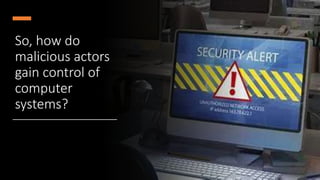
So, how do
malicious actors
gain control of
computer
systems?
Malware
• Malware means malicious software.
One of the most common cyber
threats, malware is software that a
cybercriminal or hacker has created
to disrupt or damage a legitimate
user’s computer.
• Often spread via an unsolicited email
attachment or legitimate-looking
download, malware may be used by
cybercriminals to make money or in
politically motivated cyber-attacks.
There are a
number of
different types
of malware,
including:
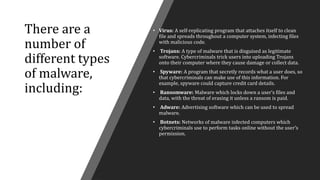
• Virus: A self-replicating program that attaches itself to clean
file and spreads throughout a computer system, infecting files
with malicious code.
• Trojans: A type of malware that is disguised as legitimate
software. Cybercriminals trick users into uploading Trojans
onto their computer where they cause damage or collect data.
• Spyware: A program that secretly records what a user does, so
that cybercriminals can make use of this information. For
example, spyware could capture credit card details.
• Ransomware: Malware which locks down a user’s files and
data, with the threat of erasing it unless a ransom is paid.
• Adware: Advertising software which can be used to spread
malware.
• Botnets: Networks of malware infected computers which
cybercriminals use to perform tasks online without the user’s
permission.
Other
methods:
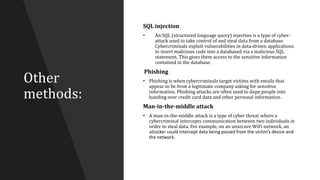
SQL injection
• An SQL (structured language query) injection is a type of cyber-
attack used to take control of and steal data from a database.
Cybercriminals exploit vulnerabilities in data-driven applications
to insert malicious code into a databased via a malicious SQL
statement. This gives them access to the sensitive information
contained in the database.
Phishing
• Phishing is when cybercriminals target victims with emails that
appear to be from a legitimate company asking for sensitive
information. Phishing attacks are often used to dupe people into
handing over credit card data and other personal information.
Man-in-the-middle attack
• A man-in-the-middle attack is a type of cyber threat where a
cybercriminal intercepts communication between two individuals in
order to steal data. For example, on an unsecure WiFi network, an
attacker could intercept data being passed from the victim’s device and
the network.
Latest cyber threats
Romance scams
• In February 2020, the FBI warned U.S.
citizens to be aware of confidence
fraud that cybercriminals commit
using dating sites, chat rooms and
apps. Perpetrators take advantage of
people seeking new partners, duping
victims into giving away personal data.
• The FBI reports that romance cyber
threats affected 114 victims in New
Mexico in 2019, with financial losses
amounting to $1.6 million.
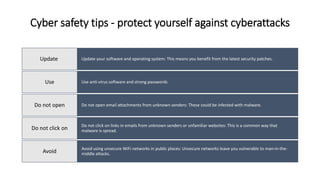
Cyber safety tips - protect yourself against cyberattacks
Update your software and operating system: This means you benefit from the latest security patches.
Update
Use anti-virus software and strong passwords
Use
Do not open email attachments from unknown senders: These could be infected with malware.
Do not open
Do not click on links in emails from unknown senders or unfamiliar websites: This is a common way that
malware is spread.
Do not click on
Avoid using unsecure WiFi networks in public places: Unsecure networks leave you vulnerable to man-in-the-
middle attacks.
Avoid
Conclusion
• I hope that my information will be helpful for
you to improve your knowledge about cyber
security and to overcome several security
loopholes in your computer operations.
• Also it helps to spread
awareness among normal people
about emerging security threats .
Queries
www.kaspersky.co.in/resource
-center/definitions/what-is-
cyber-security.
THANK YOU

Cyber security

  • 1.
    CYBER SECURITY This Photo byUnknown author is licensed under CC BY. By: Annas Furquan Pasha 20011A0503 B.Tech 3rd Year JNTUH College Of Engineering
  • 2.
    What is CyberSecurity? • Cyber security is the practice of defending computers, servers, mobile devices, electronic systems, networks, and data from malicious attacks. • It's also known as information technology security or electronic information security. This Photo by Unknown author is licensed under CC BY-NC.
  • 3.
    This Photo byUnknown author is licensed under CC BY-SA-NC.
  • 4.
    • The globalcyber threat continues to evolve at a rapid pace, with a rising number of data breaches each year. A report by RiskBased Security revealed that a shocking 7.9 billion records have been exposed by data breaches in the first nine months of 2019 alone. This figure is more than double (112%) the number of records exposed in the same period in 2018. • With the scale of the cyber threat set to continue to rise, the International Data Corporation predicts that worldwide spending on cyber-security solutions will reach a massive $133.7 billion by 2022.
  • 5.
    • In theU.S., the National Institute of Standards and Technology (NIST) has created a cyber-security framework. To combat the proliferation of malicious code and aid in early detection, the framework recommends continuous, real-time monitoring of all electronic resources. • The Australian Cyber Security Centre(ACSC) regularly publishes guidance on how organizations can counter the latest cyber-security threats.
  • 6.
    Cyber security Strategy -India • Security policy, Legal Framework - IT Act 2000 - IT(Amendment ) Bill 2006 – Data Protection and Computer Crimes • Research and Development - Cyber Monitoring - Network Security • International Collaboration
  • 7.
    TYPES OF CYBER THREATS Thethreats countered by cyber- security are three-fold: 1. Cybercrime includes single actors or groups targeting systems for financial gain or to cause disruption. 2. Cyber-attack often involves politically motivated information gathering. 3. Cyberterrorism is intended to undermine electronic systems to cause panic or fear.
  • 8.
    So, how do maliciousactors gain control of computer systems?
  • 9.
    Malware • Malware meansmalicious software. One of the most common cyber threats, malware is software that a cybercriminal or hacker has created to disrupt or damage a legitimate user’s computer. • Often spread via an unsolicited email attachment or legitimate-looking download, malware may be used by cybercriminals to make money or in politically motivated cyber-attacks.
  • 10.
    There are a numberof different types of malware, including: • Virus: A self-replicating program that attaches itself to clean file and spreads throughout a computer system, infecting files with malicious code. • Trojans: A type of malware that is disguised as legitimate software. Cybercriminals trick users into uploading Trojans onto their computer where they cause damage or collect data. • Spyware: A program that secretly records what a user does, so that cybercriminals can make use of this information. For example, spyware could capture credit card details. • Ransomware: Malware which locks down a user’s files and data, with the threat of erasing it unless a ransom is paid. • Adware: Advertising software which can be used to spread malware. • Botnets: Networks of malware infected computers which cybercriminals use to perform tasks online without the user’s permission.
  • 11.
    Other methods: SQL injection • AnSQL (structured language query) injection is a type of cyber- attack used to take control of and steal data from a database. Cybercriminals exploit vulnerabilities in data-driven applications to insert malicious code into a databased via a malicious SQL statement. This gives them access to the sensitive information contained in the database. Phishing • Phishing is when cybercriminals target victims with emails that appear to be from a legitimate company asking for sensitive information. Phishing attacks are often used to dupe people into handing over credit card data and other personal information. Man-in-the-middle attack • A man-in-the-middle attack is a type of cyber threat where a cybercriminal intercepts communication between two individuals in order to steal data. For example, on an unsecure WiFi network, an attacker could intercept data being passed from the victim’s device and the network.
  • 12.
  • 13.
    Romance scams • InFebruary 2020, the FBI warned U.S. citizens to be aware of confidence fraud that cybercriminals commit using dating sites, chat rooms and apps. Perpetrators take advantage of people seeking new partners, duping victims into giving away personal data. • The FBI reports that romance cyber threats affected 114 victims in New Mexico in 2019, with financial losses amounting to $1.6 million.
  • 14.
    Cyber safety tips- protect yourself against cyberattacks Update your software and operating system: This means you benefit from the latest security patches. Update Use anti-virus software and strong passwords Use Do not open email attachments from unknown senders: These could be infected with malware. Do not open Do not click on links in emails from unknown senders or unfamiliar websites: This is a common way that malware is spread. Do not click on Avoid using unsecure WiFi networks in public places: Unsecure networks leave you vulnerable to man-in-the- middle attacks. Avoid
  • 15.
    Conclusion • I hopethat my information will be helpful for you to improve your knowledge about cyber security and to overcome several security loopholes in your computer operations. • Also it helps to spread awareness among normal people about emerging security threats .
  • 16.
  • 17.