Why kernel space sucks
            (Or: Deconstructing two myths)
(Or: An abridged history of kernel-userspace interface blunders...)


                                                 Michael Kerrisk
  OpenFest 2011
                                                      © 2011
   5 Nov 2011
                                                 mtk@man7.org
  Sofia, Bulgaria
                                                 http://man7.org/
Who am I?
●    Professionally: programmer (primarily); also teacher
      and writer
●    Working with UNIX and Linux for nearly 25 years
●    Linux man-pages maintainer since 2004
    ●   117 releases to date
    ●   written or cowritten ~250 of ~950 man pages
    ●   lots of API testing, many bug reports
●    Author of a book on the kernel-userspace API
●    IOW: I've spent a lot of time looking at the interface


                                                          2
    man7.org
Intro: Why Userspace Sucks
●   Paper/talk by Dave Jones of Red Hat
    ●   First presented at Ottawa LS 2006
●   A lead-in to deconstructing a couple of myths
●   Why Userspace Sucks → WUSS


    ●   http://www.kernel.org/doc/ols/2006/ols2006v1-pages-441-450.pdf
    ●   http://www.codemonkey.org.uk/projects/talks/ols2k6.tar.gz
    ●   http://lwn.net/Articles/192214/


                                                                    3
    man7.org
Motivation for WUSS
●   We (kernel developers) have created a
    magnificently performant kernel
●   But, can we make it better?
    ●   Why does it take so long to boot, start applications,
        and shut down?
    ●   Why does my idle laptop consume so much battery
        power?


                                                          4
    man7.org
Findings from WUSS
●   DJ starts instrumenting the kernel, and finds...
    ●   Boot up: 80k stat(), 27k open(), 1.4k exec()
    ●   Shutdown: 23k stat(), 9k open()
●   Userspace programmers wreck performance
    doing crazy things!
    ●   open() and reparse same file multiple times!
    ●   read config files for many devices not even present!
    ●   stat() (or even open()) 100s of files they never need
    ●   timers triggering regular unnecessary wake-ups


                                                         5
    man7.org
Conclusions from WUSS
●   Room for a lot of improvement in userspace!
●   Userspace programmers should be aware of
    and using trace and analysis tools
    ●   (perf, LTTng, ftrace, systemtap, strace, valgrind,
        powertop, etc.)


                                                             6
    man7.org
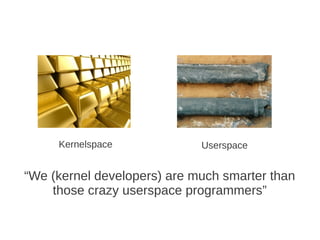
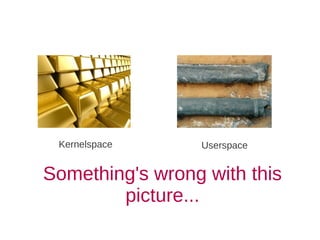
Kernelspace             Userspace


“We (kernel developers) are much smarter than
    those crazy userspace programmers”
Kernelspace     Userspace


Something's wrong with this
        picture...
Let's question a couple of myths...
●   Myth 1: Kernel programmers (can) always get
    things right (in the end)
●   Myth 2: Code is always the best way to
    contribute to Free Software


                                             9
    man7.org
Myth 1
    Kernel programmers
(can) always get things right
         (in the end)

 Except, there's (at least) one place
   where they don't: the interface
The kernel-userspace interface
●   Application programming interface (API)
    presented by kernel to userspace programs
    ●   System calls (← I'll focus here)
    ●   Pseudo-file systems (/proc, /sys, etc.)
    ●   ioctl() interfaces (device drivers)
    ●   Netlink sockets
    ●   Obscure pieces (AUXV, VDSO, ...)


                                                  11
    man7.org
API designs must be done
     right first time
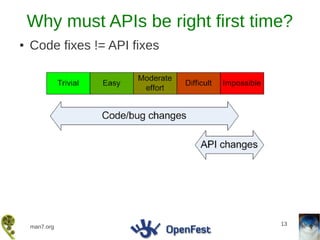
Why must APIs be right first time?
●   Code fixes != API fixes


                                    13
    man7.org
Why is fixing APIs so hard?
●   Usually, “fixing” an interface means breaking
    the interface for some applications


       “We care about user-space interfaces to an insane
      degree. We go to extreme lengths to maintain even
          badly designed or unintentional interfaces.
      Breaking user programs simply isn't acceptable.”
                      [LKML, Dec 2005]

                                                       14
    man7.org
We have to live with our mistakes!

    So: any API mistake by kernel
hackers creates pain that thousands
of userspace programmers must live
          with for decades
So, what does it mean
 to get an API right?
Doing (kernel-userspace) APIs right
●   Properly designed and implemented API should:
    ●   be bug free!
    ●   have a well thought out design
        –   simple as possible (but no simpler)
        –   easy to use / difficult to misuse
    ●   be consistent with related/similar APIs
    ●   integrate well with existing APIs
        –   e.g., interactions with fork(), exec(), threads, signals, FDs?
    ●   be as general as possible
    ●   be extensible, where needed; accommodate future growth trends
    ●   adhere to relevant standards (as far as possible)
    ●   be as good as, or better than, earlier APIs with similar functionality
    ●   be maintainable over time (a multilayered question)


                                                                             17
    man7.org
So how do kernel
developers score?
  (BSDers, please laugh quietly)
Bugs
Bugs
●   utimensat(2) [2.6.22]
    ●   Set file timestamps
    ●   Multiple bugs!
         –     http://linux-man-pages.blogspot.com/2008/06/whats-wrong-with-kernel-userland_30.html

    ●   Fixed in 2.6.26
●   signalfd() [2.6.22]
    ●   Receive signals via a file descriptor
    ●   Didn't correctly obtain data sent with sigqueue(2)
    ●   Fixed in 2.6.25


                                                                                                      20
    man7.org
Bugs
●   Examples of other interfaces with significant,
    easy to find bugs at release:
    ●   inotify [2.6.13]
    ●   splice() [2.6.17] (http://marc.info/?l=linux-mm&m=114238448331607&w=2)
    ●   timerfd [2.6.22] (http://marc.info/?l=linux-kernel&m=118517213626087&w=2)


                                                                                    21
    man7.org
Bugs—what's going on?
●   There's a quality control issue; way too many
    bugs in released interfaces
●   Pre-release testing insufficient and haphazard:
    ●   Too few testers (maybe just kernel developer)
    ●   No unit tests
    ●   Insufficient test coverage
    ●   No clear specification against which to test
●   Even if bug is fixed, users may still need to care
    ●   special casing for kernel versions


                                                        22
    man7.org
Thinking about
    design
Code it now, think about it later
●   Vanishing arguments:
    ●   readdir(2) ignores count argument
    ●   getcpu(2) [2.6.19] ignores tcache argument
    ●   epoll_create() [2.6] ignores size arg. (must be > 0)
        since 2.6.8
●   Probably, argument wasn't needed to start with
    ●   Or: recognized as a bad idea and made a no-op


                                                         24
    man7.org
Code it now, think about it later
●   futimesat() [2.6.16]
     ●   Extends utimes()
     ●   Proposed for POSIX.1-2008
     ●   Implemented on Linux
     ●   POSIX.1 members realize API is insufficient
         → standardized different API
     ●   utimensat() added in Linux 2.6.22


                                                       25
    man7.org
Code it now, think about it later
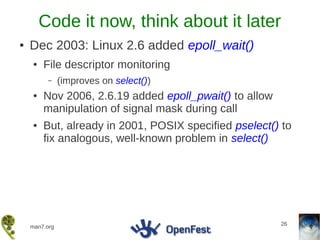
●   Dec 2003: Linux 2.6 added epoll_wait()
    ●   File descriptor monitoring
         –     (improves on select())
    ●   Nov 2006, 2.6.19 added epoll_pwait() to allow
        manipulation of signal mask during call
    ●   But, already in 2001, POSIX specified pselect() to
        fix analogous, well-known problem in select()


                                                        26
    man7.org
Consistency
Interface inconsistencies
●   mlock(start, length):
    ●   Round start down to page size
    ●   Round length up to next page boundary
    ●   mlock(4000, 6000) affects bytes 0..12287
●   remap_file_pages(start, length, ...) [2.6]:
    ●   Round start down to page boundary
    ●   Round length down to page boundary(!)
    ●   remap_file_pages(4000, 6000, ...) ? → 0..4095
●   User expectation: similar APIs should behave
    similarly

                                                        28
    man7.org
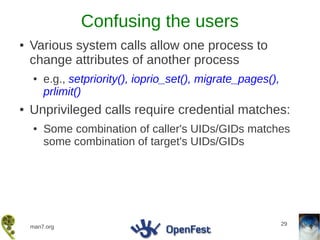
Confusing the users
●   Various system calls allow one process to
    change attributes of another process
    ●   e.g., setpriority(), ioprio_set(), migrate_pages(),
        prlimit()
●   Unprivileged calls require credential matches:
    ●   Some combination of caller's UIDs/GIDs matches
        some combination of target's UIDs/GIDs


                                                              29
    man7.org
Confusing the users
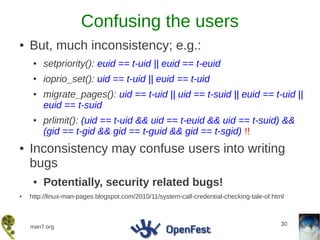
●   But, much inconsistency; e.g.:
     ●   setpriority(): euid == t-uid || euid == t-euid
     ●   ioprio_set(): uid == t-uid || euid == t-uid
     ●   migrate_pages(): uid == t-uid || uid == t-suid || euid == t-uid ||
         euid == t-suid
     ●   prlimit(): (uid == t-uid && uid == t-euid && uid == t-suid) &&
         (gid == t-gid && gid == t-guid && gid == t-sgid) !!
●   Inconsistency may confuse users into writing
    bugs
     ●   Potentially, security related bugs!
●   http://linux-man-pages.blogspot.com/2010/11/system-call-credential-checking-tale-of.html


                                                                                           30
    man7.org
Generality
Is the interface sufficiently general?
●   2.6.22 added timerfd(ufd, flags, utimerspec)
    ●   Create timer that notifies via a file descriptor
●   But API didn't allow user to:
    ●   Retrieve previous value when setting new timer value
    ●   Do a “get” to retrieve time until next expiration
         –     http://marc.info/?l=linux-kernel&m=118517213626087&w=2
         –     http://lwn.net/Articles/245533/
●   Older APIs ([gs]etitimer(), POSIX timers) did
    provide this functionality!


                                                                        32
    man7.org
Is the interface sufficiently general?
●   Solution:
    ●   timerfd() disabled in kernel 2.6.23
    ●   2.6.25 did it right:
         –     timerfd_create(), timerfd_settime(), timerfd_gettime()
         –     (API analogous to POSIX timers)
●   Was an ABI breakage, but
    ●   Only in a single kernel version
    ●   Original API was never exposed via glibc


                                                                    33
    man7.org
Are we learning
from the past?
Are we learning from past mistakes?
●   Dnotify [2.4]
    ●   Directory change notification API
    ●   Many problems
●   So, we added inotify [2.6.13]
    ●   But, inotify still doesn't get it all right
●   Now [2.6.37] we have yet another API, fanotify
    ●   Designed for virus scanners
    ●   Adds some functionality
    ●   Doesn't provide all functionality of inotify
●   Couldn't we have had a new API that did everything?

                                                       35
    man7.org
Extensibility
Is the interface extensible?
●   Too often, an early API didn't allow for
    extensions
●   Common solution is a new API, with a flags arg:
    ●   umount() → umount2() [2.2]
    ●   epoll_create() [2.6] → epoll_create2() [2.6.27]
    ●   futimesat() [2.6.16] → epoll_create2() [2.6.22]
    ●   signalfd() [2.6.22] → signalfd4() [2.6.27]
●   When adding a new API, consider adding an
    (unused) flags argument to allow extensions

                                                          37
    man7.org
Futureproofing
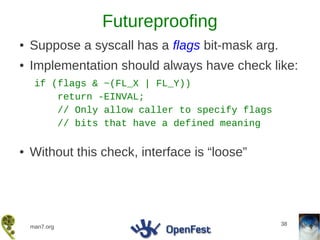
●   Suppose a syscall has a flags bit-mask arg.
●   Implementation should always have check like:
     if (flags & ~(FL_X | FL_Y))
         return -EINVAL;
         // Only allow caller to specify flags
         // bits that have a defined meaning

●   Without this check, interface is “loose”


                                                  38
    man7.org
Futureproofing
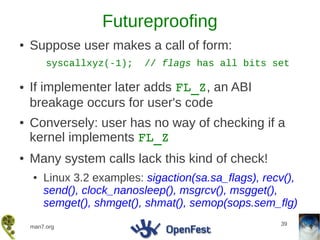
●   Suppose user makes a call of form:
         syscallxyz(-1);    // flags has all bits set

●   If implementer later adds FL_Z, an ABI
    breakage occurs for user's code
●   Conversely: user has no way of checking if a
    kernel implements FL_Z
●   Many system calls lack this kind of check!
    ●   Linux 3.2 examples: sigaction(sa.sa_flags), recv(),
        send(), clock_nanosleep(), msgrcv(), msgget(),
        semget(), shmget(), shmat(), semop(sops.sem_flg)
                                                       39
    man7.org
Futureproofing
●   Should checks be added after the fact?
    ●   e.g., umount2() [2.2] added check in 2.6.34;
        timerfd_settime() [2.6.25] added check in 2.6.29
●   But adding check can also create ABI breakage
    ●   Apps get errors where previously they did not
●   Loose APIs allow the user to define interface
    ●   Worst case: can't add new flags values to interface


                                                        40
    man7.org
Futureproofing failures
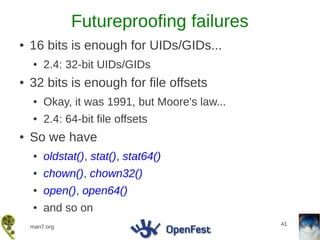
●   16 bits is enough for UIDs/GIDs...
    ●   2.4: 32-bit UIDs/GIDs
●   32 bits is enough for file offsets
    ●   Okay, it was 1991, but Moore's law...
    ●   2.4: 64-bit file offsets
●   So we have
    ●   oldstat(), stat(), stat64()
    ●   chown(), chown32()
    ●   open(), open64()
    ●   and so on
                                                41
    man7.org
Maintainability
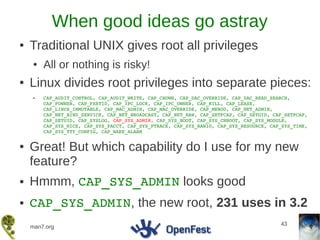
When good ideas go astray
●   Traditional UNIX gives root all privileges
    ●   All or nothing is risky!
●   Linux divides root privileges into separate pieces:
    ●   CAP_AUDIT_CONTROL, CAP_AUDIT_WRITE, CAP_CHOWN, CAP_DAC_OVERRIDE, CAP_DAC_READ_SEARCH, 
        CAP_FOWNER, CAP_FSETID, CAP_IPC_LOCK, CAP_IPC_OWNER, CAP_KILL, CAP_LEASE, 
        CAP_LINUX_IMMUTABLE, CAP_MAC_ADMIN, CAP_MAC_OVERRIDE, CAP_MKNOD, CAP_NET_ADMIN, 
        CAP_NET_BIND_SERVICE, CAP_NET_BROADCAST, CAP_NET_RAW, CAP_SETFCAP, CAP_SETGID, CAP_SETPCAP, 
        CAP_SETUID, CAP_SYSLOG, CAP_SYS_ADMIN, CAP_SYS_BOOT, CAP_SYS_CHROOT, CAP_SYS_MODULE, 
        CAP_SYS_NICE, CAP_SYS_PACCT, CAP_SYS_PTRACE, CAP_SYS_RAWIO, CAP_SYS_RESOURCE, CAP_SYS_TIME, 
        CAP_SYS_TTY_CONFIG, CAP_WAKE_ALARM


●   Great! But which capability do I use for my new
    feature?
●   Hmmm, CAP_SYS_ADMIN looks good
●   CAP_SYS_ADMIN, the new root, 231 uses in 3.2
                                                                                         43
    man7.org
Standards and
  portability
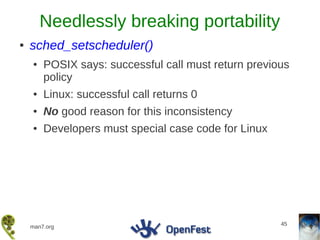
Needlessly breaking portability
●   sched_setscheduler()
    ●   POSIX says: successful call must return previous
        policy
    ●   Linux: successful call returns 0
    ●   No good reason for this inconsistency
    ●   Developers must special case code for Linux


                                                      45
    man7.org
Actually,
it wasn't just us...
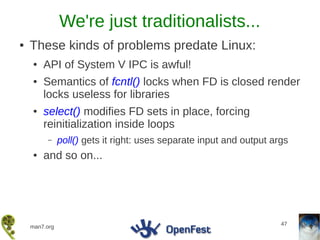
We're just traditionalists...
●   These kinds of problems predate Linux:
    ●   API of System V IPC is awful!
    ●   Semantics of fcntl() locks when FD is closed render
        locks useless for libraries
    ●   select() modifies FD sets in place, forcing
        reinitialization inside loops
         –     poll() gets it right: uses separate input and output args
    ●   and so on...


                                                                      47
    man7.org
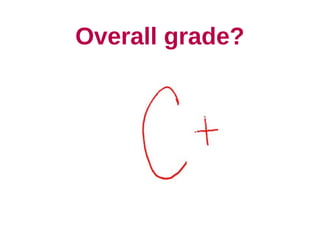
Overall grade?
Why do these API problems
    keep happening?
●   Excessive focus on code as primary
    contribution of value for a software project
●   Poor feedback loop between developers and
    users
Myth 2
Code is always the best way
to contribute to Free Software
“Show me the code!”
“Show me the code!”

 But anyone can write code,
  and if the design is good
     but the code is bad,
the code can usually be fixed
“Show me the code!”

             Sometimes,
other sentences are more appropriate,
and encourage contributions that are
        as (or more) valuable
“Show me the users'
  requirements!”
“Show me the users' requirements”
●   Does the API serve needs of multiple users, or
    is it just one developer scratching an itch?
    ●   Beware of limited perspectives!
●   Is the API designed for generality?
●   Is the API extensible for possible future
    requirements?


                                                55
    man7.org
“Show me the design
specification / documentation!”
“Show me the design spec. / documentation!”
●   How do we know if implementation deviates
    from intention?
●   What shall we code our tests against?
●   Writing documentation turns out often to be a
    natural sanity check for design
●   A decent man page suffices
    ●   Many of the bugs mentioned earlier were found
        while writing man pages...
    ●   It's all a question of when it's written...


                                                        57
    man7.org
“Show me the design review!”
●   Did other people actually review your design?
●   Is the API:
     ●   as simple as possible?
     ●   easy to use / difficult to misuse?
     ●   consistent with related/similar APIs?
     ●   well integrated with existing APIs?
     ●   as general as possible
     ●   extensible?
     ●   following standards, where relevant?
     ●   at least as good as earlier APIs with similar functionality?
     ●   maintainable?
                                                              59
    man7.org
“Show me the tests!”
●   Did you (the developer) write some tests?
●   More importantly: did someone else write some
    tests?
●   Do the tests cover all reasonable cases?
●   Do you test for unreasonable cases?
     ●   Do unexpected inputs generate suitable error returns?
●   While writing tests, did you find the interface easy
    to use / difficult to misuse? (Did you consequently
    make some design changes?)
●   What bugs did you discover during testing?
                                                       61
    man7.org
Finally...
●   If you're a potential contributor, don't fall into the
    trap of believing that code is the only (or best)
    vehicle for contribution
●   As a maintainer, are you letting your project
    down by failing to encourage these other types
    of contribution?
Thanks!
                    (slides up soon at http://man7.org/conf/)


Michael Kerrisk                                                                Linux man-pages project
mtk@man7.org                                                                   mtk.manpages@gmail.com
http://man7.org/                                                               http://man7.org/linux/man-pages/

                          Mamaku (Black Tree Fern) image (c) Rob Suisted


                                                                                                     New Zealand Blue Penguin (Kororā)
                                                                                                     Image (c) livescience.com
                          naturespic.com


 No Starch Press, 2010
  http://man7.org/tlpi/

Why kernelspace sucks?

  • 1.
    Why kernel spacesucks (Or: Deconstructing two myths) (Or: An abridged history of kernel-userspace interface blunders...) Michael Kerrisk OpenFest 2011 © 2011 5 Nov 2011 mtk@man7.org Sofia, Bulgaria http://man7.org/
  • 2.
    Who am I? ● Professionally: programmer (primarily); also teacher and writer ● Working with UNIX and Linux for nearly 25 years ● Linux man-pages maintainer since 2004 ● 117 releases to date ● written or cowritten ~250 of ~950 man pages ● lots of API testing, many bug reports ● Author of a book on the kernel-userspace API ● IOW: I've spent a lot of time looking at the interface 2 man7.org
  • 3.
    Intro: Why UserspaceSucks ● Paper/talk by Dave Jones of Red Hat ● First presented at Ottawa LS 2006 ● A lead-in to deconstructing a couple of myths ● Why Userspace Sucks → WUSS ● http://www.kernel.org/doc/ols/2006/ols2006v1-pages-441-450.pdf ● http://www.codemonkey.org.uk/projects/talks/ols2k6.tar.gz ● http://lwn.net/Articles/192214/ 3 man7.org
  • 4.
    Motivation for WUSS ● We (kernel developers) have created a magnificently performant kernel ● But, can we make it better? ● Why does it take so long to boot, start applications, and shut down? ● Why does my idle laptop consume so much battery power? 4 man7.org
  • 5.
    Findings from WUSS ● DJ starts instrumenting the kernel, and finds... ● Boot up: 80k stat(), 27k open(), 1.4k exec() ● Shutdown: 23k stat(), 9k open() ● Userspace programmers wreck performance doing crazy things! ● open() and reparse same file multiple times! ● read config files for many devices not even present! ● stat() (or even open()) 100s of files they never need ● timers triggering regular unnecessary wake-ups 5 man7.org
  • 6.
    Conclusions from WUSS ● Room for a lot of improvement in userspace! ● Userspace programmers should be aware of and using trace and analysis tools ● (perf, LTTng, ftrace, systemtap, strace, valgrind, powertop, etc.) 6 man7.org
  • 7.
    Kernelspace Userspace “We (kernel developers) are much smarter than those crazy userspace programmers”
  • 8.
    Kernelspace Userspace Something's wrong with this picture...
  • 9.
    Let's question acouple of myths... ● Myth 1: Kernel programmers (can) always get things right (in the end) ● Myth 2: Code is always the best way to contribute to Free Software 9 man7.org
  • 10.
    Myth 1 Kernel programmers (can) always get things right (in the end) Except, there's (at least) one place where they don't: the interface
  • 11.
    The kernel-userspace interface ● Application programming interface (API) presented by kernel to userspace programs ● System calls (← I'll focus here) ● Pseudo-file systems (/proc, /sys, etc.) ● ioctl() interfaces (device drivers) ● Netlink sockets ● Obscure pieces (AUXV, VDSO, ...) 11 man7.org
  • 12.
    API designs mustbe done right first time
  • 13.
    Why must APIsbe right first time? ● Code fixes != API fixes 13 man7.org
  • 14.
    Why is fixingAPIs so hard? ● Usually, “fixing” an interface means breaking the interface for some applications “We care about user-space interfaces to an insane degree. We go to extreme lengths to maintain even badly designed or unintentional interfaces. Breaking user programs simply isn't acceptable.” [LKML, Dec 2005] 14 man7.org
  • 15.
    We have tolive with our mistakes! So: any API mistake by kernel hackers creates pain that thousands of userspace programmers must live with for decades
  • 16.
    So, what doesit mean to get an API right?
  • 17.
    Doing (kernel-userspace) APIsright ● Properly designed and implemented API should: ● be bug free! ● have a well thought out design – simple as possible (but no simpler) – easy to use / difficult to misuse ● be consistent with related/similar APIs ● integrate well with existing APIs – e.g., interactions with fork(), exec(), threads, signals, FDs? ● be as general as possible ● be extensible, where needed; accommodate future growth trends ● adhere to relevant standards (as far as possible) ● be as good as, or better than, earlier APIs with similar functionality ● be maintainable over time (a multilayered question) 17 man7.org
  • 18.
    So how dokernel developers score? (BSDers, please laugh quietly)
  • 19.
  • 20.
    Bugs ● utimensat(2) [2.6.22] ● Set file timestamps ● Multiple bugs! – http://linux-man-pages.blogspot.com/2008/06/whats-wrong-with-kernel-userland_30.html ● Fixed in 2.6.26 ● signalfd() [2.6.22] ● Receive signals via a file descriptor ● Didn't correctly obtain data sent with sigqueue(2) ● Fixed in 2.6.25 20 man7.org
  • 21.
    Bugs ● Examples of other interfaces with significant, easy to find bugs at release: ● inotify [2.6.13] ● splice() [2.6.17] (http://marc.info/?l=linux-mm&m=114238448331607&w=2) ● timerfd [2.6.22] (http://marc.info/?l=linux-kernel&m=118517213626087&w=2) 21 man7.org
  • 22.
    Bugs—what's going on? ● There's a quality control issue; way too many bugs in released interfaces ● Pre-release testing insufficient and haphazard: ● Too few testers (maybe just kernel developer) ● No unit tests ● Insufficient test coverage ● No clear specification against which to test ● Even if bug is fixed, users may still need to care ● special casing for kernel versions 22 man7.org
  • 23.
  • 24.
    Code it now,think about it later ● Vanishing arguments: ● readdir(2) ignores count argument ● getcpu(2) [2.6.19] ignores tcache argument ● epoll_create() [2.6] ignores size arg. (must be > 0) since 2.6.8 ● Probably, argument wasn't needed to start with ● Or: recognized as a bad idea and made a no-op 24 man7.org
  • 25.
    Code it now,think about it later ● futimesat() [2.6.16] ● Extends utimes() ● Proposed for POSIX.1-2008 ● Implemented on Linux ● POSIX.1 members realize API is insufficient → standardized different API ● utimensat() added in Linux 2.6.22 25 man7.org
  • 26.
    Code it now,think about it later ● Dec 2003: Linux 2.6 added epoll_wait() ● File descriptor monitoring – (improves on select()) ● Nov 2006, 2.6.19 added epoll_pwait() to allow manipulation of signal mask during call ● But, already in 2001, POSIX specified pselect() to fix analogous, well-known problem in select() 26 man7.org
  • 27.
  • 28.
    Interface inconsistencies ● mlock(start, length): ● Round start down to page size ● Round length up to next page boundary ● mlock(4000, 6000) affects bytes 0..12287 ● remap_file_pages(start, length, ...) [2.6]: ● Round start down to page boundary ● Round length down to page boundary(!) ● remap_file_pages(4000, 6000, ...) ? → 0..4095 ● User expectation: similar APIs should behave similarly 28 man7.org
  • 29.
    Confusing the users ● Various system calls allow one process to change attributes of another process ● e.g., setpriority(), ioprio_set(), migrate_pages(), prlimit() ● Unprivileged calls require credential matches: ● Some combination of caller's UIDs/GIDs matches some combination of target's UIDs/GIDs 29 man7.org
  • 30.
    Confusing the users ● But, much inconsistency; e.g.: ● setpriority(): euid == t-uid || euid == t-euid ● ioprio_set(): uid == t-uid || euid == t-uid ● migrate_pages(): uid == t-uid || uid == t-suid || euid == t-uid || euid == t-suid ● prlimit(): (uid == t-uid && uid == t-euid && uid == t-suid) && (gid == t-gid && gid == t-guid && gid == t-sgid) !! ● Inconsistency may confuse users into writing bugs ● Potentially, security related bugs! ● http://linux-man-pages.blogspot.com/2010/11/system-call-credential-checking-tale-of.html 30 man7.org
  • 31.
  • 32.
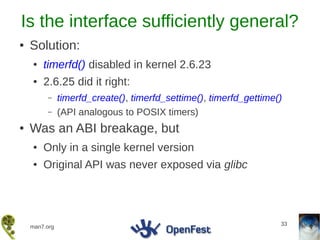
    Is the interfacesufficiently general? ● 2.6.22 added timerfd(ufd, flags, utimerspec) ● Create timer that notifies via a file descriptor ● But API didn't allow user to: ● Retrieve previous value when setting new timer value ● Do a “get” to retrieve time until next expiration – http://marc.info/?l=linux-kernel&m=118517213626087&w=2 – http://lwn.net/Articles/245533/ ● Older APIs ([gs]etitimer(), POSIX timers) did provide this functionality! 32 man7.org
  • 33.
    Is the interfacesufficiently general? ● Solution: ● timerfd() disabled in kernel 2.6.23 ● 2.6.25 did it right: – timerfd_create(), timerfd_settime(), timerfd_gettime() – (API analogous to POSIX timers) ● Was an ABI breakage, but ● Only in a single kernel version ● Original API was never exposed via glibc 33 man7.org
  • 34.
  • 35.
    Are we learningfrom past mistakes? ● Dnotify [2.4] ● Directory change notification API ● Many problems ● So, we added inotify [2.6.13] ● But, inotify still doesn't get it all right ● Now [2.6.37] we have yet another API, fanotify ● Designed for virus scanners ● Adds some functionality ● Doesn't provide all functionality of inotify ● Couldn't we have had a new API that did everything? 35 man7.org
  • 36.
  • 37.
    Is the interfaceextensible? ● Too often, an early API didn't allow for extensions ● Common solution is a new API, with a flags arg: ● umount() → umount2() [2.2] ● epoll_create() [2.6] → epoll_create2() [2.6.27] ● futimesat() [2.6.16] → epoll_create2() [2.6.22] ● signalfd() [2.6.22] → signalfd4() [2.6.27] ● When adding a new API, consider adding an (unused) flags argument to allow extensions 37 man7.org
  • 38.
    Futureproofing ● Suppose a syscall has a flags bit-mask arg. ● Implementation should always have check like: if (flags & ~(FL_X | FL_Y)) return -EINVAL; // Only allow caller to specify flags // bits that have a defined meaning ● Without this check, interface is “loose” 38 man7.org
  • 39.
    Futureproofing ● Suppose user makes a call of form: syscallxyz(-1); // flags has all bits set ● If implementer later adds FL_Z, an ABI breakage occurs for user's code ● Conversely: user has no way of checking if a kernel implements FL_Z ● Many system calls lack this kind of check! ● Linux 3.2 examples: sigaction(sa.sa_flags), recv(), send(), clock_nanosleep(), msgrcv(), msgget(), semget(), shmget(), shmat(), semop(sops.sem_flg) 39 man7.org
  • 40.
    Futureproofing ● Should checks be added after the fact? ● e.g., umount2() [2.2] added check in 2.6.34; timerfd_settime() [2.6.25] added check in 2.6.29 ● But adding check can also create ABI breakage ● Apps get errors where previously they did not ● Loose APIs allow the user to define interface ● Worst case: can't add new flags values to interface 40 man7.org
  • 41.
    Futureproofing failures ● 16 bits is enough for UIDs/GIDs... ● 2.4: 32-bit UIDs/GIDs ● 32 bits is enough for file offsets ● Okay, it was 1991, but Moore's law... ● 2.4: 64-bit file offsets ● So we have ● oldstat(), stat(), stat64() ● chown(), chown32() ● open(), open64() ● and so on 41 man7.org
  • 42.
  • 43.
    When good ideasgo astray ● Traditional UNIX gives root all privileges ● All or nothing is risky! ● Linux divides root privileges into separate pieces: ● CAP_AUDIT_CONTROL, CAP_AUDIT_WRITE, CAP_CHOWN, CAP_DAC_OVERRIDE, CAP_DAC_READ_SEARCH,  CAP_FOWNER, CAP_FSETID, CAP_IPC_LOCK, CAP_IPC_OWNER, CAP_KILL, CAP_LEASE,  CAP_LINUX_IMMUTABLE, CAP_MAC_ADMIN, CAP_MAC_OVERRIDE, CAP_MKNOD, CAP_NET_ADMIN,  CAP_NET_BIND_SERVICE, CAP_NET_BROADCAST, CAP_NET_RAW, CAP_SETFCAP, CAP_SETGID, CAP_SETPCAP,  CAP_SETUID, CAP_SYSLOG, CAP_SYS_ADMIN, CAP_SYS_BOOT, CAP_SYS_CHROOT, CAP_SYS_MODULE,  CAP_SYS_NICE, CAP_SYS_PACCT, CAP_SYS_PTRACE, CAP_SYS_RAWIO, CAP_SYS_RESOURCE, CAP_SYS_TIME,  CAP_SYS_TTY_CONFIG, CAP_WAKE_ALARM ● Great! But which capability do I use for my new feature? ● Hmmm, CAP_SYS_ADMIN looks good ● CAP_SYS_ADMIN, the new root, 231 uses in 3.2 43 man7.org
  • 44.
    Standards and portability
  • 45.
    Needlessly breaking portability ● sched_setscheduler() ● POSIX says: successful call must return previous policy ● Linux: successful call returns 0 ● No good reason for this inconsistency ● Developers must special case code for Linux 45 man7.org
  • 46.
  • 47.
    We're just traditionalists... ● These kinds of problems predate Linux: ● API of System V IPC is awful! ● Semantics of fcntl() locks when FD is closed render locks useless for libraries ● select() modifies FD sets in place, forcing reinitialization inside loops – poll() gets it right: uses separate input and output args ● and so on... 47 man7.org
  • 48.
  • 49.
    Why do theseAPI problems keep happening? ● Excessive focus on code as primary contribution of value for a software project ● Poor feedback loop between developers and users
  • 50.
    Myth 2 Code isalways the best way to contribute to Free Software
  • 51.
  • 52.
    “Show me thecode!” But anyone can write code, and if the design is good but the code is bad, the code can usually be fixed
  • 53.
    “Show me thecode!” Sometimes, other sentences are more appropriate, and encourage contributions that are as (or more) valuable
  • 54.
    “Show me theusers' requirements!”
  • 55.
    “Show me theusers' requirements” ● Does the API serve needs of multiple users, or is it just one developer scratching an itch? ● Beware of limited perspectives! ● Is the API designed for generality? ● Is the API extensible for possible future requirements? 55 man7.org
  • 56.
    “Show me thedesign specification / documentation!”
  • 57.
    “Show me thedesign spec. / documentation!” ● How do we know if implementation deviates from intention? ● What shall we code our tests against? ● Writing documentation turns out often to be a natural sanity check for design ● A decent man page suffices ● Many of the bugs mentioned earlier were found while writing man pages... ● It's all a question of when it's written... 57 man7.org
  • 58.
    “Show me thedesign review!”
  • 59.
    “Show me thedesign review!” ● Did other people actually review your design? ● Is the API: ● as simple as possible? ● easy to use / difficult to misuse? ● consistent with related/similar APIs? ● well integrated with existing APIs? ● as general as possible ● extensible? ● following standards, where relevant? ● at least as good as earlier APIs with similar functionality? ● maintainable? 59 man7.org
  • 60.
    “Show me thetests!”
  • 61.
    “Show me thetests!” ● Did you (the developer) write some tests? ● More importantly: did someone else write some tests? ● Do the tests cover all reasonable cases? ● Do you test for unreasonable cases? ● Do unexpected inputs generate suitable error returns? ● While writing tests, did you find the interface easy to use / difficult to misuse? (Did you consequently make some design changes?) ● What bugs did you discover during testing? 61 man7.org
  • 62.
    Finally... ● If you're a potential contributor, don't fall into the trap of believing that code is the only (or best) vehicle for contribution ● As a maintainer, are you letting your project down by failing to encourage these other types of contribution?
  • 63.
    Thanks! (slides up soon at http://man7.org/conf/) Michael Kerrisk Linux man-pages project mtk@man7.org mtk.manpages@gmail.com http://man7.org/ http://man7.org/linux/man-pages/ Mamaku (Black Tree Fern) image (c) Rob Suisted New Zealand Blue Penguin (Kororā) Image (c) livescience.com naturespic.com No Starch Press, 2010 http://man7.org/tlpi/