Linux System Programming1st Edition Robert Love
download
https://ebookbell.com/product/linux-system-programming-1st-
edition-robert-love-23142636
Explore and download more ebooks at ebookbell.com
2.
Here are somerecommended products that we believe you will be
interested in. You can click the link to download.
Linux System Programmingupdated For The 30 Linux Kernel 2nd Edition
2nd Edition Robert Love
https://ebookbell.com/product/linux-system-programmingupdated-for-
the-30-linux-kernel-2nd-edition-2nd-edition-robert-love-23137816
Linux System Programming Techniques Become A Proficient Linux System
Programmer Using Expert Recipes And Techniques 1st Edition Jackbenny
Persson
https://ebookbell.com/product/linux-system-programming-techniques-
become-a-proficient-linux-system-programmer-using-expert-recipes-and-
techniques-1st-edition-jackbenny-persson-26746788
Linux System Programming 1st Edition Robert Love
https://ebookbell.com/product/linux-system-programming-1st-edition-
robert-love-36252016
Linux System Programming Robert Love Love Robert
https://ebookbell.com/product/linux-system-programming-robert-love-
love-robert-11483566
3.
Linux System ProgrammingRobert Love
https://ebookbell.com/product/linux-system-programming-robert-
love-43040764
Linux System Programming Techniques Jackbenny Persson
https://ebookbell.com/product/linux-system-programming-techniques-
jackbenny-persson-33382176
Linux System Programming Robert Love
https://ebookbell.com/product/linux-system-programming-robert-
love-43039044
Linux System Programming Robert Love
https://ebookbell.com/product/linux-system-programming-robert-
love-193883574
Handson System Programming With Linux Explore Linux System Programming
Interfaces Theory And Practice Kaiwan N Billimoria
https://ebookbell.com/product/handson-system-programming-with-linux-
explore-linux-system-programming-interfaces-theory-and-practice-
kaiwan-n-billimoria-7350724
Other Linux resourcesfrom O’Reilly
Related titles Building Embedded Linux
Systems
Designing Embedded
Hardware
Linux Device Drivers
Linux Kernel in a Nutshell
Programming Embedded
Systems
Running Linux
Understanding Linux
Network Internals
Understanding the Linux
Kernel
Linux Books
Resource Center
linux.oreilly.com is a complete catalog of O’Reilly’s books on
Linux and Unix and related technologies, including sample
chapters and code examples.
ONLamp.com is the premier site for the open source web plat-
form: Linux, Apache, MySQL and either Perl, Python, or PHP.
Conferences O’Reilly brings diverse innovators together to nurture the ideas
that spark revolutionary industries. We specialize in document-
ing the latest tools and systems, translating the innovator’s
knowledge into useful skills for those in the trenches. Visit con-
ferences.oreilly.com for our upcoming events.
Safari Bookshelf (safari.oreilly.com) is the premier online refer-
ence library for programmers and IT professionals. Conduct
searches across more than 1,000 books. Subscribers can zero in
on answers to time-critical questions in a matter of seconds.
Read the books on your Bookshelf from cover to cover or sim-
ply flip to the page you need. Try it today for free.
viii | Tableof Contents
Advanced Signal Management 298
Sending a Signal with a Payload 305
Conclusion 306
10. Time . . . . . . . . . . . . . . . . . . . . . . . . . . . . . . . . . . . . . . . . . . . . . . . . . . . . . . . . . . . . 308
Time’s Data Structures 310
POSIX Clocks 313
Getting the Current Time of Day 315
Setting the Current Time of Day 318
Playing with Time 320
Tuning the System Clock 321
Sleeping and Waiting 324
Timers 330
Appendix. GCC Extensions to the C Language . . . . . . . . . . . . . . . . . . . . . . . . . . . . . 339
Bibliography . . . . . . . . . . . . . . . . . . . . . . . . . . . . . . . . . . . . . . . . . . . . . . . . . . . . . . . . . . . 351
Index . . . . . . . . . . . . . . . . . . . . . . . . . . . . . . . . . . . . . . . . . . . . . . . . . . . . . . . . . . . . . . . . . 355
15.
ix
Foreword
There is anold line that Linux kernel developers like to throw out when they are feel-
ing grumpy: “User space is just a test load for the kernel.”
By muttering this line, the kernel developers aim to wash their hands of all responsi-
bility for any failure to run user-space code as well as possible. As far as they’re
concerned, user-space developers should just go away and fix their own code, as any
problems are definitely not the kernel’s fault.
To prove that it usually is not the kernel that is at fault, one leading Linux kernel
developer has been giving a “Why User Space Sucks” talk to packed conference
rooms for more than three years now, pointing out real examples of horrible user-
space code that everyone relies on every day. Other kernel developers have created
tools that show how badly user-space programs are abusing the hardware and drain-
ing the batteries of unsuspecting laptops.
But while user-space code might be just a “test load” for kernel developers to scoff
at, it turns out that all of these kernel developers also depend on that user-space code
every day. If it weren’t present, all the kernel would be good for would be to print
out alternating ABABAB patterns on the screen.
Right now, Linux is the most flexible and powerful operating system that has ever
been created, running everything from the tiniest cell phones and embedded devices
to more than 70 percent of the world’s top 500 supercomputers. No other operating
system has ever been able to scale so well and meet the challenges of all of these dif-
ferent hardware types and environments.
And along with the kernel, code running in user space on Linux can also operate on
all of those platforms, providing the world with real applications and utilities people
rely on.
In this book, Robert Love has taken on the unenviable task of teaching the reader
about almost every system call on a Linux system. In so doing, he has produced a
tome that will allow you to fully understand how the Linux kernel works from a
user-space perspective, and also how to harness the power of this system.
16.
x | Foreword
Theinformation in this book will show you how to create code that will run on all of
the different Linux distributions and hardware types. It will allow you to understand
how Linux works and how to take advantage of its flexibility.
In the end, this book teaches you how to write code that doesn't suck, which is the
best thing of all.
—Greg Kroah-Hartman
17.
xi
Preface
This book isabout system programming—specifically, system programming on
Linux. System programming is the practice of writing system software, which is code
that lives at a low level, talking directly to the kernel and core system libraries. Put
another way, the topic of the book is Linux system calls and other low-level func-
tions, such as those defined by the C library.
While many books cover system programming for Unix systems, few tackle the sub-
ject with a focus solely on Linux, and fewer still (if any) address the very latest Linux
releases and advanced Linux-only interfaces. Moreover, this book benefits from a
special touch: I have written a lot of code for Linux, both for the kernel and for sys-
tem software built thereon. In fact, I have implemented some of the system calls and
other features covered in this book. Consequently, this book carries a lot of insider
knowledge, covering not just how the system interfaces should work, but how they
actually work, and how you (the programmer) can use them most efficiently. This
book, therefore, combines in a single work a tutorial on Linux system programming,
a reference manual covering the Linux system calls, and an insider’s guide to writing
smarter, faster code. The text is fun and accessible, and regardless of whether you
code at the system level on a daily basis, this book will teach you tricks that will
enable you to write better code.
Audience and Assumptions
The following pages assume that the reader is familiar with C programming and the
Linux programming environment—not necessarily well-versed in the subjects, but at
least acquainted with them. If you have not yet read any books on the C program-
ming language, such as the classic Brian W. Kernighan and Dennis M. Ritchie work
The C Programming Language (Prentice Hall; the book is familiarly known as K&R),
I highly recommend you check one out. If you are not comfortable with a Unix text
editor—Emacs and vim being the most common and highly regarded—start playing
18.
xii | Preface
withone. You’ll also want to be familiar with the basics of using gcc, gdb, make, and
so on. Plenty of other books on tools and practices for Linux programming are out
there; the bibliography at the end of this book lists several useful references.
I’ve made few assumptions about the reader’s knowledge of Unix or Linux system
programming. This book will start from the ground up, beginning with the basics,
and winding its way up to the most advanced interfaces and optimization tricks.
Readers of all levels, I hope, will find this work worthwhile and learn something
new. In the course of writing the book, I certainly did.
Nor do I make assumptions about the persuasion or motivation of the reader.
Engineers wishing to program (better) at a low level are obviously targeted, but
higher-level programmers looking for a stronger standing on the foundations on
which they rest will also find a lot to interest them. Simply curious hackers are also
welcome, for this book should satiate their hunger, too. Whatever readers want and
need, this book should cast a net wide enough—as least as far as Linux system pro-
gramming is concerned—to satisfy them.
Regardless of your motives, above all else, have fun.
Contents of This Book
This book is broken into 10 chapters, an appendix, and a bibliography.
Chapter 1, Introduction and Essential Concepts
This chapter serves as an introduction, providing an overview of Linux, system
programming, the kernel, the C library, and the C compiler. Even advanced
users should visit this chapter—trust me.
Chapter 2, File I/O
This chapter introduces files, the most important abstraction in the Unix envi-
ronment, and file I/O, the basis of the Linux programming mode. This chapter
covers reading from and writing to files, along with other basic file I/O operations.
The chapter culminates with a discussion on how the Linux kernel implements and
manages files.
Chapter 3, Buffered I/O
This chapter discusses an issue with the basic file I/O interfaces—buffer size
management—and introduces buffered I/O in general, and standard I/O in par-
ticular, as solutions.
Chapter 4, Advanced File I/O
This chapter completes the I/O troika with a treatment on advanced I/O inter-
faces, memory mappings, and optimization techniques. The chapter is capped with
a discussion on avoiding seeks, and the role of the Linux kernel’s I/O scheduler.
19.
Preface | xiii
Chapter5, Process Management
This chapter introduces Unix’s second most important abstraction, the process,
and the family of system calls for basic process management, including the ven-
erable fork.
Chapter 6, Advanced Process Management
This chapter continues the treatment with a discussion of advanced process
management, including real-time processes.
Chapter 7, File and Directory Management
This chapter discusses creating, moving, copying, deleting, and otherwise man-
aging files and directories.
Chapter 8, Memory Management
This chapter covers memory management. It begins by introducing Unix con-
cepts of memory, such as the process address space and the page, and continues
with a discussion of the interfaces for obtaining memory from and returning
memory to the kernel. The chapter concludes with a treatment on advanced
memory-related interfaces.
Chapter 9, Signals
This chapter covers signals. It begins with a discussion of signals and their role
on a Unix system. It then covers signal interfaces, starting with the basic, and
concluding with the advanced.
Chapter 10, Time
This chapter discusses time, sleeping, and clock management. It covers the basic
interfaces up through POSIX clocks and high-resolution timers.
Appendix, GCC Extensions to the C Language
The Appendix reviews many of the optimizations provided by gcc and GNU C,
such as attributes for marking a function constant, pure, and inline.
The book concludes with a bibliography of recommended reading, listing both use-
ful supplements to this work, and books that address prerequisite topics not covered
herein.
Versions Covered in This Book
The Linux system interface is definable as the application binary interface and appli-
cation programming interface provided by the triplet of the Linux kernel (the heart
of the operating system), the GNU C library (glibc), and the GNU C Compiler (gcc—
now formally called the GNU Compiler Collection, but we are concerned only with
C). This book covers the system interface defined by Linux kernel version 2.6.22,
glibc version 2.5, and gcc version 4.2. Interfaces in this book should be backward
compatible with older versions (excluding new interfaces), and forward compatible
to newer versions.
20.
xiv | Preface
Ifany evolving operating system is a moving target, Linux is a rabid cheetah.
Progress is measured in days, not years, and frequent releases of the kernel and other
components constantly morph the playing field. No book can hope to capture such a
dynamic beast in a timeless fashion.
Nonetheless, the programming environment defined by system programming is set in
stone. Kernel developers go to great pains not to break system calls, the glibc devel-
opers highly value forward and backward compatibility, and the Linux toolchain
generates compatible code across versions (particularly for the C language). Conse-
quently, while Linux may be constantly on the go, Linux system programming
remains stable, and a book based on a snapshot of the system, especially at this point
in Linux’s development, has immense staying power. What I am trying to say is sim-
ple: don’t worry about system interfaces changing, and buy this book!
Conventions Used in This Book
The following typographical conventions are used in this book:
Italic
Used for emphasis, new terms, URLs, foreign phrases, Unix commands and util-
ities, filenames, directory names, and pathnames.
Constant width
Indicates header files, variables, attributes, functions, types, parameters, objects,
macros, and other programming constructs.
Constant width italic
Indicates text (for example, a pathname component) to be replaced with a user-
supplied value.
This icon signifies a tip, suggestion, or general note.
Most of the code in this book is in the form of brief, but usable, code snippets. They
look like this:
while (1) {
int ret;
ret = fork ( );
if (ret == -1)
perror ("fork");
}
Great pains have been taken to provide code snippets that are concise but usable. No
special header files, full of crazy macros and illegible shortcuts, are required. Instead
of building a few gigantic programs, this book is filled with many simple examples.
21.
Preface | xv
Asthe examples are descriptive and fully usable, yet small and clear, I hope they will
provide a useful tutorial on the first read, and remain a good reference on subse-
quent passes.
Nearly all of the examples in this book are self-contained. This means you can easily
copy them into your text editor, and put them to actual use. Unless otherwise men-
tioned, all of the code snippets should build without any special compiler flags. (In a
few cases, you need to link with a special library.) I recommend the following com-
mand to compile a source file:
$ gcc -Wall -Wextra -O2 -g -o snippet snippet.c
This compiles the source file snippet.c into the executable binary snippet, enabling
many warning checks, significant but sane optimizations, and debugging. The code
in this book should compile using this command without errors or warnings—
although of course, you might have to build a skeleton program around the snippet
first.
When a section introduces a new function, it is in the usual Unix manpage format
with a special emphasized font, which looks like this:
#include <fcntl.h>
int posix_fadvise (int fd, off_t pos, off_t len, int advice);
The required headers, and any needed definitions, are at the top, followed by a full
prototype of the call.
Safari® Books Online
When you see a Safari® Books Online icon on the cover of your
favorite technology book, that means the book is available online
through the O’Reilly Network Safari Bookshelf.
Safari offers a solution that’s better than e-books. It’s a virtual library that lets you
easily search thousands of top tech books, cut and paste code samples, download
chapters, and find quick answers when you need the most accurate, current informa-
tion. Try it for free at http://safari.oreilly.com.
Using Code Examples
This book is here to help you get your job done. In general, you may use the code in
this book in your programs and documentation. You do not need to contact us for
permission unless you are reproducing a significant portion of the code. For exam-
ple, writing a program that uses several chunks of code from this book does not
require permission. Selling or distributing a CD-ROM of examples from O’Reilly
books does require permission. Answering a question by citing this book and quoting
22.
xvi | Preface
examplecode does not require permission. Incorporating a significant amount of
example code from this book into your product’s documentation does require
permission.
We appreciate attribution. An attribution usually includes the title, author, pub-
lisher, and ISBN. For example: “Linux System Programming by Robert Love. Copy-
right 2007 O’Reilly Media, Inc., 978-0-596-00958-8.”
If you believe that your use of code examples falls outside of fair use or the permis-
sion given above, feel free to contact us at permissions@oreilly.com.
How to Contact Us
Please address comments and questions concerning this book to the publisher:
O’Reilly Media, Inc.
1005 Gravenstein Highway North
Sebastopol, CA 95472
800-998-9938 (in the United States or Canada)
707-829-0515 (international or local)
707-829-0104 (fax)
We have a web page for this book, where we list errata, examples, and any addi-
tional information. You can access this page at this address:
http://www.oreilly.com/catalog/9780596009588/
To comment or ask technical questions about this book, you can send an email to
the following address:
bookquestions@oreilly.com
For more information about our books, conferences, Resource Centers, and the
O’Reilly Network, see our web site at this address:
http://www.oreilly.com
Acknowledgments
Many hearts and minds contributed to the completion of this manuscript. While no
list would be complete, it is my sincere pleasure to acknowledge the assistance and
friendship of individuals who provided encouragement, knowledge, and support
along the way.
Andy Oram is a phenomenal editor and human being. This effort would have been
impossible without his hard work. A rare breed, Andy couples deep technical knowl-
edge with a poetic command of the English language.
23.
Preface | xvii
BrianJepson served brilliantly as editor for a period, and his sterling efforts continue
to reverberate throughout this work as well.
This book was blessed with phenomenal technical reviewers, true masters of their
craft, without whom this work would pale in comparison to the final product you
now read. The technical reviewers were Robert Day, Jim Lieb, Chris Rivera, Joey
Shaw, and Alain Williams. Despite their toils, any errors remain my own.
Rachel Head performed flawlessly as copyeditor. In her aftermath, red ink decorated
my written word—readers will certainly appreciate her corrections.
For numerous reasons, thanks and respect to Paul Amici, Mikey Babbitt, Keith Bar-
bag, Jacob Berkman, Dave Camp, Chris DiBona, Larry Ewing, Nat Friedman, Albert
Gator, Dustin Hall, Joyce Hawkins, Miguel de Icaza, Jimmy Krehl, Greg Kroah-
Hartman, Doris Love, Jonathan Love, Linda Love, Tim O’Reilly, Aaron Matthews,
John McCain, Randy O’Dowd, Salvatore Ribaudo and family, Chris Rivera, Joey
Shaw, Sarah Stewart, Peter Teichman, Linus Torvalds, Jon Trowbridge, Jeremy Van-
Doren and family, Luis Villa, Steve Weisberg and family, and Helen Whisnant.
Final thanks to my parents, Bob and Elaine.
—Robert Love
Boston
25.
1
Chapter 1 CHAPTER1
Introduction and Essential
Concepts
This book is about system programming, which is the art of writing system software.
System software lives at a low level, interfacing directly with the kernel and core
system libraries. System software includes your shell and your text editor, your com-
piler and your debugger, your core utilities and system daemons. These components
are entirely system software, based on the kernel and the C library. Much other soft-
ware (such as high-level GUI applications) lives mostly in the higher levels, delving
into the low level only on occasion, if at all. Some programmers spend all day every
day writing system software; others spend only part of their time on this task. There
is no programmer, however, who does not benefit from some understanding of
system programming. Whether it is the programmer’s raison d’être, or merely a foun-
dation for higher-level concepts, system programming is at the heart of all software
that we write.
In particular, this book is about system programming on Linux. Linux is a modern
Unix-like system, written from scratch by Linus Torvalds, and a loose-knit commu-
nity of hackers around the globe. Although Linux shares the goals and ideology of
Unix, Linux is not Unix. Instead, Linux follows its own course, diverging where
desired, and converging only where practical. Generally, the core of Linux system
programming is the same as on any other Unix system. Beyond the basics, however,
Linux does well to differentiate itself—in comparison with traditional Unix systems,
Linux is rife with additional system calls, different behavior, and new features.
System Programming
Traditionally speaking, all Unix programming is system-level programming. Histori-
cally, Unix systems did not include many higher-level abstractions. Even programming
in a development environment such as the X Window System exposed in full view the
core Unix system API. Consequently, it can be said that this book is a book on Linux
26.
2 | Chapter1: Introduction and Essential Concepts
programming in general. But note that this book does not cover the Linux
programming environment—there is no tutorial on make in these pages. What is cov-
ered is the system programming API exposed on a modern Linux machine.
System programming is most commonly contrasted with application programming.
System-level and application-level programming differ in some aspects, but not in
others. System programming is distinct in that system programmers must have a
strong awareness of the hardware and operating system on which they are working.
Of course, there are also differences between the libraries used and calls made.
Depending on the “level” of the stack at which an application is written, the two may
not actually be very interchangeable, but, generally speaking, moving from applica-
tion programming to system programming (or vice versa) is not hard. Even when the
application lives very high up the stack, far from the lowest levels of the system,
knowledge of system programming is important. And the same good practices are
employed in all forms of programming.
The last several years have witnessed a trend in application programming away from
system-level programming and toward very high-level development, either through
web software (such as JavaScript or PHP), or through managed code (such as C# or
Java). This development, however, does not foretell the death of system program-
ming. Indeed, someone still has to write the JavaScript interpreter and the C#
runtime, which is itself system programming. Furthermore, the developers writing
PHP or Java can still benefit from knowledge of system programming, as an under-
standing of the core internals allows for better code no matter where in the stack the
code is written.
Despite this trend in application programming, the majority of Unix and Linux code
is still written at the system level. Much of it is C, and subsists primarily on interfaces
provided by the C library and the kernel. This is traditional system programming—
Apache, bash, cp, Emacs, init, gcc, gdb, glibc, ls, mv, vim, and X. These applications
are not going away anytime soon.
The umbrella of system programming often includes kernel development, or at least
device driver writing. But this book, like most texts on system programming, is
unconcerned with kernel development. Instead, it focuses on user-space system-level
programming; that is, everything above the kernel (although knowledge of kernel
internals is a useful adjunct to this text). Likewise, network programming—sockets
and such—is not covered in this book. Device driver writing and network program-
ming are large, expansive topics, best tackled in books dedicated to the subject.
What is the system-level interface, and how do I write system-level applications in
Linux? What exactly do the kernel and the C library provide? How do I write opti-
mal code, and what tricks does Linux provide? What neat system calls are provided
in Linux compared to other Unix variants? How does it all work? Those questions
are at the center of this book.
There are three cornerstones to system programming in Linux: system calls, the C
library, and the C compiler. Each deserves an introduction.
27.
System Programming |3
System Calls
System programming starts with system calls. System calls (often shorted to syscalls)
are function invocations made from user space—your text editor, favorite game, and so
on—into the kernel (the core internals of the system) in order to request some service
or resource from the operating system. System calls range from the familiar, such as
read() and write(), to the exotic, such as get_thread_area() and set_tid_address().
Linux implements far fewer system calls than most other operating system kernels.
For example, a count of the i386 architecture’s system calls comes in at around 300,
compared with the allegedly thousands of system calls on Microsoft Windows. In the
Linux kernel, each machine architecture (such as Alpha, i386, or PowerPC) imple-
ments its own list of available system calls. Consequently, the system calls available
on one architecture may differ from those available on another. Nonetheless, a very
large subset of system calls—more than 90 percent—is implemented by all architec-
tures. It is this shared subset, these common interfaces, that I cover in this book.
Invoking system calls
It is not possible to directly link user-space applications with kernel space. For rea-
sons of security and reliability, user-space applications must not be allowed to
directly execute kernel code or manipulate kernel data. Instead, the kernel must pro-
vide a mechanism by which a user-space application can “signal” the kernel that it
wishes to invoke a system call. The application can then trap into the kernel through
this well-defined mechanism, and execute only code that the kernel allows it to exe-
cute. The exact mechanism varies from architecture to architecture. On i386, for
example, a user-space application executes a software interrupt instruction, int, with
a value of 0x80. This instruction causes a switch into kernel space, the protected
realm of the kernel, where the kernel executes a software interrupt handler—and
what is the handler for interrupt 0x80? None other than the system call handler!
The application tells the kernel which system call to execute and with what parame-
ters via machine registers. System calls are denoted by number, starting at 0. On the
i386 architecture, to request system call 5 (which happens to be open( )), the user-
space application stuffs 5 in register eax before issuing the int instruction.
Parameter passing is handled in a similar manner. On i386, for example, a register is
used for each possible parameter—registers ebx, ecx, edx, esi, and edi contain, in
order, the first five parameters. In the rare event of a system call with more than five
parameters, a single register is used to point to a buffer in user space where all of the
parameters are kept. Of course, most system calls have only a couple of parameters.
Other architectures handle system call invocation differently, although the spirit is
the same. As a system programmer, you usually do not need any knowledge of how
the kernel handles system call invocation. That knowledge is encoded into the stan-
dard calling conventions for the architecture, and handled automatically by the
compiler and the C library.
28.
4 | Chapter1: Introduction and Essential Concepts
The C Library
The C library (libc) is at the heart of Unix applications. Even when you’re programming
in another language, the C library is most likely in play, wrapped by the higher-level
libraries, providing core services, and facilitating system call invocation. On modern
Linux systems, the C library is provided by GNU libc, abbreviated glibc, and pro-
nounced gee-lib-see or, less commonly, glib-see.
The GNU C library provides more than its name suggests. In addition to implement-
ing the standard C library, glibc provides wrappers for system calls, threading
support, and basic application facilities.
The C Compiler
In Linux, the standard C compiler is provided by the GNU Compiler Collection (gcc).
Originally, gcc was GNU’s version of cc, the C Compiler. Thus, gcc stood for GNU C
Compiler. Over time, support was added for more and more languages. Conse-
quently, nowadays gcc is used as the generic name for the family of GNU compilers.
However, gcc is also the binary used to invoke the C compiler. In this book, when I
talk of gcc, I typically mean the program gcc, unless context suggests otherwise.
The compiler used in a Unix system—Linux included—is highly relevant to system
programming, as the compiler helps implement the C standard (see “C Language
Standards”) and the system ABI (see “APIs and ABIs”), both later in this chapter.
APIs and ABIs
Programmers are naturally interested in ensuring their programs run on all of the sys-
tems that they have promised to support, now and in the future. They want to feel
secure that programs they write on their Linux distributions will run on other Linux
distributions, as well as on other supported Linux architectures and newer (or ear-
lier) Linux versions.
At the system level, there are two separate sets of definitions and descriptions that
impact portability. One is the application programming interface (API), and the other
is the application binary interface (ABI). Both define and describe the interfaces
between different pieces of computer software.
APIs
An API defines the interfaces by which one piece of software communicates with
another at the source level. It provides abstraction by providing a standard set of
interfaces—usually functions—that one piece of software (typically, although not
29.
APIs and ABIs| 5
necessarily, a higher-level piece) can invoke from another piece of software (usually a
lower-level piece). For example, an API might abstract the concept of drawing text
on the screen through a family of functions that provide everything needed to draw
the text. The API merely defines the interface; the piece of software that actually pro-
vides the API is known as the implementation of the API.
It is common to call an API a “contract.” This is not correct, at least in the legal sense
of the term, as an API is not a two-way agreement. The API user (generally, the
higher-level software) has zero input into the API and its implementation. It may use
the API as-is, or not use it at all: take it or leave it! The API acts only to ensure that if
both pieces of software follow the API, they are source compatible; that is, that the
user of the API will successfully compile against the implementation of the API.
A real-world example is the API defined by the C standard and implemented by the
standard C library. This API defines a family of basic and essential functions, such as
string-manipulation routines.
Throughout this book, we will rely on the existence of various APIs, such as the stan-
dard I/O library discussed in Chapter 3. The most important APIs in Linux system
programming are discussed in the section “Standards” later in this chapter.
ABIs
Whereas an API defines a source interface, an ABI defines the low-level binary inter-
face between two or more pieces of software on a particular architecture. It defines
how an application interacts with itself, how an application interacts with the kernel,
and how an application interacts with libraries. An ABI ensures binary compatibility,
guaranteeing that a piece of object code will function on any system with the same
ABI, without requiring recompilation.
ABIs are concerned with issues such as calling conventions, byte ordering, register
use, system call invocation, linking, library behavior, and the binary object format.
The calling convention, for example, defines how functions are invoked, how argu-
ments are passed to functions, which registers are preserved and which are mangled,
and how the caller retrieves the return value.
Although several attempts have been made at defining a single ABI for a given archi-
tecture across multiple operating systems (particularly for i386 on Unix systems), the
efforts have not met with much success. Instead, operating systems—Linux
included—tend to define their own ABIs however they see fit. The ABI is intimately
tied to the architecture; the vast majority of an ABI speaks of machine-specific
concepts, such as particular registers or assembly instructions. Thus, each machine
architecture has its own ABI on Linux. In fact, we tend to call a particular ABI by its
machine name, such as alpha, or x86-64.
30.
6 | Chapter1: Introduction and Essential Concepts
System programmers ought to be aware of the ABI,but usually do not need to
memorize it. The ABI is enforced by the toolchain—the compiler, the linker, and so
on—and does not typically otherwise surface. Knowledge of the ABI, however, can
lead to more optimal programming, and is required if writing assembly code or hack-
ing on the toolchain itself (which is, after all, system programming).
The ABI for a given architecture on Linux is available on the Internet and imple-
mented by that architecture’s toolchain and kernel.
Standards
Unix system programming is an old art. The basics of Unix programming have
existed untouched for decades. Unix systems, however, are dynamic beasts. Behav-
ior changes and features are added. To help bring order to chaos, standards groups
codify system interfaces into official standards. Numerous such standards exist, but
technically speaking, Linux does not officially comply with any of them. Instead,
Linux aims toward compliance with two of the most important and prevalent stan-
dards: POSIX and the Single UNIX Specification (SUS).
POSIX and SUS document, among other things, the C API for a Unix-like operating
system interface. Effectively, they define system programming, or at least a common
subset thereof, for compliant Unix systems.
POSIX and SUS History
In the mid-1980s, the Institute of Electrical and Electronics Engineers (IEEE) spear-
headed an effort to standardize system-level interfaces on Unix systems. Richard
Stallman, founder of the Free Software movement, suggested the standard be named
POSIX (pronounced pahz-icks), which now stands for Portable Operating System
Interface.
The first result of this effort, issued in 1988, was IEEE Std 1003.1-1988 (POSIX 1988,
for short). In 1990, the IEEE revised the POSIX standard with IEEE Std 1003.1-1990
(POSIX 1990). Optional real-time and threading support were documented in, respec-
tively, IEEE Std 1003.1b-1993 (POSIX 1993 or POSIX.1b), and IEEE Std 1003.1c-1995
(POSIX 1995 or POSIX.1c). In 2001, the optional standards were rolled together with
the base POSIX 1990, creating a single standard: IEEE Std 1003.1-2001 (POSIX 2001).
The latest revision, released in April 2004, is IEEE Std 1003.1-2004. All of the core
POSIX standards are abbreviated POSIX.1, with the 2004 revision being the latest.
In the late 1980s and early 1990s, Unix system vendors were engaged in the “Unix
Wars,” with each struggling to define its Unix variant as the Unix operating system.
Several major Unix vendors rallied around The Open Group, an industry consortium
31.
Standards | 7
formedfrom the merging of the Open Software Foundation (OSF) and X/Open. The
Open Group provides certification, white papers, and compliance testing. In the
early 1990s, with the Unix Wars raging, The Open Group released the Single UNIX
Specification. SUS rapidly grew in popularity, in large part due to its cost (free) ver-
sus the high cost of the POSIX standard. Today, SUS incorporates the latest POSIX
standard.
The first SUS was published in 1994. Systems compliant with SUSv1 are given the
mark UNIX 95. The second SUS was published in 1997, and compliant systems are
marked UNIX 98. The third and latest SUS, SUSv3, was published in 2002. Compli-
ant systems are given the mark UNIX 03. SUSv3 revises and combines IEEE Std
1003.1-2001 and several other standards. Throughout this book, I will mention
when system calls and other interfaces are standardized by POSIX. I mention POSIX
and not SUS because the latter subsumes the former.
C Language Standards
Dennis Ritchie and Brian Kernighan’s famed book, The C Programming Language
(Prentice Hall), acted as the informal C specification for many years following its
1978 publication. This version of C came to be known as K&R C. C was already
rapidly replacing BASIC and other languages as the lingua franca of microcomputer
programming. Therefore, to standardize the by then quite popular language, in 1983,
the American National Standards Institute (ANSI) formed a committee to develop an
official version of C, incorporating features and improvements from various vendors
and the new C++ language. The process was long and laborious, but ANSI C was
completed in 1989. In 1990, the International Organization for Standardization
(ISO) ratified ISO C90, based on ANSI C with a small handful of modifications.
In 1995, the ISO released an updated (although rarely implemented) version of the C
language, ISO C95. This was followed in 1999 with a large update to the language,
ISO C99, that introduced many new features, including inline functions, new data
types, variable-length arrays, C++-style comments, and new library functions.
Linux and the Standards
As stated earlier, Linux aims toward POSIX and SUS compliance. It provides the
interfaces documented in SUSv3 and POSIX.1, including the optional real-time
(POSIX.1b) and optional threading (POSIX.1c) support. More importantly, Linux
tries to provide behavior in line with POSIX and SUS requirements. In general, fail-
ing to agree with the standards is considered a bug. Linux is believed to comply with
POSIX.1 and SUSv3, but as no official POSIX or SUS certification has been per-
formed (particularly on each and every revision of Linux), I cannot say that Linux is
officially POSIX- or SUS-compliant.
32.
8 | Chapter1: Introduction and Essential Concepts
With respect to language standards, Linux fares well. The gcc C compiler supports
ISO C99. In addition, gcc provides many of its own extensions to the C language.
These extensions are collectively called GNU C, and are documented in the
Appendix.
Linux has not had a great history of forward compatibility,* although these days it
fares much better. Interfaces documented by standards, such as the standard C
library, will obviously always remain source compatible. Binary compatibility is
maintained across a given major version of glibc, at the very least. And as C is stan-
dardized, gcc will always compile legal C correctly, although gcc-specific extensions
may be deprecated and eventually removed with new gcc releases. Most importantly,
the Linux kernel guarantees the stability of system calls. Once a system call is imple-
mented in a stable version of the Linux kernel, it is set in stone.
Among the various Linux distributions, the Linux Standard Base (LSB) standardizes
much of the Linux system. The LSB is a joint project of several Linux vendors under
the auspices of the Linux Foundation (formerly the Free Standards Group). The LSB
extends POSIX and SUS, and adds several standards of its own; it attempts to provide
a binary standard, allowing object code to run unmodified on compliant systems.
Most Linux vendors comply with the LSB to some degree.
This Book and the Standards
This book deliberately avoids paying lip service to any of the standards. Far too
frequently, Unix system programming books must stop to elaborate on how an inter-
face behaves in one standard versus another, whether a given system call is
implemented on this system versus that, and similar page-filling bloat. This book,
however, is specifically about system programming on a modern Linux system, as
provided by the latest versions of the Linux kernel (2.6), gcc C compiler (4.2), and C
library (2.5).
As system interfaces are generally set in stone—the Linux kernel developers go to
great pains to never break the system call interfaces, for example—and provide some
level of both source and binary compatibility, this approach allows us to dive into
the details of Linux’s system interface unfettered by concerns of compatibility with
numerous other Unix systems and standards. This focus on Linux also enables this
book to offer in-depth treatment of cutting-edge Linux-specific interfaces that will
remain relevant and valid far into the future. The book draws upon an intimate
knowledge of Linux, and particularly of the implementation and behavior of compo-
nents such as gcc and the kernel, to provide an insider’s view, full of the best
practices and optimization tips of an experienced veteran.
* Experienced Linux users might remember the switch from a.out to ELF, the switch from libc5 to glibc, gcc
changes, and so on. Thankfully, those days are behind us.
33.
Concepts of LinuxProgramming | 9
Concepts of Linux Programming
This section presents a concise overview of the services provided by a Linux system.
All Unix systems, Linux included, provide a mutual set of abstractions and inter-
faces. Indeed, this commonality defines Unix. Abstractions such as the file and the
process, interfaces to manage pipes and sockets, and so on, are at the core of what is
Unix.
This overview assumes that you are familiar with the Linux environment: I presume
that you can get around in a shell, use basic commands, and compile a simple C pro-
gram. This is not an overview of Linux, or its programming environment, but rather
of the “stuff” that forms the basis of Linux system programming.
Files and the Filesystem
The file is the most basic and fundamental abstraction in Linux. Linux follows the
everything-is-a-file philosophy (although not as strictly as some other systems, such
as Plan9*). Consequently, much interaction transpires via reading of and writing to
files, even when the object in question is not what you would consider your every-
day file.
In order to be accessed, a file must first be opened. Files can be opened for reading,
writing, or both. An open file is referenced via a unique descriptor, a mapping from
the metadata associated with the open file back to the specific file itself. Inside the
Linux kernel, this descriptor is handled by an integer (of the C type int) called the
file descriptor, abbreviated fd. File descriptors are shared with user space, and are
used directly by user programs to access files. A large part of Linux system program-
ming consists of opening, manipulating, closing, and otherwise using file descriptors.
Regular files
What most of us call “files” are what Linux labels regular files. A regular file con-
tains bytes of data, organized into a linear array called a byte stream. In Linux, no
further organization or formatting is specified for a file. The bytes may have any val-
ues, and they may be organized within the file in any way. At the system level, Linux
does not enforce a structure upon files beyond the byte stream. Some operating sys-
tems, such as VMS, provide highly structured files, supporting concepts such as
records. Linux does not.
Any of the bytes within a file may be read from or written to. These operations start
at a specific byte, which is one’s conceptual “location” within the file. This location
is called the file position or file offset. The file position is an essential piece of the
* Plan9, an operating system born of Bell Labs, is often called the successor to Unix. It features several inno-
vative ideas, and is an adherent of the everything-is-a-file philosophy.
34.
10 | Chapter1: Introduction and Essential Concepts
metadata that the kernel associates with each open file. When a file is first opened, the
file position is zero. Usually, as bytes in the file are read from or written to, byte-by-byte,
the file position increases in kind. The file position may also be set manually to a given
value, even a value beyond the end of the file. Writing a byte to a file position beyond
the end of the file will cause the intervening bytes to be padded with zeros. While it
is possible to write bytes in this manner to a position beyond the end of the file, it is
not possible to write bytes to a position before the beginning of a file. Such a prac-
tice sounds nonsensical, and, indeed, would have little use. The file position starts at
zero; it cannot be negative. Writing a byte to the middle of a file overwrites the byte
previously located at that offset. Thus, it is not possible to expand a file by writing
into the middle of it. Most file writing occurs at the end of the file. The file posi-
tion’s maximum value is bounded only by the size of the C type used to store it,
which is 64-bits in contemporary Linux.
The size of a file is measured in bytes, and is called its length. The length, in other
words, is simply the number of bytes in the linear array that make up the file. A file’s
length can be changed via an operation called truncation. A file can be truncated to a
new size smaller than its original size, which results in bytes being removed from the
end of the file. Confusingly, given the operation’s name, a file can also be “trun-
cated” to a new size larger than its original size. In that case, the new bytes (which
are added to the end of the file) are filled with zeros. A file may be empty (have a
length of zero), and thus contain no valid bytes. The maximum file length, as with
the maximum file position, is bounded only by limits on the sizes of the C types that
the Linux kernel uses to manage files. Specific filesystems, however, may impose
their own restrictions, bringing the maximum length down to a smaller value.
A single file can be opened more than once, by a different or even the same process.
Each open instance of a file is given a unique file descriptor; processes can share their
file descriptors, allowing a single descriptor to be used by more than one process.
The kernel does not impose any restrictions on concurrent file access. Multiple pro-
cesses are free to read from and write to the same file at the same time. The results of
such concurrent accesses rely on the ordering of the individual operations, and are
generally unpredictable. User-space programs typically must coordinate amongst
themselves to ensure that concurrent file accesses are sufficiently synchronized.
Although files are usually accessed via filenames, they actually are not directly associ-
ated with such names. Instead, a file is referenced by an inode (originally information
node), which is assigned a unique numerical value. This value is called the inode
number, often abbreviated as i-number or ino. An inode stores metadata associated
with a file, such as its modification timestamp, owner, type, length, and the location
of the file’s data—but no filename! The inode is both a physical object, located on
disk in Unix-style filesystems, and a conceptual entity, represented by a data struc-
ture in the Linux kernel.
35.
Concepts of LinuxProgramming | 11
Directories and links
Accessing a file via its inode number is cumbersome (and also a potential security
hole), so files are always opened from user space by a name, not an inode number.
Directories are used to provide the names with which to access files. A directory acts
as a mapping of human-readable names to inode numbers. A name and inode pair is
called a link. The physical on-disk form of this mapping—a simple table, a hash, or
whatever—is implemented and managed by the kernel code that supports a given
filesystem. Conceptually, a directory is viewed like any normal file, with the differ-
ence that it contains only a mapping of names to inodes. The kernel directly uses this
mapping to perform name-to-inode resolutions.
When a user-space application requests that a given filename be opened, the kernel
opens the directory containing the filename and searches for the given name. From
the filename, the kernel obtains the inode number. From the inode number, the
inode is found. The inode contains metadata associated with the file, including the
on-disk location of the file’s data.
Initially, there is only one directory on the disk, the root directory. This directory is
usually denoted by the path /. But, as we all know, there are typically many directo-
ries on a system. How does the kernel know which directory to look in to find a given
filename?
As mentioned previously, directories are much like regular files. Indeed, they even have
associated inodes. Consequently, the links inside of directories can point to the inodes
of other directories. This means directories can nest inside of other directories, form-
ing a hierarchy of directories. This, in turn, allows for the use of the pathnames with
which all Unix users are familiar—for example, /home/blackbeard/landscaping.txt.
When the kernel is asked to open a pathname like this, it walks each directory entry
(called a dentry inside of the kernel) in the pathname to find the inode of the next
entry. In the preceding example, the kernel starts at /, gets the inode for home, goes
there, gets the inode for blackbeard, runs there, and finally gets the inode for
landscaping.txt. This operation is called directory or pathname resolution. The Linux
kernel also employs a cache, called the dentry cache, to store the results of directory
resolutions, providing for speedier lookups in the future given temporal locality.*
A pathname that starts at the root directory is said to be fully qualified, and is called
an absolute pathname. Some pathnames are not fully qualified; instead, they are pro-
vided relative to some other directory (for example, todo/plunder). These paths are
called relative pathnames. When provided with a relative pathname, the kernel
begins the pathname resolution in the current working directory. From the current
working directory, the kernel looks up the directory todo. From there, the kernel gets
the inode for plunder.
* Temporal locality is the high likelihood of an access to a particular resource being followed by another access
to the same resource. Many resources on a computer exhibit temporal locality.
36.
12 | Chapter1: Introduction and Essential Concepts
Although directories are treated like normal files, the kernel does not allow them to
be opened and manipulated like regular files. Instead, they must be manipulated
using a special set of system calls. These system calls allow for the adding and remov-
ing of links, which are the only two sensible operations anyhow. If user space were
allowed to manipulate directories without the kernel’s mediation, it would be too
easy for a single simple error to wreck the filesystem.
Hard links
Conceptually, nothing covered thus far would prevent multiple names resolving to
the same inode. Indeed, this is allowed. When multiple links map different names to
the same inode, we call them hard links.
Hard links allow for complex filesystem structures with multiple pathnames point-
ing to the same data. The hard links can be in the same directory, or in two or more
different directories. In either case, the kernel simply resolves the pathname to the
correct inode. For example, a specific inode that points to a specific chunk of data
can be hard linked from /home/bluebeard/map.txt and /home/blackbeard/treasure.txt.
Deleting a file involves unlinking it from the directory structure, which is done sim-
ply by removing its name and inode pair from a directory. Because Linux supports
hard links, however, the filesystem cannot destroy the inode and its associated data
on every unlink operation. What if another hard link existed elsewhere in the filesys-
tem? To ensure that a file is not destroyed until all links to it are removed, each inode
contains a link count that keeps track of the number of links within the filesystem
that point to it. When a pathname is unlinked, the link count is decremented by one;
only when it reaches zero are the inode and its associated data actually removed from
the filesystem.
Symbolic links
Hard links cannot span filesystems because an inode number is meaningless outside
of the inode’s own filesystem. To allow links that can span filesystems, and that are a
bit simpler and less transparent, Unix systems also implement symbolic links (often
shortened to symlinks).
Symbolic links look like regular files. A symlink has its own inode and data chunk,
which contains the complete pathname of the linked-to file. This means symbolic
links can point anywhere, including to files and directories that reside on different
filesystems, and even to files and directories that do not exist. A symbolic link that
points to a nonexistent file is called a broken link.
Symbolic links incur more overhead than hard links because resolving a symbolic
link effectively involves resolving two files: the symbolic link, and then the linked-to
file. Hard links do not incur this additional overhead—there is no difference between
accessing a file linked into the filesystem more than once, and one linked only once.
The overhead of symbolic links is minimal, but it is still considered a negative.
37.
Concepts of LinuxProgramming | 13
Symbolic links are also less transparent than hard links. Using hard links is entirely
transparent; in fact, it takes effort to find out that a file is linked more than once!
Manipulating symbolic links, on the other hand, requires special system calls. This
lack of transparency is often considered a positive, with symbolic links acting more
as shortcuts than as filesystem-internal links.
Special files
Special files are kernel objects that are represented as files. Over the years, Unix sys-
tems have supported a handful of different special files. Linux supports four: block
device files, character device files, named pipes, and Unix domain sockets. Special
files are a way to let certain abstractions fit into the filesystem, partaking in the every-
thing-is-a-file paradigm. Linux provides a system call to create a special file.
Device access in Unix systems is performed via device files, which act and look like
normal files residing on the filesystem. Device files may be opened, read from, and
written to, allowing user space to access and manipulate devices (both physical and
virtual) on the system. Unix devices are generally broken into two groups: character
devices and block devices. Each type of device has its own special device file.
A character device is accessed as a linear queue of bytes. The device driver places
bytes onto the queue, one by one, and user space reads the bytes in the order that
they were placed on the queue. A keyboard is an example of a character device. If the
user types “peg,” for example, an application would want to read from the keyboard
device the p, the e, and, finally, the g. When there are no more characters left to read,
the device returns end-of-file (EOF). Missing a character, or reading them in any
other order, would make little sense. Character devices are accessed via character
device files.
A block device, in contrast, is accessed as an array of bytes. The device driver maps
the bytes over a seekable device, and user space is free to access any valid bytes in the
array, in any order—it might read byte 12, then byte 7, and then byte 12 again. Block
devices are generally storage devices. Hard disks, floppy drives, CD-ROM drives, and
flash memory are all examples of block devices. They are accessed via block device
files.
Named pipes (often called FIFOs, short for “first in, first out”) are an interprocess
communication (IPC) mechanism that provides a communication channel over a file
descriptor, accessed via a special file. Regular pipes are the method used to “pipe”
the output of one program into the input of another; they are created in memory via
a system call, and do not exist on any filesystem. Named pipes act like regular pipes,
but are accessed via a file, called a FIFO special file. Unrelated processes can access
this file and communicate.
Sockets are the final type of special file. Sockets are an advanced form of IPC that
allow for communication between two different processes, not only on the same
machine, but on two different machines. In fact, sockets form the basis of network
38.
14 | Chapter1: Introduction and Essential Concepts
and Internet programming. They come in multiple varieties, including the Unix
domain socket, which is the form of socket used for communication within the local
machine. Whereas sockets communicating over the Internet might use a hostname
and port pair for identifying the target of communication, Unix domain sockets use a
special file residing on a filesystem, often simply called a socket file.
Filesystems and namespaces
Linux, like all Unix systems, provides a global and unified namespace of files and
directories. Some operating systems separate different disks and drives into sepa-
rate namespaces—for example, a file on a floppy disk might be accessible via the
pathname A:plank.jpg, while the hard drive is located at C:. In Unix, that same file
on a floppy might be accessible via the pathname /media/floppy/plank.jpg, or even
via /home/captain/stuff/plank.jpg, right alongside files from other media. That is, on
Unix, the namespace is unified.
A filesystem is a collection of files and directories in a formal and valid hierarchy.
Filesystems may be individually added to and removed from the global namespace of
files and directories. These operations are called mounting and unmounting. Each file-
system is mounted to a specific location in the namespace, known as a mount point.
The root directory of the filesystem is then accessible at this mount point. For exam-
ple, a CD might be mounted at /media/cdrom, making the root of the filesystem on
the CD accessible at that mount point. The first filesystem mounted is located in the
root of the namespace, /, and is called the root filesystem. Linux systems always have
a root filesystem. Mounting other filesystems at other mount points is optional.
Filesystems usually exist physically (i.e., are stored on disk), although Linux also
supports virtual filesystems that exist only in memory, and network filesystems that
exist on machines across the network. Physical filesystems reside on block storage
devices, such as CDs, floppy disks, compact flash cards, or hard drives. Some such
devices are partionable, which means that they can be divided up into multiple file-
systems, all of which can be manipulated individually. Linux supports a wide range
of filesystems—certainly anything that the average user might hope to come across—
including media-specific filesystems (for example, ISO9660), network filesystems
(NFS), native filesystems (ext3), filesystems from other Unix systems (XFS), and even
filesystems from non-Unix systems (FAT).
The smallest addressable unit on a block device is the sector. The sector is a physical
quality of the device. Sectors come in various powers of two, with 512 bytes being
quite common. A block device cannot transfer or access a unit of data smaller than a
sector; all I/O occurs in terms of one or more sectors.
39.
Concepts of LinuxProgramming | 15
Likewise, the smallest logically addressable unit on a filesystem is the block. The
block is an abstraction of the filesystem, not of the physical media on which the file-
system resides. A block is usually a power-of-two multiple of the sector size. Blocks
are generally larger than the sector, but they must be smaller than the page size* (the
smallest unit addressable by the memory management unit, a hardware component).
Common block sizes are 512 bytes, 1 kilobyte, and 4 kilobytes.
Historically, Unix systems have only a single shared namespace, viewable by all users
and all processes on the system. Linux takes an innovative approach, and supports
per-process namespaces, allowing each process to optionally have a unique view of
the system’s file and directory hierarchy.† By default, each process inherits the
namespace of its parent, but a process may elect to create its own namespace with its
own set of mount points, and a unique root directory.
Processes
If files are the most fundamental abstraction in a Unix system, processes are the sec-
ond most fundamental. Processes are object code in execution: active, alive, running
programs. But they’re more than just object code—processes consist of data,
resources, state, and a virtualized computer.
Processes begin life as executable object code, which is machine-runnable code in an
executable format that the kernel understands (the format most common in Linux is
ELF). The executable format contains metadata, and multiple sections of code and
data. Sections are linear chunks of the object code that load into linear chunks of
memory. All bytes in a section are treated the same, given the same permissions, and
generally used for similar purposes.
The most important and common sections are the text section, the data section, and
the bss section. The text section contains executable code and read-only data, such as
constant variables, and is typically marked read-only and executable. The data
section contains initialized data, such as C variables with defined values, and is typi-
cally marked readable and writable. The bss section contains uninitialized global
data. Because the C standard dictates default values for C variables that are essen-
tially all zeros, there is no need to store the zeros in the object code on disk. Instead,
the object code can simply list the uninitialized variables in the bss section, and the
kernel can map the zero page (a page of all zeros) over the section when it is loaded
into memory. The bss section was conceived solely as an optimization for this pur-
pose. The name is a historic relic; it stands for block started by symbol, or block storage
segment. Other common sections in ELF executables are the absolute section (which
contains nonrelocatable symbols) and the undefined section (a catchall).
* This is an artificial kernel limitation, in the name of simplicity, that may go away in the future.
† This approach was first pioneered by Bell Labs’ Plan9.
40.
16 | Chapter1: Introduction and Essential Concepts
A process is also associated with various system resources, which are arbitrated and
managed by the kernel. Processes typically request and manipulate resources only
through system calls. Resources include timers, pending signals, open files, network
connections, hardware, and IPC mechanisms. A process’ resources, along with data
and statistics related to the process, are stored inside the kernel in the process’
process descriptor.
A process is a virtualization abstraction. The Linux kernel, supporting both preemp-
tive multitasking and virtual memory, provides a process both a virtualized processor,
and a virtualized view of memory. From the process’ perspective, the view of the sys-
tem is as though it alone were in control. That is, even though a given process may be
scheduled alongside many other processes, it runs as though it has sole control of the
system. The kernel seamlessly and transparently preempts and reschedules pro-
cesses, sharing the system’s processors among all running processes. Processes never
know the difference. Similarly, each process is afforded a single linear address space,
as if it alone were in control of all of the memory in the system. Through virtual
memory and paging, the kernel allows many processes to coexist on the system, each
operating in a different address space. The kernel manages this virtualization through
hardware support provided by modern processors, allowing the operating system to
concurrently manage the state of multiple independent processes.
Threads
Each process consists of one or more threads of execution (usually just called
threads). A thread is the unit of activity within a process, the abstraction responsible
for executing code, and maintaining the process’ running state.
Most processes consist of only a single thread; they are called single-threaded. Pro-
cesses that contain multiple threads are said to be multithreaded. Traditionally, Unix
programs have been single-threaded, owing to Unix’s historic simplicity, fast process
creation times, and robust IPC mechanisms, all of which mitigate the desire for
threads.
A thread consists of a stack (which stores its local variables, just as the process stack
does on nonthreaded systems), processor state, and a current location in the object
code (usually stored in the processor’s instruction pointer). The majority of the
remaining parts of a process are shared among all threads.
Internally, the Linux kernel implements a unique view of threads: they are simply
normal processes that happen to share some resources (most notably, an address
space). In user space, Linux implements threads in accordance with POSIX 1003.1c
(known as pthreads). The name of the current Linux thread implementation, which
is part of glibc, is the Native POSIX Threading Library (NPTL).
Process hierarchy
Each process is identified by a unique positive integer called the process ID (pid). The
pid of the first process is 1, and each subsequent process receives a new, unique pid.
41.
Concepts of LinuxProgramming | 17
In Linux, processes form a strict hierarchy, known as the process tree. The process
tree is rooted at the first process, known as the init process, which is typically the
init(8) program. New processes are created via the fork( ) system call. This system
call creates a duplicate of the calling process. The original process is called the par-
ent; the new process is called the child. Every process except the first has a parent. If
a parent process terminates before its child, the kernel will reparent the child to the
init process.
When a process terminates, it is not immediately removed from the system. Instead,
the kernel keeps parts of the process resident in memory, to allow the process’ parent
to inquire about its status upon terminating. This is known as waiting on the termi-
nated process. Once the parent process has waited on its terminated child, the child
is fully destroyed. A process that has terminated, but not yet been waited upon, is
called a zombie. The init process routinely waits on all of its children, ensuring that
reparented processes do not remain zombies forever.
Users and Groups
Authorization in Linux is provided by users and groups. Each user is associated with
a unique positive integer called the user ID (uid). Each process is in turn associated
with exactly one uid, which identifies the user running the process, and is called the
process’ real uid. Inside the Linux kernel, the uid is the only concept of a user. Users
themselves, however, refer to themselves and other users through usernames, not
numerical values. Usernames and their corresponding uids are stored in /etc/passwd,
and library routines map user-supplied usernames to the corresponding uids.
During login, the user provides a username and password to the login(1) program. If
given a valid username and the correct password, the login(1) program spawns the
user’s login shell, which is also specified in /etc/passwd, and makes the shell’s uid
equal to that of the user. Child processes inherit the uids of their parents.
The uid 0 is associated with a special user known as root. The root user has special
privileges, and can do almost anything on the system. For example, only the root
user can change a process’ uid. Consequently, the login(1) program runs as root.
In addition to the real uid, each process also has an effective uid, a saved uid, and a
filesystem uid. While the real uid is always that of the user who started the process,
the effective uid may change under various rules to allow a process to execute with
the rights of different users. The saved uid stores the original effective uid; its value is
used in deciding what effective uid values the user may switch to. The filesystem uid,
which is usually equal to the effective uid, is used for verifying filesystem access.
Each user may belong to one or more groups, including a primary or login group, listed
in /etc/passwd, and possibly a number of supplemental groups, listed in /etc/group. Each
process is therefore also associated with a corresponding group ID (gid), and has a real
gid, an effective gid, a saved gid, and a filesystem gid. Processes are generally associated
with a user’s login group, not any of the supplemental groups.
42.
18 | Chapter1: Introduction and Essential Concepts
Certain security checks allow processes to perform certain operations only if they
meet specific criteria. Historically, Unix has made this decision very black-and-white:
processes with uid 0 had access, while no others did. Recently, Linux has replaced
this security system with a more general capabilities system. Instead of a simple
binary check, capabilities allow the kernel to base access on much more fine-grained
settings.
Permissions
The standard file permission and security mechanism in Linux is the same as that in
historic Unix.
Each file is associated with an owning user, an owning group, and a set of permis-
sion bits. The bits describe the ability of the owning user, the owning group, and
everybody else to read, write, and execute the file; there are three bits for each of the
three classes, making nine bits in total. The owners and the permissions are stored in
the file’s inode.
For regular files, the permissions are rather obvious: they specify the ability to open a
file for reading, open a file for writing, or execute a file. Read and write permissions
are the same for special files as for regular files, although what exactly is read or writ-
ten is up to the special file in question. Execute permissions are ignored on special
files. For directories, read permission allows the contents of the directory to be listed,
write permission allows new links to be added inside the directory, and execute per-
mission allows the directory to be entered and used in a pathname. Table 1-1 lists each
of the nine permission bits, their octal values (a popular way of representing the nine
bits), their text values (as ls might show them), and their corresponding meanings.
In addition to historic Unix permissions, Linux also supports access control lists
(ACLs). ACLs allow for much more detailed and exacting permission and security
controls, at the cost of increased complexity and on-disk storage.
Table 1-1. Permission bits and their values
Bit Octal value Text value Corresponding permission
8 400 r-------- Owner may read
7 200 -w------- Owner may write
6 100 --x------ Owner may execute
5 040 ---r----- Group may read
4 020 ----w---- Group may write
3 010 -----x--- Group may execute
2 004 ------r-- Everyone else may read
1 002 -------w- Everyone else may write
0 001 --------x Everyone else may execute
43.
Concepts of LinuxProgramming | 19
Signals
Signals are a mechanism for one-way asynchronous notifications. A signal may be
sent from the kernel to a process, from a process to another process, or from a pro-
cess to itself. Signals typically alert a process to some event, such as a segmentation
fault, or the user pressing Ctrl-C.
The Linux kernel implements about 30 signals (the exact number is architecture-
dependent). Each signal is represented by a numeric constant and a textual name.
For example, SIGHUP, used to signal that a terminal hangup has occurred, has a value
of 1 on the i386 architecture.
With the exception of SIGKILL (which always terminates the process), and SIGSTOP
(which always stops the process), processes may control what happens when they
receive a signal. They can accept the default action, which may be to terminate the
process, terminate and coredump the process, stop the process, or do nothing,
depending on the signal. Alternatively, processes can elect to explicitly ignore or
handle signals. Ignored signals are silently dropped. Handled signals cause the execu-
tion of a user-supplied signal handler function. The program jumps to this function
as soon as the signal is received, and (when the signal handler returns) the control of
the program resumes at the previously interrupted instruction.
Interprocess Communication
Allowing processes to exchange information and notify each other of events is one of
an operating system’s most important jobs. The Linux kernel implements most of
the historic Unix IPC mechanisms—including those defined and standardized by
both System V and POSIX—as well as implementing a mechanism or two of its own.
IPC mechanisms supported by Linux include pipes, named pipes, semaphores, mes-
sage queues, shared memory, and futexes.
Headers
Linux system programming revolves around a handful of headers. Both the kernel
itself and glibc provide the headers used in system-level programming. These headers
include the standard C fare (for example, <string.h>), and the usual Unix offerings
(say, <unistd.h>).
Error Handling
It goes without saying that checking for and handling errors are of paramount impor-
tance. In system programming, an error is signified via a function’s return value, and
described via a special variable, errno. glibc transparently provides errno support for
both library and system calls. The vast majority of interfaces covered in this book
will use this mechanism to communicate errors.
44.
20 | Chapter1: Introduction and Essential Concepts
Functions notify the caller of errors via a special return value, which is usually -1
(the exact value used depends on the function). The error value alerts the caller to
the occurrence of an error, but provides no insight into why the error occurred. The
errno variable is used to find the cause of the error.
This variable is defined in <errno.h> as follows:
extern int errno;
Its value is valid only immediately after an errno-setting function indicates an error
(usually by returning -1), as it is legal for the variable to be modified during the suc-
cessful execution of a function.
The errno variable may be read or written directly; it is a modifiable lvalue. The
value of errno maps to the textual description of a specific error. A preprocessor
#define also maps to the numeric errno value. For example, the preprocessor define
EACCESS equals 1, and represents “permission denied.” See Table 1-2 for a listing of
the standard defines and the matching error descriptions.
Table 1-2. Errors and their descriptions
Preprocessor define Description
E2BIG Argument list too long
EACCESS Permission denied
EAGAIN Try again
EBADF Bad file number
EBUSY Device or resource busy
ECHILD No child processes
EDOM Math argument outside of domain of function
EEXIT File already exists
EFAULT Bad address
EFBIG File too large
EINTR System call was interrupted
EINVAL Invalid argument
EIO I/O error
EISDIR Is a directory
EMFILE Too many open files
EMLINK Too many links
ENFILE File table overflow
ENODEV No such device
ENOENT No such file or directory
ENOEXEC Exec format error
ENOMEM Out of memory
ENOSPC No space left on device
45.
Concepts of LinuxProgramming | 21
The C library provides a handful of functions for translating an errno value to the
corresponding textual representation. This is needed only for error reporting, and the
like; checking and handling errors can be done using the preprocessor defines and
errno directly.
The first such function is perror( ):
#include <stdio.h>
void perror (const char *str);
This function prints to stderr (standard error) the string representation of the current
error described by errno, prefixed by the string pointed at by str, followed by a
colon. To be useful, the name of the function that failed should be included in the
string. For example:
if (close (fd) == -1)
perror ("close");
The C library also provides strerror( ) and strerror_r( ), prototyped as:
#include <string.h>
char * strerror (int errnum);
and:
#include <string.h>
int strerror_r (int errnum, char *buf, size_t len);
The former function returns a pointer to a string describing the error given by errnum.
The string may not be modified by the application, but can be modified by subse-
quent perror( ) and strerror( ) calls. In this manner, it is not thread-safe.
ENOTDIR Not a directory
ENOTTY Inappropriate I/O control operation
ENXIO No such device or address
EPERM Operation not permitted
EPIPE Broken pipe
ERANGE Result too large
EROFS Read-only filesystem
ESPIPE Invalid seek
ESRCH No such process
ETXTBSY Text file busy
EXDEV Improper link
Table 1-2. Errors and their descriptions (continued)
Preprocessor define Description
46.
22 | Chapter1: Introduction and Essential Concepts
The strerror_r( ) function is thread-safe. It fills the buffer of length len pointed at
by buf. A call to strerror_r( ) returns 0 on success, and -1 on failure. Humorously, it
sets errno on error.
For a few functions, the entire range of the return type is a legal return value. In
those cases, errno must be zeroed before invocation, and checked afterward (these
functions promise to only return a nonzero errno on actual error). For example:
errno = 0;
arg = strtoul (buf, NULL, 0);
if (errno)
perror ("strtoul");
A common mistake in checking errno is to forget that any library or system call can
modify it. For example, this code is buggy:
if (fsync (fd) == -1) {
fprintf (stderr, "fsync failed!n");
if (errno == EIO)
fprintf (stderr, "I/O error on %d!n", fd);
}
If you need to preserve the value of errno across function invocations, save it:
if (fsync (fd) == -1) {
int err = errno;
fprintf (stderr, "fsync failed: %sn", strerror (errno));
if (err == EIO) {
/* if the error is I/O-related, jump ship */
fprintf (stderr, "I/O error on %d!n", fd);
exit (EXIT_FAILURE);
}
}
In single-threaded programs, errno is a global variable, as shown earlier in this sec-
tion. In multithreaded programs, however, errno is stored per-thread, and is thus
thread-safe.
Getting Started with System Programming
This chapter looked at the fundamentals of Linux system programming and pro-
vided a programmer’s overview of the Linux system. The next chapter discusses
basic file I/O. This includes, of course, reading from and writing to files; however,
because Linux implements many interfaces as files, file I/O is crucial to a lot more
than just, well, files.
With the preliminaries behind us, growing smaller on the horizon, it’s time to dive
into actual system programming. Let’s go!
47.
23
Chapter 2 CHAPTER2
File I/O
This chapter covers the basics of reading to and writing from files. Such operations
form the core of a Unix system. The next chapter covers standard I/O from the stan-
dard C library, and Chapter 4 continues the coverage with a treatment of the more
advanced and specialized file I/O interfaces. Chapter 7 rounds out the discussion by
addressing the topic of file and directory manipulation.
Before a file can be read from or written to, it must be opened. The kernel maintains
a per-process list of open files, called the file table. This table is indexed via nonnega-
tive integers known as file descriptors (often abbreviated fds). Each entry in the list
contains information about an open file, including a pointer to an in-memory copy of
the file’s backing inode and associated metadata, such as the file position and access
modes. Both user space and kernel space use file descriptors as unique per-process
cookies. Opening a file returns a file descriptor, while subsequent operations (read-
ing, writing, and so on) take the file descriptor as their primary argument.
By default, a child process receives a copy of its parent’s file table. The list of open
files and their access modes, current file positions, and so on, are the same, but a
change in one process—say, the child closing a file—does not affect the other pro-
cess’ file table. However, as you’ll see in Chapter 5, it is possible for the child and
parent to share the parent’s file table (as threads do).
File descriptors are represented by the C int type. Not using a special type—an fd_t,
say—is often considered odd, but is, historically, the Unix way. Each Linux process
has a maximum number of files that it may open. File descriptors start at 0, and go
up to one less than this maximum value. By default, the maximum is 1,024, but it
can be configured as high as 1,048,576. Because negative values are not legal file
descriptors, –1 is often used to indicate an error from a function that would other-
wise return a valid file descriptor.
Unless the process explicitly closes them, every process by convention has at least
three file descriptors open: 0, 1, and 2. File descriptor 0 is standard in (stdin), file
descriptor 1 is standard out (stdout), and file descriptor 2 is standard error (stderr).
48.
24 | Chapter2: File I/O
Instead of referencing these integers directly, the C library provides the preprocessor
defines STDIN_FILENO, STDOUT_FILENO, and STDERR_FILENO.
Note that file descriptors can reference more than just regular files. They are used for
accessing device files and pipes, directories and futexes, FIFOs, and sockets—follow-
ing the everything-is-a-file philosophy, just about anything you can read or write is
accessible via a file descriptor.
Opening Files
The most basic method of accessing a file is via the read( ) and write( ) system calls.
Before a file can be accessed, however, it must be opened via an open( ) or creat( )
system call. Once done using the file, it should be closed using the system call close().
The open( ) System Call
A file is opened, and a file descriptor is obtained with the open( ) system call:
#include <sys/types.h>
#include <sys/stat.h>
#include <fcntl.h>
int open (const char *name, int flags);
int open (const char *name, int flags, mode_t mode);
The open( ) system call maps the file given by the pathname name to a file descriptor,
which it returns on success. The file position is set to zero, and the file is opened for
access according to the flags given by flags.
Flags for open( )
The flags argument must be one of O_RDONLY, O_WRONLY, or O_RDWR. Respectively,
these arguments request that the file be opened only for reading, only for writing, or
for both reading and writing.
For example, the following code opens /home/kidd/madagascar for reading:
int fd;
fd = open ("/home/kidd/madagascar", O_RDONLY);
if (fd == -1)
/* error */
A file opened only for writing cannot also be read, and vice versa. The process issu-
ing the open( ) system call must have sufficient permissions to obtain the access
requested.
The flags argument can be bitwise-ORed with one or more of the following values,
modifying the behavior of the open request:
49.
Opening Files |25
O_APPEND
The file will be opened in append mode. That is, before each write, the file posi-
tion will be updated to point to the end of the file. This occurs even if another
process has written to the file after the issuing process’ last write, thereby chang-
ing the file position. (See “Append Mode” later in this chapter).
O_ASYNC
A signal (SIGIO by default) will be generated when the specified file becomes
readable or writable. This flag is available only for terminals and sockets, not for
regular files.
O_CREAT
If the file denoted by name does not exist, the kernel will create it. If the file
already exists, this flag has no effect unless O_EXCL is also given.
O_DIRECT
The file will be opened for direct I/O (see “Direct I/O” later in this chapter).
O_DIRECTORY
If name is not a directory, the call to open( ) will fail. This flag is used internally by
the opendir( ) library call.
O_EXCL
When given with O_CREAT, this flag will cause the call to open( ) to fail if the file
given by name already exists. This is used to prevent race conditions on file
creation.
O_LARGEFILE
The given file will be opened using 64-bit offsets, allowing files larger than two
gigabytes to be opened. This is implied on 64-bit architectures.
O_NOCTTY
If the given name refers to a terminal device (say, /dev/tty), it will not become the
process’ controlling terminal, even if the process does not currently have a con-
trolling terminal. This flag is not frequently used.
O_NOFOLLOW
If name is a symbolic link, the call to open( ) will fail. Normally, the link is
resolved, and the target file is opened. If other components in the given path are
links, the call will still succeed. For example, if name is /etc/ship/plank.txt, the call
will fail if plank.txt is a symbolic link. It will succeed, however, if etc or ship is a
symbolic link, so long as plank.txt is not.
O_NONBLOCK
If possible, the file will be opened in nonblocking mode. Neither the open( ) call,
nor any other operation will cause the process to block (sleep) on the I/O. This
behavior may be defined only for FIFOs.
50.
26 | Chapter2: File I/O
O_SYNC
The file will be opened for synchronous I/O. No write operation will complete
until the data has been physically written to disk; normal read operations are
already synchronous, so this flag has no effect on reads. POSIX additionally
defines O_DSYNC and O_RSYNC; on Linux, these flags are synonymous with O_SYNC.
(See “The O_SYNC Flag,” later in this chapter.)
O_TRUNC
If the file exists, it is a regular file, and the given flags allow for writing, the file
will be truncated to zero length. Use of O_TRUNC on a FIFO or terminal device is
ignored. Use on other file types is undefined. Specifying O_TRUNC with O_RDONLY is
also undefined, as you need write access to the file in order to truncate it.
For example, the following code opens for writing the file /home/teach/pearl. If the
file already exists, it will be truncated to a length of zero. Because the O_CREAT flag is
not specified, if the file does not exist, the call will fail:
int fd;
fd = open ("/home/teach/pearl", O_WRONLY | O_TRUNC);
if (fd == -1)
/* error */
Owners of New Files
Determining which user owns a new file is straightforward: the uid of the file’s
owner is the effective uid of the process creating the file.
Determining the owning group is more complicated. The default behavior is to set
the file’s group to the effective gid of the process creating the file. This is the System
V behavior (the behavioral model for much of Linux), and the standard Linux modus
operandi.
To be difficult, however, BSD defined its own behavior: the file’s group is set to the
gid of the parent directory. This behavior is available on Linux via a mount-time
option*—it is also the behavior that will occur on Linux by default if the file’s parent
directory has the set group ID (setgid) bit set. Although most Linux systems will use
the System V behavior (where new files receive the gid of the creating process), the
possibility of the BSD behavior (where new files receive the gid of the parent direc-
tory) implies that code that truly cares needs to manually set the group via the chown( )
system call (see Chapter 7).
Thankfully, caring about the owning group of a file is uncommon.
* The mount options bsdgroups or sysvgroups.
51.
Opening Files |27
Permissions of New Files
Both of the previously given forms of the open( ) system call are valid. The mode argu-
ment is ignored unless a file is created; it is required if O_CREAT is given. If you forget
to provide the mode argument when using O_CREAT, the results are undefined, and
often quite ugly—so don’t forget!
When a file is created, the mode argument provides the permissions of the newly
created file. The mode is not checked on this particular open of the file, so you can
perform contradictory operations, such as opening the file for writing, but assigning
the file read-only permissions.
The mode argument is the familiar Unix permission bitset, such as octal 0644 (owner
can read and write, everyone else can only read). Technically speaking, POSIX
allowed the exact values to be implementation-specific, allowing different Unix sys-
tems to lay out the permission bits however they desired. To compensate for the
nonportability of bit positions in the mode, POSIX introduced the following set of
constants that may be binary-ORed together, and supplied for the mode argument:
S_IRWXU
Owner has read, write, and execute permission.
S_IRUSR
Owner has read permission.
S_IWUSR
Owner has write permission.
S_IXUSR
Owner has execute permission.
S_IRWXG
Group has read, write, and execute permission.
S_IRGRP
Group has read permission.
S_IWGRP
Group has write permission.
S_IXGRP
Group has execute permission.
S_IRWXO
Everyone else has read, write, and execute permission.
S_IROTH
Everyone else has read permission.
52.
28 | Chapter2: File I/O
S_IWOTH
Everyone else has write permission.
S_IXOTH
Everyone else has execute permission.
The actual permission bits that hit the disk are determined by binary-ANDing the
mode argument with the complement of the user’s file creation mask (umask). Infor-
mally, the bits in the umask are turned off in the mode argument given to open( ).
Thus, the usual umask of 022 would cause a mode argument of 0666 to become 0644
(0666 & ~022). As a system programmer, you normally do not take into consider-
ation the umask when setting permissions—the umask exists to allow the user to
limit the permissions that his programs set on new files.
As an example, the following code opens the file given by file for writing. If the file
does not exist, assuming a umask of 022, it is created with the permissions 0644
(even though the mode argument specifies 0664). If it does exist, it is truncated to zero
length:
int fd;
fd = open (file, O_WRONLY | O_CREAT | O_TRUNC,
S_IWUSR | S_IRUSR | S_IWGRP | S_IRGRP | S_IROTH);
if (fd == -1)
/* error */
The creat( ) Function
The combination of O_WRONLY | O_CREAT | O_TRUNC is so common that a system call
exists to provide just that behavior:
#include <sys/types.h>
#include <sys/stat.h>
#include <fcntl.h>
int creat (const char *name, mode_t mode);
Yes, this function’s name is missing an e. Ken Thompson, the creator
of Unix, once joked that the missing letter was his largest regret in the
design of Unix.
The following typical creat( ) call:
int fd;
fd = creat (file, 0644);
if (fd == -1)
/* error */
53.
Reading via read() | 29
is identical to:
int fd;
fd = open (file, O_WRONLY | O_CREAT | O_TRUNC, 0644);
if (fd == -1)
/* error */
On most Linux architectures,* creat( ) is a system call, even though it can be imple-
mented in user space as simply:
int creat (const char *name, int mode)
{
return open (name, O_WRONLY | O_CREAT | O_TRUNC, mode);
}
This duplication is a historic relic from when open( ) had only two arguments.
Today, the creat( ) system call remains around for compatibility. New architectures
can implement creat( ) as shown in glibc.
Return Values and Error Codes
Both open( ) and creat( ) return a file descriptor on success. On error, both return -1,
and set errno to an appropriate error value (Chapter 1 discussed errno and listed the
potential error values). Handling an error on file open is not complicated, as gener-
ally there will have been few or no steps performed prior to the open that need to be
undone. A typical response would be prompting the user for a different filename or
simply terminating the program.
Reading via read( )
Now that you know how to open a file, let’s look at how to read it. In the following
section, we will examine writing.
The most basic—and common—mechanism used for reading is the read( ) system
call, defined in POSIX.1:
#include <unistd.h>
ssize_t read (int fd, void *buf, size_t len);
Each call reads up to len bytes into buf from the current file offset of the file refer-
enced by fd. On success, the number of bytes written into buf is returned. On error,
the call returns -1, and errno is set. The file position is advanced by the number of
bytes read from fd. If the object represented by fd is not capable of seeking (for
example, a character device file), the read always occurs from the “current” position.
* Recall that system calls are defined on a per-architecture basis. Thus, while i386 has a creat( ) system call,
Alpha does not. You can use creat( ) on any architecture, of course, but it may be a library function instead
of having its own system call.
54.
30 | Chapter2: File I/O
Basic usage is simple. This example reads from the file descriptor fd into word. The
number of bytes read is equal to the size of the unsigned long type, which is four
bytes on 32-bit Linux systems, and eight bytes on 64-bit systems. On return, nr con-
tains the number of bytes read, or -1 on error:
unsigned long word;
ssize_t nr;
/* read a couple bytes into 'word' from 'fd' */
nr = read (fd, &word, sizeof (unsigned long));
if (nr == -1)
/* error */
There are two problems with this naïve implementation: the call might return with-
out reading all len bytes, and it could produce certain errors that this code does not
check for and handle. Code such as this, unfortunately, is very common. Let’s see
how to improve it.
Return Values
It is legal for read( ) to return a positive nonzero value less than len. This can hap-
pen for a number of reasons: less than len bytes may have been available, the system
call may have been interrupted by a signal, the pipe may have broken (if fd is a pipe),
and so on.
The possibility of a return value of 0 is another consideration when using read( ).
The read( ) system call returns 0 to indicate end-of-file (EOF); in this case, of course,
no bytes were read. EOF is not considered an error (and hence is not accompanied
by a -1 return value); it simply indicates that the file position has advanced past the
last valid offset in the file, and thus there is nothing else to read. If, however, a call is
made for len bytes, but no bytes are available for reading, the call will block (sleep)
until the bytes become available (assuming the file descriptor was not opened in non-
blocking mode; see “Nonblocking Reads”). Note that this is different from returning
EOF. That is, there is a difference between “no data available” and “end of data.” In
the EOF case, the end of the file was reached. In the case of blocking, the read is
waiting for more data—say, in the case of reading from a socket or a device file.
Some errors are recoverable. For example, if a call to read( ) is interrupted by a sig-
nal before any bytes are read, it returns -1 (a 0 could be confused with EOF), and
errno is set to EINTR. In that case, you can resubmit the read.
Indeed, a call to read( ) can result in many possibilities:
• The call returns a value equal to len. All len read bytes are stored in buf. The
results are as intended.
• The call returns a value less than len, but greater than zero. The read bytes are
stored in buf. This can occur because a signal interrupted the read midway, an
error occurred in the middle of the read, more than zero, but less than len bytes’
d'immoralité politique, commesi cette espèce de trahison
était moindre qu'aucune autre. Ce n'est pas seulement une
dégradation d'un rang qui ne devrait être occupé que par la
loyauté la plus pure et la plus exemplaire; c'est un acte qui
les fait déchoir de leurs droits à la renommée de
gentilshommes, et les réduit au niveau des plus bas et des
plus vils de leur espèce, qui insulte à la noble et ancienne
indépendance caractéristique de la pairie anglaise, et qui est
calculé pour déshonorer et avilir la législature anglaise aux
yeux de toute l'Europe et devant la plus lointaine postérité.
Par quelle magie la noblesse peut-elle ainsi changer le vice en
vertu, je ne le sais pas, et je ne souhaite pas le savoir; mais
en tout autre sujet que la politique, et parmi toutes autres
personnes que des lords de la chambre à coucher, un tel
exemple de la plus grossière perfidie serait flétri, comme il le
mérite, par l'infamie et l'exécration[331].
Puis se retournant vers les communes:
Un Parlement ainsi lié et contrôlé, sans cœur et sans
liberté, au lieu de limiter la prérogative de la couronne,
l'étend, l'établit et la consolide au delà de tout précédent, de
toute condition et de toute limite. Mais quand la chambre des
communes anglaises serait si ignominieusement morte à la
conscience du poids dont elle doit peser dans la constitution,
quand elle aurait si entièrement oublié ses anciennes luttes et
ses anciens triomphes dans la grande cause de la liberté et
de l'humanité, quand elle serait si indifférente à l'objet et à
l'intérêt premier de son institution originelle, j'ai la confiance
que le courage caractéristique de cette nation serait encore
au niveau de cette épreuve; j'ai la confiance que le peuple
anglais serait aussi jaloux des influences secrètes qu'il est
supérieur aux violences ouvertes; j'ai la confiance qu'il n'est
pas plus disposé à défendre son intérêt contre la déprédation
et l'insulte étrangère qu'à rencontrer face à face et jeter par
terre cette conspiration nocturne contre la constitution[332].
57.
Voilà les explosionsd'un naturel par excellence doux et aimable;
jugez des autres. Une sorte d'exagération passionnée règne dans les
débats que soulèvent le procès de Warren Hastings et la Révolution
française, dans la rhétorique acrimonieuse et dans la déclamation
outrée de Sheridan, dans le sarcasme impitoyable et dans la pompe
sentencieuse du second Pitt. Ils aiment la vulgarité brutale des
couleurs voyantes; ils recherchent les grands mots accumulés, les
oppositions symétriquement prolongées, les périodes énormes et
retentissantes. Ils ne craignent point de rebuter, et ils ont besoin de
faire effet. La force, c'est là leur trait, et celui du plus grand d'entre
eux, le premier esprit de ce temps, Edmund Burke. «Prenez Burke à
partie, disait Johnson, sur tel sujet qu'il vous plaira; il est toujours
prêt à vous tenir tête.» Il n'était point entré au Parlement, comme
Fox et les deux Pitt, dès l'aurore de la jeunesse, mais à trente-cinq
ans, ayant eu le temps de s'instruire à fond de toutes choses, savant
dans le droit, l'histoire, la philosophie, les lettres, maître d'une
érudition si universelle qu'on l'a comparé à lord Bacon. Mais ce qui le
distinguait entre tous les autres, c'était une large intelligence
compréhensive qui, exercée par des études et des compositions
philosophiques[333], saisissait les ensembles, et, par delà les textes,
les constitutions et les chiffres, apercevait la direction invisible des
événements et l'esprit intime des choses, en couvrant de son dédain
«ces prétendus hommes d'État, troupeau profane de manœuvres
vulgaires, qui nient l'existence de tout ce qui n'est point grossier et
matériel, et qui, bien loin d'être capables de diriger le grand
mouvement d'un empire, ne sont pas dignes de tourner une roue
dans la machine.» Par-dessus tant de dons, il avait une de ces
imaginations fécondantes et précises qui croient que la connaissance
achevée est une vue intérieure, qui ne quittent point un sujet sans
l'avoir revêtu de ses couleurs et de ses formes; et qui, traversant les
statistiques et le fatras des documents arides, recomposent et
reconstruisent devant les yeux du lecteur un pays lointain et une
nation étrangère avec ses monuments, ses costumes, ses paysages
et tout le détail mouvant des physionomies et des mœurs. À toutes
ces puissances d'esprit qui font le systématique, il ajoutait toutes les
énergies du cœur qui font l'enthousiaste. Pauvre, inconnu, ayant
58.
dépensé sa jeunesseà compiler pour les libraires, il était parvenu, à
force de travail et de mérite, avec une réputation pure et une
conscience intacte, sans que les épreuves de sa vie obscure ou les
séductions de sa vie brillante eussent entamé son indépendance ou
terni la fleur de sa loyauté. Il apportait dans la politique une horreur
du crime, une vivacité et une sincérité de conscience, une humanité,
une sensibilité, qui ne semblent convenir qu'à un jeune homme. Il
appuyait la société humaine sur des maximes de morale, réclamait
pour les sentiments nobles la conduite des affaires, et semblait avoir
pris à tâche de relever et d'autoriser tout ce qu'il y a de généreux
dans le cœur humain. Il avait noblement combattu pour de nobles
causes: contre les attentats du pouvoir en Angleterre, contre les
attentats du peuple en France, contre les attentats des particuliers
dans l'Inde. Il avait défendu, avec des recherches immenses et un
désintéressement incontesté, les Hindous tyrannisés par l'avidité
anglaise, et «ces derniers misérables cultivateurs qui survivaient
attachés au sol, le dos écorché par le fermier, puis une seconde fois
mis à vif par le cessionnaire, livrés à une succession de despotismes
que leur brièveté rendait plus rapaces, et flagellés ainsi de verges en
verges, tant qu'on leur trouvait une dernière goutte de sang pour
leur extorquer un dernier grain de riz[334].» Il s'était fait partout le
champion d'un principe et le persécuteur d'un vice, et on le voyait
lancer à l'attaque toutes les forces de son étonnant savoir, de sa
haute raison, de son style splendide, avec l'ardeur infatigable et
intempérante d'un moraliste et d'un chevalier.
Ne le lisez que par grandes masses; ce n'est qu'ainsi qu'il est
grand: autrement l'outré, le commun, le bizarre vous arrêteront et
vous choqueront; mais si vous vous livrez à lui, vous serez emporté
et entraîné. La masse énorme des documents roule impétueusement
dans un courant d'éloquence. Quelquefois le discours parlé ou écrit
n'a pas trop d'un volume pour déployer le cortége de ses preuves
multipliées et de ses courageuses colères. C'est l'exposé de toute
une administration, c'est l'histoire entière de l'Inde anglaise, c'est la
théorie complète des révolutions et de l'état politique qui arrive
comme un vaste fleuve débordant pour choquer, de son effort
59.
incessant et desa masse accumulée, quelque crime qu'on veut
absoudre ou quelque injustice qu'on veut consacrer. Sans doute il y
a de l'écume sur ses remous, il y a de la bourbe dans son lit; des
milliers d'étranges créatures se jouent tempêtueusement à la
surface; il ne choisit pas, il prodigue; il précipite par myriades ses
imaginations pullulantes, emphase et crudités, déclamations et
apostrophes, plaisanteries et exécrations, tout l'entassement
grotesque ou horrible des régions reculées et des cités populeuses
que sa science et sa fantaisie infatigables ont traversées. Il dira, en
parlant de ces prêts usuraires à quarante-huit pour cent et à intérêts
composés par lesquels les Anglais ont dévasté l'Inde, que «cette
dette forme l'ignoble sanie putride dans laquelle s'est engendrée
toute cette couvée rampante d'ascarides, avec les replis infinis
insatiablement noués nœuds sur nœuds de ces ténias invincibles qui
dévorent la nourriture et rongent les entrailles de l'Inde[335].» Rien
ne lui paraîtra excessif, ni la description des supplices, ni l'atrocité
des images, ni le cliquetis assourdissant des antithèses, ni la fanfare
prolongée des malédictions, ni la gigantesque bizarrerie des
bouffonneries. Entre ses mains, le duc de Bedford, qui lui a reproché
sa pension, deviendra, «parmi les créatures de la couronne, le
léviathan qui, deci delà, roule sa masse colossale, joue et gambade
dans l'océan des bontés royales, qui pourtant, tout énorme qu'il soit
et quoique couvrant une lieue de son étendue, n'est après tout
qu'une créature, puisque ses côtes, ses nageoires, ses fanons, son
lard, ses ouïes elles-mêmes, par lesquelles il lance un jet d'eau
contre son origine et éclabousse les autres d'écume, tout en lui et
autour de lui vient du trône[336].» Il n'a point de goût, ses pareils
non plus. La fine déduction grecque ou française n'a jamais trouvé
place chez les nations germaniques; tout y est gros ou mal dégrossi;
il ne sert de rien à celui-ci d'étudier Cicéron et d'emprisonner son
élan dans les digues régulières de la rhétorique latine. Il reste à
demi barbare, empâté dans l'exagération et la violence; mais sa
fougue est si soutenue, sa conviction si forte, son émotion si
chaleureuse et si surabondante, qu'on se laisse aller, qu'on oublie
toute répugnance, qu'on ne voit plus dans ses irrégularités et ses
débordements que les effusions d'un grand cœur et d'un profond
60.
esprit trop ouvertset trop pleins, et qu'on admire avec une sorte de
vénération inconnue cet épanchement extraordinaire, impétueux
comme un torrent, large comme une mer, où ondoie l'inépuisable
variété des couleurs et des formes sous le soleil d'une imagination
magnifique qui communique à cette houle limoneuse toute la
splendeur de ses rayons.
VI
Ouvrez Reynolds pour revoir d'un coup d'œil toutes ces figures, et
mettez en regard les fins portraits français de ce temps, ces
ministres allègres, ces archevêques galants et gracieux, ce maréchal
de Saxe qui, dans le monument de Strasbourg, descend vers son
tombeau avec le goût et l'aisance d'un courtisan sur l'escalier de
Versailles. Ici[337], sous des ciels noyés de brouillards pâles, parmi
de molles ombres vaporeuses, apparaissent des têtes expressives ou
réfléchies; la rude saillie du caractère n'a point fait peur à l'artiste; le
bouffi brutal et bête, l'étrange oiseau de proie lugubre, le mufle
grognon du mauvais dogue, il a tout mis; chez lui, la politesse
niveleuse n'a point effacé les aspérités de l'individu sous un
agrément uniforme. La beauté s'y trouve, mais ailleurs, dans la
froide décision du regard, dans le profond sérieux et dans la
noblesse triste du visage pâle, dans la gravité consciencieuse et
l'indomptable résolution du geste contenu. Au lieu des courtisanes
de Lély, on voit à côté d'eux des dames honnêtes, parfois sévères et
actives, de bonnes mères entourées de leurs petits enfants qui les
baisent et s'embrassent; la morale est venue, et avec elle le
sentiment du home et de la famille, la décence du costume, l'air
pensif, la tenue correcte des héroïnes de miss Burney. Ils ont réussi.
Bakewell transforme et réforme leur bétail, Arthur Young, leur
agriculture, Howard leurs prisons, Arkwright et Watt leur industrie,
Adam Smith leur économie politique, Bentham leur droit pénal,
Locke, Hutcheson, Ferguson, Joseph Butler, Reid, Stewart, Price leur
psychologie et leur morale. Ils ont épuré leurs mœurs privées, ils
purifient leurs mœurs publiques. Ils ont assis leur gouvernement, ils
61.
se sont confirmésdans leur religion. Johnson peut dire avec vérité
«qu'aucune nation dans le monde ne cultive mieux son sol et son
esprit.» Il n'y en a pas de si riche, de si libre, de si bien nourrie, où
les efforts publics et privés soient dirigés avec tant d'assiduité,
d'énergie et d'habileté vers l'amélioration de la chose privée et
publique. Un seul point leur manque, la haute spéculation; c'est
justement ce point qui, dans le manque du reste, fait à ce moment
la gloire de la France, et leurs caricatures montrent avec un bon
sens burlesque, face à face et dans une opposition étrange, d'un
côté le Français dans une chaumière lézardée, grelottant, les dents
longues, maigre, ayant pour tout repas des escargots et une poignée
de racines, du reste enchanté de son sort, consolé par une cocarde
républicaine et des proclamations humanitaires; de l'autre l'Anglais
rouge et bouffi de graisse, attablé dans une chambre confortable
devant le plus succulent des roastbeefs, avec un pot de bière
écumante, occupé à gronder contre la détresse publique et ces
traîtres de ministres qui vont tout ruiner.
Ils arrivent ainsi au seuil de la Révolution française, conservateurs
et chrétiens, en face des Français libres penseurs et révolutionnaires.
Sans le savoir, les deux peuples roulent depuis deux siècles vers ce
choc terrible; sans le savoir, ils n'ont travaillé que pour l'aggraver.
Tout leur effort, toutes leurs idées, tous leurs grands hommes ont
accéléré l'élan qui les précipite vers ce conflit inévitable. Cent
cinquante ans de politesse et d'idées générales ont persuadé aux
Français d'avoir confiance en la bonté humaine et en la raison pure.
Cent cinquante ans de réflexions morales et de luttes politiques ont
rattaché l'Anglais à la religion positive et à la constitution établie.
Chacun a son dogme contraire et son enthousiasme contraire. Aucun
des deux ne comprend l'autre, et chacun des deux déteste l'autre.
Ce que l'un appelle rénovation, l'autre l'appelle destruction; ce que
l'un révère comme l'établissement du droit, l'autre le maudit comme
le renversement de tous les droits. Ce qui semble à l'un
l'anéantissement de la superstition paraît à l'autre l'abolition de la
morale. Jamais le contraste des deux esprits et des deux civilisations
ne s'est marqué en caractères plus visibles, et c'est encore Burke,
62.
qui, avec lasupériorité d'un penseur et l'hostilité d'un Anglais, s'est
chargé de nous les montrer.
Il s'indigne à l'idée de cette «farce tragi-comique» qu'on appelle à
Paris la régénération du genre humain. Il nie que la contagion d'une
pareille folie puisse jamais empoisonner l'Angleterre. Il raille les
badauds, qui, éveillés par les bourdonnements des sociétés
démocratiques, se croient sur le bord d'une révolution. «Parce
qu'une demi-douzaine de sauterelles sous une fougère font retentir
la prairie de leur importun bruissement, pendant que des milliers de
grands troupeaux, reposant sous l'ombre des chênes britanniques,
ruminent leur pâture et se tiennent silencieux, n'allez pas vous
imaginer que ceux qui font du bruit soient les seuls habitants de la
prairie, qu'ils doivent être en grand nombre, ou qu'après tout ils
soient autre chose qu'une petite troupe maigre, desséchée,
sautillante, quoique bruyante et incommode, d'insectes
éphémères[338].» La véritable Angleterre, «tous ceux[339] qui ont
sur leur tête un bon toit et sur leur dos un bon habit» n'a que de
l'aversion et du dédain[340] pour les maximes et les actes de la
Révolution française. «La seule idée de fabriquer un nouveau
gouvernement suffit pour nous remplir de dégoût et d'horreur. Nous
avons toujours souhaité dériver du passé tout ce que nous
possédons, comme un héritage légué par nos ancêtres[341].» Nos
titres ne flottent pas en l'air dans l'imagination des philosophes; ils
sont consignés dans la Grande Charte. «Nous réclamons nos
franchises, non comme les droits des hommes, mais comme les
droits des hommes de l'Angleterre.» Nous méprisons ce verbiage
abstrait, qui vide l'homme de toute équité et de tout respect pour le
gonfler de présomption et de théories. «Nous n'avons pas été
préparés et troussés, comme des oiseaux empaillés dans un
muséum, pour être remplis de loques, de paille et de misérables
chiffons de papier sali à propos des droits de l'homme[342].» Notre
constitution n'est pas un contrat fictif de la fabrique de votre
Rousseau, bon pour être violé tous les trois mois, mais un contrat
réel par lequel roi, nobles, peuple, Église, chacun tient les autres et
se sent tenu. La couronne du prince et le privilége du noble y sont
63.
aussi sacrés quela terre du paysan ou l'outil du manœuvre. Quelle
que soit l'acquisition ou l'héritage, nous respectons chacun dans son
acquisition ou dans son héritage, et notre loi n'a qu'un objet, qui est
de conserver à chacun son bien et son droit. «Nous regardons les
rois avec vénération, les parlements avec affection, les magistrats
avec soumission, les prêtres avec respect, les nobles avec
déférence[343]. Nous sommes décidés à garder une Église établie,
une monarchie établie, une aristocratie établie, une démocratie
établie, chacune au degré où elle existe et non à un plus grand.»
Nous révérons la propriété partout, celle des corporations comme
celle des individus, celle de l'Église comme celle du laïque. Nous
jugeons que ni un homme ni une assemblée d'hommes n'a le droit
de dépouiller un homme ni une assemblée d'hommes de ce qui est
son bien authentique et son héritage transmis. «Il n'y a pas un
personnage public dans ce royaume qui ne réprouve la déshonnête,
perfide et cruelle confiscation que votre assemblée nationale a été
contrainte d'exercer sur votre Église[344].» Nous ne souffrirons
jamais que chez nous le domaine établi de la nôtre soit converti en
une pension qui la mette dans la dépendance du trésor. Nous avons
fait notre Église, comme notre roi et notre noblesse, indépendante;
«nous voyons sans chagrin ni mauvaise humeur un archevêque
précéder un duc, un évêque de Durham ou de Winchester posséder
dix mille livres sterling de rente.» Nous répugnons à votre vol,
d'abord parce qu'il est un attentat à la propriété, ensuite parce qu'il
est une tentative contre la religion. Nous estimons qu'il n'y a pas de
société sans croyances; nous dérivons la justice de son origine
sacrée, et nous sentons qu'en tarissant sa source on dessèche tout
le ruisseau. Nous avons rejeté comme un venin l'infidélité qui a sali
les commencements de notre siècle et du vôtre, et nous nous en
sommes purgés pendant que vous vous en êtes imbus. «Aucun des
hommes nés chez nous depuis quarante ans n'a lu un mot de
Collins, Toland, Tindal et de tout ce troupeau qui prenait le nom de
libres penseurs. L'athéisme n'est pas seulement contre notre raison,
il est encore contre nos instincts. Nous sommes protestants, non par
indifférence, mais par zèle[345]. L'Église et l'État sont dans nos
esprits deux idées inséparables.» Nous asseyons notre établissement
64.
sur le sentimentdu droit, et le sentiment du droit sur le respect de
Dieu.
À la place du droit et de Dieu, qui reconnaissez-vous pour maître?
Le peuple souverain, c'est-à-dire l'arbitraire changeant de la majorité
comptée par têtes. Nous nions que le plus grand nombre ait le droit
de défaire une constitution. «La constitution d'un pays une fois
établie par un contrat tacite ou exprimé, il n'y a pas de pouvoir
existant qui puisse l'altérer sans violer le contrat, à moins que ce ne
soit du consentement de toutes les parties[346].» Nous nions que le
plus grand nombre ait le droit de faire une constitution; il faudrait
que d'abord l'unanimité eût conféré ce droit au plus grand nombre.
Nous nions que la force brutale soit l'autorité légitime, et que la
populace soit la nation[347]. «Une véritable aristocratie naturelle
n'est point dans l'État un intérêt séparé ni séparable. Quand de
grandes multitudes agissent ensemble sous cette discipline de la
nature, je reconnais le peuple; mais, si vous séparez l'espèce
vulgaire des hommes de leurs chefs naturels pour les ranger en
bataille contre leurs chefs naturels, je ne reconnais plus le corps
vénérable que vous appelez le peuple dans ce troupeau débandé de
déserteurs et de vagabonds[348].» Nous détestons de toute notre
haine le droit de tyrannie que vous leur donnez sur les autres, et
nous détestons encore davantage le droit d'insurrection que vous
leur livrez contre eux-mêmes. Nous croyons qu'une constitution est
un dépôt transmis à la génération présente par les générations
passées pour être remis aux générations futures, et que si une
génération peut en disposer comme de son bien, elle doit aussi le
respecter comme le bien d'autrui. Nous estimons que si un
réformateur «porte la main sur les fautes de l'État, ce doit être
comme sur les blessures d'un père, avec une vénération pieuse et
une sollicitude tremblante.... Par votre facilité désordonnée à
changer l'État aussi souvent, aussi profondément, en autant de
manières qu'il y a de caprices et de modes flottantes, la continuité et
la chaîne entière de la communauté seront rompues. Aucune
génération ne sera plus rattachée aux autres. Les hommes vivront et
mourront isolés comme les mouches d'un été[349].» Nous répudions
65.
cette raison courteet grossière qui sépare l'homme de ses attaches
et ne voit en lui que le présent, qui sépare l'homme de la société et
ne le compte que pour une tête dans un troupeau. Nous méprisons
«cette philosophie d'écoliers et cette arithmétique de
douaniers[350],» par laquelle vous découpez l'État et les droits
d'après les lieues carrées et les unités numériques. Nous avons
horreur de cette grossièreté cynique qui «arrachant rudement la
décente draperie de la vie, réduit une reine à n'être qu'une femme et
une femme à n'être qu'un animal[351],» qui jette à bas l'esprit
chevaleresque et l'esprit religieux, les deux couronnes de la nature
humaine, pour les plonger avec la science dans la bourbe populaire
et les fouler «sous les sabots d'une multitude bestiale[352].» Nous
avons horreur de ce nivellement systématique qui, désorganisant la
société civile, amène au gouvernement «des avocats chicaniers, des
usuriers poussés par une tourbe de femmes éhontées, d'hôteliers,
de clercs, de garçons de boutique, de perruquiers, de danseurs de
théâtre[353],» et qui finira, «si la monarchie reprend jamais
l'ascendant en France, par livrer la nation au pouvoir le plus
arbitraire qui ait jamais paru sous le ciel[354].»
Voilà ce que Burke écrivait dès 1790 à l'aurore de la Révolution
française[355]. L'année d'après, le peuple de Birmingham allait
détruire les maisons des jacobins anglais, et les mineurs de
Wednesbury sortaient en corps de leurs houillères pour venir aussi
au secours «du roi et de l'Église». Croisade contre croisade;
l'Angleterre effarouchée était aussi fanatique que la France
enthousiaste. Pitt déclarait qu'on ne pouvait «traiter avec une nation
d'athées[356].» Burke disait que la guerre était non entre un peuple
et un peuple, mais «entre la propriété et la force.» La fureur de
l'exécration, de l'invective et de la destruction montait des deux
parts comme un incendie[357]. Ce n'était point le heurt de deux
gouvernements, mais de deux civilisations et de deux doctrines. Les
deux énormes machines, lancées de tout leur poids et de toute leur
vitesse, s'étaient rencontrées face à face, non par hasard, mais par
fatalité. Un âge entier de littérature et de philosophie avait amassé la
houille qui remplissait leurs flancs et construit la voie qui dirigeait
66.
leur course. Dansce tonnerre du choc, parmi ces bouillonnements
de la vapeur ruisselante et brûlante, dans ces flammes rouges qui
grincent autour des cuivres et tourbillonnent en grondant jusqu'au
ciel, un spectateur attentif découvre encore l'espèce et
l'accumulation de la force qui à fourni à un tel élan, disloqué de
telles cuirasses et jonché le sol de pareils débris.
CHAPITRE IV.
Addison.
67.
I. Addison etSwift dans leur siècle. — En quoi ils se
ressemblent et en quoi ils diffèrent.
II. L'homme. — Son éducation et sa culture. — Ses vers
latins. — Son voyage en France et en Italie. — Son
Épître à lord Halifax. — Ses Remarques sur l'Italie. —
Son Dialogue sur les médailles. — Son poëme sur la
Campagne de Blenheim. — Sa douceur et sa bonté.
— Ses succès et son bonheur.
III. Son sérieux et sa raison. — Ses études solides et son
observation exacte. — Sa connaissance des hommes
et sa pratique des affaires. — Noblesse de son
caractère et de sa conduite. — Élévation de sa morale
et de sa religion. — Comment sa vie et son caractère
ont contribué à l'agrément et à l'utilité de ses écrits.
IV. Le moraliste. — Ses essais sont tous moraux. — Contre
la vie grossière, sensuelle ou mondaine. — Cette
morale est pratique, et partant banale et décousue. —
Comment elle s'appuie sur le raisonnement et le
calcul. — Comment elle a pour but la satisfaction en
ce monde, et le bonheur dans l'autre. — Mesquinerie
spéculative de sa conception religieuse. — Excellence
pratique de sa conception religieuse.
V. L'écrivain. — Conciliation de la morale et de l'élégance.
— Quel style convient aux gens du monde. — Mérites
de ce style. — Inconvénients de ce style. — Addison
critique. — Son jugement sur Le Paradis perdu. —
Accord de son art et de sa critique. — Limites de la
critique et de l'art classiques. — Ce qui manque à
l'éloquence d'Addison, de l'Anglais et du moraliste.
68.
VI. La plaisanteriegrave. — L'humour. — L'imagination
sérieuse et féconde. — Sir Roger de Coverley. — Le
sentiment religieux et poétique. — Vision de Mirza. —
Comment le fonds germanique subsiste sous la
culture latine.
Dans cette vaste transformation des esprits qui occupe tout le dix-
huitième siècle et donne à l'Angleterre son assiette politique et
morale, deux hommes paraissent, supérieurs dans la politique et la
morale, tous deux écrivains accomplis, les plus accomplis qu'on ait
vus en Angleterre; tous deux organes accrédités d'un parti, maîtres
dans l'art de persuader ou de convaincre; tous deux bornés dans la
philosophie et dans l'art, incapables de considérer les sentiments
d'une façon désintéressée, toujours appliqués à voir dans les choses
des motifs d'approbation ou de blâme; du reste différents jusqu'au
contraste, l'un heureux, bienveillant, aimé, l'autre haï, haineux et le
plus infortuné des hommes; l'un partisan de la liberté et des plus
nobles espérances de l'homme, l'autre avocat du parti rétrograde et
détracteur acharné de la nature humaine; l'un mesuré, délicat, ayant
fourni le modèle des plus solides qualités anglaises, perfectionnées
par la culture continentale; l'autre effréné et terrible, ayant donné
l'exemple des plus âpres instincts anglais, déployés sans limite ni
règle, par tous les ravages et à travers tous les désespoirs. Pour
pénétrer dans l'intérieur de cette civilisation et de ce peuple, il n'y a
pas de meilleur moyen que de s'arrêter avec insistance sur Swift et
sur Addison.
I
«Après une soirée passée avec Addison, dit Steele, j'ai souvent
réfléchi que j'avais eu le plaisir de causer avec un proche parent de
Térence ou de Catulle, qui avait tout leur esprit et tout leur naturel,
et par-dessus eux une invention et un agrément[358] plus exquis et
plus délicieux qu'on ne vit jamais en personne.» Et Pope, rival
d'Addison, et rival aigri, ajoutait: «Sa conversation a quelque chose
69.
de plus charmantque tout ce que j'ai jamais vu en aucun homme.»
Ces mots expriment tout le talent d'Addison; ses écrits sont des
causeries, chefs-d'œuvre de l'urbanité et de la raison anglaises;
presque tous les détails de son caractère et de sa vie ont contribué à
nourrir cette urbanité et cette raison.
Dès dix-sept ans, on le rencontre à l'Université d'Oxford, studieux
et calme, amateur de promenades solitaires sous les rangées
d'ormes et parmi les belles prairies qui bordent la rive de la
Cherwell. Dans le fagot épineux de l'éducation scolaire, il choisit la
seule fleur, bien fanée sans doute, la versification latine, mais qui,
comparée à l'érudition, à la théologie, à la logique du temps, est
encore une fleur. Il célèbre en strophes ou en hexamètres la paix de
Ryswick ou le système du docteur Burnet; il compose de petits
poëmes ingénieux sur les marionnettes, sur la guerre des pygmées
et des grues; il apprend à louer et à badiner, en latin, il est vrai, mais
avec tant de succès que ses vers le recommandent aux bienfaits des
ministres et parviennent jusqu'à Boileau. En même temps il se
pénètre des poëtes romains; il les sait par cœur, même les plus
affectés, même Claudien et Prudence; tout à l'heure en Italie les
citations vont pleuvoir de sa plume; de haut en bas, dans tous les
coins et sur toutes les faces, sa mémoire est tapissée de vers latins.
On sent qu'il en a l'amour, qu'il les scande avec volupté, qu'une belle
césure le ravit, que toutes les délicatesses le touchent, que nulle
nuance d'art ou d'émotion ne lui échappe, que son tact littéraire
s'est raffiné et préparé pour goûter toutes les beautés de la pensée
et des expressions. Ce penchant trop longtemps gardé est un signe
de petit esprit, je l'avoue; on ne doit pas passer tant de temps à
inventer des centons; Addison eût mieux fait d'élargir sa
connaissance, d'étudier les prosateurs romains, les lettres grecques,
l'antiquité chrétienne, l'Italie moderne, qu'il ne sait guère. Mais cette
culture bornée, en le laissant moins fort, l'a rendu plus délicat. Il a
formé son art en n'étudiant que les monuments de l'urbanité latine;
il a pris le goût des élégances et de finesses, des réussites et des
artifices de style; il est devenu attentif sur soi, correct, capable de
savoir et de perfectionner sa propre langue. Dans les réminiscences
70.
calculées, dans lesallusions heureuses, dans l'esprit discret de ses
petits poëmes, je trouve d'avance plusieurs traits du Spectator.
Au sortir de l'Université, il voyagea longuement dans les deux pays
les plus polis du monde, la France et l'Italie. Il vit à Paris, chez son
ambassadeur, cette régulière et brillante société qui donna le ton à
l'Europe; il visita Boileau, Malebranche, contempla avec une curiosité
un peu malicieuse les révérences des dames fardées et maniérées
de Versailles, la grâce et les civilités presque fades des
gentilshommes beaux parleurs et beaux danseurs. Il s'égaya de nos
façons complimenteuses, et remarqua que chez nous un tailleur et
un cordonnier en s'abordant se félicitaient de l'honneur qu'ils avaient
de se saluer. En Italie, il admira les œuvres d'art et les loua dans une
épitre[359], dont l'enthousiasme est un peu froid, mais fort bien
écrit[360]. Vous voyez qu'il eut la culture fine qu'on donne
aujourd'hui aux jeunes gens du meilleur monde. Et ce ne furent
point des amusements de badauds ou des tracasseries d'auberge qui
l'occupèrent. Ses chers poëtes latins le suivaient partout; il les avait
relus avant de partir; il récitait leurs vers dans les lieux dont ils font
mention. «Je dois avouer, dit-il, qu'un des principaux agréments que
j'ai rencontrés dans mon voyage a été d'examiner les diverses
descriptions en quelque sorte sur les lieux, de comparer la figure
naturelle de la contrée avec les paysages que les poëtes nous en ont
tracés[361].» Ce sont les plaisirs d'un gourmet en littérature; rien de
plus littéraire et de moins pédant que le récit qu'il en écrivit au
retour[362]. Bientôt cette curiosité raffinée et délicate le conduisit
aux médailles. «Il y a une parenté, dit-il, entre elles et la poésie,»
car elles servent à commenter les anciens auteurs; telle effigie des
Grâces rend visible un vers d'Horace. Et à ce sujet il écrivit un fort
agréable dialogue, choisissant pour personnages des gens bien
élevés, «versés dans les parties les plus polies du savoir, et qui
avaient voyagé dans les contrées les plus civilisées de l'Europe.» Il
mit la scène «sur les bords de la Tamise, parmi les fraîches brises qui
s'élèvent de la rivière et l'aimable mélange d'ombrages et de sources
dont tout le pays abonde[363];» puis, avec une gaieté tempérée et
douce, il s'y moqua des pédants, qui consument leur vie à disserter
71.
sur la togeou la chaussure romaine, mais indiqua en homme de
goût et d'esprit les services que les médailles peuvent rendre à
l'histoire et aux beaux-arts. Y eut-il jamais une meilleure éducation
pour un lettré homme du monde? Depuis longtemps déjà il
aboutissait à la poésie du monde, je veux dire aux vers corrects de
commande et de compliment. Dans toute société polie on recherche
l'ornement de la pensée; on lui veut de beaux habits rares, brillants,
qui la distinguent des pensées vulgaires, et pour cela on lui impose
la rime, la mesure, l'expression noble; on lui compose un magasin de
termes choisis, de métaphores vérifiées, d'images convenues qui
sont comme une garde-robe aristocratique dont elle doit s'empêtrer
et se parer. Les gens d'esprit y sont tenus d'y faire des vers et dans
un certain style, comme les autres y sont tenus d'y étaler des
dentelles et sur certain patron. Addison revêtit ce costume et le
porta avec correction et avec aisance, passant sans difficulté d'une
habitude à une habitude semblable et des vers latins aux vers
anglais. Son principal morceau, la Campagne[364], est un excellent
modèle de style convenable et classique. Chaque vers est plein,
achevé en lui-même, muni d'une antithèse habile, ou d'une bonne
épithète, ou d'une figure abréviative. Les pays y ont leur nom noble:
l'Italie s'appelle l'Ausonie, la mer Noire s'appelle la mer Scythique; il
y a des montagnes de morts et un fracas d'éloquence autorisé par
Lucien; il y a de jolis tours d'adresse oratoire imités d'Ovide; les
canons sont désignés par des périphrases poétiques comme plus
tard dans Delille[365]. Le poëme est une amplification officielle et
décorative semblable à celle que Voltaire arrangea plus tard sur la
victoire de Fontenoy. Addison fit mieux encore: il composa un opéra,
une comédie, une tragédie fort admirée sur la mort de Caton. Ces
exercices furent partout, au siècle dernier, un brevet d'entrée dans le
beau style et dans le beau monde. Au sortir du collége, un jeune
homme, du temps de Voltaire, devait faire sa tragédie, comme
aujourd'hui il doit écrire un article d'économie politique; c'était la
preuve alors qu'il pouvait causer avec les dames, comme c'est la
preuve aujourd'hui qu'il peut raisonner avec les hommes. Il
apprenait l'art d'égayer, de toucher, de parler d'amour; il sortait ainsi
des études arides ou spéciales; il savait choisir parmi les événements
72.
et les sentimentsceux qui peuvent intéresser ou plaire; il était
capable de tenir sa place dans la bonne compagnie, d'y être
quelquefois agréable, de n'y être jamais choquant. Telle est la
culture que ces ouvrages ont donnée à Addison; peu importe qu'ils
soient médiocres. Il y a manié les passions, le comique; il a trouvé
dans son opéra quelques peintures vives et riantes, dans sa tragédie
quelques accents nobles ou attendrissants; il est sorti du
raisonnement et de la dissertation pure; il s'est acquis l'art de rendre
la morale sensible et la vérité parlante; il a su donner une
physionomie aux idées, et une physionomie attachante. Ainsi s'est
formé l'écrivain achevé, au contact de l'urbanité antique et moderne,
étrangère et nationale, par le spectacle des beaux-arts, la pratique
du monde et l'étude du style, par le choix continu et délicat de tout
ce qu'il y a d'agréable dans les choses et dans les hommes, dans la
vie et dans l'art.
Sa politesse a reçu de son caractère un tour et un charme
singulier. Elle n'était pas extérieure, simplement voulue et officielle;
elle venait du fond même. Il était doux et bon, d'une sensibilité fine,
timide même jusqu'à rester muet et paraître lourd en nombreuse
compagnie ou devant des étrangers, ne retrouvant sa verve que
devant des amis intimes, et disant même qu'on ne peut bien causer,
sinon à deux. Il ne pouvait souffrir la discussion âpre; quand
l'adversaire était intraitable, il faisait semblant de l'approuver, et,
pour toute punition, l'enfonçait discrètement dans sa sottise. Il
s'écartait volontiers des contestations politiques; invité à les aborder
dans son Spectator, il s'enfermait dans les matières inoffensives et
générales qui peuvent intéresser tout le monde sans choquer
personne. Il eût souffert de faire souffrir autrui. Quoique whig très-
décidé et très-fidèle, il resta modéré dans la polémique, et dans un
temps où les vainqueurs tâchaient légalement d'assassiner ou de
ruiner les vaincus, il se borna à montrer les fautes de raisonnement
que faisaient les tories ou à railler courtoisement leurs préjugés. À
Dublin, il alla le premier serrer la main de Swift, son grand
adversaire tombé. Insulté aigrement par Dennis et par Pope, il
refusa d'employer contre eux son crédit ou son esprit, et jusqu'au
73.
bout loua Pope.Rien de plus touchant, quand on a lu sa vie, que son
Essai sur la bonté; on voit que sans s'en douter il parle de lui-même.
«Les plus grands esprits, dit-il, que j'ai rencontrés étaient des
hommes éminents par leur humanité. Il n'y a point de société ni de
conversation qui puisse subsister dans le monde sans bonté ou
quelque autre chose qui en ait l'apparence et en tienne la place;
pour cette raison, les hommes ont été forcés d'inventer une sorte de
bienveillance qui est ce que nous désignons par le mot d'urbanité.»
Il vient ici d'expliquer involontairement sa grâce et son succès.
Quelques lignes plus loin il ajoute: «La bonté naît avec nous; mais la
santé, la prospérité et les bons traitements que nous recevons du
monde contribuent beaucoup à l'entretenir[366].» C'est encore lui-
même qu'il dévoile ici: il fut très-heureux, et son bonheur se
répandit tout autour de lui en sentiments affectueux, en
ménagements soutenus, en gaieté sereine. Dès le collége il est
célèbre; ses vers latins lui donnent une place de fellow à Oxford; il y
passe dix ans parmi des amusements graves et des études qui lui
plaisent. Dès vingt-deux ans, Dryden, le prince de la littérature, le
loue magnifiquement. Au sortir d'Oxford, les ministres lui font une
pension de trois cents guinées pour achever son éducation et le
préparer au service du public. Au retour de ses voyages, son poëme
sur Blenheim le place au premier rang des whigs. Il devient député,
secrétaire en chef dans le gouvernement d'Irlande, sous-secrétaire
d'État, ministre. Les haines des partis l'épargnent; dans la défaite
universelle des whigs, il est réélu au Parlement; dans la guerre
furieuse des whigs et des tories, whigs et tories s'assemblent pour
applaudir sa tragédie de Caton; les plus cruels pamphlétaires le
respectent; son honnêteté, son talent, semblent élevés d'un
commun accord au-dessus des contestations. Il vit dans
l'abondance, l'activité et les honneurs, sagement et utilement, parmi
les admirations assidues et les affections soutenues d'amis savants
et distingués qui ne peuvent se rassasier de sa conversation, parmi
les applaudissements de tous les hommes vertueux et de tous les
esprits cultivés de l'Angleterre. Si deux fois la chute de son parti
semble abattre ou retarder sa fortune, il se tient debout sans
beaucoup d'effort, par réflexion et sang-froid, préparé aux
74.
événements, acceptant lamédiocrité, assis dans une tranquillité
naturelle et acquise, s'accommodant aux hommes sans leur céder,
respectueux envers les grands sans s'abaisser, exempt de révolte
secrète et de souffrance intérieure. Ce sont là les sources de son
talent; y en a-t-il de plus pures et de plus belles? y a-t-il quelque
chose de plus engageant que la politesse et l'élégance du monde,
sans la verve factice et les mensonges complimenteurs du monde?
Et chercherez-vous un entretien plus aimable que celui d'un homme
heureux et bon, dont le savoir, le goût, l'esprit ne s'emploient que
pour vous donner du plaisir?
II
Ce plaisir vous sera utile. Votre interlocuteur est aussi grave que
poli; il veut et peut vous instruire autant que vous amuser; son
éducation a été aussi solide qu'élégante; il avoue même dans son
Spectator qu'il aime mieux le ton sérieux que le ton plaisant. Il est
naturellement réfléchi, silencieux, attentif. Il a étudié avec une
conscience d'érudit et d'observateur les lettres, les hommes et les
choses. Quand il a voyagé en Italie, ç'a été à la manière anglaise,
notant les différences des mœurs, les particularités du sol, les bons
et mauvais effets des divers gouvernements, s'approvisionnant de
mémoires précis, de documents circonstanciés sur les impôts, les
bâtiments, les minéraux, l'atmosphère, les ports, l'administration, et
je ne sais combien d'autres sujets[367]. Un lord anglais qui passe en
Hollande entre fort bien dans une boutique de fromages pour voir de
ses yeux toutes les parties de la fabrication; il revient, comme
Addison, muni de chiffres exacts, de notes complètes; ces amas de
renseignements vérifiés sont le fondement du sens droit des Anglais.
Addison y ajouta la pratique des affaires, ayant été tour à tour ou à
la fois journaliste, député, homme d'État, mêlé de cœur et de main à
tous les combats et à toutes les chances des partis. La simple
éducation littéraire ne fait que de jolis causeurs, capables d'orner ou
de publier des idées qu'ils n'ont pas et que les autres leur
fournissent. Si les écrivains veulent inventer, il faut qu'ils regardent
75.
non les livreset les salons, mais les événements et les hommes; la
conversation des gens spéciaux leur est plus utile que l'étude des
périodes parfaites; ils ne penseront par eux-mêmes qu'autant qu'ils
auront vécu ou agi. Addison sut agir et vivre. À lire ses rapports, ses
lettres, ses discussions, on sent que la politique et le gouvernement
lui ont donné la moitié de son esprit. Placer les gens, manier
l'argent, interpréter la loi, démêler les motifs des hommes, prévoir
les altérations de l'opinion publique, être forcé de juger juste, vite et
vingt fois par jour, sur des intérêts présents et grands, sous la
surveillance du public et l'espionnage des adversaires, voilà les
aliments qui ont nourri sa raison et soutenu ses entretiens; un tel
homme pouvait juger et conseiller l'homme; ses jugements n'étaient
pas des amplifications arrangées par un effort de tête, mais des
observations contrôlées par l'expérience; on pouvait l'écouter en des
sujets moraux, comme on écoute un physicien en des matières de
physique; on le sentait autorisé et on se sentait instruit.
Au bout d'un peu de temps on se sentait meilleur car on
reconnaissait en lui dès l'abord une âme singulièrement élevée, très-
pure, préoccupée de l'honnête jusqu'à en faire son souci constant et
son plus cher plaisir. Il aimait naturellement les belles choses, la
bonté et la justice, la science et la liberté. Dès sa première jeunesse,
il s'était joint au parti libéral, et jusqu'au bout il y demeura, espérant
bien de la raison et de la vertu humaines, marquant les misères où
tombent les peuples qui avec leur indépendance abandonnent leur
dignité[368]. Il suivait les hautes découvertes de la physique nouvelle
pour rehausser encore l'idée qu'il avait de l'œuvre divine. Il aimait
les grandes et graves émotions qui nous révèlent la noblesse de
notre nature et l'infirmité de notre condition. Il employait tout son
talent et tous ses écrits à nous donner le sentiment de ce que nous
valons et de ce que nous devons être. Des deux tragédies qu'il fit ou
médita, l'une était sur la mort de Caton, le plus vertueux des
Romains; l'autre sur celle de Socrate, le plus vertueux des Grecs:
encore, à la fin de la première, il eut un scrupule, et de peur
d'excuser le suicide, il donna à Caton un remords. Son opéra de
Rosamonde s'achève par le conseil de préférer l'amour honnête aux
76.
joies défendues; sonSpectator, son Tatler, son Guardian sont les
sermons d'un prédicateur laïque. Bien plus, il a pratiqué ses
maximes. Lorsqu'il fut dans les emplois, son intégrité resta entière; il
servit les gens, souvent sans les connaître, toujours gratuitement,
refusant les présents même déguisés. Lorsqu'il fut hors des emplois,
sa loyauté resta entière; il persévéra dans ses opinions et dans ses
amitiés, sans aigreur ni bassesse, louant hardiment ses protecteurs
tombés[369], ne craignant pas de s'exposer par là à perdre les seules
ressources qu'il eût encore. Il était noble par nature, et il l'était aussi
par raison. Il jugeait qu'il y a du bon sens à être honnête. Son
premier soin, comme il le dit, était de ranger ses passions «du côté
de la vérité.» Il s'était fait intérieurement un portrait de la créature
raisonnable, et y conformait sa conduite autant par réflexion que par
instinct. Il appuyait chaque vertu sur un ordre de principes et de
preuves. Sa logique nourrissait sa morale, et la rectitude de son
esprit achevait la droiture de son cœur. Sa religion, tout anglaise,
était pareille. Il appuyait sa foi sur une suite régulière de discussions
historiques[370]; il établissait l'existence de Dieu par une suite
régulière d'inductions morales; la démonstration minutieuse et solide
était partout le guide et l'auteur de ses croyances et de ses
émotions. Ainsi disposé, il aimait à concevoir Dieu comme le chef
raisonnable du monde; il transformait les accidents et les nécessités
en calculs et en directions; il voyait l'ordre et la Providence dans le
conflit des choses, et sentait autour de lui la sagesse qu'il tâchait de
mettre en lui-même. Il se confiait en Dieu, comme un être bon et
juste qui se sent aux mains d'un être juste et bon; il vivait volontiers
dans sa pensée et en sa présence, et songeait à l'avenir inconnu qui
doit achever la nature humaine et accomplir l'ordre moral. Quand
vint la fin, il repassa sa vie et se trouva on ne sait quel tort envers
Gay; ce tort était bien léger sans doute, puisque Gay ne le
soupçonnait pas. Addison le pria de venir auprès de son lit, et lui
demanda pardon. Au moment de mourir, il voulut encore être utile,
et fit approcher lord Warwick, son beau-fils, dont la légèreté l'avait
inquiété plus d'une fois. Il était si faible que d'abord il ne put parler.
Le jeune, homme, après avoir attendu un instant, lui dit: «Cher
Monsieur, vous m'avez fait demander; je crois, j'espère que vous
77.
Welcome to ourwebsite – the perfect destination for book lovers and
knowledge seekers. We believe that every book holds a new world,
offering opportunities for learning, discovery, and personal growth.
That’s why we are dedicated to bringing you a diverse collection of
books, ranging from classic literature and specialized publications to
self-development guides and children's books.
More than just a book-buying platform, we strive to be a bridge
connecting you with timeless cultural and intellectual values. With an
elegant, user-friendly interface and a smart search system, you can
quickly find the books that best suit your interests. Additionally,
our special promotions and home delivery services help you save time
and fully enjoy the joy of reading.
Join us on a journey of knowledge exploration, passion nurturing, and
personal growth every day!
ebookbell.com

![Linux System Programming
by Robert Love
Copyright © 2007 O’Reilly Media, Inc. All rights reserved.
Printed in the United States of America.
Published by O’Reilly Media, Inc., 1005 Gravenstein Highway North, Sebastopol, CA 95472.
O’Reilly books may be purchased for educational, business, or sales promotional use. Online editions
are also available for most titles (safari.oreilly.com). For more information, contact our
corporate/institutional sales department: (800) 998-9938 or corporate@oreilly.com.
Editor: Andy Oram
Production Editor: Sumita Mukherji
Copyeditor: Rachel Head
Proofreader: Sumita Mukherji
Indexer: John Bickelhaupt
Cover Designer: Karen Montgomery
Interior Designer: David Futato
Illustrator: Jessamyn Read
Printing History:
September 2007: First Edition.
Nutshell Handbook, the Nutshell Handbook logo, and the O’Reilly logo are registered trademarks of
O’Reilly Media, Inc. The Linux series designations, Linux System Programming, images of the man in
the flying machine, and related trade dress are trademarks of O’Reilly Media, Inc.
Many of the designations used by manufacturers and sellers to distinguish their products are claimed as
trademarks. Where those designations appear in this book, and O’Reilly Media, Inc. was aware of a
trademark claim, the designations have been printed in caps or initial caps.
While every precaution has been taken in the preparation of this book, the publisher and author assume
no responsibility for errors or omissions, or for damages resulting from the use of the information
contained herein.
This book uses RepKover™
, a durable and flexible lay-flat binding.
ISBN-10: 0-596-00958-5
ISBN-13: 978-0-596-00958-8
[M]](https://image.slidesharecdn.com/11571318-250527182812-ac53adf5/85/Linux-System-Programming-1st-Edition-Robert-Love-10-320.jpg)
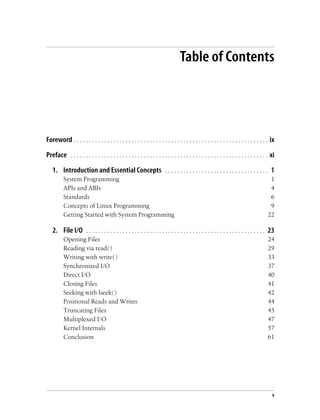
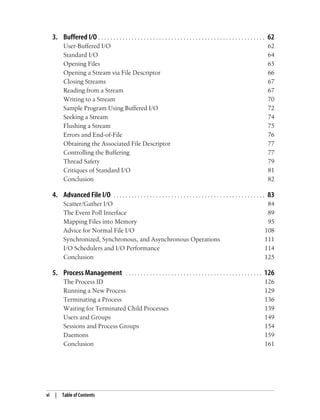
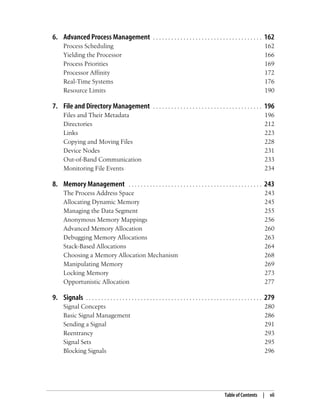


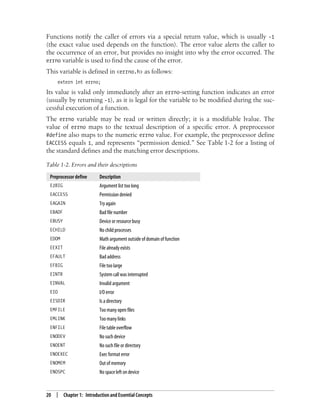
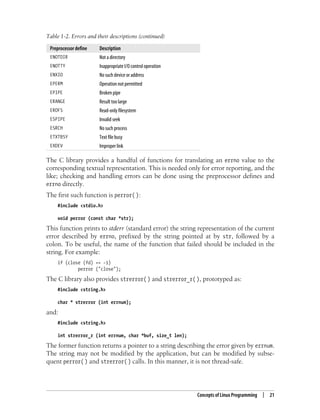
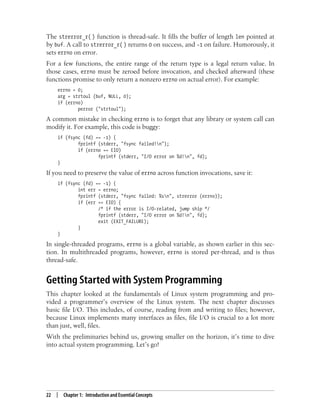
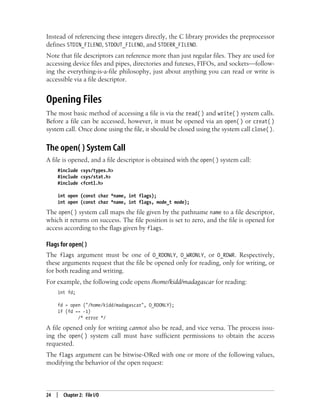
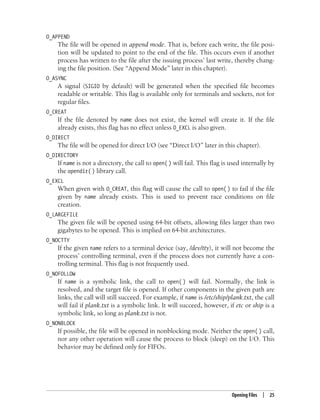
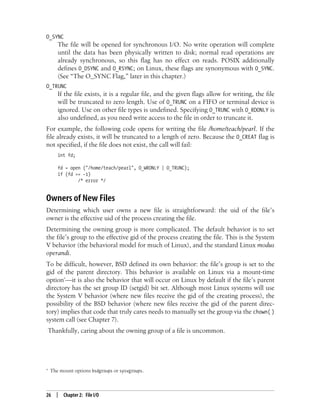
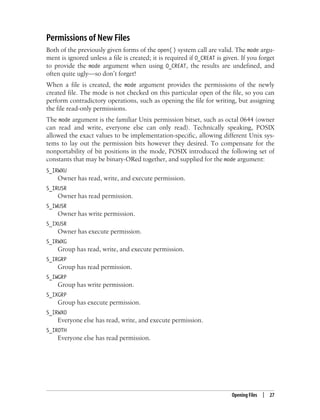
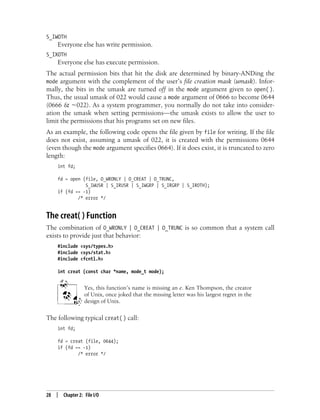
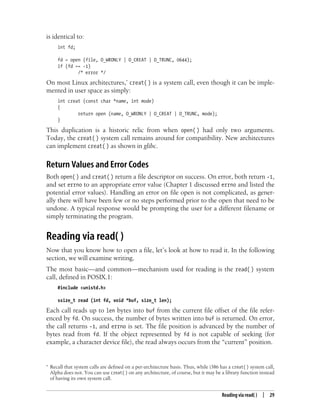
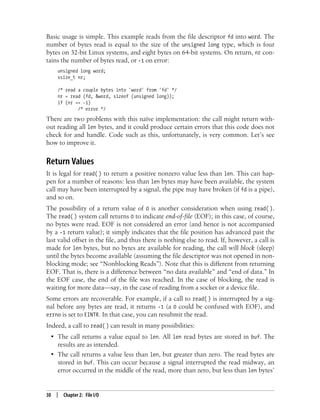
![d'immoralité politique, comme si cette espèce de trahison
était moindre qu'aucune autre. Ce n'est pas seulement une
dégradation d'un rang qui ne devrait être occupé que par la
loyauté la plus pure et la plus exemplaire; c'est un acte qui
les fait déchoir de leurs droits à la renommée de
gentilshommes, et les réduit au niveau des plus bas et des
plus vils de leur espèce, qui insulte à la noble et ancienne
indépendance caractéristique de la pairie anglaise, et qui est
calculé pour déshonorer et avilir la législature anglaise aux
yeux de toute l'Europe et devant la plus lointaine postérité.
Par quelle magie la noblesse peut-elle ainsi changer le vice en
vertu, je ne le sais pas, et je ne souhaite pas le savoir; mais
en tout autre sujet que la politique, et parmi toutes autres
personnes que des lords de la chambre à coucher, un tel
exemple de la plus grossière perfidie serait flétri, comme il le
mérite, par l'infamie et l'exécration[331].
Puis se retournant vers les communes:
Un Parlement ainsi lié et contrôlé, sans cœur et sans
liberté, au lieu de limiter la prérogative de la couronne,
l'étend, l'établit et la consolide au delà de tout précédent, de
toute condition et de toute limite. Mais quand la chambre des
communes anglaises serait si ignominieusement morte à la
conscience du poids dont elle doit peser dans la constitution,
quand elle aurait si entièrement oublié ses anciennes luttes et
ses anciens triomphes dans la grande cause de la liberté et
de l'humanité, quand elle serait si indifférente à l'objet et à
l'intérêt premier de son institution originelle, j'ai la confiance
que le courage caractéristique de cette nation serait encore
au niveau de cette épreuve; j'ai la confiance que le peuple
anglais serait aussi jaloux des influences secrètes qu'il est
supérieur aux violences ouvertes; j'ai la confiance qu'il n'est
pas plus disposé à défendre son intérêt contre la déprédation
et l'insulte étrangère qu'à rencontrer face à face et jeter par
terre cette conspiration nocturne contre la constitution[332].](https://image.slidesharecdn.com/11571318-250527182812-ac53adf5/85/Linux-System-Programming-1st-Edition-Robert-Love-56-320.jpg)
![Voilà les explosions d'un naturel par excellence doux et aimable;
jugez des autres. Une sorte d'exagération passionnée règne dans les
débats que soulèvent le procès de Warren Hastings et la Révolution
française, dans la rhétorique acrimonieuse et dans la déclamation
outrée de Sheridan, dans le sarcasme impitoyable et dans la pompe
sentencieuse du second Pitt. Ils aiment la vulgarité brutale des
couleurs voyantes; ils recherchent les grands mots accumulés, les
oppositions symétriquement prolongées, les périodes énormes et
retentissantes. Ils ne craignent point de rebuter, et ils ont besoin de
faire effet. La force, c'est là leur trait, et celui du plus grand d'entre
eux, le premier esprit de ce temps, Edmund Burke. «Prenez Burke à
partie, disait Johnson, sur tel sujet qu'il vous plaira; il est toujours
prêt à vous tenir tête.» Il n'était point entré au Parlement, comme
Fox et les deux Pitt, dès l'aurore de la jeunesse, mais à trente-cinq
ans, ayant eu le temps de s'instruire à fond de toutes choses, savant
dans le droit, l'histoire, la philosophie, les lettres, maître d'une
érudition si universelle qu'on l'a comparé à lord Bacon. Mais ce qui le
distinguait entre tous les autres, c'était une large intelligence
compréhensive qui, exercée par des études et des compositions
philosophiques[333], saisissait les ensembles, et, par delà les textes,
les constitutions et les chiffres, apercevait la direction invisible des
événements et l'esprit intime des choses, en couvrant de son dédain
«ces prétendus hommes d'État, troupeau profane de manœuvres
vulgaires, qui nient l'existence de tout ce qui n'est point grossier et
matériel, et qui, bien loin d'être capables de diriger le grand
mouvement d'un empire, ne sont pas dignes de tourner une roue
dans la machine.» Par-dessus tant de dons, il avait une de ces
imaginations fécondantes et précises qui croient que la connaissance
achevée est une vue intérieure, qui ne quittent point un sujet sans
l'avoir revêtu de ses couleurs et de ses formes; et qui, traversant les
statistiques et le fatras des documents arides, recomposent et
reconstruisent devant les yeux du lecteur un pays lointain et une
nation étrangère avec ses monuments, ses costumes, ses paysages
et tout le détail mouvant des physionomies et des mœurs. À toutes
ces puissances d'esprit qui font le systématique, il ajoutait toutes les
énergies du cœur qui font l'enthousiaste. Pauvre, inconnu, ayant](https://image.slidesharecdn.com/11571318-250527182812-ac53adf5/85/Linux-System-Programming-1st-Edition-Robert-Love-57-320.jpg)
![dépensé sa jeunesse à compiler pour les libraires, il était parvenu, à
force de travail et de mérite, avec une réputation pure et une
conscience intacte, sans que les épreuves de sa vie obscure ou les
séductions de sa vie brillante eussent entamé son indépendance ou
terni la fleur de sa loyauté. Il apportait dans la politique une horreur
du crime, une vivacité et une sincérité de conscience, une humanité,
une sensibilité, qui ne semblent convenir qu'à un jeune homme. Il
appuyait la société humaine sur des maximes de morale, réclamait
pour les sentiments nobles la conduite des affaires, et semblait avoir
pris à tâche de relever et d'autoriser tout ce qu'il y a de généreux
dans le cœur humain. Il avait noblement combattu pour de nobles
causes: contre les attentats du pouvoir en Angleterre, contre les
attentats du peuple en France, contre les attentats des particuliers
dans l'Inde. Il avait défendu, avec des recherches immenses et un
désintéressement incontesté, les Hindous tyrannisés par l'avidité
anglaise, et «ces derniers misérables cultivateurs qui survivaient
attachés au sol, le dos écorché par le fermier, puis une seconde fois
mis à vif par le cessionnaire, livrés à une succession de despotismes
que leur brièveté rendait plus rapaces, et flagellés ainsi de verges en
verges, tant qu'on leur trouvait une dernière goutte de sang pour
leur extorquer un dernier grain de riz[334].» Il s'était fait partout le
champion d'un principe et le persécuteur d'un vice, et on le voyait
lancer à l'attaque toutes les forces de son étonnant savoir, de sa
haute raison, de son style splendide, avec l'ardeur infatigable et
intempérante d'un moraliste et d'un chevalier.
Ne le lisez que par grandes masses; ce n'est qu'ainsi qu'il est
grand: autrement l'outré, le commun, le bizarre vous arrêteront et
vous choqueront; mais si vous vous livrez à lui, vous serez emporté
et entraîné. La masse énorme des documents roule impétueusement
dans un courant d'éloquence. Quelquefois le discours parlé ou écrit
n'a pas trop d'un volume pour déployer le cortége de ses preuves
multipliées et de ses courageuses colères. C'est l'exposé de toute
une administration, c'est l'histoire entière de l'Inde anglaise, c'est la
théorie complète des révolutions et de l'état politique qui arrive
comme un vaste fleuve débordant pour choquer, de son effort](https://image.slidesharecdn.com/11571318-250527182812-ac53adf5/85/Linux-System-Programming-1st-Edition-Robert-Love-58-320.jpg)
![incessant et de sa masse accumulée, quelque crime qu'on veut
absoudre ou quelque injustice qu'on veut consacrer. Sans doute il y
a de l'écume sur ses remous, il y a de la bourbe dans son lit; des
milliers d'étranges créatures se jouent tempêtueusement à la
surface; il ne choisit pas, il prodigue; il précipite par myriades ses
imaginations pullulantes, emphase et crudités, déclamations et
apostrophes, plaisanteries et exécrations, tout l'entassement
grotesque ou horrible des régions reculées et des cités populeuses
que sa science et sa fantaisie infatigables ont traversées. Il dira, en
parlant de ces prêts usuraires à quarante-huit pour cent et à intérêts
composés par lesquels les Anglais ont dévasté l'Inde, que «cette
dette forme l'ignoble sanie putride dans laquelle s'est engendrée
toute cette couvée rampante d'ascarides, avec les replis infinis
insatiablement noués nœuds sur nœuds de ces ténias invincibles qui
dévorent la nourriture et rongent les entrailles de l'Inde[335].» Rien
ne lui paraîtra excessif, ni la description des supplices, ni l'atrocité
des images, ni le cliquetis assourdissant des antithèses, ni la fanfare
prolongée des malédictions, ni la gigantesque bizarrerie des
bouffonneries. Entre ses mains, le duc de Bedford, qui lui a reproché
sa pension, deviendra, «parmi les créatures de la couronne, le
léviathan qui, deci delà, roule sa masse colossale, joue et gambade
dans l'océan des bontés royales, qui pourtant, tout énorme qu'il soit
et quoique couvrant une lieue de son étendue, n'est après tout
qu'une créature, puisque ses côtes, ses nageoires, ses fanons, son
lard, ses ouïes elles-mêmes, par lesquelles il lance un jet d'eau
contre son origine et éclabousse les autres d'écume, tout en lui et
autour de lui vient du trône[336].» Il n'a point de goût, ses pareils
non plus. La fine déduction grecque ou française n'a jamais trouvé
place chez les nations germaniques; tout y est gros ou mal dégrossi;
il ne sert de rien à celui-ci d'étudier Cicéron et d'emprisonner son
élan dans les digues régulières de la rhétorique latine. Il reste à
demi barbare, empâté dans l'exagération et la violence; mais sa
fougue est si soutenue, sa conviction si forte, son émotion si
chaleureuse et si surabondante, qu'on se laisse aller, qu'on oublie
toute répugnance, qu'on ne voit plus dans ses irrégularités et ses
débordements que les effusions d'un grand cœur et d'un profond](https://image.slidesharecdn.com/11571318-250527182812-ac53adf5/85/Linux-System-Programming-1st-Edition-Robert-Love-59-320.jpg)
![esprit trop ouverts et trop pleins, et qu'on admire avec une sorte de
vénération inconnue cet épanchement extraordinaire, impétueux
comme un torrent, large comme une mer, où ondoie l'inépuisable
variété des couleurs et des formes sous le soleil d'une imagination
magnifique qui communique à cette houle limoneuse toute la
splendeur de ses rayons.
VI
Ouvrez Reynolds pour revoir d'un coup d'œil toutes ces figures, et
mettez en regard les fins portraits français de ce temps, ces
ministres allègres, ces archevêques galants et gracieux, ce maréchal
de Saxe qui, dans le monument de Strasbourg, descend vers son
tombeau avec le goût et l'aisance d'un courtisan sur l'escalier de
Versailles. Ici[337], sous des ciels noyés de brouillards pâles, parmi
de molles ombres vaporeuses, apparaissent des têtes expressives ou
réfléchies; la rude saillie du caractère n'a point fait peur à l'artiste; le
bouffi brutal et bête, l'étrange oiseau de proie lugubre, le mufle
grognon du mauvais dogue, il a tout mis; chez lui, la politesse
niveleuse n'a point effacé les aspérités de l'individu sous un
agrément uniforme. La beauté s'y trouve, mais ailleurs, dans la
froide décision du regard, dans le profond sérieux et dans la
noblesse triste du visage pâle, dans la gravité consciencieuse et
l'indomptable résolution du geste contenu. Au lieu des courtisanes
de Lély, on voit à côté d'eux des dames honnêtes, parfois sévères et
actives, de bonnes mères entourées de leurs petits enfants qui les
baisent et s'embrassent; la morale est venue, et avec elle le
sentiment du home et de la famille, la décence du costume, l'air
pensif, la tenue correcte des héroïnes de miss Burney. Ils ont réussi.
Bakewell transforme et réforme leur bétail, Arthur Young, leur
agriculture, Howard leurs prisons, Arkwright et Watt leur industrie,
Adam Smith leur économie politique, Bentham leur droit pénal,
Locke, Hutcheson, Ferguson, Joseph Butler, Reid, Stewart, Price leur
psychologie et leur morale. Ils ont épuré leurs mœurs privées, ils
purifient leurs mœurs publiques. Ils ont assis leur gouvernement, ils](https://image.slidesharecdn.com/11571318-250527182812-ac53adf5/85/Linux-System-Programming-1st-Edition-Robert-Love-60-320.jpg)
![qui, avec la supériorité d'un penseur et l'hostilité d'un Anglais, s'est
chargé de nous les montrer.
Il s'indigne à l'idée de cette «farce tragi-comique» qu'on appelle à
Paris la régénération du genre humain. Il nie que la contagion d'une
pareille folie puisse jamais empoisonner l'Angleterre. Il raille les
badauds, qui, éveillés par les bourdonnements des sociétés
démocratiques, se croient sur le bord d'une révolution. «Parce
qu'une demi-douzaine de sauterelles sous une fougère font retentir
la prairie de leur importun bruissement, pendant que des milliers de
grands troupeaux, reposant sous l'ombre des chênes britanniques,
ruminent leur pâture et se tiennent silencieux, n'allez pas vous
imaginer que ceux qui font du bruit soient les seuls habitants de la
prairie, qu'ils doivent être en grand nombre, ou qu'après tout ils
soient autre chose qu'une petite troupe maigre, desséchée,
sautillante, quoique bruyante et incommode, d'insectes
éphémères[338].» La véritable Angleterre, «tous ceux[339] qui ont
sur leur tête un bon toit et sur leur dos un bon habit» n'a que de
l'aversion et du dédain[340] pour les maximes et les actes de la
Révolution française. «La seule idée de fabriquer un nouveau
gouvernement suffit pour nous remplir de dégoût et d'horreur. Nous
avons toujours souhaité dériver du passé tout ce que nous
possédons, comme un héritage légué par nos ancêtres[341].» Nos
titres ne flottent pas en l'air dans l'imagination des philosophes; ils
sont consignés dans la Grande Charte. «Nous réclamons nos
franchises, non comme les droits des hommes, mais comme les
droits des hommes de l'Angleterre.» Nous méprisons ce verbiage
abstrait, qui vide l'homme de toute équité et de tout respect pour le
gonfler de présomption et de théories. «Nous n'avons pas été
préparés et troussés, comme des oiseaux empaillés dans un
muséum, pour être remplis de loques, de paille et de misérables
chiffons de papier sali à propos des droits de l'homme[342].» Notre
constitution n'est pas un contrat fictif de la fabrique de votre
Rousseau, bon pour être violé tous les trois mois, mais un contrat
réel par lequel roi, nobles, peuple, Église, chacun tient les autres et
se sent tenu. La couronne du prince et le privilége du noble y sont](https://image.slidesharecdn.com/11571318-250527182812-ac53adf5/85/Linux-System-Programming-1st-Edition-Robert-Love-62-320.jpg)
![aussi sacrés que la terre du paysan ou l'outil du manœuvre. Quelle
que soit l'acquisition ou l'héritage, nous respectons chacun dans son
acquisition ou dans son héritage, et notre loi n'a qu'un objet, qui est
de conserver à chacun son bien et son droit. «Nous regardons les
rois avec vénération, les parlements avec affection, les magistrats
avec soumission, les prêtres avec respect, les nobles avec
déférence[343]. Nous sommes décidés à garder une Église établie,
une monarchie établie, une aristocratie établie, une démocratie
établie, chacune au degré où elle existe et non à un plus grand.»
Nous révérons la propriété partout, celle des corporations comme
celle des individus, celle de l'Église comme celle du laïque. Nous
jugeons que ni un homme ni une assemblée d'hommes n'a le droit
de dépouiller un homme ni une assemblée d'hommes de ce qui est
son bien authentique et son héritage transmis. «Il n'y a pas un
personnage public dans ce royaume qui ne réprouve la déshonnête,
perfide et cruelle confiscation que votre assemblée nationale a été
contrainte d'exercer sur votre Église[344].» Nous ne souffrirons
jamais que chez nous le domaine établi de la nôtre soit converti en
une pension qui la mette dans la dépendance du trésor. Nous avons
fait notre Église, comme notre roi et notre noblesse, indépendante;
«nous voyons sans chagrin ni mauvaise humeur un archevêque
précéder un duc, un évêque de Durham ou de Winchester posséder
dix mille livres sterling de rente.» Nous répugnons à votre vol,
d'abord parce qu'il est un attentat à la propriété, ensuite parce qu'il
est une tentative contre la religion. Nous estimons qu'il n'y a pas de
société sans croyances; nous dérivons la justice de son origine
sacrée, et nous sentons qu'en tarissant sa source on dessèche tout
le ruisseau. Nous avons rejeté comme un venin l'infidélité qui a sali
les commencements de notre siècle et du vôtre, et nous nous en
sommes purgés pendant que vous vous en êtes imbus. «Aucun des
hommes nés chez nous depuis quarante ans n'a lu un mot de
Collins, Toland, Tindal et de tout ce troupeau qui prenait le nom de
libres penseurs. L'athéisme n'est pas seulement contre notre raison,
il est encore contre nos instincts. Nous sommes protestants, non par
indifférence, mais par zèle[345]. L'Église et l'État sont dans nos
esprits deux idées inséparables.» Nous asseyons notre établissement](https://image.slidesharecdn.com/11571318-250527182812-ac53adf5/85/Linux-System-Programming-1st-Edition-Robert-Love-63-320.jpg)
![sur le sentiment du droit, et le sentiment du droit sur le respect de
Dieu.
À la place du droit et de Dieu, qui reconnaissez-vous pour maître?
Le peuple souverain, c'est-à-dire l'arbitraire changeant de la majorité
comptée par têtes. Nous nions que le plus grand nombre ait le droit
de défaire une constitution. «La constitution d'un pays une fois
établie par un contrat tacite ou exprimé, il n'y a pas de pouvoir
existant qui puisse l'altérer sans violer le contrat, à moins que ce ne
soit du consentement de toutes les parties[346].» Nous nions que le
plus grand nombre ait le droit de faire une constitution; il faudrait
que d'abord l'unanimité eût conféré ce droit au plus grand nombre.
Nous nions que la force brutale soit l'autorité légitime, et que la
populace soit la nation[347]. «Une véritable aristocratie naturelle
n'est point dans l'État un intérêt séparé ni séparable. Quand de
grandes multitudes agissent ensemble sous cette discipline de la
nature, je reconnais le peuple; mais, si vous séparez l'espèce
vulgaire des hommes de leurs chefs naturels pour les ranger en
bataille contre leurs chefs naturels, je ne reconnais plus le corps
vénérable que vous appelez le peuple dans ce troupeau débandé de
déserteurs et de vagabonds[348].» Nous détestons de toute notre
haine le droit de tyrannie que vous leur donnez sur les autres, et
nous détestons encore davantage le droit d'insurrection que vous
leur livrez contre eux-mêmes. Nous croyons qu'une constitution est
un dépôt transmis à la génération présente par les générations
passées pour être remis aux générations futures, et que si une
génération peut en disposer comme de son bien, elle doit aussi le
respecter comme le bien d'autrui. Nous estimons que si un
réformateur «porte la main sur les fautes de l'État, ce doit être
comme sur les blessures d'un père, avec une vénération pieuse et
une sollicitude tremblante.... Par votre facilité désordonnée à
changer l'État aussi souvent, aussi profondément, en autant de
manières qu'il y a de caprices et de modes flottantes, la continuité et
la chaîne entière de la communauté seront rompues. Aucune
génération ne sera plus rattachée aux autres. Les hommes vivront et
mourront isolés comme les mouches d'un été[349].» Nous répudions](https://image.slidesharecdn.com/11571318-250527182812-ac53adf5/85/Linux-System-Programming-1st-Edition-Robert-Love-64-320.jpg)
![cette raison courte et grossière qui sépare l'homme de ses attaches
et ne voit en lui que le présent, qui sépare l'homme de la société et
ne le compte que pour une tête dans un troupeau. Nous méprisons
«cette philosophie d'écoliers et cette arithmétique de
douaniers[350],» par laquelle vous découpez l'État et les droits
d'après les lieues carrées et les unités numériques. Nous avons
horreur de cette grossièreté cynique qui «arrachant rudement la
décente draperie de la vie, réduit une reine à n'être qu'une femme et
une femme à n'être qu'un animal[351],» qui jette à bas l'esprit
chevaleresque et l'esprit religieux, les deux couronnes de la nature
humaine, pour les plonger avec la science dans la bourbe populaire
et les fouler «sous les sabots d'une multitude bestiale[352].» Nous
avons horreur de ce nivellement systématique qui, désorganisant la
société civile, amène au gouvernement «des avocats chicaniers, des
usuriers poussés par une tourbe de femmes éhontées, d'hôteliers,
de clercs, de garçons de boutique, de perruquiers, de danseurs de
théâtre[353],» et qui finira, «si la monarchie reprend jamais
l'ascendant en France, par livrer la nation au pouvoir le plus
arbitraire qui ait jamais paru sous le ciel[354].»
Voilà ce que Burke écrivait dès 1790 à l'aurore de la Révolution
française[355]. L'année d'après, le peuple de Birmingham allait
détruire les maisons des jacobins anglais, et les mineurs de
Wednesbury sortaient en corps de leurs houillères pour venir aussi
au secours «du roi et de l'Église». Croisade contre croisade;
l'Angleterre effarouchée était aussi fanatique que la France
enthousiaste. Pitt déclarait qu'on ne pouvait «traiter avec une nation
d'athées[356].» Burke disait que la guerre était non entre un peuple
et un peuple, mais «entre la propriété et la force.» La fureur de
l'exécration, de l'invective et de la destruction montait des deux
parts comme un incendie[357]. Ce n'était point le heurt de deux
gouvernements, mais de deux civilisations et de deux doctrines. Les
deux énormes machines, lancées de tout leur poids et de toute leur
vitesse, s'étaient rencontrées face à face, non par hasard, mais par
fatalité. Un âge entier de littérature et de philosophie avait amassé la
houille qui remplissait leurs flancs et construit la voie qui dirigeait](https://image.slidesharecdn.com/11571318-250527182812-ac53adf5/85/Linux-System-Programming-1st-Edition-Robert-Love-65-320.jpg)
![VI. La plaisanterie grave. — L'humour. — L'imagination
sérieuse et féconde. — Sir Roger de Coverley. — Le
sentiment religieux et poétique. — Vision de Mirza. —
Comment le fonds germanique subsiste sous la
culture latine.
Dans cette vaste transformation des esprits qui occupe tout le dix-
huitième siècle et donne à l'Angleterre son assiette politique et
morale, deux hommes paraissent, supérieurs dans la politique et la
morale, tous deux écrivains accomplis, les plus accomplis qu'on ait
vus en Angleterre; tous deux organes accrédités d'un parti, maîtres
dans l'art de persuader ou de convaincre; tous deux bornés dans la
philosophie et dans l'art, incapables de considérer les sentiments
d'une façon désintéressée, toujours appliqués à voir dans les choses
des motifs d'approbation ou de blâme; du reste différents jusqu'au
contraste, l'un heureux, bienveillant, aimé, l'autre haï, haineux et le
plus infortuné des hommes; l'un partisan de la liberté et des plus
nobles espérances de l'homme, l'autre avocat du parti rétrograde et
détracteur acharné de la nature humaine; l'un mesuré, délicat, ayant
fourni le modèle des plus solides qualités anglaises, perfectionnées
par la culture continentale; l'autre effréné et terrible, ayant donné
l'exemple des plus âpres instincts anglais, déployés sans limite ni
règle, par tous les ravages et à travers tous les désespoirs. Pour
pénétrer dans l'intérieur de cette civilisation et de ce peuple, il n'y a
pas de meilleur moyen que de s'arrêter avec insistance sur Swift et
sur Addison.
I
«Après une soirée passée avec Addison, dit Steele, j'ai souvent
réfléchi que j'avais eu le plaisir de causer avec un proche parent de
Térence ou de Catulle, qui avait tout leur esprit et tout leur naturel,
et par-dessus eux une invention et un agrément[358] plus exquis et
plus délicieux qu'on ne vit jamais en personne.» Et Pope, rival
d'Addison, et rival aigri, ajoutait: «Sa conversation a quelque chose](https://image.slidesharecdn.com/11571318-250527182812-ac53adf5/85/Linux-System-Programming-1st-Edition-Robert-Love-68-320.jpg)
![calculées, dans les allusions heureuses, dans l'esprit discret de ses
petits poëmes, je trouve d'avance plusieurs traits du Spectator.
Au sortir de l'Université, il voyagea longuement dans les deux pays
les plus polis du monde, la France et l'Italie. Il vit à Paris, chez son
ambassadeur, cette régulière et brillante société qui donna le ton à
l'Europe; il visita Boileau, Malebranche, contempla avec une curiosité
un peu malicieuse les révérences des dames fardées et maniérées
de Versailles, la grâce et les civilités presque fades des
gentilshommes beaux parleurs et beaux danseurs. Il s'égaya de nos
façons complimenteuses, et remarqua que chez nous un tailleur et
un cordonnier en s'abordant se félicitaient de l'honneur qu'ils avaient
de se saluer. En Italie, il admira les œuvres d'art et les loua dans une
épitre[359], dont l'enthousiasme est un peu froid, mais fort bien
écrit[360]. Vous voyez qu'il eut la culture fine qu'on donne
aujourd'hui aux jeunes gens du meilleur monde. Et ce ne furent
point des amusements de badauds ou des tracasseries d'auberge qui
l'occupèrent. Ses chers poëtes latins le suivaient partout; il les avait
relus avant de partir; il récitait leurs vers dans les lieux dont ils font
mention. «Je dois avouer, dit-il, qu'un des principaux agréments que
j'ai rencontrés dans mon voyage a été d'examiner les diverses
descriptions en quelque sorte sur les lieux, de comparer la figure
naturelle de la contrée avec les paysages que les poëtes nous en ont
tracés[361].» Ce sont les plaisirs d'un gourmet en littérature; rien de
plus littéraire et de moins pédant que le récit qu'il en écrivit au
retour[362]. Bientôt cette curiosité raffinée et délicate le conduisit
aux médailles. «Il y a une parenté, dit-il, entre elles et la poésie,»
car elles servent à commenter les anciens auteurs; telle effigie des
Grâces rend visible un vers d'Horace. Et à ce sujet il écrivit un fort
agréable dialogue, choisissant pour personnages des gens bien
élevés, «versés dans les parties les plus polies du savoir, et qui
avaient voyagé dans les contrées les plus civilisées de l'Europe.» Il
mit la scène «sur les bords de la Tamise, parmi les fraîches brises qui
s'élèvent de la rivière et l'aimable mélange d'ombrages et de sources
dont tout le pays abonde[363];» puis, avec une gaieté tempérée et
douce, il s'y moqua des pédants, qui consument leur vie à disserter](https://image.slidesharecdn.com/11571318-250527182812-ac53adf5/85/Linux-System-Programming-1st-Edition-Robert-Love-70-320.jpg)
![sur la toge ou la chaussure romaine, mais indiqua en homme de
goût et d'esprit les services que les médailles peuvent rendre à
l'histoire et aux beaux-arts. Y eut-il jamais une meilleure éducation
pour un lettré homme du monde? Depuis longtemps déjà il
aboutissait à la poésie du monde, je veux dire aux vers corrects de
commande et de compliment. Dans toute société polie on recherche
l'ornement de la pensée; on lui veut de beaux habits rares, brillants,
qui la distinguent des pensées vulgaires, et pour cela on lui impose
la rime, la mesure, l'expression noble; on lui compose un magasin de
termes choisis, de métaphores vérifiées, d'images convenues qui
sont comme une garde-robe aristocratique dont elle doit s'empêtrer
et se parer. Les gens d'esprit y sont tenus d'y faire des vers et dans
un certain style, comme les autres y sont tenus d'y étaler des
dentelles et sur certain patron. Addison revêtit ce costume et le
porta avec correction et avec aisance, passant sans difficulté d'une
habitude à une habitude semblable et des vers latins aux vers
anglais. Son principal morceau, la Campagne[364], est un excellent
modèle de style convenable et classique. Chaque vers est plein,
achevé en lui-même, muni d'une antithèse habile, ou d'une bonne
épithète, ou d'une figure abréviative. Les pays y ont leur nom noble:
l'Italie s'appelle l'Ausonie, la mer Noire s'appelle la mer Scythique; il
y a des montagnes de morts et un fracas d'éloquence autorisé par
Lucien; il y a de jolis tours d'adresse oratoire imités d'Ovide; les
canons sont désignés par des périphrases poétiques comme plus
tard dans Delille[365]. Le poëme est une amplification officielle et
décorative semblable à celle que Voltaire arrangea plus tard sur la
victoire de Fontenoy. Addison fit mieux encore: il composa un opéra,
une comédie, une tragédie fort admirée sur la mort de Caton. Ces
exercices furent partout, au siècle dernier, un brevet d'entrée dans le
beau style et dans le beau monde. Au sortir du collége, un jeune
homme, du temps de Voltaire, devait faire sa tragédie, comme
aujourd'hui il doit écrire un article d'économie politique; c'était la
preuve alors qu'il pouvait causer avec les dames, comme c'est la
preuve aujourd'hui qu'il peut raisonner avec les hommes. Il
apprenait l'art d'égayer, de toucher, de parler d'amour; il sortait ainsi
des études arides ou spéciales; il savait choisir parmi les événements](https://image.slidesharecdn.com/11571318-250527182812-ac53adf5/85/Linux-System-Programming-1st-Edition-Robert-Love-71-320.jpg)
![bout loua Pope. Rien de plus touchant, quand on a lu sa vie, que son
Essai sur la bonté; on voit que sans s'en douter il parle de lui-même.
«Les plus grands esprits, dit-il, que j'ai rencontrés étaient des
hommes éminents par leur humanité. Il n'y a point de société ni de
conversation qui puisse subsister dans le monde sans bonté ou
quelque autre chose qui en ait l'apparence et en tienne la place;
pour cette raison, les hommes ont été forcés d'inventer une sorte de
bienveillance qui est ce que nous désignons par le mot d'urbanité.»
Il vient ici d'expliquer involontairement sa grâce et son succès.
Quelques lignes plus loin il ajoute: «La bonté naît avec nous; mais la
santé, la prospérité et les bons traitements que nous recevons du
monde contribuent beaucoup à l'entretenir[366].» C'est encore lui-
même qu'il dévoile ici: il fut très-heureux, et son bonheur se
répandit tout autour de lui en sentiments affectueux, en
ménagements soutenus, en gaieté sereine. Dès le collége il est
célèbre; ses vers latins lui donnent une place de fellow à Oxford; il y
passe dix ans parmi des amusements graves et des études qui lui
plaisent. Dès vingt-deux ans, Dryden, le prince de la littérature, le
loue magnifiquement. Au sortir d'Oxford, les ministres lui font une
pension de trois cents guinées pour achever son éducation et le
préparer au service du public. Au retour de ses voyages, son poëme
sur Blenheim le place au premier rang des whigs. Il devient député,
secrétaire en chef dans le gouvernement d'Irlande, sous-secrétaire
d'État, ministre. Les haines des partis l'épargnent; dans la défaite
universelle des whigs, il est réélu au Parlement; dans la guerre
furieuse des whigs et des tories, whigs et tories s'assemblent pour
applaudir sa tragédie de Caton; les plus cruels pamphlétaires le
respectent; son honnêteté, son talent, semblent élevés d'un
commun accord au-dessus des contestations. Il vit dans
l'abondance, l'activité et les honneurs, sagement et utilement, parmi
les admirations assidues et les affections soutenues d'amis savants
et distingués qui ne peuvent se rassasier de sa conversation, parmi
les applaudissements de tous les hommes vertueux et de tous les
esprits cultivés de l'Angleterre. Si deux fois la chute de son parti
semble abattre ou retarder sa fortune, il se tient debout sans
beaucoup d'effort, par réflexion et sang-froid, préparé aux](https://image.slidesharecdn.com/11571318-250527182812-ac53adf5/85/Linux-System-Programming-1st-Edition-Robert-Love-73-320.jpg)
![événements, acceptant la médiocrité, assis dans une tranquillité
naturelle et acquise, s'accommodant aux hommes sans leur céder,
respectueux envers les grands sans s'abaisser, exempt de révolte
secrète et de souffrance intérieure. Ce sont là les sources de son
talent; y en a-t-il de plus pures et de plus belles? y a-t-il quelque
chose de plus engageant que la politesse et l'élégance du monde,
sans la verve factice et les mensonges complimenteurs du monde?
Et chercherez-vous un entretien plus aimable que celui d'un homme
heureux et bon, dont le savoir, le goût, l'esprit ne s'emploient que
pour vous donner du plaisir?
II
Ce plaisir vous sera utile. Votre interlocuteur est aussi grave que
poli; il veut et peut vous instruire autant que vous amuser; son
éducation a été aussi solide qu'élégante; il avoue même dans son
Spectator qu'il aime mieux le ton sérieux que le ton plaisant. Il est
naturellement réfléchi, silencieux, attentif. Il a étudié avec une
conscience d'érudit et d'observateur les lettres, les hommes et les
choses. Quand il a voyagé en Italie, ç'a été à la manière anglaise,
notant les différences des mœurs, les particularités du sol, les bons
et mauvais effets des divers gouvernements, s'approvisionnant de
mémoires précis, de documents circonstanciés sur les impôts, les
bâtiments, les minéraux, l'atmosphère, les ports, l'administration, et
je ne sais combien d'autres sujets[367]. Un lord anglais qui passe en
Hollande entre fort bien dans une boutique de fromages pour voir de
ses yeux toutes les parties de la fabrication; il revient, comme
Addison, muni de chiffres exacts, de notes complètes; ces amas de
renseignements vérifiés sont le fondement du sens droit des Anglais.
Addison y ajouta la pratique des affaires, ayant été tour à tour ou à
la fois journaliste, député, homme d'État, mêlé de cœur et de main à
tous les combats et à toutes les chances des partis. La simple
éducation littéraire ne fait que de jolis causeurs, capables d'orner ou
de publier des idées qu'ils n'ont pas et que les autres leur
fournissent. Si les écrivains veulent inventer, il faut qu'ils regardent](https://image.slidesharecdn.com/11571318-250527182812-ac53adf5/85/Linux-System-Programming-1st-Edition-Robert-Love-74-320.jpg)
![non les livres et les salons, mais les événements et les hommes; la
conversation des gens spéciaux leur est plus utile que l'étude des
périodes parfaites; ils ne penseront par eux-mêmes qu'autant qu'ils
auront vécu ou agi. Addison sut agir et vivre. À lire ses rapports, ses
lettres, ses discussions, on sent que la politique et le gouvernement
lui ont donné la moitié de son esprit. Placer les gens, manier
l'argent, interpréter la loi, démêler les motifs des hommes, prévoir
les altérations de l'opinion publique, être forcé de juger juste, vite et
vingt fois par jour, sur des intérêts présents et grands, sous la
surveillance du public et l'espionnage des adversaires, voilà les
aliments qui ont nourri sa raison et soutenu ses entretiens; un tel
homme pouvait juger et conseiller l'homme; ses jugements n'étaient
pas des amplifications arrangées par un effort de tête, mais des
observations contrôlées par l'expérience; on pouvait l'écouter en des
sujets moraux, comme on écoute un physicien en des matières de
physique; on le sentait autorisé et on se sentait instruit.
Au bout d'un peu de temps on se sentait meilleur car on
reconnaissait en lui dès l'abord une âme singulièrement élevée, très-
pure, préoccupée de l'honnête jusqu'à en faire son souci constant et
son plus cher plaisir. Il aimait naturellement les belles choses, la
bonté et la justice, la science et la liberté. Dès sa première jeunesse,
il s'était joint au parti libéral, et jusqu'au bout il y demeura, espérant
bien de la raison et de la vertu humaines, marquant les misères où
tombent les peuples qui avec leur indépendance abandonnent leur
dignité[368]. Il suivait les hautes découvertes de la physique nouvelle
pour rehausser encore l'idée qu'il avait de l'œuvre divine. Il aimait
les grandes et graves émotions qui nous révèlent la noblesse de
notre nature et l'infirmité de notre condition. Il employait tout son
talent et tous ses écrits à nous donner le sentiment de ce que nous
valons et de ce que nous devons être. Des deux tragédies qu'il fit ou
médita, l'une était sur la mort de Caton, le plus vertueux des
Romains; l'autre sur celle de Socrate, le plus vertueux des Grecs:
encore, à la fin de la première, il eut un scrupule, et de peur
d'excuser le suicide, il donna à Caton un remords. Son opéra de
Rosamonde s'achève par le conseil de préférer l'amour honnête aux](https://image.slidesharecdn.com/11571318-250527182812-ac53adf5/85/Linux-System-Programming-1st-Edition-Robert-Love-75-320.jpg)
![joies défendues; son Spectator, son Tatler, son Guardian sont les
sermons d'un prédicateur laïque. Bien plus, il a pratiqué ses
maximes. Lorsqu'il fut dans les emplois, son intégrité resta entière; il
servit les gens, souvent sans les connaître, toujours gratuitement,
refusant les présents même déguisés. Lorsqu'il fut hors des emplois,
sa loyauté resta entière; il persévéra dans ses opinions et dans ses
amitiés, sans aigreur ni bassesse, louant hardiment ses protecteurs
tombés[369], ne craignant pas de s'exposer par là à perdre les seules
ressources qu'il eût encore. Il était noble par nature, et il l'était aussi
par raison. Il jugeait qu'il y a du bon sens à être honnête. Son
premier soin, comme il le dit, était de ranger ses passions «du côté
de la vérité.» Il s'était fait intérieurement un portrait de la créature
raisonnable, et y conformait sa conduite autant par réflexion que par
instinct. Il appuyait chaque vertu sur un ordre de principes et de
preuves. Sa logique nourrissait sa morale, et la rectitude de son
esprit achevait la droiture de son cœur. Sa religion, tout anglaise,
était pareille. Il appuyait sa foi sur une suite régulière de discussions
historiques[370]; il établissait l'existence de Dieu par une suite
régulière d'inductions morales; la démonstration minutieuse et solide
était partout le guide et l'auteur de ses croyances et de ses
émotions. Ainsi disposé, il aimait à concevoir Dieu comme le chef
raisonnable du monde; il transformait les accidents et les nécessités
en calculs et en directions; il voyait l'ordre et la Providence dans le
conflit des choses, et sentait autour de lui la sagesse qu'il tâchait de
mettre en lui-même. Il se confiait en Dieu, comme un être bon et
juste qui se sent aux mains d'un être juste et bon; il vivait volontiers
dans sa pensée et en sa présence, et songeait à l'avenir inconnu qui
doit achever la nature humaine et accomplir l'ordre moral. Quand
vint la fin, il repassa sa vie et se trouva on ne sait quel tort envers
Gay; ce tort était bien léger sans doute, puisque Gay ne le
soupçonnait pas. Addison le pria de venir auprès de son lit, et lui
demanda pardon. Au moment de mourir, il voulut encore être utile,
et fit approcher lord Warwick, son beau-fils, dont la légèreté l'avait
inquiété plus d'une fois. Il était si faible que d'abord il ne put parler.
Le jeune, homme, après avoir attendu un instant, lui dit: «Cher
Monsieur, vous m'avez fait demander; je crois, j'espère que vous](https://image.slidesharecdn.com/11571318-250527182812-ac53adf5/85/Linux-System-Programming-1st-Edition-Robert-Love-76-320.jpg)