Who are we?
       Iliyan “ILF” Stoyanov                   Venelin “Venski” Gornishki


• A Linux-everywhere advocate since his    •A programmer with “no-bullshit” attitude
first experience with the OS back in                    interested in all things “Apple”
1997                                         •Fluent in Java, Objective-C, PHP, C++

•
  Started work as a system administrator          •Survived as a web, application and

back in 2000, before he graduated high             mobile devices programmer in few
school                                                        Bulgarian IT companies
•Managed to survive stints in HP and        •While at University of Leuven, did work

the fast paced online bookmaker and            that would be the basis of next gen e-
online payment and money service                                              signatures
industries, while still keeping his        •Joined Iliyan Stoyanov in the tech start-

curiosity for technology                         up 'Evil Puppy' where he is an equal
•Founded the tech start-up 'Evil Puppy'                                equity partner.
with his high-school classmate Venelin
The State of Things: Climate
               Change
● What is climate change?


● Why is it important?


   (A brief walk-through of your bottom line)
Getting Political
●   Why climate change got political?
    ➢   The epic battle of left and right
●   How could a leftist idea be a
    fiscally responsible one and why
    should your business care?
Enter the Cloud
●   Public Clouds vs Private Clouds
          A story of infrastructure
      investments vs. infrastructure
               independance
Clouds and power consumption
    According to a Greenpeace study (take the projection with
                        a grain of salt):
●   In 2007 Public Cloud Computing consumed 632
    billion kWh
●   In 2020 Public Cloud Computing is projected to
    consume 1963 billion kWh or the equivalent of
    1034 megatones of CO2
Clouds and power consumption
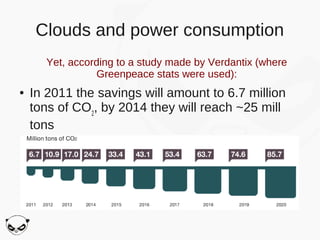
      Yet, according to a study made by Verdantix (where
                Greenpeace stats were used):
●   In 2011 the savings will amount to 6.7 million
    tons of CO2, by 2014 they will reach ~25 mill
    tons
Clouds and power consumption
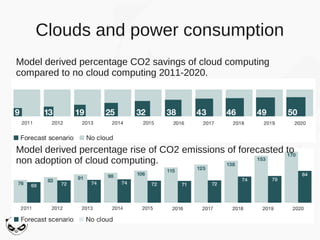
Model derived percentage CO2 savings of cloud computing
compared to no cloud computing 2011-2020.


Model derived percentage rise of CO2 emissions of forecasted to
non adoption of cloud computing.
Enter OpenSource
    (How and why should you build your own private cloud)

●   The tools of the trade:
    ●   libvirt (libvirt.org) – The virtualization API:
        The Open Source Virtualization-Agnostic
        tool, that would help you build your open
        source cloud infrastructure
         –   Supported containers and hypervisors
         –   Network Capabilities
         –   Storage back-end support
         –   Nodes management and live virtual machine migration
             between hardware nodes
The tools of the trade:

●   KVM – The Kernel Virtual Machine
    fully featured hypervisor with all the necessary “bells and
    whistles” to support AMD-V and Intel-VT
    ●   Industry backed – Red Hat, IBM, HP, Canonical, Novell,
        etc.
    ●   KVM supports all AMD/Intel Virtualization technologies
        including RVI/EPT, Direct Access to PCI (including PCI-
        E) hardware
    ●   Allows running of unmodified 32-bit and 64-bit guests –
        Linux, Windows, FreeBSD, OpenBSD, NetBSD, Solaris,
        QNX and even the x86 version of Android
The tools of the trade: KVM

●   Includes para-virtualized Block Device and Network Device support (virt-
    io). Drivers for Windows, Linux, FreeBSD 9, NetBSD, DragonFlyBSD
●   Allows for very aggressive use of system resources – over committing of
    memory and CPUs is a breeze and shines on NUMA systems
●   At one case we achieved up to 250% higher density vs VMWare ESXi
    4.1 thanks to some clever use of KSM (kernel SamePage Merging).
       –   Dropped the use of 1 full blade enclosure = 8400W (Dell PowerEdge 1955)
       –   And dropped the consumed power of another blade enclosure to ~2400W from ~3800W
           (HP BladeSystems c7000)
The tools of the trade:

    “I have all these old Opteron
 servers circa 2005 and they do not
   support virtualization. Should I
   throw them out and invest in a
          new equipment?”
           “Yes” and “No”
The tools of the trade: OS-level virtualization
    Let the LXC drive your business forward

●   lxc - Linux Containers
    virtual system mechanism that allows running multiple
    isolated Linux systems inside a Linux system host
    ●   No hypervisor, no overhead – OS guests run at almost 100% of
        bare-metal speed
    ●   Every container has it's own network space and process space
        thanks to linux control groups (cgroups)
    ●   lxc doesn't require hardware acceleration which makes is great
        on small and embedded systems – the best solution of some
        fringe server architectures like ARM and MIPS
The tools of the trade:

●   No live migration of guests between hardware
    hosts
●   You can run only Linux OSes inside the host. It
    is perfectly fine to run x86 and x86_64 Debian,
    Fedora, CentOS, Ubuntu guests over a x86_64
    Arch host, for example, however you can't run
    *BSD, Windows or any other OS
●   Truly open-source, community driven effort with
    no apparent industry support, although, there
    seems to be some Canonical backing
What's Next?
               Virtualize everything!
             and bring down energy consumption
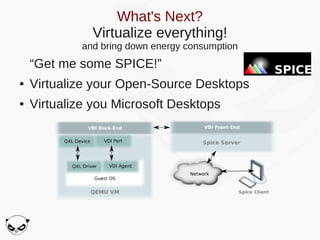
    “Get me some SPICE!”
●   Virtualize your Open-Source Desktops
●   Virtualize you Microsoft Desktops
What's Next?
                Virtualize everything!
             and bring down energy consumption


●   Shorten your development and deployment
                cycle in the cloud


“Carbon reduction is one driver, but not the primary driver. The
primary driver is time to market. Developers used to take 45 days
to get new servers, but in our virtualized private cloud environment,
it takes just a couple of minutes.”
                                                        Paul Stemmler,
                                                            Citigroup
What's Next?
                        Scale-out
                 Crossing over to the Public cloud
●   OpenStack
    ●   Developed by NASA and Rackspace, with the
        support of Canonical, Dell, HP, Intel, SuSE, AMD,
        Cisco, etc
    ●   Gives the ability of a company to turn it's Private
        Cloud to a Public One and provide IaaS to anyone
    ●   Completely Open Source (Apache License)
    ●   Modular Design
What's Next?
                        Scale-out
                 Crossing over to the Public cloud
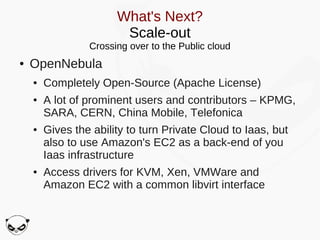
●   OpenNebula
    ●   Completely Open-Source (Apache License)
    ●   A lot of prominent users and contributors – KPMG,
        SARA, CERN, China Mobile, Telefonica
    ●   Gives the ability to turn Private Cloud to Iaas, but
        also to use Amazon's EC2 as a back-end of you
        Iaas infrastructure
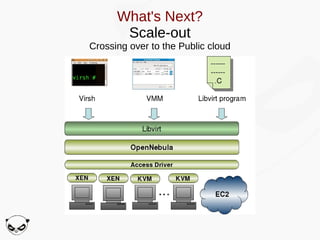
    ●   Access drivers for KVM, Xen, VMWare and
        Amazon EC2 with a common libvirt interface
What's Next?
       Scale-out
Crossing over to the Public cloud
Q&A*

*If we run out of time and you still have
 questions, find us around during the
OpenFest and we'll be happy to answer
   your queries as best as we can

Using Open Source technologies to create Enterprise Level Cloud System

  • 1.
    Who are we? Iliyan “ILF” Stoyanov Venelin “Venski” Gornishki • A Linux-everywhere advocate since his •A programmer with “no-bullshit” attitude first experience with the OS back in interested in all things “Apple” 1997 •Fluent in Java, Objective-C, PHP, C++ • Started work as a system administrator •Survived as a web, application and back in 2000, before he graduated high mobile devices programmer in few school Bulgarian IT companies •Managed to survive stints in HP and •While at University of Leuven, did work the fast paced online bookmaker and that would be the basis of next gen e- online payment and money service signatures industries, while still keeping his •Joined Iliyan Stoyanov in the tech start- curiosity for technology up 'Evil Puppy' where he is an equal •Founded the tech start-up 'Evil Puppy' equity partner. with his high-school classmate Venelin
  • 2.
    The State ofThings: Climate Change ● What is climate change? ● Why is it important? (A brief walk-through of your bottom line)
  • 3.
    Getting Political ● Why climate change got political? ➢ The epic battle of left and right ● How could a leftist idea be a fiscally responsible one and why should your business care?
  • 4.
    Enter the Cloud ● Public Clouds vs Private Clouds A story of infrastructure investments vs. infrastructure independance
  • 5.
    Clouds and powerconsumption According to a Greenpeace study (take the projection with a grain of salt): ● In 2007 Public Cloud Computing consumed 632 billion kWh ● In 2020 Public Cloud Computing is projected to consume 1963 billion kWh or the equivalent of 1034 megatones of CO2
  • 6.
    Clouds and powerconsumption Yet, according to a study made by Verdantix (where Greenpeace stats were used): ● In 2011 the savings will amount to 6.7 million tons of CO2, by 2014 they will reach ~25 mill tons
  • 7.
    Clouds and powerconsumption Model derived percentage CO2 savings of cloud computing compared to no cloud computing 2011-2020. Model derived percentage rise of CO2 emissions of forecasted to non adoption of cloud computing.
  • 8.
    Enter OpenSource (How and why should you build your own private cloud) ● The tools of the trade: ● libvirt (libvirt.org) – The virtualization API: The Open Source Virtualization-Agnostic tool, that would help you build your open source cloud infrastructure – Supported containers and hypervisors – Network Capabilities – Storage back-end support – Nodes management and live virtual machine migration between hardware nodes
  • 9.
    The tools ofthe trade: ● KVM – The Kernel Virtual Machine fully featured hypervisor with all the necessary “bells and whistles” to support AMD-V and Intel-VT ● Industry backed – Red Hat, IBM, HP, Canonical, Novell, etc. ● KVM supports all AMD/Intel Virtualization technologies including RVI/EPT, Direct Access to PCI (including PCI- E) hardware ● Allows running of unmodified 32-bit and 64-bit guests – Linux, Windows, FreeBSD, OpenBSD, NetBSD, Solaris, QNX and even the x86 version of Android
  • 10.
    The tools ofthe trade: KVM ● Includes para-virtualized Block Device and Network Device support (virt- io). Drivers for Windows, Linux, FreeBSD 9, NetBSD, DragonFlyBSD ● Allows for very aggressive use of system resources – over committing of memory and CPUs is a breeze and shines on NUMA systems ● At one case we achieved up to 250% higher density vs VMWare ESXi 4.1 thanks to some clever use of KSM (kernel SamePage Merging). – Dropped the use of 1 full blade enclosure = 8400W (Dell PowerEdge 1955) – And dropped the consumed power of another blade enclosure to ~2400W from ~3800W (HP BladeSystems c7000)
  • 11.
    The tools ofthe trade: “I have all these old Opteron servers circa 2005 and they do not support virtualization. Should I throw them out and invest in a new equipment?” “Yes” and “No”
  • 12.
    The tools ofthe trade: OS-level virtualization Let the LXC drive your business forward ● lxc - Linux Containers virtual system mechanism that allows running multiple isolated Linux systems inside a Linux system host ● No hypervisor, no overhead – OS guests run at almost 100% of bare-metal speed ● Every container has it's own network space and process space thanks to linux control groups (cgroups) ● lxc doesn't require hardware acceleration which makes is great on small and embedded systems – the best solution of some fringe server architectures like ARM and MIPS
  • 13.
    The tools ofthe trade: ● No live migration of guests between hardware hosts ● You can run only Linux OSes inside the host. It is perfectly fine to run x86 and x86_64 Debian, Fedora, CentOS, Ubuntu guests over a x86_64 Arch host, for example, however you can't run *BSD, Windows or any other OS ● Truly open-source, community driven effort with no apparent industry support, although, there seems to be some Canonical backing
  • 14.
    What's Next? Virtualize everything! and bring down energy consumption “Get me some SPICE!” ● Virtualize your Open-Source Desktops ● Virtualize you Microsoft Desktops
  • 15.
    What's Next? Virtualize everything! and bring down energy consumption ● Shorten your development and deployment cycle in the cloud “Carbon reduction is one driver, but not the primary driver. The primary driver is time to market. Developers used to take 45 days to get new servers, but in our virtualized private cloud environment, it takes just a couple of minutes.” Paul Stemmler, Citigroup
  • 16.
    What's Next? Scale-out Crossing over to the Public cloud ● OpenStack ● Developed by NASA and Rackspace, with the support of Canonical, Dell, HP, Intel, SuSE, AMD, Cisco, etc ● Gives the ability of a company to turn it's Private Cloud to a Public One and provide IaaS to anyone ● Completely Open Source (Apache License) ● Modular Design
  • 17.
    What's Next? Scale-out Crossing over to the Public cloud ● OpenNebula ● Completely Open-Source (Apache License) ● A lot of prominent users and contributors – KPMG, SARA, CERN, China Mobile, Telefonica ● Gives the ability to turn Private Cloud to Iaas, but also to use Amazon's EC2 as a back-end of you Iaas infrastructure ● Access drivers for KVM, Xen, VMWare and Amazon EC2 with a common libvirt interface
  • 18.
    What's Next? Scale-out Crossing over to the Public cloud
  • 19.
    Q&A* *If we runout of time and you still have questions, find us around during the OpenFest and we'll be happy to answer your queries as best as we can