photo: Jodie Willard


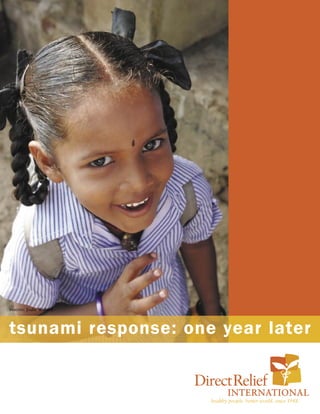
tsunami response: one year later
DIRECT RELIEF BY THE NUMBERS
    (THROUGH DECEMBER 15, 2005)

    $14.3 million in cash received to aid
    tsunami victims. Direct Relief maintains
    a strict policy of using 100 percent of all                                                             photo: Jay Farbman
    tsunami contributions exclusively for
    direct tsunami expenditures. The                   H OW YO U R M O N E Y WA S SPENT
    organization is absorbing all administrative
    costs associated with the tsunami
    response.                                      Millions of lives were devastated by the massive Indian Ocean
                                                   earthquake and resulting series of tsunamis that ravaged coastal
    $50 million in direct aid provided in the
    form of donated medical products and
                                                   communities throughout the Indian Ocean in December 2004.
    cash grants                                    Direct Relief International’s emergency response and ongoing
    4 million courses of treatment of              recovery activities in this enormously complex tragedy have
    specifically requested medicines,               been structured around two basic principles. The first is that our
    supplies, and medical equipment through        organizational role in the area of health is to support, strengthen,
    42 shipments to Indonesia, India, Sri          and enable local people and organizations in the affected
    Lanka, and Somalia with a wholesale            communities. It was they who lost the most, have the most at
    value of $41.7 million                         stake in the long-term outcomes, and for whom the resources we
                                                   received were intended to benefit. The second is that designated
    $8.3 million in cash grants provided
    to 55 emergency and ongoing medical
                                                   money and resources received following the tsunami were for the
    needs and to rebuild housing, water            benefit of people in affected areas, and that our responsibilities in
    systems, and health facilities                 responding are those of trustees accountable both to those who
                                                   gave generously and those for whom the resources were given.
    70.2: percentage of tsunami funds              This report reflects our adherence to these principles, which will
    expended                                       continue to guide our activities to assist communities and people
                                                   who still face tremendous challenges going forward.

                                                   With long experience in emergency response and a strong
                                                   network of partner facilities and organizations in the affected
                                                   area, Direct Relief was able to respond quickly, effectively, and on
                                                   a large scale. Emergency medical shipments were airlifted within
                                                   72 hours. Within the first two weeks, 48,000 lbs. of material aid
                                                   had been sent to hospitals, clinics, medical outreach programs,
                                                   and healthcare professionals through 13 separate air freight
                                                   shipments. The response was supported by FedEx, which provided
                                                   extensive air transport and logistics assistance.

                                                   Overall, Direct Relief has furnished over $8.3 million in
                                                   cash grants from the total of $14.3 million in total tsunami
                                                   contributions received. Complementing a massive infusion
                                                   of essential medical resources - all of which were specifically
                                                   requested by end-user health professionals -- these targeted
                                                   investments have been made in locally managed efforts designed
                                                   to serve communities now and in the future.

                                                   In reporting on our organization’s efforts over the past year, we
                                                   recognize that the faith, resiliency, and hard work of the people in
                                                   countries affected by the tsunami are the most important factors
                                                   in recovering from this tragic event. We remain committed to
                                                   helping them in the months and years ahead.
photo: Jodie Willard


                                                                               | INDIA |

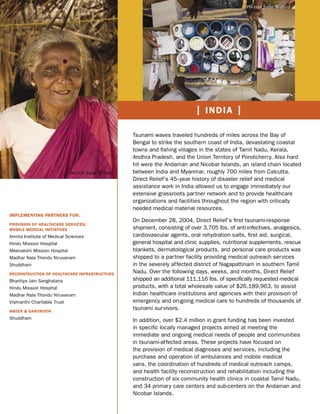
                                                     Tsunami waves traveled hundreds of miles across the Bay of
                                                     Bengal to strike the southern coast of India, devastating coastal
                                                     towns and fishing villages in the states of Tamil Nadu, Kerala,
                                                     Andhra Pradesh, and the Union Territory of Pondicherry. Also hard
                                                     hit were the Andaman and Nicobar Islands, an island chain located
                              photo: Jodie Willard   between India and Myanmar, roughly 700 miles from Calcutta.
                                                     Direct Relief’s 45–year history of disaster relief and medical
                                                     assistance work in India allowed us to engage immediately our
                                                     extensive grassroots partner network and to provide healthcare
                                                     organizations and facilities throughout the region with critically
                                                     needed medical material resources.
IMPLEMENTING PARTNERS FOR:
                                                     On December 28, 2004, Direct Relief’s first tsunami-response
PROVISION OF HEALTHCARE SERVICES/
MOBILE MEDICAL INITIATIVES                           shipment, consisting of over 3,705 lbs. of anti-infectives, analgesics,
Amrita Institute of Medical Sciences                 cardiovascular agents, oral rehydration salts, first aid, surgical,
Hindu Mission Hospital                               general hospital and clinic supplies, nutritional supplements, rescue
Meenakshi Mission Hospital                           blankets, dermatological products, and personal care products was
Madhar Nala Thondu Niruvanam                         shipped to a partner facility providing medical outreach services
Shuddham                                             in the severely affected district of Nagapattinam in southern Tamil
RECONSTRUCTION OF HEALTHCARE INFRASTRUCTURE          Nadu. Over the following days, weeks, and months, Direct Relief
Bharitiya Jain Sanghatana                            shipped an additional 111,116 lbs. of specifically requested medical
Hindu Mission Hospital                               products, with a total wholesale value of $26,189,963, to assist
Madhar Nala Thondu Niruvanam                         Indian healthcare institutions and agencies with their provision of
Vishranthi Charitable Trust                          emergency and on-going medical care to hundreds of thousands of
WATER & SANITATION
                                                     tsunami survivors.
Shuddham                                             In addition, over $2.4 million in grant funding has been invested
                                                     in specific locally managed projects aimed at meeting the
                                                     immediate and ongoing medical needs of people and communities
                                                     in tsunami-affected areas. These projects have focused on
                                                     the provision of medical diagnoses and services, including the
                                                     purchase and operation of ambulances and mobile medical
                                                     vans, the coordination of hundreds of medical outreach camps,
                                                     and health facility reconstruction and rehabilitation including the
                                                     construction of six community health clinics in coastal Tamil Nadu,
                                                     and 34 primary care centers and sub-centers on the Andaman and
                                                     Nicobar Islands.
photo: Jodie Willard


                                  photo: Jodie Willard


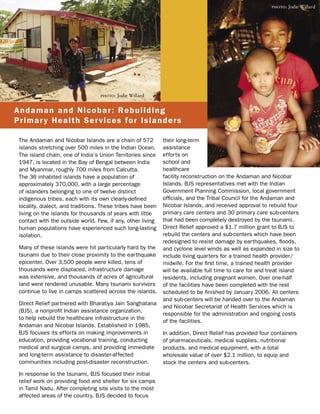
A n d aman and Nicobar : Reb u i l d i n g
P r i mar y Health Ser vices fo r I s l a n d e r s

 The Andaman and Nicobar Islands are a chain of 572      their long-term
 islands stretching over 500 miles in the Indian Ocean.  assistance
 The island chain, one of India’s Union Territories sinceefforts on
 1947, is located in the Bay of Bengal between India     school and
 and Myanmar, roughly 700 miles from Calcutta.           healthcare
 The 36 inhabited islands have a population of           facility reconstruction on the Andaman and Nicobar
 approximately 370,000, with a large percentage          Islands. BJS representatives met with the Indian
 of islanders belonging to one of twelve distinct        Government Planning Commission, local government
 indigenous tribes, each with its own clearly-defined     officials, and the Tribal Council for the Andaman and
                                                         Nicobar Islands, and received approval to rebuild four
 locality, dialect, and traditions. These tribes have been
 living on the islands for thousands of years with littleprimary care centers and 30 primary care sub-centers
                                                         that had been completely destroyed by the tsunami.
 contact with the outside world. Few, if any, other living
 human populations have experienced such long-lasting    Direct Relief approved a $1.7 million grant to BJS to
 isolation.                                              rebuild the centers and sub-centers which have been
                                                         redesigned to resist damage by earthquakes, floods,
 Many of these islands were hit particularly hard by the and cyclone level winds as well as expanded in size to
 tsunami due to their close proximity to the earthquake include living quarters for a trained health provider/
 epicenter. Over 3,500 people were killed, tens of       midwife. For the first time, a trained health provider
 thousands were displaced, infrastructure damage         will be available full time to care for and treat island
 was extensive, and thousands of acres of agricultural   residents, including pregnant women. Over one-half
 land were rendered unusable. Many tsunami survivors of the facilities have been completed with the rest
 continue to live in camps scattered across the islands. scheduled to be finished by January 2006. All centers
                                                         and sub-centers will be handed over to the Andaman
 Direct Relief partnered with Bharatiya Jain Sanghatana
                                                         and Nicobar Secretariat of Health Services which is
 (BJS), a nonprofit Indian assistance organization,
                                                         responsible for the administration and ongoing costs
 to help rebuild the healthcare infrastructure in the
                                                         of the facilities.
 Andaman and Nicobar Islands. Established in 1985,
 BJS focuses its efforts on making improvements in       In addition, Direct Relief has provided four containers
 education, providing vocational training, conducting    of pharmaceuticals, medical supplies, nutritional
 medical and surgical camps, and providing immediate products, and medical equipment, with a total
 and long-term assistance to disaster-affected           wholesale value of over $2.1 million, to equip and
 communities including post-disaster reconstruction.     stock the centers and sub-centers.

 In response to the tsunami, BJS focused their initial
 relief work on providing food and shelter for six camps
 in Tamil Nadu. After completing site visits to the most
 affected areas of the country, BJS decided to focus
photo: Jayne Kulzer

  IMPLEMENTING PARTNERS FOR:
  PROVISION OF HEALTHCARE SERVICES/
  MOBILE MEDICAL INITIATIVES
  Acehkita Foundation
  Community, Habitat, Finance International
  International Medical Corps
  International Relief and Development
     Yayasan Peduli Kesechatan Aceh
     The Center for Humanitarian and
        Social Empowerment
     Embun Pagi Foundation
     Islamic Medical Association and Network
     The Indonesian Planned Parenthood
        Association-Aceh
     Persatuan Perawat Nasional Indonesia
     Pusat Kajian dan Perlindungan Anak
     Wahana Amal Sesama Mahluk Allah
     Solidaritas Perempuan Bungoeng Jeumpa Aceh
     InfoAceh
  RECONSTRUCTION OF HEALTHCARE
  INFRASTRUCTURE
  International Relief and Development                                       | INDONESIA |
     Sisters of Charity of Our Lady Mother of Mercy
  PSYCHOLOGICAL SERVICES
  International Relief and Development
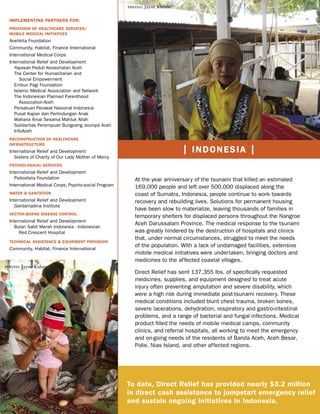
     Psikodista Foundation                                At the year anniversary of the tsunami that killed an estimated
  International Medical Corps; Psycho-social Program      169,000 people and left over 500,000 displaced along the
  WATER & SANITATION                                      coast of Sumatra, Indonesia, people continue to work towards
  International Relief and Development                    recovery and rebuilding lives. Solutions for permanent housing
     Gardamadina Institute
                                                          have been slow to materialize, leaving thousands of families in
  VECTOR-BORNE DISEASE CONTROL
                                                          temporary shelters for displaced persons throughout the Nangroe
  International Relief and Development
                                                          Aceh Darussalam Province. The medical response to the tsunami
     Bulan Sabit Merah Indonesia - Indonesian
       Red Crescent Hospital                              was greatly hindered by the destruction of hospitals and clinics
                                                          that, under normal circumstances, struggled to meet the needs
  TECHNICAL ASSISTANCE & EQUIPMENT PROVISION
                                                          of the population. With a lack of undamaged facilities, extensive
  Community, Habitat, Finance International
                                                          mobile medical initiatives were undertaken, bringing doctors and
                                                          medicines to the affected coastal villages.
photo: Jayne Kulzer
                                                          Direct Relief has sent 137,355 lbs. of specifically requested
                                                          medicines, supplies, and equipment designed to treat acute
                                                          injury often preventing amputation and severe disability, which
                                                          were a high risk during immediate post-tsunami recovery. These
                                                          medical conditions included blunt chest trauma, broken bones,
                                                          severe lacerations, dehydration, respiratory and gastro-intestinal
                                                          problems, and a range of bacterial and fungal infections. Medical
                                                          product filled the needs of mobile medical camps, community
                                                          clinics, and referral hospitals, all working to meet the emergency
                                                          and on-going needs of the residents of Banda Aceh, Aceh Besar,
                                                          Pidie, Nias Island, and other affected regions.


                                                       To date, Direct Relief has provided nearly $3.2 million
                                                       in direct cash assistance to jumpstart emergency relief
                                                       and sustain ongoing initiatives in Indonesia.
                                photo: Jayne Kulzer
photo: Ana Fuentes


                                                                         photo: Jayne Kulzer


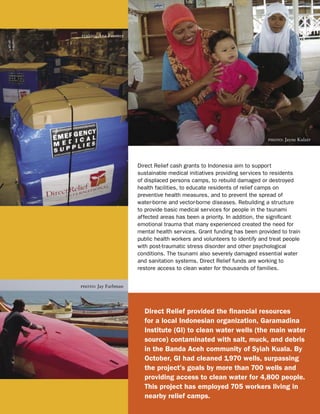
                     Direct Relief cash grants to Indonesia aim to support
                     sustainable medical initiatives providing services to residents
                     of displaced persons camps, to rebuild damaged or destroyed
                     health facilities, to educate residents of relief camps on
                     preventive health measures, and to prevent the spread of
                     water-borne and vector-borne diseases. Rebuilding a structure
                     to provide basic medical services for people in the tsunami
                     affected areas has been a priority. In addition, the significant
                     emotional trauma that many experienced created the need for
                     mental health services. Grant funding has been provided to train
                     public health workers and volunteers to identify and treat people
                     with post-traumatic stress disorder and other psychological
                     conditions. The tsunami also severely damaged essential water
                     and sanitation systems. Direct Relief funds are working to
                     restore access to clean water for thousands of families.


photo: Jay Farbman


                       Direct Relief provided the financial resources
                       for a local Indonesian organization, Garamadina
                       Institute (GI) to clean water wells (the main water
                       source) contaminated with salt, muck, and debris
                       in the Banda Aceh community of Syiah Kuala. By
                       October, GI had cleaned 1,970 wells, surpassing
                       the project’s goals by more than 700 wells and
                       providing access to clean water for 4,800 people.
                       This project has employed 705 workers living in
                       nearby relief camps.
IMPLEMENTING PARTNERS FOR:
PROVISION OF HEALTHCARE SERVICES/ MOBILE
MEDICAL INITIATIVES
American Refugee Committee
International Medical Corps
Sarvodaya
World Federation of Occupational Therapists
St. John’s Ambulance Brigade, Sri Lanka
Foundation for Social Welfare
                                                      photo: Jodie Willard
International Relief and Development
   Foundation of Goodness
   Jaffna Diocese of the Church of South India                        | SRI LANKA |
   EMACE Foundation of Sri Lanka
   Family Planning Association of Sri Lanka
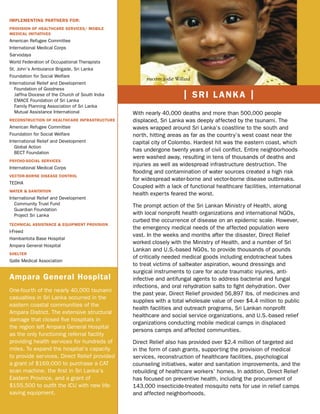
   Mutual Assistance International               With nearly 40,000 deaths and more than 500,000 people
RECONSTRUCTION OF HEALTHCARE INFRASTRUCTURE      displaced, Sri Lanka was deeply affected by the tsunami. The
American Refugee Committee                       waves wrapped around Sri Lanka’s coastline to the south and
Foundation for Social Welfare                    north, hitting areas as far as the country’s west coast near the
International Relief and Development             capital city of Colombo. Hardest hit was the eastern coast, which
   Global Action
   BECT Foundation
                                                 has undergone twenty years of civil conflict. Entire neighborhoods
                                                 were washed away, resulting in tens of thousands of deaths and
PSYCHO-SOCIAL SERVICES
                                                 injuries as well as widespread infrastructure destruction. The
International Medical Corps
                                                 flooding and contamination of water sources created a high risk
VECTOR-BORNE DISEASE CONTROL
                                                 for widespread water-borne and vector-borne disease outbreaks.
TEDHA
                                                 Coupled with a lack of functional healthcare facilities, international
WATER & SANITATION
                                                 health experts feared the worst.
International Relief and Development
   Community Trust Fund                          The prompt action of the Sri Lankan Ministry of Health, along
   Guardian Foundation
   Project Sri Lanka                             with local nonprofit health organizations and international NGOs,
                                                 curbed the occurrence of disease on an epidemic scale. However,
TECHNICAL ASSISTANCE & EQUIPMENT PROVISION
                                                 the emergency medical needs of the affected population were
I-Freed
                                                 vast. In the weeks and months after the disaster, Direct Relief
Hambantota Base Hospital
                                                 worked closely with the Ministry of Health, and a number of Sri
Ampara General Hospital
                                                 Lankan and U.S.-based NGOs, to provide thousands of pounds
SHELTER
                                                 of critically needed medical goods including endotracheal tubes
Galle Medical Association
                                                 to treat victims of saltwater aspiration, wound dressings and
                                                 surgical instruments to care for acute traumatic injuries, anti-
Ampara General Hospital                          infective and antifungal agents to address bacterial and fungal
                                                 infections, and oral rehydration salts to fight dehydration. Over
One-fourth of the nearly 40,000 tsunami
                                                 the past year, Direct Relief provided 56,897 lbs. of medicines and
casualties in Sri Lanka occurred in the
                                                 supplies with a total wholesale value of over $4.4 million to public
eastern coastal communities of the
                                                 health facilities and outreach programs, Sri Lankan nonprofit
Ampara District. The extensive structural
                                                 healthcare and social service organizations, and U.S.-based relief
damage that closed five hospitals in
                                                 organizations conducting mobile medical camps in displaced
the region left Ampara General Hospital
                                                 persons camps and affected communities.
as the only functioning referral facility
providing health services for hundreds of        Direct Relief also has provided over $2.4 million of targeted aid
miles. To expand the hospital’s capacity         in the form of cash grants, supporting the provision of medical
to provide services, Direct Relief provided      services, reconstruction of healthcare facilities, psychological
a grant of $169,000 to purchase a CAT            counseling initiatives, water and sanitation improvements, and the
scan machine, the first in Sri Lanka’s            rebuilding of healthcare workers’ homes. In addition, Direct Relief
Eastern Province, and a grant of                 has focused on preventive health, including the procurement of
$155,500 to outfit the ICU with new life-         143,000 insecticide-treated mosquito nets for use in relief camps
saving equipment.                                and affected neighborhoods.
photo: Damon Taugher


Sustainable Development
Foundation
The Sustainable Development Foundation
(SDF) was founded in 1996 with efforts
focused on making livelihood, socio-
economic, and environmental improvements
for marginalized groups. In response to the
tsunami, SDF, along with other local Thai
NGOs that had been working in the affected
area pre-tsunami, banded together and
provided rapid assistance to the communities
(searching for people, mobilizing communities,
organizing funerals, and establishing
temporary shelters). On December 28, 2004,
34 NGOs formed the ‘The Collaborative
Network for the Rehabilitation of the Andaman                       | THAILAND |
Community and Natural Resources’ to
further assist tsunami-affected communities
through long-term rehabilitation efforts. SDF
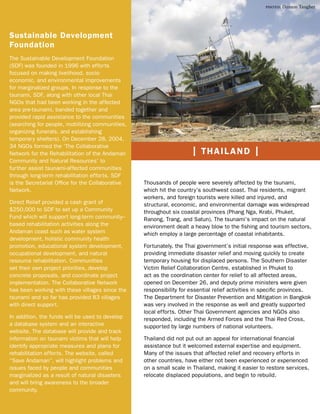
is the Secretariat Office for the Collaborative   Thousands of people were severely affected by the tsunami,
Network.                                         which hit the country’s southwest coast. Thai residents, migrant
                                                 workers, and foreign tourists were killed and injured, and
Direct Relief provided a cash grant of           structural, economic, and environmental damage was widespread
$250,000 to SDF to set up a Community            throughout six coastal provinces (Phang Nga, Krabi, Phuket,
Fund which will support long-term community–     Ranong, Trang, and Satun). The tsunami’s impact on the natural
based rehabilitation activities along the        environment dealt a heavy blow to the fishing and tourism sectors,
Andaman coast such as water system               which employ a large percentage of coastal inhabitants.
development, holistic community health
promotion, educational system development,       Fortunately, the Thai government’s initial response was effective,
occupational development, and natural            providing immediate disaster relief and moving quickly to create
resource rehabilitation. Communities             temporary housing for displaced persons. The Southern Disaster
set their own project priorities, develop        Victim Relief Collaboration Centre, established in Phuket to
concrete proposals, and coordinate project       act as the coordination center for relief to all affected areas,
implementation. The Collaborative Network        opened on December 26, and deputy prime ministers were given
has been working with these villages since the   responsibility for essential relief activities in specific provinces.
tsunami and so far has provided 83 villages      The Department for Disaster Prevention and Mitigation in Bangkok
with direct support.                             was very involved in the response as well and greatly supported
                                                 local efforts. Other Thai Government agencies and NGOs also
In addition, the funds will be used to develop   responded, including the Armed Forces and the Thai Red Cross,
a database system and an interactive             supported by large numbers of national volunteers.
website. The database will provide and track
information on tsunami victims that will help    Thailand did not put out an appeal for international financial
identify appropriate measures and plans for      assistance but it welcomed external expertise and equipment.
rehabilitation efforts. The website, called      Many of the issues that affected relief and recovery efforts in
“Save Andaman”, will highlight problems and      other countries, have either not been experienced or experienced
issues faced by people and communities           on a small scale in Thailand, making it easier to restore services,
marginalized as a result of natural disasters    relocate displaced populations, and begin to rebuild.
and will bring awareness to the broader
community.
photo: Jodie Willard


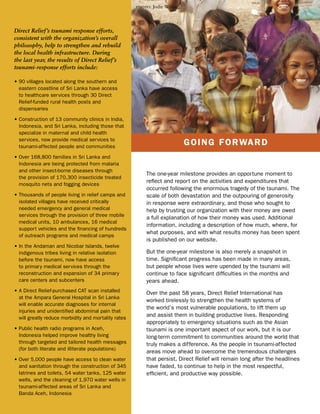
Direct Relief’s tsunami response efforts,
consistent with the organization’s overall
philosophy, help to strengthen and rebuild
the local health infrastructure. During
the last year, the results of Direct Relief’s
tsunami-response efforts include:

• 90 villages located along the southern and
  eastern coastline of Sri Lanka have access
  to healthcare services through 30 Direct
  Relief-funded rural health posts and
  dispensaries

• Construction of 13 community clinics in India,
  Indonesia, and Sri Lanka, including those that
  specialize in maternal and child health
  services, now provide medical services to
  tsunami-affected people and communities
                                                                             G O I N G F O R WA R D
• Over 168,800 families in Sri Lanka and
  Indonesia are being protected from malaria
  and other insect-borne diseases through
                                                          The one-year milestone provides an opportune moment to
  the provision of 170,300 insecticide treated
                                                          reflect and report on the activities and expenditures that
  mosquito nets and fogging devices
                                                          occurred following the enormous tragedy of the tsunami. The
• Thousands of people living in relief camps and          scale of both devastation and the outpouring of generosity
  isolated villages have received critically              in response were extraordinary, and those who sought to
  needed emergency and general medical                    help by trusting our organization with their money are owed
  services through the provision of three mobile
                                                          a full explanation of how their money was used. Additional
  medical units, 10 ambulances, 16 medical
                                                          information, including a description of how much, where, for
  support vehicles and the financing of hundreds
                                                          what purposes, and with what results money has been spent
  of outreach programs and medical camps
                                                          is published on our website.
• In the Andaman and Nicobar Islands, twelve
  indigenous tribes living in relative isolation          But the one-year milestone is also merely a snapshot in
  before the tsunami, now have access                     time. Significant progress has been made in many areas,
  to primary medical services through the                 but people whose lives were upended by the tsunami will
  reconstruction and expansion of 34 primary              continue to face significant difficulties in the months and
  care centers and subcenters                             years ahead.
• A Direct Relief-purchased CAT scan installed            Over the past 58 years, Direct Relief International has
  at the Ampara General Hospital in Sri Lanka
                                                          worked tirelessly to strengthen the health systems of
  will enable accurate diagnoses for internal
                                                          the world’s most vulnerable populations, to lift them up
  injuries and unidentified abdominal pain that
  will greatly reduce morbidity and mortality rates
                                                          and assist them in building productive lives. Responding
                                                          appropriately to emergency situations such as the Asian
• Public health radio programs in Aceh,                   tsunami is one important aspect of our work, but it is our
  Indonesia helped improve healthy living                 long-term commitment to communities around the world that
  through targeted and tailored health messages           truly makes a difference. As the people in tsunami-affected
  (for both literate and illiterate populations)
                                                          areas move ahead to overcome the tremendous challenges
• Over 5,000 people have access to clean water            that persist, Direct Relief will remain long after the headlines
  and sanitation through the construction of 345          have faded, to continue to help in the most respectful,
  latrines and toilets, 54 water tanks, 125 water         efficient, and productive way possible.
  wells, and the cleaning of 1,970 water wells in
  tsunami-affected areas of Sri Lanka and
  Banda Aceh, Indonesia
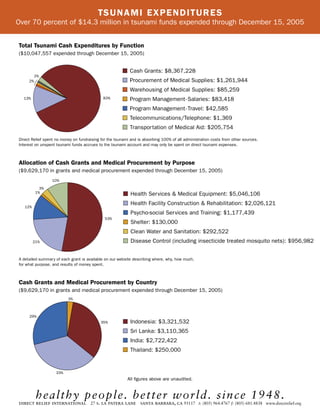
TS U N A M I E X P E N D I T U R E S
Over 70 percent of $14.3 million in tsunami funds expended through December 15, 2005


Total Tsunami Cash Expenditures by Function
($10,047,557 expended through December 15, 2005)


                                                           Cash Grants: $8,367,228
       2%
     2%                                                    Procurement of Medical Supplies: $1,261,944
                                                           Warehousing of Medical Supplies: $85,259
  13%                                        83%           Program Management- Salaries: $83,418
                                                           Program Management- Travel: $42,585
                                                           Telecommunications/Telephone: $1,369
                                                           Transportation of Medical Aid: $205,754

Direct Relief spent no money on fundraising for the tsunami and is absorbing 100% of all administration costs from other sources.
Interest on unspent tsunami funds accrues to the tsunami account and may only be spent on direct tsunami expenses.


Allocation of Cash Grants and Medical Procurement by Purpose
($9,629,170 in grants and medical procurement expended through December 15, 2005)
                 10%

            3%
          1%
                                                            Health Services & Medical Equipment: $5,046,106
                                                            Health Facility Construction & Rehabilitation: $2,026,121
   12%
                                                            Psycho-social Services and Training: $1,177,439
                                              53%
                                                            Shelter: $130,000
                                                            Clean Water and Sanitation: $292,522
         21%                                                Disease Control (including insecticide treated mosquito nets): $956,982


A detailed summary of each grant is available on our website describing where, why, how much,
for what purpose, and results of money spent.


Cash Grants and Medical Procurement by Country
($9,629,170 in grants and medical procurement expended through December 15, 2005)
                          3%


     29%
                                            35%             Indonesia: $3,321,532
                                                            Sri Lanka: $3,110,365
                                                            India: $2,722,422
                                                            Thailand: $250,000


                    33%
                                                          All figures above are unaudited.


          h e a l t hy people. better world. since 194 8 .
direct relief international 27 s. la patera lane santa barbara, ca 93117 t: (805) 964.4767 f: (805) 681.4838 www.directrelief.org

Tsunami response one year later

  • 1.
    photo: Jodie Willard tsunamiresponse: one year later
  • 2.
    DIRECT RELIEF BYTHE NUMBERS (THROUGH DECEMBER 15, 2005) $14.3 million in cash received to aid tsunami victims. Direct Relief maintains a strict policy of using 100 percent of all photo: Jay Farbman tsunami contributions exclusively for direct tsunami expenditures. The H OW YO U R M O N E Y WA S SPENT organization is absorbing all administrative costs associated with the tsunami response. Millions of lives were devastated by the massive Indian Ocean earthquake and resulting series of tsunamis that ravaged coastal $50 million in direct aid provided in the form of donated medical products and communities throughout the Indian Ocean in December 2004. cash grants Direct Relief International’s emergency response and ongoing 4 million courses of treatment of recovery activities in this enormously complex tragedy have specifically requested medicines, been structured around two basic principles. The first is that our supplies, and medical equipment through organizational role in the area of health is to support, strengthen, 42 shipments to Indonesia, India, Sri and enable local people and organizations in the affected Lanka, and Somalia with a wholesale communities. It was they who lost the most, have the most at value of $41.7 million stake in the long-term outcomes, and for whom the resources we received were intended to benefit. The second is that designated $8.3 million in cash grants provided to 55 emergency and ongoing medical money and resources received following the tsunami were for the needs and to rebuild housing, water benefit of people in affected areas, and that our responsibilities in systems, and health facilities responding are those of trustees accountable both to those who gave generously and those for whom the resources were given. 70.2: percentage of tsunami funds This report reflects our adherence to these principles, which will expended continue to guide our activities to assist communities and people who still face tremendous challenges going forward. With long experience in emergency response and a strong network of partner facilities and organizations in the affected area, Direct Relief was able to respond quickly, effectively, and on a large scale. Emergency medical shipments were airlifted within 72 hours. Within the first two weeks, 48,000 lbs. of material aid had been sent to hospitals, clinics, medical outreach programs, and healthcare professionals through 13 separate air freight shipments. The response was supported by FedEx, which provided extensive air transport and logistics assistance. Overall, Direct Relief has furnished over $8.3 million in cash grants from the total of $14.3 million in total tsunami contributions received. Complementing a massive infusion of essential medical resources - all of which were specifically requested by end-user health professionals -- these targeted investments have been made in locally managed efforts designed to serve communities now and in the future. In reporting on our organization’s efforts over the past year, we recognize that the faith, resiliency, and hard work of the people in countries affected by the tsunami are the most important factors in recovering from this tragic event. We remain committed to helping them in the months and years ahead. photo: Jodie Willard
  • 3.
    photo: Jodie Willard | INDIA | Tsunami waves traveled hundreds of miles across the Bay of Bengal to strike the southern coast of India, devastating coastal towns and fishing villages in the states of Tamil Nadu, Kerala, Andhra Pradesh, and the Union Territory of Pondicherry. Also hard hit were the Andaman and Nicobar Islands, an island chain located photo: Jodie Willard between India and Myanmar, roughly 700 miles from Calcutta. Direct Relief’s 45–year history of disaster relief and medical assistance work in India allowed us to engage immediately our extensive grassroots partner network and to provide healthcare organizations and facilities throughout the region with critically needed medical material resources. IMPLEMENTING PARTNERS FOR: On December 28, 2004, Direct Relief’s first tsunami-response PROVISION OF HEALTHCARE SERVICES/ MOBILE MEDICAL INITIATIVES shipment, consisting of over 3,705 lbs. of anti-infectives, analgesics, Amrita Institute of Medical Sciences cardiovascular agents, oral rehydration salts, first aid, surgical, Hindu Mission Hospital general hospital and clinic supplies, nutritional supplements, rescue Meenakshi Mission Hospital blankets, dermatological products, and personal care products was Madhar Nala Thondu Niruvanam shipped to a partner facility providing medical outreach services Shuddham in the severely affected district of Nagapattinam in southern Tamil RECONSTRUCTION OF HEALTHCARE INFRASTRUCTURE Nadu. Over the following days, weeks, and months, Direct Relief Bharitiya Jain Sanghatana shipped an additional 111,116 lbs. of specifically requested medical Hindu Mission Hospital products, with a total wholesale value of $26,189,963, to assist Madhar Nala Thondu Niruvanam Indian healthcare institutions and agencies with their provision of Vishranthi Charitable Trust emergency and on-going medical care to hundreds of thousands of WATER & SANITATION tsunami survivors. Shuddham In addition, over $2.4 million in grant funding has been invested in specific locally managed projects aimed at meeting the immediate and ongoing medical needs of people and communities in tsunami-affected areas. These projects have focused on the provision of medical diagnoses and services, including the purchase and operation of ambulances and mobile medical vans, the coordination of hundreds of medical outreach camps, and health facility reconstruction and rehabilitation including the construction of six community health clinics in coastal Tamil Nadu, and 34 primary care centers and sub-centers on the Andaman and Nicobar Islands.
  • 4.
    photo: Jodie Willard photo: Jodie Willard A n d aman and Nicobar : Reb u i l d i n g P r i mar y Health Ser vices fo r I s l a n d e r s The Andaman and Nicobar Islands are a chain of 572 their long-term islands stretching over 500 miles in the Indian Ocean. assistance The island chain, one of India’s Union Territories sinceefforts on 1947, is located in the Bay of Bengal between India school and and Myanmar, roughly 700 miles from Calcutta. healthcare The 36 inhabited islands have a population of facility reconstruction on the Andaman and Nicobar approximately 370,000, with a large percentage Islands. BJS representatives met with the Indian of islanders belonging to one of twelve distinct Government Planning Commission, local government indigenous tribes, each with its own clearly-defined officials, and the Tribal Council for the Andaman and Nicobar Islands, and received approval to rebuild four locality, dialect, and traditions. These tribes have been living on the islands for thousands of years with littleprimary care centers and 30 primary care sub-centers that had been completely destroyed by the tsunami. contact with the outside world. Few, if any, other living human populations have experienced such long-lasting Direct Relief approved a $1.7 million grant to BJS to isolation. rebuild the centers and sub-centers which have been redesigned to resist damage by earthquakes, floods, Many of these islands were hit particularly hard by the and cyclone level winds as well as expanded in size to tsunami due to their close proximity to the earthquake include living quarters for a trained health provider/ epicenter. Over 3,500 people were killed, tens of midwife. For the first time, a trained health provider thousands were displaced, infrastructure damage will be available full time to care for and treat island was extensive, and thousands of acres of agricultural residents, including pregnant women. Over one-half land were rendered unusable. Many tsunami survivors of the facilities have been completed with the rest continue to live in camps scattered across the islands. scheduled to be finished by January 2006. All centers and sub-centers will be handed over to the Andaman Direct Relief partnered with Bharatiya Jain Sanghatana and Nicobar Secretariat of Health Services which is (BJS), a nonprofit Indian assistance organization, responsible for the administration and ongoing costs to help rebuild the healthcare infrastructure in the of the facilities. Andaman and Nicobar Islands. Established in 1985, BJS focuses its efforts on making improvements in In addition, Direct Relief has provided four containers education, providing vocational training, conducting of pharmaceuticals, medical supplies, nutritional medical and surgical camps, and providing immediate products, and medical equipment, with a total and long-term assistance to disaster-affected wholesale value of over $2.1 million, to equip and communities including post-disaster reconstruction. stock the centers and sub-centers. In response to the tsunami, BJS focused their initial relief work on providing food and shelter for six camps in Tamil Nadu. After completing site visits to the most affected areas of the country, BJS decided to focus
  • 5.
    photo: Jayne Kulzer IMPLEMENTING PARTNERS FOR: PROVISION OF HEALTHCARE SERVICES/ MOBILE MEDICAL INITIATIVES Acehkita Foundation Community, Habitat, Finance International International Medical Corps International Relief and Development Yayasan Peduli Kesechatan Aceh The Center for Humanitarian and Social Empowerment Embun Pagi Foundation Islamic Medical Association and Network The Indonesian Planned Parenthood Association-Aceh Persatuan Perawat Nasional Indonesia Pusat Kajian dan Perlindungan Anak Wahana Amal Sesama Mahluk Allah Solidaritas Perempuan Bungoeng Jeumpa Aceh InfoAceh RECONSTRUCTION OF HEALTHCARE INFRASTRUCTURE International Relief and Development | INDONESIA | Sisters of Charity of Our Lady Mother of Mercy PSYCHOLOGICAL SERVICES International Relief and Development Psikodista Foundation At the year anniversary of the tsunami that killed an estimated International Medical Corps; Psycho-social Program 169,000 people and left over 500,000 displaced along the WATER & SANITATION coast of Sumatra, Indonesia, people continue to work towards International Relief and Development recovery and rebuilding lives. Solutions for permanent housing Gardamadina Institute have been slow to materialize, leaving thousands of families in VECTOR-BORNE DISEASE CONTROL temporary shelters for displaced persons throughout the Nangroe International Relief and Development Aceh Darussalam Province. The medical response to the tsunami Bulan Sabit Merah Indonesia - Indonesian Red Crescent Hospital was greatly hindered by the destruction of hospitals and clinics that, under normal circumstances, struggled to meet the needs TECHNICAL ASSISTANCE & EQUIPMENT PROVISION of the population. With a lack of undamaged facilities, extensive Community, Habitat, Finance International mobile medical initiatives were undertaken, bringing doctors and medicines to the affected coastal villages. photo: Jayne Kulzer Direct Relief has sent 137,355 lbs. of specifically requested medicines, supplies, and equipment designed to treat acute injury often preventing amputation and severe disability, which were a high risk during immediate post-tsunami recovery. These medical conditions included blunt chest trauma, broken bones, severe lacerations, dehydration, respiratory and gastro-intestinal problems, and a range of bacterial and fungal infections. Medical product filled the needs of mobile medical camps, community clinics, and referral hospitals, all working to meet the emergency and on-going needs of the residents of Banda Aceh, Aceh Besar, Pidie, Nias Island, and other affected regions. To date, Direct Relief has provided nearly $3.2 million in direct cash assistance to jumpstart emergency relief and sustain ongoing initiatives in Indonesia. photo: Jayne Kulzer
  • 6.
    photo: Ana Fuentes photo: Jayne Kulzer Direct Relief cash grants to Indonesia aim to support sustainable medical initiatives providing services to residents of displaced persons camps, to rebuild damaged or destroyed health facilities, to educate residents of relief camps on preventive health measures, and to prevent the spread of water-borne and vector-borne diseases. Rebuilding a structure to provide basic medical services for people in the tsunami affected areas has been a priority. In addition, the significant emotional trauma that many experienced created the need for mental health services. Grant funding has been provided to train public health workers and volunteers to identify and treat people with post-traumatic stress disorder and other psychological conditions. The tsunami also severely damaged essential water and sanitation systems. Direct Relief funds are working to restore access to clean water for thousands of families. photo: Jay Farbman Direct Relief provided the financial resources for a local Indonesian organization, Garamadina Institute (GI) to clean water wells (the main water source) contaminated with salt, muck, and debris in the Banda Aceh community of Syiah Kuala. By October, GI had cleaned 1,970 wells, surpassing the project’s goals by more than 700 wells and providing access to clean water for 4,800 people. This project has employed 705 workers living in nearby relief camps.
  • 7.
    IMPLEMENTING PARTNERS FOR: PROVISIONOF HEALTHCARE SERVICES/ MOBILE MEDICAL INITIATIVES American Refugee Committee International Medical Corps Sarvodaya World Federation of Occupational Therapists St. John’s Ambulance Brigade, Sri Lanka Foundation for Social Welfare photo: Jodie Willard International Relief and Development Foundation of Goodness Jaffna Diocese of the Church of South India | SRI LANKA | EMACE Foundation of Sri Lanka Family Planning Association of Sri Lanka Mutual Assistance International With nearly 40,000 deaths and more than 500,000 people RECONSTRUCTION OF HEALTHCARE INFRASTRUCTURE displaced, Sri Lanka was deeply affected by the tsunami. The American Refugee Committee waves wrapped around Sri Lanka’s coastline to the south and Foundation for Social Welfare north, hitting areas as far as the country’s west coast near the International Relief and Development capital city of Colombo. Hardest hit was the eastern coast, which Global Action BECT Foundation has undergone twenty years of civil conflict. Entire neighborhoods were washed away, resulting in tens of thousands of deaths and PSYCHO-SOCIAL SERVICES injuries as well as widespread infrastructure destruction. The International Medical Corps flooding and contamination of water sources created a high risk VECTOR-BORNE DISEASE CONTROL for widespread water-borne and vector-borne disease outbreaks. TEDHA Coupled with a lack of functional healthcare facilities, international WATER & SANITATION health experts feared the worst. International Relief and Development Community Trust Fund The prompt action of the Sri Lankan Ministry of Health, along Guardian Foundation Project Sri Lanka with local nonprofit health organizations and international NGOs, curbed the occurrence of disease on an epidemic scale. However, TECHNICAL ASSISTANCE & EQUIPMENT PROVISION the emergency medical needs of the affected population were I-Freed vast. In the weeks and months after the disaster, Direct Relief Hambantota Base Hospital worked closely with the Ministry of Health, and a number of Sri Ampara General Hospital Lankan and U.S.-based NGOs, to provide thousands of pounds SHELTER of critically needed medical goods including endotracheal tubes Galle Medical Association to treat victims of saltwater aspiration, wound dressings and surgical instruments to care for acute traumatic injuries, anti- Ampara General Hospital infective and antifungal agents to address bacterial and fungal infections, and oral rehydration salts to fight dehydration. Over One-fourth of the nearly 40,000 tsunami the past year, Direct Relief provided 56,897 lbs. of medicines and casualties in Sri Lanka occurred in the supplies with a total wholesale value of over $4.4 million to public eastern coastal communities of the health facilities and outreach programs, Sri Lankan nonprofit Ampara District. The extensive structural healthcare and social service organizations, and U.S.-based relief damage that closed five hospitals in organizations conducting mobile medical camps in displaced the region left Ampara General Hospital persons camps and affected communities. as the only functioning referral facility providing health services for hundreds of Direct Relief also has provided over $2.4 million of targeted aid miles. To expand the hospital’s capacity in the form of cash grants, supporting the provision of medical to provide services, Direct Relief provided services, reconstruction of healthcare facilities, psychological a grant of $169,000 to purchase a CAT counseling initiatives, water and sanitation improvements, and the scan machine, the first in Sri Lanka’s rebuilding of healthcare workers’ homes. In addition, Direct Relief Eastern Province, and a grant of has focused on preventive health, including the procurement of $155,500 to outfit the ICU with new life- 143,000 insecticide-treated mosquito nets for use in relief camps saving equipment. and affected neighborhoods.
  • 8.
    photo: Damon Taugher SustainableDevelopment Foundation The Sustainable Development Foundation (SDF) was founded in 1996 with efforts focused on making livelihood, socio- economic, and environmental improvements for marginalized groups. In response to the tsunami, SDF, along with other local Thai NGOs that had been working in the affected area pre-tsunami, banded together and provided rapid assistance to the communities (searching for people, mobilizing communities, organizing funerals, and establishing temporary shelters). On December 28, 2004, 34 NGOs formed the ‘The Collaborative Network for the Rehabilitation of the Andaman | THAILAND | Community and Natural Resources’ to further assist tsunami-affected communities through long-term rehabilitation efforts. SDF is the Secretariat Office for the Collaborative Thousands of people were severely affected by the tsunami, Network. which hit the country’s southwest coast. Thai residents, migrant workers, and foreign tourists were killed and injured, and Direct Relief provided a cash grant of structural, economic, and environmental damage was widespread $250,000 to SDF to set up a Community throughout six coastal provinces (Phang Nga, Krabi, Phuket, Fund which will support long-term community– Ranong, Trang, and Satun). The tsunami’s impact on the natural based rehabilitation activities along the environment dealt a heavy blow to the fishing and tourism sectors, Andaman coast such as water system which employ a large percentage of coastal inhabitants. development, holistic community health promotion, educational system development, Fortunately, the Thai government’s initial response was effective, occupational development, and natural providing immediate disaster relief and moving quickly to create resource rehabilitation. Communities temporary housing for displaced persons. The Southern Disaster set their own project priorities, develop Victim Relief Collaboration Centre, established in Phuket to concrete proposals, and coordinate project act as the coordination center for relief to all affected areas, implementation. The Collaborative Network opened on December 26, and deputy prime ministers were given has been working with these villages since the responsibility for essential relief activities in specific provinces. tsunami and so far has provided 83 villages The Department for Disaster Prevention and Mitigation in Bangkok with direct support. was very involved in the response as well and greatly supported local efforts. Other Thai Government agencies and NGOs also In addition, the funds will be used to develop responded, including the Armed Forces and the Thai Red Cross, a database system and an interactive supported by large numbers of national volunteers. website. The database will provide and track information on tsunami victims that will help Thailand did not put out an appeal for international financial identify appropriate measures and plans for assistance but it welcomed external expertise and equipment. rehabilitation efforts. The website, called Many of the issues that affected relief and recovery efforts in “Save Andaman”, will highlight problems and other countries, have either not been experienced or experienced issues faced by people and communities on a small scale in Thailand, making it easier to restore services, marginalized as a result of natural disasters relocate displaced populations, and begin to rebuild. and will bring awareness to the broader community.
  • 9.
    photo: Jodie Willard DirectRelief’s tsunami response efforts, consistent with the organization’s overall philosophy, help to strengthen and rebuild the local health infrastructure. During the last year, the results of Direct Relief’s tsunami-response efforts include: • 90 villages located along the southern and eastern coastline of Sri Lanka have access to healthcare services through 30 Direct Relief-funded rural health posts and dispensaries • Construction of 13 community clinics in India, Indonesia, and Sri Lanka, including those that specialize in maternal and child health services, now provide medical services to tsunami-affected people and communities G O I N G F O R WA R D • Over 168,800 families in Sri Lanka and Indonesia are being protected from malaria and other insect-borne diseases through The one-year milestone provides an opportune moment to the provision of 170,300 insecticide treated reflect and report on the activities and expenditures that mosquito nets and fogging devices occurred following the enormous tragedy of the tsunami. The • Thousands of people living in relief camps and scale of both devastation and the outpouring of generosity isolated villages have received critically in response were extraordinary, and those who sought to needed emergency and general medical help by trusting our organization with their money are owed services through the provision of three mobile a full explanation of how their money was used. Additional medical units, 10 ambulances, 16 medical information, including a description of how much, where, for support vehicles and the financing of hundreds what purposes, and with what results money has been spent of outreach programs and medical camps is published on our website. • In the Andaman and Nicobar Islands, twelve indigenous tribes living in relative isolation But the one-year milestone is also merely a snapshot in before the tsunami, now have access time. Significant progress has been made in many areas, to primary medical services through the but people whose lives were upended by the tsunami will reconstruction and expansion of 34 primary continue to face significant difficulties in the months and care centers and subcenters years ahead. • A Direct Relief-purchased CAT scan installed Over the past 58 years, Direct Relief International has at the Ampara General Hospital in Sri Lanka worked tirelessly to strengthen the health systems of will enable accurate diagnoses for internal the world’s most vulnerable populations, to lift them up injuries and unidentified abdominal pain that will greatly reduce morbidity and mortality rates and assist them in building productive lives. Responding appropriately to emergency situations such as the Asian • Public health radio programs in Aceh, tsunami is one important aspect of our work, but it is our Indonesia helped improve healthy living long-term commitment to communities around the world that through targeted and tailored health messages truly makes a difference. As the people in tsunami-affected (for both literate and illiterate populations) areas move ahead to overcome the tremendous challenges • Over 5,000 people have access to clean water that persist, Direct Relief will remain long after the headlines and sanitation through the construction of 345 have faded, to continue to help in the most respectful, latrines and toilets, 54 water tanks, 125 water efficient, and productive way possible. wells, and the cleaning of 1,970 water wells in tsunami-affected areas of Sri Lanka and Banda Aceh, Indonesia
  • 10.
    TS U NA M I E X P E N D I T U R E S Over 70 percent of $14.3 million in tsunami funds expended through December 15, 2005 Total Tsunami Cash Expenditures by Function ($10,047,557 expended through December 15, 2005) Cash Grants: $8,367,228 2% 2% Procurement of Medical Supplies: $1,261,944 Warehousing of Medical Supplies: $85,259 13% 83% Program Management- Salaries: $83,418 Program Management- Travel: $42,585 Telecommunications/Telephone: $1,369 Transportation of Medical Aid: $205,754 Direct Relief spent no money on fundraising for the tsunami and is absorbing 100% of all administration costs from other sources. Interest on unspent tsunami funds accrues to the tsunami account and may only be spent on direct tsunami expenses. Allocation of Cash Grants and Medical Procurement by Purpose ($9,629,170 in grants and medical procurement expended through December 15, 2005) 10% 3% 1% Health Services & Medical Equipment: $5,046,106 Health Facility Construction & Rehabilitation: $2,026,121 12% Psycho-social Services and Training: $1,177,439 53% Shelter: $130,000 Clean Water and Sanitation: $292,522 21% Disease Control (including insecticide treated mosquito nets): $956,982 A detailed summary of each grant is available on our website describing where, why, how much, for what purpose, and results of money spent. Cash Grants and Medical Procurement by Country ($9,629,170 in grants and medical procurement expended through December 15, 2005) 3% 29% 35% Indonesia: $3,321,532 Sri Lanka: $3,110,365 India: $2,722,422 Thailand: $250,000 33% All figures above are unaudited. h e a l t hy people. better world. since 194 8 . direct relief international 27 s. la patera lane santa barbara, ca 93117 t: (805) 964.4767 f: (805) 681.4838 www.directrelief.org