THEORETICAL SETTING FOR
BUSINESS RESEARCH
SUNDAR B. N.
Assistant Professor
Meaning of theory
Research is closely related to theory. Theory provides a conceptual
model for research. Research in turn contributes to theory. It is
important to distinguish the modern scientific usage of the word
theory from other meanings the word may have.
In common parlance, theory is frequently identified with
speculations, what is theoretical is unrealistic, visionary.
This is a wrong notion; theory is the accumulated stored facts.
It may define as a set of systematically interrelated concepts,
definitions and propositions that are advanced to explain and
predict phenomena (facts).
Definition of Theory
Arnold Rose defines theory as “an integrated body of
definitions, assumptions and general propositions
covering a given subject matter from which a
comprehensive and consistent set of specific and
testable principles can be deducted logically”.
Kerlinlger Fred.N defines theory as “ A set of
systematically interrelated that are advanced to
explain and predict phenomena/facts.”
Meaning of Theoretical Setting
•The theoretical setting (or theoretical framework) in business research
refers to the foundation of concepts, models, and theories on which a
research study is built.
•It provides a logical structure that connects the research problem,
objectives, variables, and expected relationships.
Example of Theoretical Setting
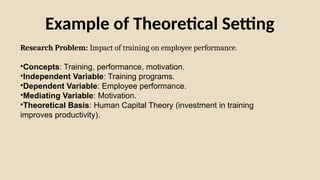
Research Problem: Impact of training on employee performance.
•Concepts: Training, performance, motivation.
•Independent Variable: Training programs.
•Dependent Variable: Employee performance.
•Mediating Variable: Motivation.
•Theoretical Basis: Human Capital Theory (investment in training
improves productivity).
Importance Theoretical Setting
•Gives direction to the research.
•Helps in identifying key variables and their relationships.
•Ensures that the study is grounded in existing knowledge.
•Provides a basis for hypothesis development and testing.
Components of Theoretical Setting
•Concepts / Constructs – Abstract ideas used in research (e.g., job
satisfaction, motivation, customer loyalty).
•Variables – Measurable representations of concepts.
•Independent variable (cause)
•Dependent variable (effect)
•Moderating / mediating variables
•Theories / Models – Established explanations (e.g., Maslow’s motivation
theory, Porter’s five forces).
•Relationships / Propositions – Logical links between variables.
•Assumptions – Conditions accepted as true for the study.
Contribution of Research to Theory
The relationship between theory and research is contributory. Research
contributes to the development of theory. Let us discuss major
contributions of research to theory.
a) Research initiate theory.
The findings of research may lead to the formulation of theories. Scientific experiment
have led to the development of various theories in physics, chemistry etc,. Similarly
research in social sciences has contributed to the development of several theories.
b) Research tests an existing theory.
One major function of empirical research is to test hypotheses deduced from existing
theories. If a hypothesis is not conformed by research, the theory from which the
hypothesis is deduced in re-examined and tested.
Contribution of Research to Theory (2)
c) Reformulation of an existing theory - When a theory does not fit in
to new findings of research, it is rejected and reformulated to encompass the new
findings.
d) Research refocuses theory.
Empirical research may give a new focus to the existing theory.
e) Research clarifies theory - Concepts are drawn from theory. But
researcher cannot proceed on the basis of their theoretical meaning. For research
purpose the concepts must be operationalized and defined especially with concrete
empirical indications. Such clarifications and redefinitions lead to the discovery of
new hypotheses.
In short, theory and research are inseparable complementary components of scientific
endeavour.
Theory and Facts
Theory and facts are interrelated. Facts are empirically
verifiable observation and theories establish
relationship between facts and order them in
meaningful way.
Theory summaries facts in to empirical
generalizations; and it predict facts. Facts in turn,
help to initiate theories; facts lead to the
reformulation of an existing theory and modify
them.
Role of Theory in Research
Theory helps research in several useful ways. Following are the major contributions of
theory to research.
a) Theory delimits the study.
Theory narrows the range of facts to be studied. It helps to select a few relevant aspects of
a phenomenon. Any phenomenon may be studied from different angles. Theory helps
the researcher to work with in framework is science.
b) Theory provides conceptual model.
Theory provides a conceptual framework for a study. It helps a researcher to develop
conceptual structure for the proper formulation of the selected problems.
c) Theory summarizes.
Theory summarizes what is already known about the object of study. From time to time in
any science there will be changes in the structure of relationship between
propositions. In each area, scientist move from older systems of theory towards a more
acceptable new system.
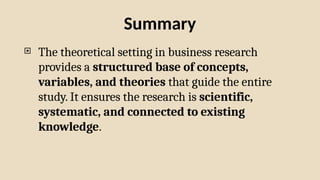
Summary
 The theoretical setting in business research
provides a structured base of concepts,
variables, and theories that guide the entire
study. It ensures the research is scientific,
systematic, and connected to existing
knowledge.
Reference
Mahesh .C. (2011). Unit-1 Social Research Methods.
University of Calicut

Theoretical Setting for Business Research

  • 1.
    THEORETICAL SETTING FOR BUSINESSRESEARCH SUNDAR B. N. Assistant Professor
  • 2.
    Meaning of theory Researchis closely related to theory. Theory provides a conceptual model for research. Research in turn contributes to theory. It is important to distinguish the modern scientific usage of the word theory from other meanings the word may have. In common parlance, theory is frequently identified with speculations, what is theoretical is unrealistic, visionary. This is a wrong notion; theory is the accumulated stored facts. It may define as a set of systematically interrelated concepts, definitions and propositions that are advanced to explain and predict phenomena (facts).
  • 3.
    Definition of Theory ArnoldRose defines theory as “an integrated body of definitions, assumptions and general propositions covering a given subject matter from which a comprehensive and consistent set of specific and testable principles can be deducted logically”. Kerlinlger Fred.N defines theory as “ A set of systematically interrelated that are advanced to explain and predict phenomena/facts.”
  • 4.
    Meaning of TheoreticalSetting •The theoretical setting (or theoretical framework) in business research refers to the foundation of concepts, models, and theories on which a research study is built. •It provides a logical structure that connects the research problem, objectives, variables, and expected relationships.
  • 5.
    Example of TheoreticalSetting Research Problem: Impact of training on employee performance. •Concepts: Training, performance, motivation. •Independent Variable: Training programs. •Dependent Variable: Employee performance. •Mediating Variable: Motivation. •Theoretical Basis: Human Capital Theory (investment in training improves productivity).
  • 6.
    Importance Theoretical Setting •Givesdirection to the research. •Helps in identifying key variables and their relationships. •Ensures that the study is grounded in existing knowledge. •Provides a basis for hypothesis development and testing.
  • 7.
    Components of TheoreticalSetting •Concepts / Constructs – Abstract ideas used in research (e.g., job satisfaction, motivation, customer loyalty). •Variables – Measurable representations of concepts. •Independent variable (cause) •Dependent variable (effect) •Moderating / mediating variables •Theories / Models – Established explanations (e.g., Maslow’s motivation theory, Porter’s five forces). •Relationships / Propositions – Logical links between variables. •Assumptions – Conditions accepted as true for the study.
  • 8.
    Contribution of Researchto Theory The relationship between theory and research is contributory. Research contributes to the development of theory. Let us discuss major contributions of research to theory. a) Research initiate theory. The findings of research may lead to the formulation of theories. Scientific experiment have led to the development of various theories in physics, chemistry etc,. Similarly research in social sciences has contributed to the development of several theories. b) Research tests an existing theory. One major function of empirical research is to test hypotheses deduced from existing theories. If a hypothesis is not conformed by research, the theory from which the hypothesis is deduced in re-examined and tested.
  • 9.
    Contribution of Researchto Theory (2) c) Reformulation of an existing theory - When a theory does not fit in to new findings of research, it is rejected and reformulated to encompass the new findings. d) Research refocuses theory. Empirical research may give a new focus to the existing theory. e) Research clarifies theory - Concepts are drawn from theory. But researcher cannot proceed on the basis of their theoretical meaning. For research purpose the concepts must be operationalized and defined especially with concrete empirical indications. Such clarifications and redefinitions lead to the discovery of new hypotheses. In short, theory and research are inseparable complementary components of scientific endeavour.
  • 10.
    Theory and Facts Theoryand facts are interrelated. Facts are empirically verifiable observation and theories establish relationship between facts and order them in meaningful way. Theory summaries facts in to empirical generalizations; and it predict facts. Facts in turn, help to initiate theories; facts lead to the reformulation of an existing theory and modify them.
  • 11.
    Role of Theoryin Research Theory helps research in several useful ways. Following are the major contributions of theory to research. a) Theory delimits the study. Theory narrows the range of facts to be studied. It helps to select a few relevant aspects of a phenomenon. Any phenomenon may be studied from different angles. Theory helps the researcher to work with in framework is science. b) Theory provides conceptual model. Theory provides a conceptual framework for a study. It helps a researcher to develop conceptual structure for the proper formulation of the selected problems. c) Theory summarizes. Theory summarizes what is already known about the object of study. From time to time in any science there will be changes in the structure of relationship between propositions. In each area, scientist move from older systems of theory towards a more acceptable new system.
  • 12.
    Summary  The theoreticalsetting in business research provides a structured base of concepts, variables, and theories that guide the entire study. It ensures the research is scientific, systematic, and connected to existing knowledge.

  • 13.
    Reference Mahesh .C. (2011).Unit-1 Social Research Methods. University of Calicut