Unit 1  Please call me Beth Use of Statements with be;  Possesive adjectives and  Wh-questions with be   Viri M. C.  2008 Rev. Ceci
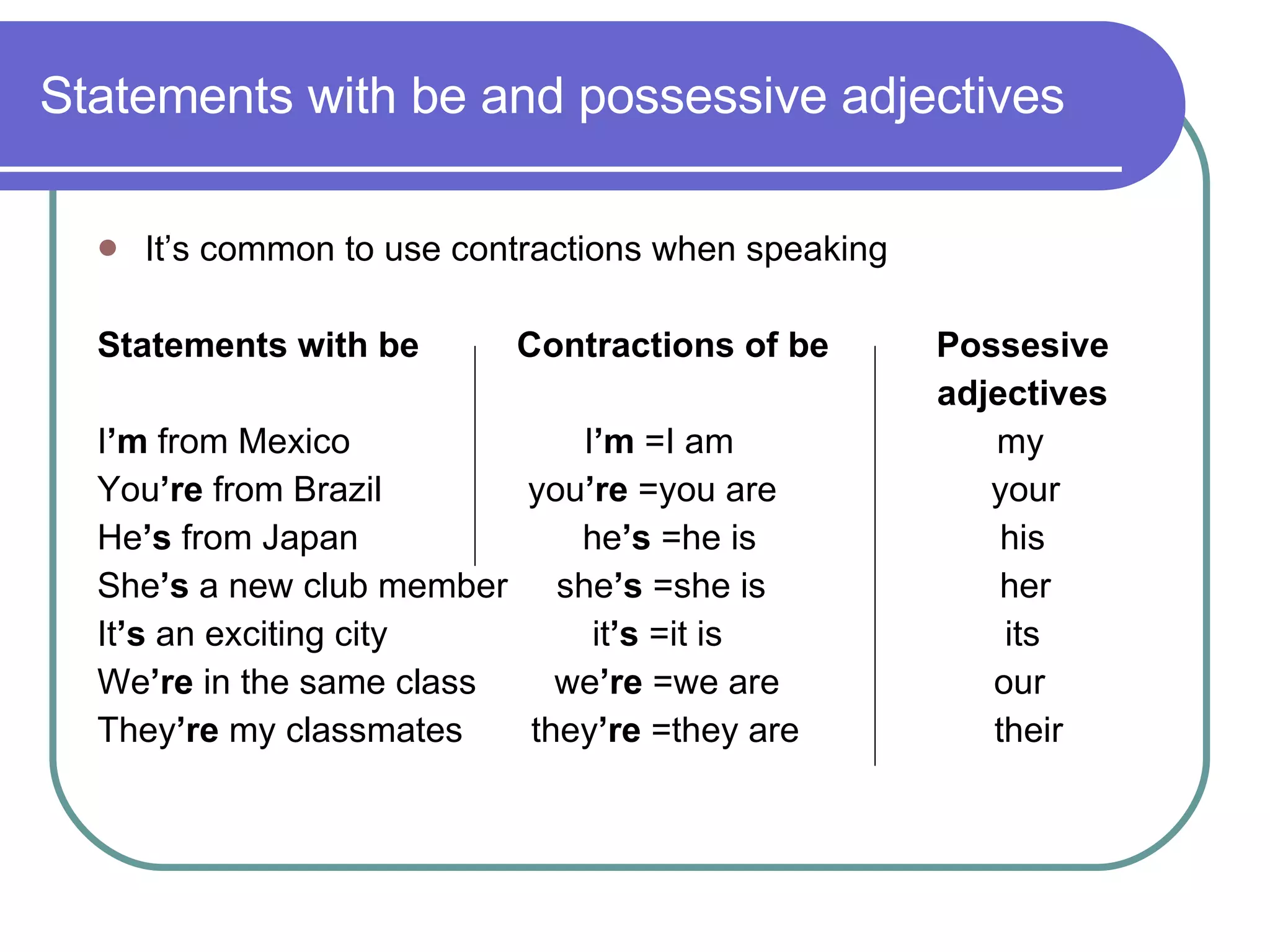
Statements with be and possessive adjectives   It’s common to use contractions when speaking Statements with be  Contractions of be  Possesive    adjectives   I ’m  from Mexico  I ’m  =I am  my You ’re  from Brazil  you ’re  =you are  your He ’s  from Japan  he ’s  =he is  his She ’s  a new club member  she ’s  =she is  her It ’s  an exciting city  it ’s  =it is  its We ’re  in the same class  we ’re  =we are  our  They ’re  my classmates  they ’re  =they are  their
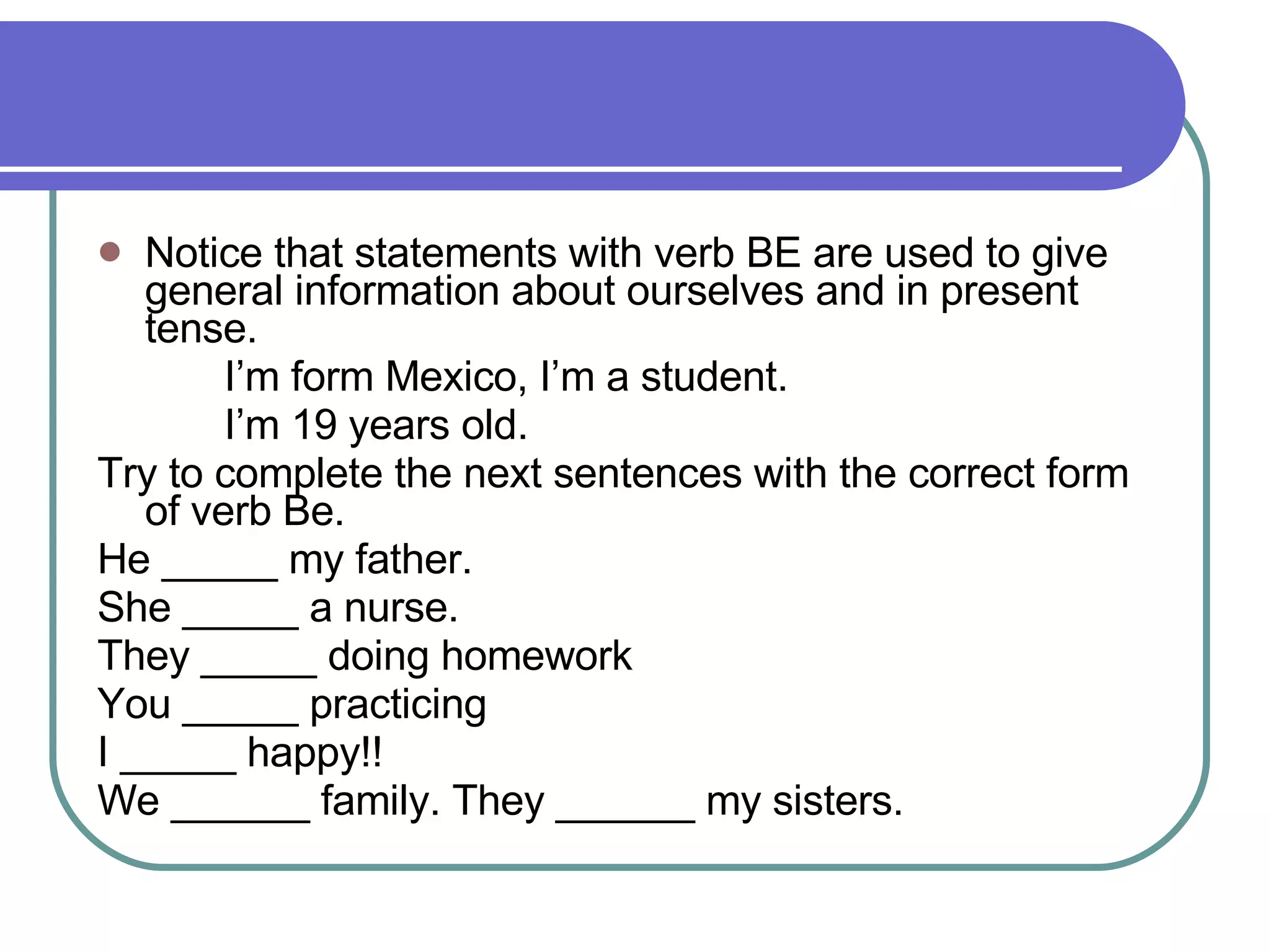
Notice that statements with verb BE are used to give general information about ourselves and in present tense.  I’m form Mexico, I’m a student.  I’m 19 years old.  Try to complete the next sentences with the correct form of verb Be. He _____ my father.  She _____ a nurse. They _____ doing homework You _____ practicing I _____ happy!! We ______ family. They ______ my sisters.
Possessive adjectives I my You  your He his She her It its We our You your They their Possessive adjectives are always followed by a noun, either singular or plural. The form of the possessive is the same before a singular or plural noun. My teacher My Cousins Your bag your books We use possessive adjectives to make it clear that one person or thing belongs to another, or is associated with another. My  name is Sandra  My  classroom We use the possessive adjective  its  when the possessor is an animal or a thing. Don’t confuse  its  with  it’s  (it’s = it is or it has) Have you seen  its  legs?  It’s  (it has) only got three!!
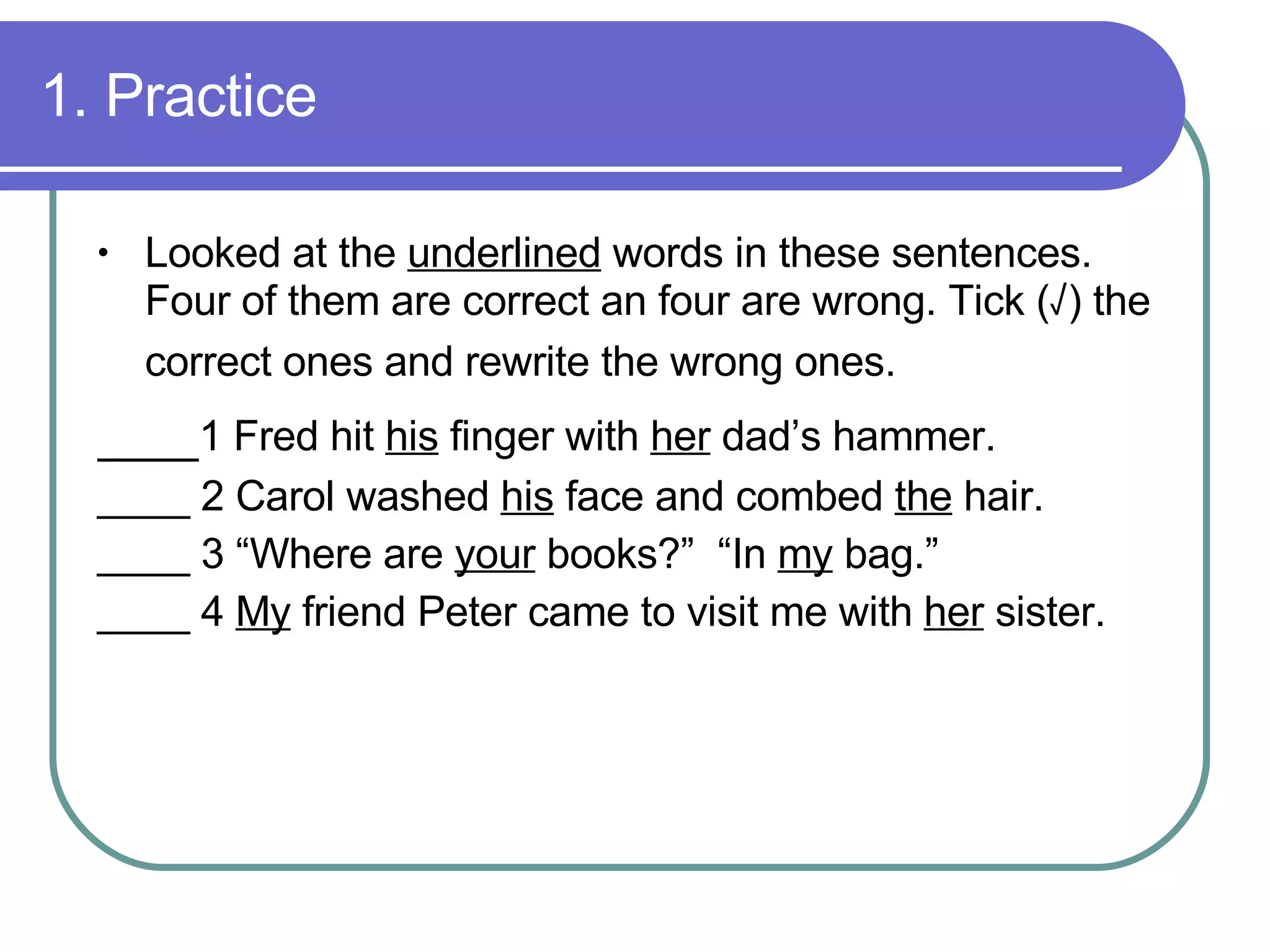
1. Practice Looked at the  underlined  words in these sentences. Four of them are correct an four are wrong. Tick ( √ ) the correct ones and rewrite the wrong ones.   _____ 1 Fred hit  his  finger with  her  dad’s hammer.  ____ 2 Carol washed  his  face and combed  the  hair. ____ 3 “Where are  your  books?”  “In  my  bag.” ____ 4  My  friend Peter came to visit me with  her  sister.
2. Complete the sentence below about “my brothers and sisters, and myself”, using words from the box.  me  my  we  us him  his  you  your her  her  them their   I have four brothers and sisters: a boy, a girl and twins (the twins are boys).  We all live together.  1 We have three bedrooms; one for ___ sister, one for the twins, and one for ___ brother and ___. 2 ___ sister’s bedroom is a mess; ___ is a very untidy girl, and leaves ___ clothes on the floor. ___ mother often tells ___ to tidy her room. 3 ___ brother and ___ are untidy too; ___ leave ___ things all over the house, and ___ father tells ___ to be tidier.
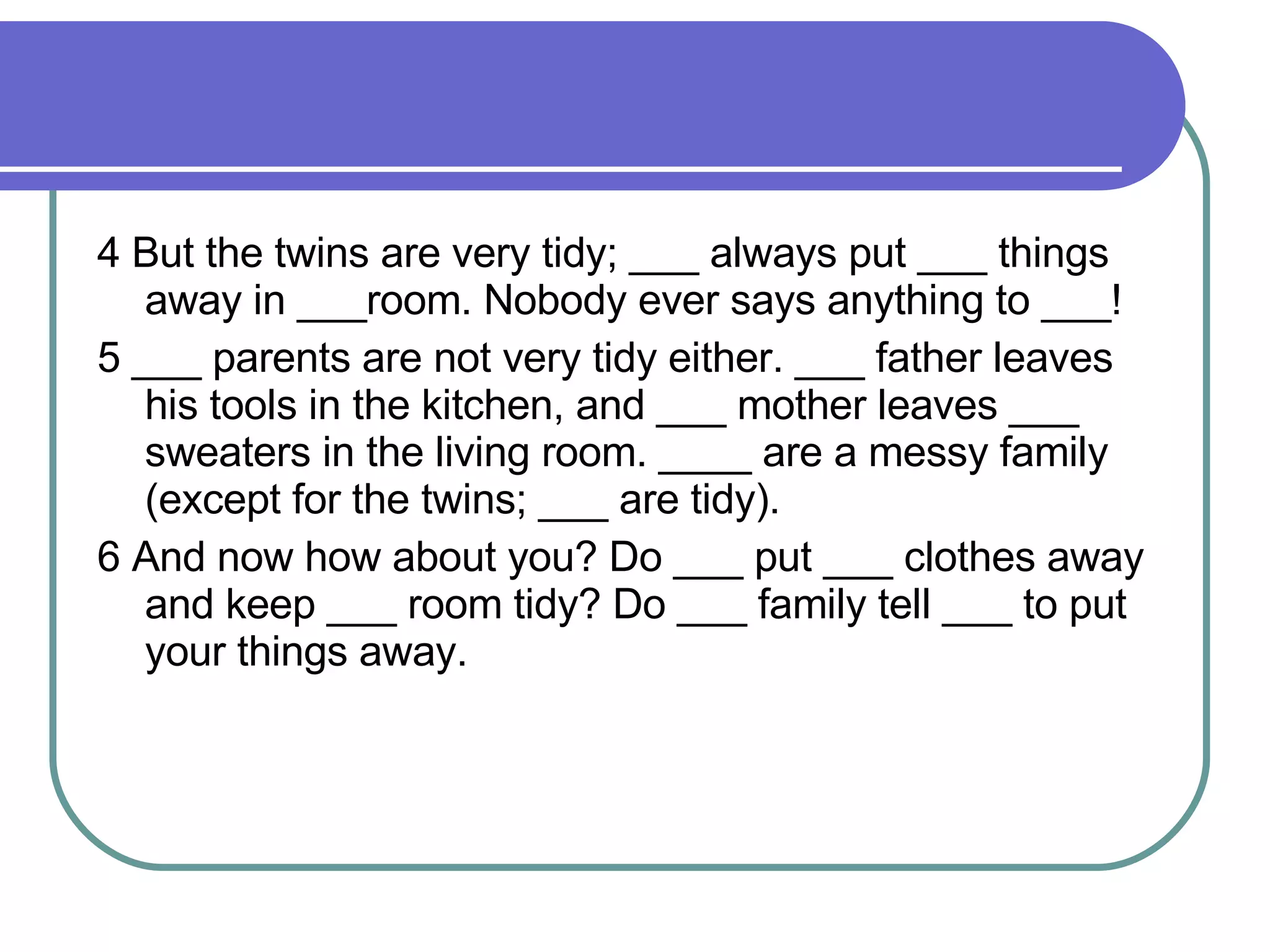
4 But the twins are very tidy; ___ always put ___ things away in ___room. Nobody ever says anything to ___! 5 ___ parents are not very tidy either. ___ father leaves his tools in the kitchen, and ___ mother leaves ___ sweaters in the living room. ____ are a messy family (except for the twins; ___ are tidy).  6 And now how about you? Do ___ put ___ clothes away and keep ___ room tidy? Do ___ family tell ___ to put your things away.
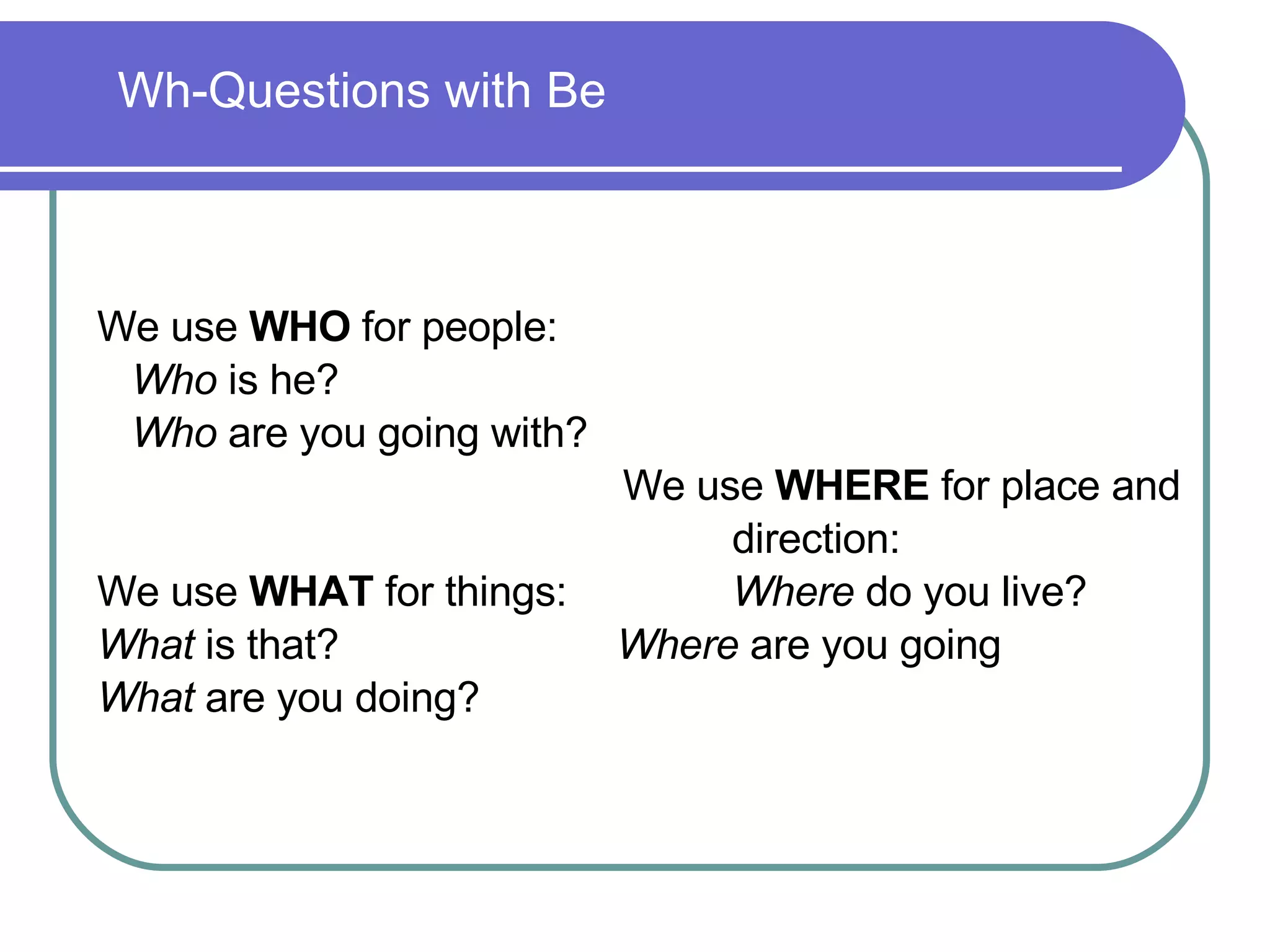
We use  WHO  for people: Who  is he? Who  are you going with? We use  WHERE  for place and  direction: We use  WHAT  for things: Where  do you live? What  is that?    Where  are you going What  are you doing?  Wh-Questions with Be
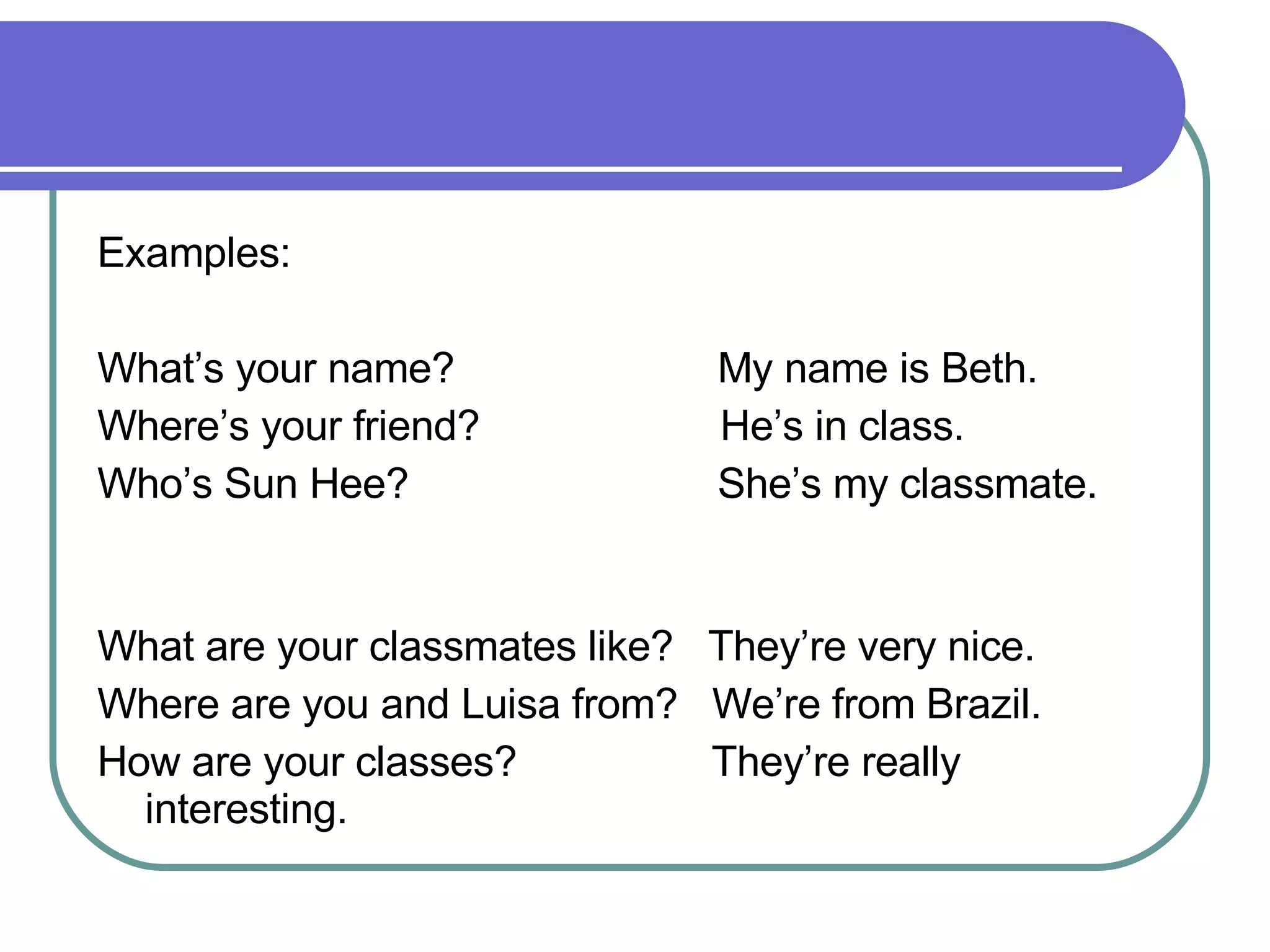
Examples:  What’s your name?  My name is Beth. Where’s your friend?  He’s in class. Who’s Sun Hee?  She’s my classmate.  What are your classmates like?  They’re very nice.  Where are you and Luisa from?  We’re from Brazil. How are your classes?  They’re really interesting.
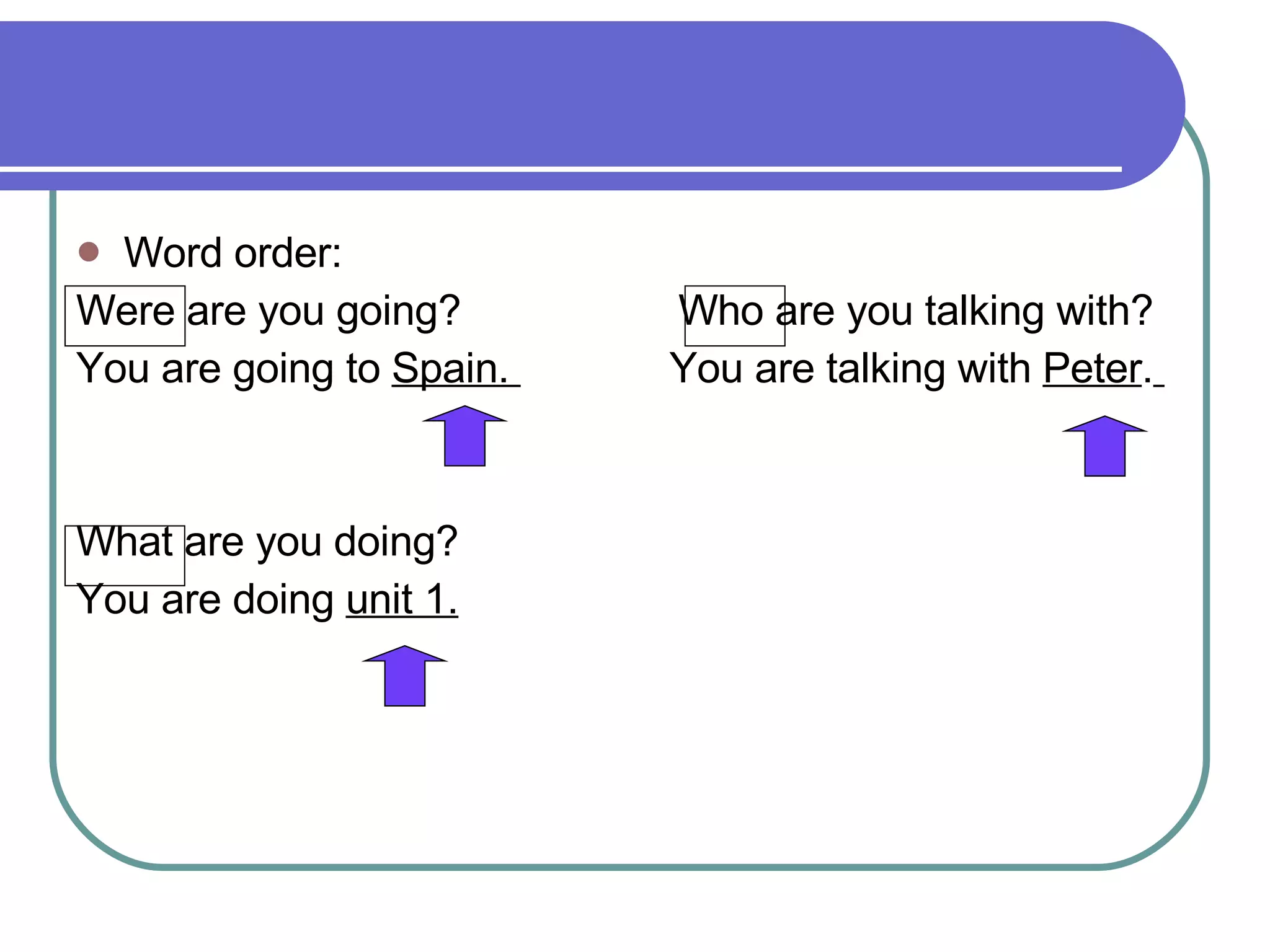
Word order:  Were are you going?  Who are you talking with?  You are going to  Spain.  You are talking with  Peter .   What are you doing? You are doing  unit 1.
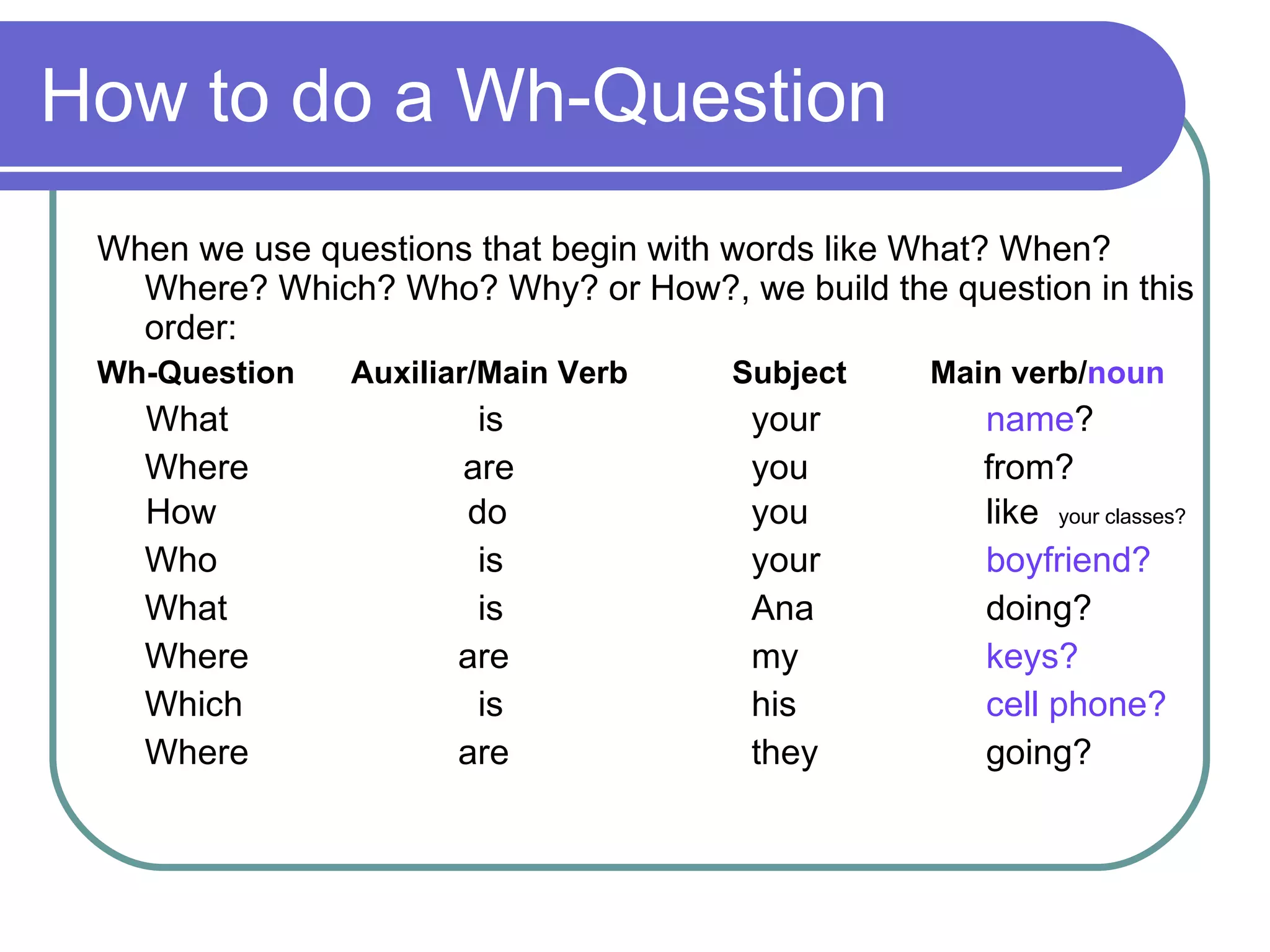
How to do a Wh-Question When we use questions that begin with words like What? When? Where? Which? Who? Why? or How?, we build the question in this order: Wh-Question Auxiliar/Main Verb Subject   Main verb/ noun What is    your name ? Where  are    you  from? How   do   you  like  your classes? Who is   your  boyfriend? What  is    Ana doing? Where   are    my keys? Which is    his cell phone? Where   are   they going?
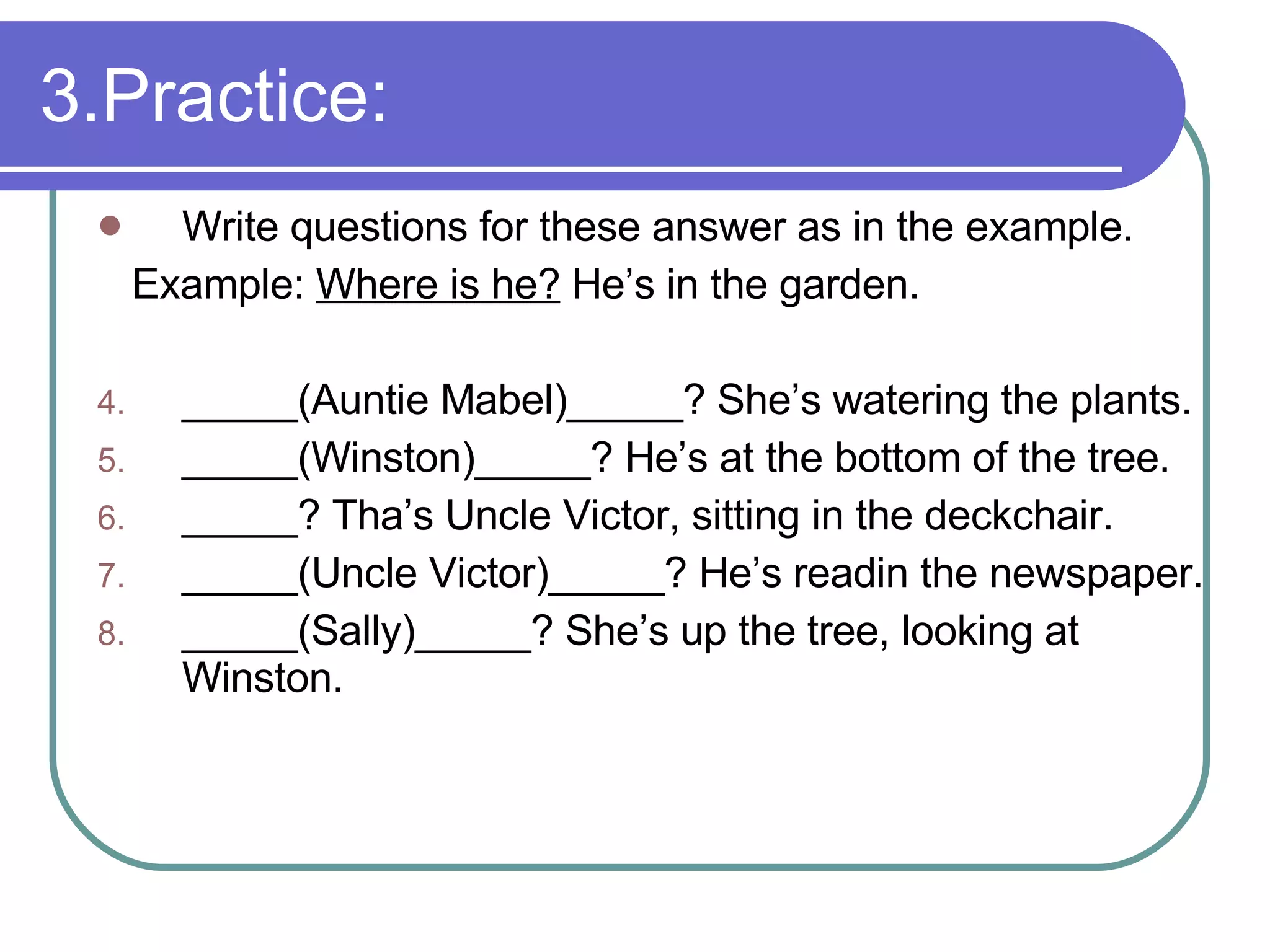
3.Practice: Write questions for these answer as in the example. Example:  Where is he?  He’s in the garden. _____(Auntie Mabel)_____? She’s watering the plants. _____(Winston)_____? He’s at the bottom of the tree. _____? Tha’s Uncle Victor, sitting in the deckchair. _____(Uncle Victor)_____? He’s readin the newspaper. _____(Sally)_____? She’s up the tree, looking at Winston.
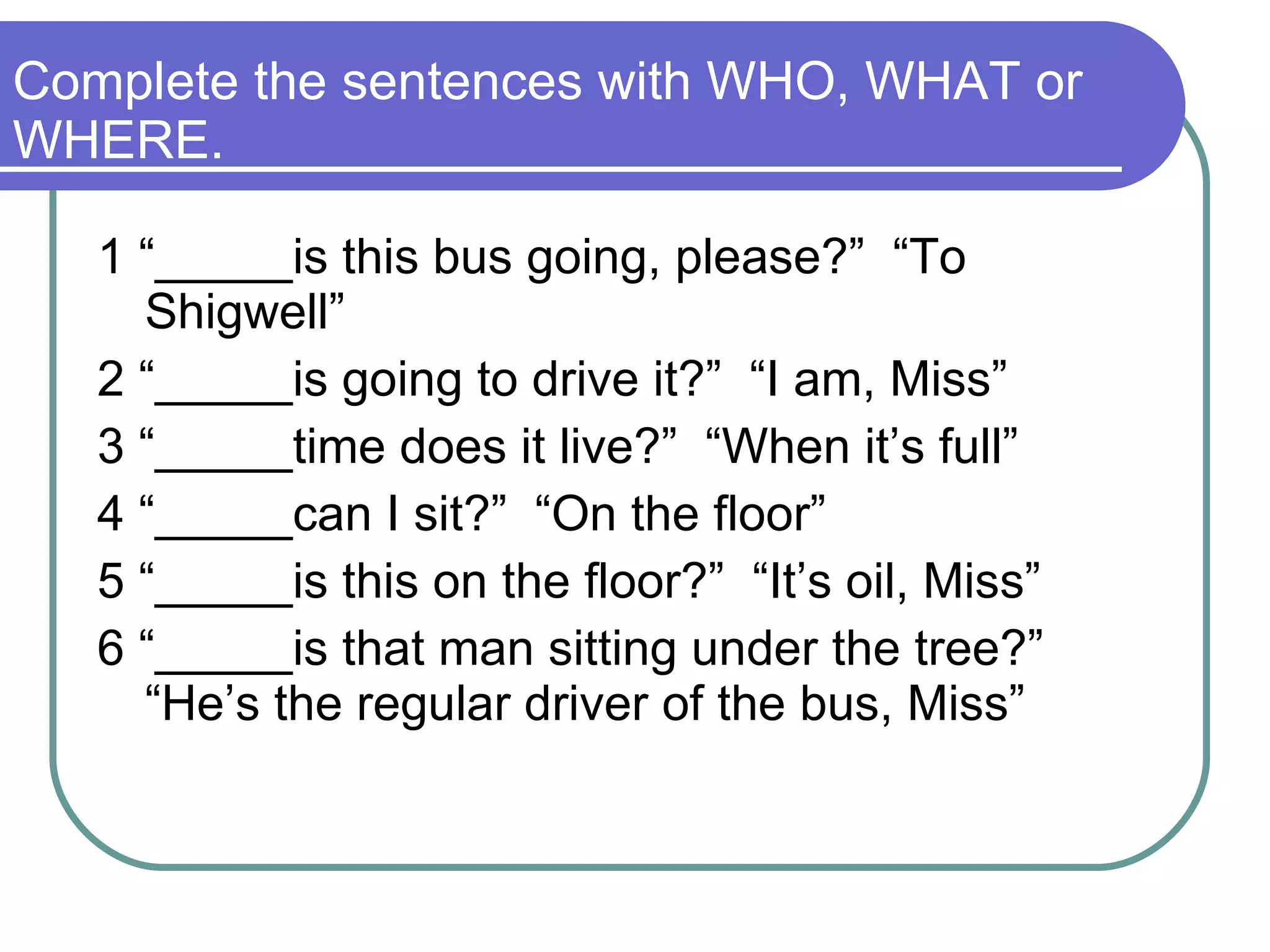
Complete the sentences with WHO, WHAT or WHERE. 1 “_____is this bus going, please?”  “To Shigwell” 2 “_____is going to drive it?”  “I am, Miss” 3 “_____time does it live?”  “When it’s full” 4 “_____can I sit?”  “On the floor” 5 “_____is this on the floor?”  “It’s oil, Miss” 6 “_____is that man sitting under the tree?”  “He’s the regular driver of the bus, Miss”
Bibliography Interchange 1, Third Edition, Student’s Book by Jack C. Richards with Jonathan Hull and Susan Proctor.  Multilevel English Grammar Programme, Level 1, Student’s Book by John Shepherd.  English Grammar in Steps by David Bolton and Noel Goodey.

Unit 1

  • 1.
    Unit 1 Please call me Beth Use of Statements with be; Possesive adjectives and Wh-questions with be Viri M. C. 2008 Rev. Ceci
  • 2.
    Statements with beand possessive adjectives It’s common to use contractions when speaking Statements with be Contractions of be Possesive adjectives I ’m from Mexico I ’m =I am my You ’re from Brazil you ’re =you are your He ’s from Japan he ’s =he is his She ’s a new club member she ’s =she is her It ’s an exciting city it ’s =it is its We ’re in the same class we ’re =we are our They ’re my classmates they ’re =they are their
  • 3.
    Notice that statementswith verb BE are used to give general information about ourselves and in present tense. I’m form Mexico, I’m a student. I’m 19 years old. Try to complete the next sentences with the correct form of verb Be. He _____ my father. She _____ a nurse. They _____ doing homework You _____ practicing I _____ happy!! We ______ family. They ______ my sisters.
  • 4.
    Possessive adjectives Imy You your He his She her It its We our You your They their Possessive adjectives are always followed by a noun, either singular or plural. The form of the possessive is the same before a singular or plural noun. My teacher My Cousins Your bag your books We use possessive adjectives to make it clear that one person or thing belongs to another, or is associated with another. My name is Sandra My classroom We use the possessive adjective its when the possessor is an animal or a thing. Don’t confuse its with it’s (it’s = it is or it has) Have you seen its legs? It’s (it has) only got three!!
  • 5.
    1. Practice Lookedat the underlined words in these sentences. Four of them are correct an four are wrong. Tick ( √ ) the correct ones and rewrite the wrong ones. _____ 1 Fred hit his finger with her dad’s hammer. ____ 2 Carol washed his face and combed the hair. ____ 3 “Where are your books?” “In my bag.” ____ 4 My friend Peter came to visit me with her sister.
  • 6.
    2. Complete thesentence below about “my brothers and sisters, and myself”, using words from the box. me my we us him his you your her her them their I have four brothers and sisters: a boy, a girl and twins (the twins are boys). We all live together. 1 We have three bedrooms; one for ___ sister, one for the twins, and one for ___ brother and ___. 2 ___ sister’s bedroom is a mess; ___ is a very untidy girl, and leaves ___ clothes on the floor. ___ mother often tells ___ to tidy her room. 3 ___ brother and ___ are untidy too; ___ leave ___ things all over the house, and ___ father tells ___ to be tidier.
  • 7.
    4 But thetwins are very tidy; ___ always put ___ things away in ___room. Nobody ever says anything to ___! 5 ___ parents are not very tidy either. ___ father leaves his tools in the kitchen, and ___ mother leaves ___ sweaters in the living room. ____ are a messy family (except for the twins; ___ are tidy). 6 And now how about you? Do ___ put ___ clothes away and keep ___ room tidy? Do ___ family tell ___ to put your things away.
  • 8.
    We use WHO for people: Who is he? Who are you going with? We use WHERE for place and direction: We use WHAT for things: Where do you live? What is that? Where are you going What are you doing? Wh-Questions with Be
  • 9.
    Examples: What’syour name? My name is Beth. Where’s your friend? He’s in class. Who’s Sun Hee? She’s my classmate. What are your classmates like? They’re very nice. Where are you and Luisa from? We’re from Brazil. How are your classes? They’re really interesting.
  • 10.
    Word order: Were are you going? Who are you talking with? You are going to Spain. You are talking with Peter . What are you doing? You are doing unit 1.
  • 11.
    How to doa Wh-Question When we use questions that begin with words like What? When? Where? Which? Who? Why? or How?, we build the question in this order: Wh-Question Auxiliar/Main Verb Subject Main verb/ noun What is your name ? Where are you from? How do you like your classes? Who is your boyfriend? What is Ana doing? Where are my keys? Which is his cell phone? Where are they going?
  • 12.
    3.Practice: Write questionsfor these answer as in the example. Example: Where is he? He’s in the garden. _____(Auntie Mabel)_____? She’s watering the plants. _____(Winston)_____? He’s at the bottom of the tree. _____? Tha’s Uncle Victor, sitting in the deckchair. _____(Uncle Victor)_____? He’s readin the newspaper. _____(Sally)_____? She’s up the tree, looking at Winston.
  • 13.
    Complete the sentenceswith WHO, WHAT or WHERE. 1 “_____is this bus going, please?” “To Shigwell” 2 “_____is going to drive it?” “I am, Miss” 3 “_____time does it live?” “When it’s full” 4 “_____can I sit?” “On the floor” 5 “_____is this on the floor?” “It’s oil, Miss” 6 “_____is that man sitting under the tree?” “He’s the regular driver of the bus, Miss”
  • 14.
    Bibliography Interchange 1,Third Edition, Student’s Book by Jack C. Richards with Jonathan Hull and Susan Proctor. Multilevel English Grammar Programme, Level 1, Student’s Book by John Shepherd. English Grammar in Steps by David Bolton and Noel Goodey.