Language Presentation
Cathy Schlei, Camilla Cook, Paul Sebastian and
Anita McCallum
Date: 1 November 2016
Outline for today
The two main themes of the presentation will
be:
The philosophy of our Whole School
Language Policy
Language pathways, what does Language A
and Language B mean, your child’s
language experiences
3 key points from our Philosophy
● The importance of English as the language of
instruction throughout all of our programmes
● Prem teachers are teachers of the English
language, explicitly supporting students in all
their learning.
● A strong mother tongue is essential for
students to develop as thinkers and
communicators.
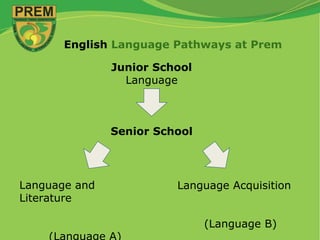
English Language Pathways at Prem
Language and
Literature
Language Acquisition
(Language B)
Junior School
Language
Senior School
Every child’s experience is unique
Example 1:
Esmerelda’s Mother Tongue is English as
both parents speak English to her at
home. She has never spoken French
before. Esmerelda is taking English
Language and Literature and French
Language Acquisition.
Every child’s experience is unique
Example 2:
Oye speaks Thai at home with both of
her parents. She has learnt English in
the Junior School for the past two years.
She is taking Thai Language and
Literature and English Language
Acquisition.
Every child’s experience is unique
Example 3: Johnny speaks both English
and Korean at home with his parents.
English with Mum and Korean with Dad.
Johnny can speak, read and write in both
languages, but he is more confident in
Korean so he is taking Korean Language
and Literature and English Language
Acquisition.
Things to remember...
What is most important is that every child is able to
study Language and Literature in at least one
language.
The number 1 factor in academic success is having
strong literacy skills.
Language and Literature and Language Acquisition
are distinctly different courses but are both worth up
to 7 points in the Diploma Programme.
What does this look like for your
child?
What is your child’s Mother Tongue?
What successes and challenges do they
experience?
What concerns or questions do you have?
Questions and follow up

Whole School Language Presentation (Nov 2016)

  • 1.
    Language Presentation Cathy Schlei,Camilla Cook, Paul Sebastian and Anita McCallum Date: 1 November 2016
  • 2.
    Outline for today Thetwo main themes of the presentation will be: The philosophy of our Whole School Language Policy Language pathways, what does Language A and Language B mean, your child’s language experiences
  • 3.
    3 key pointsfrom our Philosophy ● The importance of English as the language of instruction throughout all of our programmes ● Prem teachers are teachers of the English language, explicitly supporting students in all their learning. ● A strong mother tongue is essential for students to develop as thinkers and communicators.
  • 4.
    English Language Pathwaysat Prem Language and Literature Language Acquisition (Language B) Junior School Language Senior School
  • 5.
    Every child’s experienceis unique Example 1: Esmerelda’s Mother Tongue is English as both parents speak English to her at home. She has never spoken French before. Esmerelda is taking English Language and Literature and French Language Acquisition.
  • 6.
    Every child’s experienceis unique Example 2: Oye speaks Thai at home with both of her parents. She has learnt English in the Junior School for the past two years. She is taking Thai Language and Literature and English Language Acquisition.
  • 7.
    Every child’s experienceis unique Example 3: Johnny speaks both English and Korean at home with his parents. English with Mum and Korean with Dad. Johnny can speak, read and write in both languages, but he is more confident in Korean so he is taking Korean Language and Literature and English Language Acquisition.
  • 8.
    Things to remember... Whatis most important is that every child is able to study Language and Literature in at least one language. The number 1 factor in academic success is having strong literacy skills. Language and Literature and Language Acquisition are distinctly different courses but are both worth up to 7 points in the Diploma Programme.
  • 9.
    What does thislook like for your child? What is your child’s Mother Tongue? What successes and challenges do they experience? What concerns or questions do you have?
  • 10.

Editor's Notes

  • #2 Anita to introduce
  • #3 Anita - also add how the Language policy was developed including sessions by Linda Kay at PSC meetings
  • #4 Paul
  • #5 Anita and Paul
  • #6 Camilla
  • #7 Cathy
  • #8 Cathy
  • #9 Paul
  • #10 Reflection - Camilla
  • #11 Anita and Paul