Shaping the Way We
Teach English
The Landscape of English Language Teaching!
!
Required Readings for the Course

These articles English Teaching Forum are specially chosen for this
MOOC. They are taken from the American English website 

(http://americanenglish.state.gov),where you can download hundreds
of others. They are packaged together here to make it easy to read as an
eBook on a tablet or smartphone using free apps such as Google Play
Books (Android) or iBooks (iOS).
!
!
!
!
!
!
!
!
Week 1!
!
Mary Ashworth and H. Patricia Wakefield
or in kindergarten or grade one, marks an important turning point in terms of
language development. At home, children develop both their physical and con-
versational skills in unstructured circumstances. The greater part of their expe-
rience is often with one caregiver. Even when more than one is involved, the
number is usually limited and they are delighted to focus exclusively on the
child. Learning, although it is spontaneous and unstructured, is nevertheless
steady and involving for the child.
The function of schools is to broaden children’s range of experiences, introduce
new possibilities, systematize the process of learning, help develop thinking skills
and, ultimately, empower students to take responsibility for their own learning.
The strategies children have developed at home to make sense of their world, to
2 V O L U M E 4 3 N U M B E R 1 2 0 0 5 E N G L I S H T E A C H I N G F O R U M
05-0001 ETF_02_07 1/10/05 9:20 AM Page 2
talk about their experiences and to wonder
about what is new or imaginary continue to be
effective. These strategies should not be sup-
planted by the school but augmented by
teachers skilled in helping all children discov-
er their potential.
Gordon Wells told us that knowledge can-
not be transmitted in isolation, but must be
reinvented as the learner brings to each new
situation his own previous experience and
background and interprets new information
from that perspective. By the time children
come to school, they are already successful
communicators. They know what language is
for and how to use it competently. As they
experience new situations and interact with
new adults and children, they continue to use
language to interpret, ask questions, negotiate,
comment and wonder. With skillful guidance
from and the understanding of teachers, chil-
dren’s language continues to grow and blos-
som in the school environment.
“Meaning-making in conversation is a col-
laborative activity,” Gordon Wells wrote. The
wise early childhood teacher knows how to
create an atmosphere in which children’s expe-
riences outside school are valued and talked
about, where their ideas and comments are lis-
tened to with respect, and where they learn to
reflect on what they know. Language is the key
to creative thinking, solving problems and col-
laborative learning. The growth and develop-
ment of language is a lifelong activity, an
essential component of successful living.
Learning a second language
Although they may not be able to express
themselves in English very well, the young
ESL children you are meeting for the first time
are, in fact, experienced language users. Cog-
nitively and linguistically, they are as well-
developed as their English speaking counter-
parts, but this development has taken place in
another language and culture. Now they must
begin the process of transferring what they
know to a new context and continuing their
development in two languages.
First, however, here are some facts about
language that are important to keep in mind:
Language is a human universal. All cultural
groups have a language system that their
members master in order to communicate
with each other.
Language is systematic. Every language has its
own characteristic way of combining sounds,
words and sentences.
No language is wholly regular. Exceptions to
the rule are found in all languages.
All languages enable speakers to create new
utterances. However, these utterances must
conform to the rules established over the cen-
turies by speakers of a particular language.
Language is both creative and functional. A
speaker of any language can both create
and comprehend an infinite number of
utterances based on a finite number of
rules. These utterances can cover a multi-
tude of functions, such as requesting, refus-
ing, promising, warning, denying, agree-
ing, disagreeing and expressing emotions.
Languages change. For example, new words
can be created to meet the scientific and tech-
nological demands of the modern world.
Human beings have an innate capacity to
learn language. All children, unless they are
severely neurologically impaired, are capa-
ble of learning a language.
Language can be non-verbal as well as verbal.
Facial expressions, gestures and other body
movements may convey messages, the
meanings of which are culturally specific.
Language and culture are closely related.
Customs, traditions, values, stories, reli-
gion, history and other manifestations of
culture are transmitted to a large extent
through language.
Language and thought are closely related.
Children and adults use language to share
their thoughts and to expand and clarify
concepts.
Although there are many similarities
between the way first and second languages are
acquired, there are also important differences
that cannot be ignored.
Young English-speaking children do not
know another language; ESL/EFL children do.
They have mastered many of the skills involved
in listening and talking. They know what lan-
guage is and how to use it to request, demand,
invite, socialize and much more.
All young children are highly motivated to
learn language. Surrounded by love and atten-
tion, encouraged and complimented for all their
vocal efforts, they continually make every at-
tempt to communicate. Children learning a
3E N G L I S H T E A C H I N G F O R U M V O L U M E 4 3 N U M B E R 1 2 0 0 5
05-0001 ETF_02_07 1/10/05 9:20 AM Page 3
second language, however, may not feel the
same urgency to communicate in English as
their English-speaking counterparts. They can
already make themselves understood in their
home language. Their initial efforts to speak
English at school may be met not with praise
and encouragement, but with misunderstanding
and ridicule. In addition, they may hear English
only at school, never at home, so that their ex-
posure to comprehensible input is limited.
When young children attempt to use lan-
guage at home, their adult caregivers try very
hard to understand the meaning of their utter-
ances and pay little attention to its form. For
ESL/EFL children, the opposite is too often
true. When they attempt to use English at
school, the teacher often pays more attention
to the form than to the message.
Young children learn their home language
slowly over a number of years. There is no pres-
sure; every advance is enthusiastically wel-
comed. When it becomes necessary for children
to learn English to communicate at school, the
atmosphere is very different. There is consid-
erable pressure on them to learn the new lan-
guage quickly. This pressure does not necessar-
ily come from the teacher, but may originate
with other children, the school system and
their parents. Encouragement of children’s ef-
forts should include praise for making prog-
ress, which is often phenomenal.
Concepts and language development go
hand in hand. All young children develop con-
cepts of shape and color at an early age. Some
of these ideas transfer easily into another lan-
guage. Others, however, are different and can
cause confusion. For example, the color spec-
trum is not divided the same way in all cultures.
Yellow and green are separated by vocabulary
into two colors in English; in some other cul-
tures, one word describes that range of color.
On the other hand, there are some notable sim-
ilarities that help teachers as they plan activities.
For example, the concept of round—a circle—
is universal; only the vocabulary is different.
All children need to hear English modeled
by both adults and their peers in a variety of
situations. In both languages, there is a role for
imitation. Although not all the phonemes, or
sounds, of English are not found in other lan-
guages and vice versa, all children benefit from
activities that highlight different combinations
of sounds. For example, in the song, “Old
MacDonald Had a Farm,” each verse intro-
duces a new animal sound. In English, the cow
says, “A moo-moo here, and a moo-moo there.”
But this approximation of animal sounds is
not the same in all languages. A Chinese cow,
for example, says, “Woo.”
All children need to play with language, try
it out, test it, receive feedback and try again.
This is the way children test the rules and
adjust them to their own world view, a process
that prevails among all language learners.
All children need to have adult language
adjusted to their level of understanding and,
finally, all children learn faster when language
and content are combined. Language is a tool
for learning.
Learning a concept is not a one-shot deal
Children need a variety of experiences with
a concept in a variety of situations with a vari-
ety of people. Each new experience will result
in some modification, extension or limitation
of the concept.
The following are some of the clusters of
concepts that young children should become
familiar with over time:
Identification of objects beginning with those
that are immediate and personal, such as
body parts, clothing and objects in the
classroom.
Classification according to color, shape, size,
number, function and kind, again begin-
ning with what is immediate, personal and
concrete; comparing and contrasting these.
Spatial relationships such as near and far, in
front of and behind and under and over. In
every classroom, opportunities abound for
both the informal and formal teaching of
spatial relationships. For example, activities
such as games, handicrafts and tidying up
can all involve opportunities to develop chil-
dren’s awareness of spatial relationships.
Temporal relationships such as past, present
and future, before and after, and since and
during. Because time is less concrete than
space, it represents an increased level of dif-
ficulty for some children. Some aspects of
time, such as attitudes towards the future
or the keeping of appointments, are cul-
ture-bound.
Emotional and familial relationships such as
love and hate, happiness and unhappiness,
4 V O L U M E 4 3 N U M B E R 1 2 0 0 5 E N G L I S H T E A C H I N G F O R U M
05-0001 ETF_02_07 1/10/05 9:20 AM Page 4
loyalty, family, kinship, self and others,
including both other children and adults.
Many of these concepts are culture-bound.
In North America, for example, far more
emphasis is placed on the individual than on
the group. As another example, some cul-
tures differentiate between an uncle on the
mother’s side and an uncle on the father’s
side. Unless teachers are aware of these dif-
ferences, they may confuse the children.
Ordering which can evolve from one of the
other concept clusters. For example, items
that have been classified as big or little can
be arranged in order from biggest to littlest,
or yesterday’s field trip can be reviewed in
chronological sequence by talking about
what the class did first, next, and so on.
Equivalency which involves recognizing
that although things may differ in some
respects, they may in fact be the same—or
equivalent—in others. For example, differ-
ent shapes may enclose the same area, or
different shaped vessels may contain the
same amount of liquid. Practical experience
with containers of the same or different size
helps develop the concept of equivalency.
Early literacy
Early literacy, a term widely used in current
educational literature, describes how young
children gradually become aware of the uses of
written language in their environment. This
ever-increasing awareness of writing and read-
ing is now considered an integral part of chil-
dren’s early language development.
Before this theory emerged, researchers
thought language development in the early
years was only a precursor to the acquisition of
the essential skills of reading, encoding and de-
coding. It was widely believed that the so-called
readiness skills (letter recognition, recognition
of the sound-symbol correspondence, etc.)
that preceded the act of reading could be
taught only when children were developmen-
tally and physically ready to absorb them. This
readiness, it was believed, occurred as a result
of maturation after children began formal
schooling and were ready to be taught the spe-
cific skills that would enable them to read.
Learning centers
In most preschool and primary settings,
learning centers, sometimes called activity
centers or play areas, are used as an organiza-
tional structure for the classroom. These cen-
ters provide a variety of learning experiences
and materials, encouraging children to
explore, experiment, discover and socialize in
their individual ways. As the children do so,
teachers can observe differences in learning
styles as well as children’s responses to stories,
songs or field trips.
At first, some ESL/EFL children may be
overwhelmed by the variety of new materials,
the freedom to choose, which may be strange
to them, and their inability to play as they
would like to with other children because of a
language barrier. Their responses may be quite
different: some may withdraw silently, others
may wander aimlessly from center to center,
and still others may choose one area, such as
the water table, and refuse to move. Sensitive
teachers will be sympathetic to their need for
time to adjust to the new environment.
The number of learning centers in a class-
room varies with the needs of the children, the
imagination of the teacher and the limitations
of the space. They are all useful for involving
children in different activities, for extending
language and thinking and for encouraging
social interaction with different groups.
Learning centers give teachers a chance to
observe ESL/EFL children closely as they
interact with others, and to make note of their
linguistic, cultural and social needs. If their
English is to develop so that it can keep pace
with their cognitive development, teachers
need to ensure that the progression is logical
and continuous, that language support is visu-
al, aural and emotional and that stimulation is
appropriate and consistent.
Block center
This area, like the others, provides oppor-
tunities for learning through play. It gives teach-
ers a chance to observe the concepts ESL/EFL
children have already developed in their first
language, ensure that they have an opportuni-
ty to express these concepts in English, and
plan for extension.
Number, order, shape, size, space and mea-
surement are only a few of the concepts
ESL/EFL children may have already developed
in their first language. Age is not always a reli-
able measure of what children know: observ-
ing children as you interact with them is much
5E N G L I S H T E A C H I N G F O R U M V O L U M E 4 3 N U M B E R 1 2 0 0 5
05-0001 ETF_02_07 1/10/05 9:20 AM Page 5
more informative. For example, teachers might
say things like, “This is a circle. Can you find a
triangle?” “Let’s put the triangle on top of the
circle.” “Where is the triangle? The circle?”
The possible extensions are endless, but they
should be organized, not haphazard, so that
ESL/EFL children are guided gradually towards
expressing concepts appropriate to their stage of
development. In addition to mathematical con-
cepts, many other kinds of concepts can be
introduced and extended during play in the
block corner. For example, this center provides
an ideal vehicle for integrating studies in various
areas of the curriculum, such as science, social
studies, literacy and mathematics.
Art or creating center
This area offers children the opportunity to
create, experiment and respond personally to
ideas and events.
The things children produce at this center
provide insights into what they are thinking
but cannot yet express in English. Discussing
work-in-progress or completed work with the
children gives teachers a chance to praise, in-
vite appreciation from others and build chil-
dren’s self-confidence.
Equipment at this center will include ma-
terials such as modeling dough, cookie cut-
ters, paints, brushes, paper, coloring pens and
pencils, fabric scraps, glue, easels and tables.
Signing their art work reinforces the children’s
concept of one of the functions of written
language—labeling.
Dramatic play center
Perhaps more than any other, this center
provides both children and teachers with the
best opportunities for learning. As children
reenact a story, role play in the house corner,
choose costumes from the dress-up box or
experiment with items from the prop box, they
engage in many different cognitive activities:
solving problems, hypothesizing, predicting
and sequencing are but a few. Their dialogue
with other children or a teacher helps them use
language to clarify these thinking skills.
This center, popular with most children, is
particularly appealing to ESL/EFL children.
Here, they can become someone else, use Eng-
lish as another character and let their imagina-
tions soar. Teachers watch and learn, partici-
pating only when required.
Sand or water table
The presence of one of these centers does
not preclude the presence of the other. We are
treating them as one, however, because the
activities they encourage are similar—only the
medium is different. To conserve space, some
teachers set up a sand table for a month or
two, then switch to a water table. Equipment
at both should include utensils for measuring,
pouring, scooping and digging, and toys, such
as cars, trucks, bulldozers, boats, balls, animals
and people. Children discover for themselves
that different-shaped containers may hold the
same amount, that some objects float and oth-
ers do not, that sand can be molded but water
can not, and so on.
Library
In some early childhood education class-
rooms, the library is a center, a cozy, inviting
corner where books are kept on shelves within
easy reach of children who want to sit quietly
to look and read. When children gather for cir-
cle or story time, this corner is often used.
Although the library is located in a specific
area, it is so integral to all the learning activities
in some classrooms that children constantly
carry books to other areas to use as references.
Whatever the design, the library is impor-
tant for ESL/EFL children. They need to be
encouraged to look at books, choose stories for
reading, listen to tapes while following along
in the books and borrow books to take home.
They should also be encouraged to share
books from home with other children. If the
books are written in another language, it is a
wonderful opportunity for the other children
to see and learn about a different system of
writing. The illustrations, too, may be very
different from those in English books.
Writing center
Like the library, the writing center, too, is
portable. Reading and writing are integral to
language development and must be included in
the activities of every classroom every day. Very
young children learn to do things like write their
names on their artwork, read labels on class-
room objects, manipulate the day, month and
date on the calendar, choose the appropriate
words to describe the weather, and recognize the
month in which their birthdays occur.
6 V O L U M E 4 3 N U M B E R 1 2 0 0 5 E N G L I S H T E A C H I N G F O R U M
05-0001 ETF_02_07 1/10/05 9:20 AM Page 6
ESL/EFL children should not be excluded
from these activities. No matter how proficient
they are in English when they enter the pro-
gram, written representation should be part of
their daily routine, because all four language
modes—listening, speaking, writing and read-
ing—are interrelated and develop concurrently.
Science center
The science center changes constantly to
keep pace with the children’s varying interests
and the changing seasons of the year. Whether
it is gathering colored leaves in the fall and
observing what happens to them, looking at
pictures of birds to help identify them when
on a field trip, melting snow in winter, or
planting seeds in the spring, the list of activi-
ties is endless. The purpose of the science cen-
ter is to pique children’s curiosity and encour-
age them to observe, question and draw
conclusions. At this center, they learn to do
things like make graphs and charts, record
their observations and interpret data.
Table toys
This learning area often has a variety of
toys and equipment, all of which need a flat
surface for manipulation. They may include
small cars and trucks, dolls or animals, puzzles
and games, and scissors and paper for cutting
out. Centers like this encourage the develop-
ment of hand-eye coordination and fine
motor skills, as well as providing a respite for
ESL/EFL children who may want to play qui-
etly on their own for a while.
Music center
The music center has a fascinating array of
instruments that can be used to create different
sounds and rhythms. They may be commer-
cially created or homemade, whatever the teach-
er can provide—ukuleles, drums, marimbas,
recorders, flutes, sticks, etc. Some centers have
a record player or tape deck that may be used
in large- or small-group activities.
The uses of the music center vary with every
group. Sometimes, it is the focus for a singsong
accompanied by a rhythm band, sometimes
one or two children use it to listen quietly to a
record or story on tape, or sometimes a child
wants to play with one or more of the instru-
ments, experimenting with ways of making
different sounds.
Music is not usually confined to a specific
area. Songs are used at transition times, at
clean-up times, for group activities, and for say-
ing good-bye. ESL/EFL children respond well
to songs because it is often easier to sing some-
thing in another language than to say it.
From Teaching the World’s Children: ESL
for Ages Three to Seven by MARY ASHWORTH
and H. PATRICIA WAKEFIELD. © 2004 by Pip-
pin Publishing Corporation. Reprinted with
permission of the publisher. All rights
reserved
7E N G L I S H T E A C H I N G F O R U M V O L U M E 4 3 N U M B E R 1 2 0 0 5
05-0001 ETF_02_07 1/10/05 9:20 AM Page 7
T
10
Bülent Alan and Fredricka L. Stoller
T U R K E Y A N D U N I T E D S T A T E S
HE IMPLEMENTATION OF PROJECT WORK DIFFERS GREATLY FROM ONE INSTRUCTIONAL
setting to another. In some settings, fairly non-elaborated tasks, confined to a
single class session, are labeled as projects. In other settings, elaborate sets of
tasks establish the process for completing the project and span an entire instruc-
tional unit; in settings like these, the benefits of project work are maximized
because students are actively engaged in information gathering, processing, and
reporting over a period of time, and the outcome is increased content knowledge
and language mastery. In addition, students experience increased motivation,
autonomy, engagement, and a more positive attitude toward English. Although
project-based learning presents challenges for teachers and students (Beckett
2002; Eyring 1997), most project-work proponents assert that the advantages
outweigh the disadvantages.
Maximizing
the
Benefitsof
ProjectWork
in
Foreign
Language Classrooms
V O L U M E 4 3 N U M B E R 4 2 0 0 5 E N G L I S H T E A C H I N G F O R U M
05-0004 ETF_10_21 10/18/05 3:19 PM Page 10
In this article, we focus on how English lan-
guage teachers can capitalize on the content
and language learning benefits of project
work. To explore the topic, we examine the
characteristics of under-exploited project
work, outline the features that maximize the
potential benefits of project work, and present
a case study of project-based learning. We con-
clude with recommendations for English as a
Foreign Language (EFL) teachers and materi-
als writers who want to integrate project-based
learning into their own curricula.
Under-exploited project work
Numerous language educators incorporate
what they call “project work” into their class-
rooms, even though the lessons do not maxi-
mize the full potential of project work. For ex-
ample, in some settings, basic communicative
activities used to help students get to know one
another better and to promote conversation
have been labeled as projects. What often oc-
curs in such settings is that students, when giv-
en the chance, join groups with their friends.
They complete their non-elaborated tasks in a
superficial way without much collaboration. Stu-
dents socialize, but rarely assist each other with
the language and information-gathering de-
mands of the task (if there are any demands).
In some settings, project work is merely a
source of entertainment and a break from rou-
tine classroom activities. Though projects
often focus on challenging, real-world subject
matter, students are often solely concerned
with the visual attractiveness of their projects,
paying little attention to content and language
learning. In these settings, teachers often rein-
force this misdirected attention by assessing
student projects according to their visual
appeal, ignoring students’ gains in language
and content learning.
In other settings, students are constrained
in their ability to grow from their projects,
either because of excessive teacher control or
because of the absence of teacher feedback and
guidance during the process. In settings char-
acterized by too much teacher control, we find
instructors who dictate each step of the process
without giving students any voice in defining
the project. Generally, such excessive control
inhibits students from taking responsibility for
their own learning and developing a sense of
ownership toward the project. In these settings,
students are rarely asked to provide feedback
on the project experience; thus, often the same
project is incorporated into future instruction,
with no modification, which usually results in
the same lack of student engagement. Another
problem occurs when repeating students influ-
ence new students with their negative attitudes
toward the project, further undermining the
potential of the project.
Project work can be more effective when
teachers relax their control, when students re-
gard the teacher as a guide (Sheppard and
Stoller 1995), and when students provide feed-
back on the experience so that projects can be
improved each year. A total relaxation of teach-
er control, however, is not the solution to a
teacher-centered project. In some cases, stu-
dents are left alone and receive no guidance on
the language, content, or process demands of
the project. Here, it seems, teachers have ig-
nored both the process-based nature of project
work and students’ need for support at differ-
ent stages in the project. Finding the proper
balance between teacher guidance and student
autonomy enhances the advantages of project
work in the language classroom.
Project work that maximizes benefits
Projects that are structured to maximize
language, content, and real-life skill learning
require a combination of teacher guidance,
teacher feedback, student engagement, and elab-
orated tasks with some degree of challenge.
Generally, such projects are multidimensional.
A review of numerous case-study reports
(Allen 2004; Gardner 1995; Gu 2004; Ho
2003; Lee 2002; Levine 2004; Papandreou
1994; Tomei, Glick, and Holst 1999) reveals
that successful project-based learning:
• focuses on real-world subject matter that
can sustain the interest of students
• requires student collaboration and, at the
same time, some degree of student
autonomy and independence
• can accommodate a purposeful and
explicit focus on form and other aspects
of language
• is process and product oriented, with an
emphasis on integrated skills and end-of-
project reflection.
The end result is often authenticity of experi-
ence, improved language and content knowl-
11E N G L I S H T E A C H I N G F O R U M V O L U M E 4 3 N U M B E R 4 2 0 0 5
05-0004 ETF_10_21 10/18/05 3:19 PM Page 11
edge, increased metacognitive awareness,
enhanced critical thinking and decision-mak-
ing abilities, intensity of motivation and
engagement, improved social skills, and a
familiarity with target language resources.
One way to maximize the potential bene-
fits of project work is to follow the ten-step
process advocated by Stoller (1997) and Shep-
pard and Stoller (1995). The ten steps are
summarized below.
Step 1: Students and instructor agree
on a theme for the project
The students and instructor come to an
agreement on a project theme. Because proj-
ects range from structured, semi-structured, to
unstructured in terms of the degree to which
the teacher defines the project (Stoller 1997),
instructors should identify ways (large or
small) in which students can develop some
sense of ownership toward the project.
Step 2: Students and instructor determine
the final outcome of the project
With the nature and objectives of the proj-
ect in mind, the students and instructor deter-
mine the final outcome of the project (e.g.,
bulletin board display, written report, debate,
brochure, letter, handbook, oral presentation,
video, multimedia presentation, theatrical per-
formance). At this point, the students and
instructor negotiate the most appropriate
audience for their projects (e.g., classmates,
other students, parents, program director, city
mayor, a local business).
Step3: Students and instructor structure
the project
After the theme and final outcome of the
project are determined, the students and
instructor work out project details that guide
students from the opening activity to the com-
pletion of the project. In this step, students
consider their roles, responsibilities, and col-
laborative work groups. After negotiating a
deadline for project completion, students
reach a consensus on the timing for gathering,
sharing, and compiling information, and then
presenting their final project.
Step 4: Instructor prepares students for the
demands of information gathering
At this stage, the instructor prepares students
for the language, skill, and strategy demands
associated with information gathering. With
student ability levels in mind, the instructor
prepares instructional activities for each of the
information-gathering tasks. For instance, if
students will be conducting interviews to
gather information, the instructor may plan
activities in which students have to form ques-
tions, ask follow-up questions, request clarifi-
cation, and take notes. If students are expect-
ed to write letters, the instructor might review
the format and language of formal letters. If
they intend to conduct an Internet search, the
instructor may review search procedures and
introduce useful note-taking strategies.
Step 5: Students gather information
After practicing the skills, strategies, and lan-
guage needed for gathering information, stu-
dents are ready to collect information using
methods such as interviewing, letter writing,
and library searches. Whenever possible, the in-
structor brings in relevant content resources to
get students started on their information quests.
Step 6: Instructor prepares students to compile
and analyze data
At this stage, students need to master the
language, skills, and strategies needed to com-
pile, analyze, and synthesize the information
that they have collected from different sources.
The instructor prepares students to do much
of this on their own through tasks that
involve, for example, categorizing, making
comparisons, and using graphic organizers
such as charts and time lines. Numerous train-
ing sessions might need to be planned,
depending on the types of information col-
lected and the ways in which it was collected
(e.g., taped interviews, brochures received in
response to solicitation letters, library research,
and note-taking).
Step 7: Students compile and analyze
information
After engaging in teacher-guided prepara-
tory activities, students are ready to tackle the
demands of compiling and analyzing the gath-
ered information. Working in groups, stu-
dents organize information and then discuss
the value of the data that they have collected,
keeping some and discarding others. The goal
is to identify information that is critical for the
completion of their projects.
Step 8: Instructor prepares students for the
language demands of the final activity
As in Steps 4 and 6, the instructor designs
language-improvement activities to help stu-
12 V O L U M E 4 3 N U M B E R 4 2 0 0 5 E N G L I S H T E A C H I N G F O R U M
05-0004 ETF_10_21 10/18/05 3:19 PM Page 12
dents successfully present the final outcome of
the project. Those activities may focus on skills
for successful oral presentations, effective writ-
ten revisions and editing, persuasive debates,
and so forth. Some focus on form might be
greatly appreciated by students at this point.
Step 9: Students present the final product
Students present the final outcome of their
projects, as planned in Step 2.
Step 10: Students evaluate the project
In this last, often neglected stage of project
work, students reflect on the language mastered
and the subject matter acquired during the proj-
ect. In addition, students are asked to make rec-
ommendations that can be used to enhance
similar projects in the future. It is during this
stage that teachers provide students with feed-
back on their language and content learning.
Project work options
The details of project work are largely de-
pendent on contextual factors, language pro-
gram objectives, and available resources. For
instance, in Turkey, at higher education levels,
students of agriculture can engage in project
work about soil erosion, which is a serious
contemporary issue, with the goal of generat-
ing possible solutions for deforestation in
Turkey. Engineering students can prepare
written reports after investigating the advan-
tages and disadvantages of a third bridge over
the Bosphorus in Istanbul; they might even
send their reports to interested officials. Stu-
dents enrolled in a vocational school on the
southern coast of Turkey might design a web-
site that introduces their town, with an eye
toward attracting and building tourism in the
area (Hüseyin Yücel, personal communication,
May 2004). Academic English-preparation
students in their first year of university studies
can explore a self-selected topic related to their
majors (reported orally to classmates and in
writing for their teacher) to prepare them for
future studies (Semra Sadik, personal commu-
nication, June 2004). Students majoring in
physical education may investigate reasons for
the limited numbers of Turkish athletes in
recent Olympic games. EFL students in the
eastern part of Turkey might conduct a survey
aimed at determining the causes for low
female-student school enrollments, conclud-
ing with suggestions, submitted to local offi-
cials, for turning around the trend.
Students studying EFL in other countries
are known to focus their projects on issues spe-
cific to their own countries, regions, and stud-
ies. Italian vocational high schools, for example,
have structured their curricula around topics
of relevance to students in various vocational
areas, resulting in brochures for tourists, travel
itineraries submitted to travel agencies, school
banquet manuals, and many other real-world
items. EFL students in Tunisian high schools
have explored topics as diverse as mining and
traditional marriage practices as part of their
project work, culminating in video presenta-
tions of their findings. EFL students in Japan
are surveying visitors at major tourist destina-
tions—with note pad, tape recorder, and cam-
era in hand—about topics of contemporary
interest. In line with such practices, Brazilian,
Costa Rican, or Malaysian students could con-
duct projects with an environmental slant that
are aimed at convincing local or national gov-
ernments to take necessary precautions to pro-
tect local rain forests. (See Lee 2002, for a
description of a project involving the creation
of a booklet that describes an environmentally
sound home, with suggestions for environ-
mentally sensitive lifestyles.) These examples,
like those in Appendices 1 and 2, represent just
a sampling of possible projects and outcomes
that can be integrated into EFL classrooms.
Project work: A case study
Here we showcase a real-world project de-
signed for intermediate and high-intermediate
EFL students enrolled in the English Prepara-
tory Program, in the School of Foreign Lan-
guages at Anadolu University, Eskis¸ehir,
Turkey. As part of this semi-structured project,
defined and organized by both the teacher and
students, students evaluate the effectiveness of
the local tramcar system. As part of their data
collection, they interview experts from the
university, authorities from the city govern-
ment, and residents of Eskis¸ehir. They also
write formal letters to the city to request infor-
mation and conduct library and Web research.
At the conclusion of the project, students pre-
sent results to students in the School of For-
eign Languages as well as to guests from the
university and city government by means of a
public forum, reinforced by a bulletin board
display with findings and recommendations.
The principal goal of the month-long project
13E N G L I S H T E A C H I N G F O R U M V O L U M E 4 3 N U M B E R 4 2 0 0 5
05-0004 ETF_10_21 10/18/05 3:19 PM Page 13
is to give students a voice in reshaping their
town and its tramcar system. By the conclu-
sion of the project, students are able to do the
following:
• Gather pertinent information through
various data-collection techniques, such
as interviews, surveys, and library and
Web research
• Engage in critical thinking activities, par-
tially through synthesis activities
• See improvement in their language skills
• Use English with more self-confidence
The project, structured following Stoller’s
(1997) ten steps, is described below.
Step 1: Students and instructor agree
on a project
The instructor conducts a lesson designed
to raise students’ awareness of a local tramcar
issue. This opening lesson, meant to encour-
age students to participate in shaping public
opinion, elicits students’ attitudes toward pub-
lic transportation, specifically tramcars, and
provides them with the vocabulary and lan-
guage needed to participate in the project.
The instructor asks students where they live
and how they travel to school. To facilitate this
interaction, the instructor creates an overhead
transparency with a grid that lists different
forms of transportation, including tramcars.
The instructor fills in the grid with students’
initials or tally marks to indicate who uses
which forms of transportation. After filling in
the grid, the instructor asks students to work in
small groups, ideally with at least one student
whose hometown has tramcar transportation.
Students are asked to discuss the effectiveness
of their hometown public transportation. A
handout providing relevant vocabulary and a
list of possible questions guides students in
group discussions (see Figure 1).
Follow-up activities are useful to guide stu-
dents in comparing the advantages and disad-
vantages of the Eskis¸ehir tramcar system with
the systems of other cities. At the conclusion
of group discussions, each group reports its
14 V O L U M E 4 3 N U M B E R 4 2 0 0 5 E N G L I S H T E A C H I N G F O R U M
FIGURE 1: EFFECTIVENESS OF HOMETOWN TRANSPORTATION SYSTEM
05-0004 ETF_10_21 10/18/05 3:19 PM Page 14
most important finding, most worrisome dis-
covery, and any similarities discovered about
tramcar systems in other cities.
The instructor then asks students to take a
few minutes to fill in a semantic feature analy-
sis grid that juxtaposes different features of
the local tramcar and bus systems (see Figure
2). Then students are asked to brainstorm the
advantages and disadvantages of the Eskis¸ehir
tramcar, considering factors such as the loca-
tions of their homes, routes, and tramcar sta-
tions (see Figure 3).
After students complete these activities,
the instructor elicits suggestions for improv-
ing the quality of Eskis¸ehir public transport.
The instructor asks students to judge whether
it is possible to implement the solutions that
they have put forward. Next, the instructor
tells students about a project that will help
them improve their English and might also
improve the local tramcar system. Finally, the
instructor introduces the essentials of the proj-
ect, giving students the opportunity to fine-
tune the project so that they develop a sense
of ownership.
Step 2: Students and instructor determine the
final outcome of the project
The teacher proposes that students report
the results of their investigation, with sugges-
tions for improved public transportation: (1)
in a letter to the local government, (2) at an
open public forum with invited guests, and
(3) on a bulletin board in Anadolu Universi-
ty’s School of Foreign Languages. Students are
encouraged to include the following in their
bulletin board display: a copy of a letter sent to
the Eskis¸ehir municipality requesting a mod-
ified tramcar system that caters to the needs of
university students, written reports, pho-
tographs, and transcripts of interviews with
15E N G L I S H T E A C H I N G F O R U M V O L U M E 4 3 N U M B E R 4 2 0 0 5
FIGURE 2: SEMANTIC FEATURE ANALYSIS GRID
WHAT DO YOU THINK OF THE TRAMCAR SYSTEM IN ESKIS¸EHIR?
Pros Cons
FIGURE 3: GRID FOR BRAINSTORMING ACTIVITY
05-0004 ETF_10_21 10/18/05 3:19 PM Page 15
students, community members, and universi-
ty experts.
Feedback on this preliminary plan is solicit-
ed from students. At this stage, students are
also given the opportunity to define their var-
ied audiences for the letter, public forum, and
bulletin board display. For instance, besides
the Foreign Languages School director, teach-
ers, and students, they decide who else to
invite from the university governing council
and the Eskis¸ehir municipality.
Step 3: Students and instructor structure
the project
At this stage, students help to structure the
project. To do so, they consider questions such
as:
1. What information is needed to conduct
an examination of the local tramcar
system?
2. Where and how might pertinent infor-
mation be found?
a. Who will be interviewed to deter-
mine public opinion? To identify the
views of experts on public trans-
portation? To ascertain the views of
the local government?
b. What information might be found
at the library? On the Web? At the
City Hall? At public transportation
stations?
3. How will information be gathered,
compiled, and analyzed?
During these deliberations, students decide
on their primary roles and responsibilities. For
instance, students determine who will conduct
interviews; take photos; do library and Web
searches; draw graphs, pictures, and charts;
finalize the bulletin board display; and make
opening remarks, present data, and entertain
questions at the open forum. While determin-
ing roles, the students’ majors are taken into
account so they can be assigned roles most
closely aligned with their interests and abilities.
For instance, students from the fine arts depart-
ment might be responsible for the layout of the
bulletin board display, journalism students can
conduct oral interviews, aspiring English
majors can write letters soliciting information,
and math majors can compile statistics. To bal-
ance the workload, students can pair up with
others to offer assistance at different points in
the project. With the deadline for the final out-
come in mind, students reach a consensus
about the sequencing of project tasks.
Step 4: Instructor prepares students
for information gathering
At this stage, the instructor prepares stu-
dents for the upcoming language and skill
demands of the information-gathering stage of
the project. These lessons train students to
conduct interviews (e.g., forming a question,
posing follow-up questions, requesting clarifi-
cation and/or elaboration) and introduce them
to the standard parts of an interview: polite
opening, body, and thank you (see Lee, Li, and
Lee 1999, for more details on the various stages
of an interview). The instructor might help
students determine the level of language for-
mality and content of the questions to be asked
of different interviewees. Mock interviews can
be conducted with classmates, family mem-
bers, teachers, or other language students on
campus. Audiotaped mock interviews can be
reviewed in class for appropriateness, polite-
ness, pronunciation, stress, and grammar.
For students who are responsible for writ-
ing formal letters, the instructor introduces
writing conventions associated with formal
letter writing by means of model letters. Stu-
dents write several drafts of their letters, fol-
lowed by editing and revision activities that
examine levels of formality, formatting, and
linguistic accuracy. Guided peer-feedback ses-
sions represent effective ways to encourage
student collaboration and writing practice.
For students who are going to use the Web
and library to gather relevant information, the
instructor initiates brainstorming sessions in
which students consider the best ways to
search for information in these venues. As part
of this preparation, the instructor may intro-
duce students to relevant search engines or
websites on mass transit.
Step 5: Students gather information
After practicing the skills, strategies, and
language they need for gathering information,
students are ready to conduct informal inter-
views with students and local residents of
Eskis¸ehir. Students who are to conduct formal
interviews make appointments and conduct
interviews with experts. (The instructor may
need to help students find equipment needed
for interviews, such as tape recorders.) Stu-
16 V O L U M E 4 3 N U M B E R 4 2 0 0 5 E N G L I S H T E A C H I N G F O R U M
05-0004 ETF_10_21 10/18/05 3:19 PM Page 16
dents gathering information by means of let-
ters of inquiry draft their letters, solicit feed-
back from classmates and the instructor, and
then send out their letters. Students who are
to conduct library and Web searches move
ahead. Throughout this stage, the instructor
monitors students’ progress, making sure that
they are on the right track, giving them feed-
back on their language use throughout.
Step 6: Instructor prepares students
for compiling and analyzing data
After data have been gathered, students
need to compile, evaluate, and synthesize the
relevant information. The instructor prepares
students for this vital stage of the project by
using model transcripts, letters, lists, and grids
to illustrate different categorization, evalua-
tion, and interpretation techniques. This is a
good time to introduce students to conversa-
tional gambits that they can use with each
other to negotiate the meaning and relevance
of gathered data, such as “I see your point,
but…” and “Don’t you think that…?”
Step 7: Students compile and analyze
information
After students have been introduced to
techniques for compiling and analyzing data,
they are ready to organize and synthesize their
own data. Groups of students discuss the value
of their data, discarding that which seems
inappropriate and organizing and then evalu-
ating that which seems particularly valuable.
Students discuss the best ways to present rele-
vant data to their varied audiences.
Step 8: Instructor prepares students
for the final activity
At this stage, the instructor prepares stu-
dents for the language, skill, and content
demands presented by the final written display
and oral presentation. A simulation of the
open forum provides opportunities to work
on fluency, pronunciation, intonation, and
conversational gambits that will contribute to
the flow of the event. (See Mach, Stoller, and
Tardy 1997 for a related discussion.) Students
who are not actually involved in the public
forum might be assigned different roles for the
simulation, such as a representative from the
municipality of Eskis¸ehir, representatives of the
university governing council, or the director
and teachers of the School of Foreign Lan-
guages. These students could be directed to
anticipate what kinds of questions the actual
audience might ask about the bulletin board
display. At the conclusion of the simulation,
the class can brainstorm about challenges that
might be encountered during the actual open
forum, such as irrelevant questions, hard-to-
understand questions, and public resistance to
findings and suggestions. In addition, possible
solutions to these challenges can be discussed,
including a list of possible questions and
responses, back-up visual displays, and con-
versational gambits to ask for clarification. A
discussion of open-forum logistics (e.g., room
set-up, invitations to audience members,
videotaping) would be appropriate as well.
Discussions of the bulletin board, with an
emphasis on presentation of information, lay-
out, visual appeal, clarity, and peer editing
(that focuses on mechanics, grammar, level of
formality, cohesion) are appropriate at this
point.
Step 9: Students present final product
Students are now ready to mount the bul-
letin board display and participate in the open
forum, representing the final outcomes of the
class project. (Videotaping the open forum
facilitates meaningful feedback in the final
stage of the project.)
Step 10: Students evaluate the project
This last stage of the project serves multiple
purposes. On the more traditional side, teach-
ers provide students with feedback on their
language, content, strategy, and skill use, using
the videotape of the open forum as one means
of interactive evaluation. Less traditional, but
equally valuable, are the opportunities stu-
dents will have to: (1) reflect on the language,
skills, and strategies that they have mastered to
conduct the project; (2) consider the content
that they have learned to complete the project;
(3) contemplate the impact of the project; and
(4) offer suggestions for improved project-
work assignments for future classes.
Conclusion
We have showcased the details of one proj-
ect designed for an EFL setting. Although the
tramcar theme itself may not be transferable to
other settings, because of its very local rele-
vance, basic features of the project could easily
be transferred to other EFL classrooms. These
transferable features, in the form of recommen-
dations for EFL teachers and materials writers
17E N G L I S H T E A C H I N G F O R U M V O L U M E 4 3 N U M B E R 4 2 0 0 5
05-0004 ETF_10_21 10/18/05 3:19 PM Page 17
who attempt to integrate project-based learn-
ing into their own curricula, appear below.
• Devise projects with students’ immediate
and future language needs and content
interests in mind, while at the same time
remaining vigilant of institutional expec-
tations and available resources.
• Specify language, content, task, skill, and
strategy learning objectives in line with
students’ needs and institutional expec-
tations to maximize the benefits of the
project.
• Strive to engage students in all stages of
the project. Begin by giving students the
chance to structure parts of the project,
even if those contributions are small,
with the aim of building a sense of stu-
dent ownership and pride in project
engagement.
• Design and sequence tasks with great
care. Make sure that (1) skills are inte-
grated to achieve real communicative
purposes, (2) students are obliged to use
various strategies for meaningful aims, (3)
critical thinking is required for successful
task completion, and (4) students are
held accountable for content learning.
• Integrate tasks that require both inde-
pendent and collaborative work. Help
students reach agreement about different
team member responsibilities. Students
should view each other as single links in
a chain that unite, through exchanges of
information and negotiation of meaning,
to produce a successful project outcome.
• Be sure to plan an opening activity that
promotes students’ interests, taps back-
ground knowledge, introduces impor-
tant vocabulary, and builds up expecta-
tions for the final activity.
• Take advantage of Steps 4, 6, and 8 to
provide explicit instruction so that stu-
dents not only improve their language
abilities but also excel in the information
gathering, processing, and reporting
stages of the project.
• Allow time for feedback at the conclu-
sion of the project and at other critical
junctures as well.
We close by directing readers to Appendix 3
for a list of questions for teachers to consider
as they assess the viability of projects for their
classrooms and develop actual projects for and
with their students.
References
Allen, L. Q. 2004. Implementing a culture portfo-
lio project within a constructivist paradigm.
Foreign Language Annals 37 (2): 232–39.
Beckett, G. H. 2002. Teacher and student evalua-
tions of project-based instruction. TESL Cana-
da Journal 19 (2): 52–66.
Eyring, J. L. 1997. Is project work worth it? Wash-
ington, DC: Education Resources Information
Center. ERIC Database ED407838.
Gardner, D. 1995. Student-produced video docu-
mentary provides a real reason for using the tar-
get language. Language Learning Journal 12:
54–56.
Gu, P. 2004. Tech view: Leaving the bathtub to
make waves. Essential Teacher 1 (4): 32–35.
Ho, R. 2003. Project approach: Teaching. 2nd ed.
Washington, DC: Education Resources Infor-
mation Center. ERIC Database ED478224.
Lee, I. 2002. Project work made easy in the English
classroom. Canadian Modern Language Review
59 (2): 282–90.
Lee, M. M. T., B. K. W. Li, and I. K. B. Lee. 1999.
Project work: Practical guidelines. Hong Kong:
Hong Kong Institute of Education.
Levine, G. S. 2004. Global simulation: A student-
centered, task-based format for intermediate
foreign language courses. Foreign Language
Annals 37 (1): 26–36.
Mach, T., F. L. Stoller, and C. Tardy. 1997. A gam-
bit-driven debate. In New ways in content-based
instruction, eds. D. Brinton and P. Master,
64–68. Alexandria, VA: TESOL.
Papandreou, A. P. 1994. An application of the proj-
ects approach to EFL. English Teaching Forum
32 (3): 41–42.
Sheppard, K., and F. L. Stoller. 1995. Guidelines
for the integration of student projects in ESP
classrooms. English Teaching Forum 33 (2):
10–15.
Stoller, F. L. 1997. Project work: A means to pro-
mote language and content. English Teaching
Forum 35 (4): 2–9, 37.
Tomei, J., C. Glick, and M. Holst. 1999. Project
work in the Japanese university classroom. The
Language Teacher 23 (3): 5–8.
BÜLENT ALAN earned his MA in TEFL at
Bilkent University, Ankara, Turkey. He
teaches and coordinates reading courses at
Anadolu University, School of Foreign Lan-
guages, in Eskis,ehir, Turkey. He also teach-
es in the Distance ELT BA program there.
FREDRICKA L. STOLLER is a Professor of Eng-
lish at Northern Arizona University,
Flagstaff, Arizona, where she teaches in the
MA-TESL and PhD in Applied Linguistics
programs. In 2002–2003, she was a Ful-
bright Senior Lecturer at Bilkent University
in Ankara, Turkey.
18 V O L U M E 4 3 N U M B E R 4 2 0 0 5 E N G L I S H T E A C H I N G F O R U M
05-0004 ETF_10_21 10/18/05 3:19 PM Page 18
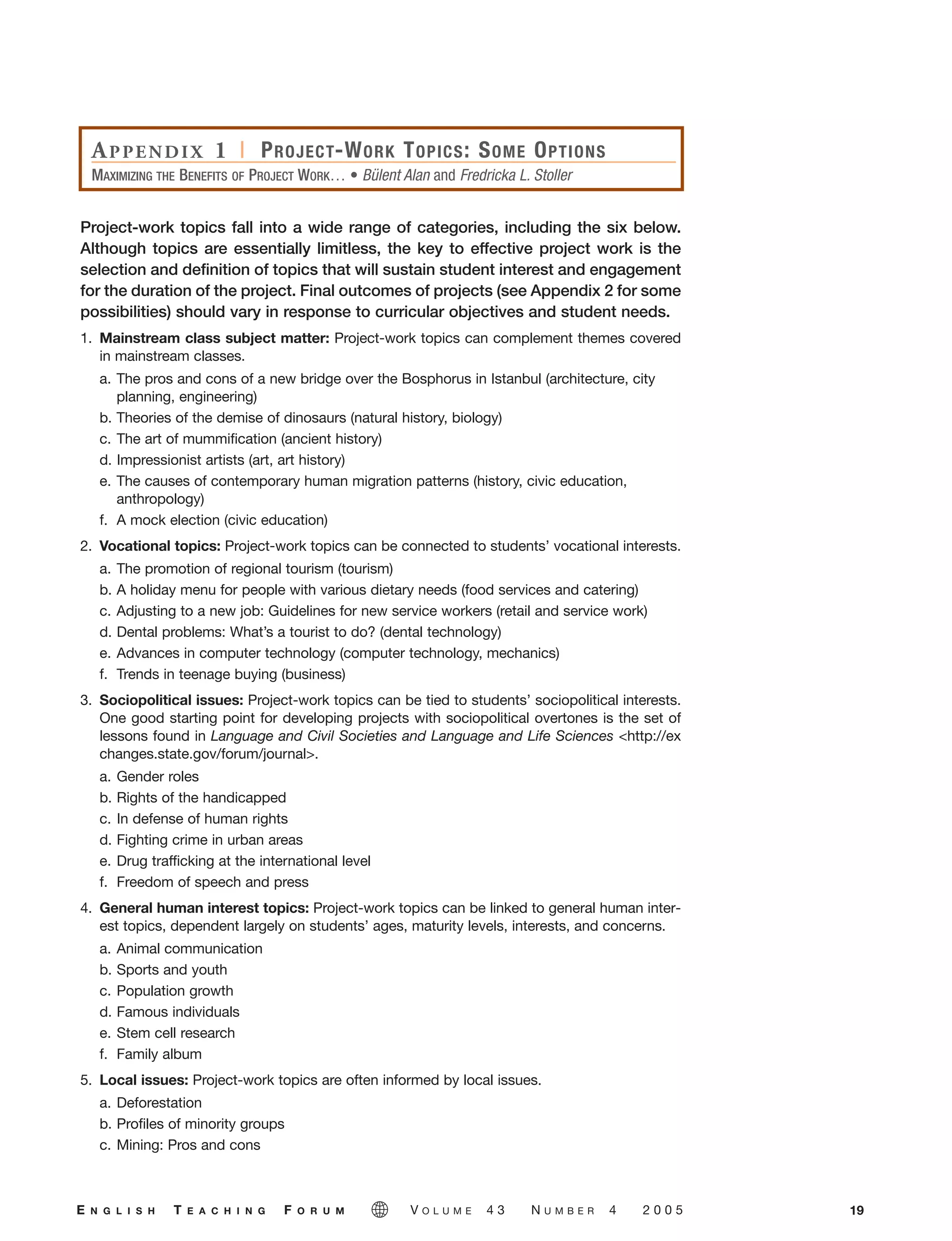
Project-work topics fall into a wide range of categories, including the six below.
Although topics are essentially limitless, the key to effective project work is the
selection and definition of topics that will sustain student interest and engagement
for the duration of the project. Final outcomes of projects (see Appendix 2 for some
possibilities) should vary in response to curricular objectives and student needs.
1. Mainstream class subject matter: Project-work topics can complement themes covered
in mainstream classes.
a. The pros and cons of a new bridge over the Bosphorus in Istanbul (architecture, city
planning, engineering)
b. Theories of the demise of dinosaurs (natural history, biology)
c. The art of mummification (ancient history)
d. Impressionist artists (art, art history)
e. The causes of contemporary human migration patterns (history, civic education,
anthropology)
f. A mock election (civic education)
2. Vocational topics: Project-work topics can be connected to students’ vocational interests.
a. The promotion of regional tourism (tourism)
b. A holiday menu for people with various dietary needs (food services and catering)
c. Adjusting to a new job: Guidelines for new service workers (retail and service work)
d. Dental problems: What’s a tourist to do? (dental technology)
e. Advances in computer technology (computer technology, mechanics)
f. Trends in teenage buying (business)
3. Sociopolitical issues: Project-work topics can be tied to students’ sociopolitical interests.
One good starting point for developing projects with sociopolitical overtones is the set of
lessons found in Language and Civil Societies and Language and Life Sciences <http://ex
changes.state.gov/forum/journal>.
a. Gender roles
b. Rights of the handicapped
c. In defense of human rights
d. Fighting crime in urban areas
e. Drug trafficking at the international level
f. Freedom of speech and press
4. General human interest topics: Project-work topics can be linked to general human inter-
est topics, dependent largely on students’ ages, maturity levels, interests, and concerns.
a. Animal communication
b. Sports and youth
c. Population growth
d. Famous individuals
e. Stem cell research
f. Family album
5. Local issues: Project-work topics are often informed by local issues.
a. Deforestation
b. Profiles of minority groups
c. Mining: Pros and cons
19E N G L I S H T E A C H I N G F O R U M V O L U M E 4 3 N U M B E R 4 2 0 0 5
APPENDIX 1 | PROJECT-WORK TOPICS: SOME OPTIONS
MAXIMIZING THE BENEFITS OF PROJECT WORK… • Bülent Alan and Fredricka L. Stoller
05-0004 ETF_10_21 10/18/05 3:19 PM Page 19
d. European Union membership
e. New monetary systems
f. Economic crises and solutions
6. Global issues: Project-work topics often are defined by global issues that are of interest to
students.
a. International terrorism
b. International efforts to fight air, water, and noise pollution
c. International efforts to turn global warming around
d. AIDS, malaria
e. Civil wars
f. Water shortages
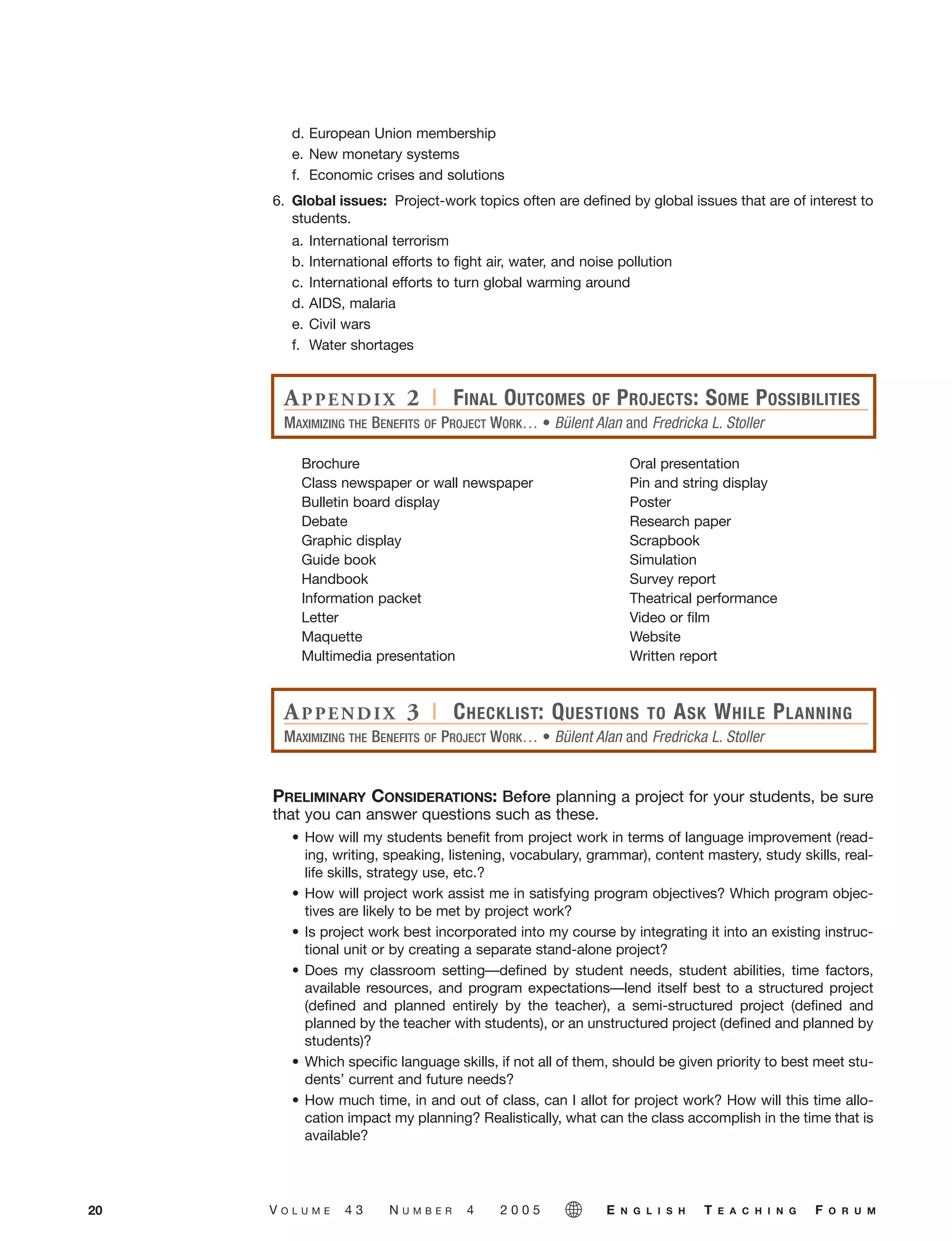
Brochure Oral presentation
Class newspaper or wall newspaper Pin and string display
Bulletin board display Poster
Debate Research paper
Graphic display Scrapbook
Guide book Simulation
Handbook Survey report
Information packet Theatrical performance
Letter Video or film
Maquette Website
Multimedia presentation Written report
PRELIMINARY CONSIDERATIONS: Before planning a project for your students, be sure
that you can answer questions such as these.
• How will my students benefit from project work in terms of language improvement (read-
ing, writing, speaking, listening, vocabulary, grammar), content mastery, study skills, real-
life skills, strategy use, etc.?
• How will project work assist me in satisfying program objectives? Which program objec-
tives are likely to be met by project work?
• Is project work best incorporated into my course by integrating it into an existing instruc-
tional unit or by creating a separate stand-alone project?
• Does my classroom setting—defined by student needs, student abilities, time factors,
available resources, and program expectations—lend itself best to a structured project
(defined and planned entirely by the teacher), a semi-structured project (defined and
planned by the teacher with students), or an unstructured project (defined and planned by
students)?
• Which specific language skills, if not all of them, should be given priority to best meet stu-
dents’ current and future needs?
• How much time, in and out of class, can I allot for project work? How will this time allo-
cation impact my planning? Realistically, what can the class accomplish in the time that is
available?
20 V O L U M E 4 3 N U M B E R 4 2 0 0 5 E N G L I S H T E A C H I N G F O R U M
APPENDIX 2 | FINAL OUTCOMES OF PROJECTS: SOME POSSIBILITIES
MAXIMIZING THE BENEFITS OF PROJECT WORK… • Bülent Alan and Fredricka L. Stoller
APPENDIX 3 | CHECKLIST: QUESTIONS TO ASK WHILE PLANNING
MAXIMIZING THE BENEFITS OF PROJECT WORK… • Bülent Alan and Fredricka L. Stoller
05-0004 ETF_10_21 10/18/05 3:19 PM Page 20
• How might Stoller’s ten-step framework (summarized in this article) need to be adapted
for my teaching situation?
PROJECT PLANNING: While planning a project for your class, pose the following ques-
tions and make every effort to find answers to them.
• What project-work topics are likely to (1) sustain student interests, (2) increase student
motivation, and (3) ensure meaningful student engagement?
• What can I do to give students a voice in the selection of the project-work theme, the des-
ignation of a project outcome, and the process of the project (even if I have structured the
project myself)? In other words, what can I do to ensure that students develop a sense of
ownership in the project?
• How can the project be designed to build upon (1) what students already know, (2) what
they are already able to do, and (3) what they want to learn?
• What resources are readily available for the project theme (in print, on the Web, on video,
from different people/organizations, etc.)? What resources might I, myself, collect to share
with students? What resources will students be able to access on their own in a timely
fashion?
• Which elaborated tasks will help me meet program objectives and assist students in com-
pleting the project in a satisfactory manner?
• How can I structure elaborated tasks so that they lead to an authentic experience and crit-
ical thinking?
• What activities can I incorporate into the process of project completion that will increase
students’ metacognitive awareness?
• How will I assign student work groups? Should I group students who are similar or dif-
ferent in language ability, motivational level, etc.? Should I let students form groups of their
own or should I assign students to groups?
• How can I structure the project so that it is both sufficiently challenging and manageable
at the same time?
• What language and content-learning demands are inherent in Steps 5 (information gath-
ering), 7 (information compiling and analyzing), and 9 (information reporting)? How can I
best prepare students for those demands in Steps 4, 6, and 8?
• What grammar points stand out as being particularly relevant in Steps 5, 7, and 9? How,
and at what point(s) in the project, can I focus explicitly on form so that students can prac-
tice relevant grammar points in a meaningful way?
• How can I structure the project so that there is a proper balance among teacher guidance
(and feedback), and student autonomy and collaboration?
• How can I structure the project so that students are engaged in meaningful and purpose-
ful integrated skills?
• How can I conclude the project so that students have the opportunity to reflect on their
improved language abilities and the content that they learned as a result of the project?
How can I solicit honest feedback from students about the project-work experience so
that I can use their insights to assist me in future planning of projects?
21E N G L I S H T E A C H I N G F O R U M V O L U M E 4 3 N U M B E R 4 2 0 0 5
05-0004 ETF_10_21 10/18/05 3:19 PM Page 21
"What Is It?":
A Multipurpose
Language Teaching
Technique
PAUL NATION
Victoria University of Wellington
Paul Nation is a lecturer at the
English Language Institute of Vic-
toria University, Wellington, New
Zealand. The English Language
Institute runs a nine-month Diploma
course for teachers of English as a
foreign or second language from
Southeast Asia, the Pacific, and the
Middle East. At present his par-
ticular interest is in teaching
vocabulary and cooperative learn-
ing. His book Language Teaching
Techniques is due to be published
by Cambridge University Press in
1978. He has published articles in
English Teaching Forum, English
Language Teaching Journal,
R.E.L.C. Journal, and The Modern
Language Journal. Mr. Nation has
taught in Indonesia for several
years and through his students has
a close connection with many
Southeast Asian countries.
What is it?
It's interesting.
It's easy to make.
It makes your learners think.
It's good for work in pairs, groups, or with the whole
class.
It gives each learner a chance to show his skill.
It can be used for listening, reading, writing, or
speaking.
Do you give up? The answer is: my favorite teaching
technique-the "What Is It?" technique.
Teaching the spoken skills
Let's look at an example of this technique used
as a listening and speaking exercise. First, the teacher
thinks of something that his students know well, and
he describes it:
It's black and silver.
It's quite heavy.
It's made of metal and rubber.
It costs a lot of money.
We can find it on the roads.
It has two wheels and a motor.
It's used for going from one place to another.
What is it?
When a student thinks that he knows what the teacher
is describing, he raises his hand. He does not shout
out. When the teacher reaches the end of the descrip-
tion, he asks one of the students who has raised his
hand to name the object he has described.
The teacher describes several things in this way while
the students listen and try to guess the objects being
described. Then the teacher writes an example on the
blackboard, using the same sentence patterns as in the
example above. He then gives another example to show
that all he has to do is change the underlined words to
make a new description:
20
It's brown.
It's square.
It's made of wood.
It costs about fifty dollars.
It has four legs.
We can find it in a classroom.
It's used for writing, reading, and resting.
What is it?
16I 3
'2.-0 ·- z..3} s2._
Nation, P. (1978). "What is it?": A multipurpose language teaching technique. English Teaching Forum, 16 (3),
20-23, 32.
Nation / "What Is It?": A Multipurpose Language Teaching Technique 21
HavingtheStudentsChoose. Next, the teacher chooses
something for the class to describe, and the students
suggest substitutions in the model sentences on the
blackboard to make a good description. When they can
do this easily, the teacher asks one of them to think
of something and then describe it by closely following
the model on the blackboard. While the student de-
scribes the object, the teacher and the other students
try to guess what it is. This is one of the good features
of the "What Is It?" technique: each student has the
chance to possess information that the others in the
class, including the teacher, do not have. The student
knows what he is going to describe; the others do not.
They must therefore listen carefully to his description
in order to find out what it is. This puts the student in
a superior position to the teacher and the other students
in the class. In many classrooms this is a rare situation;
usually only the teacher is in the superior position. The
"What Is It?" technique enables us to change this
situation.
Providing Practice for Beginners. Even beginners can
use the "What Is It?" technique for language practice.
The teacher puts the following simple patterns on the
blackboard:
a shop.
We can find it in a school.
a house.
silver.
It's brown.
colorless.
black.
metal.
It's made of wood.
glass.
big.
It's square.
round.
long.
a neck.
a lid.
a handle.
It has four legs·.
four corners.
numbers on it.
ink in it.
holding things.
holding water.
I , d f drawing.
t s use or sitting.
eating.
telling the time.
On another part of the blackboard the teacher writes
this pattern or puts up a chart containing pictures of
the following things:
It's
a chair.
a tin.1
a ruler.
a clock.
a box.
a pen.
a glass.
a blackboard.
a table.
a knife.
a bottle.
a pencil.
The teacher also writes each noun in this pattern on
a small piece of paper and distributes these among
some of the students. One of the students then de-
scribes the object on his piece of paper by reading
appropriate sentences from the patterns on the black-
board. The other students listen, and when the descrip-
tion is finished they read aloud the appropriate sen-
tence from the last pattern, naming the object. Here is
an example:
Student A: We can find it in a shop.2
We can find it in a house.
It's silver.
It's made of metal.
It's round.
It has a lid.
It's used for holding things.
Student B: It's a tin.
Teaching vocabulary
The "What Is It?" technique can also be used to
introduce new vocabulary. Let's imagine that the
teacher wants to introduce the word stirrup. He may
describe it as follows:
A stirrup is silver.
A stirrup is strong.
A stirrup is made of iron.
A stirrup has a fiat bottom.
We can find a stirrup on a horse.
A stirrup is used to put your foot into when you ride
a horse.
When the teacher finishes his description he tells the
students to try to translate the word into their mother
tongue. (If there is no roughly equivalent word in the
mother tongue, they can draw a picture or point to one
of several pictures that the teacher may make available.)
1. In American English, It's a can or It's a tin can.
2. In Ameri<;:an English this would probably be store.
22 ENGLISH TEACHING FORUM • JULY 1978
While describing a stirrup, the teacher repeats each
sentence once or twice before going on to the next one.
He also goes back and repeats the previous sentences
several times before he reaches the end of the descrip-
tion. In this way the students will have heard the new
word stirrup many times by the end of the description.
They will also have listened with close attention because
they want to discover what the new word means. Some
teachers make the mistake of giving the meaning of
new vocabulary too quickly. Once the students have
been given the meaning of the word, they have no
reason to pay attention any longer. Experiments on
remembering (Jenkins 1974) have shown that recalling
the form of a word (its spelling or sound) is more diffi-
cult than recalling its meaning. For this reason, tech-
niques that give the student an opportunity for repeated
attention to a new word before discovering its meaning
are important for vocabulary learning. If the learners
are asked to translate stirrup after listening to the de-
scription, this is in some ways the same as a direct
translation where the teacher says, "Stirrup in your
mother tongue is ." But the differences are
important: Direct translation is quick; the "What Is It?"
technique, involving the describing of the object before
the learners are asked to translate, wastes some teach-
ing time, but it makes valuable use of learning time.
By listening to the description the learners have heard
the new word several times, they have had to make an
effort to get the meaning, and they have been active
in telling the teacher what they think the translation
should be (Nation, English Language Teaching Journal,
forthcoming).
Limiting the Information. The order of the sentences
in the "What Is It?" technique is important if the teacher
wants to keep the meaning of the new word away from
the learners for as long as possible. The following ex-
ample shows how this may be done. This time I will
teach a technical word used in botany. As you read the
description, make a note of the point at which you felt
that you knew the common name for the technical word.
Brassicas are green.
Brassicas are made of leaves.
Brassicas have big leaves.
One costs about sixty cents.
We can find brassicas in most vegetable gardens.
Brassicas are round.
Brassicas are used for eating.
Many people cook brassicas before they eat them.
You should not have been able to guess that the new
word brassica referred to cabbages, cauliflowers, etc.,
until after you had read almost all of the sentences. So,
in constructing a "What Is It?" exercise the teacher
should make sure that the first sentences do not provide
too much information. In this way he can give the stu-
dents an opportunity to meet the new word several
times.
Providing for Individual Work. The "What Is It?"
technique can also be used for individual vocabulary
work, with the exercises on cards or in a book. Here is
an example:
ONE MORE SENTENCE
From the five "Missing Sentences" given at the end,
find the one that belongs to each of the groups of related
sentences. Write the number of the sentence and, next
to it, the name of the object described in the group of
sentences to which it belongs.
A farm is a big piece of land.
A farm is usually in the country.
Sometimes a man grows vegetables or rice on a farm.
A hen is a big bird.
We eat eggs from a hen.
A hen eats corn and other things.
A hen cannot swim.
A map is very useful.
A map is a picture of streets, roads, towns, and cities.
A map shows us the hills, mountains, and rivers.
A restaurant is a building.
A man sells food in a restaurant.
People can buy many kinds of food and drink there.
Sometimes a telegram brings good news.
Sometimes a telegram brings bad news.
We send a telegram at the post office.
The Missing Sentences
1. We use it when we want to know the way.
2. People go there to eat.
3. Sometimes a man keeps animals there.
4. People keep it and feed it.
5. It travels quickly through a wire.
This exercise may also be used to teach verbs, adjec-
tives, or adverbs; in that case the missing sentence has
an empty space where the new word should be.
Introducing Vocabulary Incidentally. The "What Is
It?" technique can also be used to introduce new vo-
cabulary incidentally. This often adds extra interest.
For example, if the teacher is describing a fork in a
listen-and-guess exercise, he might say:
It is silver. Silver is a color as well as a material.
Can you think of other things that are silver but are
not made of silver?
It is long.
It usually has four prongs. Do you know what a
prong is? ...
The value of the "What Is It?" technique in teaching
vocabulary lies in the opportunity it provides the stu-
Nation / "What Is It?": A Multipurpose Language Teaching Technique 23
dents to give repeated attention to the new word while
requiring them to play an active part in discovering the
meaning. It can be used in classes where English is
the medium of instruction for subjects such as geog-
raphy, mathematics, and general science as well as in
special ESL classes.
Teaching the written skills
The "What Is It?" technique can be used in creating
short puzzles to give practice in reading. The students
read the description and respond by doing one of the
following:
1. completing a sentence
2. writing a name
3. drawing a picture
4. choosing a name, picture, or sentence from sev-
eral given choices
Here is an example to illustrate these different kinds of
responses:
It is usually colorless and partly round. We can find
it in houses. Every house has several of them. It is
made of glass and metal. It shines when electricity
passes through it.
1. We usually use it when _____
2. What is it?
3. Draw a picture of it.
4. Itisa _____
cup pot bulb window
Providing for Individual Differences. It is easy to
give useful composition practice in a class with a wide
range of ability by using the "What Is It?" technique.
The teacher introduces the technique in the way de-
scribed at the beginning of this article. Then he tells
the students to write a description of something, using
the model sentences that he has put on the blackboard
and adding other suitable sentences if they can. In this
way, the students who have only a little difficulty with
English can add many sentences that are not based
on the model; these who find writing difficult can use
only the model sentences.
Even when learners describe the same thing and use
only the model sentences it is unlikely that any of the
descriptions will be exactly the same; the "What Is It?"
technique is a good bridge between strictly controlled
composition and free composition. After the students
have written their compositions they can exchange them
with other students in the class, who read them and try
to guess what is being described. Composition work thus
becomes a communicative activity.
Using Other Questions. There is no reason why the
technique should be limited to the question "What is
it?" There are many other possibilities: "What book or
film is it?," "Who is it?," "What country or city is it?,"
"What animal is it?" Here are some examples of possi-
ble models (Nation, Language Teaching Techniques,
forthcoming):
a. Each student describes one of his friends or a
person that everyone knows:
He is about thirty years old.
He is one meter eighty centimeters tall.
He has black hair and brown eyes.
He is wearing a blue shirt and black trousers.
He is wearing glasses.
He is carrying a bag I sitting near me.
Who is he?
b. Each student describes an animal and the others
try to guess its name:
It is big. It is brown. It has four legs. It has horns.
It has a long tail. It does not have wings. It lives
in a field. It can give us milk. It cannot fly. Its
body is covered with thick skin. It is tame, so it is
not afraid of people. What is it?
c. Each student chooses and describes a different
country, city, or place:
It has a warm climate. It has three seasons. They
are the wet season, the dry season, and the cool
season. It is a small country. It has a small popu-
lation. Many of the farmers in that country grow
rice/raise cattle. It sells wood to other countries.
It buys cars from other countries. It is part of the
Middle East/Asia/South America. It is to the
south of/near the Indian Sea. Its neighbors are
India and Burma. The people there speak many
languages. These languages are Singhalese, Tamil,
and English. The capital city is called __
---· What country is it?
d. Each student has a different book and describes
his own book:
Jane Eyre was written by Charlotte Bronte.
Charlotte Bronte lived over a hundred years ago.
She was English.
Jane Eyre is an interesting book. (Instead of in-
teresting you can have long, difficult, expensive,
famous, etc.) It has a hard cover. It is three hun-
dred and twenty pages long. It has twelve chap-
ters. It has many pictures (a table of contents, an
index, some questions at the back). It has a red
cover. There is a picture of a girl on the cover. It
was first printed by Oxford University Press in
1864.
It is a love story. It is about a young girl.
Summary
The "What Is It?" technique has many useful fea-
tures:
1. It can be used to teach vocabulary and to give
continued on page 32
"What Is It?": A Multipurpose language Teaching Technique continued from page 23
practice in listening, speaking, reading, and writing.
2. It involves the students in meaningful communica-
tive activity.
3. It gives each student a chance to be iu a superior
position as the source of information. Students perform-
ing are much more interesting than the teacher perform-
ing.
4. It can be used with classes containing students of
widely differing achievement in English. It can also be
used with beginners or advanced learners.
5. It requires little work from the teacher but a large
amount of effort and attention from the students.
6. It can act as a bridge between controlled and free
activities in speaking and writing.
7. It can provide challenging opportunities for at-
tention to repeated material in listening, reading, and
vocabulary-learning activities.
8. It is fun for both teacher and students.
REFERENCES
Jenkins, J. J. 1974. Language and memory. In Psychology and
communication, ed. G. A. Miller, pp. 181-193. Washing·
ton, D.C.: Voice of America, Forum Series.
Nation, I. S. P. Forthcoming. Translation and the teaching of
meaning: some techniques. English Language Teaching
Journal.
Nation, I. S. P. Forthcoming. Language teaching techniques.
London: Cambridge University Press. 0
32
!
!
!
!
!
!
!
!
Week 2!
!
Judith A. Rance-Roney
Reconceptualizing Interactional
Groups: Grouping Schemes for
Maximizing Language Learning
Group work. When it works, we are pleased. But when it does not—
when the learners stare at each other without speaking or when two learners
begin an argument that threatens to disrupt the whole lesson—
we know we should have done it better.
20 2 0 1 0 N U M B E R 1 | E N G L I S H T E A C H I N G F O R U M
I
n the field of English as a Second/
Foreign Language (ESL/EFL), it
has long been recognized that for
second language acquisition to occur
learners must use English to construct
meaning and interact with others in
authentic contexts. The importance
of learner interaction in acquiring a
second language has made the teacher-
directed student-centered classroom the
standard for effective instruction, in
print if not in practice. While this
standard may seem contradictory,
effective teacher directives can opti-
mize student autonomy and facilitate
effective cooperative learning, which is
at the core of a student-centered envi-
ronment. These principles have led
to the increasing use of group work
in the second language classroom,
wherein students work in teams to
construct knowledge and accomplish
tasks through collaborative interac-
tion. However, not much has been
written about the classroom manage-
ment strategies that underlie the prac-
tice, and less has been written about
directing the membership of small
groups as students engage in learning
tasks and activities.
For many teachers, group activ-
ity planning is often based on last-
minute decisions or left to chance.
When there is forethought, it mostly
surrounds putting problem students
in the “least-likely-to-cause-trouble”
group. Teachers frequently com-
ment that they have not been given
clear guidance in the management of
groups; in fact, a quick survey of cur-
rent TESOL education and methods
texts reveals little information about
how to accomplish this complex
classroom management task beyond
the recommendations that teachers
use interactional groups because of
21E N G L I S H T E A C H I N G F O R U M | N U M B E R 1 2 0 1 0
the multiple benefits for English learners
(Diaz-Rico 2008), use a variety of groupings
tied to the instructional purpose (Echevarria,
Vogt, and Short 2008), and make the process
for cooperative groups (task orientation, roles,
appropriate behaviors, etc.) explicit to stu-
dents (Herrell and Jordan 2008).
However, drawing together information
from a range of educational areas includ-
ing curriculum, second language acquisition
studies, and effective school research, we can
create some reasonable guidelines for recon-
ceptualizing the process of forming groups.
An exploration of the types of collaborative
tasks and activities that most successfully
meet the instructor’s objectives will go a long
way towards optimizing the effectiveness of
groups, and will affect decisions about suc-
cessful strategies and group size and con-
figuration. After discussing the rationale for
collaborative interaction, this article will offer
examples on how to deal with these group
management issues when coordinating col-
laborative work in the ESL/EFL classroom.
What the research says
Language acquisition research has long
supported the benefits of student interac-
tion, which include useful language practice
(Doughty and Pica 1986, among others),
student-to-student scaffolding during chal-
lenging tasks (Storch 2001, among others),
and the formation of personal agency in
academic settings (Morita 2004). Howev-
er, research also yields a conflicting picture
of what happens when students interact in
groups and even questions the effectiveness of
collaborative groups. While early research sug-
gested that language manipulation increased
in small-group activities (Doughty and Pica
1986), other research found that “negotiating
for meaning” was not an often-used strategy
and that some learners chose to remain dis-
engaged in the group setting. In other words,
while the teacher may strive to foster engaging
student interaction during the lesson, stu-
dents may have other ideas. Recent research
points to an intricate web of factors that affect
the types of interaction and level of learner
participation in group activities. The role of
personality, sense of agency, and collaborative
orientation (Storch 2001; Morita 2004), and
proficiency level (Watanabe and Swain 2007)
suggest that the picture is more complex than
what had previously been assumed.
Nevertheless, even though the research on
the quality of interaction in groups is not alto-
gether clear, teachers generally do agree that a
well-planned group activity holds great poten-
tial value. Small-group collaboration allows
learners to rehearse for the larger whole-class
discussion to follow, to practice pronunciation
of words, to structure conversations conceptu-
ally, and to build conversational efficacy in a
less formal and less anxiety-ridden context. In
addition to increased language practice, the
ability to appropriately interact in groups has
become a goal in itself, in part because many
students will be required to work on team
projects in courses such as global business,
science, and other academic subjects taught in
U.S. classrooms.
How many students in a group?
The first decision the teacher must face
involves the optimum number of learners per
group. Bell (1988) suggests a range of three to
seven students. One misconception of teach-
ers is that all groups must have the same num-
ber of members. In fact, a group of reticent
students may be capped at three to force all
to speak, while a larger group of six dominant
students will receive valuable practice at social
turn-taking. There is no instructional rule
that demands equal group size.
Fixed vs. flexible grouping
The second decision that teachers face is
fixed grouping (consistent group membership
for extended periods) vs. flexible grouping
(the teacher decides group membership for
each lesson or task). Fixed group rosters allow
learners to get to know others in a deeper
way and to develop tolerant and trusting
relationships; it also saves the teacher valu-
able planning time. However, when groups
remain together for too long, learners may
be missing out on a diversity of viewpoints
and language interactions. Thus, the balance
between the security of established groups
and the chance to work with most members
of the class becomes a goal of grouping strat-
egies. One solution proposed by Bell (1988)
joins the two conflicting goals: each student
belongs to three or four different fixed groups
and rotates among them based on the learn-
22 2 0 1 0 N U M B E R 1 | E N G L I S H T E A C H I N G F O R U M
ing objectives and the type of task that is
assigned.
Planning for group membership
Twenty-five years ago, the use of small
interactional groups was designed to facili-
tate communication in a new language,
which acknowledged the important role of
socially situated interaction in the develop-
ment of communicative competence (Savi-
gnon 1983). As educators, we focused on
student personalities in grouping decisions
or perhaps decided to group according to
relative language proficiency. However, the
current focus on academic pre-university
preparation in many programs, both in the
United States and in international settings,
demands that we take a new look at the
way in which we form collaborative groups
to ensure that all learners engage deeply
with the academic content, develop spoken
literacy for academic interaction, and assert
themselves and participate effectively in the
academic conversation.
Most educators believe that the skills
needed to participate in group discussions
and team decision-making can be explicitly
taught and practiced. The membership of the
interactional group is a critical consider-
ation. A group that is well matched to the
task will talk a lot even if the task is weak.
Conversely, a teacher could design a rich
learning experience, but if the individuals
choose non-involvement because of the group
membership, it fails. Choosing group mem-
bership requires much artistry, as it demands
sensitivity to cultural contexts, to individual
personalities in the class, and to the variety of
skill levels.
I experienced this challenge firsthand
when structuring interactional groups in
my multilingual class of university students.
(While my teaching context was an ESL
program for international students in the
United States, the same principles apply
in EFL contexts.) My students had a wide
range of language proficiencies and English
experiences, and an even greater diversity of
specific language skill levels and personality
types. Some students had great oral fluency
but were less strong in reading and writing;
others lacked proficiency in speaking but
were advanced learners in reading, and to a
lesser extent, writing. For example, Edgardo,
a student from Venezuela who had spent a
year in a U.S. high school, was orally fluent
but scored significantly lower on his English
reading test. He sat next to Pongsak, a quiet
student from Thailand, who had been in the
United States for only a few weeks when the
class began. While Edgardo’s spoken English
was nearly as fluent as a native speaker’s and
he spoke with confidence, Pongsak’s speaking
was hesitant and often difficult to compre-
hend. However, both Edgardo’s and Pongsak’s
writing differed substantially from standard
academic English, and both had similar read-
ing proficiencies that limited their access to
academic texts. My instructional objective
was to prepare both students for college-level
work in an English-medium university and to
provide them with the collaborative speaking
skill and academic English experience neces-
sary to participate in the student-led team
projects advocated by U.S. colleges. While
my goals were the same for each of these
learners, their ability to progress towards
acquiring language and collaborative skills in
group work would have been limited had I
only considered my goals and not the com-
plex interactional patterns that would help or
hinder acquisition as Pongsak and Edgardo
worked together in the group.
There are several bases on which expe-
rienced teachers form groups: language
proficiency, personality, friendships, shared
native language, and academic orientation.
However, one of the variables not often con-
sidered by the classroom teacher is the objec-
tive of the task itself. While general guidelines
may point the teacher in the direction of
conventional wisdom, the content of the task
may point a different way. Several options on
how to plan group membership around task
objectives follow.
Oral language proficiency grouping
One of the first instincts of a teacher is to
group students heterogeneously so that the
members with higher proficiency can support
the learners with lower proficiency. However,
without intervention and planning, the stu-
dents with higher spoken English proficiency
often will take over the conversational work-
load, giving the less proficient little practice in
speaking. This replicates the typical conversa-
tion pattern when my low-proficiency English
23E N G L I S H T E A C H I N G F O R U M | N U M B E R 1 2 0 1 0
learners are put on collaborative teams with
native English speakers. The English learners
sit silently at the periphery of the circle, mar-
ginalized from the group. Thus, in the ESL
classroom, it is often better to group individu-
als by similar proficiency so that all will have
equal opportunity and responsibility to speak.
One technique for quick implementation is to
keep a list of students ordered by proficiency
level, with the most proficient students in
the class at the top and the least proficient at
the bottom. If you choose to form triads, for
example, count down the list by three, draw
a line, and group by three until you reach
the end of the list. This gives you ready-made
proficiency groups.
Another instructional strategy, if you do
group heterogeneously, is to use a multi-
response format by arranging a series of tasks
in increasing levels of difficulty. Assign specif-
ic students to the tasks that best fit their pro-
ficiency levels. For example, if I want students
to discuss the causes of the American Civil
War, I might list and number five questions
at increasing levels of linguistic challenge.
Question 1 might ask simply, “In what years
did the Civil War happen?” Question 5, for
the highest proficiency student, might read,
“How did the differing cultures of North vs.
South contribute to the causes of the Ameri-
can Civil War?” Each student is assigned a
question number to report on, based on his
or her proficiency level.
Personality grouping
Personality grouping is based on domi-
nance vs. reticence. In other words, in a
homogeneous scheme, active students are
grouped together to fight it out, allowing
reticent learners to interact more casually. If
you have designed a task that has a defined
outcome and learners understand that there
is a job to be accomplished, then grouping
the reticent learners together forces them
to take the initiative to complete the task
even though there may be a minimal use of
English. Noise does not always equal shared
participation. In fact, when groups are less
loud, often it is because all learners are giv-
ing a respectful space to speak. The loudest
groups sometimes signal the owning of the
conversation by an argumentative few. When
the objective is for learners to work with a
problem and achieve consensus on a solu-
tion, this homogeneous grouping scheme will
maximize chances for all group members to
engage in conversation.
When forming groups based on personal-
ity, it is important for the teacher to designate
a group leader who possesses the positive traits
of high task orientation, negotiating ability,
and leadership. In following this plan, the
group leader models effective leadership for
other members so that later they may take
over the leadership role.
Controlled affiliation grouping
What is the level of trust among group
members? How important is diversity of
opinion and diversity of perception? When
friends are grouped with friends, trust will
be high, but diversity will be limited because
of the likelihood of common experiences
and viewpoints. In general, asking learners
to work with members of the class whom
they do not know well fosters more on-task
learning, allows multiple viewpoints to be
considered, and nurtures the growth of a class
community as individuals get to know and
trust one another. However, if the topic is
emotionally charged and controversial, creat-
ing a safe space to allow free discussion may
make instructional sense. For example, in
the discussion of a piece of literature that
contained chapters of violence and sexually
suggestive scenes, I grouped by gender and
close affiliation, which allowed for a safer,
deeper, and more authentic literary analysis.
This was the case in the class reading of Maya
Angelou’s (1971) I Know Why the Caged Bird
Sings. The affiliation grouping allowed me to
speak privately with a group of female stu-
dents about skipping one chapter that might
have been uncomfortable or objectionable,
and allowed the students to discuss those parts
of the book that were personally engaging but
topically safe.
Shared first language (L1) groupings
Do you have a multilingual class of Eng-
lish learners? Generally, it is prevailing wis-
dom to group learners together who do not
share a native language since this fosters
maximum communication in English. Stu-
dents then have no other choice but to use
English as the medium of conversation to
accomplish a task. However, there may be
an academic task for which you want your
24 2 0 1 0 N U M B E R 1 | E N G L I S H T E A C H I N G F O R U M
learners to use academic resources and termi-
nology in the L1 to assist the task in the L2.
When the objective is to master challenging
content with language learning as an auxil-
iary goal, grouping learners by L1 groups is
reasonable. For example, when you are teach-
ing the finer points of English punctuation,
allowing learners to use some L1 to discuss
the nuances of punctuation leads to more
efficient learning, in addition to the value-
added discussions of punctuation differences
between languages. Paradoxically, English
accuracy may be facilitated through the use
of the L1 to scaffold the L2. Furthermore,
when the academic task requires the cogni-
tive processing of highly abstract informa-
tion, allowing the shared language groups to
codeswitch during discussion leads to greater
analytic depth. For example, identifying ele-
ments of deconstructionism within a novel
demands that learners codeswitch in order to
fully analyze literary factors.
Academic orientation groups
Are there class members who are less
prepared academically than others? Does the
task suggest that a mix of students will
allow the stronger to scaffold the less strong,
enhancing the academic conversation for all?
For example, when integrating challenging
academic content, such as science, with lan-
guage learning, learners with strong academic
backgrounds (irrespective of proficiency) can
supply needed content expertise that allows all
group members to learn the content and con-
currently focus on language development. If
the goal is for learners to develop collaborative
knowledge, heterogeneous grouping based on
content knowledge makes sense.
Although the intricacies in group work
planning may seem overwhelming at first,
much of the process can become routine.
Establishing a variety of grouping schemes at
the beginning of the year, giving each group-
ing scheme a name, and listing the learners
in that scheme on a chart posted in the class-
room leads to more efficient teacher planning.
Planning the interactional group task
The critical approach to planning for
groups is to focus on what key outcomes you
hope to see in your learners and to plan rich,
thoughtful, and interesting tasks for group
work. On the surface, designing a group
task appears relatively easy, but to achieve
outcomes beyond simple language practice
the teacher must construct tasks and imple-
ment strategies that address not only language
practice, but also support content learning,
foster critical thinking, and develop a hoped-
for supportive classroom community. Table 1
lists several instructional strategies that can be
used to achieve five desired learner outcomes.
Assigning group roles
Again, it is important to assign each group
member a role within the group. While the
teacher may select the leader-facilitator or may
have each group choose the leader on its own,
other roles are also needed:
• Choose a scribe to take notes and orga-
nize the group discussion on a large
piece of paper so every group member
can follow the discussion threads.
Table 1: Effective Instructional Strategies for Desired Learner Outcomes
Desired Learner Outcomes Effective Instructional Strategies
1. Foster a sense of community,
belonging, and safety.
• Begin your class with community-building activities
for the explicit purpose of having students learn one
another’s names, personalities, and cultures. This
develops tolerance for cultures and ethnicities that
have experienced mutual attitudes of bias or conflict.
• Design tasks and activities that are personally mean-
ingful and capture the teachable moment of a learner
engaged in the difficult task of communicating in a
new language. Embed the task in a narrative to foster
personal connections.
25E N G L I S H T E A C H I N G F O R U M | N U M B E R 1 2 0 1 0
2. Maximize opportunities for
rehearsing, practicing, and
engaging in creative manipu-
lation of the language.
• Design group tasks so that all learners must participate
and contribute to the group. Design and assign tasks
that compel the group to find a solution to a problem,
resolve a conflict, or reach consensus on an issue.
• Provide the linguistic input necessary for learners to
fully perform and benefit from the task. Teach vocab-
ulary, idioms, and structures needed for meaning-
making. Give learners the opportunity to individually
prepare and rehearse the language before it is called
into use by allowing five minutes of study time before
the group discussion begins.
• In a classroom with diverse proficiencies, create multi-
ple response formats related to the topic (easier tasks for
lower proficiency, harder for more advanced learners).
3. Utilize functional language to
accomplish a linguistic, aca-
demic, or managerial task.
• Explicitly teach functional language and conversa-
tional strategies that learners will likely need, such
as how to disagree and interrupt in a polite manner.
Teach learners awareness of body language appropri-
ate for English-situated conversations (leaning slightly
forward, making eye contact, etc.).
4. Increase awareness of other
cultures and tolerance for
diverse personalities. Engage
in appropriate social practices
for the context.
• Define specific but revolving roles for learners (discus-
sion leader, notetaker, etc.) so that all learners are secure
in expectations but have an opportunity to engage
in differing roles and at times assume leadership.
• Make the rules of engagement explicit to solidify expec-
tations for tolerance of diverse viewpoints, respectful
use of language, equality of turn-taking, and the right
to speak. Consider writing these rules down on chart
paper and posting them during group work.
5. Develop new knowledge about
a content area or cultural
topic. Engage in critical think-
ing and problem solving.
• Integrate important academic or cultural content in
the design of activities so students are not only grow-
ing linguistically, but are gaining knowledge. Design
tasks that replicate the kind of academic tasks that
students will need outside the classroom in English
for Academic Purposes (EAP) or U.S. K–12 settings,
which facilitates the conceptual bridge between the
ESL/EFL classroom and academic contexts.
• Foster critical thinking through a task design that
requires students to read, write, and listen to academic
or other information sources before engaging in the
academic conversations required for the task.
• Design tasks that engage and challenge students on a
deep linguistic and knowledge level involving problem
solving, predicting, critiquing, applying, and other
cognitively challenging manipulations of language and
information.
• Choose topics of interest that will engage and excite
the learners to know more and discuss more freely.
26 2 0 1 0 N U M B E R 1 | E N G L I S H T E A C H I N G F O R U M
• Appoint a reporter to report back to the
class during a whole-class debrief.
• Assign a vocabulary monitor to compile
new words from a discussion and give
each group member a list the following
day.
• Appoint a time monitor to keep track of
the time allowed for the discussion.
Depending on the task and the number of
members in each group, roles may be added
or deleted. Remember, however, that even
though each student might have a different
role, all group members must still participate
in the assigned task (for example, the time
manager should not simply sit and look at
the clock). And, to make sure that all students
know what each role entails, teachers should
clearly explain the responsibilities of each role
before group work begins.
Reconceptualizing interactional groups
With the increasing complexity of the
ESL/EFL curriculum amidst a push for con-
tent-infused language teaching, it is crucial to
reconceptualize interactional groups and to
consider a greater sophistication of decision-
making, not only in the intentional choices
we make in membership but also in the tasks
that we construct for group work. Certainly,
while the examples above represent only a
small sample of potential schemes, each edu-
cator must reflect on the unique classroom
context and class membership when directing
group work to meet objectives. The bottom
line is that the quality of learner interaction
is too important to be left to chance. If we
intend to maximize language learning and
use, greater reflection and planning will cer-
tainly be needed.
References
Angelou, M. 1971. I know why the caged bird sings.
New York: Bantam.
Bell, J. 1988. Teaching multilevel classes in ESL. San
Diego: Dormac.
Diaz-Rico, L. T. 2008. A course for teaching English
learners. Boston: Pearson Education.
Doughty, C., and T. Pica. 1986. Information gap
tasks: Do they facilitate second language acquisi-
tion? TESOL Quarterly 20 (2): 305–25.
Echevarría, J., M. Vogt, and D. J. Short. 2008.
Making content comprehensible for English learn-
ers: The SIOP model. 3rd ed. Boston: Allyn and
Bacon.
Herrell, A. J., and M. Jordan. 2008. Fifty strategies
for teaching English language learners. 3rd ed.
Boston: Allyn and Bacon.
Morita, N. 2004. Negotiating participation and
identity in second language academic communi-
ties. TESOL Quarterly 38 (4): 573–603.
Savignon, S. J. 1983. Communicative competence:
Theory and classroom practice. Texts and contexts
in second language learning. Reading, MA: Addi-
son Wesley.
Storch, N. 2001. How collaborative is pair work?
ESL tertiary students composing in pairs. Lan-
guage Teaching Research 5 (1), 29–53.
Watanabe, Y., and M. Swain. 2007. Effects of pro-
ficiency differences and patterns of pair interac-
tion on second language learning: Collaborative
dialogue between adult ESL learners. Language
Teaching Research 11 (2), 121–42.
JUDITH A. RANCE-RONEY is a teacher
educator and Chair of Education at
DeSales University in Pennsylvania. She
has taught English for twenty-five years
both in the United States and Asia. Her
interests lie in training teachers in the
techniques and technologies for the
effective English language classroom.
!
!
!
!
!
!
!
!
Week 3!
!
32 2 0 1 2 N u m b e r 1 | E n g l i s h T e a c h i n g F o r u m
Destroying the Teacher: The Need
for Learner-Centered Teaching
BY ALAN C. McLEAN
This article was first published in Volume 18, No. 3 (1980).
“He most honors my style who learns under it to destroy the
teacher.” —Walt Whitman
“Most children in school are scared most of the time.”
—John Holt
“Much of what we say and do in school only makes children feel
that they do not know things that, in fact, they knew perfectly
well before we began to talk about them.’’ —John Holt
“If the culture of the teacher is to become part of the conscious-
ness of the child, then the culture of the child must first be in the
consciousness of the teacher.’’ —Basil Bernstein
“Schools are designed on the assumption that there is a secret to
everything in life; that the quality of life depends on knowing that
secret; that secrets can be known only in orderly succession; and
that only teachers can properly reveal these secrets.” —Ivan lllich
“Who needs the most practice talking in school? Who gets the
most?” —John Holt
“In the average classroom someone is talking for two-thirds of
the time, two-thirds of the talk is teacher-talk, and two-thirds of
the teacher-talk is direct influence.’’ —N.A. Flanders
“Language complexity increases when the child writes or speaks
about events in which the child has participated in a goal-seek-
ing process.” —J.S. Bruner
“Information is rarely, if ever, stored in the human nervous sys-
tem without affective coding.’’ —Earl W. Stevick
“We must not fool ourselves...into thinking that guiding children
to answers by carefully chosen leading questions is in any im-
portant respect different from just telling them the answers in
the first place....The only answer that really sticks in a child’s
mind is the answer to a question that he asked or might ask of
himself.’’ —John Holt
“True knowledge, Plato argues, must be within us all, and
learning consists solely of discovering what we already know.”
—Colin Blakemore
“If a teacher is indeed wise he does not bid you enter the house
of his wisdom, but rather leads you to the threshold of your own
mind.’’ —Kahlil Gibran
The title of this article comes from a poem by Walt
Whit­man: “He most honors my style who learns under
it to de­stroy the teacher.” I chose this epigraph because I
wish to plead for a less dominant classroom role for the lan-
guage teacher, in accord with the importance of classroom
interac­tion in the language-learning process.
First, I would like to encourage a lessening of attention
to the linguistic content of language teaching, and suggest
that such content, and the theoretical basis on which we
choose it, are not as crucial for language learning as are
aspects of classroom behavior. Too often, in discussing the
teaching of English,we behave as if language were the most
impor­tant factor in the classroom. I think this is seldom
the case.
We need to see English as essentially an educative sub­
ject,linked to the cognitive development of learners, rather
than as something isolated from the rest of the curriculum.
Unfortunately, in many classrooms throughout the world,
little true education takes place. Instead, there is rote learn­
ing of material irrelevant to the learners’ interests. We need
to be aware of the educational potential of English in such
circumstances.
To fully realize this potential we need to look outside
the confines of English language teaching itself. There is
now a considerable body of work that focuses on the con-
ditions under which children learn most effectively. This
work re­lates both to the internal processes involved in ap-
prehending and storing information and to the most favor-
able condi­tions for the operation of these processes.I would
like to consider here the relevance of this work to the teach-
ing of English.I will deal with it under five main headings:
33E n g l i s h T e a c h i n g F o r u m | N u m b e r 1 2 0 1 2
reduc­tion of coercion, active learner involvement, experi-
ence be­fore interpretation, avoidance of oversimplification,
and the value of silence.
Reduction of coercion
Several of the quotations accompanying this article
come from the American educationist John Holt. One of
Holt’s major beliefs is that for most pupils school is a place
of fear. Children are coerced by various means to produce
answers that are acceptable to their teacher rather than to
engage in practical thinking.Coercion can be nonviolent,of
course. The threat of withdrawal of love or approval is, in
fact, often much more powerful than the threat of physical
punish­ment.Whatever its form,we need to end unnecessary
coer­cion in class and thus minimize defensive learning.
The fear that many children experience arises most
often out of bewilderment, which itself frequently re-
sults from the clash between the culture of the learner
and that of the teacher. Holt puts it well: “Much of what
we say and do in school only makes children feel that they
do not know things that, in fact, they knew perfectly well
before we began to talk about them.” As Bernstein shows,
the clash be­tween learner and teacher, which may involve
any of a number of factors—age, class, or nationality, for
example—can inhibit true learning insofar as the teacher
does not have access to the learner’s world. There is a clear
need for the teacher to endeavor to get into the learner’s
conscious­ness much more than he usually does at present.
Unfortunately, in many countries the typical teaching
style is authoritarian. The teacher is, in Illich’s phrase, the
“custodian of the secret”: he is the source from which all
wisdom flows,and he is always correct.This position is very
threatening to most learners. It is vital for the teacher to
show that he is not superhuman,that he can make mis­takes,
and that there are many things of which he is igno­rant.
Onlywhentheteacher’sauthorityrecedescanthelearnerbe
thrown back on his own resources. There is clear evidence
thatthelearnerhasamarkedabilitytocorrectmis­takesthat
hehasmade;furthermore,mistakessocorrectedwillseldom
be repeated, whereas mistakes corrected by the teacher of-
ten will be made again. But this self-correcting mechanism
can operate only when the teacher gives up playing God.
Active learner involvement
Teachers talk too much.And too much of this talk is di­
rective. Many of us are wryly familiar with Flanders’ “two-
thirds”rule,which,in my experience,holds true even in the
most “progressive” classrooms. The only solution is for the
teacher consciously to become more silent,so that the learn-
er may become more vocal.
Learning is most effective when the learner is the
initiator of the learning process. (Bruner notes that this
holds true even for children a few weeks old.) With regard
to language, it has been found that syntactic complexity
and sentence length both increase when the topic is one in
which the learner has been actively involved. This surely
argues for the kind of withdrawal of control on the teach-
er’s part that I have recommended above.
Related to the above fact is evidence that the emotion
as­sociated with learning an item is important in storing it.
In a recent article,Brown has described affective factors as
“the keys to language-learning success.’’ Even hostility, it
appears, stores items better than a total lack of emotional
in­volvement—though perhaps this is a path we should
not follow too far!
There is thus a clear need for the content of language­
teaching materials to involve the learner—to relate to his
needs, interests, and moral concerns. It seems to me that
too much of our material is empty of such involvement.
Characters and situations in English-teaching course
books are fre­quently vapid stereotypes. Although some
writers might argue that materials, for the widest dis-
tribution, must be morally value-free, I would say that
being morally neutral is itself to make a decision about
values.
Another important finding is that learning improves
when goals are set before tasks are begun: the learner
should be aware of the learning objectives. Relating this
to reading, for example, we may consider it more useful to
ask questions about a text before the students read it than
afterward. In this way, the learner will approach the text
with a set purpose, as adults normally do. After all, we sel-
dom read anything without a reason; yet that is what we
ask our learners to do time and time again.
Experience before interpretation
Psychologists such as Bruner and Piaget have stressed
the need for an initial tactile stage of learning. Bruner calls
it the “enactive” stage and Piaget the “sensorimotor” stage,
but the principle is the same,namely,that the learner needs
time to “mess around” with target material before he is
asked to give proof that he has learned it. We may have no-
ticed this process while watching our own children begin-
ning to read. There is a good deal of handling of printed
material, or playing with it, of changing the words of the
text before real reading starts. And this period of experienc-
ing the material seems to be a necessary precondition for
interpreting it.Yet we often ask language learners to dispense
with this stage when they are dealing with a particular
piece of learning.
34 2 0 1 2 N u m b e r 1 | E n g l i s h T e a c h i n g F o r u m
Avoidance of oversimplification
It may seem paradoxical to follow the above plea for
giving the learner more time to experience target material
by asking the teacher not to oversimplify it. In reality,
however, this is another aspect of the same principle: that
learning is something only the learner can do.The teacher
cannot learn for the pupil; he can only provide good con-
ditions within which learning may take place. If things
are made too easy for the learner, he will not be inclined
to use his own learning resources.
What I am specifically questioning is the idea that
a step-by-step approach is the only way to learn. Holt
says: “If we taught children to speak, they would never
learn.” What he means is that as teachers we would want
to break up the learning process into a series of gradeable
steps and prevent movement from one step to another
until the first step had been mastered. We would ensure
that the learner was not exposed to tasks that were, we
felt, beyond his abilities. It is doubtful if learners always
benefit from such a piecemeal approach. The indications
are that the excessive suppression of irregularities in lan-
guage does not make the learning task easier—it makes it
more difficult.If,for example,irregularities in spelling are
systematically suppressed, and we offer the learner only a
predigested, simplified variety of language, we make the
transfer to real language more difficult. Teaching the no-
tion of irregularity from the beginning gives the learner a
more accurate picture of what is involved in learning the
language.
Again, let us relate this question of oversimplifying
to the problem of reading. New words and structures in a
reading passage are commonly practiced and drilled be-
fore the passage is read, so that the learner does not have
to cope with anything that he hasn’t seen before. In some
cultures it is regarded as improper, in fact, to ignore any
word that ap­pears in the text, the printed text itself be-
ing accorded an almost religious respect. Yet if we drill all
the new language in the reading passage before it is read,
we are preventing the learner from developing a crucial
reading skill: the need to guess, to make hypotheses, to
play hunches about the nature of the text—specifically, to
predict what is likely to come next. The ability to pick up
context cues within a text is vital to the successful decod-
ing of it.Merritt has de­scribed the act of reading as “one of
prediction and model­making rather than word-recogni-
tion.”And Goodman defines the process as follows: “Read-
ing is a selective process.It involves partial use of available
language cues.…
As this partial information is processed, tentative
deci­sions are made, to be confirmed, rejected, or refined as
reading progresses.’’If we oversimplify texts or prepare the
learner for them too fully, we are preventing him from at­
tainingaskillwhichisavitalpartofamaturereadingability.
The value of silence
A key psychological process underlying all learning is
the transfer of learning items from the short-term memory
to the long-term memory. Research by Luria (among oth-
ers) suggests that a period of silence during the short-term
memory span (calculated to be approximately twenty sec-
onds) encourages this transfer. In examining the mental
processes of a professional mnemonist, Luria found that
such a period of silence between items was necessary for
their effective storage.
Protagonists of the Silent Way have emphasized the
value of silence in the teaching process. Anyone who has
undergone Silent Way teaching will, I think, confirm how
active the learner is forced to be during the period of silence.
Silence is also fundamental to Curran’s Community
Language Learning. Each period of learning is followed by
a period of reflection,the first part of which is conducted in
silence. La Forge describes the value of this silence as fol-
lows: “The silence cannot be underestimated in any way for
its value and impact on progress in language learning. Far
from being a vacuous period of time after the experience
part of the class, the silence of the reflection period is char-
acterized by intensive activity.”
I believe that these findings should make us reconsider
the value of teacher talk in our classrooms. For example,
are we always justified in engaging in immediate repetition
of items? Perhaps a more effective method would be for
the initial presentation of an item to be followed by a short
period of silence, in which the item is available for short-
term memory review and long-term memory transfer by
the learner.This would also fit in better with the idea of the
teacher as facilitator (to use Rogers’s term),advocated earlier
in this article.
Finally, I would like to stress the need for all of us to
consider learners as whole and integrated human beings
and respond to them as such. We should see English as a
means of education, relating closely to the development of
the learner’s cognitive ability, rather than as simply the in-
culcation of a specific series of linguistic skills.
Let me end by drawing your attention to the two final
quotations, by neurologist Colin Blakemore and philoso-
pher Kahlil Gibran.Both serve to emphasize something we
often tend to forget: namely, that teaching is not so much a
process of cramming outside knowledge into the learner’s
mind as of drawing out the knowledge that each of our stu-
dents has within him.
35E n g l i s h T e a c h i n g F o r u m | N u m b e r 1 2 0 1 2
References
Bernstein, Basil. 1970. Education cannot compensate for
society. New Society.
Blakemore,Colin.1977.Mechanicsofmind.BBCPublications.
Brown, H. Douglas. 1977. Some limitations of C-L/CLL
models of second language teaching.TESOL Quarterly
(December 1977).
Bruner,Jerome S.1973.The relevance of education.New York:
Norton (Penguin 1974).
Flanders, Ned A. 1962. Using interaction analysis in the
in-service training of teachers. Journal of Experimental
Education, 30, 4.
La Forge, Paul G. 1977. Uses of social silence in the inter-
personal dynam­ics of community language learning.
TESOL Quarterly (December 1977).
Gibran, Kahlil. 1926. The prophet. Heinemann.
Goodman, Kenneth S. 1967. Reading: a psycholinguistic
guessing game. Journal of the Reading Specialist.
Holt,John.1969.How children fail.New York: Dell (Pelican).
–––. 1972. How children learn. New York: Dell (Pelican
1979).
Illich, Ivan. 1972. Deschooling society. New York: Harper &
Row (Penguin 1973).
Luria, A. R. 1968. The mind of a mnemonist. New York: Basic
(Penguin 1975).
Merritt, John E. 1974. What shall we teach? Ward Lock.
Rogers, Carl A. 1965. Client-centered therapy: its current
practice, impli­cations, and theory. New York: Houghton
Mifflin.
Stevick, Earl W. 1976. Memory, meaning and method.
Rowley, Mass: Newbury House.
Whitman,Walt.1976.Leaves of grass.New York: Penguin.
!
!
!
!
!
!
!
!
Week 4!
!
34 V O L U M E 4 3 N U M B E R 1 2 0 0 5 E N G L I S H T E A C H I N G F O R U M
Kassim Shaaban
of English as a foreign language at the primary level in many countries (Rixon
1992). This trend has come at a time when the field of EFL/ESL is witnessing a
notable shift from structural teaching approaches to communicative, humanistic,
and learner-centered approaches. These new approaches in teaching EFL/ESL
recognize that affective considerations are of vital importance for the acquisition
of a foreign/second language; they suggest teaching methods and techniques that
help learners acquire the language in an anxiety-reduced environment (Stevick
1990; Krashen 1982; Asher 1988).
Consequently, the assessment of students’ progress and achievement in
EFL/ESL classes should be carried out in a manner that does not cause anxiety
in the students. As new EFL/ESL curricula have moved in the direction of devel-
oping communicative skills through the integration of language and content as
well as language skill integration, the tradi-
tional paper-and-pencil tests no longer cover
the variety of activities and tasks that take
place in the elementary classroom. The sum-
mative form of testing that permeated the tra-
ditional curricula would not be fair to students
whose studies are based on communicative
activities. Fortunately, the field of evaluation
has witnessed a major shift from strictly sum-
mative testing tools and procedures to a more
humanistic approach using informal assess-
ment techniques that stress formative evalua-
tion (O’Neil 1992).
This article discusses alternative forms of
assessment, in particular, personal-response
and performance-based assessment, which, in
congruence with the learner-centered princi-
ples of new methodological approaches, treat
assessment as an integral part of teaching cul-
minating in formative evaluation.
Importance of assessment
In all academic settings, assessment is
viewed as closely related to instruction.
Assessment is needed to help teachers and ad-
ministrators make decisions about students’
linguistic abilities, their placement in appro-
priate levels, and their achievement. The suc-
cess of any assessment depends on the effective
selection and use of appropriate tools and pro-
cedures as well as on the proper interpretation
of students’ performance. Assessment tools and
procedures, in addition to being essential for
evaluating students’ progress and achievement,
also help in evaluating the suitability and effec-
tiveness of the curriculum, the teaching meth-
odology, and the instructional materials.
In the past, assessment tools and proce-
dures were chosen at the level of the Ministry
of Education, school district, school adminis-
tration, or program coordinator. With the ad-
vent of learner-centered and communicative
teaching methodologies, however, in many
settings “control over the collection and inter-
pretation of assessment information has shift-
ed from centralized authority towards the class-
rooms where assessment occurs on a regular
basis” (Fradd and Hudelson 1995:5). This
shift gives the classroom teacher a decisive role
in assessing students and makes it necessary
for the teacher to look for new assessment
techniques to evaluate students’ achievement
and progress.
Alternatives in assessment
The testing tools and procedures discussed
in this article are characterized by a deliberate
move from traditional formal assessment to a
less formal, less quantitative framework. Pierce
and O’Malley define alternative assessment as
“any method of finding out what a student
knows or can do that is intended to show
growth and inform instruction and is not a
standardized or traditional test” (1992:2).
Specifically, alternative ways of assessing stu-
dents take into account variation in students’
needs, interests, and learning styles; and they
attempt to integrate assessment and learning
activities. Also, they indicate successful perfor-
mance, highlight positive traits, and provide
formative rather than summative evaluation.
Until recently the assessment scene in
EFL/ESL classes has been dominated by sum-
mative evaluation of learner achievement,
focusing on mastery of discrete language
points and linguistic accuracy, rather than on
communicative competence, with test items
typically consisting of matching or gap-filling.
Communicative teaching methodology brings
with it a considerable emphasis on formative
evaluation “with more use of descriptive
records of learner development in language
and learning which [track] language develop-
ment along with other curricular abilities”
(Rea-Dickins and Rixon 1997:151).
Therefore, assessment becomes a diagnostic
tool that provides feedback to the learner and
the teacher about the suitability of the cur-
riculum and instructional materials, the effec-
tiveness of the teaching methods, and the
strengths and weaknesses of the students. Fur-
thermore, it helps demonstrate to young learn-
ers that they are making progress in their lin-
guistic development, which can boost
motivation. This encourages students to do
more and the teacher to work on refining the
process of learning rather than its product.
“Young learners are notoriously poor test-
takers…. [T]he younger the child being eval-
uated, assessed, or tested, the more errors are
made…[and] the greater the risk of assigning
false labels to them” (Katz 1997:1). Tradition-
al classroom testing procedures can cause chil-
dren a great deal of anxiety that affects their
language learning as well as their self-image
(Smith 1996). Therefore, children need to
learn and be evaluated in an anxiety-reduced,
35E N G L I S H T E A C H I N G F O R U M V O L U M E 4 3 N U M B E R 1 2 0 0 5
if not anxiety-free, environment. This can be
achieved if children perceive assessment as an
integral component of the learning/teaching
process rather than an independent process
whose purpose is to pass judgment on their
abilities in relation to their classmates.
Using formative assessment can help
decrease the level of anxiety generated by con-
centration on linguistic accuracy and increase
students’ comfort zone and feeling of success
by stressing communicative fluency. Some
teachers and researchers call for allowing stu-
dents to have a say not only in deciding the
format of the test but also in deciding its con-
tent and the way it is administered. Thus,
Mayerhof (1992) suggests allowing students to
discuss questions during the test quietly as
long as each writes his own answers; of course,
she is referring to subjective types of questions.
Friel (1989) recommends involving students
in suggesting topics for the test or in generat-
ing some questions.
Murphey (1994/95) ventures beyond this
concept to recommend that students make
their own tests. He considers that student-
made tests are an effective “way to mine stu-
dents’ different perceptions and use them,
building upon what a group knows as a whole
and getting them to collaborate in their learn-
ing” Murphey (1994/1995:12). He suggests
the following process: students choose the
questions that will go into the test under the
guidance of the teacher; a few days later, work-
ing in pairs, they ask each other questions dur-
ing class; later on, the questions are asked
again with a new partner to reinforce what is
being learned. Students are graded by their
partners or by the teacher for the correctness
of their answers and for the appropriateness
and correctness of their English.
A final characteristic of alternative assess-
ment techniques for young learners is that they
are performance-based, requiring students to
perform authentic tasks using oral and/or writ-
ten communication skills. These techniques
can include traditional classroom activities,
such as giving oral reports and writing essays,
but they may also involve nontraditional tasks,
such as cooperative group work and problem
solving. Teachers score the task performances
holistically (Shohamy 1995; Wiggins 1989).
Student performance should be measured
against standards previously discussed in class.
Types of student responses
Brown and Hudson (1998) identified these
three types of responses required in most class-
room assessment: selected-response (true-false,
matching, multiple choice), constructed
response (fill-in, short answer, performance),
and personal-response (conferences, portfo-
lios, self and peer assessment). At the primary
level, assessment should begin with the use of
personal response. As students’ proficiency lev-
els increase, teachers can move gradually into
constructed response assessment and later into
selected-response assessment.
Many techniques of alternative assessment
were developed in line with the taxonomy of
student response types identified by Krashen
and Terrell (1983) and adapted by Olsen
(1992), which suggests that there are four
stages of language development in FL/SL
learners. The first stage is preproduction, in
which learners have a silent period and their
performance indicators are mostly kinesthetic
in nature. During instruction and assessment,
teachers may ask students to point, act out,
choose, mark, gesture, and follow instructions.
The second stage is early speech, in which per-
formance indicators are kinesthetic responses
and one- or two-word utterances. During
instruction and assessment, teachers ask stu-
dents to name, number, list, and group words
or phrases. The third stage is speech emergence,
in which the performance indicators are one-
and two-word utterances, plus phrases and
simple sentences. During instruction and
assessment, students are asked to describe,
define, recall, retell, summarize, compare, and
contrast. The fourth stage is fluency emergence,
in which performance indicators are words,
phrases, and complete sentences. Students are
asked to justify, create, give opinions, debate,
defend, analyze, and evaluate (Krashen and
Terrell 1983).
Another assessment procedure that is com-
patible with communicative approaches to
FL/SL language teaching is the 3Rs: recognition,
replication, and reorganization (Olsen 1996).
These three types of responses mirror the four
stages of language acquisition of Krashen and
Terrell. Thus, recognition requires simple
physical responses and short verbal responses.
Replication corresponds to early speech and
fluency emergence. The last step, reorgani-
zation, “can accommodate various levels of
V O L U M E 4 3 N U M B E R 1 2 0 0 5 E N G L I S H T E A C H I N G F O R U M36
language proficiency from ‘silent’ and ‘speech
emergence’ through ‘fluent’ stages of Krashen
and Terrell’s taxonomy as well as articulate,
highly verbal responses” (Olsen 1996:16). It
requires students to demonstrate the ability to
take given information and reorganize it into
different formats. Reorganization usually in-
cludes tasks that lend themselves to group work,
such as creating a time line, an outline, or a
semantic map; problem solving; analyzing and
reporting the results of a questionnaire; writing
up the text of an oral interview; and rewriting
a narrative as a dialogue.
Classroom assessment techniques
The following assessment techniques can be
used for effective and practical measurements
of students’ abilities, progress, and achievement
in a variety of educational settings.
Nonverbal Responses: At the early stages of
learning, before the emergence of speech, chil-
dren should be instructed and assessed largely
through the use of physical performance
responses and pictorial products (Tannen-
baum 1996). These tasks require simple direc-
tions to carry out. As an assessment technique,
this type of response may help lower the level
of anxiety normally associated with evalua-
tion, as students see it as a natural extension of
learning activities. At a later stage, students
may perform hands-on tasks. For example,
they may be asked to “produce and manipu-
late drawings, dioramas, models, graphs, and
charts” (Tannenbaum 1996:1). This technique
fits very well within the Total Physical
Response methodology for early language
development (Asher 1988).
Oral Interview: Pierce and O’Malley (1992)
suggest using visual cues in oral interviews at
the early stages of acquisition. Thus a student
may be asked to choose pictures to talk about,
and the teacher’s role is to guide the student by
asking questions that require the use of related
vocabulary. This technique works well during
the early speech and speech emergence stages.
Role-play: This informal assessment technique
combines oral performance and physical activ-
ity. Children of all ages, when assessed through
this technique, feel comfortable and motivat-
ed, especially when the activity lends itself to
cooperative learning and is seen as a fun way of
learning. Kelner (1993) believes that role-play
can be an enjoyable way of informal assess-
ment that could be used effectively within a
content-based curriculum. For example, he rec-
ommends the use of role play to express math-
ematical concepts such as fractions, to demon-
strate basic concepts in science such as the life
cycle, and to represent historical events or lit-
erary characters.
Written Narratives: Assessment of the written
communicative abilities of children could be
achieved through purposeful, authentic tasks,
such as writing letters to friends, writing letters
to favorite television program characters, and
writing and responding to invitations. Young
learners enjoy story telling and are usually moti-
vated to listen to stories as well as to tell them.
Teachers can take advantage of this interest in
stories and have their students write narratives
that relate to personal experiences, retell or mod-
ify nursery stories and fairy tales, or retell histor-
ical events from different perspectives.
Oller (1987) suggests the use of a narra-
tive development technique in an integrated
process of teaching and assessment. The first
step in the process is to check on how well
learners are following the story line. To estab-
lish the basic facts, the teachers asks yes-no
questions, then the teacher moves on to infor-
mation questions.
Presentations: Presentations are important for
assessment because they can provide a com-
prehensive record of students’ abilities in both
oral and written performance. Furthermore,
presentations give the teacher some insights
into student’s interests, work habits, and orga-
nizational abilities. Presentations cover a wide
range of meaningful activities, including poet-
ry readings, plays, role-plays, dramatizations,
and interviews.
Classroom presentations are nowadays
becoming more sophisticated as a result of
increasing access to educational technology. In
many parts of the world, students are becom-
ing more aware of the power of multimedia for
communicating information, and they enjoy
keeping audio, video, and electronic records of
their involvement in class presentations.
Student-Teacher Conferences: Student-teacher
conferences, including structured interviews,
can be an effective informal way of assessing a
student’s progress in language learning. Con-
ferences and interviews provide opportunities
37E N G L I S H T E A C H I N G F O R U M V O L U M E 4 3 N U M B E R 1 2 0 0 5
for one-on-one interactions where the teacher
can learn about a student’s communicative
abilities, emotional and social well-being,
attention span, attitudes, pace of learning, and
strengths and weaknesses (Smith 1996; Aller-
son and Grabe 1986).
Conferences can be most effective when
they follow focused observations. Observa-
tions could be done in class, for example, in
cooperative learning groups, or out of class,
for example, on the playground. Gomez, Park-
er, Lara-Alecio, Ochoa, and Gomez, Jr. (1996)
have developed an observational instrument
for assessing learners’ oral performance in nat-
uralistic language settings, which focuses on
these seven language abilities: understanding
by others, providing information needed by
the listener, absence of hesitations, willingness
to participate in conversations, self-initiated
utterances, accuracy (in grammar, usage, and
vocabulary), and topic development.
Tambini (1999) also recommends the use of
conferences to assess the oral and written abili-
ties of children. He, too, favors conferences that
follow observations and concentrate directly on
the learning processes and strategies employed
by the student. For assessing oral skills, he sug-
gests that children be evaluated primarily on
their ability to understand and communicate
with teachers and classmates. In assessment of
writing tasks, conferences could be used to dis-
cuss drafts of essays and evaluate progress.
Self-Assessment: Young learners may also par-
ticipate in self-assessment. Although self-
assessment may seem inappropriate at first, it
can yield accurate judgments of students’ lin-
guistic abilities, weaknesses and strengths, and
improvement (McNamara and Deane 1995).
Self-assessment could be done using one of the
following two techniques:
K-W-L charts: With this type of chart, individ-
ual students provide examples of what they
know, what they wonder, what they have
learned. K-W-L charts are especially effective
when used at the beginning and at the end of
a period of study. At the start of a course, the
completed charts can help the teacher learn
about students’ background knowledge and
interests. At the end of a course, the charts can
help the students reflect on what they have
learned as well as gain awareness of their
improvements (Tannenbaum 1996).
Learning logs: A learning log is a record of the
students’ experiences with the use of the Eng-
lish language outside the classroom, including
the when and the where of language use and
why certain experiences were successful and
others weren’t. Students may also use logs to
comment on what they have studied in class
and to record what they have understood and
what they haven’t (Brown 1998). An advan-
tage of learning logs is that they can contribute
to the teacher’s understanding of the students’
use of metacognitive learning strategies.
Dialogue Journals: These journals are interac-
tive in nature; they take the form of an ongo-
ing written dialogue between teacher and stu-
dent. Dialogue journals have proven effective
and enjoyable for students regardless of their
level of proficiency. They are informal and
provide a means of free, uncensored expres-
sion, enabling students to write without wor-
rying about being corrected (Peyton and Reed
1990). Teachers can also use journals “to col-
lect information on students’ views, beliefs,
attitudes, and motivation related to a class or
program or to the process involved in learning
various language skills” (Brown 1998:4). As an
assessment technique, dialogue journals can
help the teacher assess students’ writing ability
and improvement over time.
Peer and Group Assessment: Recent trends in
EFL/ESL teaching methodology have stressed
the need to develop students’ ability to work
cooperatively with others in groups. For
assessment, for example, students can write
evaluative, encouraging notes for each mem-
ber of their team emphasizing their positive
contribution to team work. The role of the
teacher would be to provide guidance, to
explain to the students what they have to eval-
uate in one another’s work, and to help them
identify and apply properly the evaluation cri-
teria. At the end of group tasks, if necessary,
the teacher can give each student a test to
check their individual performance. Propo-
nents of cooperative learning suggest the
teacher should give a group grade to help rein-
force the merits of group work.
Student Portfolios: The concept of portfolio
was borrowed from the field of fine arts where
portfolios are used to display the best samples of
an artist’s work (Brown 1998). The purpose of
a portfolio in the context of language teaching
38 V O L U M E 4 3 N U M B E R 1 2 0 0 5 E N G L I S H T E A C H I N G F O R U M
is to demonstrate the extent of a student’s com-
municative competence in the target language
through samples of oral and written work (Wolf
1989). Student portfolios may be defined as
“the use of records of a student’s work over time
and in a variety of modes to show the depth,
breadth, and development of the student’s abil-
ities” (Pierce and O’Malley 1992:2). Arter and
Spandel argue that portfolios must include “stu-
dent participation in selection of portfolio con-
tent; the guidelines for selection; the criteria for
judging merit; and evidence of student reflec-
tion” (1992:36). As a systematic collection of a
student’s work, which may be shown to parents,
peers, other teachers, and outside observers, a
portfolio requires close cooperation between
the teacher and the student in identifying the
samples of that student’s work to be included.
Since portfolios trace a student’s progress over
time, it is imperative that revisions and drafts be
included and that all samples be dated.
As for the contents of portfolios, they should
be multi-sourced and include a variety of the
written and oral work that illustrates students’
efforts, progress, achievements, and even con-
cerns. Therefore, the portfolio of a young
EFL/ESL learner might include the following:
audiotaped or videotaped recordings, writing
samples (such as entries made in journals, logs,
and book reports), conference or observation
notes, and artwork (such as drawings, charts,
and graphs). The portfolio could also include
self-assessment checklists (such as K-W-L
charts) and anecdotal records. Finally, the
portfolio could include samples of the tests
and quizzes that are periodically used by teach-
ers as part of assessing the achievement and
overall performance of their students in rela-
tion to others or to standards.
If portfolios are implemented clearly and
systematically as an alternative means of assess-
ment, they have several advantages over tradi-
tional forms of assessment (Pierce and O’Mal-
ley 1992; Brown and Hudson 1998; Moya
and O’Malley 1994). First, they provide the
teacher with a detailed picture of a student’s
language performance in a variety of different
tasks. Second, they can enhance students’ self-
image as they participate in the decisions
about content and can help them identify
their strengths and weakness in the target lan-
guage. Finally, they integrate teaching and
assessment in a continuous process.
Conclusion
This article has emphasized the need for
teachers to use a variety of types of alternative
assessment, especially non-threatening infor-
mal techniques, with young EFL/ESL learn-
ers. However, there is no claim that these types
of assessment are without shortcomings.
Brown and Hudson point out that “perfor-
mance assessments are relatively difficult to
produce and relatively time-consuming to
administer…. Reliability may be problematic
because of rater inconsistencies, limited number
of observations, [and] subjectivity in the scoring
process” (1998: 662). For example, in self-assess-
ment, accuracy of perceptions varies from one
student to another and is usually affected by
language proficiency (Blanche 1988).
Other objections could be raised about
informal assessment. However, teachers should
not be expected to use techniques of alternative
assessment exclusively. Teachers should strive to
familiarize their students with all forms of
assessment because each form has its merits and
uses, as well as its problems and shortcomings.
In most academic settings, it is necessary to
test students, sometimes even young ones, in
the traditional way with paper-and-pencil tests
(e.g., true-false, matching, multiple choice,
and cloze). In many cases, decisions will be
made about students based on their perfor-
mance on such tests, for example, in compar-
isons with students in other schools. One
major argument for using alternative tech-
niques with young learners, however, is that
official or standardized proficiency examina-
tions usually cannot adequately determine
their performance levels. Alternative assess-
ment techniques present a dynamic rather than
static picture of their linguistic development.
Many of the assessment techniques dis-
cussed in this article can be integrated into
daily classroom activities and give a compre-
hensive picture of the students’ abilities,
progress, and achievement. Unlike traditional
tests that only provide a numerical description
of students, these techniques of alternative
assessment can document “a story for every
student—and what is the ultimate goal of
evaluation but to give us the knowledge to be
able to reflect upon, discuss, and assist a stu-
dent’s journey through the learning process”
(Huerta-Macias 1995:10).
39E N G L I S H T E A C H I N G F O R U M V O L U M E 4 3 N U M B E R 1 2 0 0 5
References
Allerson, G. and W. Grabe. 1986. Reading assess-
ment. In Teaching second language reading for
academic purposes, eds. F. Dubin, D. Eskey, and
W. Grabe. Reading, MA: Addison-Wesley.
Arter, J. A. and V. Spandel. 1992. Using portfolios
of student work in instruction and assessment.
Educational Measurement: Issues and Practice,
11, 1, pp. 36–44
Asher, J. 1988. Learning another language through
actions:The complete teacher’s guidebook, (3rd ed.),
Los Gatos, CA: Sky Oaks Productions.
Blanche, P. 1988. Self-assessment of foreign lan-
guage skills: Implications for teachers and
resources. RELC Journal, 19, 1, pp. 75–93.
Brown, J. D., ed. 1998. New ways of classroom assess-
ment. Alexandria, VA: TESOL.
Brown, J. D. and T. Hudson. 1998. The alterna-
tives in language assessment. TESOL Quarterly,
32, 4, pp. 653–675.
Fradd, S. and S. Hudelson. 1995. Alternative
assessment: A process that promotes collabora-
tion and reflection. TESOL Journal, 5, 1, p. 5.
Friel, M. 1989. Reading technical texts: A class test.
English Teaching Forum, 27, 1, pp. 32–33.
Gomez, L., R. Parker, R. Lara-Alecio, S. H. Ochoa,
and R. Gomez, Jr. 1996. Naturalistic language
assessment of LEP students in classroom inter-
actions. The Bilingual Research Journal, 20, 1,
pp. 69–92.
Huerta-Macias, A. 1995. Alternative assessment:
Responses to commonly asked questions.
TESOL Journal, 5, 1, pp. 8–11.
Katz, L. 1997. A developmental approach to assess-
ment of young children. ERIC Digest.
ED407127. Champaign, IL: ERIC Clearing-
house on Elementary and Early Childhood
Education.
Kelner, L. B. 1993. The creative classroom: A guide
for using creative drama in the classroom, Pre K-6.
Portsmouth, NH: Heinemann.
Krashen, S. 1982. Principles and practices in second
language acquisition. Oxford: Pergamon.
Krashen, S. D. and T. Terrell. 1983. The natural
approach: Language acquisition in the classroom.
Englewood Cliffs, NJ: Alemany Press.
Mayerhof, E. 1992. Communication dynamics as
test anxiety therapy. English Teaching Forum, 30,
1, pp. 45–47.
McNamara, M. J. and D. Deane. 1995. Self-assess-
ment activities: Towards autonomy in language
learning. TESOL Journal, 5, 1, pp. 17–21.
Moya, S. S. and J. M. O’Malley. 1994. A portfolio
assessment model for ESL. The Journal of Edu-
cational Issues of Language Minority Students, 13,
pp. 13–36.
Murphey, T. 1994/1995. Tests: Learning through
negotiated interaction. TESOL Journal, 4, 2,
pp. 12–16.
Oller, J. W, Jr. 1987. Practical ideas for language
teachers from a quarter century of language
testing. English Teaching Forum, 25, 4, pp.
42–46, 55.
Olsen, R.E. W-B. 1996. Classroom questioning,
classroom talk. Handouts given at the American
University of Beirut ESL Workshop held in Lar-
naca, Cyprus.
————. 1992. Cooperative learning and social
studies. In Cooperative language learning: A
teacher’s resource book, ed. C. Kessler. Englewood
Cliffs, NJ: Prentice Hall Regents.
O’Neil, J. 1992. Putting performance assess-
ment to the test. Educational Leadership, 49,
8, pp. 14–19.
Peyton, J. K. and L. Reed. 1990. Dialogue journal
writing with nonnative English speakers: A hand-
book for teachers. Alexandria, VA: TESOL.
Pierce, L. V. and J. M. O’Malley. 1992. Performance
and portfolio assessment for language minority stu-
dents. Washington, DC: National Clearing-
house for Bilingual Education.
Rea-Dickins, P. and S. Rixon. 1997. The assessment
of young learners of English as a foreign lan-
guage. In Encyclopedia of language and educa-
tion, Vol. 7: Language testing and assessment, eds.
C. Clapham and D. Carson. The Netherlands:
Kluwer Academic Publishers.
Rixon, S. 1992. English and other languages for
younger children. Language Teaching, 25, 2,
pp. 73–79.
Shohamy, E. 1995. Performance assessment in lan-
guage testing. Annual Review of Applied Linguis-
tics, 15, pp. 188–211.
Smith, K. 1996. Assessing and testing young learn-
ers: Can we? Should we? In Entry points: Papers
from a symposium of the research, testing, and
young learners special interest groups, ed. D.
Allen. Kent, England: IATEFL.
Stevick, E. 1990. Humanism in language teaching: A
critical perspective. Oxford: Oxford University
Press.
Tambini, R. F. 1999. Aligning learning activities
and assessment strategies in the ESL classroom.
The Internet TESL Journal, 5, 9, 4 pages.
Tannenbaum, J. A. 1996. Practical ideas on alterna-
tive assessment for ESL students. ERIC Digest.
ED395500, Washington, DC: ERIC Clearing-
house on Languages and Linguistics.
Wiggins, G. 1989. A true test: Toward more
authentic and equitable assessment. Phi Delta
Kappa, 70, pp. 703-713.
Wolf, D. P. 1989. Portfolio assessment: Sampling
student work. Educational Leadership, 46,
pp. 35–39.
This article originally appeared in the Octo-
ber 2001 issue.
40 V O L U M E 4 3 N U M B E R 1 2 0 0 5 E N G L I S H T E A C H I N G F O R U M
!
!
!
!
!
!
!
!
Week 5!
38
Songs and poems are a natural
part of early childhood educa-
tion in the United States.
Native English-speaking children in all
regions of the United States are taught
a wide variety of songs and poems
either by their family members or
their teachers. Even teachers and par-
ents who are not musically inclined
share songs and poems with young
learners. Many teachers working with
children learning English as a Foreign
Language (EFL) also know the value
of children’s verse in the young learn-
er classroom.
Experienced teachers know that
songs and poems are an excellent way
to begin or end a lesson. At the begin-
ning of a lesson they can help children
make the transition from their native
language into English as the lesson
warm-up. Whenever possible it is best
to select a piece of verse that is direct-
ly related to the content of the lesson.
For example, if you are teaching body
parts, you could easily begin the class
by doing the chant, “Head, Shoul-
ders, Knees and Toes.” At the end of
the lesson, a good way to dismiss the
children is by singing or chanting a
piece of verse. This may even be done
while children are lining up to leave
or while they are waiting at the door
for the dismissal bell to ring.
There are a number of different
ways that songs and poems can be pre-
sented to children. Often the first step
is to introduce any key vocabulary
that may be unfamiliar. Props, such as
real objects or pictures of objects, can
be used to present the key vocabulary
for a song or poem. Actions can also
help children learn unfamiliar vocab-
ulary. The props or actions not only
help children remember the words and
meanings of new words but also help
children remember the context or sit-
uation depicted in the piece of verse.
Once the key vocabulary has been
presented, teachers find it useful to
introduce young learners to pieces of
verse one line at a time. The teacher
says one line of the song or poem
using the props or actions that illus-
trate it, and then the children repeat
the line. This procedure continues
until all the lines of the targeted piece
of verse have been said and repeated.
Next the learners repeat the entire
selection of verse using props or
2 0 0 6 N U M B E R 2 | E N G L I S H T E A C H I N G F O R U M
Using Favorite Songs and Poems
with Young Learners
Caroline Linse
S O U T H K O R E A
06-0002 ETF_38_56 3/7/06 9:41 AM Page 38
actions to help them remember the words. In
addition, teachers may have children clap out
the syllables of a piece of verse as a way to keep
young learners actively involved.
Using actions to accompany songs
and poems
Children love to move as they chant or sing
poems and songs. It is easy to make up actions
to accompany many pieces of verse. The
actions can be as simple as moving a hand or
fingers. For example, the following poem can
be transformed into a fun action rhyme by
adding simple movements (as indicated).
Other songs and poems can be made more
interesting with the addition of whole body
motions. It is best to start by standing, if at all
possible, away from desks, tables, and chairs
when reciting pieces of verse with accompany-
ing whole body motions. See the box in the
next column for the types of actions that could
accompany the verse “Humpty Dumpty.”
Children may want to make up their own
actions to accompany different pieces of verse.
If a digital camera is available, learners may
want to take pictures of the learner-created ac-
tions for each song or poem. If a digital camera
is not available, learners and/or teachers may
draw pictures of the learner-created actions.
Puppets
Children enjoy puppets and often will talk
to a puppet more freely than to a teacher. Pup-
pets work well with many songs, such as “The
Farmer in the Dell.” Puppets can be made by
cutting out the pictures provided with this ar-
ticle and mounting the pictures on chopsticks
or popsicle sticks. Hold up the appropriate
puppet as the song is chanted or sung. Once
children are familiar with the song, they can
assume different roles, and each child can hold
the puppet that matches his/her role.
Innovations
Children can create innovations for their
favorite songs and poems. Innovations are dif-
ferent versions of pieces of verse created by
substituting individual words for some of the
original words. When children create their own
39E N G L I S H T E A C H I N G F O R U M | N U M B E R 2 2 0 0 6
Here is the Beehive
Here is the beehive; where are the bees?
(Fold your fingers into a fist.)
Hidden away where nobody sees.
(Hold up your fist.)
Watch and you’ll see them come out of the hive.
(Wave your fist.)
One, two, three, four, five.
(Open up fist, one finger at a time.)
Bzzzzzz…………..
(Wave fingers in the air.)
Humpty Dumpty
Humpty Dumpty sat on a wall,
(Pantomime sitting on a wall by squatting.)
Humpty Dumpty had a great fall;
(Pantomime falling down.)
All the king’s horses and all the king’s men
(Pantomime looking sad, weary, and unable to get up.)
Couldn’t put Humpty together again.
(Turn and stagger away.)
06-0002 ETF_38_56 3/7/06 9:41 AM Page 39
innovations, they substitute words in the verse
with their own words. The number and types
of words substituted will vary depending upon
the song or poem. Look at the example below.
Personal songbooks
Children can make their own personal
songbooks by copying the texts from the
board or using photocopies of the texts. Learn-
ers can also be provided with pictures, such as
the ones provided with this article, or they can
draw their own pictures. If learners have creat-
ed their own innovations for songs, they
should make sure they put them into their
songbooks, complete with illustrations.
Sources for songs
Two very good sources for children’s songs
are available on the Internet. These websites
have been set up primarily for native English
speakers and their teachers and family mem-
bers who may have difficulty remembering the
words to favorite songs. The first site: www.bus
songs.com was designed to help adults remem-
ber the words to the songs that they wanted to
pass on to their children. The second site,
www.songsforteaching.com, was designed to
help teachers use music across the curriculum
to teach a wide variety of concepts and skills.
On pages 43 to 45 are some songs that have
delighted native English-speaking children in
the United States for a long, long time. You and
your students are likely to enjoy them just
as much!
Song and poem charts
Song and poem charts can be created for
different pieces of verse. Song and poem charts
are large posters containing different pieces of
verse. In some cases, all of the words are print-
ed on the poster with a few illustrations to
provide context. In other cases, some words
and some rebus pictures, with a couple of
illustrations, constitute the chart. Rebus pic-
tures are small pictures that are used in place
of words that are unfamiliar or that children
cannot read. Whenever possible, try to include
on the chart illustrations like the ones provid-
ed with this article.
Two examples of song charts follow this arti-
cle.The first example of “Home on the Range”
shows a song chart with the text and a photo.
Note that the photo can be used to teach two
of the key vocabulary items, range (a large area
of open land where livestock wander and
graze) and buffalo. More than anything, the
photo serves as decoration to make the song
chart more attractive.
The second song chart shows “Home on
the Range” with rebus pictures. Song charts
can also be created with the musical scores for
learners who have learned how to read music.
Note how the rebus pictures are put into the
chart in place of the written nouns. Rebus pic-
tures are used to help native English-speaking
children ease into reading. In the foreign lan-
guage classroom, rebus pictures help learners
use a visual picture cue to remind them of the
word and the meaning of the word.
CAROLINE T. LINSE, Associate Professor,
Sookmyung Women’s University, Seoul,
Korea, is the author of numerous student
textbooks. She is also the author of the
book: Practical English Language Teaching:
Young Learners (McGraw Hill).
40 2 0 0 6 N U M B E R 2 | E N G L I S H T E A C H I N G F O R U M
Original
Around the Garden
Round and round the garden,
Goes the little mouse.
Up, up, up he creeps,
Up into his house.
Innovation of
Around the Garden
Round and round the farmyard,
Goes the little horse.
’Round, ’round, ’round he struts,
’Round into his barn.
06-0002 ETF_38_56 3/7/06 9:41 AM Page 40
41E N G L I S H T E A C H I N G F O R U M | N U M B E R 2 2 0 0 6
Home on the Range
Oh, give me a home where the buffalo roam,
Where the deer and the antelope play,
Where seldom is heard a discouraging word,
And the skies are not cloudy all day.
Home, home on the range,
Where the deer and the antelope play,
Where seldom is heard a discouraging word,
And the skies are not cloudy all day.
06-0002 ETF_38_56 3/7/06 9:41 AM Page 41
42 2 0 0 6 N U M B E R 2 | E N G L I S H T E A C H I N G F O R U M
Oh, give me a where the roam,
Where the and the play,
Where seldom is heard a discouraging word,
And the are not all day.
, on the range,
Where the and the play,
Where seldom is heard a discouraging word,
And the are not all day.
on the Range
06-0002 ETF_38_56 3/7/06 9:50 AM Page 42
18 2 0 1 3 N U M B E R 1 | E N G L I S H T E A C H I N G F O R U M
U N I T E D S T A T E S A N D P E R U
Spencer Salas, Paul G. Fitchett, and Leonardo Mercado
Talking to Learn across
Classrooms and Communities
A
s teachers, we value the role
of participatory and explor-
atory civil dialogue in our
classrooms for its pedagogical benefits
(Haneda and Wells 2008; Heyden
2003; McCann et al. 2006; O’Keefe
1995) and, even more, for what dis-
cussion profoundly represents for
democratic societies (Dewey 2009;
Fitchett and Salas 2010; Hoffman
2000; McCoy and Scully 2002).
Despite its many benefits, discussion
does not always come easily, especially
in language classrooms. Some educa-
tors dismiss dialogue as too advanced
for emerging English speakers. Others
believe in and want to include thought-
ful discussion in their curricular reper-
toire, but they hesitate, worried that
students are not yet ready. Problemati-
cally, when students approach the end
of their formal trajectories as language
learners, they and their teachers have
had little practice with the ins and outs
of talking with each other in purpose-
ful and thoughtful ways; thus, we are
all disappointed.
In our combined experiences, we
have seen the familiar sequence of a
teacher asking a question, a student
or students responding, and the same
teacher evaluating that response while
the rest of the students wait their
“turns.” In other instances, talking is
framed as a debate with two teams
committed to outtalking each other
and competing for the teacher’s atten-
tion. Yet discussion can be something
much more than a contest for the
teacher’s recognition or an argument
with a winner and a loser. Structured
and focused classroom discussion—
“talking to learn”—can move student
interactions with the target language
forward while simultaneously serving
as a catharsis whereby competitive-
ness and egocentrism are replaced
with respect, empathy, and perspec-
tive sharing (Fitchett and Salas 2010).
In this article, we will outline
our guiding principles for engaging
students in thoughtful, participatory
classroom discussions. These broad
underlying principles or macro-strate-
gies strike a balance between structure
and creativity central to orchestrat-
ing participatory, student-centered
dialogue (Freire 2000; Shor 1992).
19E N G L I S H T E A C H I N G F O R U M | N U M B E R 1 2 0 1 3
Engage
students in
lived
experiences
Align
dialogue with
student goals
and
expectations
Honor
difference,
reflect, and
offer closure
Principled
Discussion:
“Talking to
Learn”
Offer multiple
opportunities
for students
to prepare
Focus on
meaning and
value active
listening
Keep the
conversation
horizontal
We begin by articulating a model for promot-
ing principled discussion (see Figure  1). We
conclude with a set of three specific but versa-
tile formats for talking to learn in the English
as a Foreign Language (EFL) classroom.
Engage participants in focused
discussions drawing from their
experiences
Although there are compelling reasons
to engage students in critical discussions of
current events, frequently learners may lack
the background knowledge to engage in such
discussions. Teachers who do opt for discus-
sions of contemporary or historical events
should make sure that students are given
access to multiple information sources and
ample content preparation in order to discuss
the topic in an informed manner (Adler 2004;
Hess 2009). Participants can access articles,
lectures, videos, and specialized websites on
the Internet or other sources.
At the same time, students do come
to classrooms with a multitude of lived
experiences. We suggest focusing discus-
sions around those “funds of knowledge”
(Moll 2011) to stimulate purposeful and
introspective talk. For example, a potential
theme for discussion might focus critically
on the gendered roles that define women
and men in their homes and communities.
Questions generated around such a theme
might include, “What are the roles of fathers
and mothers in raising children?” or “Should
children be raised equally by both parents?”
Other theme-based questions may include,
“What is the difference between having only
one working parent as opposed to two?”;
“What can be done to stem crime in our
neighborhoods?”; or “How is bullying a seri-
Figure 1. A model for principled discussion
20 2 0 1 3 N U M B E R 1 | E N G L I S H T E A C H I N G F O R U M
ous problem and what should be done to
address it in schools?”
Student involvement in the composition
of the questions is a way of approaching the
complexity or diversity of thought that a
theme might generate. With a theme in hand,
small groups of participants might then move
to developing potential questions for discus-
sion. The theme of friendship, for example,
might generate questions such as “What
are the qualities of a true friend?” or “What
are the limits of friendship?” At this point,
teachers can help students sculpt thoughtful,
well-structured, and emotionally and develop-
mentally appropriate questions for discussion.
Questions generate more questions. For
example, thinking about the limits of friend-
ship, participants might begin to critically
examine their personal working definition of
“friendship” with specific examples of how
that relationship is or is not demonstrated.
With some thoughtful facilitation on the part
of the teacher, participants can choose what is
personally most relevant to them while main-
taining coherence with the curriculum.
Create multiple opportunities for
participants to prepare
Teachers often reward students for spon-
taneity. However, spontaneity can exclude
students who prefer to think deeply before
they speak. If teachers do opt for spontane-
ity, questions should focus on topics that are
exceedingly familiar to students, such as daily
routines or personal preferences.
Thoughtful discussions depend on
thoughtful preparation. Language learners
benefit from structured opportunities to pre-
pare and organize ideas before actually par-
ticipating in discussion. We recommend that
teachers encourage all participants to write
their ideas on paper first and to bring that
writing to the discussion—this way we can
be certain that all participants have some-
thing to say or, if necessary, to read. Pre-
discussion preparation might engage students
in well-known cooperative learning practices
such as think-pair-share, three-step interview,
or round-robin brainstorming (Kagan and
Kagan 2009). We have also found it helpful
for students to end these brief preliminary
composition activities by writing down the
questions that emerged in the course of pre-
discussion writing and small-group work.
Writing questions about questions and about
one’s own initial response creates a tentative
stance, where one begins to explore ideas and
adopt an opinion about a topic. Recursive
questioning also sends the message that dia-
logue is not merely a space to state one’s posi-
tion, but also a means of questioning our own
points of view.
Writing and talking in advance of a discus-
sion widens the circle of participation. Prepar-
ing for a discussion is not limited to helping
students gather and organize what they are
going to say, but also lays the foundation for
how they will interact with each other. In
advance of the activity, teachers and students
might outline their expectations of appropri-
ate behaviors such as routines for turn-taking,
protocols for disagreeing and agreeing, strate-
gies for soliciting examples from peers, and
challenging classmates to consider alternative
viewpoints. In a series of mini-lessons before
or after a discussion, teachers and students
might examine specific structures and lan-
guage that are indicative of and necessary for
respectful dialogue.
Participants might practice various ways
of expressing agreement (“That’s an interest-
ing point—I’ve thought about that too”) or
disagreement with an idea or point of view
(“I’m afraid I disagree”), or ways to indicate
uncertainty or tentativeness in ways that pro-
mote talk as opposed to silencing or shutting
down others (“That’s an interesting way to
think about it. I’m not sure what my opinion
is”). With training and practice over time,
language learners at different levels can use
a variety of expressions naturally and confi-
dently (see Figure 2).
Keep the conversation horizontal
It is often a struggle to decentralize the
conversation away from what the teacher
thinks. However, the top-down talk that
teachers are expected to provide in many
classrooms undermines the dialogic format
we advocate here. Cruz and Thornton (2009)
and Oxfam (2006) identify a number of
potential teacher roles ranging from a com-
mitted participant who expresses his or her
opinion while encouraging the expression of
others to one of an “impartial chairperson”
who recasts students’ opinions without ever
21E N G L I S H T E A C H I N G F O R U M | N U M B E R 1 2 0 1 3
Level Expression
Elementary
That’s an interesting opinion. In addition, I think…
That’s a good point. But I have a different opinion. I…
Intermediate
I never thought of that before. Could you explain that
point a little more?
You have made some interesting points, but my opinion
may be a little different.
Advanced
Certainly, I would have to agree with…on this issue.
Furthermore, I can say that…
What an interesting suggestion. Could you elaborate more
on that idea, please?
Figure 2. The language of discussion
revealing his or her point of view. Teachers
might very well express their opinion or might
hold off. (“I’m not completely sure of what
I think. I’d like to hear what everybody else
thinks first.”)
One simple strategy to decentralize discus-
sions is for teachers to position themselves
physically such that they become a participant
among participants. A circle format is ideal.
In classroom spaces that do not accommodate
grouping and re-grouping, classmates might
elect a peer to represent the range of their
opinions in a panel format. After a series of
opening statements from each of the panelists,
the discussion might turn to questions and
probing from the panelists and “audience.”
Discussion formats sometimes favor extro-
verted students. Providing specific feedback
about individuals’ frequency of participation at
the close of a discussion and thinking together
how we might all work to encourage each
other to participate are strategies for raising
awareness of group dynamics and individual
levels of participation. For example, ask par-
ticipants to identify a contribution they made
to a discussion and contributions others made
to the discussion. Articulate questions that the
discussion generated and identify behaviors
that encouraged or discouraged participation.
Asking students questions such as “What did
you do to encourage a classmate to share his
or her opinion?” or “What do you do when
one of your classmates begins dominating the
discussion?” or “How did your body language
indicate that you were listening to your class-
mates?” can elicit feedback about behaviors
that enhance or detract from dialogue.
Recognize what specific students did at
certain points of the discussion that moved the
dialogue forward, e.g., “I liked the way Leo and
Paul asked each other for specific examples of
the limitations of friendship. I appreciate that
Spencer invited Leo into the conversation by
asking him what he thought.” Students can
also provide feedback to their teachers, letting
them know how they felt during the discussion
because of their teachers’ interventions and
observations regarding their performance.
Focus on meaning and value active
listening
A planned, intensive focus on form might
be a part of the pre-discussion preparation
sequences when students are consciously
readying themselves to engage in high-quality
language production. There are some instruc-
tional instances when real-time, corrective
feedback is appropriate (Ellis 2001; Harmer
2007; Nation 2007). However, once the dia-
logue begins, the focus should be on meaning
making. When students are talking thought-
fully together about something that they care
22 2 0 1 3 N U M B E R 1 | E N G L I S H T E A C H I N G F O R U M
about, teachers should concentrate on under-
standing and helping them clarify or elaborate
their points of view and challenging them to
consider alternative perspectives with empa-
thy. What students are trying to say should
be valued over form. As opposed to correcting
student language, teacher-talk might sound
something like, “Is there another way that
we might think about friendships?” or “Can
you think of any reasons why someone would
want to put limits on friendship?”
During the discussion, the class might
identify individual participants who can help
out with students struggling to express their
ideas. We also imagine that students talk-
ing about something that matters to them
might have a tendency to shift into their first
language (L1). Instead of penalizing students
for attempting to express an idea or thought,
consider students’ use of L1 as an indicator of
their motivation.
Dialogue depends on both talking and
good “listenership” (O’Keeffe, McCarthy, and
Carter 2007; Rost 2006). We encourage teach-
ers to think of ways to promote active and
thoughtful listening by assigning certain stu-
dents the role of observers. During a discussion
or structured interchange, observers might take
notes on content and participant strategies and
behaviors that either stimulate or block the
dialogue. After the discussion, observers might
report out to the class, highlighting strands of
the discussion that they found important or
particularly thoughtful. Students might also
reflect on individual or collective behaviors
and strategies that encouraged or discouraged
thoughtful participation. Students’ debriefing
might include what individuals learned from
their classmates and what new questions the
discussion generated.
Align progressively more demanding
dialogue with student goals and
expectations
Teachers can carefully plan discussion
activities that engage students in meaning-
ful, participatory dialogue in ways that make
the most of their potential at any particular
point in time or language level. Curricular
vetting or the practice of validating planned
learning events in a course or program against
well-established criteria or benchmarks, such
as Bloom’s Taxonomy or international pro-
ficiency standards, can bolster that potential
(Mercado 2012). Teachers can plan discus-
sions over the course of a semester or year so
that turn-taking, question formulation, and
reflective discourse all gain complexity and
richness as students move to higher levels of
language development.
As they help students engage in evaluation
and synthesis, teachers can cross-reference
the competencies and skills that increasingly
complex discussion activities require against
the descriptors of well-known proficiency
standards or guidelines, such as the American
Council on the Teaching of Foreign Languages
(ACTFL) or the Common European Frame-
work of Reference for Languages (CEFR). To
that end, discussions will advance the level
of thought, elaboration, and complexity for
successful participation and simultaneously
contribute to the consolidation of skills and
competencies that correspond to the level of
proficiency students are seeking to develop.
Parker (2003) proposes two models for pro-
gressive discussion: deliberation and seminar.
Through deliberation, participants’ discussion
centers on resolving a common dilemma or
controversial issue such as “Should website
providers be responsible for the quality and
usage of material on the site?” or “Which of
the main tenants of democracy is more impor-
tant: freedom or equality?” Unlike debate,
deliberation challenges learners to mediate
their perspectives in order to find an alterna-
tive middle ground.
Seminar, rather than resolving issues,
attempts to expand understanding of an idea
or concept. Frequently associated with inqui-
ry and questioning strategies, seminar for-
mats challenge students to question their own
assumptions and understandings. For example,
a seminar might entail an investigation of a
single text, such as Hughes’s (1995) “I Too”—a
free-verse poem that challenges the racial seg-
regation of the early twentieth-century United
States. Both deliberation and seminar provide
students the opportunities to become critical
consumers of their own language acquisition
through advanced, engaged discourse.
Honor difference, reflect, and offer
closure
At the conclusion of a classroom discus-
sion, we suggest that teachers try to bring
23E N G L I S H T E A C H I N G F O R U M | N U M B E R 1 2 0 1 3
some closure to the dialogue. Closure might
include a synthesis or review of the various
points of view that were expressed during the
course of the conversation, the questions that
the discussion generated, and the identifica-
tion of behaviors that advanced the process.
Discussions can generate strong emotions.
Teachers should recognize these feelings but
at the same time honor the diverse ways in
which individuals might problem-solve or
conceptualize a particular issue.
Ending a discussion does not involve identi-
fying who was “more right.” Rather, closure as
we understand it involves reflection on where
the discussion took us in our individual and
collective thinking and what additional ques-
tions it generated. To emphasize the generative
dimension of classroom discussion, teachers
might finish the discussion with individual or
small-group writing—a chance for participants
to get down on paper what they did not say but
wish they had and what they are now thinking.
We also suggest that once teachers have mod-
eled bringing closure to a discussion, students
themselves might also take a more active role in
facilitating that process.
Three formats for classroom dialogue
Teachers can approach discussion in various
ways. We conclude here with three formats
that we have found particularly generative and
flexible in terms of age and language readiness.
1. Gallery Walk
The concept of a gallery walk comes from
the world of art. Just as in an art gallery, par-
ticipants move from one image to the next—
responding at an immediate level to the images
displayed. In the language classroom, images
might be visual (a picture or graphic) or textual
(a word, phrase, or short reading). Develop a set
of written or visual images around a theme or
concept and use chart paper to post the images
or texts on tables or on the wall. A gallery walk
structured around the theme of friendship
might include pictures or artistic renderings of
friendship; quotes about friendship such as “A
friend to all is a friend to none”; or even simple
words such as enemy or friend. Direct teams or
groups to stations with a colored marker specif-
ic to their team. Have them respond in writing
to each visual or textual prompt. Debrief the
class on responses and encourage individual or
collaborative elaboration of ideas.
2. Rating agreement/disagreement
Rating activities are useful discussion scaf-
folds (McCann et al. 2006). In designing
a rating activity, teachers should choose a
theme that allows for a variety of opinions—
some potentially controversial. We suggest,
for example, value-oriented topics that address
the lived experiences of students and encour-
age a wide range of responses, e.g., a ranking
activity that elicits opinions about gendered
roles in family and society; friendship; hones-
ty, etc. We have structured ranking activities,
for example, around the theme of love—tak-
ing popular quotes about the emotion such as
“All you need is love” or “Love is blind” and
asking student groups to rate their level of
agreement or disagreement using a numerical
scale ranging from one to five. Afterwards, a
representative from each group reports on two
to three highlights of the small group’s discus-
sion. Follow up by having students create a
multilayered definition for whatever category
the ranking activity is examining.
3. Scenarios for role play
Role plays stress the adoption of perspec-
tive. They offer emerging English speakers a
platform that emphasizes the complexity of
the human condition by simulating conflict,
resolution, and compromise (Au 2010; Cruz
and Thornton 2009). Choose a short narra-
tive to read and identify participants who will
take on the perspectives of the various charac-
ters. Thinking about the theme of friendship,
teachers might select a short reading such as
The Giving Tree by Silverstein (1964)—the
poignant tale of a tree who gives a little boy
all she has until she is nothing but a stump
for the boy-turned-old-man to sit on. Allow
characters to prepare with the support of a
small-group opening statement explaining
their motivation and point of view: Why as
“tree” did I give all of myself to the boy? Why
as “boy” did I ask so much of the tree? Follow
up with pre-prepared questions from the class
to the “tree” and the “boy.”
From “What do I think?” to “How could
we think differently together?”
As current and former classroom teachers,
we recognize that, as much as we believe in
dialogue, thoughtful discussion takes practice
both in and outside the classroom. Students
have the right to articulate their individual
24 2 0 1 3 N U M B E R 1 | E N G L I S H T E A C H I N G F O R U M
and collective values informed by their lived
experiences. However, such perspectives can
evolve. Thoughtful classroom dialogue is a
powerful medium through which students
can gain fluency and confidence in the lan-
guage while making substantial progress in
developing their language proficiency. When
discussion focuses on promoting empathetic,
genuine interchange, talking to learn can
transform traditional classrooms into com-
munities of accomplished learners who inter-
act and respect each other as equals. We
believe that English language classrooms can
and should mirror the sorts of communities
that we are in the process of still becoming—
ones committed to exploratory, civil, and
participatory dialogue. Classroom practice
that supports the notion of “cultural democ-
racy” (Banks 2008; Parker 2003) honors
students’ individual perceptions of content
and concept as valid, educative, and fluid.
What is more, instructional environments
emphasizing openness of discourse embody
the tolerance and civic understanding that
we need more of in our communities (Avery
2002; Torney-Purta and Richardson 2003).
However, far too often, in our classrooms and
our communities, discussion is adversarial,
polemic, and insular.
It does not have to be that way. Engaging
students in discussion encourages perspective-
taking and a dialogue of civility and tolerance
grounded in mutual understanding, respect,
and empathy (Avery 2002; Fitchett and Salas
2010). Constructive dialogue, as exempli-
fied in the model presented here, empowers
students and teachers to reach these goals
while making a substantial contribution to
their English language development. As Hess
(2002) notes, teachers should teach both “for
and with” discussion. That is to say, it is not
enough to teach English learners the form and
function of the language. Students must also
be skilled in how to enact and sustain mutu-
ally challenging but respectful discourse. As
such, talking to learn across classrooms and
communities can empower English learners
of all levels with the skills and stances upon
which our cultural and political democratic
traditions are grounded and upon which our
collective futures as open societies depend.
References
Adler, M. 2004. The paideia proposal. In The cur-
riculum studies reader, ed. D. J. Flinders and
S. J. Thornton, 159–62. New York: Routledge-
Falmer.
Au, W. 2010. Not playing around: Teaching role-
plays in social education. In Social studies and
diversity education: What we do and why we
do it, ed. E. E. Heilman, 292–95. New York:
Routledge.
Avery, P. G. 2002. Teaching tolerance: What
research tells us. Social Education 66 (5): 270–
75.
Banks, J. A. 2008. Diversity, group identity, and
citizenship education in a global age. Educa-
tional Researcher 37 (3): 129–39.
Cruz, B. C., and S. J. Thornton. 2009. Teaching
social studies to English language learners. New
York: Routledge.
Dewey, J. 2009. Democracy and education: An intro-
duction to the philosophy of education. New York:
WLC Books. (Orig. pub. 1916.)
Ellis, R. 2001. Introduction: Investigating form-
focused instruction. Language Learning 51 (s1):
1–46.
Fitchett, P. G., and S. Salas. 2010. “You lie—That’s
not true”: Immigration and preservice teacher
education. Action in Teacher Education 32 (4):
96–104.
Freire, P. 2000. Pedagogy of the oppressed. New York:
Continuum. (Orig. pub. 1970.)
Haneda, M., and G. Wells. 2008. Learning an
additional language through dialogic inquiry.
Language and Education 22 (2): 114–36.
Harmer, J. 2007. The practice of English language
teaching. 4th ed. Harlow, UK: Pearson Long-
man.
Hess, D. E. 2002. Discussing controversial public
issues in secondary social studies classrooms:
Learning from skilled teachers. Theory and
Research in Social Education 30 (1): 10–41.
——. 2009. Controversy in the classroom: The demo-
cratic power of discussion. New York: Routledge.
Heyden, R. 2003. Literature circles as a differenti-
ated instructional strategy for including ESL
students in mainstream classrooms. Canadian
Modern Language Review 59 (3): 463–75.
Hoffman, M. L. 2000. Empathy and moral develop-
ment: Implications for caring and justice. Cam-
bridge: Cambridge University Press.
Hughes, L. 1995. I, too. In The collected poems of
Langston Hughes, ed. A. Rampersad and D.
Roessel, 46. New York: Vintage.
Kagan, S., and M. Kagan. 2009. Kagan cooperative
learning. San Clemente, CA: Kagan.
McCann, T. M., L. R. Johannessen, E. Kahn, and
J. M. Flanagan. 2006. Talking in class: Using dis-
cussion to enhance teaching and learning. Urbana,
IL: National Council of Teachers of English.
McCoy, M. L., and P. L. Scully. 2002. Deliberative
dialogue to expand civic engagement: What
kind of talk does democracy need? National
Civic Review 91 (2): 117–35.
Mercado, L. 2012. Guarantor of quality assurance.
25E N G L I S H T E A C H I N G F O R U M | N U M B E R 1 2 0 1 3
In A handbook for language program administra-
tors. 2nd ed. Ed. M. A. Christison and F. Stoller,
117–36. Miami, FL: Alta Book Center.
Moll, L. C. 2011. Only life educates: Immigrant
families, the cultivation of biliteracy, and the
mobility of knowledge. In Vygotsky in 21st cen-
tury society: Advances in cultural historical theory
and praxis with non-dominant communities, ed.
P. R. Portes and S. Salas, 151–61. New York:
Peter Lang.
Nation, P. 2007. The four strands. Innovation in
Language Learning and Teaching 1 (1): 1–12.
O’Keefe, V. 1995. Speaking to think, thinking to
speak: The importance of talk in the learning pro-
cess. Portsmouth, NH: Boynton-Cook.
O’Keeffe, A., M. McCarthy, and R. Carter. 2007.
From corpus to classroom: Language use and
language teaching. Cambridge: Cambridge Uni-
versity Press.
Oxfam. 2006. Teaching controversial issues. www.
oxfam.org.uk/education/teachersupport/cpd/
controversial/files/teaching_controversial_
issues.pdf
Parker, W. C. 2003. Teaching democracy: Unity and
diversity in public life. New York: Teachers Col-
lege Press.
Rost, M. 2006. Areas of research that influence L2
listening instruction. In Current trends in the
development and teaching of the four language
skills, ed. E. Usó-Juan and A. Martinez-Flor,
47–74. Berlin: Mouton De Gruyter.
Shor, I. 1992. Empowering education: Critical teach-
ing for social change. Chicago: University of
Chicago Press.
Silverstein, S. 1964. The giving tree. New York:
Harper and Row.
Torney-Purta, J., and W. K. Richardson. 2003.
Teaching for the meaningful practice of demo-
cratic citizenship: Learning from the IEA civic
eduation study in 28 countries. In Civic learning
in teacher education: International perspectives
on education for democracy in the preparation
of teachers, ed. J. J. Patrick, G. E. Hamot, and
R. S. Leming, 25–44. Bloomington, IN: ERIC
Clearinghouse for Social Studies/Social Science
Education. Eric Digest ED 475824. www.eric.
ed.gov/PDFS/ED475824.pdf
SPENCER SALAS is an Assistant Professor in
TESL Education in the Department of
Middle, Secondary, and K–12 Education
at the University of North Carolina at
Charlotte.
PAUL G. FITCHETT is Assistant Professor of
Education in the Department of Middle,
Secondary, and K–12 Education at the
University of North Carolina at Charlotte.
His research interests include the
intersection of social studies education,
teacher characteristics, and educational
policy.
LEONARDO MERCADO, originally from Queens,
New York, is the Academic Director at the
Instituto Cultural Peruano Norteamericano
and has been an ESL/EFL teacher, teacher
trainer, program administrator, and certified
language proficiency tester for more than
15 years.

Shaping the Way We Teach English - Various works

  • 1.
    Shaping the WayWe Teach English The Landscape of English Language Teaching! ! Required Readings for the Course
 These articles English Teaching Forum are specially chosen for this MOOC. They are taken from the American English website 
 (http://americanenglish.state.gov),where you can download hundreds of others. They are packaged together here to make it easy to read as an eBook on a tablet or smartphone using free apps such as Google Play Books (Android) or iBooks (iOS).
  • 2.
  • 3.
    Mary Ashworth andH. Patricia Wakefield or in kindergarten or grade one, marks an important turning point in terms of language development. At home, children develop both their physical and con- versational skills in unstructured circumstances. The greater part of their expe- rience is often with one caregiver. Even when more than one is involved, the number is usually limited and they are delighted to focus exclusively on the child. Learning, although it is spontaneous and unstructured, is nevertheless steady and involving for the child. The function of schools is to broaden children’s range of experiences, introduce new possibilities, systematize the process of learning, help develop thinking skills and, ultimately, empower students to take responsibility for their own learning. The strategies children have developed at home to make sense of their world, to 2 V O L U M E 4 3 N U M B E R 1 2 0 0 5 E N G L I S H T E A C H I N G F O R U M 05-0001 ETF_02_07 1/10/05 9:20 AM Page 2
  • 4.
    talk about theirexperiences and to wonder about what is new or imaginary continue to be effective. These strategies should not be sup- planted by the school but augmented by teachers skilled in helping all children discov- er their potential. Gordon Wells told us that knowledge can- not be transmitted in isolation, but must be reinvented as the learner brings to each new situation his own previous experience and background and interprets new information from that perspective. By the time children come to school, they are already successful communicators. They know what language is for and how to use it competently. As they experience new situations and interact with new adults and children, they continue to use language to interpret, ask questions, negotiate, comment and wonder. With skillful guidance from and the understanding of teachers, chil- dren’s language continues to grow and blos- som in the school environment. “Meaning-making in conversation is a col- laborative activity,” Gordon Wells wrote. The wise early childhood teacher knows how to create an atmosphere in which children’s expe- riences outside school are valued and talked about, where their ideas and comments are lis- tened to with respect, and where they learn to reflect on what they know. Language is the key to creative thinking, solving problems and col- laborative learning. The growth and develop- ment of language is a lifelong activity, an essential component of successful living. Learning a second language Although they may not be able to express themselves in English very well, the young ESL children you are meeting for the first time are, in fact, experienced language users. Cog- nitively and linguistically, they are as well- developed as their English speaking counter- parts, but this development has taken place in another language and culture. Now they must begin the process of transferring what they know to a new context and continuing their development in two languages. First, however, here are some facts about language that are important to keep in mind: Language is a human universal. All cultural groups have a language system that their members master in order to communicate with each other. Language is systematic. Every language has its own characteristic way of combining sounds, words and sentences. No language is wholly regular. Exceptions to the rule are found in all languages. All languages enable speakers to create new utterances. However, these utterances must conform to the rules established over the cen- turies by speakers of a particular language. Language is both creative and functional. A speaker of any language can both create and comprehend an infinite number of utterances based on a finite number of rules. These utterances can cover a multi- tude of functions, such as requesting, refus- ing, promising, warning, denying, agree- ing, disagreeing and expressing emotions. Languages change. For example, new words can be created to meet the scientific and tech- nological demands of the modern world. Human beings have an innate capacity to learn language. All children, unless they are severely neurologically impaired, are capa- ble of learning a language. Language can be non-verbal as well as verbal. Facial expressions, gestures and other body movements may convey messages, the meanings of which are culturally specific. Language and culture are closely related. Customs, traditions, values, stories, reli- gion, history and other manifestations of culture are transmitted to a large extent through language. Language and thought are closely related. Children and adults use language to share their thoughts and to expand and clarify concepts. Although there are many similarities between the way first and second languages are acquired, there are also important differences that cannot be ignored. Young English-speaking children do not know another language; ESL/EFL children do. They have mastered many of the skills involved in listening and talking. They know what lan- guage is and how to use it to request, demand, invite, socialize and much more. All young children are highly motivated to learn language. Surrounded by love and atten- tion, encouraged and complimented for all their vocal efforts, they continually make every at- tempt to communicate. Children learning a 3E N G L I S H T E A C H I N G F O R U M V O L U M E 4 3 N U M B E R 1 2 0 0 5 05-0001 ETF_02_07 1/10/05 9:20 AM Page 3
  • 5.
    second language, however,may not feel the same urgency to communicate in English as their English-speaking counterparts. They can already make themselves understood in their home language. Their initial efforts to speak English at school may be met not with praise and encouragement, but with misunderstanding and ridicule. In addition, they may hear English only at school, never at home, so that their ex- posure to comprehensible input is limited. When young children attempt to use lan- guage at home, their adult caregivers try very hard to understand the meaning of their utter- ances and pay little attention to its form. For ESL/EFL children, the opposite is too often true. When they attempt to use English at school, the teacher often pays more attention to the form than to the message. Young children learn their home language slowly over a number of years. There is no pres- sure; every advance is enthusiastically wel- comed. When it becomes necessary for children to learn English to communicate at school, the atmosphere is very different. There is consid- erable pressure on them to learn the new lan- guage quickly. This pressure does not necessar- ily come from the teacher, but may originate with other children, the school system and their parents. Encouragement of children’s ef- forts should include praise for making prog- ress, which is often phenomenal. Concepts and language development go hand in hand. All young children develop con- cepts of shape and color at an early age. Some of these ideas transfer easily into another lan- guage. Others, however, are different and can cause confusion. For example, the color spec- trum is not divided the same way in all cultures. Yellow and green are separated by vocabulary into two colors in English; in some other cul- tures, one word describes that range of color. On the other hand, there are some notable sim- ilarities that help teachers as they plan activities. For example, the concept of round—a circle— is universal; only the vocabulary is different. All children need to hear English modeled by both adults and their peers in a variety of situations. In both languages, there is a role for imitation. Although not all the phonemes, or sounds, of English are not found in other lan- guages and vice versa, all children benefit from activities that highlight different combinations of sounds. For example, in the song, “Old MacDonald Had a Farm,” each verse intro- duces a new animal sound. In English, the cow says, “A moo-moo here, and a moo-moo there.” But this approximation of animal sounds is not the same in all languages. A Chinese cow, for example, says, “Woo.” All children need to play with language, try it out, test it, receive feedback and try again. This is the way children test the rules and adjust them to their own world view, a process that prevails among all language learners. All children need to have adult language adjusted to their level of understanding and, finally, all children learn faster when language and content are combined. Language is a tool for learning. Learning a concept is not a one-shot deal Children need a variety of experiences with a concept in a variety of situations with a vari- ety of people. Each new experience will result in some modification, extension or limitation of the concept. The following are some of the clusters of concepts that young children should become familiar with over time: Identification of objects beginning with those that are immediate and personal, such as body parts, clothing and objects in the classroom. Classification according to color, shape, size, number, function and kind, again begin- ning with what is immediate, personal and concrete; comparing and contrasting these. Spatial relationships such as near and far, in front of and behind and under and over. In every classroom, opportunities abound for both the informal and formal teaching of spatial relationships. For example, activities such as games, handicrafts and tidying up can all involve opportunities to develop chil- dren’s awareness of spatial relationships. Temporal relationships such as past, present and future, before and after, and since and during. Because time is less concrete than space, it represents an increased level of dif- ficulty for some children. Some aspects of time, such as attitudes towards the future or the keeping of appointments, are cul- ture-bound. Emotional and familial relationships such as love and hate, happiness and unhappiness, 4 V O L U M E 4 3 N U M B E R 1 2 0 0 5 E N G L I S H T E A C H I N G F O R U M 05-0001 ETF_02_07 1/10/05 9:20 AM Page 4
  • 6.
    loyalty, family, kinship,self and others, including both other children and adults. Many of these concepts are culture-bound. In North America, for example, far more emphasis is placed on the individual than on the group. As another example, some cul- tures differentiate between an uncle on the mother’s side and an uncle on the father’s side. Unless teachers are aware of these dif- ferences, they may confuse the children. Ordering which can evolve from one of the other concept clusters. For example, items that have been classified as big or little can be arranged in order from biggest to littlest, or yesterday’s field trip can be reviewed in chronological sequence by talking about what the class did first, next, and so on. Equivalency which involves recognizing that although things may differ in some respects, they may in fact be the same—or equivalent—in others. For example, differ- ent shapes may enclose the same area, or different shaped vessels may contain the same amount of liquid. Practical experience with containers of the same or different size helps develop the concept of equivalency. Early literacy Early literacy, a term widely used in current educational literature, describes how young children gradually become aware of the uses of written language in their environment. This ever-increasing awareness of writing and read- ing is now considered an integral part of chil- dren’s early language development. Before this theory emerged, researchers thought language development in the early years was only a precursor to the acquisition of the essential skills of reading, encoding and de- coding. It was widely believed that the so-called readiness skills (letter recognition, recognition of the sound-symbol correspondence, etc.) that preceded the act of reading could be taught only when children were developmen- tally and physically ready to absorb them. This readiness, it was believed, occurred as a result of maturation after children began formal schooling and were ready to be taught the spe- cific skills that would enable them to read. Learning centers In most preschool and primary settings, learning centers, sometimes called activity centers or play areas, are used as an organiza- tional structure for the classroom. These cen- ters provide a variety of learning experiences and materials, encouraging children to explore, experiment, discover and socialize in their individual ways. As the children do so, teachers can observe differences in learning styles as well as children’s responses to stories, songs or field trips. At first, some ESL/EFL children may be overwhelmed by the variety of new materials, the freedom to choose, which may be strange to them, and their inability to play as they would like to with other children because of a language barrier. Their responses may be quite different: some may withdraw silently, others may wander aimlessly from center to center, and still others may choose one area, such as the water table, and refuse to move. Sensitive teachers will be sympathetic to their need for time to adjust to the new environment. The number of learning centers in a class- room varies with the needs of the children, the imagination of the teacher and the limitations of the space. They are all useful for involving children in different activities, for extending language and thinking and for encouraging social interaction with different groups. Learning centers give teachers a chance to observe ESL/EFL children closely as they interact with others, and to make note of their linguistic, cultural and social needs. If their English is to develop so that it can keep pace with their cognitive development, teachers need to ensure that the progression is logical and continuous, that language support is visu- al, aural and emotional and that stimulation is appropriate and consistent. Block center This area, like the others, provides oppor- tunities for learning through play. It gives teach- ers a chance to observe the concepts ESL/EFL children have already developed in their first language, ensure that they have an opportuni- ty to express these concepts in English, and plan for extension. Number, order, shape, size, space and mea- surement are only a few of the concepts ESL/EFL children may have already developed in their first language. Age is not always a reli- able measure of what children know: observ- ing children as you interact with them is much 5E N G L I S H T E A C H I N G F O R U M V O L U M E 4 3 N U M B E R 1 2 0 0 5 05-0001 ETF_02_07 1/10/05 9:20 AM Page 5
  • 7.
    more informative. Forexample, teachers might say things like, “This is a circle. Can you find a triangle?” “Let’s put the triangle on top of the circle.” “Where is the triangle? The circle?” The possible extensions are endless, but they should be organized, not haphazard, so that ESL/EFL children are guided gradually towards expressing concepts appropriate to their stage of development. In addition to mathematical con- cepts, many other kinds of concepts can be introduced and extended during play in the block corner. For example, this center provides an ideal vehicle for integrating studies in various areas of the curriculum, such as science, social studies, literacy and mathematics. Art or creating center This area offers children the opportunity to create, experiment and respond personally to ideas and events. The things children produce at this center provide insights into what they are thinking but cannot yet express in English. Discussing work-in-progress or completed work with the children gives teachers a chance to praise, in- vite appreciation from others and build chil- dren’s self-confidence. Equipment at this center will include ma- terials such as modeling dough, cookie cut- ters, paints, brushes, paper, coloring pens and pencils, fabric scraps, glue, easels and tables. Signing their art work reinforces the children’s concept of one of the functions of written language—labeling. Dramatic play center Perhaps more than any other, this center provides both children and teachers with the best opportunities for learning. As children reenact a story, role play in the house corner, choose costumes from the dress-up box or experiment with items from the prop box, they engage in many different cognitive activities: solving problems, hypothesizing, predicting and sequencing are but a few. Their dialogue with other children or a teacher helps them use language to clarify these thinking skills. This center, popular with most children, is particularly appealing to ESL/EFL children. Here, they can become someone else, use Eng- lish as another character and let their imagina- tions soar. Teachers watch and learn, partici- pating only when required. Sand or water table The presence of one of these centers does not preclude the presence of the other. We are treating them as one, however, because the activities they encourage are similar—only the medium is different. To conserve space, some teachers set up a sand table for a month or two, then switch to a water table. Equipment at both should include utensils for measuring, pouring, scooping and digging, and toys, such as cars, trucks, bulldozers, boats, balls, animals and people. Children discover for themselves that different-shaped containers may hold the same amount, that some objects float and oth- ers do not, that sand can be molded but water can not, and so on. Library In some early childhood education class- rooms, the library is a center, a cozy, inviting corner where books are kept on shelves within easy reach of children who want to sit quietly to look and read. When children gather for cir- cle or story time, this corner is often used. Although the library is located in a specific area, it is so integral to all the learning activities in some classrooms that children constantly carry books to other areas to use as references. Whatever the design, the library is impor- tant for ESL/EFL children. They need to be encouraged to look at books, choose stories for reading, listen to tapes while following along in the books and borrow books to take home. They should also be encouraged to share books from home with other children. If the books are written in another language, it is a wonderful opportunity for the other children to see and learn about a different system of writing. The illustrations, too, may be very different from those in English books. Writing center Like the library, the writing center, too, is portable. Reading and writing are integral to language development and must be included in the activities of every classroom every day. Very young children learn to do things like write their names on their artwork, read labels on class- room objects, manipulate the day, month and date on the calendar, choose the appropriate words to describe the weather, and recognize the month in which their birthdays occur. 6 V O L U M E 4 3 N U M B E R 1 2 0 0 5 E N G L I S H T E A C H I N G F O R U M 05-0001 ETF_02_07 1/10/05 9:20 AM Page 6
  • 8.
    ESL/EFL children shouldnot be excluded from these activities. No matter how proficient they are in English when they enter the pro- gram, written representation should be part of their daily routine, because all four language modes—listening, speaking, writing and read- ing—are interrelated and develop concurrently. Science center The science center changes constantly to keep pace with the children’s varying interests and the changing seasons of the year. Whether it is gathering colored leaves in the fall and observing what happens to them, looking at pictures of birds to help identify them when on a field trip, melting snow in winter, or planting seeds in the spring, the list of activi- ties is endless. The purpose of the science cen- ter is to pique children’s curiosity and encour- age them to observe, question and draw conclusions. At this center, they learn to do things like make graphs and charts, record their observations and interpret data. Table toys This learning area often has a variety of toys and equipment, all of which need a flat surface for manipulation. They may include small cars and trucks, dolls or animals, puzzles and games, and scissors and paper for cutting out. Centers like this encourage the develop- ment of hand-eye coordination and fine motor skills, as well as providing a respite for ESL/EFL children who may want to play qui- etly on their own for a while. Music center The music center has a fascinating array of instruments that can be used to create different sounds and rhythms. They may be commer- cially created or homemade, whatever the teach- er can provide—ukuleles, drums, marimbas, recorders, flutes, sticks, etc. Some centers have a record player or tape deck that may be used in large- or small-group activities. The uses of the music center vary with every group. Sometimes, it is the focus for a singsong accompanied by a rhythm band, sometimes one or two children use it to listen quietly to a record or story on tape, or sometimes a child wants to play with one or more of the instru- ments, experimenting with ways of making different sounds. Music is not usually confined to a specific area. Songs are used at transition times, at clean-up times, for group activities, and for say- ing good-bye. ESL/EFL children respond well to songs because it is often easier to sing some- thing in another language than to say it. From Teaching the World’s Children: ESL for Ages Three to Seven by MARY ASHWORTH and H. PATRICIA WAKEFIELD. © 2004 by Pip- pin Publishing Corporation. Reprinted with permission of the publisher. All rights reserved 7E N G L I S H T E A C H I N G F O R U M V O L U M E 4 3 N U M B E R 1 2 0 0 5 05-0001 ETF_02_07 1/10/05 9:20 AM Page 7
  • 9.
    T 10 Bülent Alan andFredricka L. Stoller T U R K E Y A N D U N I T E D S T A T E S HE IMPLEMENTATION OF PROJECT WORK DIFFERS GREATLY FROM ONE INSTRUCTIONAL setting to another. In some settings, fairly non-elaborated tasks, confined to a single class session, are labeled as projects. In other settings, elaborate sets of tasks establish the process for completing the project and span an entire instruc- tional unit; in settings like these, the benefits of project work are maximized because students are actively engaged in information gathering, processing, and reporting over a period of time, and the outcome is increased content knowledge and language mastery. In addition, students experience increased motivation, autonomy, engagement, and a more positive attitude toward English. Although project-based learning presents challenges for teachers and students (Beckett 2002; Eyring 1997), most project-work proponents assert that the advantages outweigh the disadvantages. Maximizing the Benefitsof ProjectWork in Foreign Language Classrooms V O L U M E 4 3 N U M B E R 4 2 0 0 5 E N G L I S H T E A C H I N G F O R U M 05-0004 ETF_10_21 10/18/05 3:19 PM Page 10
  • 10.
    In this article,we focus on how English lan- guage teachers can capitalize on the content and language learning benefits of project work. To explore the topic, we examine the characteristics of under-exploited project work, outline the features that maximize the potential benefits of project work, and present a case study of project-based learning. We con- clude with recommendations for English as a Foreign Language (EFL) teachers and materi- als writers who want to integrate project-based learning into their own curricula. Under-exploited project work Numerous language educators incorporate what they call “project work” into their class- rooms, even though the lessons do not maxi- mize the full potential of project work. For ex- ample, in some settings, basic communicative activities used to help students get to know one another better and to promote conversation have been labeled as projects. What often oc- curs in such settings is that students, when giv- en the chance, join groups with their friends. They complete their non-elaborated tasks in a superficial way without much collaboration. Stu- dents socialize, but rarely assist each other with the language and information-gathering de- mands of the task (if there are any demands). In some settings, project work is merely a source of entertainment and a break from rou- tine classroom activities. Though projects often focus on challenging, real-world subject matter, students are often solely concerned with the visual attractiveness of their projects, paying little attention to content and language learning. In these settings, teachers often rein- force this misdirected attention by assessing student projects according to their visual appeal, ignoring students’ gains in language and content learning. In other settings, students are constrained in their ability to grow from their projects, either because of excessive teacher control or because of the absence of teacher feedback and guidance during the process. In settings char- acterized by too much teacher control, we find instructors who dictate each step of the process without giving students any voice in defining the project. Generally, such excessive control inhibits students from taking responsibility for their own learning and developing a sense of ownership toward the project. In these settings, students are rarely asked to provide feedback on the project experience; thus, often the same project is incorporated into future instruction, with no modification, which usually results in the same lack of student engagement. Another problem occurs when repeating students influ- ence new students with their negative attitudes toward the project, further undermining the potential of the project. Project work can be more effective when teachers relax their control, when students re- gard the teacher as a guide (Sheppard and Stoller 1995), and when students provide feed- back on the experience so that projects can be improved each year. A total relaxation of teach- er control, however, is not the solution to a teacher-centered project. In some cases, stu- dents are left alone and receive no guidance on the language, content, or process demands of the project. Here, it seems, teachers have ig- nored both the process-based nature of project work and students’ need for support at differ- ent stages in the project. Finding the proper balance between teacher guidance and student autonomy enhances the advantages of project work in the language classroom. Project work that maximizes benefits Projects that are structured to maximize language, content, and real-life skill learning require a combination of teacher guidance, teacher feedback, student engagement, and elab- orated tasks with some degree of challenge. Generally, such projects are multidimensional. A review of numerous case-study reports (Allen 2004; Gardner 1995; Gu 2004; Ho 2003; Lee 2002; Levine 2004; Papandreou 1994; Tomei, Glick, and Holst 1999) reveals that successful project-based learning: • focuses on real-world subject matter that can sustain the interest of students • requires student collaboration and, at the same time, some degree of student autonomy and independence • can accommodate a purposeful and explicit focus on form and other aspects of language • is process and product oriented, with an emphasis on integrated skills and end-of- project reflection. The end result is often authenticity of experi- ence, improved language and content knowl- 11E N G L I S H T E A C H I N G F O R U M V O L U M E 4 3 N U M B E R 4 2 0 0 5 05-0004 ETF_10_21 10/18/05 3:19 PM Page 11
  • 11.
    edge, increased metacognitiveawareness, enhanced critical thinking and decision-mak- ing abilities, intensity of motivation and engagement, improved social skills, and a familiarity with target language resources. One way to maximize the potential bene- fits of project work is to follow the ten-step process advocated by Stoller (1997) and Shep- pard and Stoller (1995). The ten steps are summarized below. Step 1: Students and instructor agree on a theme for the project The students and instructor come to an agreement on a project theme. Because proj- ects range from structured, semi-structured, to unstructured in terms of the degree to which the teacher defines the project (Stoller 1997), instructors should identify ways (large or small) in which students can develop some sense of ownership toward the project. Step 2: Students and instructor determine the final outcome of the project With the nature and objectives of the proj- ect in mind, the students and instructor deter- mine the final outcome of the project (e.g., bulletin board display, written report, debate, brochure, letter, handbook, oral presentation, video, multimedia presentation, theatrical per- formance). At this point, the students and instructor negotiate the most appropriate audience for their projects (e.g., classmates, other students, parents, program director, city mayor, a local business). Step3: Students and instructor structure the project After the theme and final outcome of the project are determined, the students and instructor work out project details that guide students from the opening activity to the com- pletion of the project. In this step, students consider their roles, responsibilities, and col- laborative work groups. After negotiating a deadline for project completion, students reach a consensus on the timing for gathering, sharing, and compiling information, and then presenting their final project. Step 4: Instructor prepares students for the demands of information gathering At this stage, the instructor prepares students for the language, skill, and strategy demands associated with information gathering. With student ability levels in mind, the instructor prepares instructional activities for each of the information-gathering tasks. For instance, if students will be conducting interviews to gather information, the instructor may plan activities in which students have to form ques- tions, ask follow-up questions, request clarifi- cation, and take notes. If students are expect- ed to write letters, the instructor might review the format and language of formal letters. If they intend to conduct an Internet search, the instructor may review search procedures and introduce useful note-taking strategies. Step 5: Students gather information After practicing the skills, strategies, and lan- guage needed for gathering information, stu- dents are ready to collect information using methods such as interviewing, letter writing, and library searches. Whenever possible, the in- structor brings in relevant content resources to get students started on their information quests. Step 6: Instructor prepares students to compile and analyze data At this stage, students need to master the language, skills, and strategies needed to com- pile, analyze, and synthesize the information that they have collected from different sources. The instructor prepares students to do much of this on their own through tasks that involve, for example, categorizing, making comparisons, and using graphic organizers such as charts and time lines. Numerous train- ing sessions might need to be planned, depending on the types of information col- lected and the ways in which it was collected (e.g., taped interviews, brochures received in response to solicitation letters, library research, and note-taking). Step 7: Students compile and analyze information After engaging in teacher-guided prepara- tory activities, students are ready to tackle the demands of compiling and analyzing the gath- ered information. Working in groups, stu- dents organize information and then discuss the value of the data that they have collected, keeping some and discarding others. The goal is to identify information that is critical for the completion of their projects. Step 8: Instructor prepares students for the language demands of the final activity As in Steps 4 and 6, the instructor designs language-improvement activities to help stu- 12 V O L U M E 4 3 N U M B E R 4 2 0 0 5 E N G L I S H T E A C H I N G F O R U M 05-0004 ETF_10_21 10/18/05 3:19 PM Page 12
  • 12.
    dents successfully presentthe final outcome of the project. Those activities may focus on skills for successful oral presentations, effective writ- ten revisions and editing, persuasive debates, and so forth. Some focus on form might be greatly appreciated by students at this point. Step 9: Students present the final product Students present the final outcome of their projects, as planned in Step 2. Step 10: Students evaluate the project In this last, often neglected stage of project work, students reflect on the language mastered and the subject matter acquired during the proj- ect. In addition, students are asked to make rec- ommendations that can be used to enhance similar projects in the future. It is during this stage that teachers provide students with feed- back on their language and content learning. Project work options The details of project work are largely de- pendent on contextual factors, language pro- gram objectives, and available resources. For instance, in Turkey, at higher education levels, students of agriculture can engage in project work about soil erosion, which is a serious contemporary issue, with the goal of generat- ing possible solutions for deforestation in Turkey. Engineering students can prepare written reports after investigating the advan- tages and disadvantages of a third bridge over the Bosphorus in Istanbul; they might even send their reports to interested officials. Stu- dents enrolled in a vocational school on the southern coast of Turkey might design a web- site that introduces their town, with an eye toward attracting and building tourism in the area (Hüseyin Yücel, personal communication, May 2004). Academic English-preparation students in their first year of university studies can explore a self-selected topic related to their majors (reported orally to classmates and in writing for their teacher) to prepare them for future studies (Semra Sadik, personal commu- nication, June 2004). Students majoring in physical education may investigate reasons for the limited numbers of Turkish athletes in recent Olympic games. EFL students in the eastern part of Turkey might conduct a survey aimed at determining the causes for low female-student school enrollments, conclud- ing with suggestions, submitted to local offi- cials, for turning around the trend. Students studying EFL in other countries are known to focus their projects on issues spe- cific to their own countries, regions, and stud- ies. Italian vocational high schools, for example, have structured their curricula around topics of relevance to students in various vocational areas, resulting in brochures for tourists, travel itineraries submitted to travel agencies, school banquet manuals, and many other real-world items. EFL students in Tunisian high schools have explored topics as diverse as mining and traditional marriage practices as part of their project work, culminating in video presenta- tions of their findings. EFL students in Japan are surveying visitors at major tourist destina- tions—with note pad, tape recorder, and cam- era in hand—about topics of contemporary interest. In line with such practices, Brazilian, Costa Rican, or Malaysian students could con- duct projects with an environmental slant that are aimed at convincing local or national gov- ernments to take necessary precautions to pro- tect local rain forests. (See Lee 2002, for a description of a project involving the creation of a booklet that describes an environmentally sound home, with suggestions for environ- mentally sensitive lifestyles.) These examples, like those in Appendices 1 and 2, represent just a sampling of possible projects and outcomes that can be integrated into EFL classrooms. Project work: A case study Here we showcase a real-world project de- signed for intermediate and high-intermediate EFL students enrolled in the English Prepara- tory Program, in the School of Foreign Lan- guages at Anadolu University, Eskis¸ehir, Turkey. As part of this semi-structured project, defined and organized by both the teacher and students, students evaluate the effectiveness of the local tramcar system. As part of their data collection, they interview experts from the university, authorities from the city govern- ment, and residents of Eskis¸ehir. They also write formal letters to the city to request infor- mation and conduct library and Web research. At the conclusion of the project, students pre- sent results to students in the School of For- eign Languages as well as to guests from the university and city government by means of a public forum, reinforced by a bulletin board display with findings and recommendations. The principal goal of the month-long project 13E N G L I S H T E A C H I N G F O R U M V O L U M E 4 3 N U M B E R 4 2 0 0 5 05-0004 ETF_10_21 10/18/05 3:19 PM Page 13
  • 13.
    is to givestudents a voice in reshaping their town and its tramcar system. By the conclu- sion of the project, students are able to do the following: • Gather pertinent information through various data-collection techniques, such as interviews, surveys, and library and Web research • Engage in critical thinking activities, par- tially through synthesis activities • See improvement in their language skills • Use English with more self-confidence The project, structured following Stoller’s (1997) ten steps, is described below. Step 1: Students and instructor agree on a project The instructor conducts a lesson designed to raise students’ awareness of a local tramcar issue. This opening lesson, meant to encour- age students to participate in shaping public opinion, elicits students’ attitudes toward pub- lic transportation, specifically tramcars, and provides them with the vocabulary and lan- guage needed to participate in the project. The instructor asks students where they live and how they travel to school. To facilitate this interaction, the instructor creates an overhead transparency with a grid that lists different forms of transportation, including tramcars. The instructor fills in the grid with students’ initials or tally marks to indicate who uses which forms of transportation. After filling in the grid, the instructor asks students to work in small groups, ideally with at least one student whose hometown has tramcar transportation. Students are asked to discuss the effectiveness of their hometown public transportation. A handout providing relevant vocabulary and a list of possible questions guides students in group discussions (see Figure 1). Follow-up activities are useful to guide stu- dents in comparing the advantages and disad- vantages of the Eskis¸ehir tramcar system with the systems of other cities. At the conclusion of group discussions, each group reports its 14 V O L U M E 4 3 N U M B E R 4 2 0 0 5 E N G L I S H T E A C H I N G F O R U M FIGURE 1: EFFECTIVENESS OF HOMETOWN TRANSPORTATION SYSTEM 05-0004 ETF_10_21 10/18/05 3:19 PM Page 14
  • 14.
    most important finding,most worrisome dis- covery, and any similarities discovered about tramcar systems in other cities. The instructor then asks students to take a few minutes to fill in a semantic feature analy- sis grid that juxtaposes different features of the local tramcar and bus systems (see Figure 2). Then students are asked to brainstorm the advantages and disadvantages of the Eskis¸ehir tramcar, considering factors such as the loca- tions of their homes, routes, and tramcar sta- tions (see Figure 3). After students complete these activities, the instructor elicits suggestions for improv- ing the quality of Eskis¸ehir public transport. The instructor asks students to judge whether it is possible to implement the solutions that they have put forward. Next, the instructor tells students about a project that will help them improve their English and might also improve the local tramcar system. Finally, the instructor introduces the essentials of the proj- ect, giving students the opportunity to fine- tune the project so that they develop a sense of ownership. Step 2: Students and instructor determine the final outcome of the project The teacher proposes that students report the results of their investigation, with sugges- tions for improved public transportation: (1) in a letter to the local government, (2) at an open public forum with invited guests, and (3) on a bulletin board in Anadolu Universi- ty’s School of Foreign Languages. Students are encouraged to include the following in their bulletin board display: a copy of a letter sent to the Eskis¸ehir municipality requesting a mod- ified tramcar system that caters to the needs of university students, written reports, pho- tographs, and transcripts of interviews with 15E N G L I S H T E A C H I N G F O R U M V O L U M E 4 3 N U M B E R 4 2 0 0 5 FIGURE 2: SEMANTIC FEATURE ANALYSIS GRID WHAT DO YOU THINK OF THE TRAMCAR SYSTEM IN ESKIS¸EHIR? Pros Cons FIGURE 3: GRID FOR BRAINSTORMING ACTIVITY 05-0004 ETF_10_21 10/18/05 3:19 PM Page 15
  • 15.
    students, community members,and universi- ty experts. Feedback on this preliminary plan is solicit- ed from students. At this stage, students are also given the opportunity to define their var- ied audiences for the letter, public forum, and bulletin board display. For instance, besides the Foreign Languages School director, teach- ers, and students, they decide who else to invite from the university governing council and the Eskis¸ehir municipality. Step 3: Students and instructor structure the project At this stage, students help to structure the project. To do so, they consider questions such as: 1. What information is needed to conduct an examination of the local tramcar system? 2. Where and how might pertinent infor- mation be found? a. Who will be interviewed to deter- mine public opinion? To identify the views of experts on public trans- portation? To ascertain the views of the local government? b. What information might be found at the library? On the Web? At the City Hall? At public transportation stations? 3. How will information be gathered, compiled, and analyzed? During these deliberations, students decide on their primary roles and responsibilities. For instance, students determine who will conduct interviews; take photos; do library and Web searches; draw graphs, pictures, and charts; finalize the bulletin board display; and make opening remarks, present data, and entertain questions at the open forum. While determin- ing roles, the students’ majors are taken into account so they can be assigned roles most closely aligned with their interests and abilities. For instance, students from the fine arts depart- ment might be responsible for the layout of the bulletin board display, journalism students can conduct oral interviews, aspiring English majors can write letters soliciting information, and math majors can compile statistics. To bal- ance the workload, students can pair up with others to offer assistance at different points in the project. With the deadline for the final out- come in mind, students reach a consensus about the sequencing of project tasks. Step 4: Instructor prepares students for information gathering At this stage, the instructor prepares stu- dents for the upcoming language and skill demands of the information-gathering stage of the project. These lessons train students to conduct interviews (e.g., forming a question, posing follow-up questions, requesting clarifi- cation and/or elaboration) and introduce them to the standard parts of an interview: polite opening, body, and thank you (see Lee, Li, and Lee 1999, for more details on the various stages of an interview). The instructor might help students determine the level of language for- mality and content of the questions to be asked of different interviewees. Mock interviews can be conducted with classmates, family mem- bers, teachers, or other language students on campus. Audiotaped mock interviews can be reviewed in class for appropriateness, polite- ness, pronunciation, stress, and grammar. For students who are responsible for writ- ing formal letters, the instructor introduces writing conventions associated with formal letter writing by means of model letters. Stu- dents write several drafts of their letters, fol- lowed by editing and revision activities that examine levels of formality, formatting, and linguistic accuracy. Guided peer-feedback ses- sions represent effective ways to encourage student collaboration and writing practice. For students who are going to use the Web and library to gather relevant information, the instructor initiates brainstorming sessions in which students consider the best ways to search for information in these venues. As part of this preparation, the instructor may intro- duce students to relevant search engines or websites on mass transit. Step 5: Students gather information After practicing the skills, strategies, and language they need for gathering information, students are ready to conduct informal inter- views with students and local residents of Eskis¸ehir. Students who are to conduct formal interviews make appointments and conduct interviews with experts. (The instructor may need to help students find equipment needed for interviews, such as tape recorders.) Stu- 16 V O L U M E 4 3 N U M B E R 4 2 0 0 5 E N G L I S H T E A C H I N G F O R U M 05-0004 ETF_10_21 10/18/05 3:19 PM Page 16
  • 16.
    dents gathering informationby means of let- ters of inquiry draft their letters, solicit feed- back from classmates and the instructor, and then send out their letters. Students who are to conduct library and Web searches move ahead. Throughout this stage, the instructor monitors students’ progress, making sure that they are on the right track, giving them feed- back on their language use throughout. Step 6: Instructor prepares students for compiling and analyzing data After data have been gathered, students need to compile, evaluate, and synthesize the relevant information. The instructor prepares students for this vital stage of the project by using model transcripts, letters, lists, and grids to illustrate different categorization, evalua- tion, and interpretation techniques. This is a good time to introduce students to conversa- tional gambits that they can use with each other to negotiate the meaning and relevance of gathered data, such as “I see your point, but…” and “Don’t you think that…?” Step 7: Students compile and analyze information After students have been introduced to techniques for compiling and analyzing data, they are ready to organize and synthesize their own data. Groups of students discuss the value of their data, discarding that which seems inappropriate and organizing and then evalu- ating that which seems particularly valuable. Students discuss the best ways to present rele- vant data to their varied audiences. Step 8: Instructor prepares students for the final activity At this stage, the instructor prepares stu- dents for the language, skill, and content demands presented by the final written display and oral presentation. A simulation of the open forum provides opportunities to work on fluency, pronunciation, intonation, and conversational gambits that will contribute to the flow of the event. (See Mach, Stoller, and Tardy 1997 for a related discussion.) Students who are not actually involved in the public forum might be assigned different roles for the simulation, such as a representative from the municipality of Eskis¸ehir, representatives of the university governing council, or the director and teachers of the School of Foreign Lan- guages. These students could be directed to anticipate what kinds of questions the actual audience might ask about the bulletin board display. At the conclusion of the simulation, the class can brainstorm about challenges that might be encountered during the actual open forum, such as irrelevant questions, hard-to- understand questions, and public resistance to findings and suggestions. In addition, possible solutions to these challenges can be discussed, including a list of possible questions and responses, back-up visual displays, and con- versational gambits to ask for clarification. A discussion of open-forum logistics (e.g., room set-up, invitations to audience members, videotaping) would be appropriate as well. Discussions of the bulletin board, with an emphasis on presentation of information, lay- out, visual appeal, clarity, and peer editing (that focuses on mechanics, grammar, level of formality, cohesion) are appropriate at this point. Step 9: Students present final product Students are now ready to mount the bul- letin board display and participate in the open forum, representing the final outcomes of the class project. (Videotaping the open forum facilitates meaningful feedback in the final stage of the project.) Step 10: Students evaluate the project This last stage of the project serves multiple purposes. On the more traditional side, teach- ers provide students with feedback on their language, content, strategy, and skill use, using the videotape of the open forum as one means of interactive evaluation. Less traditional, but equally valuable, are the opportunities stu- dents will have to: (1) reflect on the language, skills, and strategies that they have mastered to conduct the project; (2) consider the content that they have learned to complete the project; (3) contemplate the impact of the project; and (4) offer suggestions for improved project- work assignments for future classes. Conclusion We have showcased the details of one proj- ect designed for an EFL setting. Although the tramcar theme itself may not be transferable to other settings, because of its very local rele- vance, basic features of the project could easily be transferred to other EFL classrooms. These transferable features, in the form of recommen- dations for EFL teachers and materials writers 17E N G L I S H T E A C H I N G F O R U M V O L U M E 4 3 N U M B E R 4 2 0 0 5 05-0004 ETF_10_21 10/18/05 3:19 PM Page 17
  • 17.
    who attempt tointegrate project-based learn- ing into their own curricula, appear below. • Devise projects with students’ immediate and future language needs and content interests in mind, while at the same time remaining vigilant of institutional expec- tations and available resources. • Specify language, content, task, skill, and strategy learning objectives in line with students’ needs and institutional expec- tations to maximize the benefits of the project. • Strive to engage students in all stages of the project. Begin by giving students the chance to structure parts of the project, even if those contributions are small, with the aim of building a sense of stu- dent ownership and pride in project engagement. • Design and sequence tasks with great care. Make sure that (1) skills are inte- grated to achieve real communicative purposes, (2) students are obliged to use various strategies for meaningful aims, (3) critical thinking is required for successful task completion, and (4) students are held accountable for content learning. • Integrate tasks that require both inde- pendent and collaborative work. Help students reach agreement about different team member responsibilities. Students should view each other as single links in a chain that unite, through exchanges of information and negotiation of meaning, to produce a successful project outcome. • Be sure to plan an opening activity that promotes students’ interests, taps back- ground knowledge, introduces impor- tant vocabulary, and builds up expecta- tions for the final activity. • Take advantage of Steps 4, 6, and 8 to provide explicit instruction so that stu- dents not only improve their language abilities but also excel in the information gathering, processing, and reporting stages of the project. • Allow time for feedback at the conclu- sion of the project and at other critical junctures as well. We close by directing readers to Appendix 3 for a list of questions for teachers to consider as they assess the viability of projects for their classrooms and develop actual projects for and with their students. References Allen, L. Q. 2004. Implementing a culture portfo- lio project within a constructivist paradigm. Foreign Language Annals 37 (2): 232–39. Beckett, G. H. 2002. Teacher and student evalua- tions of project-based instruction. TESL Cana- da Journal 19 (2): 52–66. Eyring, J. L. 1997. Is project work worth it? Wash- ington, DC: Education Resources Information Center. ERIC Database ED407838. Gardner, D. 1995. Student-produced video docu- mentary provides a real reason for using the tar- get language. Language Learning Journal 12: 54–56. Gu, P. 2004. Tech view: Leaving the bathtub to make waves. Essential Teacher 1 (4): 32–35. Ho, R. 2003. Project approach: Teaching. 2nd ed. Washington, DC: Education Resources Infor- mation Center. ERIC Database ED478224. Lee, I. 2002. Project work made easy in the English classroom. Canadian Modern Language Review 59 (2): 282–90. Lee, M. M. T., B. K. W. Li, and I. K. B. Lee. 1999. Project work: Practical guidelines. Hong Kong: Hong Kong Institute of Education. Levine, G. S. 2004. Global simulation: A student- centered, task-based format for intermediate foreign language courses. Foreign Language Annals 37 (1): 26–36. Mach, T., F. L. Stoller, and C. Tardy. 1997. A gam- bit-driven debate. In New ways in content-based instruction, eds. D. Brinton and P. Master, 64–68. Alexandria, VA: TESOL. Papandreou, A. P. 1994. An application of the proj- ects approach to EFL. English Teaching Forum 32 (3): 41–42. Sheppard, K., and F. L. Stoller. 1995. Guidelines for the integration of student projects in ESP classrooms. English Teaching Forum 33 (2): 10–15. Stoller, F. L. 1997. Project work: A means to pro- mote language and content. English Teaching Forum 35 (4): 2–9, 37. Tomei, J., C. Glick, and M. Holst. 1999. Project work in the Japanese university classroom. The Language Teacher 23 (3): 5–8. BÜLENT ALAN earned his MA in TEFL at Bilkent University, Ankara, Turkey. He teaches and coordinates reading courses at Anadolu University, School of Foreign Lan- guages, in Eskis,ehir, Turkey. He also teach- es in the Distance ELT BA program there. FREDRICKA L. STOLLER is a Professor of Eng- lish at Northern Arizona University, Flagstaff, Arizona, where she teaches in the MA-TESL and PhD in Applied Linguistics programs. In 2002–2003, she was a Ful- bright Senior Lecturer at Bilkent University in Ankara, Turkey. 18 V O L U M E 4 3 N U M B E R 4 2 0 0 5 E N G L I S H T E A C H I N G F O R U M 05-0004 ETF_10_21 10/18/05 3:19 PM Page 18
  • 18.
    Project-work topics fallinto a wide range of categories, including the six below. Although topics are essentially limitless, the key to effective project work is the selection and definition of topics that will sustain student interest and engagement for the duration of the project. Final outcomes of projects (see Appendix 2 for some possibilities) should vary in response to curricular objectives and student needs. 1. Mainstream class subject matter: Project-work topics can complement themes covered in mainstream classes. a. The pros and cons of a new bridge over the Bosphorus in Istanbul (architecture, city planning, engineering) b. Theories of the demise of dinosaurs (natural history, biology) c. The art of mummification (ancient history) d. Impressionist artists (art, art history) e. The causes of contemporary human migration patterns (history, civic education, anthropology) f. A mock election (civic education) 2. Vocational topics: Project-work topics can be connected to students’ vocational interests. a. The promotion of regional tourism (tourism) b. A holiday menu for people with various dietary needs (food services and catering) c. Adjusting to a new job: Guidelines for new service workers (retail and service work) d. Dental problems: What’s a tourist to do? (dental technology) e. Advances in computer technology (computer technology, mechanics) f. Trends in teenage buying (business) 3. Sociopolitical issues: Project-work topics can be tied to students’ sociopolitical interests. One good starting point for developing projects with sociopolitical overtones is the set of lessons found in Language and Civil Societies and Language and Life Sciences <http://ex changes.state.gov/forum/journal>. a. Gender roles b. Rights of the handicapped c. In defense of human rights d. Fighting crime in urban areas e. Drug trafficking at the international level f. Freedom of speech and press 4. General human interest topics: Project-work topics can be linked to general human inter- est topics, dependent largely on students’ ages, maturity levels, interests, and concerns. a. Animal communication b. Sports and youth c. Population growth d. Famous individuals e. Stem cell research f. Family album 5. Local issues: Project-work topics are often informed by local issues. a. Deforestation b. Profiles of minority groups c. Mining: Pros and cons 19E N G L I S H T E A C H I N G F O R U M V O L U M E 4 3 N U M B E R 4 2 0 0 5 APPENDIX 1 | PROJECT-WORK TOPICS: SOME OPTIONS MAXIMIZING THE BENEFITS OF PROJECT WORK… • Bülent Alan and Fredricka L. Stoller 05-0004 ETF_10_21 10/18/05 3:19 PM Page 19
  • 19.
    d. European Unionmembership e. New monetary systems f. Economic crises and solutions 6. Global issues: Project-work topics often are defined by global issues that are of interest to students. a. International terrorism b. International efforts to fight air, water, and noise pollution c. International efforts to turn global warming around d. AIDS, malaria e. Civil wars f. Water shortages Brochure Oral presentation Class newspaper or wall newspaper Pin and string display Bulletin board display Poster Debate Research paper Graphic display Scrapbook Guide book Simulation Handbook Survey report Information packet Theatrical performance Letter Video or film Maquette Website Multimedia presentation Written report PRELIMINARY CONSIDERATIONS: Before planning a project for your students, be sure that you can answer questions such as these. • How will my students benefit from project work in terms of language improvement (read- ing, writing, speaking, listening, vocabulary, grammar), content mastery, study skills, real- life skills, strategy use, etc.? • How will project work assist me in satisfying program objectives? Which program objec- tives are likely to be met by project work? • Is project work best incorporated into my course by integrating it into an existing instruc- tional unit or by creating a separate stand-alone project? • Does my classroom setting—defined by student needs, student abilities, time factors, available resources, and program expectations—lend itself best to a structured project (defined and planned entirely by the teacher), a semi-structured project (defined and planned by the teacher with students), or an unstructured project (defined and planned by students)? • Which specific language skills, if not all of them, should be given priority to best meet stu- dents’ current and future needs? • How much time, in and out of class, can I allot for project work? How will this time allo- cation impact my planning? Realistically, what can the class accomplish in the time that is available? 20 V O L U M E 4 3 N U M B E R 4 2 0 0 5 E N G L I S H T E A C H I N G F O R U M APPENDIX 2 | FINAL OUTCOMES OF PROJECTS: SOME POSSIBILITIES MAXIMIZING THE BENEFITS OF PROJECT WORK… • Bülent Alan and Fredricka L. Stoller APPENDIX 3 | CHECKLIST: QUESTIONS TO ASK WHILE PLANNING MAXIMIZING THE BENEFITS OF PROJECT WORK… • Bülent Alan and Fredricka L. Stoller 05-0004 ETF_10_21 10/18/05 3:19 PM Page 20
  • 20.
    • How mightStoller’s ten-step framework (summarized in this article) need to be adapted for my teaching situation? PROJECT PLANNING: While planning a project for your class, pose the following ques- tions and make every effort to find answers to them. • What project-work topics are likely to (1) sustain student interests, (2) increase student motivation, and (3) ensure meaningful student engagement? • What can I do to give students a voice in the selection of the project-work theme, the des- ignation of a project outcome, and the process of the project (even if I have structured the project myself)? In other words, what can I do to ensure that students develop a sense of ownership in the project? • How can the project be designed to build upon (1) what students already know, (2) what they are already able to do, and (3) what they want to learn? • What resources are readily available for the project theme (in print, on the Web, on video, from different people/organizations, etc.)? What resources might I, myself, collect to share with students? What resources will students be able to access on their own in a timely fashion? • Which elaborated tasks will help me meet program objectives and assist students in com- pleting the project in a satisfactory manner? • How can I structure elaborated tasks so that they lead to an authentic experience and crit- ical thinking? • What activities can I incorporate into the process of project completion that will increase students’ metacognitive awareness? • How will I assign student work groups? Should I group students who are similar or dif- ferent in language ability, motivational level, etc.? Should I let students form groups of their own or should I assign students to groups? • How can I structure the project so that it is both sufficiently challenging and manageable at the same time? • What language and content-learning demands are inherent in Steps 5 (information gath- ering), 7 (information compiling and analyzing), and 9 (information reporting)? How can I best prepare students for those demands in Steps 4, 6, and 8? • What grammar points stand out as being particularly relevant in Steps 5, 7, and 9? How, and at what point(s) in the project, can I focus explicitly on form so that students can prac- tice relevant grammar points in a meaningful way? • How can I structure the project so that there is a proper balance among teacher guidance (and feedback), and student autonomy and collaboration? • How can I structure the project so that students are engaged in meaningful and purpose- ful integrated skills? • How can I conclude the project so that students have the opportunity to reflect on their improved language abilities and the content that they learned as a result of the project? How can I solicit honest feedback from students about the project-work experience so that I can use their insights to assist me in future planning of projects? 21E N G L I S H T E A C H I N G F O R U M V O L U M E 4 3 N U M B E R 4 2 0 0 5 05-0004 ETF_10_21 10/18/05 3:19 PM Page 21
  • 21.
    "What Is It?": AMultipurpose Language Teaching Technique PAUL NATION Victoria University of Wellington Paul Nation is a lecturer at the English Language Institute of Vic- toria University, Wellington, New Zealand. The English Language Institute runs a nine-month Diploma course for teachers of English as a foreign or second language from Southeast Asia, the Pacific, and the Middle East. At present his par- ticular interest is in teaching vocabulary and cooperative learn- ing. His book Language Teaching Techniques is due to be published by Cambridge University Press in 1978. He has published articles in English Teaching Forum, English Language Teaching Journal, R.E.L.C. Journal, and The Modern Language Journal. Mr. Nation has taught in Indonesia for several years and through his students has a close connection with many Southeast Asian countries. What is it? It's interesting. It's easy to make. It makes your learners think. It's good for work in pairs, groups, or with the whole class. It gives each learner a chance to show his skill. It can be used for listening, reading, writing, or speaking. Do you give up? The answer is: my favorite teaching technique-the "What Is It?" technique. Teaching the spoken skills Let's look at an example of this technique used as a listening and speaking exercise. First, the teacher thinks of something that his students know well, and he describes it: It's black and silver. It's quite heavy. It's made of metal and rubber. It costs a lot of money. We can find it on the roads. It has two wheels and a motor. It's used for going from one place to another. What is it? When a student thinks that he knows what the teacher is describing, he raises his hand. He does not shout out. When the teacher reaches the end of the descrip- tion, he asks one of the students who has raised his hand to name the object he has described. The teacher describes several things in this way while the students listen and try to guess the objects being described. Then the teacher writes an example on the blackboard, using the same sentence patterns as in the example above. He then gives another example to show that all he has to do is change the underlined words to make a new description: 20 It's brown. It's square. It's made of wood. It costs about fifty dollars. It has four legs. We can find it in a classroom. It's used for writing, reading, and resting. What is it? 16I 3 '2.-0 ·- z..3} s2._ Nation, P. (1978). "What is it?": A multipurpose language teaching technique. English Teaching Forum, 16 (3), 20-23, 32.
  • 22.
    Nation / "WhatIs It?": A Multipurpose Language Teaching Technique 21 HavingtheStudentsChoose. Next, the teacher chooses something for the class to describe, and the students suggest substitutions in the model sentences on the blackboard to make a good description. When they can do this easily, the teacher asks one of them to think of something and then describe it by closely following the model on the blackboard. While the student de- scribes the object, the teacher and the other students try to guess what it is. This is one of the good features of the "What Is It?" technique: each student has the chance to possess information that the others in the class, including the teacher, do not have. The student knows what he is going to describe; the others do not. They must therefore listen carefully to his description in order to find out what it is. This puts the student in a superior position to the teacher and the other students in the class. In many classrooms this is a rare situation; usually only the teacher is in the superior position. The "What Is It?" technique enables us to change this situation. Providing Practice for Beginners. Even beginners can use the "What Is It?" technique for language practice. The teacher puts the following simple patterns on the blackboard: a shop. We can find it in a school. a house. silver. It's brown. colorless. black. metal. It's made of wood. glass. big. It's square. round. long. a neck. a lid. a handle. It has four legs·. four corners. numbers on it. ink in it. holding things. holding water. I , d f drawing. t s use or sitting. eating. telling the time. On another part of the blackboard the teacher writes this pattern or puts up a chart containing pictures of the following things: It's a chair. a tin.1 a ruler. a clock. a box. a pen. a glass. a blackboard. a table. a knife. a bottle. a pencil. The teacher also writes each noun in this pattern on a small piece of paper and distributes these among some of the students. One of the students then de- scribes the object on his piece of paper by reading appropriate sentences from the patterns on the black- board. The other students listen, and when the descrip- tion is finished they read aloud the appropriate sen- tence from the last pattern, naming the object. Here is an example: Student A: We can find it in a shop.2 We can find it in a house. It's silver. It's made of metal. It's round. It has a lid. It's used for holding things. Student B: It's a tin. Teaching vocabulary The "What Is It?" technique can also be used to introduce new vocabulary. Let's imagine that the teacher wants to introduce the word stirrup. He may describe it as follows: A stirrup is silver. A stirrup is strong. A stirrup is made of iron. A stirrup has a fiat bottom. We can find a stirrup on a horse. A stirrup is used to put your foot into when you ride a horse. When the teacher finishes his description he tells the students to try to translate the word into their mother tongue. (If there is no roughly equivalent word in the mother tongue, they can draw a picture or point to one of several pictures that the teacher may make available.) 1. In American English, It's a can or It's a tin can. 2. In Ameri<;:an English this would probably be store.
  • 23.
    22 ENGLISH TEACHINGFORUM • JULY 1978 While describing a stirrup, the teacher repeats each sentence once or twice before going on to the next one. He also goes back and repeats the previous sentences several times before he reaches the end of the descrip- tion. In this way the students will have heard the new word stirrup many times by the end of the description. They will also have listened with close attention because they want to discover what the new word means. Some teachers make the mistake of giving the meaning of new vocabulary too quickly. Once the students have been given the meaning of the word, they have no reason to pay attention any longer. Experiments on remembering (Jenkins 1974) have shown that recalling the form of a word (its spelling or sound) is more diffi- cult than recalling its meaning. For this reason, tech- niques that give the student an opportunity for repeated attention to a new word before discovering its meaning are important for vocabulary learning. If the learners are asked to translate stirrup after listening to the de- scription, this is in some ways the same as a direct translation where the teacher says, "Stirrup in your mother tongue is ." But the differences are important: Direct translation is quick; the "What Is It?" technique, involving the describing of the object before the learners are asked to translate, wastes some teach- ing time, but it makes valuable use of learning time. By listening to the description the learners have heard the new word several times, they have had to make an effort to get the meaning, and they have been active in telling the teacher what they think the translation should be (Nation, English Language Teaching Journal, forthcoming). Limiting the Information. The order of the sentences in the "What Is It?" technique is important if the teacher wants to keep the meaning of the new word away from the learners for as long as possible. The following ex- ample shows how this may be done. This time I will teach a technical word used in botany. As you read the description, make a note of the point at which you felt that you knew the common name for the technical word. Brassicas are green. Brassicas are made of leaves. Brassicas have big leaves. One costs about sixty cents. We can find brassicas in most vegetable gardens. Brassicas are round. Brassicas are used for eating. Many people cook brassicas before they eat them. You should not have been able to guess that the new word brassica referred to cabbages, cauliflowers, etc., until after you had read almost all of the sentences. So, in constructing a "What Is It?" exercise the teacher should make sure that the first sentences do not provide too much information. In this way he can give the stu- dents an opportunity to meet the new word several times. Providing for Individual Work. The "What Is It?" technique can also be used for individual vocabulary work, with the exercises on cards or in a book. Here is an example: ONE MORE SENTENCE From the five "Missing Sentences" given at the end, find the one that belongs to each of the groups of related sentences. Write the number of the sentence and, next to it, the name of the object described in the group of sentences to which it belongs. A farm is a big piece of land. A farm is usually in the country. Sometimes a man grows vegetables or rice on a farm. A hen is a big bird. We eat eggs from a hen. A hen eats corn and other things. A hen cannot swim. A map is very useful. A map is a picture of streets, roads, towns, and cities. A map shows us the hills, mountains, and rivers. A restaurant is a building. A man sells food in a restaurant. People can buy many kinds of food and drink there. Sometimes a telegram brings good news. Sometimes a telegram brings bad news. We send a telegram at the post office. The Missing Sentences 1. We use it when we want to know the way. 2. People go there to eat. 3. Sometimes a man keeps animals there. 4. People keep it and feed it. 5. It travels quickly through a wire. This exercise may also be used to teach verbs, adjec- tives, or adverbs; in that case the missing sentence has an empty space where the new word should be. Introducing Vocabulary Incidentally. The "What Is It?" technique can also be used to introduce new vo- cabulary incidentally. This often adds extra interest. For example, if the teacher is describing a fork in a listen-and-guess exercise, he might say: It is silver. Silver is a color as well as a material. Can you think of other things that are silver but are not made of silver? It is long. It usually has four prongs. Do you know what a prong is? ... The value of the "What Is It?" technique in teaching vocabulary lies in the opportunity it provides the stu-
  • 24.
    Nation / "WhatIs It?": A Multipurpose Language Teaching Technique 23 dents to give repeated attention to the new word while requiring them to play an active part in discovering the meaning. It can be used in classes where English is the medium of instruction for subjects such as geog- raphy, mathematics, and general science as well as in special ESL classes. Teaching the written skills The "What Is It?" technique can be used in creating short puzzles to give practice in reading. The students read the description and respond by doing one of the following: 1. completing a sentence 2. writing a name 3. drawing a picture 4. choosing a name, picture, or sentence from sev- eral given choices Here is an example to illustrate these different kinds of responses: It is usually colorless and partly round. We can find it in houses. Every house has several of them. It is made of glass and metal. It shines when electricity passes through it. 1. We usually use it when _____ 2. What is it? 3. Draw a picture of it. 4. Itisa _____ cup pot bulb window Providing for Individual Differences. It is easy to give useful composition practice in a class with a wide range of ability by using the "What Is It?" technique. The teacher introduces the technique in the way de- scribed at the beginning of this article. Then he tells the students to write a description of something, using the model sentences that he has put on the blackboard and adding other suitable sentences if they can. In this way, the students who have only a little difficulty with English can add many sentences that are not based on the model; these who find writing difficult can use only the model sentences. Even when learners describe the same thing and use only the model sentences it is unlikely that any of the descriptions will be exactly the same; the "What Is It?" technique is a good bridge between strictly controlled composition and free composition. After the students have written their compositions they can exchange them with other students in the class, who read them and try to guess what is being described. Composition work thus becomes a communicative activity. Using Other Questions. There is no reason why the technique should be limited to the question "What is it?" There are many other possibilities: "What book or film is it?," "Who is it?," "What country or city is it?," "What animal is it?" Here are some examples of possi- ble models (Nation, Language Teaching Techniques, forthcoming): a. Each student describes one of his friends or a person that everyone knows: He is about thirty years old. He is one meter eighty centimeters tall. He has black hair and brown eyes. He is wearing a blue shirt and black trousers. He is wearing glasses. He is carrying a bag I sitting near me. Who is he? b. Each student describes an animal and the others try to guess its name: It is big. It is brown. It has four legs. It has horns. It has a long tail. It does not have wings. It lives in a field. It can give us milk. It cannot fly. Its body is covered with thick skin. It is tame, so it is not afraid of people. What is it? c. Each student chooses and describes a different country, city, or place: It has a warm climate. It has three seasons. They are the wet season, the dry season, and the cool season. It is a small country. It has a small popu- lation. Many of the farmers in that country grow rice/raise cattle. It sells wood to other countries. It buys cars from other countries. It is part of the Middle East/Asia/South America. It is to the south of/near the Indian Sea. Its neighbors are India and Burma. The people there speak many languages. These languages are Singhalese, Tamil, and English. The capital city is called __ ---· What country is it? d. Each student has a different book and describes his own book: Jane Eyre was written by Charlotte Bronte. Charlotte Bronte lived over a hundred years ago. She was English. Jane Eyre is an interesting book. (Instead of in- teresting you can have long, difficult, expensive, famous, etc.) It has a hard cover. It is three hun- dred and twenty pages long. It has twelve chap- ters. It has many pictures (a table of contents, an index, some questions at the back). It has a red cover. There is a picture of a girl on the cover. It was first printed by Oxford University Press in 1864. It is a love story. It is about a young girl. Summary The "What Is It?" technique has many useful fea- tures: 1. It can be used to teach vocabulary and to give continued on page 32
  • 25.
    "What Is It?":A Multipurpose language Teaching Technique continued from page 23 practice in listening, speaking, reading, and writing. 2. It involves the students in meaningful communica- tive activity. 3. It gives each student a chance to be iu a superior position as the source of information. Students perform- ing are much more interesting than the teacher perform- ing. 4. It can be used with classes containing students of widely differing achievement in English. It can also be used with beginners or advanced learners. 5. It requires little work from the teacher but a large amount of effort and attention from the students. 6. It can act as a bridge between controlled and free activities in speaking and writing. 7. It can provide challenging opportunities for at- tention to repeated material in listening, reading, and vocabulary-learning activities. 8. It is fun for both teacher and students. REFERENCES Jenkins, J. J. 1974. Language and memory. In Psychology and communication, ed. G. A. Miller, pp. 181-193. Washing· ton, D.C.: Voice of America, Forum Series. Nation, I. S. P. Forthcoming. Translation and the teaching of meaning: some techniques. English Language Teaching Journal. Nation, I. S. P. Forthcoming. Language teaching techniques. London: Cambridge University Press. 0 32
  • 26.
  • 27.
    Judith A. Rance-Roney ReconceptualizingInteractional Groups: Grouping Schemes for Maximizing Language Learning Group work. When it works, we are pleased. But when it does not— when the learners stare at each other without speaking or when two learners begin an argument that threatens to disrupt the whole lesson— we know we should have done it better. 20 2 0 1 0 N U M B E R 1 | E N G L I S H T E A C H I N G F O R U M I n the field of English as a Second/ Foreign Language (ESL/EFL), it has long been recognized that for second language acquisition to occur learners must use English to construct meaning and interact with others in authentic contexts. The importance of learner interaction in acquiring a second language has made the teacher- directed student-centered classroom the standard for effective instruction, in print if not in practice. While this standard may seem contradictory, effective teacher directives can opti- mize student autonomy and facilitate effective cooperative learning, which is at the core of a student-centered envi- ronment. These principles have led to the increasing use of group work in the second language classroom, wherein students work in teams to construct knowledge and accomplish tasks through collaborative interac- tion. However, not much has been written about the classroom manage- ment strategies that underlie the prac- tice, and less has been written about directing the membership of small groups as students engage in learning tasks and activities. For many teachers, group activ- ity planning is often based on last- minute decisions or left to chance. When there is forethought, it mostly surrounds putting problem students in the “least-likely-to-cause-trouble” group. Teachers frequently com- ment that they have not been given clear guidance in the management of groups; in fact, a quick survey of cur- rent TESOL education and methods texts reveals little information about how to accomplish this complex classroom management task beyond the recommendations that teachers use interactional groups because of
  • 28.
    21E N GL I S H T E A C H I N G F O R U M | N U M B E R 1 2 0 1 0 the multiple benefits for English learners (Diaz-Rico 2008), use a variety of groupings tied to the instructional purpose (Echevarria, Vogt, and Short 2008), and make the process for cooperative groups (task orientation, roles, appropriate behaviors, etc.) explicit to stu- dents (Herrell and Jordan 2008). However, drawing together information from a range of educational areas includ- ing curriculum, second language acquisition studies, and effective school research, we can create some reasonable guidelines for recon- ceptualizing the process of forming groups. An exploration of the types of collaborative tasks and activities that most successfully meet the instructor’s objectives will go a long way towards optimizing the effectiveness of groups, and will affect decisions about suc- cessful strategies and group size and con- figuration. After discussing the rationale for collaborative interaction, this article will offer examples on how to deal with these group management issues when coordinating col- laborative work in the ESL/EFL classroom. What the research says Language acquisition research has long supported the benefits of student interac- tion, which include useful language practice (Doughty and Pica 1986, among others), student-to-student scaffolding during chal- lenging tasks (Storch 2001, among others), and the formation of personal agency in academic settings (Morita 2004). Howev- er, research also yields a conflicting picture of what happens when students interact in groups and even questions the effectiveness of collaborative groups. While early research sug- gested that language manipulation increased in small-group activities (Doughty and Pica 1986), other research found that “negotiating for meaning” was not an often-used strategy and that some learners chose to remain dis- engaged in the group setting. In other words, while the teacher may strive to foster engaging student interaction during the lesson, stu- dents may have other ideas. Recent research points to an intricate web of factors that affect the types of interaction and level of learner participation in group activities. The role of personality, sense of agency, and collaborative orientation (Storch 2001; Morita 2004), and proficiency level (Watanabe and Swain 2007) suggest that the picture is more complex than what had previously been assumed. Nevertheless, even though the research on the quality of interaction in groups is not alto- gether clear, teachers generally do agree that a well-planned group activity holds great poten- tial value. Small-group collaboration allows learners to rehearse for the larger whole-class discussion to follow, to practice pronunciation of words, to structure conversations conceptu- ally, and to build conversational efficacy in a less formal and less anxiety-ridden context. In addition to increased language practice, the ability to appropriately interact in groups has become a goal in itself, in part because many students will be required to work on team projects in courses such as global business, science, and other academic subjects taught in U.S. classrooms. How many students in a group? The first decision the teacher must face involves the optimum number of learners per group. Bell (1988) suggests a range of three to seven students. One misconception of teach- ers is that all groups must have the same num- ber of members. In fact, a group of reticent students may be capped at three to force all to speak, while a larger group of six dominant students will receive valuable practice at social turn-taking. There is no instructional rule that demands equal group size. Fixed vs. flexible grouping The second decision that teachers face is fixed grouping (consistent group membership for extended periods) vs. flexible grouping (the teacher decides group membership for each lesson or task). Fixed group rosters allow learners to get to know others in a deeper way and to develop tolerant and trusting relationships; it also saves the teacher valu- able planning time. However, when groups remain together for too long, learners may be missing out on a diversity of viewpoints and language interactions. Thus, the balance between the security of established groups and the chance to work with most members of the class becomes a goal of grouping strat- egies. One solution proposed by Bell (1988) joins the two conflicting goals: each student belongs to three or four different fixed groups and rotates among them based on the learn-
  • 29.
    22 2 01 0 N U M B E R 1 | E N G L I S H T E A C H I N G F O R U M ing objectives and the type of task that is assigned. Planning for group membership Twenty-five years ago, the use of small interactional groups was designed to facili- tate communication in a new language, which acknowledged the important role of socially situated interaction in the develop- ment of communicative competence (Savi- gnon 1983). As educators, we focused on student personalities in grouping decisions or perhaps decided to group according to relative language proficiency. However, the current focus on academic pre-university preparation in many programs, both in the United States and in international settings, demands that we take a new look at the way in which we form collaborative groups to ensure that all learners engage deeply with the academic content, develop spoken literacy for academic interaction, and assert themselves and participate effectively in the academic conversation. Most educators believe that the skills needed to participate in group discussions and team decision-making can be explicitly taught and practiced. The membership of the interactional group is a critical consider- ation. A group that is well matched to the task will talk a lot even if the task is weak. Conversely, a teacher could design a rich learning experience, but if the individuals choose non-involvement because of the group membership, it fails. Choosing group mem- bership requires much artistry, as it demands sensitivity to cultural contexts, to individual personalities in the class, and to the variety of skill levels. I experienced this challenge firsthand when structuring interactional groups in my multilingual class of university students. (While my teaching context was an ESL program for international students in the United States, the same principles apply in EFL contexts.) My students had a wide range of language proficiencies and English experiences, and an even greater diversity of specific language skill levels and personality types. Some students had great oral fluency but were less strong in reading and writing; others lacked proficiency in speaking but were advanced learners in reading, and to a lesser extent, writing. For example, Edgardo, a student from Venezuela who had spent a year in a U.S. high school, was orally fluent but scored significantly lower on his English reading test. He sat next to Pongsak, a quiet student from Thailand, who had been in the United States for only a few weeks when the class began. While Edgardo’s spoken English was nearly as fluent as a native speaker’s and he spoke with confidence, Pongsak’s speaking was hesitant and often difficult to compre- hend. However, both Edgardo’s and Pongsak’s writing differed substantially from standard academic English, and both had similar read- ing proficiencies that limited their access to academic texts. My instructional objective was to prepare both students for college-level work in an English-medium university and to provide them with the collaborative speaking skill and academic English experience neces- sary to participate in the student-led team projects advocated by U.S. colleges. While my goals were the same for each of these learners, their ability to progress towards acquiring language and collaborative skills in group work would have been limited had I only considered my goals and not the com- plex interactional patterns that would help or hinder acquisition as Pongsak and Edgardo worked together in the group. There are several bases on which expe- rienced teachers form groups: language proficiency, personality, friendships, shared native language, and academic orientation. However, one of the variables not often con- sidered by the classroom teacher is the objec- tive of the task itself. While general guidelines may point the teacher in the direction of conventional wisdom, the content of the task may point a different way. Several options on how to plan group membership around task objectives follow. Oral language proficiency grouping One of the first instincts of a teacher is to group students heterogeneously so that the members with higher proficiency can support the learners with lower proficiency. However, without intervention and planning, the stu- dents with higher spoken English proficiency often will take over the conversational work- load, giving the less proficient little practice in speaking. This replicates the typical conversa- tion pattern when my low-proficiency English
  • 30.
    23E N GL I S H T E A C H I N G F O R U M | N U M B E R 1 2 0 1 0 learners are put on collaborative teams with native English speakers. The English learners sit silently at the periphery of the circle, mar- ginalized from the group. Thus, in the ESL classroom, it is often better to group individu- als by similar proficiency so that all will have equal opportunity and responsibility to speak. One technique for quick implementation is to keep a list of students ordered by proficiency level, with the most proficient students in the class at the top and the least proficient at the bottom. If you choose to form triads, for example, count down the list by three, draw a line, and group by three until you reach the end of the list. This gives you ready-made proficiency groups. Another instructional strategy, if you do group heterogeneously, is to use a multi- response format by arranging a series of tasks in increasing levels of difficulty. Assign specif- ic students to the tasks that best fit their pro- ficiency levels. For example, if I want students to discuss the causes of the American Civil War, I might list and number five questions at increasing levels of linguistic challenge. Question 1 might ask simply, “In what years did the Civil War happen?” Question 5, for the highest proficiency student, might read, “How did the differing cultures of North vs. South contribute to the causes of the Ameri- can Civil War?” Each student is assigned a question number to report on, based on his or her proficiency level. Personality grouping Personality grouping is based on domi- nance vs. reticence. In other words, in a homogeneous scheme, active students are grouped together to fight it out, allowing reticent learners to interact more casually. If you have designed a task that has a defined outcome and learners understand that there is a job to be accomplished, then grouping the reticent learners together forces them to take the initiative to complete the task even though there may be a minimal use of English. Noise does not always equal shared participation. In fact, when groups are less loud, often it is because all learners are giv- ing a respectful space to speak. The loudest groups sometimes signal the owning of the conversation by an argumentative few. When the objective is for learners to work with a problem and achieve consensus on a solu- tion, this homogeneous grouping scheme will maximize chances for all group members to engage in conversation. When forming groups based on personal- ity, it is important for the teacher to designate a group leader who possesses the positive traits of high task orientation, negotiating ability, and leadership. In following this plan, the group leader models effective leadership for other members so that later they may take over the leadership role. Controlled affiliation grouping What is the level of trust among group members? How important is diversity of opinion and diversity of perception? When friends are grouped with friends, trust will be high, but diversity will be limited because of the likelihood of common experiences and viewpoints. In general, asking learners to work with members of the class whom they do not know well fosters more on-task learning, allows multiple viewpoints to be considered, and nurtures the growth of a class community as individuals get to know and trust one another. However, if the topic is emotionally charged and controversial, creat- ing a safe space to allow free discussion may make instructional sense. For example, in the discussion of a piece of literature that contained chapters of violence and sexually suggestive scenes, I grouped by gender and close affiliation, which allowed for a safer, deeper, and more authentic literary analysis. This was the case in the class reading of Maya Angelou’s (1971) I Know Why the Caged Bird Sings. The affiliation grouping allowed me to speak privately with a group of female stu- dents about skipping one chapter that might have been uncomfortable or objectionable, and allowed the students to discuss those parts of the book that were personally engaging but topically safe. Shared first language (L1) groupings Do you have a multilingual class of Eng- lish learners? Generally, it is prevailing wis- dom to group learners together who do not share a native language since this fosters maximum communication in English. Stu- dents then have no other choice but to use English as the medium of conversation to accomplish a task. However, there may be an academic task for which you want your
  • 31.
    24 2 01 0 N U M B E R 1 | E N G L I S H T E A C H I N G F O R U M learners to use academic resources and termi- nology in the L1 to assist the task in the L2. When the objective is to master challenging content with language learning as an auxil- iary goal, grouping learners by L1 groups is reasonable. For example, when you are teach- ing the finer points of English punctuation, allowing learners to use some L1 to discuss the nuances of punctuation leads to more efficient learning, in addition to the value- added discussions of punctuation differences between languages. Paradoxically, English accuracy may be facilitated through the use of the L1 to scaffold the L2. Furthermore, when the academic task requires the cogni- tive processing of highly abstract informa- tion, allowing the shared language groups to codeswitch during discussion leads to greater analytic depth. For example, identifying ele- ments of deconstructionism within a novel demands that learners codeswitch in order to fully analyze literary factors. Academic orientation groups Are there class members who are less prepared academically than others? Does the task suggest that a mix of students will allow the stronger to scaffold the less strong, enhancing the academic conversation for all? For example, when integrating challenging academic content, such as science, with lan- guage learning, learners with strong academic backgrounds (irrespective of proficiency) can supply needed content expertise that allows all group members to learn the content and con- currently focus on language development. If the goal is for learners to develop collaborative knowledge, heterogeneous grouping based on content knowledge makes sense. Although the intricacies in group work planning may seem overwhelming at first, much of the process can become routine. Establishing a variety of grouping schemes at the beginning of the year, giving each group- ing scheme a name, and listing the learners in that scheme on a chart posted in the class- room leads to more efficient teacher planning. Planning the interactional group task The critical approach to planning for groups is to focus on what key outcomes you hope to see in your learners and to plan rich, thoughtful, and interesting tasks for group work. On the surface, designing a group task appears relatively easy, but to achieve outcomes beyond simple language practice the teacher must construct tasks and imple- ment strategies that address not only language practice, but also support content learning, foster critical thinking, and develop a hoped- for supportive classroom community. Table 1 lists several instructional strategies that can be used to achieve five desired learner outcomes. Assigning group roles Again, it is important to assign each group member a role within the group. While the teacher may select the leader-facilitator or may have each group choose the leader on its own, other roles are also needed: • Choose a scribe to take notes and orga- nize the group discussion on a large piece of paper so every group member can follow the discussion threads. Table 1: Effective Instructional Strategies for Desired Learner Outcomes Desired Learner Outcomes Effective Instructional Strategies 1. Foster a sense of community, belonging, and safety. • Begin your class with community-building activities for the explicit purpose of having students learn one another’s names, personalities, and cultures. This develops tolerance for cultures and ethnicities that have experienced mutual attitudes of bias or conflict. • Design tasks and activities that are personally mean- ingful and capture the teachable moment of a learner engaged in the difficult task of communicating in a new language. Embed the task in a narrative to foster personal connections.
  • 32.
    25E N GL I S H T E A C H I N G F O R U M | N U M B E R 1 2 0 1 0 2. Maximize opportunities for rehearsing, practicing, and engaging in creative manipu- lation of the language. • Design group tasks so that all learners must participate and contribute to the group. Design and assign tasks that compel the group to find a solution to a problem, resolve a conflict, or reach consensus on an issue. • Provide the linguistic input necessary for learners to fully perform and benefit from the task. Teach vocab- ulary, idioms, and structures needed for meaning- making. Give learners the opportunity to individually prepare and rehearse the language before it is called into use by allowing five minutes of study time before the group discussion begins. • In a classroom with diverse proficiencies, create multi- ple response formats related to the topic (easier tasks for lower proficiency, harder for more advanced learners). 3. Utilize functional language to accomplish a linguistic, aca- demic, or managerial task. • Explicitly teach functional language and conversa- tional strategies that learners will likely need, such as how to disagree and interrupt in a polite manner. Teach learners awareness of body language appropri- ate for English-situated conversations (leaning slightly forward, making eye contact, etc.). 4. Increase awareness of other cultures and tolerance for diverse personalities. Engage in appropriate social practices for the context. • Define specific but revolving roles for learners (discus- sion leader, notetaker, etc.) so that all learners are secure in expectations but have an opportunity to engage in differing roles and at times assume leadership. • Make the rules of engagement explicit to solidify expec- tations for tolerance of diverse viewpoints, respectful use of language, equality of turn-taking, and the right to speak. Consider writing these rules down on chart paper and posting them during group work. 5. Develop new knowledge about a content area or cultural topic. Engage in critical think- ing and problem solving. • Integrate important academic or cultural content in the design of activities so students are not only grow- ing linguistically, but are gaining knowledge. Design tasks that replicate the kind of academic tasks that students will need outside the classroom in English for Academic Purposes (EAP) or U.S. K–12 settings, which facilitates the conceptual bridge between the ESL/EFL classroom and academic contexts. • Foster critical thinking through a task design that requires students to read, write, and listen to academic or other information sources before engaging in the academic conversations required for the task. • Design tasks that engage and challenge students on a deep linguistic and knowledge level involving problem solving, predicting, critiquing, applying, and other cognitively challenging manipulations of language and information. • Choose topics of interest that will engage and excite the learners to know more and discuss more freely.
  • 33.
    26 2 01 0 N U M B E R 1 | E N G L I S H T E A C H I N G F O R U M • Appoint a reporter to report back to the class during a whole-class debrief. • Assign a vocabulary monitor to compile new words from a discussion and give each group member a list the following day. • Appoint a time monitor to keep track of the time allowed for the discussion. Depending on the task and the number of members in each group, roles may be added or deleted. Remember, however, that even though each student might have a different role, all group members must still participate in the assigned task (for example, the time manager should not simply sit and look at the clock). And, to make sure that all students know what each role entails, teachers should clearly explain the responsibilities of each role before group work begins. Reconceptualizing interactional groups With the increasing complexity of the ESL/EFL curriculum amidst a push for con- tent-infused language teaching, it is crucial to reconceptualize interactional groups and to consider a greater sophistication of decision- making, not only in the intentional choices we make in membership but also in the tasks that we construct for group work. Certainly, while the examples above represent only a small sample of potential schemes, each edu- cator must reflect on the unique classroom context and class membership when directing group work to meet objectives. The bottom line is that the quality of learner interaction is too important to be left to chance. If we intend to maximize language learning and use, greater reflection and planning will cer- tainly be needed. References Angelou, M. 1971. I know why the caged bird sings. New York: Bantam. Bell, J. 1988. Teaching multilevel classes in ESL. San Diego: Dormac. Diaz-Rico, L. T. 2008. A course for teaching English learners. Boston: Pearson Education. Doughty, C., and T. Pica. 1986. Information gap tasks: Do they facilitate second language acquisi- tion? TESOL Quarterly 20 (2): 305–25. Echevarría, J., M. Vogt, and D. J. Short. 2008. Making content comprehensible for English learn- ers: The SIOP model. 3rd ed. Boston: Allyn and Bacon. Herrell, A. J., and M. Jordan. 2008. Fifty strategies for teaching English language learners. 3rd ed. Boston: Allyn and Bacon. Morita, N. 2004. Negotiating participation and identity in second language academic communi- ties. TESOL Quarterly 38 (4): 573–603. Savignon, S. J. 1983. Communicative competence: Theory and classroom practice. Texts and contexts in second language learning. Reading, MA: Addi- son Wesley. Storch, N. 2001. How collaborative is pair work? ESL tertiary students composing in pairs. Lan- guage Teaching Research 5 (1), 29–53. Watanabe, Y., and M. Swain. 2007. Effects of pro- ficiency differences and patterns of pair interac- tion on second language learning: Collaborative dialogue between adult ESL learners. Language Teaching Research 11 (2), 121–42. JUDITH A. RANCE-RONEY is a teacher educator and Chair of Education at DeSales University in Pennsylvania. She has taught English for twenty-five years both in the United States and Asia. Her interests lie in training teachers in the techniques and technologies for the effective English language classroom.
  • 34.
  • 35.
    32 2 01 2 N u m b e r 1 | E n g l i s h T e a c h i n g F o r u m Destroying the Teacher: The Need for Learner-Centered Teaching BY ALAN C. McLEAN This article was first published in Volume 18, No. 3 (1980). “He most honors my style who learns under it to destroy the teacher.” —Walt Whitman “Most children in school are scared most of the time.” —John Holt “Much of what we say and do in school only makes children feel that they do not know things that, in fact, they knew perfectly well before we began to talk about them.’’ —John Holt “If the culture of the teacher is to become part of the conscious- ness of the child, then the culture of the child must first be in the consciousness of the teacher.’’ —Basil Bernstein “Schools are designed on the assumption that there is a secret to everything in life; that the quality of life depends on knowing that secret; that secrets can be known only in orderly succession; and that only teachers can properly reveal these secrets.” —Ivan lllich “Who needs the most practice talking in school? Who gets the most?” —John Holt “In the average classroom someone is talking for two-thirds of the time, two-thirds of the talk is teacher-talk, and two-thirds of the teacher-talk is direct influence.’’ —N.A. Flanders “Language complexity increases when the child writes or speaks about events in which the child has participated in a goal-seek- ing process.” —J.S. Bruner “Information is rarely, if ever, stored in the human nervous sys- tem without affective coding.’’ —Earl W. Stevick “We must not fool ourselves...into thinking that guiding children to answers by carefully chosen leading questions is in any im- portant respect different from just telling them the answers in the first place....The only answer that really sticks in a child’s mind is the answer to a question that he asked or might ask of himself.’’ —John Holt “True knowledge, Plato argues, must be within us all, and learning consists solely of discovering what we already know.” —Colin Blakemore “If a teacher is indeed wise he does not bid you enter the house of his wisdom, but rather leads you to the threshold of your own mind.’’ —Kahlil Gibran The title of this article comes from a poem by Walt Whit­man: “He most honors my style who learns under it to de­stroy the teacher.” I chose this epigraph because I wish to plead for a less dominant classroom role for the lan- guage teacher, in accord with the importance of classroom interac­tion in the language-learning process. First, I would like to encourage a lessening of attention to the linguistic content of language teaching, and suggest that such content, and the theoretical basis on which we choose it, are not as crucial for language learning as are aspects of classroom behavior. Too often, in discussing the teaching of English,we behave as if language were the most impor­tant factor in the classroom. I think this is seldom the case. We need to see English as essentially an educative sub­ ject,linked to the cognitive development of learners, rather than as something isolated from the rest of the curriculum. Unfortunately, in many classrooms throughout the world, little true education takes place. Instead, there is rote learn­ ing of material irrelevant to the learners’ interests. We need to be aware of the educational potential of English in such circumstances. To fully realize this potential we need to look outside the confines of English language teaching itself. There is now a considerable body of work that focuses on the con- ditions under which children learn most effectively. This work re­lates both to the internal processes involved in ap- prehending and storing information and to the most favor- able condi­tions for the operation of these processes.I would like to consider here the relevance of this work to the teach- ing of English.I will deal with it under five main headings:
  • 36.
    33E n gl i s h T e a c h i n g F o r u m | N u m b e r 1 2 0 1 2 reduc­tion of coercion, active learner involvement, experi- ence be­fore interpretation, avoidance of oversimplification, and the value of silence. Reduction of coercion Several of the quotations accompanying this article come from the American educationist John Holt. One of Holt’s major beliefs is that for most pupils school is a place of fear. Children are coerced by various means to produce answers that are acceptable to their teacher rather than to engage in practical thinking.Coercion can be nonviolent,of course. The threat of withdrawal of love or approval is, in fact, often much more powerful than the threat of physical punish­ment.Whatever its form,we need to end unnecessary coer­cion in class and thus minimize defensive learning. The fear that many children experience arises most often out of bewilderment, which itself frequently re- sults from the clash between the culture of the learner and that of the teacher. Holt puts it well: “Much of what we say and do in school only makes children feel that they do not know things that, in fact, they knew perfectly well before we began to talk about them.” As Bernstein shows, the clash be­tween learner and teacher, which may involve any of a number of factors—age, class, or nationality, for example—can inhibit true learning insofar as the teacher does not have access to the learner’s world. There is a clear need for the teacher to endeavor to get into the learner’s conscious­ness much more than he usually does at present. Unfortunately, in many countries the typical teaching style is authoritarian. The teacher is, in Illich’s phrase, the “custodian of the secret”: he is the source from which all wisdom flows,and he is always correct.This position is very threatening to most learners. It is vital for the teacher to show that he is not superhuman,that he can make mis­takes, and that there are many things of which he is igno­rant. Onlywhentheteacher’sauthorityrecedescanthelearnerbe thrown back on his own resources. There is clear evidence thatthelearnerhasamarkedabilitytocorrectmis­takesthat hehasmade;furthermore,mistakessocorrectedwillseldom be repeated, whereas mistakes corrected by the teacher of- ten will be made again. But this self-correcting mechanism can operate only when the teacher gives up playing God. Active learner involvement Teachers talk too much.And too much of this talk is di­ rective. Many of us are wryly familiar with Flanders’ “two- thirds”rule,which,in my experience,holds true even in the most “progressive” classrooms. The only solution is for the teacher consciously to become more silent,so that the learn- er may become more vocal. Learning is most effective when the learner is the initiator of the learning process. (Bruner notes that this holds true even for children a few weeks old.) With regard to language, it has been found that syntactic complexity and sentence length both increase when the topic is one in which the learner has been actively involved. This surely argues for the kind of withdrawal of control on the teach- er’s part that I have recommended above. Related to the above fact is evidence that the emotion as­sociated with learning an item is important in storing it. In a recent article,Brown has described affective factors as “the keys to language-learning success.’’ Even hostility, it appears, stores items better than a total lack of emotional in­volvement—though perhaps this is a path we should not follow too far! There is thus a clear need for the content of language­ teaching materials to involve the learner—to relate to his needs, interests, and moral concerns. It seems to me that too much of our material is empty of such involvement. Characters and situations in English-teaching course books are fre­quently vapid stereotypes. Although some writers might argue that materials, for the widest dis- tribution, must be morally value-free, I would say that being morally neutral is itself to make a decision about values. Another important finding is that learning improves when goals are set before tasks are begun: the learner should be aware of the learning objectives. Relating this to reading, for example, we may consider it more useful to ask questions about a text before the students read it than afterward. In this way, the learner will approach the text with a set purpose, as adults normally do. After all, we sel- dom read anything without a reason; yet that is what we ask our learners to do time and time again. Experience before interpretation Psychologists such as Bruner and Piaget have stressed the need for an initial tactile stage of learning. Bruner calls it the “enactive” stage and Piaget the “sensorimotor” stage, but the principle is the same,namely,that the learner needs time to “mess around” with target material before he is asked to give proof that he has learned it. We may have no- ticed this process while watching our own children begin- ning to read. There is a good deal of handling of printed material, or playing with it, of changing the words of the text before real reading starts. And this period of experienc- ing the material seems to be a necessary precondition for interpreting it.Yet we often ask language learners to dispense with this stage when they are dealing with a particular piece of learning.
  • 37.
    34 2 01 2 N u m b e r 1 | E n g l i s h T e a c h i n g F o r u m Avoidance of oversimplification It may seem paradoxical to follow the above plea for giving the learner more time to experience target material by asking the teacher not to oversimplify it. In reality, however, this is another aspect of the same principle: that learning is something only the learner can do.The teacher cannot learn for the pupil; he can only provide good con- ditions within which learning may take place. If things are made too easy for the learner, he will not be inclined to use his own learning resources. What I am specifically questioning is the idea that a step-by-step approach is the only way to learn. Holt says: “If we taught children to speak, they would never learn.” What he means is that as teachers we would want to break up the learning process into a series of gradeable steps and prevent movement from one step to another until the first step had been mastered. We would ensure that the learner was not exposed to tasks that were, we felt, beyond his abilities. It is doubtful if learners always benefit from such a piecemeal approach. The indications are that the excessive suppression of irregularities in lan- guage does not make the learning task easier—it makes it more difficult.If,for example,irregularities in spelling are systematically suppressed, and we offer the learner only a predigested, simplified variety of language, we make the transfer to real language more difficult. Teaching the no- tion of irregularity from the beginning gives the learner a more accurate picture of what is involved in learning the language. Again, let us relate this question of oversimplifying to the problem of reading. New words and structures in a reading passage are commonly practiced and drilled be- fore the passage is read, so that the learner does not have to cope with anything that he hasn’t seen before. In some cultures it is regarded as improper, in fact, to ignore any word that ap­pears in the text, the printed text itself be- ing accorded an almost religious respect. Yet if we drill all the new language in the reading passage before it is read, we are preventing the learner from developing a crucial reading skill: the need to guess, to make hypotheses, to play hunches about the nature of the text—specifically, to predict what is likely to come next. The ability to pick up context cues within a text is vital to the successful decod- ing of it.Merritt has de­scribed the act of reading as “one of prediction and model­making rather than word-recogni- tion.”And Goodman defines the process as follows: “Read- ing is a selective process.It involves partial use of available language cues.… As this partial information is processed, tentative deci­sions are made, to be confirmed, rejected, or refined as reading progresses.’’If we oversimplify texts or prepare the learner for them too fully, we are preventing him from at­ tainingaskillwhichisavitalpartofamaturereadingability. The value of silence A key psychological process underlying all learning is the transfer of learning items from the short-term memory to the long-term memory. Research by Luria (among oth- ers) suggests that a period of silence during the short-term memory span (calculated to be approximately twenty sec- onds) encourages this transfer. In examining the mental processes of a professional mnemonist, Luria found that such a period of silence between items was necessary for their effective storage. Protagonists of the Silent Way have emphasized the value of silence in the teaching process. Anyone who has undergone Silent Way teaching will, I think, confirm how active the learner is forced to be during the period of silence. Silence is also fundamental to Curran’s Community Language Learning. Each period of learning is followed by a period of reflection,the first part of which is conducted in silence. La Forge describes the value of this silence as fol- lows: “The silence cannot be underestimated in any way for its value and impact on progress in language learning. Far from being a vacuous period of time after the experience part of the class, the silence of the reflection period is char- acterized by intensive activity.” I believe that these findings should make us reconsider the value of teacher talk in our classrooms. For example, are we always justified in engaging in immediate repetition of items? Perhaps a more effective method would be for the initial presentation of an item to be followed by a short period of silence, in which the item is available for short- term memory review and long-term memory transfer by the learner.This would also fit in better with the idea of the teacher as facilitator (to use Rogers’s term),advocated earlier in this article. Finally, I would like to stress the need for all of us to consider learners as whole and integrated human beings and respond to them as such. We should see English as a means of education, relating closely to the development of the learner’s cognitive ability, rather than as simply the in- culcation of a specific series of linguistic skills. Let me end by drawing your attention to the two final quotations, by neurologist Colin Blakemore and philoso- pher Kahlil Gibran.Both serve to emphasize something we often tend to forget: namely, that teaching is not so much a process of cramming outside knowledge into the learner’s mind as of drawing out the knowledge that each of our stu- dents has within him.
  • 38.
    35E n gl i s h T e a c h i n g F o r u m | N u m b e r 1 2 0 1 2 References Bernstein, Basil. 1970. Education cannot compensate for society. New Society. Blakemore,Colin.1977.Mechanicsofmind.BBCPublications. Brown, H. Douglas. 1977. Some limitations of C-L/CLL models of second language teaching.TESOL Quarterly (December 1977). Bruner,Jerome S.1973.The relevance of education.New York: Norton (Penguin 1974). Flanders, Ned A. 1962. Using interaction analysis in the in-service training of teachers. Journal of Experimental Education, 30, 4. La Forge, Paul G. 1977. Uses of social silence in the inter- personal dynam­ics of community language learning. TESOL Quarterly (December 1977). Gibran, Kahlil. 1926. The prophet. Heinemann. Goodman, Kenneth S. 1967. Reading: a psycholinguistic guessing game. Journal of the Reading Specialist. Holt,John.1969.How children fail.New York: Dell (Pelican). –––. 1972. How children learn. New York: Dell (Pelican 1979). Illich, Ivan. 1972. Deschooling society. New York: Harper & Row (Penguin 1973). Luria, A. R. 1968. The mind of a mnemonist. New York: Basic (Penguin 1975). Merritt, John E. 1974. What shall we teach? Ward Lock. Rogers, Carl A. 1965. Client-centered therapy: its current practice, impli­cations, and theory. New York: Houghton Mifflin. Stevick, Earl W. 1976. Memory, meaning and method. Rowley, Mass: Newbury House. Whitman,Walt.1976.Leaves of grass.New York: Penguin.
  • 39.
  • 40.
    34 V OL U M E 4 3 N U M B E R 1 2 0 0 5 E N G L I S H T E A C H I N G F O R U M Kassim Shaaban of English as a foreign language at the primary level in many countries (Rixon 1992). This trend has come at a time when the field of EFL/ESL is witnessing a notable shift from structural teaching approaches to communicative, humanistic, and learner-centered approaches. These new approaches in teaching EFL/ESL recognize that affective considerations are of vital importance for the acquisition of a foreign/second language; they suggest teaching methods and techniques that help learners acquire the language in an anxiety-reduced environment (Stevick 1990; Krashen 1982; Asher 1988). Consequently, the assessment of students’ progress and achievement in EFL/ESL classes should be carried out in a manner that does not cause anxiety in the students. As new EFL/ESL curricula have moved in the direction of devel- oping communicative skills through the integration of language and content as
  • 41.
    well as languageskill integration, the tradi- tional paper-and-pencil tests no longer cover the variety of activities and tasks that take place in the elementary classroom. The sum- mative form of testing that permeated the tra- ditional curricula would not be fair to students whose studies are based on communicative activities. Fortunately, the field of evaluation has witnessed a major shift from strictly sum- mative testing tools and procedures to a more humanistic approach using informal assess- ment techniques that stress formative evalua- tion (O’Neil 1992). This article discusses alternative forms of assessment, in particular, personal-response and performance-based assessment, which, in congruence with the learner-centered princi- ples of new methodological approaches, treat assessment as an integral part of teaching cul- minating in formative evaluation. Importance of assessment In all academic settings, assessment is viewed as closely related to instruction. Assessment is needed to help teachers and ad- ministrators make decisions about students’ linguistic abilities, their placement in appro- priate levels, and their achievement. The suc- cess of any assessment depends on the effective selection and use of appropriate tools and pro- cedures as well as on the proper interpretation of students’ performance. Assessment tools and procedures, in addition to being essential for evaluating students’ progress and achievement, also help in evaluating the suitability and effec- tiveness of the curriculum, the teaching meth- odology, and the instructional materials. In the past, assessment tools and proce- dures were chosen at the level of the Ministry of Education, school district, school adminis- tration, or program coordinator. With the ad- vent of learner-centered and communicative teaching methodologies, however, in many settings “control over the collection and inter- pretation of assessment information has shift- ed from centralized authority towards the class- rooms where assessment occurs on a regular basis” (Fradd and Hudelson 1995:5). This shift gives the classroom teacher a decisive role in assessing students and makes it necessary for the teacher to look for new assessment techniques to evaluate students’ achievement and progress. Alternatives in assessment The testing tools and procedures discussed in this article are characterized by a deliberate move from traditional formal assessment to a less formal, less quantitative framework. Pierce and O’Malley define alternative assessment as “any method of finding out what a student knows or can do that is intended to show growth and inform instruction and is not a standardized or traditional test” (1992:2). Specifically, alternative ways of assessing stu- dents take into account variation in students’ needs, interests, and learning styles; and they attempt to integrate assessment and learning activities. Also, they indicate successful perfor- mance, highlight positive traits, and provide formative rather than summative evaluation. Until recently the assessment scene in EFL/ESL classes has been dominated by sum- mative evaluation of learner achievement, focusing on mastery of discrete language points and linguistic accuracy, rather than on communicative competence, with test items typically consisting of matching or gap-filling. Communicative teaching methodology brings with it a considerable emphasis on formative evaluation “with more use of descriptive records of learner development in language and learning which [track] language develop- ment along with other curricular abilities” (Rea-Dickins and Rixon 1997:151). Therefore, assessment becomes a diagnostic tool that provides feedback to the learner and the teacher about the suitability of the cur- riculum and instructional materials, the effec- tiveness of the teaching methods, and the strengths and weaknesses of the students. Fur- thermore, it helps demonstrate to young learn- ers that they are making progress in their lin- guistic development, which can boost motivation. This encourages students to do more and the teacher to work on refining the process of learning rather than its product. “Young learners are notoriously poor test- takers…. [T]he younger the child being eval- uated, assessed, or tested, the more errors are made…[and] the greater the risk of assigning false labels to them” (Katz 1997:1). Tradition- al classroom testing procedures can cause chil- dren a great deal of anxiety that affects their language learning as well as their self-image (Smith 1996). Therefore, children need to learn and be evaluated in an anxiety-reduced, 35E N G L I S H T E A C H I N G F O R U M V O L U M E 4 3 N U M B E R 1 2 0 0 5
  • 42.
    if not anxiety-free,environment. This can be achieved if children perceive assessment as an integral component of the learning/teaching process rather than an independent process whose purpose is to pass judgment on their abilities in relation to their classmates. Using formative assessment can help decrease the level of anxiety generated by con- centration on linguistic accuracy and increase students’ comfort zone and feeling of success by stressing communicative fluency. Some teachers and researchers call for allowing stu- dents to have a say not only in deciding the format of the test but also in deciding its con- tent and the way it is administered. Thus, Mayerhof (1992) suggests allowing students to discuss questions during the test quietly as long as each writes his own answers; of course, she is referring to subjective types of questions. Friel (1989) recommends involving students in suggesting topics for the test or in generat- ing some questions. Murphey (1994/95) ventures beyond this concept to recommend that students make their own tests. He considers that student- made tests are an effective “way to mine stu- dents’ different perceptions and use them, building upon what a group knows as a whole and getting them to collaborate in their learn- ing” Murphey (1994/1995:12). He suggests the following process: students choose the questions that will go into the test under the guidance of the teacher; a few days later, work- ing in pairs, they ask each other questions dur- ing class; later on, the questions are asked again with a new partner to reinforce what is being learned. Students are graded by their partners or by the teacher for the correctness of their answers and for the appropriateness and correctness of their English. A final characteristic of alternative assess- ment techniques for young learners is that they are performance-based, requiring students to perform authentic tasks using oral and/or writ- ten communication skills. These techniques can include traditional classroom activities, such as giving oral reports and writing essays, but they may also involve nontraditional tasks, such as cooperative group work and problem solving. Teachers score the task performances holistically (Shohamy 1995; Wiggins 1989). Student performance should be measured against standards previously discussed in class. Types of student responses Brown and Hudson (1998) identified these three types of responses required in most class- room assessment: selected-response (true-false, matching, multiple choice), constructed response (fill-in, short answer, performance), and personal-response (conferences, portfo- lios, self and peer assessment). At the primary level, assessment should begin with the use of personal response. As students’ proficiency lev- els increase, teachers can move gradually into constructed response assessment and later into selected-response assessment. Many techniques of alternative assessment were developed in line with the taxonomy of student response types identified by Krashen and Terrell (1983) and adapted by Olsen (1992), which suggests that there are four stages of language development in FL/SL learners. The first stage is preproduction, in which learners have a silent period and their performance indicators are mostly kinesthetic in nature. During instruction and assessment, teachers may ask students to point, act out, choose, mark, gesture, and follow instructions. The second stage is early speech, in which per- formance indicators are kinesthetic responses and one- or two-word utterances. During instruction and assessment, teachers ask stu- dents to name, number, list, and group words or phrases. The third stage is speech emergence, in which the performance indicators are one- and two-word utterances, plus phrases and simple sentences. During instruction and assessment, students are asked to describe, define, recall, retell, summarize, compare, and contrast. The fourth stage is fluency emergence, in which performance indicators are words, phrases, and complete sentences. Students are asked to justify, create, give opinions, debate, defend, analyze, and evaluate (Krashen and Terrell 1983). Another assessment procedure that is com- patible with communicative approaches to FL/SL language teaching is the 3Rs: recognition, replication, and reorganization (Olsen 1996). These three types of responses mirror the four stages of language acquisition of Krashen and Terrell. Thus, recognition requires simple physical responses and short verbal responses. Replication corresponds to early speech and fluency emergence. The last step, reorgani- zation, “can accommodate various levels of V O L U M E 4 3 N U M B E R 1 2 0 0 5 E N G L I S H T E A C H I N G F O R U M36
  • 43.
    language proficiency from‘silent’ and ‘speech emergence’ through ‘fluent’ stages of Krashen and Terrell’s taxonomy as well as articulate, highly verbal responses” (Olsen 1996:16). It requires students to demonstrate the ability to take given information and reorganize it into different formats. Reorganization usually in- cludes tasks that lend themselves to group work, such as creating a time line, an outline, or a semantic map; problem solving; analyzing and reporting the results of a questionnaire; writing up the text of an oral interview; and rewriting a narrative as a dialogue. Classroom assessment techniques The following assessment techniques can be used for effective and practical measurements of students’ abilities, progress, and achievement in a variety of educational settings. Nonverbal Responses: At the early stages of learning, before the emergence of speech, chil- dren should be instructed and assessed largely through the use of physical performance responses and pictorial products (Tannen- baum 1996). These tasks require simple direc- tions to carry out. As an assessment technique, this type of response may help lower the level of anxiety normally associated with evalua- tion, as students see it as a natural extension of learning activities. At a later stage, students may perform hands-on tasks. For example, they may be asked to “produce and manipu- late drawings, dioramas, models, graphs, and charts” (Tannenbaum 1996:1). This technique fits very well within the Total Physical Response methodology for early language development (Asher 1988). Oral Interview: Pierce and O’Malley (1992) suggest using visual cues in oral interviews at the early stages of acquisition. Thus a student may be asked to choose pictures to talk about, and the teacher’s role is to guide the student by asking questions that require the use of related vocabulary. This technique works well during the early speech and speech emergence stages. Role-play: This informal assessment technique combines oral performance and physical activ- ity. Children of all ages, when assessed through this technique, feel comfortable and motivat- ed, especially when the activity lends itself to cooperative learning and is seen as a fun way of learning. Kelner (1993) believes that role-play can be an enjoyable way of informal assess- ment that could be used effectively within a content-based curriculum. For example, he rec- ommends the use of role play to express math- ematical concepts such as fractions, to demon- strate basic concepts in science such as the life cycle, and to represent historical events or lit- erary characters. Written Narratives: Assessment of the written communicative abilities of children could be achieved through purposeful, authentic tasks, such as writing letters to friends, writing letters to favorite television program characters, and writing and responding to invitations. Young learners enjoy story telling and are usually moti- vated to listen to stories as well as to tell them. Teachers can take advantage of this interest in stories and have their students write narratives that relate to personal experiences, retell or mod- ify nursery stories and fairy tales, or retell histor- ical events from different perspectives. Oller (1987) suggests the use of a narra- tive development technique in an integrated process of teaching and assessment. The first step in the process is to check on how well learners are following the story line. To estab- lish the basic facts, the teachers asks yes-no questions, then the teacher moves on to infor- mation questions. Presentations: Presentations are important for assessment because they can provide a com- prehensive record of students’ abilities in both oral and written performance. Furthermore, presentations give the teacher some insights into student’s interests, work habits, and orga- nizational abilities. Presentations cover a wide range of meaningful activities, including poet- ry readings, plays, role-plays, dramatizations, and interviews. Classroom presentations are nowadays becoming more sophisticated as a result of increasing access to educational technology. In many parts of the world, students are becom- ing more aware of the power of multimedia for communicating information, and they enjoy keeping audio, video, and electronic records of their involvement in class presentations. Student-Teacher Conferences: Student-teacher conferences, including structured interviews, can be an effective informal way of assessing a student’s progress in language learning. Con- ferences and interviews provide opportunities 37E N G L I S H T E A C H I N G F O R U M V O L U M E 4 3 N U M B E R 1 2 0 0 5
  • 44.
    for one-on-one interactionswhere the teacher can learn about a student’s communicative abilities, emotional and social well-being, attention span, attitudes, pace of learning, and strengths and weaknesses (Smith 1996; Aller- son and Grabe 1986). Conferences can be most effective when they follow focused observations. Observa- tions could be done in class, for example, in cooperative learning groups, or out of class, for example, on the playground. Gomez, Park- er, Lara-Alecio, Ochoa, and Gomez, Jr. (1996) have developed an observational instrument for assessing learners’ oral performance in nat- uralistic language settings, which focuses on these seven language abilities: understanding by others, providing information needed by the listener, absence of hesitations, willingness to participate in conversations, self-initiated utterances, accuracy (in grammar, usage, and vocabulary), and topic development. Tambini (1999) also recommends the use of conferences to assess the oral and written abili- ties of children. He, too, favors conferences that follow observations and concentrate directly on the learning processes and strategies employed by the student. For assessing oral skills, he sug- gests that children be evaluated primarily on their ability to understand and communicate with teachers and classmates. In assessment of writing tasks, conferences could be used to dis- cuss drafts of essays and evaluate progress. Self-Assessment: Young learners may also par- ticipate in self-assessment. Although self- assessment may seem inappropriate at first, it can yield accurate judgments of students’ lin- guistic abilities, weaknesses and strengths, and improvement (McNamara and Deane 1995). Self-assessment could be done using one of the following two techniques: K-W-L charts: With this type of chart, individ- ual students provide examples of what they know, what they wonder, what they have learned. K-W-L charts are especially effective when used at the beginning and at the end of a period of study. At the start of a course, the completed charts can help the teacher learn about students’ background knowledge and interests. At the end of a course, the charts can help the students reflect on what they have learned as well as gain awareness of their improvements (Tannenbaum 1996). Learning logs: A learning log is a record of the students’ experiences with the use of the Eng- lish language outside the classroom, including the when and the where of language use and why certain experiences were successful and others weren’t. Students may also use logs to comment on what they have studied in class and to record what they have understood and what they haven’t (Brown 1998). An advan- tage of learning logs is that they can contribute to the teacher’s understanding of the students’ use of metacognitive learning strategies. Dialogue Journals: These journals are interac- tive in nature; they take the form of an ongo- ing written dialogue between teacher and stu- dent. Dialogue journals have proven effective and enjoyable for students regardless of their level of proficiency. They are informal and provide a means of free, uncensored expres- sion, enabling students to write without wor- rying about being corrected (Peyton and Reed 1990). Teachers can also use journals “to col- lect information on students’ views, beliefs, attitudes, and motivation related to a class or program or to the process involved in learning various language skills” (Brown 1998:4). As an assessment technique, dialogue journals can help the teacher assess students’ writing ability and improvement over time. Peer and Group Assessment: Recent trends in EFL/ESL teaching methodology have stressed the need to develop students’ ability to work cooperatively with others in groups. For assessment, for example, students can write evaluative, encouraging notes for each mem- ber of their team emphasizing their positive contribution to team work. The role of the teacher would be to provide guidance, to explain to the students what they have to eval- uate in one another’s work, and to help them identify and apply properly the evaluation cri- teria. At the end of group tasks, if necessary, the teacher can give each student a test to check their individual performance. Propo- nents of cooperative learning suggest the teacher should give a group grade to help rein- force the merits of group work. Student Portfolios: The concept of portfolio was borrowed from the field of fine arts where portfolios are used to display the best samples of an artist’s work (Brown 1998). The purpose of a portfolio in the context of language teaching 38 V O L U M E 4 3 N U M B E R 1 2 0 0 5 E N G L I S H T E A C H I N G F O R U M
  • 45.
    is to demonstratethe extent of a student’s com- municative competence in the target language through samples of oral and written work (Wolf 1989). Student portfolios may be defined as “the use of records of a student’s work over time and in a variety of modes to show the depth, breadth, and development of the student’s abil- ities” (Pierce and O’Malley 1992:2). Arter and Spandel argue that portfolios must include “stu- dent participation in selection of portfolio con- tent; the guidelines for selection; the criteria for judging merit; and evidence of student reflec- tion” (1992:36). As a systematic collection of a student’s work, which may be shown to parents, peers, other teachers, and outside observers, a portfolio requires close cooperation between the teacher and the student in identifying the samples of that student’s work to be included. Since portfolios trace a student’s progress over time, it is imperative that revisions and drafts be included and that all samples be dated. As for the contents of portfolios, they should be multi-sourced and include a variety of the written and oral work that illustrates students’ efforts, progress, achievements, and even con- cerns. Therefore, the portfolio of a young EFL/ESL learner might include the following: audiotaped or videotaped recordings, writing samples (such as entries made in journals, logs, and book reports), conference or observation notes, and artwork (such as drawings, charts, and graphs). The portfolio could also include self-assessment checklists (such as K-W-L charts) and anecdotal records. Finally, the portfolio could include samples of the tests and quizzes that are periodically used by teach- ers as part of assessing the achievement and overall performance of their students in rela- tion to others or to standards. If portfolios are implemented clearly and systematically as an alternative means of assess- ment, they have several advantages over tradi- tional forms of assessment (Pierce and O’Mal- ley 1992; Brown and Hudson 1998; Moya and O’Malley 1994). First, they provide the teacher with a detailed picture of a student’s language performance in a variety of different tasks. Second, they can enhance students’ self- image as they participate in the decisions about content and can help them identify their strengths and weakness in the target lan- guage. Finally, they integrate teaching and assessment in a continuous process. Conclusion This article has emphasized the need for teachers to use a variety of types of alternative assessment, especially non-threatening infor- mal techniques, with young EFL/ESL learn- ers. However, there is no claim that these types of assessment are without shortcomings. Brown and Hudson point out that “perfor- mance assessments are relatively difficult to produce and relatively time-consuming to administer…. Reliability may be problematic because of rater inconsistencies, limited number of observations, [and] subjectivity in the scoring process” (1998: 662). For example, in self-assess- ment, accuracy of perceptions varies from one student to another and is usually affected by language proficiency (Blanche 1988). Other objections could be raised about informal assessment. However, teachers should not be expected to use techniques of alternative assessment exclusively. Teachers should strive to familiarize their students with all forms of assessment because each form has its merits and uses, as well as its problems and shortcomings. In most academic settings, it is necessary to test students, sometimes even young ones, in the traditional way with paper-and-pencil tests (e.g., true-false, matching, multiple choice, and cloze). In many cases, decisions will be made about students based on their perfor- mance on such tests, for example, in compar- isons with students in other schools. One major argument for using alternative tech- niques with young learners, however, is that official or standardized proficiency examina- tions usually cannot adequately determine their performance levels. Alternative assess- ment techniques present a dynamic rather than static picture of their linguistic development. Many of the assessment techniques dis- cussed in this article can be integrated into daily classroom activities and give a compre- hensive picture of the students’ abilities, progress, and achievement. Unlike traditional tests that only provide a numerical description of students, these techniques of alternative assessment can document “a story for every student—and what is the ultimate goal of evaluation but to give us the knowledge to be able to reflect upon, discuss, and assist a stu- dent’s journey through the learning process” (Huerta-Macias 1995:10). 39E N G L I S H T E A C H I N G F O R U M V O L U M E 4 3 N U M B E R 1 2 0 0 5
  • 46.
    References Allerson, G. andW. Grabe. 1986. Reading assess- ment. In Teaching second language reading for academic purposes, eds. F. Dubin, D. Eskey, and W. Grabe. Reading, MA: Addison-Wesley. Arter, J. A. and V. Spandel. 1992. Using portfolios of student work in instruction and assessment. Educational Measurement: Issues and Practice, 11, 1, pp. 36–44 Asher, J. 1988. Learning another language through actions:The complete teacher’s guidebook, (3rd ed.), Los Gatos, CA: Sky Oaks Productions. Blanche, P. 1988. Self-assessment of foreign lan- guage skills: Implications for teachers and resources. RELC Journal, 19, 1, pp. 75–93. Brown, J. D., ed. 1998. New ways of classroom assess- ment. Alexandria, VA: TESOL. Brown, J. D. and T. Hudson. 1998. The alterna- tives in language assessment. TESOL Quarterly, 32, 4, pp. 653–675. Fradd, S. and S. Hudelson. 1995. Alternative assessment: A process that promotes collabora- tion and reflection. TESOL Journal, 5, 1, p. 5. Friel, M. 1989. Reading technical texts: A class test. English Teaching Forum, 27, 1, pp. 32–33. Gomez, L., R. Parker, R. Lara-Alecio, S. H. Ochoa, and R. Gomez, Jr. 1996. Naturalistic language assessment of LEP students in classroom inter- actions. The Bilingual Research Journal, 20, 1, pp. 69–92. Huerta-Macias, A. 1995. Alternative assessment: Responses to commonly asked questions. TESOL Journal, 5, 1, pp. 8–11. Katz, L. 1997. A developmental approach to assess- ment of young children. ERIC Digest. ED407127. Champaign, IL: ERIC Clearing- house on Elementary and Early Childhood Education. Kelner, L. B. 1993. The creative classroom: A guide for using creative drama in the classroom, Pre K-6. Portsmouth, NH: Heinemann. Krashen, S. 1982. Principles and practices in second language acquisition. Oxford: Pergamon. Krashen, S. D. and T. Terrell. 1983. The natural approach: Language acquisition in the classroom. Englewood Cliffs, NJ: Alemany Press. Mayerhof, E. 1992. Communication dynamics as test anxiety therapy. English Teaching Forum, 30, 1, pp. 45–47. McNamara, M. J. and D. Deane. 1995. Self-assess- ment activities: Towards autonomy in language learning. TESOL Journal, 5, 1, pp. 17–21. Moya, S. S. and J. M. O’Malley. 1994. A portfolio assessment model for ESL. The Journal of Edu- cational Issues of Language Minority Students, 13, pp. 13–36. Murphey, T. 1994/1995. Tests: Learning through negotiated interaction. TESOL Journal, 4, 2, pp. 12–16. Oller, J. W, Jr. 1987. Practical ideas for language teachers from a quarter century of language testing. English Teaching Forum, 25, 4, pp. 42–46, 55. Olsen, R.E. W-B. 1996. Classroom questioning, classroom talk. Handouts given at the American University of Beirut ESL Workshop held in Lar- naca, Cyprus. ————. 1992. Cooperative learning and social studies. In Cooperative language learning: A teacher’s resource book, ed. C. Kessler. Englewood Cliffs, NJ: Prentice Hall Regents. O’Neil, J. 1992. Putting performance assess- ment to the test. Educational Leadership, 49, 8, pp. 14–19. Peyton, J. K. and L. Reed. 1990. Dialogue journal writing with nonnative English speakers: A hand- book for teachers. Alexandria, VA: TESOL. Pierce, L. V. and J. M. O’Malley. 1992. Performance and portfolio assessment for language minority stu- dents. Washington, DC: National Clearing- house for Bilingual Education. Rea-Dickins, P. and S. Rixon. 1997. The assessment of young learners of English as a foreign lan- guage. In Encyclopedia of language and educa- tion, Vol. 7: Language testing and assessment, eds. C. Clapham and D. Carson. The Netherlands: Kluwer Academic Publishers. Rixon, S. 1992. English and other languages for younger children. Language Teaching, 25, 2, pp. 73–79. Shohamy, E. 1995. Performance assessment in lan- guage testing. Annual Review of Applied Linguis- tics, 15, pp. 188–211. Smith, K. 1996. Assessing and testing young learn- ers: Can we? Should we? In Entry points: Papers from a symposium of the research, testing, and young learners special interest groups, ed. D. Allen. Kent, England: IATEFL. Stevick, E. 1990. Humanism in language teaching: A critical perspective. Oxford: Oxford University Press. Tambini, R. F. 1999. Aligning learning activities and assessment strategies in the ESL classroom. The Internet TESL Journal, 5, 9, 4 pages. Tannenbaum, J. A. 1996. Practical ideas on alterna- tive assessment for ESL students. ERIC Digest. ED395500, Washington, DC: ERIC Clearing- house on Languages and Linguistics. Wiggins, G. 1989. A true test: Toward more authentic and equitable assessment. Phi Delta Kappa, 70, pp. 703-713. Wolf, D. P. 1989. Portfolio assessment: Sampling student work. Educational Leadership, 46, pp. 35–39. This article originally appeared in the Octo- ber 2001 issue. 40 V O L U M E 4 3 N U M B E R 1 2 0 0 5 E N G L I S H T E A C H I N G F O R U M
  • 47.
  • 48.
    38 Songs and poemsare a natural part of early childhood educa- tion in the United States. Native English-speaking children in all regions of the United States are taught a wide variety of songs and poems either by their family members or their teachers. Even teachers and par- ents who are not musically inclined share songs and poems with young learners. Many teachers working with children learning English as a Foreign Language (EFL) also know the value of children’s verse in the young learn- er classroom. Experienced teachers know that songs and poems are an excellent way to begin or end a lesson. At the begin- ning of a lesson they can help children make the transition from their native language into English as the lesson warm-up. Whenever possible it is best to select a piece of verse that is direct- ly related to the content of the lesson. For example, if you are teaching body parts, you could easily begin the class by doing the chant, “Head, Shoul- ders, Knees and Toes.” At the end of the lesson, a good way to dismiss the children is by singing or chanting a piece of verse. This may even be done while children are lining up to leave or while they are waiting at the door for the dismissal bell to ring. There are a number of different ways that songs and poems can be pre- sented to children. Often the first step is to introduce any key vocabulary that may be unfamiliar. Props, such as real objects or pictures of objects, can be used to present the key vocabulary for a song or poem. Actions can also help children learn unfamiliar vocab- ulary. The props or actions not only help children remember the words and meanings of new words but also help children remember the context or sit- uation depicted in the piece of verse. Once the key vocabulary has been presented, teachers find it useful to introduce young learners to pieces of verse one line at a time. The teacher says one line of the song or poem using the props or actions that illus- trate it, and then the children repeat the line. This procedure continues until all the lines of the targeted piece of verse have been said and repeated. Next the learners repeat the entire selection of verse using props or 2 0 0 6 N U M B E R 2 | E N G L I S H T E A C H I N G F O R U M Using Favorite Songs and Poems with Young Learners Caroline Linse S O U T H K O R E A 06-0002 ETF_38_56 3/7/06 9:41 AM Page 38
  • 49.
    actions to helpthem remember the words. In addition, teachers may have children clap out the syllables of a piece of verse as a way to keep young learners actively involved. Using actions to accompany songs and poems Children love to move as they chant or sing poems and songs. It is easy to make up actions to accompany many pieces of verse. The actions can be as simple as moving a hand or fingers. For example, the following poem can be transformed into a fun action rhyme by adding simple movements (as indicated). Other songs and poems can be made more interesting with the addition of whole body motions. It is best to start by standing, if at all possible, away from desks, tables, and chairs when reciting pieces of verse with accompany- ing whole body motions. See the box in the next column for the types of actions that could accompany the verse “Humpty Dumpty.” Children may want to make up their own actions to accompany different pieces of verse. If a digital camera is available, learners may want to take pictures of the learner-created ac- tions for each song or poem. If a digital camera is not available, learners and/or teachers may draw pictures of the learner-created actions. Puppets Children enjoy puppets and often will talk to a puppet more freely than to a teacher. Pup- pets work well with many songs, such as “The Farmer in the Dell.” Puppets can be made by cutting out the pictures provided with this ar- ticle and mounting the pictures on chopsticks or popsicle sticks. Hold up the appropriate puppet as the song is chanted or sung. Once children are familiar with the song, they can assume different roles, and each child can hold the puppet that matches his/her role. Innovations Children can create innovations for their favorite songs and poems. Innovations are dif- ferent versions of pieces of verse created by substituting individual words for some of the original words. When children create their own 39E N G L I S H T E A C H I N G F O R U M | N U M B E R 2 2 0 0 6 Here is the Beehive Here is the beehive; where are the bees? (Fold your fingers into a fist.) Hidden away where nobody sees. (Hold up your fist.) Watch and you’ll see them come out of the hive. (Wave your fist.) One, two, three, four, five. (Open up fist, one finger at a time.) Bzzzzzz………….. (Wave fingers in the air.) Humpty Dumpty Humpty Dumpty sat on a wall, (Pantomime sitting on a wall by squatting.) Humpty Dumpty had a great fall; (Pantomime falling down.) All the king’s horses and all the king’s men (Pantomime looking sad, weary, and unable to get up.) Couldn’t put Humpty together again. (Turn and stagger away.) 06-0002 ETF_38_56 3/7/06 9:41 AM Page 39
  • 50.
    innovations, they substitutewords in the verse with their own words. The number and types of words substituted will vary depending upon the song or poem. Look at the example below. Personal songbooks Children can make their own personal songbooks by copying the texts from the board or using photocopies of the texts. Learn- ers can also be provided with pictures, such as the ones provided with this article, or they can draw their own pictures. If learners have creat- ed their own innovations for songs, they should make sure they put them into their songbooks, complete with illustrations. Sources for songs Two very good sources for children’s songs are available on the Internet. These websites have been set up primarily for native English speakers and their teachers and family mem- bers who may have difficulty remembering the words to favorite songs. The first site: www.bus songs.com was designed to help adults remem- ber the words to the songs that they wanted to pass on to their children. The second site, www.songsforteaching.com, was designed to help teachers use music across the curriculum to teach a wide variety of concepts and skills. On pages 43 to 45 are some songs that have delighted native English-speaking children in the United States for a long, long time. You and your students are likely to enjoy them just as much! Song and poem charts Song and poem charts can be created for different pieces of verse. Song and poem charts are large posters containing different pieces of verse. In some cases, all of the words are print- ed on the poster with a few illustrations to provide context. In other cases, some words and some rebus pictures, with a couple of illustrations, constitute the chart. Rebus pic- tures are small pictures that are used in place of words that are unfamiliar or that children cannot read. Whenever possible, try to include on the chart illustrations like the ones provid- ed with this article. Two examples of song charts follow this arti- cle.The first example of “Home on the Range” shows a song chart with the text and a photo. Note that the photo can be used to teach two of the key vocabulary items, range (a large area of open land where livestock wander and graze) and buffalo. More than anything, the photo serves as decoration to make the song chart more attractive. The second song chart shows “Home on the Range” with rebus pictures. Song charts can also be created with the musical scores for learners who have learned how to read music. Note how the rebus pictures are put into the chart in place of the written nouns. Rebus pic- tures are used to help native English-speaking children ease into reading. In the foreign lan- guage classroom, rebus pictures help learners use a visual picture cue to remind them of the word and the meaning of the word. CAROLINE T. LINSE, Associate Professor, Sookmyung Women’s University, Seoul, Korea, is the author of numerous student textbooks. She is also the author of the book: Practical English Language Teaching: Young Learners (McGraw Hill). 40 2 0 0 6 N U M B E R 2 | E N G L I S H T E A C H I N G F O R U M Original Around the Garden Round and round the garden, Goes the little mouse. Up, up, up he creeps, Up into his house. Innovation of Around the Garden Round and round the farmyard, Goes the little horse. ’Round, ’round, ’round he struts, ’Round into his barn. 06-0002 ETF_38_56 3/7/06 9:41 AM Page 40
  • 51.
    41E N GL I S H T E A C H I N G F O R U M | N U M B E R 2 2 0 0 6 Home on the Range Oh, give me a home where the buffalo roam, Where the deer and the antelope play, Where seldom is heard a discouraging word, And the skies are not cloudy all day. Home, home on the range, Where the deer and the antelope play, Where seldom is heard a discouraging word, And the skies are not cloudy all day. 06-0002 ETF_38_56 3/7/06 9:41 AM Page 41
  • 52.
    42 2 00 6 N U M B E R 2 | E N G L I S H T E A C H I N G F O R U M Oh, give me a where the roam, Where the and the play, Where seldom is heard a discouraging word, And the are not all day. , on the range, Where the and the play, Where seldom is heard a discouraging word, And the are not all day. on the Range 06-0002 ETF_38_56 3/7/06 9:50 AM Page 42
  • 53.
    18 2 01 3 N U M B E R 1 | E N G L I S H T E A C H I N G F O R U M U N I T E D S T A T E S A N D P E R U Spencer Salas, Paul G. Fitchett, and Leonardo Mercado Talking to Learn across Classrooms and Communities A s teachers, we value the role of participatory and explor- atory civil dialogue in our classrooms for its pedagogical benefits (Haneda and Wells 2008; Heyden 2003; McCann et al. 2006; O’Keefe 1995) and, even more, for what dis- cussion profoundly represents for democratic societies (Dewey 2009; Fitchett and Salas 2010; Hoffman 2000; McCoy and Scully 2002). Despite its many benefits, discussion does not always come easily, especially in language classrooms. Some educa- tors dismiss dialogue as too advanced for emerging English speakers. Others believe in and want to include thought- ful discussion in their curricular reper- toire, but they hesitate, worried that students are not yet ready. Problemati- cally, when students approach the end of their formal trajectories as language learners, they and their teachers have had little practice with the ins and outs of talking with each other in purpose- ful and thoughtful ways; thus, we are all disappointed. In our combined experiences, we have seen the familiar sequence of a teacher asking a question, a student or students responding, and the same teacher evaluating that response while the rest of the students wait their “turns.” In other instances, talking is framed as a debate with two teams committed to outtalking each other and competing for the teacher’s atten- tion. Yet discussion can be something much more than a contest for the teacher’s recognition or an argument with a winner and a loser. Structured and focused classroom discussion— “talking to learn”—can move student interactions with the target language forward while simultaneously serving as a catharsis whereby competitive- ness and egocentrism are replaced with respect, empathy, and perspec- tive sharing (Fitchett and Salas 2010). In this article, we will outline our guiding principles for engaging students in thoughtful, participatory classroom discussions. These broad underlying principles or macro-strate- gies strike a balance between structure and creativity central to orchestrat- ing participatory, student-centered dialogue (Freire 2000; Shor 1992).
  • 54.
    19E N GL I S H T E A C H I N G F O R U M | N U M B E R 1 2 0 1 3 Engage students in lived experiences Align dialogue with student goals and expectations Honor difference, reflect, and offer closure Principled Discussion: “Talking to Learn” Offer multiple opportunities for students to prepare Focus on meaning and value active listening Keep the conversation horizontal We begin by articulating a model for promot- ing principled discussion (see Figure  1). We conclude with a set of three specific but versa- tile formats for talking to learn in the English as a Foreign Language (EFL) classroom. Engage participants in focused discussions drawing from their experiences Although there are compelling reasons to engage students in critical discussions of current events, frequently learners may lack the background knowledge to engage in such discussions. Teachers who do opt for discus- sions of contemporary or historical events should make sure that students are given access to multiple information sources and ample content preparation in order to discuss the topic in an informed manner (Adler 2004; Hess 2009). Participants can access articles, lectures, videos, and specialized websites on the Internet or other sources. At the same time, students do come to classrooms with a multitude of lived experiences. We suggest focusing discus- sions around those “funds of knowledge” (Moll 2011) to stimulate purposeful and introspective talk. For example, a potential theme for discussion might focus critically on the gendered roles that define women and men in their homes and communities. Questions generated around such a theme might include, “What are the roles of fathers and mothers in raising children?” or “Should children be raised equally by both parents?” Other theme-based questions may include, “What is the difference between having only one working parent as opposed to two?”; “What can be done to stem crime in our neighborhoods?”; or “How is bullying a seri- Figure 1. A model for principled discussion
  • 55.
    20 2 01 3 N U M B E R 1 | E N G L I S H T E A C H I N G F O R U M ous problem and what should be done to address it in schools?” Student involvement in the composition of the questions is a way of approaching the complexity or diversity of thought that a theme might generate. With a theme in hand, small groups of participants might then move to developing potential questions for discus- sion. The theme of friendship, for example, might generate questions such as “What are the qualities of a true friend?” or “What are the limits of friendship?” At this point, teachers can help students sculpt thoughtful, well-structured, and emotionally and develop- mentally appropriate questions for discussion. Questions generate more questions. For example, thinking about the limits of friend- ship, participants might begin to critically examine their personal working definition of “friendship” with specific examples of how that relationship is or is not demonstrated. With some thoughtful facilitation on the part of the teacher, participants can choose what is personally most relevant to them while main- taining coherence with the curriculum. Create multiple opportunities for participants to prepare Teachers often reward students for spon- taneity. However, spontaneity can exclude students who prefer to think deeply before they speak. If teachers do opt for spontane- ity, questions should focus on topics that are exceedingly familiar to students, such as daily routines or personal preferences. Thoughtful discussions depend on thoughtful preparation. Language learners benefit from structured opportunities to pre- pare and organize ideas before actually par- ticipating in discussion. We recommend that teachers encourage all participants to write their ideas on paper first and to bring that writing to the discussion—this way we can be certain that all participants have some- thing to say or, if necessary, to read. Pre- discussion preparation might engage students in well-known cooperative learning practices such as think-pair-share, three-step interview, or round-robin brainstorming (Kagan and Kagan 2009). We have also found it helpful for students to end these brief preliminary composition activities by writing down the questions that emerged in the course of pre- discussion writing and small-group work. Writing questions about questions and about one’s own initial response creates a tentative stance, where one begins to explore ideas and adopt an opinion about a topic. Recursive questioning also sends the message that dia- logue is not merely a space to state one’s posi- tion, but also a means of questioning our own points of view. Writing and talking in advance of a discus- sion widens the circle of participation. Prepar- ing for a discussion is not limited to helping students gather and organize what they are going to say, but also lays the foundation for how they will interact with each other. In advance of the activity, teachers and students might outline their expectations of appropri- ate behaviors such as routines for turn-taking, protocols for disagreeing and agreeing, strate- gies for soliciting examples from peers, and challenging classmates to consider alternative viewpoints. In a series of mini-lessons before or after a discussion, teachers and students might examine specific structures and lan- guage that are indicative of and necessary for respectful dialogue. Participants might practice various ways of expressing agreement (“That’s an interest- ing point—I’ve thought about that too”) or disagreement with an idea or point of view (“I’m afraid I disagree”), or ways to indicate uncertainty or tentativeness in ways that pro- mote talk as opposed to silencing or shutting down others (“That’s an interesting way to think about it. I’m not sure what my opinion is”). With training and practice over time, language learners at different levels can use a variety of expressions naturally and confi- dently (see Figure 2). Keep the conversation horizontal It is often a struggle to decentralize the conversation away from what the teacher thinks. However, the top-down talk that teachers are expected to provide in many classrooms undermines the dialogic format we advocate here. Cruz and Thornton (2009) and Oxfam (2006) identify a number of potential teacher roles ranging from a com- mitted participant who expresses his or her opinion while encouraging the expression of others to one of an “impartial chairperson” who recasts students’ opinions without ever
  • 56.
    21E N GL I S H T E A C H I N G F O R U M | N U M B E R 1 2 0 1 3 Level Expression Elementary That’s an interesting opinion. In addition, I think… That’s a good point. But I have a different opinion. I… Intermediate I never thought of that before. Could you explain that point a little more? You have made some interesting points, but my opinion may be a little different. Advanced Certainly, I would have to agree with…on this issue. Furthermore, I can say that… What an interesting suggestion. Could you elaborate more on that idea, please? Figure 2. The language of discussion revealing his or her point of view. Teachers might very well express their opinion or might hold off. (“I’m not completely sure of what I think. I’d like to hear what everybody else thinks first.”) One simple strategy to decentralize discus- sions is for teachers to position themselves physically such that they become a participant among participants. A circle format is ideal. In classroom spaces that do not accommodate grouping and re-grouping, classmates might elect a peer to represent the range of their opinions in a panel format. After a series of opening statements from each of the panelists, the discussion might turn to questions and probing from the panelists and “audience.” Discussion formats sometimes favor extro- verted students. Providing specific feedback about individuals’ frequency of participation at the close of a discussion and thinking together how we might all work to encourage each other to participate are strategies for raising awareness of group dynamics and individual levels of participation. For example, ask par- ticipants to identify a contribution they made to a discussion and contributions others made to the discussion. Articulate questions that the discussion generated and identify behaviors that encouraged or discouraged participation. Asking students questions such as “What did you do to encourage a classmate to share his or her opinion?” or “What do you do when one of your classmates begins dominating the discussion?” or “How did your body language indicate that you were listening to your class- mates?” can elicit feedback about behaviors that enhance or detract from dialogue. Recognize what specific students did at certain points of the discussion that moved the dialogue forward, e.g., “I liked the way Leo and Paul asked each other for specific examples of the limitations of friendship. I appreciate that Spencer invited Leo into the conversation by asking him what he thought.” Students can also provide feedback to their teachers, letting them know how they felt during the discussion because of their teachers’ interventions and observations regarding their performance. Focus on meaning and value active listening A planned, intensive focus on form might be a part of the pre-discussion preparation sequences when students are consciously readying themselves to engage in high-quality language production. There are some instruc- tional instances when real-time, corrective feedback is appropriate (Ellis 2001; Harmer 2007; Nation 2007). However, once the dia- logue begins, the focus should be on meaning making. When students are talking thought- fully together about something that they care
  • 57.
    22 2 01 3 N U M B E R 1 | E N G L I S H T E A C H I N G F O R U M about, teachers should concentrate on under- standing and helping them clarify or elaborate their points of view and challenging them to consider alternative perspectives with empa- thy. What students are trying to say should be valued over form. As opposed to correcting student language, teacher-talk might sound something like, “Is there another way that we might think about friendships?” or “Can you think of any reasons why someone would want to put limits on friendship?” During the discussion, the class might identify individual participants who can help out with students struggling to express their ideas. We also imagine that students talk- ing about something that matters to them might have a tendency to shift into their first language (L1). Instead of penalizing students for attempting to express an idea or thought, consider students’ use of L1 as an indicator of their motivation. Dialogue depends on both talking and good “listenership” (O’Keeffe, McCarthy, and Carter 2007; Rost 2006). We encourage teach- ers to think of ways to promote active and thoughtful listening by assigning certain stu- dents the role of observers. During a discussion or structured interchange, observers might take notes on content and participant strategies and behaviors that either stimulate or block the dialogue. After the discussion, observers might report out to the class, highlighting strands of the discussion that they found important or particularly thoughtful. Students might also reflect on individual or collective behaviors and strategies that encouraged or discouraged thoughtful participation. Students’ debriefing might include what individuals learned from their classmates and what new questions the discussion generated. Align progressively more demanding dialogue with student goals and expectations Teachers can carefully plan discussion activities that engage students in meaning- ful, participatory dialogue in ways that make the most of their potential at any particular point in time or language level. Curricular vetting or the practice of validating planned learning events in a course or program against well-established criteria or benchmarks, such as Bloom’s Taxonomy or international pro- ficiency standards, can bolster that potential (Mercado 2012). Teachers can plan discus- sions over the course of a semester or year so that turn-taking, question formulation, and reflective discourse all gain complexity and richness as students move to higher levels of language development. As they help students engage in evaluation and synthesis, teachers can cross-reference the competencies and skills that increasingly complex discussion activities require against the descriptors of well-known proficiency standards or guidelines, such as the American Council on the Teaching of Foreign Languages (ACTFL) or the Common European Frame- work of Reference for Languages (CEFR). To that end, discussions will advance the level of thought, elaboration, and complexity for successful participation and simultaneously contribute to the consolidation of skills and competencies that correspond to the level of proficiency students are seeking to develop. Parker (2003) proposes two models for pro- gressive discussion: deliberation and seminar. Through deliberation, participants’ discussion centers on resolving a common dilemma or controversial issue such as “Should website providers be responsible for the quality and usage of material on the site?” or “Which of the main tenants of democracy is more impor- tant: freedom or equality?” Unlike debate, deliberation challenges learners to mediate their perspectives in order to find an alterna- tive middle ground. Seminar, rather than resolving issues, attempts to expand understanding of an idea or concept. Frequently associated with inqui- ry and questioning strategies, seminar for- mats challenge students to question their own assumptions and understandings. For example, a seminar might entail an investigation of a single text, such as Hughes’s (1995) “I Too”—a free-verse poem that challenges the racial seg- regation of the early twentieth-century United States. Both deliberation and seminar provide students the opportunities to become critical consumers of their own language acquisition through advanced, engaged discourse. Honor difference, reflect, and offer closure At the conclusion of a classroom discus- sion, we suggest that teachers try to bring
  • 58.
    23E N GL I S H T E A C H I N G F O R U M | N U M B E R 1 2 0 1 3 some closure to the dialogue. Closure might include a synthesis or review of the various points of view that were expressed during the course of the conversation, the questions that the discussion generated, and the identifica- tion of behaviors that advanced the process. Discussions can generate strong emotions. Teachers should recognize these feelings but at the same time honor the diverse ways in which individuals might problem-solve or conceptualize a particular issue. Ending a discussion does not involve identi- fying who was “more right.” Rather, closure as we understand it involves reflection on where the discussion took us in our individual and collective thinking and what additional ques- tions it generated. To emphasize the generative dimension of classroom discussion, teachers might finish the discussion with individual or small-group writing—a chance for participants to get down on paper what they did not say but wish they had and what they are now thinking. We also suggest that once teachers have mod- eled bringing closure to a discussion, students themselves might also take a more active role in facilitating that process. Three formats for classroom dialogue Teachers can approach discussion in various ways. We conclude here with three formats that we have found particularly generative and flexible in terms of age and language readiness. 1. Gallery Walk The concept of a gallery walk comes from the world of art. Just as in an art gallery, par- ticipants move from one image to the next— responding at an immediate level to the images displayed. In the language classroom, images might be visual (a picture or graphic) or textual (a word, phrase, or short reading). Develop a set of written or visual images around a theme or concept and use chart paper to post the images or texts on tables or on the wall. A gallery walk structured around the theme of friendship might include pictures or artistic renderings of friendship; quotes about friendship such as “A friend to all is a friend to none”; or even simple words such as enemy or friend. Direct teams or groups to stations with a colored marker specif- ic to their team. Have them respond in writing to each visual or textual prompt. Debrief the class on responses and encourage individual or collaborative elaboration of ideas. 2. Rating agreement/disagreement Rating activities are useful discussion scaf- folds (McCann et al. 2006). In designing a rating activity, teachers should choose a theme that allows for a variety of opinions— some potentially controversial. We suggest, for example, value-oriented topics that address the lived experiences of students and encour- age a wide range of responses, e.g., a ranking activity that elicits opinions about gendered roles in family and society; friendship; hones- ty, etc. We have structured ranking activities, for example, around the theme of love—tak- ing popular quotes about the emotion such as “All you need is love” or “Love is blind” and asking student groups to rate their level of agreement or disagreement using a numerical scale ranging from one to five. Afterwards, a representative from each group reports on two to three highlights of the small group’s discus- sion. Follow up by having students create a multilayered definition for whatever category the ranking activity is examining. 3. Scenarios for role play Role plays stress the adoption of perspec- tive. They offer emerging English speakers a platform that emphasizes the complexity of the human condition by simulating conflict, resolution, and compromise (Au 2010; Cruz and Thornton 2009). Choose a short narra- tive to read and identify participants who will take on the perspectives of the various charac- ters. Thinking about the theme of friendship, teachers might select a short reading such as The Giving Tree by Silverstein (1964)—the poignant tale of a tree who gives a little boy all she has until she is nothing but a stump for the boy-turned-old-man to sit on. Allow characters to prepare with the support of a small-group opening statement explaining their motivation and point of view: Why as “tree” did I give all of myself to the boy? Why as “boy” did I ask so much of the tree? Follow up with pre-prepared questions from the class to the “tree” and the “boy.” From “What do I think?” to “How could we think differently together?” As current and former classroom teachers, we recognize that, as much as we believe in dialogue, thoughtful discussion takes practice both in and outside the classroom. Students have the right to articulate their individual
  • 59.
    24 2 01 3 N U M B E R 1 | E N G L I S H T E A C H I N G F O R U M and collective values informed by their lived experiences. However, such perspectives can evolve. Thoughtful classroom dialogue is a powerful medium through which students can gain fluency and confidence in the lan- guage while making substantial progress in developing their language proficiency. When discussion focuses on promoting empathetic, genuine interchange, talking to learn can transform traditional classrooms into com- munities of accomplished learners who inter- act and respect each other as equals. We believe that English language classrooms can and should mirror the sorts of communities that we are in the process of still becoming— ones committed to exploratory, civil, and participatory dialogue. Classroom practice that supports the notion of “cultural democ- racy” (Banks 2008; Parker 2003) honors students’ individual perceptions of content and concept as valid, educative, and fluid. What is more, instructional environments emphasizing openness of discourse embody the tolerance and civic understanding that we need more of in our communities (Avery 2002; Torney-Purta and Richardson 2003). However, far too often, in our classrooms and our communities, discussion is adversarial, polemic, and insular. It does not have to be that way. Engaging students in discussion encourages perspective- taking and a dialogue of civility and tolerance grounded in mutual understanding, respect, and empathy (Avery 2002; Fitchett and Salas 2010). Constructive dialogue, as exempli- fied in the model presented here, empowers students and teachers to reach these goals while making a substantial contribution to their English language development. As Hess (2002) notes, teachers should teach both “for and with” discussion. That is to say, it is not enough to teach English learners the form and function of the language. Students must also be skilled in how to enact and sustain mutu- ally challenging but respectful discourse. As such, talking to learn across classrooms and communities can empower English learners of all levels with the skills and stances upon which our cultural and political democratic traditions are grounded and upon which our collective futures as open societies depend. References Adler, M. 2004. The paideia proposal. In The cur- riculum studies reader, ed. D. J. Flinders and S. J. Thornton, 159–62. New York: Routledge- Falmer. Au, W. 2010. Not playing around: Teaching role- plays in social education. In Social studies and diversity education: What we do and why we do it, ed. E. E. Heilman, 292–95. New York: Routledge. Avery, P. G. 2002. Teaching tolerance: What research tells us. Social Education 66 (5): 270– 75. Banks, J. A. 2008. Diversity, group identity, and citizenship education in a global age. Educa- tional Researcher 37 (3): 129–39. Cruz, B. C., and S. J. Thornton. 2009. Teaching social studies to English language learners. New York: Routledge. Dewey, J. 2009. Democracy and education: An intro- duction to the philosophy of education. New York: WLC Books. (Orig. pub. 1916.) Ellis, R. 2001. Introduction: Investigating form- focused instruction. Language Learning 51 (s1): 1–46. Fitchett, P. G., and S. Salas. 2010. “You lie—That’s not true”: Immigration and preservice teacher education. Action in Teacher Education 32 (4): 96–104. Freire, P. 2000. Pedagogy of the oppressed. New York: Continuum. (Orig. pub. 1970.) Haneda, M., and G. Wells. 2008. Learning an additional language through dialogic inquiry. Language and Education 22 (2): 114–36. Harmer, J. 2007. The practice of English language teaching. 4th ed. Harlow, UK: Pearson Long- man. Hess, D. E. 2002. Discussing controversial public issues in secondary social studies classrooms: Learning from skilled teachers. Theory and Research in Social Education 30 (1): 10–41. ——. 2009. Controversy in the classroom: The demo- cratic power of discussion. New York: Routledge. Heyden, R. 2003. Literature circles as a differenti- ated instructional strategy for including ESL students in mainstream classrooms. Canadian Modern Language Review 59 (3): 463–75. Hoffman, M. L. 2000. Empathy and moral develop- ment: Implications for caring and justice. Cam- bridge: Cambridge University Press. Hughes, L. 1995. I, too. In The collected poems of Langston Hughes, ed. A. Rampersad and D. Roessel, 46. New York: Vintage. Kagan, S., and M. Kagan. 2009. Kagan cooperative learning. San Clemente, CA: Kagan. McCann, T. M., L. R. Johannessen, E. Kahn, and J. M. Flanagan. 2006. Talking in class: Using dis- cussion to enhance teaching and learning. Urbana, IL: National Council of Teachers of English. McCoy, M. L., and P. L. Scully. 2002. Deliberative dialogue to expand civic engagement: What kind of talk does democracy need? National Civic Review 91 (2): 117–35. Mercado, L. 2012. Guarantor of quality assurance.
  • 60.
    25E N GL I S H T E A C H I N G F O R U M | N U M B E R 1 2 0 1 3 In A handbook for language program administra- tors. 2nd ed. Ed. M. A. Christison and F. Stoller, 117–36. Miami, FL: Alta Book Center. Moll, L. C. 2011. Only life educates: Immigrant families, the cultivation of biliteracy, and the mobility of knowledge. In Vygotsky in 21st cen- tury society: Advances in cultural historical theory and praxis with non-dominant communities, ed. P. R. Portes and S. Salas, 151–61. New York: Peter Lang. Nation, P. 2007. The four strands. Innovation in Language Learning and Teaching 1 (1): 1–12. O’Keefe, V. 1995. Speaking to think, thinking to speak: The importance of talk in the learning pro- cess. Portsmouth, NH: Boynton-Cook. O’Keeffe, A., M. McCarthy, and R. Carter. 2007. From corpus to classroom: Language use and language teaching. Cambridge: Cambridge Uni- versity Press. Oxfam. 2006. Teaching controversial issues. www. oxfam.org.uk/education/teachersupport/cpd/ controversial/files/teaching_controversial_ issues.pdf Parker, W. C. 2003. Teaching democracy: Unity and diversity in public life. New York: Teachers Col- lege Press. Rost, M. 2006. Areas of research that influence L2 listening instruction. In Current trends in the development and teaching of the four language skills, ed. E. Usó-Juan and A. Martinez-Flor, 47–74. Berlin: Mouton De Gruyter. Shor, I. 1992. Empowering education: Critical teach- ing for social change. Chicago: University of Chicago Press. Silverstein, S. 1964. The giving tree. New York: Harper and Row. Torney-Purta, J., and W. K. Richardson. 2003. Teaching for the meaningful practice of demo- cratic citizenship: Learning from the IEA civic eduation study in 28 countries. In Civic learning in teacher education: International perspectives on education for democracy in the preparation of teachers, ed. J. J. Patrick, G. E. Hamot, and R. S. Leming, 25–44. Bloomington, IN: ERIC Clearinghouse for Social Studies/Social Science Education. Eric Digest ED 475824. www.eric. ed.gov/PDFS/ED475824.pdf SPENCER SALAS is an Assistant Professor in TESL Education in the Department of Middle, Secondary, and K–12 Education at the University of North Carolina at Charlotte. PAUL G. FITCHETT is Assistant Professor of Education in the Department of Middle, Secondary, and K–12 Education at the University of North Carolina at Charlotte. His research interests include the intersection of social studies education, teacher characteristics, and educational policy. LEONARDO MERCADO, originally from Queens, New York, is the Academic Director at the Instituto Cultural Peruano Norteamericano and has been an ESL/EFL teacher, teacher trainer, program administrator, and certified language proficiency tester for more than 15 years.