ENGLISH LANGUAGE LEARNERS
Class 10
2018
Chicken crosses the road, makes
news
Why did the chicken cross the road? We don’t know, but
now he’s in police custody.
Drivers at Kingston and Galloway Rds. found their
commute delayed Tuesday when a large bird wandered
into traffic around 8 a.m. Police reported on Twitter that
there was a “turkey or large chicken on loose, causing a
traffic disturbance.”
Moments after egging on commuters, officers made an
arrest for fowl play. “The chicken has made it to the other
side of the road,” tweeted @TPSOperations. “Now in
custody! Traffic in the area back to its regular flow!”
Reflecting on this newspaper story
The police and the newspaper reporter create
humour based on an assumption that their readers
share certain cultural and linguistic knowledge. How
would you explain the humour to an English
Language Learner?
ACTIVITY What Do You Think?
TASK: Take a few minutes to estimate the following statistics for the
Hamilton region. Jot down your answers.
• % of non-official language as mother tongue
• % of immigrants in Hamilton's total population
• Top 10 countries of origin (all of Canada)
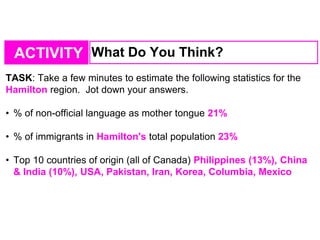
ACTIVITY What Do You Think?
TASK: Take a few minutes to estimate the following statistics for the
Hamilton region. Jot down your answers.
• % of non-official language as mother tongue 21%
• % of immigrants in Hamilton's total population 23%
• Top 10 countries of origin (all of Canada) Philippines (13%), China
& India (10%), USA, Pakistan, Iran, Korea, Columbia, Mexico
ACTIVITY You're an English Language Learner
TASK: In groups, designate yourselves as A, B, C (there can be more
than one of each letter based on group size). In groups, you will
discuss the topic below, adhering to the following rules:
• A: You have no grammatical concept of plural. You may not use
any plurals when you speak.
• B: You cannot formulate the sounds /f/ or /v/ in any of your words.
You would substitute a /p/ for the /f/ and a /b/ for the /v/.
• C: You place your adjectives after your nouns.
The Topic: You are going to be entering a cricket tournament in the
next month. Discuss your game plan for winning.
ACTIVITY You're an English Language Learner
TASK: Let's debrief. With a partner, discuss the following. Be
prepared to share out with the class.
How did the conversation go? If you had to speak this way for the
whole day, how would you feel? How important is it to feel safe in your
surroundings? What is the role of background knowledge?
ACTIVITY Fact or Myth?
TASK: In the next slides, determine if the following statement is fact or
myth. Once you decide, hold up either a fact or a myth card.
ACTIVITY Fact or Myth?
Fact or Myth: Adults are better at learning a second language than are
young children.
This is a fact. Adolescents and adults are better at second-language learning
than children. Though the opposite might sometimes appear to be the case, this
is often because children's communication typically takes place in social settings
and therefore requires a somewhat less highly developed skill level. Adults, on
the other hand, engage in situations that involve more complex communication
demands (e.g., filling out a tax form or interviewing for a job). Another factor that
makes it appear that young children are better at second language acquisition is
that they generally hear and pronounce the sounds in the new language better
than adults.
ACTIVITY Fact or Myth?
Fact or Myth: Immersion is the best way to learn a second language.
This is a myth. ELLs who are immersed in classrooms where only
English is spoken may find the experience (and their learning)
incomprehensible. By allowing students to use their native language in
the classroom, teachers can also enhance their ability to learn English.
ACTIVITY Fact or Myth?
Fact or Myth: A student’s first language interferes with his or her
ability to learn a second language.
This is a myth. A student's first language might support his or her
understanding of a second. For example, a student who is first allowed
to read a book in his native language can reread it without having to
focus on basic comprehension and can instead pay attention to other
aspects such as vocabulary and sentence structure.
ACTIVITY Fact or Myth?
Fact or Myth: It takes between five to seven years to become
proficient enough in a second language to succeed in an English-only
classroom.
This is a fact. Second language learners need at least five years
under the best learning conditions to succeed in English-only
classrooms with minimal or no support. After only one or two years of
learning a second language, a student can typically communicate in
social settings but will not have sufficient knowledge of the language
to be successful in an academic environment.
Terminology
TERMS What do ESL, ELL, & ELD Mean?
English Language Learners (ELL) are the students whose first
language is a language other than English, or is a variety of
English that is significantly different from the variety used for
instruction in Ontario schools. These students may be Canadian-
born or newcomers from other countries.
English as a Second Language (ESL) refers to the program
received by ELL students who are literate in their first language.
English Literacy Development (ELD) refers to the program
received by ELL students who are (a) not literate in their first
language, (b) have educational gaps, or (c) speak non-standard
Ontario English.
We are all ESL teachers. ESL is
not a separate curriculum subject.
students receive different levels of support,
depending on their language needs
Levels of English Language Acquisition
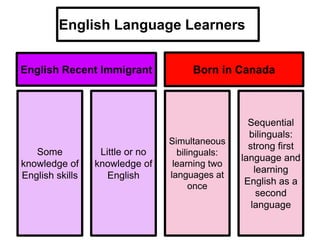
English Language Learners
English Recent Immigrant Born in Canada
Little or no
knowledge of
English
Some
knowledge of
English skills
Sequential
bilinguals:
strong first
language and
learning
English as a
second
language
Simultaneous
bilinguals:
learning two
languages at
once
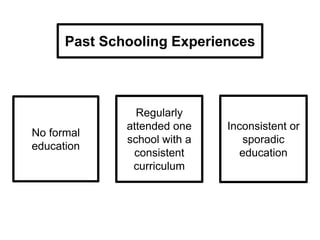
Past Schooling Experiences
Inconsistent or
sporadic
education
No formal
education
Regularly
attended one
school with a
consistent
curriculum
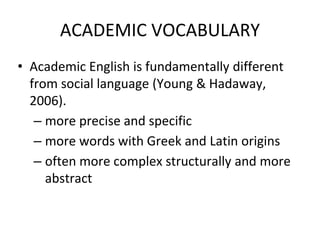
ACADEMIC VOCABULARY
• Academic English is fundamentally different
from social language (Young & Hadaway,
2006).
– more precise and specific
– more words with Greek and Latin origins
– often more complex structurally and more
abstract
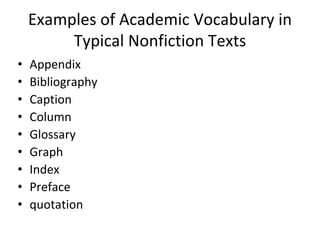
Examples of Academic Vocabulary in
Typical Nonfiction Texts
• Appendix
• Bibliography
• Caption
• Column
• Glossary
• Graph
• Index
• Preface
• quotation
Dual Word Meanings
• Activity: Math words with everyday meanings
Frequently Asked
Questions
How can I tell if I have ELLs in
my classroom?
• Conduct a Home Language survey with the whole class
• Look in the OSR (Ontario Student Record). Look for birth
certificate, immigration documents, and an English Second
Language assessment
• Access your school’s Trillium Report “Students Whose Mother
Tongue is Not English”
• Talk to the LRT
• Check the student’s Literacy Portfolio for English language
assessments
• If you are unsure, seek guidance from an English Second
Language Support teacher
• NOTE: Many ELLs are Canadian born
How much time does it take to
learn English?
• As ELL student skills develop, their academic demands increase. ELL
students are constantly trying to catch up with a “moving target”.
• Basic oral communication is developed over 1~2 years.
• It takes at least 5~7 years for ELL students to be working effectively
at grade level, using academic language.
• In cases where students have not had opportunities to develop age-
appropriate literacy in their first language, it can take up to 10 years
to be working effectively at grade level.
I have a beginning level ELL in
my classroom. Now what?
Set the student up with a buddy. The IDEAL buddy…
• Shares a common first language with the new ELL
• Is always caught up on class and homework
• Is a positive role model
• Is empathetic
• Has a supportive group of friends that will not alienate
the new ELL or the buddy
• Sensitize your mainstream students
• Bilingual volunteers
• Contact an ESL support teacher for an assessment
and suggestions for program delivery
• Choose appropriate accommodations
First language maintenance
and development is important.
Research shows that students with a strong first
language are more likely to acquire English quickly.
Parents should be encouraged to use, maintain and
develop the first language with their children to
discuss books, review school work, write to family
members, etc. Schools should encourage the use of
the first language, as it will validate students’
backgrounds, as well as assist in students’ academic
achievement.
Why is it so important to be
aware of a student's first
language?
• Urdu: why student is holding a book backwards, or not using articles
such as a/an or the
• Low German: not typically a literate language- immediate
disadvantage due to lack of connection with oral language and literacy
• Chinese: why a student doesn’t understand when we say ‘sound it out’
(not phonological)
• Punjabi: why a student is writing in between the spaces on the paper
(Punjabi script hangs from the line)
• Chinese: difficulty organizing a piece of persuasive writing (culturally it
may be considered or opinionated to begin by stating a point of view)
Knowing a student's first language can give us
a lot of background information. For example...
Strategies & Supports
Build Background Knowledge
• Asking students to brainstorm about what they already know about a topic.
• Making explicit connections between previously learned concepts and new
ones
• Using graphic organizers and other visuals to show the connections between
students' prior experiences and new learning knowledge.
• Developing learning activities that are relevant to students' cultural experiences
• Asking students to think about and write down what they know about a new
topic and then share their ideas with a partner
• Teaching new vocabulary words by making connections to students'
background knowledge
Differentiate Instruction
Present information or allow students to access information
• Provide a range of choices to access the content (e.g., books,
audio, video in home language and in English)
• Make instruction more concrete by using pictures, charts,
demonstrations, graphic organizers, or timelines
• Use visual references about concepts
• Provide texts at different reading levels (newsela is a great
resource)
Differentiate Instruction
Encourage students to make sense of the information
• Provide a range of choices for students to practise what they
are learning
• Use flexible grouping
• Use hands-on activities
• Set up classrooms with learning centers (e.g., make available
audiotapes and CDs to assist students with their reading)
• Provide materials in different languages.
Differentiate Instruction
Encourage students to make sense of the information
• Offer a range of choices to express understanding including
multimodal methods using technology (i.e., create a slide
presentation, create a performance or role play, explain ideas
using Shadow Puppet or another similar app)
• Permit the option to work independently or in a group to
complete an assignment
• Allow ELLs to use instructional supports such as translated word
lists. As students' language proficiency increases, the level of
support is reduced.
• Allow ELLs to work in pairs or in small groups
• Encourage students to discuss what they are learning. As often as
possible, these conversations should be student led and interactive
• Focus on and provide feedback on the content of ELLs' responses
in English, rather than on their pronunciation and grammar. It is
normal--and not a sign of confusion--for them to draw from their first
language.
Practising Skills & Concepts
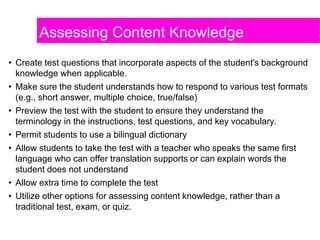
Assessing Content Knowledge
• Create test questions that incorporate aspects of the student's background
knowledge when applicable.
• Make sure the student understands how to respond to various test formats
(e.g., short answer, multiple choice, true/false)
• Preview the test with the student to ensure they understand the
terminology in the instructions, test questions, and key vocabulary.
• Permit students to use a bilingual dictionary
• Allow students to take the test with a teacher who speaks the same first
language who can offer translation supports or can explain words the
student does not understand
• Allow extra time to complete the test
• Utilize other options for assessing content knowledge, rather than a
traditional test, exam, or quiz.
Modifications &
Adaptations
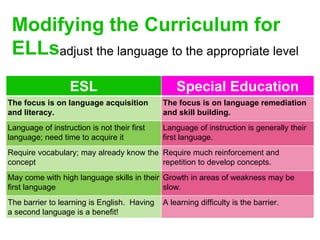
Modifying the Curriculum for
ELLs
ESL Special Education
The focus is on language acquisition
and literacy.
The focus is on language remediation
and skill building.
Language of instruction is not their first
language; need time to acquire it
Language of instruction is generally their
first language.
Require vocabulary; may already know the
concept
Require much reinforcement and
repetition to develop concepts.
May come with high language skills in their
first language
Growth in areas of weakness may be
slow.
The barrier to learning is English. Having
a second language is a benefit!
A learning difficulty is the barrier.
adjust the language to the appropriate level
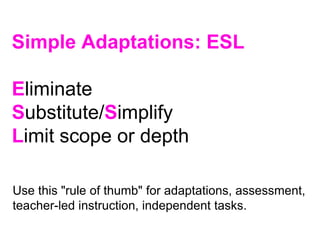
Simple Adaptations: ESL
Eliminate
Substitute/Simplify
Limit scope or depth
Use this "rule of thumb" for adaptations, assessment,
teacher-led instruction, independent tasks.
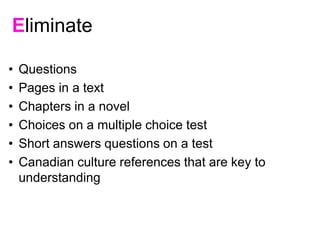
• Questions
• Pages in a text
• Chapters in a novel
• Choices on a multiple choice test
• Short answers questions on a test
• Canadian culture references that are key to
understanding
Eliminate
Substitute/Simplify
• Substitute short answer questions for graphic organizers, diagrams, or
cloze activities
• Substitute text based ‘Read and Answer Questions’ activities for key-term
vocabulary building
• Create a personal dictionary to use for all subjects
• Substitute English written responses with responses written in the student’s
first language
• Assess the student’s oral response instead
• Speak more slowly: use longer pauses between sentences and ideas; use
a natural pace rather than a slow, exaggerated one.
• Use multimodal techniques: use objects, pictures, labeled diagrams, and
videos; infuse demonstration throughout lessons; use gestures, body
language movement, and role playing.
• Your expectations for comprehension; focus instead on
vocabulary development.
• Extraneous information. Direct the student to the
page/paragraph where the answer can be found.
• Time spent on translation. Avoid translating entire texts
from English to the first language, and choose to only
translate the question and perhaps a few key terms.
• Use of jargon, slang, idiomatic speech, and figurative
language
Limit scope or depth
ACTIVITY Applying the ESL Rule
TASK: Consider how the ESL rule, strategies and supports, and other
information presented in class will inform your teaching in the J/I
context? (You can choose the grade level of your future block).
Discuss your ideas with a partner. Be prepared to share out with the
class.
• Supporting English Language Learners (1-8)
• Steps to English Proficiency
• English Language Learners ESL and ELD
Programs and Services (K-12)
• Many Roots Many Voices
• Supporting English Language Learners with
Limited Prior Schooling (3-12)
Ontario ESL Resources
RESOURCE
S
• www.readingatoz.com
• www.everythingesl.com
• www.storylineonline.com
• www.newsela.com
• Simple English Wikipedia
• iPads; Google- change language in settings/preferences
• Starting Points: Working with Young English Language Learners.
• New Instructional Model helps English Learners Succeed
Digital ESL Resources
RESOURCE
S
• Settlement Workers in Schools (SWIS)
• In Hamilton, SWISH
Local ESL Resources
RESOURCE
S
• proactively contacts newcomer parents and students to assist them with their settlement needs
• refers the families to more specialized community resources as needed
• provides group information sessions for newcomer youth and parents, often in partnership with
school staff
• provides orientation about the settlement needs of newcomers for school staff
• coordinates the Newcomer Orientation Week (NOW) and Welcome and Information for
Newcomers (WIN) programs, which take place in the last weeks of the summer in most schools
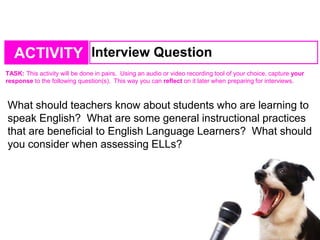
TASK: This activity will be done in pairs. Using an audio or video recording tool of your choice, capture your
response to the following question(s). This way you can reflect on it later when preparing for interviews.
ACTIVITY Interview Question
What should teachers know about students who are learning to
speak English? What are some general instructional practices
that are beneficial to English Language Learners? What should
you consider when assessing ELLs?
Burnette, J. (1999, November). Critical behaviors and strategies for teaching culturally diverse students. ERIC/ OSEP
Digest E584. ED435147. Retrieved on April 8, 2011, from http://www.eric.ed.gov:80/PDFS/ED435147.pdf
Calderon, M. (2007). Teaching reading to English language learners, grades 6–12: A framework for improving
achievement in the content areas. Thousand Oaks, CA: Corwin Press.
The Center for Public Education. (2006). Preparing English language learners for academic success. Retrieved on
April 20, 2011, from http://www.centerforpubliceducation.org/…mic-success.html
Cox, C., & Boyd-Batstone, P. S. (2009). Engaging English learners: Exploring literature, developing literacy, and
differentiating instruction. Boston, MA: Pearson Education, Inc.
The IRIS Center. (2011). Teaching English language learners: Effective instructional practices. Retrieved from
http://iris.peabody.vanderbilt.edu/module/ell/
Klingner, J. K., Hoover, J. J., & Baca, L. M. (Eds.). (2008). Why do English language learners struggle with reading?:
Distinguishing language acquisition from learning disabilities. Thousand Oaks, CA: Corwin Press.
The National Center for Culturally Responsive Educational Systems (NCCRESt). (2008). Academy 2: Culturally
responsive literacy instruction – What does it look like in the classroom. Module 5: Culturally responsive literacy.
Facilitator’s Manual.
References
Bonus Interview Question – recently
posed to applicant for occasional
teacher list
What sort of challenges do you think you will face as
an occasional teacher and how will you prepare for
them?

Class 10 ell slides 2018

  • 1.
  • 2.
    Chicken crosses theroad, makes news Why did the chicken cross the road? We don’t know, but now he’s in police custody. Drivers at Kingston and Galloway Rds. found their commute delayed Tuesday when a large bird wandered into traffic around 8 a.m. Police reported on Twitter that there was a “turkey or large chicken on loose, causing a traffic disturbance.” Moments after egging on commuters, officers made an arrest for fowl play. “The chicken has made it to the other side of the road,” tweeted @TPSOperations. “Now in custody! Traffic in the area back to its regular flow!”
  • 3.
    Reflecting on thisnewspaper story The police and the newspaper reporter create humour based on an assumption that their readers share certain cultural and linguistic knowledge. How would you explain the humour to an English Language Learner?
  • 4.
    ACTIVITY What DoYou Think? TASK: Take a few minutes to estimate the following statistics for the Hamilton region. Jot down your answers. • % of non-official language as mother tongue • % of immigrants in Hamilton's total population • Top 10 countries of origin (all of Canada)
  • 5.
    ACTIVITY What DoYou Think? TASK: Take a few minutes to estimate the following statistics for the Hamilton region. Jot down your answers. • % of non-official language as mother tongue 21% • % of immigrants in Hamilton's total population 23% • Top 10 countries of origin (all of Canada) Philippines (13%), China & India (10%), USA, Pakistan, Iran, Korea, Columbia, Mexico
  • 6.
    ACTIVITY You're anEnglish Language Learner TASK: In groups, designate yourselves as A, B, C (there can be more than one of each letter based on group size). In groups, you will discuss the topic below, adhering to the following rules: • A: You have no grammatical concept of plural. You may not use any plurals when you speak. • B: You cannot formulate the sounds /f/ or /v/ in any of your words. You would substitute a /p/ for the /f/ and a /b/ for the /v/. • C: You place your adjectives after your nouns. The Topic: You are going to be entering a cricket tournament in the next month. Discuss your game plan for winning.
  • 7.
    ACTIVITY You're anEnglish Language Learner TASK: Let's debrief. With a partner, discuss the following. Be prepared to share out with the class. How did the conversation go? If you had to speak this way for the whole day, how would you feel? How important is it to feel safe in your surroundings? What is the role of background knowledge?
  • 8.
    ACTIVITY Fact orMyth? TASK: In the next slides, determine if the following statement is fact or myth. Once you decide, hold up either a fact or a myth card.
  • 9.
    ACTIVITY Fact orMyth? Fact or Myth: Adults are better at learning a second language than are young children. This is a fact. Adolescents and adults are better at second-language learning than children. Though the opposite might sometimes appear to be the case, this is often because children's communication typically takes place in social settings and therefore requires a somewhat less highly developed skill level. Adults, on the other hand, engage in situations that involve more complex communication demands (e.g., filling out a tax form or interviewing for a job). Another factor that makes it appear that young children are better at second language acquisition is that they generally hear and pronounce the sounds in the new language better than adults.
  • 10.
    ACTIVITY Fact orMyth? Fact or Myth: Immersion is the best way to learn a second language. This is a myth. ELLs who are immersed in classrooms where only English is spoken may find the experience (and their learning) incomprehensible. By allowing students to use their native language in the classroom, teachers can also enhance their ability to learn English.
  • 11.
    ACTIVITY Fact orMyth? Fact or Myth: A student’s first language interferes with his or her ability to learn a second language. This is a myth. A student's first language might support his or her understanding of a second. For example, a student who is first allowed to read a book in his native language can reread it without having to focus on basic comprehension and can instead pay attention to other aspects such as vocabulary and sentence structure.
  • 12.
    ACTIVITY Fact orMyth? Fact or Myth: It takes between five to seven years to become proficient enough in a second language to succeed in an English-only classroom. This is a fact. Second language learners need at least five years under the best learning conditions to succeed in English-only classrooms with minimal or no support. After only one or two years of learning a second language, a student can typically communicate in social settings but will not have sufficient knowledge of the language to be successful in an academic environment.
  • 13.
  • 14.
    TERMS What doESL, ELL, & ELD Mean? English Language Learners (ELL) are the students whose first language is a language other than English, or is a variety of English that is significantly different from the variety used for instruction in Ontario schools. These students may be Canadian- born or newcomers from other countries. English as a Second Language (ESL) refers to the program received by ELL students who are literate in their first language. English Literacy Development (ELD) refers to the program received by ELL students who are (a) not literate in their first language, (b) have educational gaps, or (c) speak non-standard Ontario English.
  • 15.
    We are allESL teachers. ESL is not a separate curriculum subject.
  • 16.
    students receive differentlevels of support, depending on their language needs Levels of English Language Acquisition
  • 17.
    English Language Learners EnglishRecent Immigrant Born in Canada Little or no knowledge of English Some knowledge of English skills Sequential bilinguals: strong first language and learning English as a second language Simultaneous bilinguals: learning two languages at once
  • 18.
    Past Schooling Experiences Inconsistentor sporadic education No formal education Regularly attended one school with a consistent curriculum
  • 19.
    ACADEMIC VOCABULARY • AcademicEnglish is fundamentally different from social language (Young & Hadaway, 2006). – more precise and specific – more words with Greek and Latin origins – often more complex structurally and more abstract
  • 20.
    Examples of AcademicVocabulary in Typical Nonfiction Texts • Appendix • Bibliography • Caption • Column • Glossary • Graph • Index • Preface • quotation
  • 21.
    Dual Word Meanings •Activity: Math words with everyday meanings
  • 22.
  • 23.
    How can Itell if I have ELLs in my classroom?
  • 24.
    • Conduct aHome Language survey with the whole class • Look in the OSR (Ontario Student Record). Look for birth certificate, immigration documents, and an English Second Language assessment • Access your school’s Trillium Report “Students Whose Mother Tongue is Not English” • Talk to the LRT • Check the student’s Literacy Portfolio for English language assessments • If you are unsure, seek guidance from an English Second Language Support teacher • NOTE: Many ELLs are Canadian born
  • 25.
    How much timedoes it take to learn English?
  • 26.
    • As ELLstudent skills develop, their academic demands increase. ELL students are constantly trying to catch up with a “moving target”. • Basic oral communication is developed over 1~2 years. • It takes at least 5~7 years for ELL students to be working effectively at grade level, using academic language. • In cases where students have not had opportunities to develop age- appropriate literacy in their first language, it can take up to 10 years to be working effectively at grade level.
  • 27.
    I have abeginning level ELL in my classroom. Now what?
  • 28.
    Set the studentup with a buddy. The IDEAL buddy… • Shares a common first language with the new ELL • Is always caught up on class and homework • Is a positive role model • Is empathetic • Has a supportive group of friends that will not alienate the new ELL or the buddy
  • 29.
    • Sensitize yourmainstream students • Bilingual volunteers • Contact an ESL support teacher for an assessment and suggestions for program delivery • Choose appropriate accommodations
  • 30.
    First language maintenance anddevelopment is important.
  • 31.
    Research shows thatstudents with a strong first language are more likely to acquire English quickly.
  • 32.
    Parents should beencouraged to use, maintain and develop the first language with their children to discuss books, review school work, write to family members, etc. Schools should encourage the use of the first language, as it will validate students’ backgrounds, as well as assist in students’ academic achievement.
  • 33.
    Why is itso important to be aware of a student's first language?
  • 34.
    • Urdu: whystudent is holding a book backwards, or not using articles such as a/an or the • Low German: not typically a literate language- immediate disadvantage due to lack of connection with oral language and literacy • Chinese: why a student doesn’t understand when we say ‘sound it out’ (not phonological) • Punjabi: why a student is writing in between the spaces on the paper (Punjabi script hangs from the line) • Chinese: difficulty organizing a piece of persuasive writing (culturally it may be considered or opinionated to begin by stating a point of view) Knowing a student's first language can give us a lot of background information. For example...
  • 35.
  • 36.
    Build Background Knowledge •Asking students to brainstorm about what they already know about a topic. • Making explicit connections between previously learned concepts and new ones • Using graphic organizers and other visuals to show the connections between students' prior experiences and new learning knowledge. • Developing learning activities that are relevant to students' cultural experiences • Asking students to think about and write down what they know about a new topic and then share their ideas with a partner • Teaching new vocabulary words by making connections to students' background knowledge
  • 37.
    Differentiate Instruction Present informationor allow students to access information • Provide a range of choices to access the content (e.g., books, audio, video in home language and in English) • Make instruction more concrete by using pictures, charts, demonstrations, graphic organizers, or timelines • Use visual references about concepts • Provide texts at different reading levels (newsela is a great resource)
  • 38.
    Differentiate Instruction Encourage studentsto make sense of the information • Provide a range of choices for students to practise what they are learning • Use flexible grouping • Use hands-on activities • Set up classrooms with learning centers (e.g., make available audiotapes and CDs to assist students with their reading) • Provide materials in different languages.
  • 39.
    Differentiate Instruction Encourage studentsto make sense of the information • Offer a range of choices to express understanding including multimodal methods using technology (i.e., create a slide presentation, create a performance or role play, explain ideas using Shadow Puppet or another similar app) • Permit the option to work independently or in a group to complete an assignment
  • 40.
    • Allow ELLsto use instructional supports such as translated word lists. As students' language proficiency increases, the level of support is reduced. • Allow ELLs to work in pairs or in small groups • Encourage students to discuss what they are learning. As often as possible, these conversations should be student led and interactive • Focus on and provide feedback on the content of ELLs' responses in English, rather than on their pronunciation and grammar. It is normal--and not a sign of confusion--for them to draw from their first language. Practising Skills & Concepts
  • 41.
    Assessing Content Knowledge •Create test questions that incorporate aspects of the student's background knowledge when applicable. • Make sure the student understands how to respond to various test formats (e.g., short answer, multiple choice, true/false) • Preview the test with the student to ensure they understand the terminology in the instructions, test questions, and key vocabulary. • Permit students to use a bilingual dictionary • Allow students to take the test with a teacher who speaks the same first language who can offer translation supports or can explain words the student does not understand • Allow extra time to complete the test • Utilize other options for assessing content knowledge, rather than a traditional test, exam, or quiz.
  • 42.
  • 43.
    Modifying the Curriculumfor ELLs ESL Special Education The focus is on language acquisition and literacy. The focus is on language remediation and skill building. Language of instruction is not their first language; need time to acquire it Language of instruction is generally their first language. Require vocabulary; may already know the concept Require much reinforcement and repetition to develop concepts. May come with high language skills in their first language Growth in areas of weakness may be slow. The barrier to learning is English. Having a second language is a benefit! A learning difficulty is the barrier. adjust the language to the appropriate level
  • 44.
    Simple Adaptations: ESL Eliminate Substitute/Simplify Limitscope or depth Use this "rule of thumb" for adaptations, assessment, teacher-led instruction, independent tasks.
  • 45.
    • Questions • Pagesin a text • Chapters in a novel • Choices on a multiple choice test • Short answers questions on a test • Canadian culture references that are key to understanding Eliminate
  • 46.
    Substitute/Simplify • Substitute shortanswer questions for graphic organizers, diagrams, or cloze activities • Substitute text based ‘Read and Answer Questions’ activities for key-term vocabulary building • Create a personal dictionary to use for all subjects • Substitute English written responses with responses written in the student’s first language • Assess the student’s oral response instead • Speak more slowly: use longer pauses between sentences and ideas; use a natural pace rather than a slow, exaggerated one. • Use multimodal techniques: use objects, pictures, labeled diagrams, and videos; infuse demonstration throughout lessons; use gestures, body language movement, and role playing.
  • 47.
    • Your expectationsfor comprehension; focus instead on vocabulary development. • Extraneous information. Direct the student to the page/paragraph where the answer can be found. • Time spent on translation. Avoid translating entire texts from English to the first language, and choose to only translate the question and perhaps a few key terms. • Use of jargon, slang, idiomatic speech, and figurative language Limit scope or depth
  • 48.
    ACTIVITY Applying theESL Rule TASK: Consider how the ESL rule, strategies and supports, and other information presented in class will inform your teaching in the J/I context? (You can choose the grade level of your future block). Discuss your ideas with a partner. Be prepared to share out with the class.
  • 49.
    • Supporting EnglishLanguage Learners (1-8) • Steps to English Proficiency • English Language Learners ESL and ELD Programs and Services (K-12) • Many Roots Many Voices • Supporting English Language Learners with Limited Prior Schooling (3-12) Ontario ESL Resources RESOURCE S
  • 50.
    • www.readingatoz.com • www.everythingesl.com •www.storylineonline.com • www.newsela.com • Simple English Wikipedia • iPads; Google- change language in settings/preferences • Starting Points: Working with Young English Language Learners. • New Instructional Model helps English Learners Succeed Digital ESL Resources RESOURCE S
  • 51.
    • Settlement Workersin Schools (SWIS) • In Hamilton, SWISH Local ESL Resources RESOURCE S • proactively contacts newcomer parents and students to assist them with their settlement needs • refers the families to more specialized community resources as needed • provides group information sessions for newcomer youth and parents, often in partnership with school staff • provides orientation about the settlement needs of newcomers for school staff • coordinates the Newcomer Orientation Week (NOW) and Welcome and Information for Newcomers (WIN) programs, which take place in the last weeks of the summer in most schools
  • 52.
    TASK: This activitywill be done in pairs. Using an audio or video recording tool of your choice, capture your response to the following question(s). This way you can reflect on it later when preparing for interviews. ACTIVITY Interview Question What should teachers know about students who are learning to speak English? What are some general instructional practices that are beneficial to English Language Learners? What should you consider when assessing ELLs?
  • 53.
    Burnette, J. (1999,November). Critical behaviors and strategies for teaching culturally diverse students. ERIC/ OSEP Digest E584. ED435147. Retrieved on April 8, 2011, from http://www.eric.ed.gov:80/PDFS/ED435147.pdf Calderon, M. (2007). Teaching reading to English language learners, grades 6–12: A framework for improving achievement in the content areas. Thousand Oaks, CA: Corwin Press. The Center for Public Education. (2006). Preparing English language learners for academic success. Retrieved on April 20, 2011, from http://www.centerforpubliceducation.org/…mic-success.html Cox, C., & Boyd-Batstone, P. S. (2009). Engaging English learners: Exploring literature, developing literacy, and differentiating instruction. Boston, MA: Pearson Education, Inc. The IRIS Center. (2011). Teaching English language learners: Effective instructional practices. Retrieved from http://iris.peabody.vanderbilt.edu/module/ell/ Klingner, J. K., Hoover, J. J., & Baca, L. M. (Eds.). (2008). Why do English language learners struggle with reading?: Distinguishing language acquisition from learning disabilities. Thousand Oaks, CA: Corwin Press. The National Center for Culturally Responsive Educational Systems (NCCRESt). (2008). Academy 2: Culturally responsive literacy instruction – What does it look like in the classroom. Module 5: Culturally responsive literacy. Facilitator’s Manual. References
  • 55.
    Bonus Interview Question– recently posed to applicant for occasional teacher list What sort of challenges do you think you will face as an occasional teacher and how will you prepare for them?

Editor's Notes

  • #3 The police and the newspaper reporter create humour based on an assumption that their readers share certain cultural and linguistic knowledge. How would you explain the humour to an English Language Learner?
  • #5 Have students come up with answers to these questions - they're from early 2015 so with the incoming Syrian refugees, this is subject to change.
  • #6 These numbers are from early 2015. The percentages are due to change with the incoming Syrian refugees.
  • #7 After the activity, ask the questions on the next slide. How did the conversation go? If you had to speak this way for the whole day, how would you feel? How important is it to feel safe in your surroundings? What is the role of background knowledge?
  • #8 Reflection on activity
  • #9 I have fact/myth cards for the students that I made from paint sample squares from home depot (I just wrote fact on green cards and myth on purple ones). You can adapt or skip this activity; these points will be addressed later on. I'm using this to prime them for the rest of the class.
  • #17 The next slides will expand upon this. Students level of English, past schooling experiences, and SES are all contributing factors
  • #24 These are a series of FAQs to stimulate discussion. Will permit time for students to briefly talk about each question in groups before I show the "answer" slides and we engage in a whole class discussion.
  • #25 FAQ slide
  • #26 FAQ slide
  • #27 FAQ slide
  • #28 FAQ slide
  • #29 FAQ slide
  • #30 FAQ slide
  • #31 FAQ slide
  • #32 FAQ slide
  • #33 FAQ slide
  • #34 FAQ slide
  • #35 FAQ slide
  • #37 Strategies
  • #38 Strategies
  • #39 Strategies
  • #40 Strategies
  • #41 When providing opportunities for students to practice skills or concepts...
  • #42 Teachers should find ways to assess ELLs' content knowledge that is separate from their English language knowledge. Here are some suggesting for administering tests for ELL students
  • #44 This is to clarify differences between ELL and Special Education
  • #45 This is an acronym for remembering simple adaptations
  • #46 Adaptions
  • #47 Adaptions
  • #48 These
  • #49 Discussion activity
  • #50 Ontario Resource Documents - could also have students explore the documents as a short activity (each person in a group scans a document) and they can report back to the table group - jigsaw style. Of course time permitting on this.
  • #51 Here are some digital resources for students to explore
  • #52 The Settlement Workers in Schools (SWIS) Program is an initiative funded by Immigration, Refugees and Citizenship Canada (IRCC). The SWIS program places settlement workers from community agencies in elementary and secondary schools that have high numbers of newcomer students. In Ontario, approximately 200 settlement workers from 20 different settlement agencies are based in schools in over 20 school boards across the province.
  • #53 Can choose one question, or change/adapt those I selected. I have my students capture their answers via a voice recording on their smartphone. They can listed and reflect on their answers later. I use this as preparation for future interviews etc. It's also a good way to model using audio to capture oral responses that they can use in the classroom with their students for reflection.
  • #54 Citation information for the content on the slides