Thinking skills training in English
with pre-school children
Herbert Puchta
facebook.com/herbertpuchta.elt
@herbertpuchta
www.herbertpuchta.com
Content

• Reasons for teaching thinking skills
at pre-primary level
• Practical examples
• Q&A
Do we want
Teaching the
this?

very

young:

Do we want this?
Do we want this?
• Very young children are able to think, attend and

remember, BUT their thinking, attending and memory
are very reactive.
• Example - TV: fast paced, loud, lots of movement,
colourful, constantly changing scenes
• ‘Reactive learners’ need fast-paced sensory
bombardment to learn even very simple information!

The attention grabbing approach
Bodrova/Leong, Tools of the Mind, p.
5
Do we want
Teaching the
this?

very

young:

Or do we want this?
Or do we want this?

• children who can direct their attention, memory and
problem-solving skills on their own
• children who are gradually taking more and more
responsibility for their learning
• children who have mental tools at their disposal
that help them to attend, remember and think
better

Learning as a self directed activity
Bodrova/Leong, Tools of the Mind, p.
5
Tools of the mind extend our cognitive
capabilities. Their absence will have
serious long-term consequences on
the child’s development. Without them
children will not be able to pay
attention. They will have poor memory
skills, and will not be able to engage in
abstract thinking.
Tools of the mind
reduce the workload
for the teacher.
Cognitive tools - what for?

• Cognitive tools are to the mind what physical
•
•
•

tools are to the body.
Cognitive tools enable us to make plans, work
in teams, and solve complex problems.
Cognitive tools enable us to control our
feelings and our behaviour.
Cognitive tools dramatically improve our
memory skills.
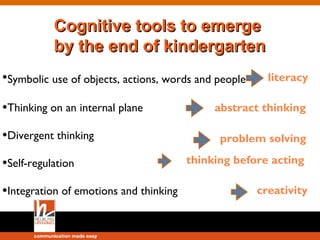
Cognitive tools to emerge
by the end of kindergarten
•Symbolic use of objects, actions, words and people
•Thinking on an internal plane
•Divergent thinking
•Self-regulation
•Integration of emotions and thinking

literacy

abstract thinking
problem solving
thinking before acting
creativity
Cognitive, social and emotional development
through

• developing students’ imagination
• taking on and acting out roles
• following a set of rules determined by
specific roles
Kindergarten ELT - cognitive tool development

IMAGINATION

•
•
•
•
•

action stories
stories
role play
art and drawing
silence (private speech - inner speech verbal thinking)
Kindergarten ELT - cognitive tool development

ROLES

•
•
•

storytelling (imagination)
role play (imagination, roles, rules!)
silence (private speech - inner speech verbal thinking)
Kindergarten ELT - cognitive tool development

•
•
•
•
•
•
•

RULES
sensomotoric thinking (self regulation!)
awareness of values (stories)
games
role play
patterns (rhythm / rhyme / chants / songs /
logical sequences)
planning (self regulation!)
routines
Language and the development of cognitive tools
(Kieran Egan)

• rhythm and rhyme
• Images and imaginative thinking
• story thinking
• small talk
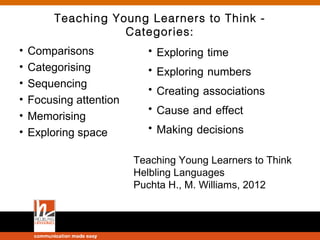
Teaching Young Learners to Think Categories:
•
•
•
•
•
•

Comparisons
Categorising
Sequencing
Focusing attention
Memorising
Exploring space

• Exploring time
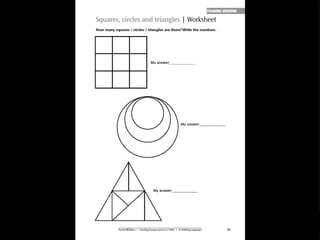
• Exploring numbers
• Creating associations
• Cause and effect
• Making decisions
Teaching Young Learners to Think
Helbling Languages
Puchta H., M. Williams, 2012
HOORAY! Let’s Play!

SB + Audio-CD
TB + 2 Audio-CDs + DVD-ROM
Cartoon Stories DVD
Cards Set (flashcards + story cards)
Interactive Whiteboard software
Peter the Panda puppet
Thank you!
Herbert Puchta
facebook.com/herbertpuchta.elt
@herbertpuchta
www.herbertpuchta.com
WEBinar:

Thinking skills training in English
with pre-school children
with

HERBERT PUCHTA

QUESTIONS & ANSWERS

Webinar Herbert Puchta

  • 1.
    Thinking skills trainingin English with pre-school children Herbert Puchta facebook.com/herbertpuchta.elt @herbertpuchta www.herbertpuchta.com
  • 2.
    Content • Reasons forteaching thinking skills at pre-primary level • Practical examples • Q&A
  • 3.
    Do we want Teachingthe this? very young: Do we want this?
  • 4.
    Do we wantthis? • Very young children are able to think, attend and remember, BUT their thinking, attending and memory are very reactive. • Example - TV: fast paced, loud, lots of movement, colourful, constantly changing scenes • ‘Reactive learners’ need fast-paced sensory bombardment to learn even very simple information! The attention grabbing approach Bodrova/Leong, Tools of the Mind, p. 5
  • 5.
    Do we want Teachingthe this? very young: Or do we want this?
  • 6.
    Or do wewant this? • children who can direct their attention, memory and problem-solving skills on their own • children who are gradually taking more and more responsibility for their learning • children who have mental tools at their disposal that help them to attend, remember and think better Learning as a self directed activity Bodrova/Leong, Tools of the Mind, p. 5
  • 7.
    Tools of themind extend our cognitive capabilities. Their absence will have serious long-term consequences on the child’s development. Without them children will not be able to pay attention. They will have poor memory skills, and will not be able to engage in abstract thinking.
  • 8.
    Tools of themind reduce the workload for the teacher.
  • 9.
    Cognitive tools -what for? • Cognitive tools are to the mind what physical • • • tools are to the body. Cognitive tools enable us to make plans, work in teams, and solve complex problems. Cognitive tools enable us to control our feelings and our behaviour. Cognitive tools dramatically improve our memory skills.
  • 10.
    Cognitive tools toemerge by the end of kindergarten •Symbolic use of objects, actions, words and people •Thinking on an internal plane •Divergent thinking •Self-regulation •Integration of emotions and thinking literacy abstract thinking problem solving thinking before acting creativity
  • 11.
    Cognitive, social andemotional development through • developing students’ imagination • taking on and acting out roles • following a set of rules determined by specific roles
  • 12.
    Kindergarten ELT -cognitive tool development IMAGINATION • • • • • action stories stories role play art and drawing silence (private speech - inner speech verbal thinking)
  • 13.
    Kindergarten ELT -cognitive tool development ROLES • • • storytelling (imagination) role play (imagination, roles, rules!) silence (private speech - inner speech verbal thinking)
  • 14.
    Kindergarten ELT -cognitive tool development • • • • • • • RULES sensomotoric thinking (self regulation!) awareness of values (stories) games role play patterns (rhythm / rhyme / chants / songs / logical sequences) planning (self regulation!) routines
  • 15.
    Language and thedevelopment of cognitive tools (Kieran Egan) • rhythm and rhyme • Images and imaginative thinking • story thinking • small talk
  • 16.
    Teaching Young Learnersto Think Categories: • • • • • • Comparisons Categorising Sequencing Focusing attention Memorising Exploring space • Exploring time • Exploring numbers • Creating associations • Cause and effect • Making decisions Teaching Young Learners to Think Helbling Languages Puchta H., M. Williams, 2012
  • 20.
    HOORAY! Let’s Play! SB+ Audio-CD TB + 2 Audio-CDs + DVD-ROM Cartoon Stories DVD Cards Set (flashcards + story cards) Interactive Whiteboard software Peter the Panda puppet
  • 21.
  • 22.
    WEBinar: Thinking skills trainingin English with pre-school children with HERBERT PUCHTA QUESTIONS & ANSWERS