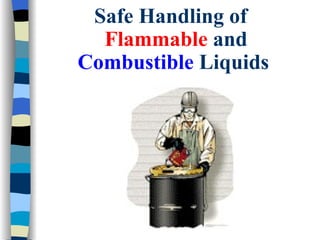
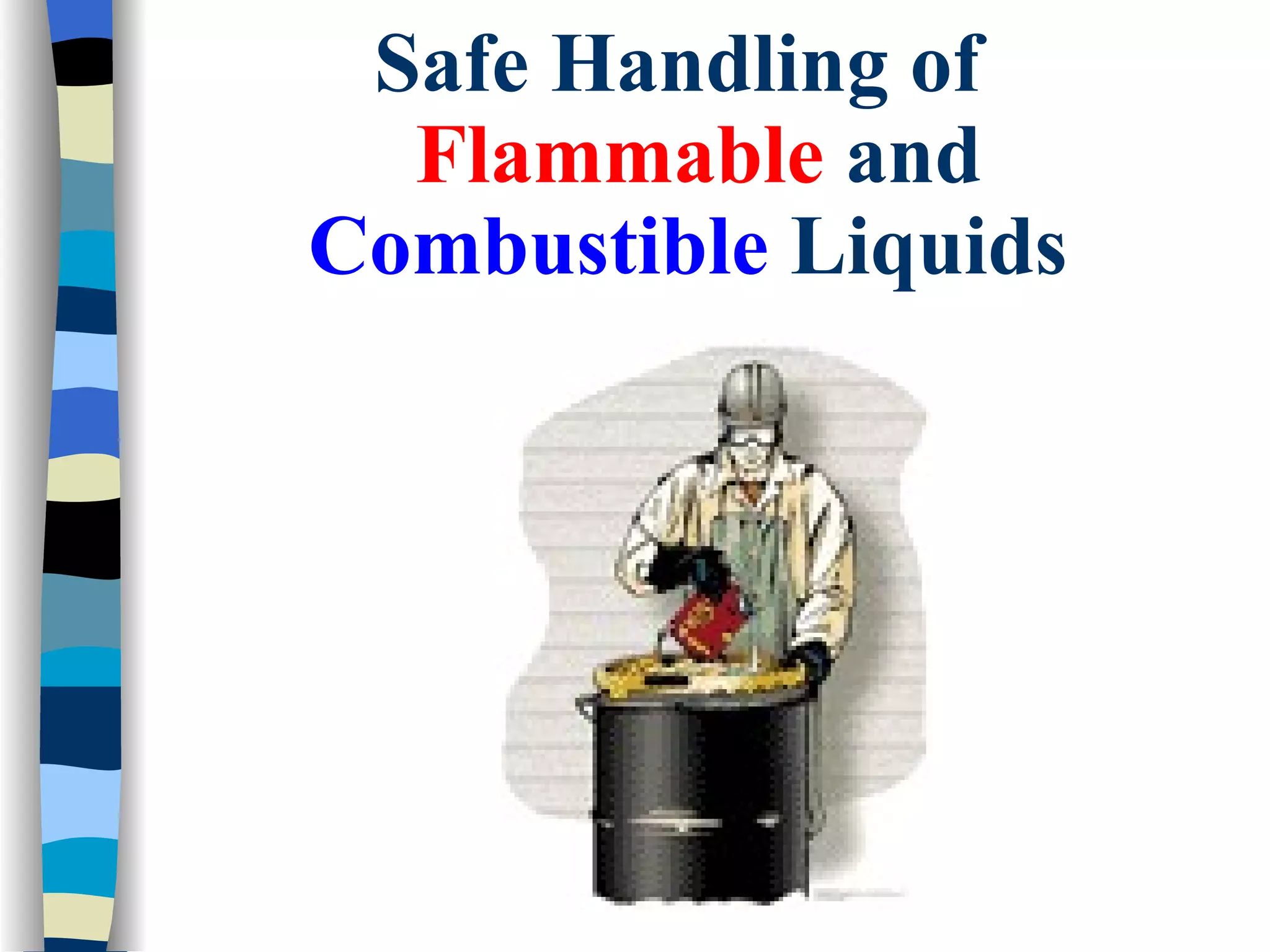
Safe Handling of
  Flammable and
Combustible Liquids
Flammable and Combustible Liquids

  The determining factor in whether a liquid is
    flammable or combustible is its flashpoint.

Flashpoint: The minimum temperature at which a liquid
  gives off enough vapor within a test vessel in
  sufficient concentration to form an ignitable mixture
  with air near the surface of the liquid.

 Remember, it is the vapors, not the liquid, that Burns!

 A chemical’s flashpoint is listed on the MSDS under the Fire and
                          Explosion section.
Flammable and Combustible Liquids
 Flammable Liquids          Combustible Liquids

 Any liquid having a         Any liquid having a
 flashpoint below 100o F     flashpoint at or above
 (37.8o C) or lower.         100o F (37.8o C).


NFPA Classes IA, IB, & IC   NFPA Classes II & IIIA & B
Flammable and Combustible Liquid
         Classifications
Flammable Liquid - any liquid having a flashpoint below 100o F
(37.8o C) or higher, the total of which make up 99 percent or more
of the total volume of the mixture. Flammable liquids shall be
known as Class I liquids. Class I liquids are divided into three
classes as follows:

Class IA - shall include liquids having flashpoints below 73 F (22.8 C)
and having a boiling point below 100 F (37.8 C).

Class IB - shall include liquids having flashpoints below 73 F (22.8 C)
And having a boiling point at or above 100 F (37.8 C).

Class IC - shall include liquids having flashpoints at or above 73 F
(22.8 C) and below 100 F (37.8 C).
Flammable and Combustible Liquid
      Classifications (Cont.)
Combustible Liquid - any liquid having a flashpoint at or above
100o F (37.8o C). Combustible liquids shall be divided into two
classes as follows:

Class II - shall include those with flashpoints at or above
100 F (37.8 C) and below 140 F (60 C), except any mixture
having components with flashpoints of 200 F (93.3 C) or higher,
the volume of which makes up 99 percent or more of the total
volume of the mixture.

Class III - shall include those with flashpoints at or above
140 F (60 C).
Flammable and Combustible Liquids
      Classifications (Cont.)
Class III liquids are subdivided into two
subclasses:

Class IIIA - shall include those with flashpoints at or
above 140 F (60 C) and below 200 F (93.3 C), except
any mixture having components with flashpoints of 200 F
(93.3 C), or higher, the total volume of which makes up
99 percent or more of the total volume of the mixture.

Class IIIB - shall include those with flashpoints at or
above 200 F (93.3 C).
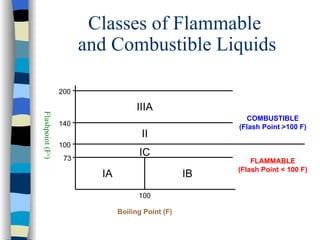
Classes of Flammable
                        and Combustible Liquids

                  200

                                    IIIA
Flashpoint (Fo)


                                                          COMBUSTIBLE
                  140                                   (Flash Point >100 F)
                                      II
                  100
                   73
                                     IC
                                                            FLAMMABLE
                                                        (Flash Point < 100 F)
                          IA                       IB
                                     100

                               Boiling Point (F)
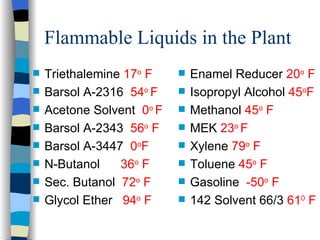
Flammable Liquids in the Plant
   Triethalemine 17o F       Enamel Reducer 20o F
   Barsol A-2316 54o F       Isopropyl Alcohol 45oF
   Acetone Solvent 0o F      Methanol 45o F
   Barsol A-2343 56o F       MEK 23o F
   Barsol A-3447 0oF         Xylene 79o F
   N-Butanol    36o F        Toluene 45o F
   Sec. Butanol 72o F        Gasoline -50o F
   Glycol Ether 94o F        142 Solvent 66/3 610 F
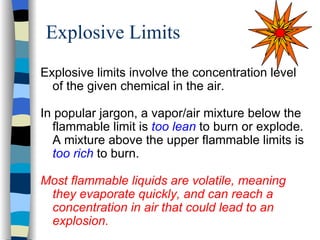
Explosive Limits
Explosive limits involve the concentration level
  of the given chemical in the air.

In popular jargon, a vapor/air mixture below the
  flammable limit is too lean to burn or explode.
  A mixture above the upper flammable limits is
  too rich to burn.

Most flammable liquids are volatile, meaning
 they evaporate quickly, and can reach a
 concentration in air that could lead to an
 explosion.
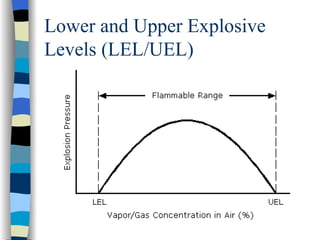
Lower and Upper Explosive
Levels (LEL/UEL)
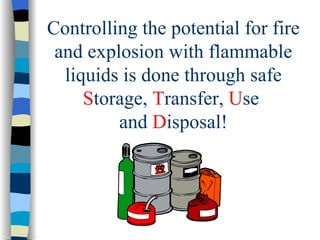
Controlling the potential for fire
 and explosion with flammable
  liquids is done through safe
     Storage, Transfer, Use
         and Disposal!
Hazards of Flammable Liquids
       Exposure Control Measures Include:
   Eliminating flames, static electricity, & sparks
    from electrical circuits.
   Temperature.
   Proper Ventilation.
   Grounding/Bonding.
   Spill Control/Emergency Response.
   Proper disposal of spent flammable
         liquids and soaked rags.
Flammable and Combustible Liquids

                  Definitions
Grounding: Applying a grounding wire to a container to
  eliminate a difference in static charge changes the
  potential between an object and ground.

Bonding: Use of a wire between two drums to eliminate
  the static charge potential between objects.
Flammable and Combustible Liquids
                     Definitions (cont.)
Ventilation: Adequate if it is sufficient to prevent the accumulation
  of significant quantities of vapor-air mixtures in concentrations
  over ¼ of the Lower Explosive Limit.

Safety Can: An approved red container, of not more than 5 gallons
  capacity, having a spring-closing lid and spout cover and so
  designed that it will safely relieve internal pressure when
  subjected to fire exposure.

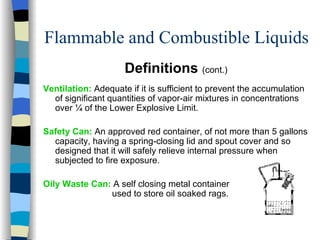
Oily Waste Can: A self closing metal container
               used to store oil soaked rags.
Container & Portable Tank
Storage
    Design, Construction and Capacity of Containers

Only approved containers and portable tanks may be used to store
flammable and combustible liquids. Metal containers and portable
tanks meeting the requirements of the Department of Transportation
are deemed acceptable when containing products.


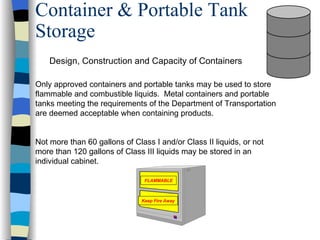
Not more than 60 gallons of Class I and/or Class II liquids, or not
more than 120 gallons of Class III liquids may be stored in an
individual cabinet.

                                FLAMMABLE


                               Keep Fire Away
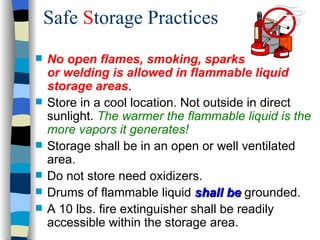
Safe Storage Practices
   No open flames, smoking, sparks
    or welding is allowed in flammable liquid
    storage areas.
   Store in a cool location. Not outside in direct
    sunlight. The warmer the flammable liquid is the
    more vapors it generates!
   Storage shall be in an open or well ventilated
    area.
   Do not store need oxidizers.
   Drums of flammable liquid shall be grounded.
   A 10 lbs. fire extinguisher shall be readily
    accessible within the storage area.
Storage Inside Building
   Flammable or combustible liquid drums shall not be
    stored so as to limit use of exits, stairways, or areas
    normally used for the safe egress of people.

   The storage of flammable or combustible liquids in
    containers or portable tanks is prohibited in office
    occupancy areas, except that which is required for
    maintenance and operation of building and operation
    of equipment.

   Leaking containers shall be removed to a storage
    room or taken to a safe location outside and the
    contents transferred to an undamaged container.
Incidental Storage (Small quantities)
Liquids located outside of storage
  cabinets/areas shall not exceed:

      25 Gallons of Class IA in containers.
      120 Gallons of Class IB, IC or
           Class II liquids in containers.
Transferring of
                Flammable Liquids
   Liquids shall be kept in covered/closed containers
    when actually not in use.
   Open flame and smoking is strictly prohibited in
    transferring areas.
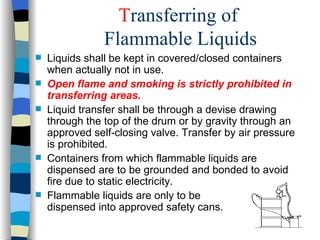
   Liquid transfer shall be through a devise drawing
    through the top of the drum or by gravity through an
    approved self-closing valve. Transfer by air pressure
    is prohibited.
   Containers from which flammable liquids are
    dispensed are to be grounded and bonded to avoid
    fire due to static electricity.
   Flammable liquids are only to be
    dispensed into approved safety cans.
Use and Disposal of
              Flammable Liquids
   Open flames, smoking, welding/brazing is
    prohibited in areas where flammable liquids are
    store, transferred, used or disposed of.
   Keep containers and drums sealed when not in use.
   Clean up spills!
   Maintain good ventilation.
   Mixing of flammable liquids is prohibited!
    (Mixing flammable liquids can lower their combined flashpoint.)
   Rags used to apply flammable liquids are to be
    disposed of in a self-closing oily waste can.

Flammableliquids

  • 1.
    Safe Handling of Flammable and Combustible Liquids
  • 2.
    Flammable and CombustibleLiquids The determining factor in whether a liquid is flammable or combustible is its flashpoint. Flashpoint: The minimum temperature at which a liquid gives off enough vapor within a test vessel in sufficient concentration to form an ignitable mixture with air near the surface of the liquid. Remember, it is the vapors, not the liquid, that Burns! A chemical’s flashpoint is listed on the MSDS under the Fire and Explosion section.
  • 3.
    Flammable and CombustibleLiquids Flammable Liquids Combustible Liquids Any liquid having a Any liquid having a flashpoint below 100o F flashpoint at or above (37.8o C) or lower. 100o F (37.8o C). NFPA Classes IA, IB, & IC NFPA Classes II & IIIA & B
  • 4.
    Flammable and CombustibleLiquid Classifications Flammable Liquid - any liquid having a flashpoint below 100o F (37.8o C) or higher, the total of which make up 99 percent or more of the total volume of the mixture. Flammable liquids shall be known as Class I liquids. Class I liquids are divided into three classes as follows: Class IA - shall include liquids having flashpoints below 73 F (22.8 C) and having a boiling point below 100 F (37.8 C). Class IB - shall include liquids having flashpoints below 73 F (22.8 C) And having a boiling point at or above 100 F (37.8 C). Class IC - shall include liquids having flashpoints at or above 73 F (22.8 C) and below 100 F (37.8 C).
  • 5.
    Flammable and CombustibleLiquid Classifications (Cont.) Combustible Liquid - any liquid having a flashpoint at or above 100o F (37.8o C). Combustible liquids shall be divided into two classes as follows: Class II - shall include those with flashpoints at or above 100 F (37.8 C) and below 140 F (60 C), except any mixture having components with flashpoints of 200 F (93.3 C) or higher, the volume of which makes up 99 percent or more of the total volume of the mixture. Class III - shall include those with flashpoints at or above 140 F (60 C).
  • 6.
    Flammable and CombustibleLiquids Classifications (Cont.) Class III liquids are subdivided into two subclasses: Class IIIA - shall include those with flashpoints at or above 140 F (60 C) and below 200 F (93.3 C), except any mixture having components with flashpoints of 200 F (93.3 C), or higher, the total volume of which makes up 99 percent or more of the total volume of the mixture. Class IIIB - shall include those with flashpoints at or above 200 F (93.3 C).
  • 7.
    Classes of Flammable and Combustible Liquids 200 IIIA Flashpoint (Fo) COMBUSTIBLE 140 (Flash Point >100 F) II 100 73 IC FLAMMABLE (Flash Point < 100 F) IA IB 100 Boiling Point (F)
  • 8.
    Flammable Liquids inthe Plant  Triethalemine 17o F  Enamel Reducer 20o F  Barsol A-2316 54o F  Isopropyl Alcohol 45oF  Acetone Solvent 0o F  Methanol 45o F  Barsol A-2343 56o F  MEK 23o F  Barsol A-3447 0oF  Xylene 79o F  N-Butanol 36o F  Toluene 45o F  Sec. Butanol 72o F  Gasoline -50o F  Glycol Ether 94o F  142 Solvent 66/3 610 F
  • 9.
    Explosive Limits Explosive limitsinvolve the concentration level of the given chemical in the air. In popular jargon, a vapor/air mixture below the flammable limit is too lean to burn or explode. A mixture above the upper flammable limits is too rich to burn. Most flammable liquids are volatile, meaning they evaporate quickly, and can reach a concentration in air that could lead to an explosion.
  • 10.
    Lower and UpperExplosive Levels (LEL/UEL)
  • 11.
    Controlling the potentialfor fire and explosion with flammable liquids is done through safe Storage, Transfer, Use and Disposal!
  • 12.
    Hazards of FlammableLiquids Exposure Control Measures Include:  Eliminating flames, static electricity, & sparks from electrical circuits.  Temperature.  Proper Ventilation.  Grounding/Bonding.  Spill Control/Emergency Response.  Proper disposal of spent flammable liquids and soaked rags.
  • 13.
    Flammable and CombustibleLiquids Definitions Grounding: Applying a grounding wire to a container to eliminate a difference in static charge changes the potential between an object and ground. Bonding: Use of a wire between two drums to eliminate the static charge potential between objects.
  • 14.
    Flammable and CombustibleLiquids Definitions (cont.) Ventilation: Adequate if it is sufficient to prevent the accumulation of significant quantities of vapor-air mixtures in concentrations over ¼ of the Lower Explosive Limit. Safety Can: An approved red container, of not more than 5 gallons capacity, having a spring-closing lid and spout cover and so designed that it will safely relieve internal pressure when subjected to fire exposure. Oily Waste Can: A self closing metal container used to store oil soaked rags.
  • 15.
    Container & PortableTank Storage Design, Construction and Capacity of Containers Only approved containers and portable tanks may be used to store flammable and combustible liquids. Metal containers and portable tanks meeting the requirements of the Department of Transportation are deemed acceptable when containing products. Not more than 60 gallons of Class I and/or Class II liquids, or not more than 120 gallons of Class III liquids may be stored in an individual cabinet. FLAMMABLE Keep Fire Away
  • 16.
    Safe Storage Practices  No open flames, smoking, sparks or welding is allowed in flammable liquid storage areas.  Store in a cool location. Not outside in direct sunlight. The warmer the flammable liquid is the more vapors it generates!  Storage shall be in an open or well ventilated area.  Do not store need oxidizers.  Drums of flammable liquid shall be grounded.  A 10 lbs. fire extinguisher shall be readily accessible within the storage area.
  • 17.
    Storage Inside Building  Flammable or combustible liquid drums shall not be stored so as to limit use of exits, stairways, or areas normally used for the safe egress of people.  The storage of flammable or combustible liquids in containers or portable tanks is prohibited in office occupancy areas, except that which is required for maintenance and operation of building and operation of equipment.  Leaking containers shall be removed to a storage room or taken to a safe location outside and the contents transferred to an undamaged container.
  • 18.
    Incidental Storage (Smallquantities) Liquids located outside of storage cabinets/areas shall not exceed:  25 Gallons of Class IA in containers.  120 Gallons of Class IB, IC or Class II liquids in containers.
  • 19.
    Transferring of Flammable Liquids  Liquids shall be kept in covered/closed containers when actually not in use.  Open flame and smoking is strictly prohibited in transferring areas.  Liquid transfer shall be through a devise drawing through the top of the drum or by gravity through an approved self-closing valve. Transfer by air pressure is prohibited.  Containers from which flammable liquids are dispensed are to be grounded and bonded to avoid fire due to static electricity.  Flammable liquids are only to be dispensed into approved safety cans.
  • 20.
    Use and Disposalof Flammable Liquids  Open flames, smoking, welding/brazing is prohibited in areas where flammable liquids are store, transferred, used or disposed of.  Keep containers and drums sealed when not in use.  Clean up spills!  Maintain good ventilation.  Mixing of flammable liquids is prohibited! (Mixing flammable liquids can lower their combined flashpoint.)  Rags used to apply flammable liquids are to be disposed of in a self-closing oily waste can.