© The McGraw-Hill Companies, Inc., 2002McGraw-Hill/Irwin
Slide
8-1
INVENTORIES AND THE
COST OF GOODS SOLD
Chapter
8
© The McGraw-Hill Companies, Inc., 2002McGraw-Hill/Irwin
Slide
8-2
InventoryInventory
Goods owned
and held for sale
to customers
Goods owned
and held for sale
to customers
Current
asset
Current
asset
Inventory DefinedInventory Defined
© The McGraw-Hill Companies, Inc., 2002McGraw-Hill/Irwin
Slide
8-3
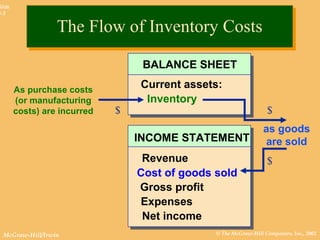
INCOME STATEMENT
Revenue
Cost of goods sold
Gross profit
Expenses
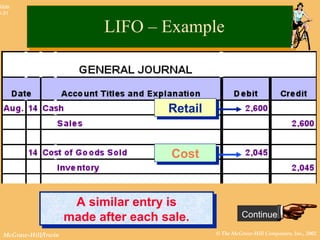
Net income
As purchase costs
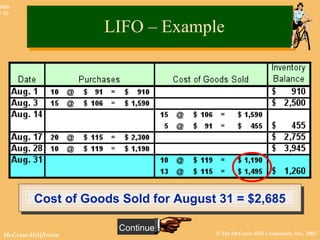
(or manufacturing
costs) are incurred
as goods
are sold
BALANCE SHEET
Current assets:
Inventory
$ $
$
The Flow of Inventory CostsThe Flow of Inventory Costs
© The McGraw-Hill Companies, Inc., 2002McGraw-Hill/Irwin
Slide
8-4
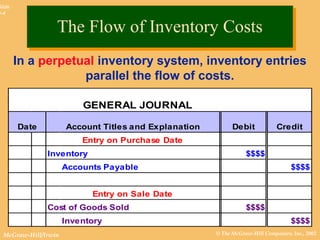
GENERAL JOURNAL
Date Account Titles and Explanation
P
R Debit Credit
Entry on Purchase Date
Inventory $$$$
Accounts Payable $$$$
Entry on Sale Date
Cost of Goods Sold $$$$
Inventory $$$$
In a perpetual inventory system, inventory entries
parallel the flow of costs.
The Flow of Inventory CostsThe Flow of Inventory Costs
© The McGraw-Hill Companies, Inc., 2002McGraw-Hill/Irwin
Slide
8-5
When identical units of inventory have
different unit costs, a question naturally
arises as to which of these costs should be
used in recording a sale of inventory.
Which Unit Did We Sell?Which Unit Did We Sell?
© The McGraw-Hill Companies, Inc., 2002McGraw-Hill/Irwin
Slide
8-6
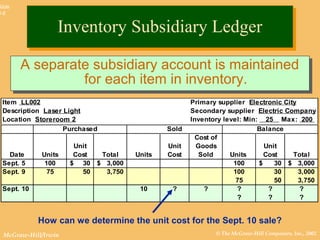
A separate subsidiary account is maintained
for each item in inventory.
A separate subsidiary account is maintained
for each item in inventory.
How can we determine the unit cost for the Sept. 10 sale?
Item LL002 Primary supplier Electronic City
Description Laser Light Secondary supplier Electric Company
Location Storeroom 2 Inventory level: Min: 25 Max: 200
Purchased Sold Balance
Date Units
Unit
Cost Total Units
Unit
Cost
Cost of
Goods
Sold Units
Unit
Cost Total
Sept. 5 100 30$ 3,000$ 100 30$ 3,000$
Sept. 9 75 50 3,750 100 30 3,000
75 50 3,750
Sept. 10 10 ? ? ? ? ?
? ? ?
Inventory Subsidiary LedgerInventory Subsidiary Ledger
© The McGraw-Hill Companies, Inc., 2002McGraw-Hill/Irwin
Slide
8-7
Specific
identification
LIFO
Average
cost
FIFO
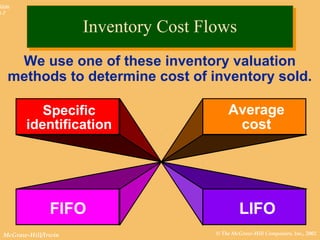
We use one of these inventory valuation
methods to determine cost of inventory sold.
Inventory Cost FlowsInventory Cost Flows
© The McGraw-Hill Companies, Inc., 2002McGraw-Hill/Irwin
Slide
8-8
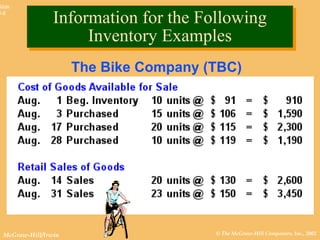
The Bike Company (TBC)
Information for the Following
Inventory Examples
Information for the Following
Inventory Examples
© The McGraw-Hill Companies, Inc., 2002McGraw-Hill/Irwin
Slide
8-9
Specific IdentificationSpecific Identification
When a unit
is sold, the
specific cost of
the unit sold is
added to cost
of goods sold.
© The McGraw-Hill Companies, Inc., 2002McGraw-Hill/Irwin
Slide
8-10
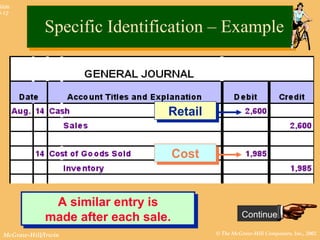
On August 14, TBC sold 20 bikes for $130 each.
Nine bikes originally cost $91 and 11 bikes
originally cost $106.
On August 14, TBC sold 20 bikes for $130 each.
Nine bikes originally cost $91 and 11 bikes
originally cost $106.
Continue
Specific Identification – ExampleSpecific Identification – Example
© The McGraw-Hill Companies, Inc., 2002McGraw-Hill/Irwin
Slide
8-11
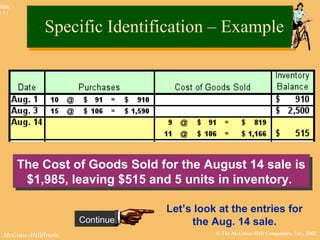
The Cost of Goods Sold for the August 14 sale is
$1,985, leaving $515 and 5 units in inventory.
The Cost of Goods Sold for the August 14 sale is
$1,985, leaving $515 and 5 units in inventory.
Continue
Let’s look at the entries for
the Aug. 14 sale.
Specific Identification – ExampleSpecific Identification – Example
© The McGraw-Hill Companies, Inc., 2002McGraw-Hill/Irwin
Slide
8-12
Continue
RetailRetail
CostCost
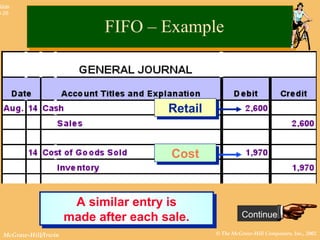
A similar entry is
made after each sale.
A similar entry is
made after each sale.
Specific Identification – ExampleSpecific Identification – Example
© The McGraw-Hill Companies, Inc., 2002McGraw-Hill/Irwin
Slide
8-13
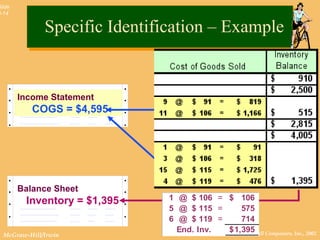
Additional purchases were made on August 17 and 28.
Costs associated with sales on August 31 were as follows: 1 @ $91,
3 @ $106, 15 @ $115, & 4 @ $119.
Additional purchases were made on August 17 and 28.
Costs associated with sales on August 31 were as follows: 1 @ $91,
3 @ $106, 15 @ $115, & 4 @ $119.
Continue
Specific Identification – ExampleSpecific Identification – Example
Cost of Goods
Sold for
August 31 =
$2,610
Cost of Goods
Sold for
August 31 =
$2,610
© The McGraw-Hill Companies, Inc., 2002McGraw-Hill/Irwin
Slide
8-14
Balance Sheet
Inventory = $1,395
Income Statement
COGS = $4,595
1 @ 106$ = 106$
5 @ 115$ = 575
6 @ 119$ = 714
End. Inv. 1,395$
Specific Identification – ExampleSpecific Identification – Example
© The McGraw-Hill Companies, Inc., 2002McGraw-Hill/Irwin
Slide
8-15
Since specific
identification is so
easy, can’t we use it
all the time?
Not really. Specific
identification is hard to use
when we sell a lot of
inventory that has lots of
different costs.
© The McGraw-Hill Companies, Inc., 2002McGraw-Hill/Irwin
Slide
8-16
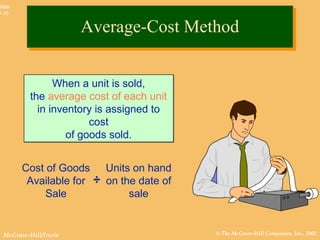
Cost of Goods
Available for
Sale
Units on hand
on the date of
sale
÷
Average-Cost MethodAverage-Cost Method
When a unit is sold,
the average cost of each unit
in inventory is assigned to
cost
of goods sold.
When a unit is sold,
the average cost of each unit
in inventory is assigned to
cost
of goods sold.
© The McGraw-Hill Companies, Inc., 2002McGraw-Hill/Irwin
Slide
8-17
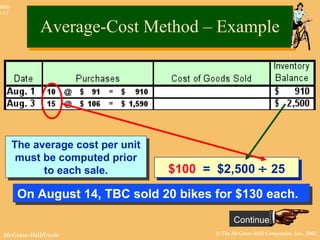
On August 14, TBC sold 20 bikes for $130 each.On August 14, TBC sold 20 bikes for $130 each.
Continue
The average cost per unit
must be computed prior
to each sale.
The average cost per unit
must be computed prior
to each sale.
Average-Cost Method – ExampleAverage-Cost Method – Example
$100 = $2,500 ÷ 25$100 = $2,500 ÷ 25
© The McGraw-Hill Companies, Inc., 2002McGraw-Hill/Irwin
Slide
8-18
Continue
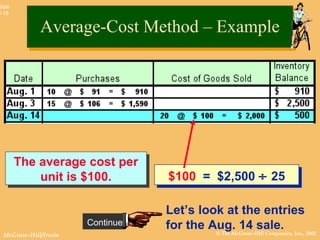
The average cost per
unit is $100.
The average cost per
unit is $100.
Let’s look at the entries
for the Aug. 14 sale.
Average-Cost Method – ExampleAverage-Cost Method – Example
$100 = $2,500 ÷ 25$100 = $2,500 ÷ 25
© The McGraw-Hill Companies, Inc., 2002McGraw-Hill/Irwin
Slide
8-19
Continue
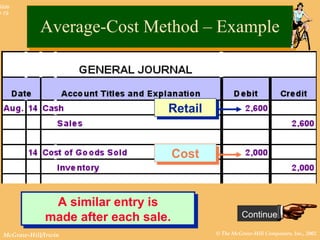
RetailRetail
CostCost
A similar entry is
made after each sale.
A similar entry is
made after each sale.
Average-Cost Method – ExampleAverage-Cost Method – Example
© The McGraw-Hill Companies, Inc., 2002McGraw-Hill/Irwin
Slide
8-20
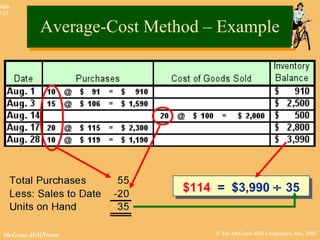
Additional purchases were made on August 17 and
August 28.
On August 31, an additional 23 units were sold.
Additional purchases were made on August 17 and
August 28.
On August 31, an additional 23 units were sold.
Continue
Average-Cost Method – ExampleAverage-Cost Method – Example
© The McGraw-Hill Companies, Inc., 2002McGraw-Hill/Irwin
Slide
8-21
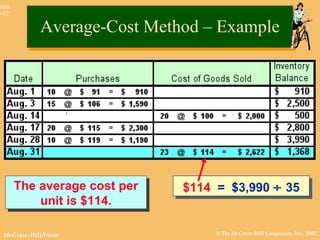
$114 = $3,990 ÷ 35$114 = $3,990 ÷ 35
Average-Cost Method – ExampleAverage-Cost Method – Example
© The McGraw-Hill Companies, Inc., 2002McGraw-Hill/Irwin
Slide
8-22
$114 = $3,990 ÷ 35$114 = $3,990 ÷ 35The average cost per
unit is $114.
The average cost per
unit is $114.
Average-Cost Method – ExampleAverage-Cost Method – Example
© The McGraw-Hill Companies, Inc., 2002McGraw-Hill/Irwin
Slide
8-23
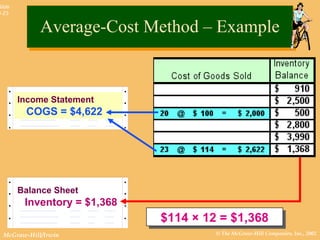
Income Statement
COGS = $4,622
Balance Sheet
Inventory = $1,368
$114 × 12 = $1,368$114 × 12 = $1,368
Average-Cost Method – ExampleAverage-Cost Method – Example
© The McGraw-Hill Companies, Inc., 2002McGraw-Hill/Irwin
Slide
8-24
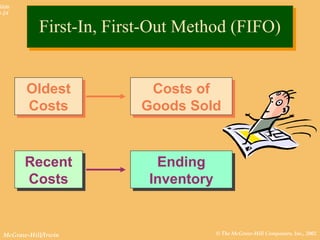
Costs of
Goods Sold
Costs of
Goods Sold
Ending
Inventory
Ending
Inventory
Oldest
Costs
Oldest
Costs
Recent
Costs
Recent
Costs
First-In, First-Out Method (FIFO)First-In, First-Out Method (FIFO)
© The McGraw-Hill Companies, Inc., 2002McGraw-Hill/Irwin
Slide
8-25
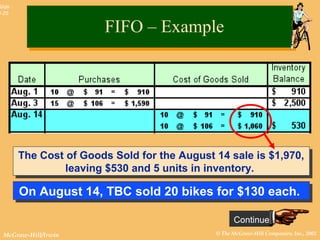
On August 14, TBC sold 20 bikes for $130 each.On August 14, TBC sold 20 bikes for $130 each.
Continue
The Cost of Goods Sold for the August 14 sale is $1,970,
leaving $530 and 5 units in inventory.
The Cost of Goods Sold for the August 14 sale is $1,970,
leaving $530 and 5 units in inventory.
FIFO – ExampleFIFO – Example
© The McGraw-Hill Companies, Inc., 2002McGraw-Hill/Irwin
Slide
8-26
RetailRetail
CostCost
Continue
A similar entry is
made after each sale.
A similar entry is
made after each sale.
FIFO – ExampleFIFO – Example
© The McGraw-Hill Companies, Inc., 2002McGraw-Hill/Irwin
Slide
8-27
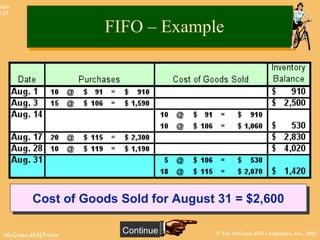
Additional purchases were made on Aug. 17 and Aug. 28.
On August 31, an additional 23 units were sold.
Additional purchases were made on Aug. 17 and Aug. 28.
On August 31, an additional 23 units were sold.
Continue
FIFO – ExampleFIFO – Example
Cost of Goods Sold for August 31 = $2,600Cost of Goods Sold for August 31 = $2,600
© The McGraw-Hill Companies, Inc., 2002McGraw-Hill/Irwin
Slide
8-28
Balance Sheet
Inventory = $1,420
Income Statement
COGS = $4,570
2 @ 115$ = 230$
10 @ 119$ = 1,190
End. Inv. 1,420$
FIFO – ExampleFIFO – Example
© The McGraw-Hill Companies, Inc., 2002McGraw-Hill/Irwin
Slide
8-29
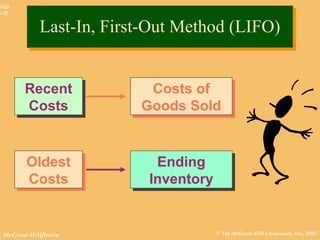
Costs of
Goods Sold
Costs of
Goods Sold
Ending
Inventory
Ending
Inventory
Recent
Costs
Recent
Costs
Oldest
Costs
Oldest
Costs
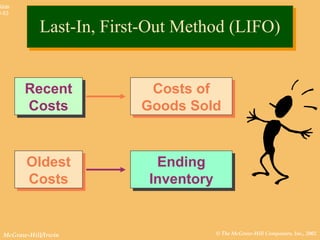
Last-In, First-Out Method (LIFO)Last-In, First-Out Method (LIFO)
© The McGraw-Hill Companies, Inc., 2002McGraw-Hill/Irwin
Slide
8-30
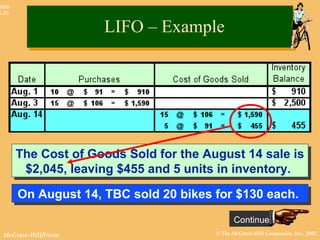
On August 14, TBC sold 20 bikes for $130 each.On August 14, TBC sold 20 bikes for $130 each.
Continue
LIFO – ExampleLIFO – Example
The Cost of Goods Sold for the August 14 sale is
$2,045, leaving $455 and 5 units in inventory.
The Cost of Goods Sold for the August 14 sale is
$2,045, leaving $455 and 5 units in inventory.
© The McGraw-Hill Companies, Inc., 2002McGraw-Hill/Irwin
Slide
8-31
Continue
RetailRetail
CostCost
A similar entry is
made after each sale.
A similar entry is
made after each sale.
LIFO – ExampleLIFO – Example
© The McGraw-Hill Companies, Inc., 2002McGraw-Hill/Irwin
Slide
8-32
Continue
LIFO – ExampleLIFO – Example
Additional purchases were made on Aug. 17 and Aug. 28.
On Aug. 31, an additional 23 units were sold.
Additional purchases were made on Aug. 17 and Aug. 28.
On Aug. 31, an additional 23 units were sold.Cost of Goods Sold for August 31 = $2,685Cost of Goods Sold for August 31 = $2,685
© The McGraw-Hill Companies, Inc., 2002McGraw-Hill/Irwin
Slide
8-33
Balance Sheet
Inventory = $1,260
Income Statement
COGS = $4,730
LIFO – ExampleLIFO – Example
5 @ 91$ = 455$
7 @ 115$ = 805
End. Inv. 1,260$
© The McGraw-Hill Companies, Inc., 2002McGraw-Hill/Irwin
Slide
8-34
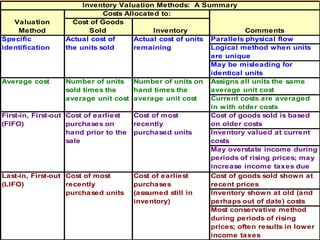
Inventory Valuation Methods: A Summary
Costs Allocated to:
Valuation
Method
Cost of Goods
Sold Inventory Comments
Specific Actual cost of Actual cost of units Parallels physical flow
identification the units sold remaining Logical method when units
are unique
May be misleading for
identical units
Average cost Number of units
sold times the
Number of units on
hand times the
Assigns all units the same
average unit cost
average unit cost average unit cost Current costs are averaged
in with older costs
First-in, First-out
(FIFO)
Cost of earliest
purchases on
Cost of most
recently
Cost of goods sold is based
on older costs
hand prior to the
sale
purchased units Inventory valued at current
costs
May overstate income during
periods of rising prices; may
increase income taxes due
Last-in, First-out
(LIFO)
Cost of most
recently
Cost of earliest
purchases
Cost of goods sold shown at
recent prices
purchased units (assumed still in
inventory)
Inventory shown at old (and
perhaps out of date) costs
Most conservative method
during periods of rising
prices; often results in lower
income taxes
© The McGraw-Hill Companies, Inc., 2002McGraw-Hill/Irwin
Slide
8-35
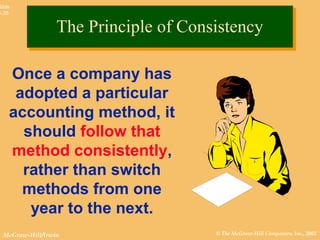
Once a company has
adopted a particular
accounting method, it
should follow that
method consistently,
rather than switch
methods from one
year to the next.
The Principle of ConsistencyThe Principle of Consistency
© The McGraw-Hill Companies, Inc., 2002McGraw-Hill/Irwin
Slide
8-36
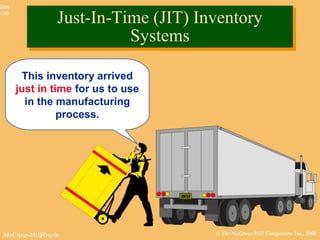
This inventory arrived
just in time for us to use
in the manufacturing
process.
Just-In-Time (JIT) Inventory
Systems
Just-In-Time (JIT) Inventory
Systems
© The McGraw-Hill Companies, Inc., 2002McGraw-Hill/Irwin
Slide
8-37
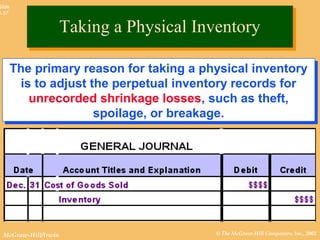
The primary reason for taking a physical inventory
is to adjust the perpetual inventory records for
unrecorded shrinkage losses, such as theft,
spoilage, or breakage.
The primary reason for taking a physical inventory
is to adjust the perpetual inventory records for
unrecorded shrinkage losses, such as theft,
spoilage, or breakage.
Taking a Physical InventoryTaking a Physical Inventory
© The McGraw-Hill Companies, Inc., 2002McGraw-Hill/Irwin
Slide
8-38
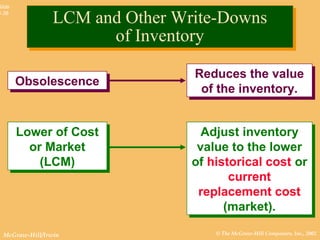
Reduces the value
of the inventory.
Reduces the value
of the inventory.
Adjust inventory
value to the lower
of historical cost or
current
replacement cost
(market).
Adjust inventory
value to the lower
of historical cost or
current
replacement cost
(market).
ObsolescenceObsolescence
Lower of Cost
or Market
(LCM)
Lower of Cost
or Market
(LCM)
LCM and Other Write-Downs
of Inventory
LCM and Other Write-Downs
of Inventory
© The McGraw-Hill Companies, Inc., 2002McGraw-Hill/Irwin
Slide
8-39
Year
End
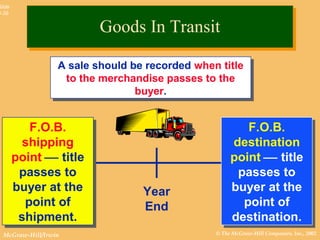
A sale should be recorded when title
to the merchandise passes to the
buyer.
A sale should be recorded when title
to the merchandise passes to the
buyer.
F.O.B.
shipping
point  title
passes to
buyer at the
point of
shipment.
F.O.B.
shipping
point  title
passes to
buyer at the
point of
shipment.
F.O.B.
destination
point  title
passes to
buyer at the
point of
destination.
F.O.B.
destination
point  title
passes to
buyer at the
point of
destination.
Goods In TransitGoods In Transit
© The McGraw-Hill Companies, Inc., 2002McGraw-Hill/Irwin
Slide
8-40
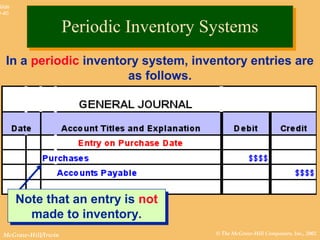
In a periodic inventory system, inventory entries are
as follows.
Note that an entry is not
made to inventory.
Note that an entry is not
made to inventory.
Periodic Inventory SystemsPeriodic Inventory Systems
© The McGraw-Hill Companies, Inc., 2002McGraw-Hill/Irwin
Slide
8-41
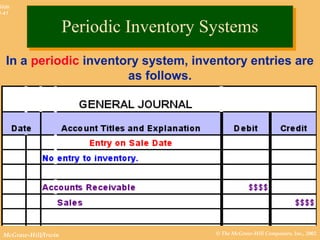
In a periodic inventory system, inventory entries are
as follows.
Periodic Inventory SystemsPeriodic Inventory Systems
© The McGraw-Hill Companies, Inc., 2002McGraw-Hill/Irwin
Slide
8-42
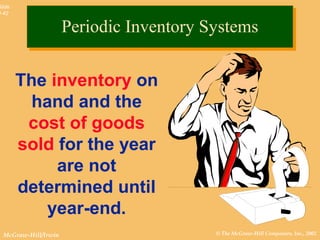
The inventory on
hand and the
cost of goods
sold for the year
are not
determined until
year-end.
Periodic Inventory SystemsPeriodic Inventory Systems
© The McGraw-Hill Companies, Inc., 2002McGraw-Hill/Irwin
Slide
8-43
Specific
identification
LIFO
Average
cost
FIFO
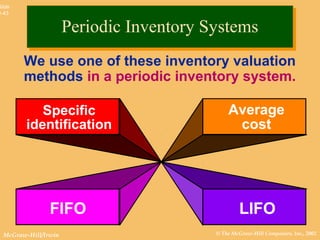
We use one of these inventory valuation
methods in a periodic inventory system.
Periodic Inventory SystemsPeriodic Inventory Systems
© The McGraw-Hill Companies, Inc., 2002McGraw-Hill/Irwin
Slide
8-44
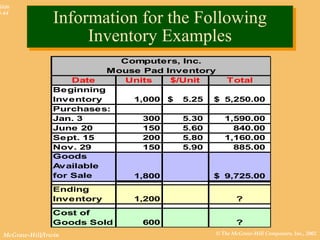
Computers, Inc.
Mouse Pad Inventory
Date Units $/Unit Total
Beginning
Inventory 1,000 5.25$ 5,250.00$
Purchases:
Jan. 3 300 5.30 1,590.00
June 20 150 5.60 840.00
Sept. 15 200 5.80 1,160.00
Nov. 29 150 5.90 885.00
Goods
Available
for Sale 1,800 9,725.00$
Ending
Inventory 1,200 ?
Cost of
Goods Sold 600 ?
Information for the Following
Inventory Examples
Information for the Following
Inventory Examples
© The McGraw-Hill Companies, Inc., 2002McGraw-Hill/Irwin
Slide
8-45
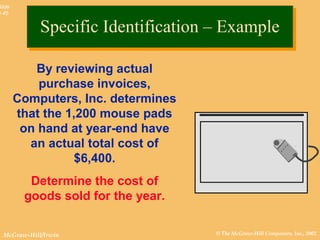
By reviewing actual
purchase invoices,
Computers, Inc. determines
that the 1,200 mouse pads
on hand at year-end have
an actual total cost of
$6,400.
Determine the cost of
goods sold for the year.
Specific Identification – ExampleSpecific Identification – Example
© The McGraw-Hill Companies, Inc., 2002McGraw-Hill/Irwin
Slide
8-46
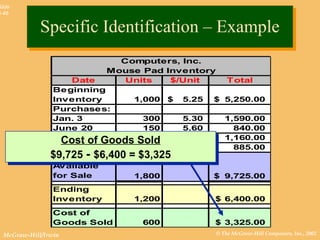
Computers, Inc.
Mouse Pad Inventory
Date Units $/Unit Total
Beginning
Inventory 1,000 5.25$ 5,250.00$
Purchases:
Jan. 3 300 5.30 1,590.00
June 20 150 5.60 840.00
Sept. 15 200 5.80 1,160.00
Nov. 29 150 5.90 885.00
Goods
Available
for Sale 1,800 9,725.00$
Ending
Inventory 1,200 6,400.00$
Cost of
Goods Sold 600 3,325.00$
Cost of Goods Sold
$9,725 - $6,400 = $3,325
Cost of Goods Sold
$9,725 - $6,400 = $3,325
Specific Identification – ExampleSpecific Identification – Example
© The McGraw-Hill Companies, Inc., 2002McGraw-Hill/Irwin
Slide
8-47
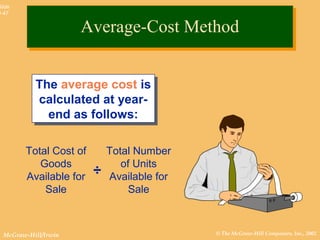
Total Cost of
Goods
Available for
Sale
Total Number
of Units
Available for
Sale
÷
The average cost is
calculated at year-
end as follows:
The average cost is
calculated at year-
end as follows:
Average-Cost MethodAverage-Cost Method
© The McGraw-Hill Companies, Inc., 2002McGraw-Hill/Irwin
Slide
8-48
Computers, Inc.
Mouse Pad Inventory
Date Units $/Unit Total
Beginning
Inventory 1,000 5.25$ 5,250.00$
Purchases:
Jan. 3 300 5.30 1,590.00
June 20 150 5.60 840.00
Sept. 15 200 5.80 1,160.00
Nov. 29 150 5.90 885.00
Goods
Available
for Sale 1,800 9,725.00$
Ending
Inventory 1,200 ?
Cost of
Goods Sold 600 ?
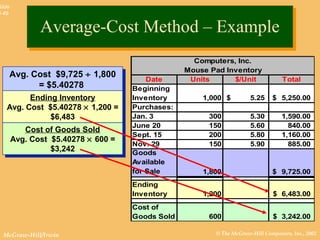
Avg. Cost $9,725 ÷ 1,800
= $5.40278
Avg. Cost $9,725 ÷ 1,800
= $5.40278
Average-Cost Method – ExampleAverage-Cost Method – Example
Computers, Inc.
Mouse Pad Inventory
Date Units $/Unit Total
Beginning
Inventory 1,000 5.25$ 5,250.00$
Purchases:
Jan. 3 300 5.30 1,590.00
June 20 150 5.60 840.00
Sept. 15 200 5.80 1,160.00
Nov. 29 150 5.90 885.00
Goods
Available
for Sale 1,800 9,725.00$
Ending
Inventory 1,200 6,483.00$
Cost of
Goods Sold 600 3,242.00$
Ending Inventory
Avg. Cost $5.40278 × 1,200 =
$6,483
Ending Inventory
Avg. Cost $5.40278 × 1,200 =
$6,483
Cost of Goods Sold
Avg. Cost $5.40278 × 600 =
$3,242
Cost of Goods Sold
Avg. Cost $5.40278 × 600 =
$3,242
© The McGraw-Hill Companies, Inc., 2002McGraw-Hill/Irwin
Slide
8-49
Costs of
Goods Sold
Costs of
Goods Sold
Ending
Inventory
Ending
Inventory
Oldest
Costs
Oldest
Costs
Recent
Costs
Recent
Costs
First-In, First-Out Method (FIFO)First-In, First-Out Method (FIFO)
© The McGraw-Hill Companies, Inc., 2002McGraw-Hill/Irwin
Slide
8-50
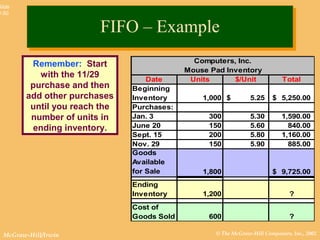
Remember: Start
with the 11/29
purchase and then
add other purchases
until you reach the
number of units in
ending inventory.
FIFO – ExampleFIFO – Example
Computers, Inc.
Mouse Pad Inventory
Date Units $/Unit Total
Beginning
Inventory 1,000 5.25$ 5,250.00$
Purchases:
Jan. 3 300 5.30 1,590.00
June 20 150 5.60 840.00
Sept. 15 200 5.80 1,160.00
Nov. 29 150 5.90 885.00
Goods
Available
for Sale 1,800 9,725.00$
Ending
Inventory 1,200 ?
Cost of
Goods Sold 600 ?
© The McGraw-Hill Companies, Inc., 2002McGraw-Hill/Irwin
Slide
8-51
Date Beg. Inv. Purchases End. Inv.
Cost of
Goods Sold
Nov. 29 150@$5.90 150@$5.90
Units 150
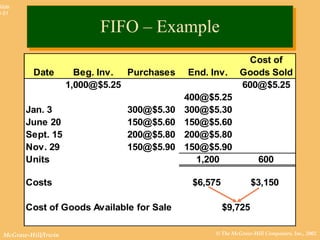
Now, let’s complete the
table.
Now, let’s complete the
table.
FIFO – ExampleFIFO – Example
Date Beg. Inv. Purchases End. Inv.
Cost of
Goods Sold
1,000@$5.25 600@$5.25
400@$5.25
Jan. 3 300@$5.30 300@$5.30
June 20 150@$5.60 150@$5.60
Sept. 15 200@$5.80 200@$5.80
Nov. 29 150@$5.90 150@$5.90
Units 1,200 600
Now, we have allocated
the cost to all 1,200 units
in ending inventory.
Date Beg. Inv. Purchases End. Inv.
Cost of
Goods Sold
1,000@$5.25 600@$5.25
400@$5.25
Jan. 3 300@$5.30 300@$5.30
June 20 150@$5.60 150@$5.60
Sept. 15 200@$5.80 200@$5.80
Nov. 29 150@$5.90 150@$5.90
Units 1,200 600
Costs $6,575 $3,150
Cost of Goods Available for Sale $9,725
© The McGraw-Hill Companies, Inc., 2002McGraw-Hill/Irwin
Slide
8-52
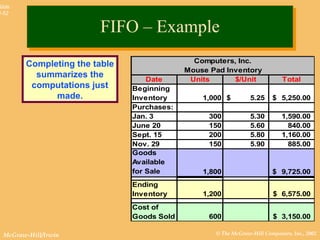
Completing the table
summarizes the
computations just
made.
FIFO – ExampleFIFO – Example
Computers, Inc.
Mouse Pad Inventory
Date Units $/Unit Total
Beginning
Inventory 1,000 5.25$ 5,250.00$
Purchases:
Jan. 3 300 5.30 1,590.00
June 20 150 5.60 840.00
Sept. 15 200 5.80 1,160.00
Nov. 29 150 5.90 885.00
Goods
Available
for Sale 1,800 9,725.00$
Ending
Inventory 1,200 6,575.00$
Cost of
Goods Sold 600 3,150.00$
© The McGraw-Hill Companies, Inc., 2002McGraw-Hill/Irwin
Slide
8-53
Costs of
Goods Sold
Costs of
Goods Sold
Ending
Inventory
Ending
Inventory
Recent
Costs
Recent
Costs
Oldest
Costs
Oldest
Costs
Last-In, First-Out Method (LIFO)Last-In, First-Out Method (LIFO)
© The McGraw-Hill Companies, Inc., 2002McGraw-Hill/Irwin
Slide
8-54
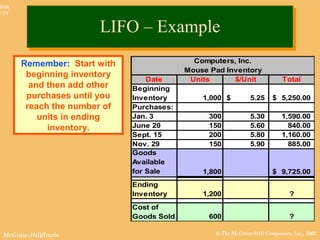
Remember: Start with
beginning inventory
and then add other
purchases until you
reach the number of
units in ending
inventory.
LIFO – ExampleLIFO – Example
Computers, Inc.
Mouse Pad Inventory
Date Units $/Unit Total
Beginning
Inventory 1,000 5.25$ 5,250.00$
Purchases:
Jan. 3 300 5.30 1,590.00
June 20 150 5.60 840.00
Sept. 15 200 5.80 1,160.00
Nov. 29 150 5.90 885.00
Goods
Available
for Sale 1,800 9,725.00$
Ending
Inventory 1,200 ?
Cost of
Goods Sold 600 ?
© The McGraw-Hill Companies, Inc., 2002McGraw-Hill/Irwin
Slide
8-55
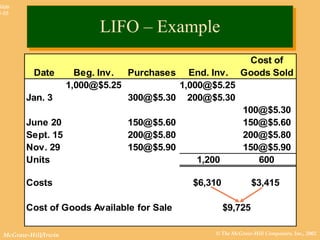
Date Beg. Inv. Purchases End. Inv.
Cost of
Goods Sold
1,000@$5.25 1,000@$5.25
Units 1,000
LIFO – ExampleLIFO – Example
Date Beg. Inv. Purchases End. Inv.
Cost of
Goods Sold
1,000@$5.25 1,000@$5.25
Jan. 3 300@$5.30 200@$5.30
100@$5.30
Units 1,200 100
Now, we have allocated
the cost to all 1,200 units
in ending inventory.
Next, let’s
complete the
table.
Next, let’s
complete the
table.
Date Beg. Inv. Purchases End. Inv.
Cost of
Goods Sold
1,000@$5.25 1,000@$5.25
Jan. 3 300@$5.30 200@$5.30
100@$5.30
June 20 150@$5.60 150@$5.60
Sept. 15 200@$5.80 200@$5.80
Nov. 29 150@$5.90 150@$5.90
Units 1,200 600
Costs $6,310 $3,415
Cost of Goods Available for Sale $9,725
© The McGraw-Hill Companies, Inc., 2002McGraw-Hill/Irwin
Slide
8-56
Completing the table
summarizes the
computations just
made.
LIFO – ExampleLIFO – Example
Computers, Inc.
Mouse Pad Inventory
Date Units $/Unit Total
Beginning
Inventory 1,000 5.25$ 5,250.00$
Purchases:
Jan. 3 300 5.30 1,590.00
June 20 150 5.60 840.00
Sept. 15 200 5.80 1,160.00
Nov. 29 150 5.90 885.00
Goods
Available
for Sale 1,800 9,725.00$
Ending
Inventory 1,200 6,310.00$
Cost of
Goods Sold 600 3,415.00$
© The McGraw-Hill Companies, Inc., 2002McGraw-Hill/Irwin
Slide
8-57
Errors in Measuring Inventory
Beginning Inventory Ending Inventory
Effect on Income Statement Overstated Understated Overstated Understated
Goods Available for Sale + - 0 0
Cost of Goods Sold + - - +
Gross Profit - + + -
Net Income - + + -
Effect on Balance Sheet
Ending Inventory 0 0 + -
Retained Earnings - + + -
An error in ending inventory in a year will result in the
same error in the beginning inventory of the next year.
An error in ending inventory in a year will result in the
same error in the beginning inventory of the next year.
Importance of an Accurate
Valuation of Inventory
Importance of an Accurate
Valuation of Inventory
© The McGraw-Hill Companies, Inc., 2002McGraw-Hill/Irwin
Slide
8-58
For interim financialstatements, we may needto estimate endinginventory and cost of
goods sold.
© The McGraw-Hill Companies, Inc., 2002McGraw-Hill/Irwin
Slide
8-59
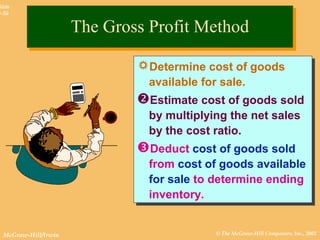
Determine cost of goods
available for sale.
Estimate cost of goods sold
by multiplying the net sales
by the cost ratio.
Deduct cost of goods sold
from cost of goods available
for sale to determine ending
inventory.
Determine cost of goods
available for sale.
Estimate cost of goods sold
by multiplying the net sales
by the cost ratio.
Deduct cost of goods sold
from cost of goods available
for sale to determine ending
inventory.
The Gross Profit MethodThe Gross Profit Method
© The McGraw-Hill Companies, Inc., 2002McGraw-Hill/Irwin
Slide
8-60
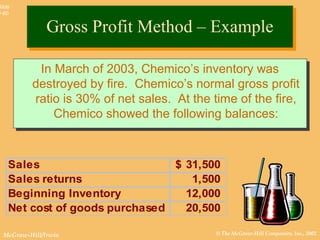
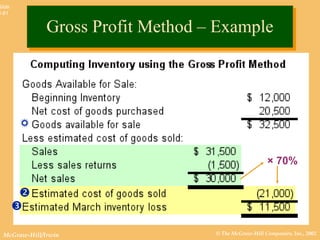
In March of 2003, Chemico’s inventory was
destroyed by fire. Chemico’s normal gross profit
ratio is 30% of net sales. At the time of the fire,
Chemico showed the following balances:
In March of 2003, Chemico’s inventory was
destroyed by fire. Chemico’s normal gross profit
ratio is 30% of net sales. At the time of the fire,
Chemico showed the following balances:
Sales 31,500$
Sales returns 1,500
Beginning Inventory 12,000
Net cost of goods purchased 20,500
Gross Profit Method – ExampleGross Profit Method – Example
© The McGraw-Hill Companies, Inc., 2002McGraw-Hill/Irwin
Slide
8-61
Gross Profit Method – ExampleGross Profit Method – Example
× 70%



© The McGraw-Hill Companies, Inc., 2002McGraw-Hill/Irwin
Slide
8-62
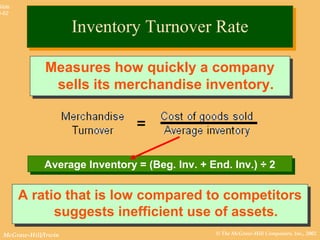
Measures how quickly a company
sells its merchandise inventory.
Measures how quickly a company
sells its merchandise inventory.
A ratio that is low compared to competitors
suggests inefficient use of assets.
A ratio that is low compared to competitors
suggests inefficient use of assets.
Average Inventory = (Beg. Inv. + End. Inv.) ÷ 2Average Inventory = (Beg. Inv. + End. Inv.) ÷ 2
Inventory Turnover RateInventory Turnover Rate
© The McGraw-Hill Companies, Inc., 2002McGraw-Hill/Irwin
Slide
8-63
Remember that identical
companies that use different
inventory methods (e.g.,
FIFO and LIFO) will have
different inventory turnover
ratios.
Accounting Methods Can Affect
Analytical Ratios
Accounting Methods Can Affect
Analytical Ratios
© The McGraw-Hill Companies, Inc., 2002McGraw-Hill/Irwin
Slide
8-64
Careful! If you
drop the inventory
we will have another
write down.
End of Chapter 8End of Chapter 8

Whbm08

  • 1.
    © The McGraw-HillCompanies, Inc., 2002McGraw-Hill/Irwin Slide 8-1 INVENTORIES AND THE COST OF GOODS SOLD Chapter 8
  • 2.
    © The McGraw-HillCompanies, Inc., 2002McGraw-Hill/Irwin Slide 8-2 InventoryInventory Goods owned and held for sale to customers Goods owned and held for sale to customers Current asset Current asset Inventory DefinedInventory Defined
  • 3.
    © The McGraw-HillCompanies, Inc., 2002McGraw-Hill/Irwin Slide 8-3 INCOME STATEMENT Revenue Cost of goods sold Gross profit Expenses Net income As purchase costs (or manufacturing costs) are incurred as goods are sold BALANCE SHEET Current assets: Inventory $ $ $ The Flow of Inventory CostsThe Flow of Inventory Costs
  • 4.
    © The McGraw-HillCompanies, Inc., 2002McGraw-Hill/Irwin Slide 8-4 GENERAL JOURNAL Date Account Titles and Explanation P R Debit Credit Entry on Purchase Date Inventory $$$$ Accounts Payable $$$$ Entry on Sale Date Cost of Goods Sold $$$$ Inventory $$$$ In a perpetual inventory system, inventory entries parallel the flow of costs. The Flow of Inventory CostsThe Flow of Inventory Costs
  • 5.
    © The McGraw-HillCompanies, Inc., 2002McGraw-Hill/Irwin Slide 8-5 When identical units of inventory have different unit costs, a question naturally arises as to which of these costs should be used in recording a sale of inventory. Which Unit Did We Sell?Which Unit Did We Sell?
  • 6.
    © The McGraw-HillCompanies, Inc., 2002McGraw-Hill/Irwin Slide 8-6 A separate subsidiary account is maintained for each item in inventory. A separate subsidiary account is maintained for each item in inventory. How can we determine the unit cost for the Sept. 10 sale? Item LL002 Primary supplier Electronic City Description Laser Light Secondary supplier Electric Company Location Storeroom 2 Inventory level: Min: 25 Max: 200 Purchased Sold Balance Date Units Unit Cost Total Units Unit Cost Cost of Goods Sold Units Unit Cost Total Sept. 5 100 30$ 3,000$ 100 30$ 3,000$ Sept. 9 75 50 3,750 100 30 3,000 75 50 3,750 Sept. 10 10 ? ? ? ? ? ? ? ? Inventory Subsidiary LedgerInventory Subsidiary Ledger
  • 7.
    © The McGraw-HillCompanies, Inc., 2002McGraw-Hill/Irwin Slide 8-7 Specific identification LIFO Average cost FIFO We use one of these inventory valuation methods to determine cost of inventory sold. Inventory Cost FlowsInventory Cost Flows
  • 8.
    © The McGraw-HillCompanies, Inc., 2002McGraw-Hill/Irwin Slide 8-8 The Bike Company (TBC) Information for the Following Inventory Examples Information for the Following Inventory Examples
  • 9.
    © The McGraw-HillCompanies, Inc., 2002McGraw-Hill/Irwin Slide 8-9 Specific IdentificationSpecific Identification When a unit is sold, the specific cost of the unit sold is added to cost of goods sold.
  • 10.
    © The McGraw-HillCompanies, Inc., 2002McGraw-Hill/Irwin Slide 8-10 On August 14, TBC sold 20 bikes for $130 each. Nine bikes originally cost $91 and 11 bikes originally cost $106. On August 14, TBC sold 20 bikes for $130 each. Nine bikes originally cost $91 and 11 bikes originally cost $106. Continue Specific Identification – ExampleSpecific Identification – Example
  • 11.
    © The McGraw-HillCompanies, Inc., 2002McGraw-Hill/Irwin Slide 8-11 The Cost of Goods Sold for the August 14 sale is $1,985, leaving $515 and 5 units in inventory. The Cost of Goods Sold for the August 14 sale is $1,985, leaving $515 and 5 units in inventory. Continue Let’s look at the entries for the Aug. 14 sale. Specific Identification – ExampleSpecific Identification – Example
  • 12.
    © The McGraw-HillCompanies, Inc., 2002McGraw-Hill/Irwin Slide 8-12 Continue RetailRetail CostCost A similar entry is made after each sale. A similar entry is made after each sale. Specific Identification – ExampleSpecific Identification – Example
  • 13.
    © The McGraw-HillCompanies, Inc., 2002McGraw-Hill/Irwin Slide 8-13 Additional purchases were made on August 17 and 28. Costs associated with sales on August 31 were as follows: 1 @ $91, 3 @ $106, 15 @ $115, & 4 @ $119. Additional purchases were made on August 17 and 28. Costs associated with sales on August 31 were as follows: 1 @ $91, 3 @ $106, 15 @ $115, & 4 @ $119. Continue Specific Identification – ExampleSpecific Identification – Example Cost of Goods Sold for August 31 = $2,610 Cost of Goods Sold for August 31 = $2,610
  • 14.
    © The McGraw-HillCompanies, Inc., 2002McGraw-Hill/Irwin Slide 8-14 Balance Sheet Inventory = $1,395 Income Statement COGS = $4,595 1 @ 106$ = 106$ 5 @ 115$ = 575 6 @ 119$ = 714 End. Inv. 1,395$ Specific Identification – ExampleSpecific Identification – Example
  • 15.
    © The McGraw-HillCompanies, Inc., 2002McGraw-Hill/Irwin Slide 8-15 Since specific identification is so easy, can’t we use it all the time? Not really. Specific identification is hard to use when we sell a lot of inventory that has lots of different costs.
  • 16.
    © The McGraw-HillCompanies, Inc., 2002McGraw-Hill/Irwin Slide 8-16 Cost of Goods Available for Sale Units on hand on the date of sale ÷ Average-Cost MethodAverage-Cost Method When a unit is sold, the average cost of each unit in inventory is assigned to cost of goods sold. When a unit is sold, the average cost of each unit in inventory is assigned to cost of goods sold.
  • 17.
    © The McGraw-HillCompanies, Inc., 2002McGraw-Hill/Irwin Slide 8-17 On August 14, TBC sold 20 bikes for $130 each.On August 14, TBC sold 20 bikes for $130 each. Continue The average cost per unit must be computed prior to each sale. The average cost per unit must be computed prior to each sale. Average-Cost Method – ExampleAverage-Cost Method – Example $100 = $2,500 ÷ 25$100 = $2,500 ÷ 25
  • 18.
    © The McGraw-HillCompanies, Inc., 2002McGraw-Hill/Irwin Slide 8-18 Continue The average cost per unit is $100. The average cost per unit is $100. Let’s look at the entries for the Aug. 14 sale. Average-Cost Method – ExampleAverage-Cost Method – Example $100 = $2,500 ÷ 25$100 = $2,500 ÷ 25
  • 19.
    © The McGraw-HillCompanies, Inc., 2002McGraw-Hill/Irwin Slide 8-19 Continue RetailRetail CostCost A similar entry is made after each sale. A similar entry is made after each sale. Average-Cost Method – ExampleAverage-Cost Method – Example
  • 20.
    © The McGraw-HillCompanies, Inc., 2002McGraw-Hill/Irwin Slide 8-20 Additional purchases were made on August 17 and August 28. On August 31, an additional 23 units were sold. Additional purchases were made on August 17 and August 28. On August 31, an additional 23 units were sold. Continue Average-Cost Method – ExampleAverage-Cost Method – Example
  • 21.
    © The McGraw-HillCompanies, Inc., 2002McGraw-Hill/Irwin Slide 8-21 $114 = $3,990 ÷ 35$114 = $3,990 ÷ 35 Average-Cost Method – ExampleAverage-Cost Method – Example
  • 22.
    © The McGraw-HillCompanies, Inc., 2002McGraw-Hill/Irwin Slide 8-22 $114 = $3,990 ÷ 35$114 = $3,990 ÷ 35The average cost per unit is $114. The average cost per unit is $114. Average-Cost Method – ExampleAverage-Cost Method – Example
  • 23.
    © The McGraw-HillCompanies, Inc., 2002McGraw-Hill/Irwin Slide 8-23 Income Statement COGS = $4,622 Balance Sheet Inventory = $1,368 $114 × 12 = $1,368$114 × 12 = $1,368 Average-Cost Method – ExampleAverage-Cost Method – Example
  • 24.
    © The McGraw-HillCompanies, Inc., 2002McGraw-Hill/Irwin Slide 8-24 Costs of Goods Sold Costs of Goods Sold Ending Inventory Ending Inventory Oldest Costs Oldest Costs Recent Costs Recent Costs First-In, First-Out Method (FIFO)First-In, First-Out Method (FIFO)
  • 25.
    © The McGraw-HillCompanies, Inc., 2002McGraw-Hill/Irwin Slide 8-25 On August 14, TBC sold 20 bikes for $130 each.On August 14, TBC sold 20 bikes for $130 each. Continue The Cost of Goods Sold for the August 14 sale is $1,970, leaving $530 and 5 units in inventory. The Cost of Goods Sold for the August 14 sale is $1,970, leaving $530 and 5 units in inventory. FIFO – ExampleFIFO – Example
  • 26.
    © The McGraw-HillCompanies, Inc., 2002McGraw-Hill/Irwin Slide 8-26 RetailRetail CostCost Continue A similar entry is made after each sale. A similar entry is made after each sale. FIFO – ExampleFIFO – Example
  • 27.
    © The McGraw-HillCompanies, Inc., 2002McGraw-Hill/Irwin Slide 8-27 Additional purchases were made on Aug. 17 and Aug. 28. On August 31, an additional 23 units were sold. Additional purchases were made on Aug. 17 and Aug. 28. On August 31, an additional 23 units were sold. Continue FIFO – ExampleFIFO – Example Cost of Goods Sold for August 31 = $2,600Cost of Goods Sold for August 31 = $2,600
  • 28.
    © The McGraw-HillCompanies, Inc., 2002McGraw-Hill/Irwin Slide 8-28 Balance Sheet Inventory = $1,420 Income Statement COGS = $4,570 2 @ 115$ = 230$ 10 @ 119$ = 1,190 End. Inv. 1,420$ FIFO – ExampleFIFO – Example
  • 29.
    © The McGraw-HillCompanies, Inc., 2002McGraw-Hill/Irwin Slide 8-29 Costs of Goods Sold Costs of Goods Sold Ending Inventory Ending Inventory Recent Costs Recent Costs Oldest Costs Oldest Costs Last-In, First-Out Method (LIFO)Last-In, First-Out Method (LIFO)
  • 30.
    © The McGraw-HillCompanies, Inc., 2002McGraw-Hill/Irwin Slide 8-30 On August 14, TBC sold 20 bikes for $130 each.On August 14, TBC sold 20 bikes for $130 each. Continue LIFO – ExampleLIFO – Example The Cost of Goods Sold for the August 14 sale is $2,045, leaving $455 and 5 units in inventory. The Cost of Goods Sold for the August 14 sale is $2,045, leaving $455 and 5 units in inventory.
  • 31.
    © The McGraw-HillCompanies, Inc., 2002McGraw-Hill/Irwin Slide 8-31 Continue RetailRetail CostCost A similar entry is made after each sale. A similar entry is made after each sale. LIFO – ExampleLIFO – Example
  • 32.
    © The McGraw-HillCompanies, Inc., 2002McGraw-Hill/Irwin Slide 8-32 Continue LIFO – ExampleLIFO – Example Additional purchases were made on Aug. 17 and Aug. 28. On Aug. 31, an additional 23 units were sold. Additional purchases were made on Aug. 17 and Aug. 28. On Aug. 31, an additional 23 units were sold.Cost of Goods Sold for August 31 = $2,685Cost of Goods Sold for August 31 = $2,685
  • 33.
    © The McGraw-HillCompanies, Inc., 2002McGraw-Hill/Irwin Slide 8-33 Balance Sheet Inventory = $1,260 Income Statement COGS = $4,730 LIFO – ExampleLIFO – Example 5 @ 91$ = 455$ 7 @ 115$ = 805 End. Inv. 1,260$
  • 34.
    © The McGraw-HillCompanies, Inc., 2002McGraw-Hill/Irwin Slide 8-34 Inventory Valuation Methods: A Summary Costs Allocated to: Valuation Method Cost of Goods Sold Inventory Comments Specific Actual cost of Actual cost of units Parallels physical flow identification the units sold remaining Logical method when units are unique May be misleading for identical units Average cost Number of units sold times the Number of units on hand times the Assigns all units the same average unit cost average unit cost average unit cost Current costs are averaged in with older costs First-in, First-out (FIFO) Cost of earliest purchases on Cost of most recently Cost of goods sold is based on older costs hand prior to the sale purchased units Inventory valued at current costs May overstate income during periods of rising prices; may increase income taxes due Last-in, First-out (LIFO) Cost of most recently Cost of earliest purchases Cost of goods sold shown at recent prices purchased units (assumed still in inventory) Inventory shown at old (and perhaps out of date) costs Most conservative method during periods of rising prices; often results in lower income taxes
  • 35.
    © The McGraw-HillCompanies, Inc., 2002McGraw-Hill/Irwin Slide 8-35 Once a company has adopted a particular accounting method, it should follow that method consistently, rather than switch methods from one year to the next. The Principle of ConsistencyThe Principle of Consistency
  • 36.
    © The McGraw-HillCompanies, Inc., 2002McGraw-Hill/Irwin Slide 8-36 This inventory arrived just in time for us to use in the manufacturing process. Just-In-Time (JIT) Inventory Systems Just-In-Time (JIT) Inventory Systems
  • 37.
    © The McGraw-HillCompanies, Inc., 2002McGraw-Hill/Irwin Slide 8-37 The primary reason for taking a physical inventory is to adjust the perpetual inventory records for unrecorded shrinkage losses, such as theft, spoilage, or breakage. The primary reason for taking a physical inventory is to adjust the perpetual inventory records for unrecorded shrinkage losses, such as theft, spoilage, or breakage. Taking a Physical InventoryTaking a Physical Inventory
  • 38.
    © The McGraw-HillCompanies, Inc., 2002McGraw-Hill/Irwin Slide 8-38 Reduces the value of the inventory. Reduces the value of the inventory. Adjust inventory value to the lower of historical cost or current replacement cost (market). Adjust inventory value to the lower of historical cost or current replacement cost (market). ObsolescenceObsolescence Lower of Cost or Market (LCM) Lower of Cost or Market (LCM) LCM and Other Write-Downs of Inventory LCM and Other Write-Downs of Inventory
  • 39.
    © The McGraw-HillCompanies, Inc., 2002McGraw-Hill/Irwin Slide 8-39 Year End A sale should be recorded when title to the merchandise passes to the buyer. A sale should be recorded when title to the merchandise passes to the buyer. F.O.B. shipping point  title passes to buyer at the point of shipment. F.O.B. shipping point  title passes to buyer at the point of shipment. F.O.B. destination point  title passes to buyer at the point of destination. F.O.B. destination point  title passes to buyer at the point of destination. Goods In TransitGoods In Transit
  • 40.
    © The McGraw-HillCompanies, Inc., 2002McGraw-Hill/Irwin Slide 8-40 In a periodic inventory system, inventory entries are as follows. Note that an entry is not made to inventory. Note that an entry is not made to inventory. Periodic Inventory SystemsPeriodic Inventory Systems
  • 41.
    © The McGraw-HillCompanies, Inc., 2002McGraw-Hill/Irwin Slide 8-41 In a periodic inventory system, inventory entries are as follows. Periodic Inventory SystemsPeriodic Inventory Systems
  • 42.
    © The McGraw-HillCompanies, Inc., 2002McGraw-Hill/Irwin Slide 8-42 The inventory on hand and the cost of goods sold for the year are not determined until year-end. Periodic Inventory SystemsPeriodic Inventory Systems
  • 43.
    © The McGraw-HillCompanies, Inc., 2002McGraw-Hill/Irwin Slide 8-43 Specific identification LIFO Average cost FIFO We use one of these inventory valuation methods in a periodic inventory system. Periodic Inventory SystemsPeriodic Inventory Systems
  • 44.
    © The McGraw-HillCompanies, Inc., 2002McGraw-Hill/Irwin Slide 8-44 Computers, Inc. Mouse Pad Inventory Date Units $/Unit Total Beginning Inventory 1,000 5.25$ 5,250.00$ Purchases: Jan. 3 300 5.30 1,590.00 June 20 150 5.60 840.00 Sept. 15 200 5.80 1,160.00 Nov. 29 150 5.90 885.00 Goods Available for Sale 1,800 9,725.00$ Ending Inventory 1,200 ? Cost of Goods Sold 600 ? Information for the Following Inventory Examples Information for the Following Inventory Examples
  • 45.
    © The McGraw-HillCompanies, Inc., 2002McGraw-Hill/Irwin Slide 8-45 By reviewing actual purchase invoices, Computers, Inc. determines that the 1,200 mouse pads on hand at year-end have an actual total cost of $6,400. Determine the cost of goods sold for the year. Specific Identification – ExampleSpecific Identification – Example
  • 46.
    © The McGraw-HillCompanies, Inc., 2002McGraw-Hill/Irwin Slide 8-46 Computers, Inc. Mouse Pad Inventory Date Units $/Unit Total Beginning Inventory 1,000 5.25$ 5,250.00$ Purchases: Jan. 3 300 5.30 1,590.00 June 20 150 5.60 840.00 Sept. 15 200 5.80 1,160.00 Nov. 29 150 5.90 885.00 Goods Available for Sale 1,800 9,725.00$ Ending Inventory 1,200 6,400.00$ Cost of Goods Sold 600 3,325.00$ Cost of Goods Sold $9,725 - $6,400 = $3,325 Cost of Goods Sold $9,725 - $6,400 = $3,325 Specific Identification – ExampleSpecific Identification – Example
  • 47.
    © The McGraw-HillCompanies, Inc., 2002McGraw-Hill/Irwin Slide 8-47 Total Cost of Goods Available for Sale Total Number of Units Available for Sale ÷ The average cost is calculated at year- end as follows: The average cost is calculated at year- end as follows: Average-Cost MethodAverage-Cost Method
  • 48.
    © The McGraw-HillCompanies, Inc., 2002McGraw-Hill/Irwin Slide 8-48 Computers, Inc. Mouse Pad Inventory Date Units $/Unit Total Beginning Inventory 1,000 5.25$ 5,250.00$ Purchases: Jan. 3 300 5.30 1,590.00 June 20 150 5.60 840.00 Sept. 15 200 5.80 1,160.00 Nov. 29 150 5.90 885.00 Goods Available for Sale 1,800 9,725.00$ Ending Inventory 1,200 ? Cost of Goods Sold 600 ? Avg. Cost $9,725 ÷ 1,800 = $5.40278 Avg. Cost $9,725 ÷ 1,800 = $5.40278 Average-Cost Method – ExampleAverage-Cost Method – Example Computers, Inc. Mouse Pad Inventory Date Units $/Unit Total Beginning Inventory 1,000 5.25$ 5,250.00$ Purchases: Jan. 3 300 5.30 1,590.00 June 20 150 5.60 840.00 Sept. 15 200 5.80 1,160.00 Nov. 29 150 5.90 885.00 Goods Available for Sale 1,800 9,725.00$ Ending Inventory 1,200 6,483.00$ Cost of Goods Sold 600 3,242.00$ Ending Inventory Avg. Cost $5.40278 × 1,200 = $6,483 Ending Inventory Avg. Cost $5.40278 × 1,200 = $6,483 Cost of Goods Sold Avg. Cost $5.40278 × 600 = $3,242 Cost of Goods Sold Avg. Cost $5.40278 × 600 = $3,242
  • 49.
    © The McGraw-HillCompanies, Inc., 2002McGraw-Hill/Irwin Slide 8-49 Costs of Goods Sold Costs of Goods Sold Ending Inventory Ending Inventory Oldest Costs Oldest Costs Recent Costs Recent Costs First-In, First-Out Method (FIFO)First-In, First-Out Method (FIFO)
  • 50.
    © The McGraw-HillCompanies, Inc., 2002McGraw-Hill/Irwin Slide 8-50 Remember: Start with the 11/29 purchase and then add other purchases until you reach the number of units in ending inventory. FIFO – ExampleFIFO – Example Computers, Inc. Mouse Pad Inventory Date Units $/Unit Total Beginning Inventory 1,000 5.25$ 5,250.00$ Purchases: Jan. 3 300 5.30 1,590.00 June 20 150 5.60 840.00 Sept. 15 200 5.80 1,160.00 Nov. 29 150 5.90 885.00 Goods Available for Sale 1,800 9,725.00$ Ending Inventory 1,200 ? Cost of Goods Sold 600 ?
  • 51.
    © The McGraw-HillCompanies, Inc., 2002McGraw-Hill/Irwin Slide 8-51 Date Beg. Inv. Purchases End. Inv. Cost of Goods Sold Nov. 29 150@$5.90 150@$5.90 Units 150 Now, let’s complete the table. Now, let’s complete the table. FIFO – ExampleFIFO – Example Date Beg. Inv. Purchases End. Inv. Cost of Goods Sold 1,000@$5.25 600@$5.25 400@$5.25 Jan. 3 300@$5.30 300@$5.30 June 20 150@$5.60 150@$5.60 Sept. 15 200@$5.80 200@$5.80 Nov. 29 150@$5.90 150@$5.90 Units 1,200 600 Now, we have allocated the cost to all 1,200 units in ending inventory. Date Beg. Inv. Purchases End. Inv. Cost of Goods Sold 1,000@$5.25 600@$5.25 400@$5.25 Jan. 3 300@$5.30 300@$5.30 June 20 150@$5.60 150@$5.60 Sept. 15 200@$5.80 200@$5.80 Nov. 29 150@$5.90 150@$5.90 Units 1,200 600 Costs $6,575 $3,150 Cost of Goods Available for Sale $9,725
  • 52.
    © The McGraw-HillCompanies, Inc., 2002McGraw-Hill/Irwin Slide 8-52 Completing the table summarizes the computations just made. FIFO – ExampleFIFO – Example Computers, Inc. Mouse Pad Inventory Date Units $/Unit Total Beginning Inventory 1,000 5.25$ 5,250.00$ Purchases: Jan. 3 300 5.30 1,590.00 June 20 150 5.60 840.00 Sept. 15 200 5.80 1,160.00 Nov. 29 150 5.90 885.00 Goods Available for Sale 1,800 9,725.00$ Ending Inventory 1,200 6,575.00$ Cost of Goods Sold 600 3,150.00$
  • 53.
    © The McGraw-HillCompanies, Inc., 2002McGraw-Hill/Irwin Slide 8-53 Costs of Goods Sold Costs of Goods Sold Ending Inventory Ending Inventory Recent Costs Recent Costs Oldest Costs Oldest Costs Last-In, First-Out Method (LIFO)Last-In, First-Out Method (LIFO)
  • 54.
    © The McGraw-HillCompanies, Inc., 2002McGraw-Hill/Irwin Slide 8-54 Remember: Start with beginning inventory and then add other purchases until you reach the number of units in ending inventory. LIFO – ExampleLIFO – Example Computers, Inc. Mouse Pad Inventory Date Units $/Unit Total Beginning Inventory 1,000 5.25$ 5,250.00$ Purchases: Jan. 3 300 5.30 1,590.00 June 20 150 5.60 840.00 Sept. 15 200 5.80 1,160.00 Nov. 29 150 5.90 885.00 Goods Available for Sale 1,800 9,725.00$ Ending Inventory 1,200 ? Cost of Goods Sold 600 ?
  • 55.
    © The McGraw-HillCompanies, Inc., 2002McGraw-Hill/Irwin Slide 8-55 Date Beg. Inv. Purchases End. Inv. Cost of Goods Sold 1,000@$5.25 1,000@$5.25 Units 1,000 LIFO – ExampleLIFO – Example Date Beg. Inv. Purchases End. Inv. Cost of Goods Sold 1,000@$5.25 1,000@$5.25 Jan. 3 300@$5.30 200@$5.30 100@$5.30 Units 1,200 100 Now, we have allocated the cost to all 1,200 units in ending inventory. Next, let’s complete the table. Next, let’s complete the table. Date Beg. Inv. Purchases End. Inv. Cost of Goods Sold 1,000@$5.25 1,000@$5.25 Jan. 3 300@$5.30 200@$5.30 100@$5.30 June 20 150@$5.60 150@$5.60 Sept. 15 200@$5.80 200@$5.80 Nov. 29 150@$5.90 150@$5.90 Units 1,200 600 Costs $6,310 $3,415 Cost of Goods Available for Sale $9,725
  • 56.
    © The McGraw-HillCompanies, Inc., 2002McGraw-Hill/Irwin Slide 8-56 Completing the table summarizes the computations just made. LIFO – ExampleLIFO – Example Computers, Inc. Mouse Pad Inventory Date Units $/Unit Total Beginning Inventory 1,000 5.25$ 5,250.00$ Purchases: Jan. 3 300 5.30 1,590.00 June 20 150 5.60 840.00 Sept. 15 200 5.80 1,160.00 Nov. 29 150 5.90 885.00 Goods Available for Sale 1,800 9,725.00$ Ending Inventory 1,200 6,310.00$ Cost of Goods Sold 600 3,415.00$
  • 57.
    © The McGraw-HillCompanies, Inc., 2002McGraw-Hill/Irwin Slide 8-57 Errors in Measuring Inventory Beginning Inventory Ending Inventory Effect on Income Statement Overstated Understated Overstated Understated Goods Available for Sale + - 0 0 Cost of Goods Sold + - - + Gross Profit - + + - Net Income - + + - Effect on Balance Sheet Ending Inventory 0 0 + - Retained Earnings - + + - An error in ending inventory in a year will result in the same error in the beginning inventory of the next year. An error in ending inventory in a year will result in the same error in the beginning inventory of the next year. Importance of an Accurate Valuation of Inventory Importance of an Accurate Valuation of Inventory
  • 58.
    © The McGraw-HillCompanies, Inc., 2002McGraw-Hill/Irwin Slide 8-58 For interim financialstatements, we may needto estimate endinginventory and cost of goods sold.
  • 59.
    © The McGraw-HillCompanies, Inc., 2002McGraw-Hill/Irwin Slide 8-59 Determine cost of goods available for sale. Estimate cost of goods sold by multiplying the net sales by the cost ratio. Deduct cost of goods sold from cost of goods available for sale to determine ending inventory. Determine cost of goods available for sale. Estimate cost of goods sold by multiplying the net sales by the cost ratio. Deduct cost of goods sold from cost of goods available for sale to determine ending inventory. The Gross Profit MethodThe Gross Profit Method
  • 60.
    © The McGraw-HillCompanies, Inc., 2002McGraw-Hill/Irwin Slide 8-60 In March of 2003, Chemico’s inventory was destroyed by fire. Chemico’s normal gross profit ratio is 30% of net sales. At the time of the fire, Chemico showed the following balances: In March of 2003, Chemico’s inventory was destroyed by fire. Chemico’s normal gross profit ratio is 30% of net sales. At the time of the fire, Chemico showed the following balances: Sales 31,500$ Sales returns 1,500 Beginning Inventory 12,000 Net cost of goods purchased 20,500 Gross Profit Method – ExampleGross Profit Method – Example
  • 61.
    © The McGraw-HillCompanies, Inc., 2002McGraw-Hill/Irwin Slide 8-61 Gross Profit Method – ExampleGross Profit Method – Example × 70%   
  • 62.
    © The McGraw-HillCompanies, Inc., 2002McGraw-Hill/Irwin Slide 8-62 Measures how quickly a company sells its merchandise inventory. Measures how quickly a company sells its merchandise inventory. A ratio that is low compared to competitors suggests inefficient use of assets. A ratio that is low compared to competitors suggests inefficient use of assets. Average Inventory = (Beg. Inv. + End. Inv.) ÷ 2Average Inventory = (Beg. Inv. + End. Inv.) ÷ 2 Inventory Turnover RateInventory Turnover Rate
  • 63.
    © The McGraw-HillCompanies, Inc., 2002McGraw-Hill/Irwin Slide 8-63 Remember that identical companies that use different inventory methods (e.g., FIFO and LIFO) will have different inventory turnover ratios. Accounting Methods Can Affect Analytical Ratios Accounting Methods Can Affect Analytical Ratios
  • 64.
    © The McGraw-HillCompanies, Inc., 2002McGraw-Hill/Irwin Slide 8-64 Careful! If you drop the inventory we will have another write down. End of Chapter 8End of Chapter 8