Slide
11-1


        Chapter

         11         STOCKHOLDERS’
                    EQUITY:
                    PAID-IN CAPITAL


McGraw-Hill/Irwin                     © The McGraw-Hill Companies, Inc., 2002
Slide
11-2


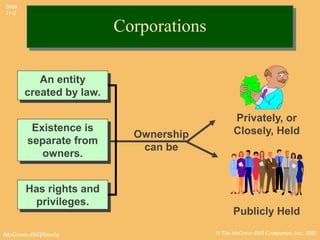
                          Corporations

           An entity
        created by law.

                                               Privately, or
         Existence is                          Closely, Held
                            Ownership
        separate from
                             can be
           owners.


        Has rights and
         privileges.
                                               Publicly Held

McGraw-Hill/Irwin                        © The McGraw-Hill Companies, Inc., 2002
Slide
11-3


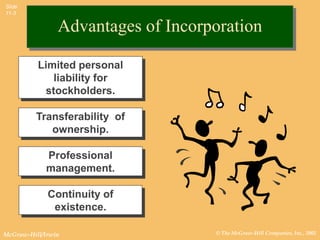
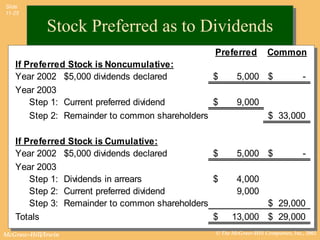
                Advantages of Incorporation

          Limited personal
             liability for
           stockholders.

         Transferability of
            ownership.

             Professional
             management.

             Continuity of
              existence.

McGraw-Hill/Irwin                   © The McGraw-Hill Companies, Inc., 2002
Slide
11-4


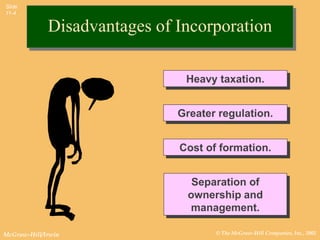
             Disadvantages of Incorporation

                               Heavy taxation.


                              Greater regulation.


                              Cost of formation.


                                 Separation of
                                ownership and
                                management.

McGraw-Hill/Irwin                    © The McGraw-Hill Companies, Inc., 2002
Slide
11-5
         Publicly Owned Corporations Face
                   Different Rules
           By LAW, publicly owned
              corporations must:
       Prepare financial statements
        in accordance with GAAP.
       Have their financial statement
        audited by an independent
        CPA.
       Comply with federal securities
        laws.
       Submit financial information
        for SEC review.
McGraw-Hill/Irwin                        © The McGraw-Hill Companies, Inc., 2002
Slide
11-6


                    Formation of a Corporation

    Each corporation is         The costs associated with
     formed according to          incorporation are usually
     the laws of the state       expensed immediately, but
                                 amortized over 5 years for
     where it is located.
                                       tax purposes.
    The application for
     corporate status is
     called the Articles of
     Incorporation.


McGraw-Hill/Irwin                         © The McGraw-Hill Companies, Inc., 2002
Slide
11-7


                    Rights of Stockholders

                                  Voting (in person
                                    or by proxy).
                                   Proportionate
                           Rights distribution of
                                    dividends.
                                   Proportionate
   Stockholders                    distribution of
                                     assets in a
                                    liquidation.
McGraw-Hill/Irwin                     © The McGraw-Hill Companies, Inc., 2002
Slide
11-8


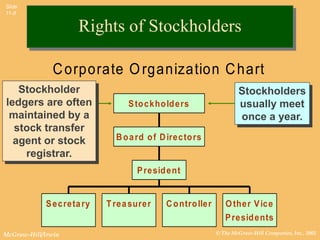
                     Rights of Stockholders

               C orporate O rganization C hart
   Stockholder                                                     Stockholders
     Ultimate
ledgers are often               S to ckho ld ers                   usually meet
      control
 maintained by a                                                   once a year.
  stock transfer
  agent or stock             B o a rd o f D irecto rs
    registrar.
                                  P resid ent


             S ecreta ry   T rea surer     C o ntro ller      O ther V ice
                                                              P resid ents
McGraw-Hill/Irwin                                          © The McGraw-Hill Companies, Inc., 2002
Slide
11-9


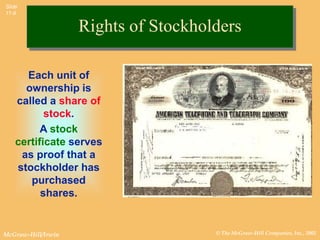
                    Rights of Stockholders

      Each unit of
      ownership is
    called a share of
           stock.
          A stock
    certificate serves
     as proof that a
    stockholder has
       purchased
          shares.


McGraw-Hill/Irwin                     © The McGraw-Hill Companies, Inc., 2002
Slide
11-10


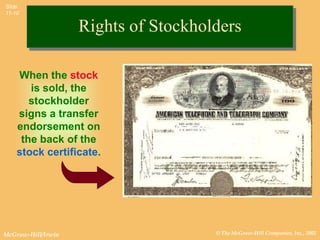
                    Rights of Stockholders

    When the stock
       is sold, the
       stockholder
    signs a transfer
    endorsement on
     the back of the
    stock certificate.


McGraw-Hill/Irwin                     © The McGraw-Hill Companies, Inc., 2002
Slide
11-11


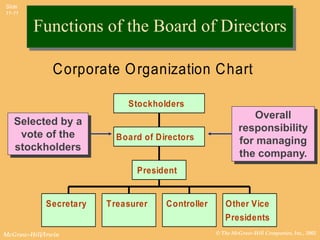
         Functions of the Board of Directors

               Corporate O rganization Chart

                             Stockholders
                                                              Overall
   Selected by a
                                                           responsibility
    vote of the            Board of Directors              for managing
   stockholders
                                                           the company.
                               President


             Secretary   Treasurer    Controller      Other Vice
                                                      Presidents
McGraw-Hill/Irwin                                  © The McGraw-Hill Companies, Inc., 2002
Slide
11-12


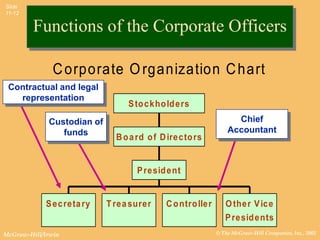
         Functions of the Corporate Officers

               C orporate O rganization C hart
 Contractual and legal
   representation
                                    S to c k ho ld e rs
             Custodian of                                            Chief
                funds                                              Accountant
                                B o a rd o f D ire c to rs


                                      P re sid e nt


             S e c re ta ry   T re a sure r    C o ntro ller      O ther V ice
                                                                  P resid ents
McGraw-Hill/Irwin                                              © The McGraw-Hill Companies, Inc., 2002
Slide
11-13


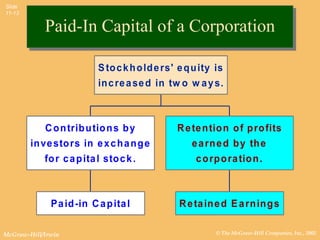
            Paid-In Capital of a Corporation

                           S to c k h o ld e rs' e q u ity is
                           in c re a se d in tw o w a y s.


            C o n trib u tio n s b y            R e te n tio n o f p ro fits
        in ve sto rs in e x c h a n g e             e a rn e d b y th e
            fo r c a p ita l sto c k .               c o rp o ra tio n .


              Pa id -in C a p ita l              R e ta in e d E a rn in g s

McGraw-Hill/Irwin                                         © The McGraw-Hill Companies, Inc., 2002
Slide
11-14
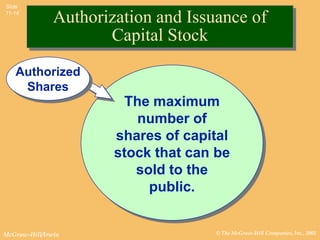
               Authorization and Issuance of
                      Capital Stock
   Authorized
    Shares
                        The maximum
                          number of
                       shares of capital
                       stock that can be
                          sold to the
                            public.


McGraw-Hill/Irwin                    © The McGraw-Hill Companies, Inc., 2002
Slide
11-15
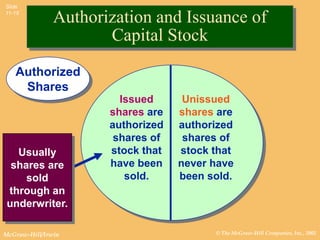
               Authorization and Issuance of
                      Capital Stock
   Authorized
    Shares
                        Issued      Unissued
                      shares are   shares are
                      authorized   authorized
                       shares of    shares of
   Usually            stock that   stock that
  shares are          have been    never have
     sold                sold.     been sold.
 through an
 underwriter.

McGraw-Hill/Irwin                        © The McGraw-Hill Companies, Inc., 2002
Slide
11-16
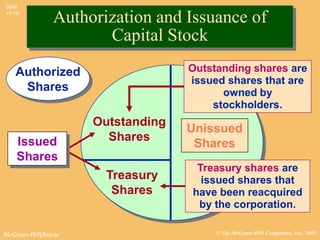
               Authorization and Issuance of
                      Capital Stock
   Authorized                     Outstanding shares are
                                  issued shares that are
    Shares                              owned by
                                      stockholders.
                    Outstanding
                                  Unissued
    Issued            Shares
                                   Shares
    Shares
                                   Treasury shares are
                      Treasury      issued shares that
                       Shares     have been reacquired
                                   by the corporation.

McGraw-Hill/Irwin                      © The McGraw-Hill Companies, Inc., 2002
Slide
11-17


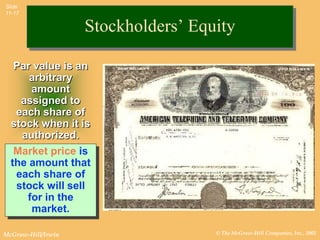
                    Stockholders’ Equity

   Par value is an
      arbitrary
      amount
    assigned to
   each share of
  stock when it is
    authorized.
   Market price is
  the amount that
   each share of
   stock will sell
     for in the
      market.

McGraw-Hill/Irwin                    © The McGraw-Hill Companies, Inc., 2002
Slide
11-18


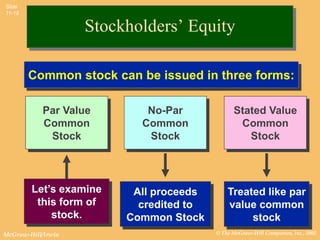
                    Stockholders’ Equity

        Common stock can be issued in three forms:

            Par Value       No-Par             Stated Value
            Common         Common               Common
             Stock          Stock                 Stock


        Let’s examine     All proceeds       Treated like par
         this form of      credited to       value common
            stock.       Common Stock             stock
McGraw-Hill/Irwin                        © The McGraw-Hill Companies, Inc., 2002
Slide
11-19


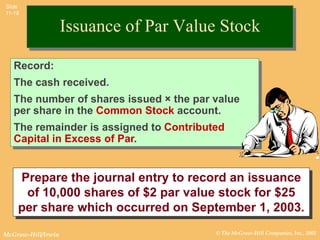
                    Issuance of Par Value Stock

   Record:
   The cash received.
   The number of shares issued × the par value
   per share in the Common Stock account.
   The remainder is assigned to Contributed
   Capital in Excess of Par.


    Prepare the journal entry to record an issuance
     of 10,000 shares of $2 par value stock for $25
    per share which occurred on September 1, 2003.

McGraw-Hill/Irwin                        © The McGraw-Hill Companies, Inc., 2002
Slide
11-20


                    Issuance of Par Value Stock

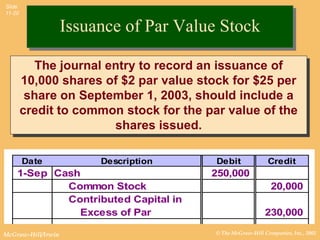
           The journal entry to record an issuance of
        10,000 shares of $2 par value stock for $25 per
         share on September 1, 2003, should include a
        credit to common stock for the par value of the
                        shares issued.

        Date             Description     Debit               Credit
    1-Sep Cash                          250,000
            Common Stock                                      20,000
            Contributed Capital in
              Excess of Par                                 230,000

McGraw-Hill/Irwin                        © The McGraw-Hill Companies, Inc., 2002
Slide
11-21


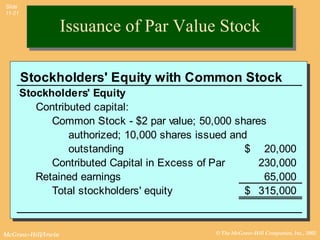
                    Issuance of Par Value Stock

        Stockholders' Equity with Common Stock
        Stockholders' Equity
           Contributed capital:
              Common Stock - $2 par value; 50,000 shares
                  authorized; 10,000 shares issued and
                  outstanding                         $ 20,000
              Contributed Capital in Excess of Par      230,000
           Retained earnings                             65,000
              Total stockholders' equity              $ 315,000


McGraw-Hill/Irwin                              © The McGraw-Hill Companies, Inc., 2002
Slide
11-22


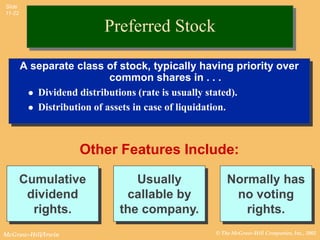
                         Preferred Stock

        A separate class of stock, typically having priority over
                            common shares in . . .
          Dividend distributions (rate is usually stated).

          Distribution of assets in case of liquidation.


                    Other Features Include:

        Cumulative             Usually              Normally has
         dividend            callable by             no voting
          rights.           the company.               rights.
McGraw-Hill/Irwin                               © The McGraw-Hill Companies, Inc., 2002
Slide
11-23


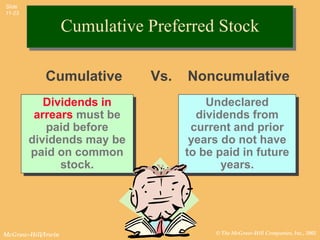
                    Cumulative Preferred Stock

            Cumulative         Vs.   Noncumulative
           Dividends in                  Undeclared
         arrears must be               dividends from
           paid before                current and prior
        dividends may be              years do not have
        paid on common               to be paid in future
              stock.                        years.


McGraw-Hill/Irwin                         © The McGraw-Hill Companies, Inc., 2002
Slide
11-24


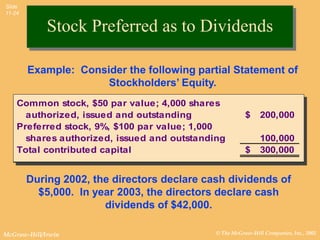
             Stock Preferred as to Dividends

        Example: Consider the following partial Statement of
                      Stockholders’ Equity.
    Common stock, $50 par value; 4,000 shares
      authorized, issued and outstanding                $     200,000
    Preferred stock, 9%, $100 par value; 1,000
      shares authorized, issued and outstanding               100,000
    Total contributed capital                           $     300,000


        During 2002, the directors declare cash dividends of
          $5,000. In year 2003, the directors declare cash
                       dividends of $42,000.

McGraw-Hill/Irwin                            © The McGraw-Hill Companies, Inc., 2002
Slide
11-25


             Stock Preferred as to Dividends
                                             Preferred          Common
   If Preferred Stock is Noncumulative:
       Example: Consider the following partial      Statement of
   Year 2002 $5,000 dividends declared          $    5,000 $                  -
                          Stockholders’ Equity.
   Year 2003
       Step 1: Current preferred dividend
   Common stock, $50 par value; 4,000 shares    $    9,000
      authorized, issued and outstanding
       Step 2: Remainder to common shareholders        $ 200,000
                                                           $ 33,000
   Preferred stock, 9%, $100 par value; 1,000
   If Preferred Stock is Cumulative: outstanding
      shares authorized, issued and                        100,000
   Total contributed capital
   Year 2002 $5,000 dividends declared          $    5,000 300,000 -
                                                       $     $
   Year 2003
     During 2000, the directors declare cash dividends of
      Step 1: Dividends in arrears             $  4,000
      Step 2: Currentyear 2001, the directors declare cash
         $5,000. In preferred dividend            9,000
      Step 3: Remainder to common shareholders
                        dividends of $42,000.           $ 29,000
   Totals                                      $ 13,000 $ 29,000
McGraw-Hill/Irwin                            © The McGraw-Hill Companies, Inc., 2002
Slide
11-26


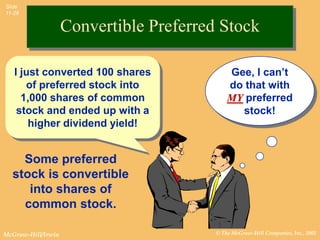
                    Convertible Preferred Stock

   I just converted 100 shares               Gee, I can’t
      of preferred stock into                do that with
     1,000 shares of common                  MY preferred
    stock and ended up with a                  stock!
       higher dividend yield!


    Some preferred
  stock is convertible
     into shares of
    common stock.

McGraw-Hill/Irwin                        © The McGraw-Hill Companies, Inc., 2002
Slide
11-27


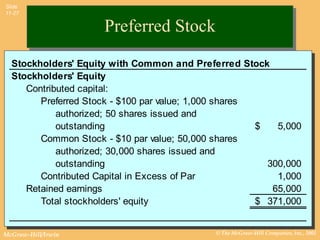
                     Preferred Stock
  Stockholders' Equity with Common and Preferred Stock
  Stockholders' Equity
     Contributed capital:
        Preferred Stock - $100 par value; 1,000 shares
            authorized; 50 shares issued and
            outstanding                                $   5,000
        Common Stock - $10 par value; 50,000 shares
            authorized; 30,000 shares issued and
            outstanding                                  300,000
        Contributed Capital in Excess of Par               1,000
     Retained earnings                                    65,000
        Total stockholders' equity                     $ 371,000


McGraw-Hill/Irwin                            © The McGraw-Hill Companies, Inc., 2002
Slide
11-28
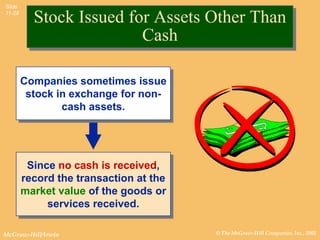
          Stock Issued for Assets Other Than
                         Cash

        Companies sometimes issue
         stock in exchange for non-
                cash assets.


         Since no cash is received,
        record the transaction at the
        market value of the goods or
             services received.

McGraw-Hill/Irwin                       © The McGraw-Hill Companies, Inc., 2002
Slide
11-29


                     I love this
                        stuff!
                     Can we do
                    some more?

McGraw-Hill/Irwin       © The McGraw-Hill Companies, Inc., 2002
Slide
11-30


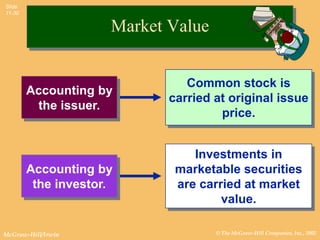
                     Market Value


                               Common stock is
        Accounting by
                            carried at original issue
         the issuer.
                                     price.


                                Investments in
        Accounting by        marketable securities
         the investor.       are carried at market
                                     value.

McGraw-Hill/Irwin                   © The McGraw-Hill Companies, Inc., 2002
Slide
11-31


             Market Price of Preferred Stock

    Factors affecting market price   The return based on
          of preferred stock:        the market value is
  l Dividend rate                    called the “dividend
  l Risk                                    yield.”
  l Level of interest rates


McGraw-Hill/Irwin                      © The McGraw-Hill Companies, Inc., 2002
Slide
11-32


             Market Price of Common Stock

      Factors affecting      Changes in market value
       market price of        have no impact on the
       common stock:           books of the issuer.

   l Investors’
     expectations of
     future profitability.
   l Risk that this level
     of profitability will
     not be achieved.
McGraw-Hill/Irwin                   © The McGraw-Hill Companies, Inc., 2002
Slide
11-33


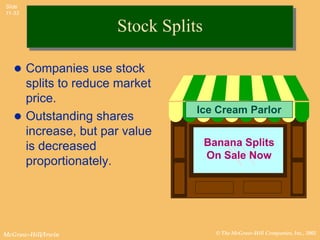
                     Stock Splits

    Companies use stock
     splits to reduce market
     price.
                                Ice Cream Parlor
    Outstanding shares
     increase, but par value
     is decreased                   Banana Splits
                                    On Sale Now
     proportionately.


McGraw-Hill/Irwin                     © The McGraw-Hill Companies, Inc., 2002
Slide
11-34


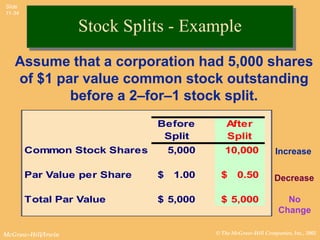
                    Stock Splits - Example
   Assume that a corporation had 5,000 shares
   of $1 par value common stock outstanding
           before a 2–for–1 stock split.
                              Before          After
                               Split          Split
        Common Stock Shares       5,000      10,000              Increase

        Par Value per Share   $    1.00    $      0.50          Decrease

        Total Par Value       $ 5,000      $ 5,000                  No
                                                                  Change

McGraw-Hill/Irwin                         © The McGraw-Hill Companies, Inc., 2002
Slide
11-35


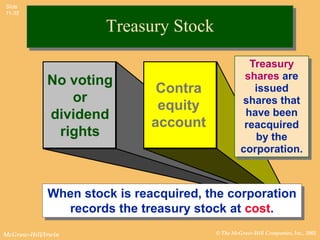
                      Treasury Stock

                                                   Treasury
             No voting                            shares are
                               Contra               issued
                or                               shares that
                               equity             have been
             dividend
                              account             reacquired
              rights                                by the
                                                 corporation.


             When stock is reacquired, the corporation
               records the treasury stock at cost.
McGraw-Hill/Irwin                       © The McGraw-Hill Companies, Inc., 2002
Slide
11-36


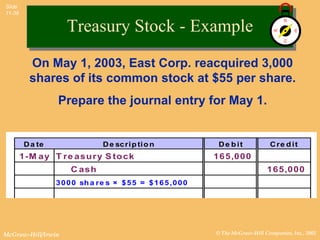
                     Treasury Stock - Example
          On May 1, 2003, East Corp. reacquired 3,000
          shares of its common stock at $55 per share.
                  Prepare the journal entry for May 1.


         D a te                  D e sc ri p ti o n             De b it             C re d i t
        1-M ay T r e asu r y S to ck                            165,000
                      C ash                                                        165,000
                  3 0 0 0 sh a re s × $ 5 5 = $ 1 6 5 , 0 0 0


McGraw-Hill/Irwin                                               © The McGraw-Hill Companies, Inc., 2002
Slide
11-37


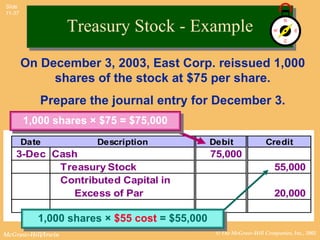
                    Treasury Stock - Example
        On December 3, 2003, East Corp. reissued 1,000
             shares of the stock at $75 per share.
             Prepare the journal entry for December 3.
        1,000 shares × $75 = $75,000
        Date
        D a te          Description
                        D e sc ri p ti o n       Debit
                                                 De b it             Credit
                                                                     C re d i t
    3-Dec Cash                                   75,000
           Treasury Stock                                               55,000
           Contributed Capital in
              Excess of Par                                             20,000

             1,000 shares × $55 cost = $55,000
McGraw-Hill/Irwin                                 © The McGraw-Hill Companies, Inc., 2002
Slide
11-38


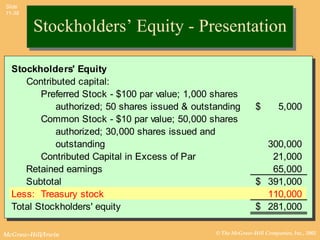
         Stockholders’ Equity - Presentation

  Stockholders' Equity
     Contributed capital:
         Preferred Stock - $100 par value; 1,000 shares
            authorized; 50 shares issued & outstanding          $        5,000
         Common Stock - $10 par value; 50,000 shares
            authorized; 30,000 shares issued and
            outstanding                                           300,000
         Contributed Capital in Excess of Par                      21,000
     Retained earnings                                             65,000
     Subtotal                                                   $ 391,000
  Less: Treasury stock                                            110,000
  Total Stockholders' equity                                    $ 281,000

McGraw-Hill/Irwin                                © The McGraw-Hill Companies, Inc., 2002
Slide
11-39


                    End of Chapter 11

                                  This isn’t what I
                                 meant when I asked
                                  for stock for my
                                      birthday!


McGraw-Hill/Irwin                   © The McGraw-Hill Companies, Inc., 2002

Financial Accounting chp 11

  • 1.
    Slide 11-1 Chapter 11 STOCKHOLDERS’ EQUITY: PAID-IN CAPITAL McGraw-Hill/Irwin © The McGraw-Hill Companies, Inc., 2002
  • 2.
    Slide 11-2 Corporations An entity created by law. Privately, or Existence is Closely, Held Ownership separate from can be owners. Has rights and privileges. Publicly Held McGraw-Hill/Irwin © The McGraw-Hill Companies, Inc., 2002
  • 3.
    Slide 11-3 Advantages of Incorporation Limited personal liability for stockholders. Transferability of ownership. Professional management. Continuity of existence. McGraw-Hill/Irwin © The McGraw-Hill Companies, Inc., 2002
  • 4.
    Slide 11-4 Disadvantages of Incorporation Heavy taxation. Greater regulation. Cost of formation. Separation of ownership and management. McGraw-Hill/Irwin © The McGraw-Hill Companies, Inc., 2002
  • 5.
    Slide 11-5 Publicly Owned Corporations Face Different Rules By LAW, publicly owned corporations must:  Prepare financial statements in accordance with GAAP.  Have their financial statement audited by an independent CPA.  Comply with federal securities laws.  Submit financial information for SEC review. McGraw-Hill/Irwin © The McGraw-Hill Companies, Inc., 2002
  • 6.
    Slide 11-6 Formation of a Corporation  Each corporation is The costs associated with formed according to incorporation are usually the laws of the state expensed immediately, but amortized over 5 years for where it is located. tax purposes.  The application for corporate status is called the Articles of Incorporation. McGraw-Hill/Irwin © The McGraw-Hill Companies, Inc., 2002
  • 7.
    Slide 11-7 Rights of Stockholders  Voting (in person or by proxy).  Proportionate Rights distribution of dividends.  Proportionate Stockholders distribution of assets in a liquidation. McGraw-Hill/Irwin © The McGraw-Hill Companies, Inc., 2002
  • 8.
    Slide 11-8 Rights of Stockholders C orporate O rganization C hart Stockholder Stockholders Ultimate ledgers are often S to ckho ld ers usually meet control maintained by a once a year. stock transfer agent or stock B o a rd o f D irecto rs registrar. P resid ent S ecreta ry T rea surer C o ntro ller O ther V ice P resid ents McGraw-Hill/Irwin © The McGraw-Hill Companies, Inc., 2002
  • 9.
    Slide 11-9 Rights of Stockholders Each unit of ownership is called a share of stock. A stock certificate serves as proof that a stockholder has purchased shares. McGraw-Hill/Irwin © The McGraw-Hill Companies, Inc., 2002
  • 10.
    Slide 11-10 Rights of Stockholders When the stock is sold, the stockholder signs a transfer endorsement on the back of the stock certificate. McGraw-Hill/Irwin © The McGraw-Hill Companies, Inc., 2002
  • 11.
    Slide 11-11 Functions of the Board of Directors Corporate O rganization Chart Stockholders Overall Selected by a responsibility vote of the Board of Directors for managing stockholders the company. President Secretary Treasurer Controller Other Vice Presidents McGraw-Hill/Irwin © The McGraw-Hill Companies, Inc., 2002
  • 12.
    Slide 11-12 Functions of the Corporate Officers C orporate O rganization C hart Contractual and legal representation S to c k ho ld e rs Custodian of Chief funds Accountant B o a rd o f D ire c to rs P re sid e nt S e c re ta ry T re a sure r C o ntro ller O ther V ice P resid ents McGraw-Hill/Irwin © The McGraw-Hill Companies, Inc., 2002
  • 13.
    Slide 11-13 Paid-In Capital of a Corporation S to c k h o ld e rs' e q u ity is in c re a se d in tw o w a y s. C o n trib u tio n s b y R e te n tio n o f p ro fits in ve sto rs in e x c h a n g e e a rn e d b y th e fo r c a p ita l sto c k . c o rp o ra tio n . Pa id -in C a p ita l R e ta in e d E a rn in g s McGraw-Hill/Irwin © The McGraw-Hill Companies, Inc., 2002
  • 14.
    Slide 11-14 Authorization and Issuance of Capital Stock Authorized Shares The maximum number of shares of capital stock that can be sold to the public. McGraw-Hill/Irwin © The McGraw-Hill Companies, Inc., 2002
  • 15.
    Slide 11-15 Authorization and Issuance of Capital Stock Authorized Shares Issued Unissued shares are shares are authorized authorized shares of shares of Usually stock that stock that shares are have been never have sold sold. been sold. through an underwriter. McGraw-Hill/Irwin © The McGraw-Hill Companies, Inc., 2002
  • 16.
    Slide 11-16 Authorization and Issuance of Capital Stock Authorized Outstanding shares are issued shares that are Shares owned by stockholders. Outstanding Unissued Issued Shares Shares Shares Treasury shares are Treasury issued shares that Shares have been reacquired by the corporation. McGraw-Hill/Irwin © The McGraw-Hill Companies, Inc., 2002
  • 17.
    Slide 11-17 Stockholders’ Equity Par value is an arbitrary amount assigned to each share of stock when it is authorized. Market price is the amount that each share of stock will sell for in the market. McGraw-Hill/Irwin © The McGraw-Hill Companies, Inc., 2002
  • 18.
    Slide 11-18 Stockholders’ Equity Common stock can be issued in three forms: Par Value No-Par Stated Value Common Common Common Stock Stock Stock Let’s examine All proceeds Treated like par this form of credited to value common stock. Common Stock stock McGraw-Hill/Irwin © The McGraw-Hill Companies, Inc., 2002
  • 19.
    Slide 11-19 Issuance of Par Value Stock Record: The cash received. The number of shares issued × the par value per share in the Common Stock account. The remainder is assigned to Contributed Capital in Excess of Par. Prepare the journal entry to record an issuance of 10,000 shares of $2 par value stock for $25 per share which occurred on September 1, 2003. McGraw-Hill/Irwin © The McGraw-Hill Companies, Inc., 2002
  • 20.
    Slide 11-20 Issuance of Par Value Stock The journal entry to record an issuance of 10,000 shares of $2 par value stock for $25 per share on September 1, 2003, should include a credit to common stock for the par value of the shares issued. Date Description Debit Credit 1-Sep Cash 250,000 Common Stock 20,000 Contributed Capital in Excess of Par 230,000 McGraw-Hill/Irwin © The McGraw-Hill Companies, Inc., 2002
  • 21.
    Slide 11-21 Issuance of Par Value Stock Stockholders' Equity with Common Stock Stockholders' Equity Contributed capital: Common Stock - $2 par value; 50,000 shares authorized; 10,000 shares issued and outstanding $ 20,000 Contributed Capital in Excess of Par 230,000 Retained earnings 65,000 Total stockholders' equity $ 315,000 McGraw-Hill/Irwin © The McGraw-Hill Companies, Inc., 2002
  • 22.
    Slide 11-22 Preferred Stock A separate class of stock, typically having priority over common shares in . . .  Dividend distributions (rate is usually stated).  Distribution of assets in case of liquidation. Other Features Include: Cumulative Usually Normally has dividend callable by no voting rights. the company. rights. McGraw-Hill/Irwin © The McGraw-Hill Companies, Inc., 2002
  • 23.
    Slide 11-23 Cumulative Preferred Stock Cumulative Vs. Noncumulative Dividends in Undeclared arrears must be dividends from paid before current and prior dividends may be years do not have paid on common to be paid in future stock. years. McGraw-Hill/Irwin © The McGraw-Hill Companies, Inc., 2002
  • 24.
    Slide 11-24 Stock Preferred as to Dividends Example: Consider the following partial Statement of Stockholders’ Equity. Common stock, $50 par value; 4,000 shares authorized, issued and outstanding $ 200,000 Preferred stock, 9%, $100 par value; 1,000 shares authorized, issued and outstanding 100,000 Total contributed capital $ 300,000 During 2002, the directors declare cash dividends of $5,000. In year 2003, the directors declare cash dividends of $42,000. McGraw-Hill/Irwin © The McGraw-Hill Companies, Inc., 2002
  • 25.
    Slide 11-25 Stock Preferred as to Dividends Preferred Common If Preferred Stock is Noncumulative: Example: Consider the following partial Statement of Year 2002 $5,000 dividends declared $ 5,000 $ - Stockholders’ Equity. Year 2003 Step 1: Current preferred dividend Common stock, $50 par value; 4,000 shares $ 9,000 authorized, issued and outstanding Step 2: Remainder to common shareholders $ 200,000 $ 33,000 Preferred stock, 9%, $100 par value; 1,000 If Preferred Stock is Cumulative: outstanding shares authorized, issued and 100,000 Total contributed capital Year 2002 $5,000 dividends declared $ 5,000 300,000 - $ $ Year 2003 During 2000, the directors declare cash dividends of Step 1: Dividends in arrears $ 4,000 Step 2: Currentyear 2001, the directors declare cash $5,000. In preferred dividend 9,000 Step 3: Remainder to common shareholders dividends of $42,000. $ 29,000 Totals $ 13,000 $ 29,000 McGraw-Hill/Irwin © The McGraw-Hill Companies, Inc., 2002
  • 26.
    Slide 11-26 Convertible Preferred Stock I just converted 100 shares Gee, I can’t of preferred stock into do that with 1,000 shares of common MY preferred stock and ended up with a stock! higher dividend yield! Some preferred stock is convertible into shares of common stock. McGraw-Hill/Irwin © The McGraw-Hill Companies, Inc., 2002
  • 27.
    Slide 11-27 Preferred Stock Stockholders' Equity with Common and Preferred Stock Stockholders' Equity Contributed capital: Preferred Stock - $100 par value; 1,000 shares authorized; 50 shares issued and outstanding $ 5,000 Common Stock - $10 par value; 50,000 shares authorized; 30,000 shares issued and outstanding 300,000 Contributed Capital in Excess of Par 1,000 Retained earnings 65,000 Total stockholders' equity $ 371,000 McGraw-Hill/Irwin © The McGraw-Hill Companies, Inc., 2002
  • 28.
    Slide 11-28 Stock Issued for Assets Other Than Cash Companies sometimes issue stock in exchange for non- cash assets. Since no cash is received, record the transaction at the market value of the goods or services received. McGraw-Hill/Irwin © The McGraw-Hill Companies, Inc., 2002
  • 29.
    Slide 11-29 I love this stuff! Can we do some more? McGraw-Hill/Irwin © The McGraw-Hill Companies, Inc., 2002
  • 30.
    Slide 11-30 Market Value Common stock is Accounting by carried at original issue the issuer. price. Investments in Accounting by marketable securities the investor. are carried at market value. McGraw-Hill/Irwin © The McGraw-Hill Companies, Inc., 2002
  • 31.
    Slide 11-31 Market Price of Preferred Stock Factors affecting market price The return based on of preferred stock: the market value is l Dividend rate called the “dividend l Risk yield.” l Level of interest rates McGraw-Hill/Irwin © The McGraw-Hill Companies, Inc., 2002
  • 32.
    Slide 11-32 Market Price of Common Stock Factors affecting Changes in market value market price of have no impact on the common stock: books of the issuer. l Investors’ expectations of future profitability. l Risk that this level of profitability will not be achieved. McGraw-Hill/Irwin © The McGraw-Hill Companies, Inc., 2002
  • 33.
    Slide 11-33 Stock Splits  Companies use stock splits to reduce market price. Ice Cream Parlor  Outstanding shares increase, but par value is decreased Banana Splits On Sale Now proportionately. McGraw-Hill/Irwin © The McGraw-Hill Companies, Inc., 2002
  • 34.
    Slide 11-34 Stock Splits - Example Assume that a corporation had 5,000 shares of $1 par value common stock outstanding before a 2–for–1 stock split. Before After Split Split Common Stock Shares 5,000 10,000 Increase Par Value per Share $ 1.00 $ 0.50 Decrease Total Par Value $ 5,000 $ 5,000 No Change McGraw-Hill/Irwin © The McGraw-Hill Companies, Inc., 2002
  • 35.
    Slide 11-35 Treasury Stock Treasury No voting shares are Contra issued or shares that equity have been dividend account reacquired rights by the corporation. When stock is reacquired, the corporation records the treasury stock at cost. McGraw-Hill/Irwin © The McGraw-Hill Companies, Inc., 2002
  • 36.
    Slide 11-36 Treasury Stock - Example On May 1, 2003, East Corp. reacquired 3,000 shares of its common stock at $55 per share. Prepare the journal entry for May 1. D a te D e sc ri p ti o n De b it C re d i t 1-M ay T r e asu r y S to ck 165,000 C ash 165,000 3 0 0 0 sh a re s × $ 5 5 = $ 1 6 5 , 0 0 0 McGraw-Hill/Irwin © The McGraw-Hill Companies, Inc., 2002
  • 37.
    Slide 11-37 Treasury Stock - Example On December 3, 2003, East Corp. reissued 1,000 shares of the stock at $75 per share. Prepare the journal entry for December 3. 1,000 shares × $75 = $75,000 Date D a te Description D e sc ri p ti o n Debit De b it Credit C re d i t 3-Dec Cash 75,000 Treasury Stock 55,000 Contributed Capital in Excess of Par 20,000 1,000 shares × $55 cost = $55,000 McGraw-Hill/Irwin © The McGraw-Hill Companies, Inc., 2002
  • 38.
    Slide 11-38 Stockholders’ Equity - Presentation Stockholders' Equity Contributed capital: Preferred Stock - $100 par value; 1,000 shares authorized; 50 shares issued & outstanding $ 5,000 Common Stock - $10 par value; 50,000 shares authorized; 30,000 shares issued and outstanding 300,000 Contributed Capital in Excess of Par 21,000 Retained earnings 65,000 Subtotal $ 391,000 Less: Treasury stock 110,000 Total Stockholders' equity $ 281,000 McGraw-Hill/Irwin © The McGraw-Hill Companies, Inc., 2002
  • 39.
    Slide 11-39 End of Chapter 11 This isn’t what I meant when I asked for stock for my birthday! McGraw-Hill/Irwin © The McGraw-Hill Companies, Inc., 2002