Riddhi Joshi
Sanket Jha
Tejas Gawade
Harshal Kesaria
Rupa Jha
Capital Edge || Kshitij 2012
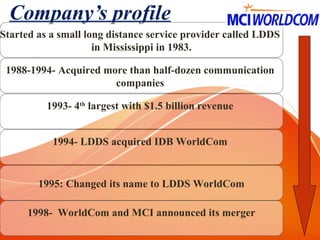
Company’s profile
Started as a small long distance service provider called LDDS
in Mississippi in 1983.
1988-1994- Acquired more than half-dozen communication
companies
1993- 4th
largest with $1.5 billion revenue
1995: Changed its name to LDDS WorldCom
1994- LDDS acquired IDB WorldCom
1998- WorldCom and MCI announced its merger
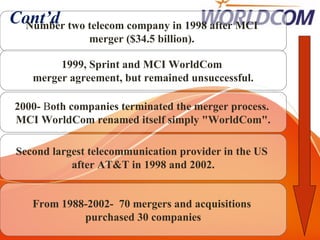
Number two telecom company in 1998 after MCI
merger ($34.5 billion).
1999, Sprint and MCI WorldCom
merger agreement, but remained unsuccessful.
2000- Both companies terminated the merger process.
MCI WorldCom renamed itself simply "WorldCom".
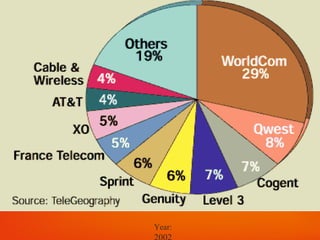
Second largest telecommunication provider in the US
after AT&T in 1998 and 2002.
From 1988-2002- 70 mergers and acquisitions
purchased 30 companies
Cont’d
Year:
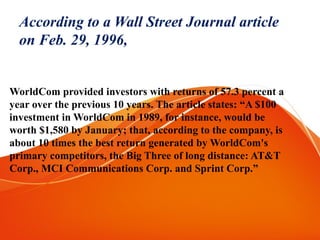
According to a Wall Street Journal article
on Feb. 29, 1996,
WorldCom provided investors with returns of 57.3 percent a
year over the previous 10 years. The article states: “A $100
investment in WorldCom in 1989, for instance, would be
worth $1,580 by January; that, according to the company, is
about 10 times the best return generated by WorldCom's
primary competitors, the Big Three of long distance: AT&T
Corp., MCI Communications Corp. and Sprint Corp.”
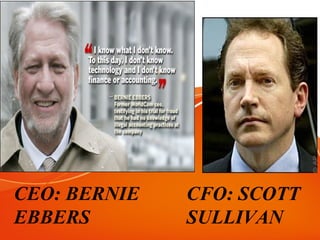
CEO: BERNIE
EBBERS
CFO: SCOTT
SULLIVAN
As WorldCom was enjoying name and fame there was huge
pressures both externally and internally to be no.1.
•Competition
•Merger or acquisition
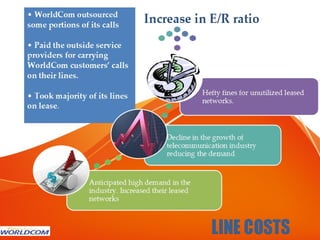
•Expenses of line costs
•Sprint demerger
•Pressure to meet expectation of Wall street
How started?
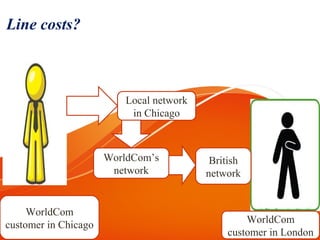
Line costs?
WorldCom
customer in Chicago WorldCom
customer in London
Local network
in Chicago
WorldCom’s
network
British
network
Cont’d
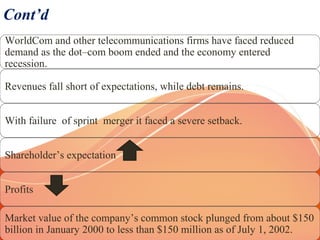
WorldCom and other telecommunications firms have faced reduced
demand as the dot–com boom ended and the economy entered
recession.
Revenues fall short of expectations, while debt remains.
With failure of sprint merger it faced a severe setback.
Shareholder’s expectation
Profits
Market value of the company’s common stock plunged from about $150
billion in January 2000 to less than $150 million as of July 1, 2002.
Dot-com boom- bust?
The dot-com bubble -1997–2000.
Marked by the founding of a group of new Internet 
based companies commonly referred to as dot-
coms. 
Companies could cause their stock prices to 
increase by simply adding an "e-" prefix to their 
name or a ".com" to the end, which one author 
called "prefix investing".
Fraud
First, WorldCom's
accounting department
underreported 'line
costs’
Second, The company
exaggerated revenue by
$ 1 billion.
• A company spends $500 to perform annual maintenance on a
cutting machine. This expenditure is an operating
expenditure and, as such, it should be treated as business
expense .Current net income would decrease as a result.
• However, if the company spends $500 to replace the motor in
the machine, this expenditure would be posted to the asset
account “Property, Plant, and Equipment”. Such an
expenditure is a capital expenditure because the life of the
equipment has been extended and/or its operating efficiency
increased.
EXPENSE VS CAPITAL EXPENDITURE
What WorldCom did?
Reduced the amount of money held in
reserve by $2.8 billion and moved this
money into the revenue line of its
financial statements.
In 2000, classified operating
expenses as long-term capital
investments ( $3.85 billion).
These changes turned WorldCom's losses
into profits to the tune of $1.38 billion in
2001. It also made WorldCom's assets
appear more valuable.
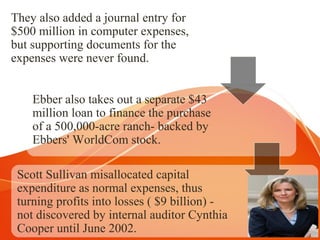
They also added a journal entry for
$500 million in computer expenses,
but supporting documents for the
expenses were never found.
Ebber also takes out a separate $43
million loan to finance the purchase
of a 500,000-acre ranch- backed by
Ebbers' WorldCom stock.
Scott Sullivan misallocated capital
expenditure as normal expenses, thus
turning profits into losses ( $9 billion) -
not discovered by internal auditor Cynthia
Cooper until June 2002.
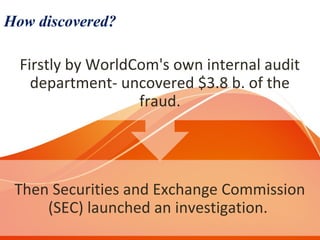
How discovered?
Then Securities and Exchange Commission
(SEC) launched an investigation.
Firstly by WorldCom's own internal audit
department- uncovered $3.8 b. of the
fraud.
What revealed?
When irregularities were spotted in MCI's books, the SEC requested
that WorldCom provide more information.
The SEC was suspicious as WorldCom was making so much
profit, AT&T was losing money.
An internal audit found that WorldCom had announced as capital
expenditures as well as the $500 million in undocumented computer
expenses. There was also another $2 billion in questionable entries.
WorldCom's audit committee was asked for documents.
Admitted to inflate its profits by $3.8 billion and not following GAAP,
over the previous five quarters. A little over a month WorldCom filed
for Chapter 11 bankruptcy.
Chapter 11 bankruptcy
Chapter 11 is a chapter of the United States Bankruptcy
Code, which permits reorganization under
the bankruptcy laws of the United States.
Chapter 11 bankruptcy is available to every business,
whether organized as a corporation or sole proprietorship,
and to individuals.
When a business is unable to service its debt or pay
its creditors, the business or its creditors can file with a
federal bankruptcy court for protection under either
Chapter 11.
Condition
The company emerged from Chapter 11 bankruptcy during 2004 with about $5.7
billion in debt and $6 billion in cash.
On August 7, 2002, the exWorldCo 5100 group was begun.
On February 14, 2005, Verizon Communications agreed to acquire MCI for $7.6
billion.
December 2005, the Microsoft announced that MCI will join it by providing Windows
Live Messenger customers "Voice Over Internet Protocol" (VoIP) service.
This was MCI's last new product—- called "MCI Web Calling".
After the merger, this product was renamed "Verizon Web Calling".
Consequence
•Stock
• Mid 1999 -$64.50 a share
• After announcement - below $1 a share
• $.06 a share
•Employees
57,000 employees lost jobs.
•Shareholders
$180 Billion of shareholder value lost.
•Company
$750 Million settlement paid to SEC
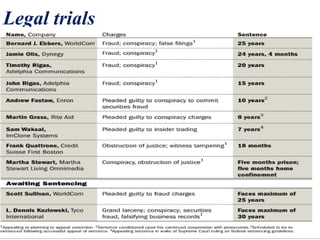
Legal trials
THANK YOU

Worldcom scam 2002

  • 1.
    Riddhi Joshi Sanket Jha TejasGawade Harshal Kesaria Rupa Jha Capital Edge || Kshitij 2012
  • 2.
    Company’s profile Started asa small long distance service provider called LDDS in Mississippi in 1983. 1988-1994- Acquired more than half-dozen communication companies 1993- 4th largest with $1.5 billion revenue 1995: Changed its name to LDDS WorldCom 1994- LDDS acquired IDB WorldCom 1998- WorldCom and MCI announced its merger
  • 3.
    Number two telecomcompany in 1998 after MCI merger ($34.5 billion). 1999, Sprint and MCI WorldCom merger agreement, but remained unsuccessful. 2000- Both companies terminated the merger process. MCI WorldCom renamed itself simply "WorldCom". Second largest telecommunication provider in the US after AT&T in 1998 and 2002. From 1988-2002- 70 mergers and acquisitions purchased 30 companies Cont’d
  • 4.
  • 5.
    According to aWall Street Journal article on Feb. 29, 1996, WorldCom provided investors with returns of 57.3 percent a year over the previous 10 years. The article states: “A $100 investment in WorldCom in 1989, for instance, would be worth $1,580 by January; that, according to the company, is about 10 times the best return generated by WorldCom's primary competitors, the Big Three of long distance: AT&T Corp., MCI Communications Corp. and Sprint Corp.”
  • 6.
  • 7.
    As WorldCom wasenjoying name and fame there was huge pressures both externally and internally to be no.1. •Competition •Merger or acquisition •Expenses of line costs •Sprint demerger •Pressure to meet expectation of Wall street How started?
  • 8.
    Line costs? WorldCom customer inChicago WorldCom customer in London Local network in Chicago WorldCom’s network British network
  • 10.
    Cont’d WorldCom and othertelecommunications firms have faced reduced demand as the dot–com boom ended and the economy entered recession. Revenues fall short of expectations, while debt remains. With failure of sprint merger it faced a severe setback. Shareholder’s expectation Profits Market value of the company’s common stock plunged from about $150 billion in January 2000 to less than $150 million as of July 1, 2002.
  • 11.
  • 12.
    Fraud First, WorldCom's accounting department underreported'line costs’ Second, The company exaggerated revenue by $ 1 billion.
  • 13.
    • A companyspends $500 to perform annual maintenance on a cutting machine. This expenditure is an operating expenditure and, as such, it should be treated as business expense .Current net income would decrease as a result. • However, if the company spends $500 to replace the motor in the machine, this expenditure would be posted to the asset account “Property, Plant, and Equipment”. Such an expenditure is a capital expenditure because the life of the equipment has been extended and/or its operating efficiency increased. EXPENSE VS CAPITAL EXPENDITURE
  • 14.
    What WorldCom did? Reducedthe amount of money held in reserve by $2.8 billion and moved this money into the revenue line of its financial statements. In 2000, classified operating expenses as long-term capital investments ( $3.85 billion). These changes turned WorldCom's losses into profits to the tune of $1.38 billion in 2001. It also made WorldCom's assets appear more valuable.
  • 15.
    They also addeda journal entry for $500 million in computer expenses, but supporting documents for the expenses were never found. Ebber also takes out a separate $43 million loan to finance the purchase of a 500,000-acre ranch- backed by Ebbers' WorldCom stock. Scott Sullivan misallocated capital expenditure as normal expenses, thus turning profits into losses ( $9 billion) - not discovered by internal auditor Cynthia Cooper until June 2002.
  • 16.
    How discovered? Then Securitiesand Exchange Commission (SEC) launched an investigation. Firstly by WorldCom's own internal audit department- uncovered $3.8 b. of the fraud.
  • 17.
    What revealed? When irregularitieswere spotted in MCI's books, the SEC requested that WorldCom provide more information. The SEC was suspicious as WorldCom was making so much profit, AT&T was losing money. An internal audit found that WorldCom had announced as capital expenditures as well as the $500 million in undocumented computer expenses. There was also another $2 billion in questionable entries. WorldCom's audit committee was asked for documents. Admitted to inflate its profits by $3.8 billion and not following GAAP, over the previous five quarters. A little over a month WorldCom filed for Chapter 11 bankruptcy.
  • 18.
    Chapter 11 bankruptcy Chapter11 is a chapter of the United States Bankruptcy Code, which permits reorganization under the bankruptcy laws of the United States. Chapter 11 bankruptcy is available to every business, whether organized as a corporation or sole proprietorship, and to individuals. When a business is unable to service its debt or pay its creditors, the business or its creditors can file with a federal bankruptcy court for protection under either Chapter 11.
  • 19.
    Condition The company emergedfrom Chapter 11 bankruptcy during 2004 with about $5.7 billion in debt and $6 billion in cash. On August 7, 2002, the exWorldCo 5100 group was begun. On February 14, 2005, Verizon Communications agreed to acquire MCI for $7.6 billion. December 2005, the Microsoft announced that MCI will join it by providing Windows Live Messenger customers "Voice Over Internet Protocol" (VoIP) service. This was MCI's last new product—- called "MCI Web Calling". After the merger, this product was renamed "Verizon Web Calling".
  • 20.
    Consequence •Stock • Mid 1999-$64.50 a share • After announcement - below $1 a share • $.06 a share •Employees 57,000 employees lost jobs. •Shareholders $180 Billion of shareholder value lost. •Company $750 Million settlement paid to SEC
  • 21.
  • 22.