© The McGraw-Hill Companies, Inc., 2002McGraw-Hill/Irwin
Rewarding Business
Performance
Chapter
24
© The McGraw-Hill Companies, Inc., 2002McGraw-Hill/Irwin
Goal Congruence
Alignment of employee
goals and objectives
with organizational
goals and objectives.
Motivation and Aligning
Goals and Objectives
Motivation and Aligning
Goals and Objectives
© The McGraw-Hill Companies, Inc., 2002McGraw-Hill/Irwin
Motivation and Aligning
Goals and Objectives
Motivation and Aligning
Goals and Objectives
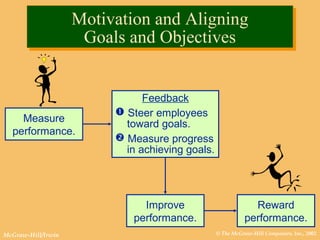
Feedback
 Steer employees
toward goals.
 Measure progress
in achieving goals.
Measure
performance.
Improve
performance.
Reward
performance.
© The McGraw-Hill Companies, Inc., 2002McGraw-Hill/Irwin
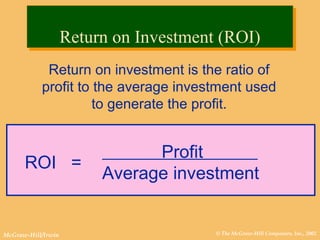
Return on investment is the ratio of
profit to the average investment used
to generate the profit.
ROI =
Profit
Average investment
Return on Investment (ROI)Return on Investment (ROI)
© The McGraw-Hill Companies, Inc., 2002McGraw-Hill/Irwin
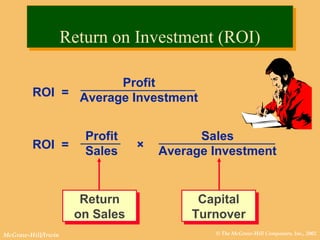
Sales
Average Investment
ROI =
Profit
Average Investment
ROI =
Profit
Sales
×
Return on Investment (ROI)Return on Investment (ROI)
Return
on Sales
Return
on Sales
Capital
Turnover
Capital
Turnover
© The McGraw-Hill Companies, Inc., 2002McGraw-Hill/Irwin
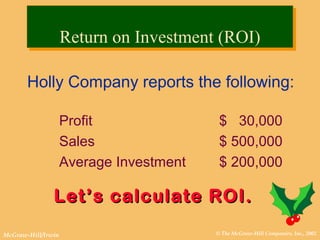
Holly Company reports the following:
Profit $ 30,000
Sales $ 500,000
Average Investment $ 200,000
Let’s calculate ROI.Let’s calculate ROI.
Return on Investment (ROI)Return on Investment (ROI)
© The McGraw-Hill Companies, Inc., 2002McGraw-Hill/Irwin
Return on Investment (ROI)Return on Investment (ROI)
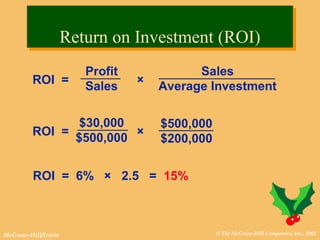
Sales
Average Investment
ROI =
Profit
Sales
×
ROI = 6% × 2.5 = 15%
$500,000
$200,000
ROI =
$30,000
$500,000
×
© The McGraw-Hill Companies, Inc., 2002McGraw-Hill/Irwin
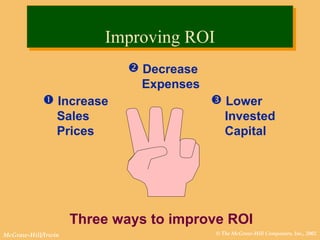
Three ways to improve ROI
 Increase
Sales
Prices
 Decrease
Expenses
 Lower
Invested
Capital
Improving ROIImproving ROI
© The McGraw-Hill Companies, Inc., 2002McGraw-Hill/Irwin
Holly’s manager was able to increase
sales revenue to $600,000 which
increased income to $42,000.
There was no change in invested capital.
Let’s calculate the new ROI.Let’s calculate the new ROI.
Improving ROIImproving ROI
© The McGraw-Hill Companies, Inc., 2002McGraw-Hill/Irwin
Improving ROIImproving ROI
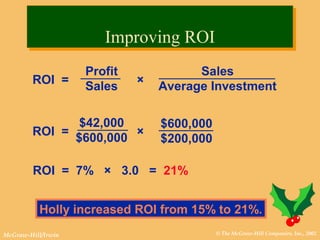
Sales
Average Investment
ROI =
Profit
Sales
×
ROI = 7% × 3.0 = 21%
Holly increased ROI from 15% to 21%.
$600,000
$200,000
ROI =
$42,000
$600,000
×
© The McGraw-Hill Companies, Inc., 2002McGraw-Hill/Irwin
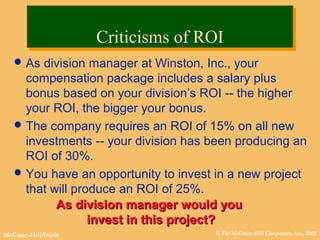
As division manager at Winston, Inc., your
compensation package includes a salary plus
bonus based on your division’s ROI -- the higher
your ROI, the bigger your bonus.
The company requires an ROI of 15% on all new
investments -- your division has been producing an
ROI of 30%.
You have an opportunity to invest in a new project
that will produce an ROI of 25%.
As division manager would youAs division manager would you
invest in this project?invest in this project?
Criticisms of ROICriticisms of ROI
© The McGraw-Hill Companies, Inc., 2002McGraw-Hill/Irwin
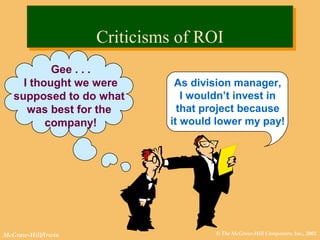
As division manager,
I wouldn’t invest in
that project because
it would lower my pay!
Criticisms of ROICriticisms of ROI
Gee . . .
I thought we were
supposed to do what
was best for the
company!
© The McGraw-Hill Companies, Inc., 2002McGraw-Hill/Irwin
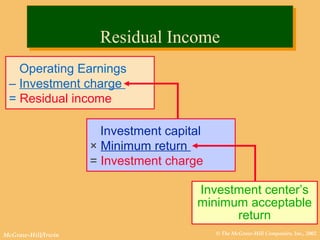
Operating Earnings
– Investment charge
= Residual income
Investment capital
× Minimum return
= Investment charge
Investment center’s
minimum acceptable
return
Residual IncomeResidual Income
© The McGraw-Hill Companies, Inc., 2002McGraw-Hill/Irwin
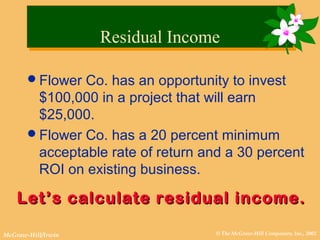
Flower Co. has an opportunity to invest
$100,000 in a project that will earn
$25,000.
Flower Co. has a 20 percent minimum
acceptable rate of return and a 30 percent
ROI on existing business.
Let’s calculate residual income.Let’s calculate residual income.
Residual IncomeResidual Income
© The McGraw-Hill Companies, Inc., 2002McGraw-Hill/Irwin
Residual IncomeResidual Income
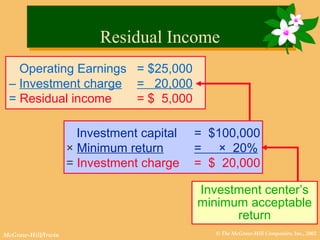
Operating Earnings = $25,000
– Investment charge = 20,000
= Residual income = $ 5,000
Investment capital = $100,000
× Minimum return = × 20%
= Investment charge = $ 20,000
Investment center’s
minimum acceptable
return
© The McGraw-Hill Companies, Inc., 2002McGraw-Hill/Irwin
As a manager at
Flower Co., would you
invest the $100,000 if
you were evaluated
using residual income?
Would your decision
be different if you were
evaluated using ROI?
Residual IncomeResidual Income
© The McGraw-Hill Companies, Inc., 2002McGraw-Hill/Irwin
Residual income encourages managers to
make profitable investments that would
be rejected by managers using ROI.
Residual IncomeResidual Income
© The McGraw-Hill Companies, Inc., 2002McGraw-Hill/Irwin
Economic value added tells us how much
shareholder wealth is being created.
Economic Value AddedEconomic Value Added
© The McGraw-Hill Companies, Inc., 2002McGraw-Hill/Irwin
Economic value addedEconomic value added is the annual after-tax
operating profit minus the total annual cost of capital.
Cost of capitalCost of capital is weighted-average after-tax
cost of long-term borrowing and the cost of debt.
Economic Value AddedEconomic Value Added
DebtEquity
© The McGraw-Hill Companies, Inc., 2002McGraw-Hill/Irwin
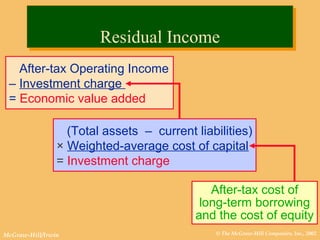
After-tax Operating Income
– Investment charge
= Economic value added
(Total assets – current liabilities)
× Weighted-average cost of capital
= Investment charge
After-tax cost of
long-term borrowing
and the cost of equity
Residual IncomeResidual Income
© The McGraw-Hill Companies, Inc., 2002McGraw-Hill/Irwin
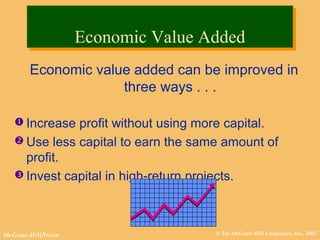
Economic value added can be improved in
three ways . . .
 Increase profit without using more capital.
 Use less capital to earn the same amount of
profit.
 Invest capital in high-return projects.
Economic Value AddedEconomic Value Added
© The McGraw-Hill Companies, Inc., 2002McGraw-Hill/Irwin
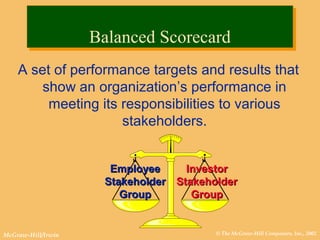
A set of performance targets and results that
show an organization’s performance in
meeting its responsibilities to various
stakeholders.
EmployeeEmployee
StakeholderStakeholder
GroupGroup
InvestorInvestor
StakeholderStakeholder
GroupGroup
Balanced ScorecardBalanced Scorecard
© The McGraw-Hill Companies, Inc., 2002McGraw-Hill/Irwin
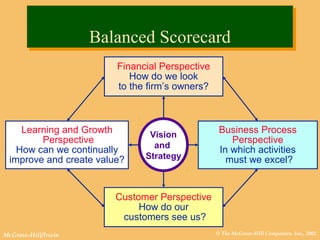
Financial Perspective
How do we look
to the firm’s owners?
Learning and Growth
Perspective
How can we continually
improve and create value?
Business Process
Perspective
In which activities
must we excel?
Customer Perspective
How do our
customers see us?
Balanced ScorecardBalanced Scorecard
Vision
and
Strategy
© The McGraw-Hill Companies, Inc., 2002McGraw-Hill/Irwin
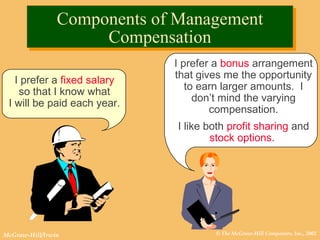
Components of Management
Compensation
Components of Management
Compensation
I prefer a fixed salary
so that I know what
I will be paid each year.
I prefer a bonus arrangement
that gives me the opportunity
to earn larger amounts. I
don’t mind the varying
compensation.
I like both profit sharing and
stock options.
© The McGraw-Hill Companies, Inc., 2002McGraw-Hill/Irwin
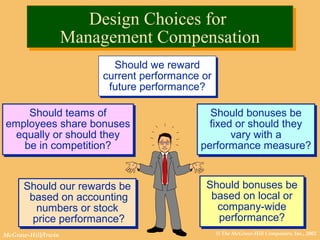
Design Choices for
Management Compensation
Design Choices for
Management Compensation
Should we reward
current performance or
future performance?
Should we reward
current performance or
future performance?
Should our rewards be
based on accounting
numbers or stock
price performance?
Should our rewards be
based on accounting
numbers or stock
price performance?
Should bonuses be
fixed or should they
vary with a
performance measure?
Should bonuses be
fixed or should they
vary with a
performance measure?
Should bonuses be
based on local or
company-wide
performance?
Should bonuses be
based on local or
company-wide
performance?
Should teams of
employees share bonuses
equally or should they
be in competition?
Should teams of
employees share bonuses
equally or should they
be in competition?
© The McGraw-Hill Companies, Inc., 2002McGraw-Hill/Irwin
End of Chapter 24End of Chapter 24
My performance
was magnificent!

Accounting by Meigs & Meigs 11/E

  • 1.
    © The McGraw-HillCompanies, Inc., 2002McGraw-Hill/Irwin Rewarding Business Performance Chapter 24
  • 2.
    © The McGraw-HillCompanies, Inc., 2002McGraw-Hill/Irwin Goal Congruence Alignment of employee goals and objectives with organizational goals and objectives. Motivation and Aligning Goals and Objectives Motivation and Aligning Goals and Objectives
  • 3.
    © The McGraw-HillCompanies, Inc., 2002McGraw-Hill/Irwin Motivation and Aligning Goals and Objectives Motivation and Aligning Goals and Objectives Feedback  Steer employees toward goals.  Measure progress in achieving goals. Measure performance. Improve performance. Reward performance.
  • 4.
    © The McGraw-HillCompanies, Inc., 2002McGraw-Hill/Irwin Return on investment is the ratio of profit to the average investment used to generate the profit. ROI = Profit Average investment Return on Investment (ROI)Return on Investment (ROI)
  • 5.
    © The McGraw-HillCompanies, Inc., 2002McGraw-Hill/Irwin Sales Average Investment ROI = Profit Average Investment ROI = Profit Sales × Return on Investment (ROI)Return on Investment (ROI) Return on Sales Return on Sales Capital Turnover Capital Turnover
  • 6.
    © The McGraw-HillCompanies, Inc., 2002McGraw-Hill/Irwin Holly Company reports the following: Profit $ 30,000 Sales $ 500,000 Average Investment $ 200,000 Let’s calculate ROI.Let’s calculate ROI. Return on Investment (ROI)Return on Investment (ROI)
  • 7.
    © The McGraw-HillCompanies, Inc., 2002McGraw-Hill/Irwin Return on Investment (ROI)Return on Investment (ROI) Sales Average Investment ROI = Profit Sales × ROI = 6% × 2.5 = 15% $500,000 $200,000 ROI = $30,000 $500,000 ×
  • 8.
    © The McGraw-HillCompanies, Inc., 2002McGraw-Hill/Irwin Three ways to improve ROI  Increase Sales Prices  Decrease Expenses  Lower Invested Capital Improving ROIImproving ROI
  • 9.
    © The McGraw-HillCompanies, Inc., 2002McGraw-Hill/Irwin Holly’s manager was able to increase sales revenue to $600,000 which increased income to $42,000. There was no change in invested capital. Let’s calculate the new ROI.Let’s calculate the new ROI. Improving ROIImproving ROI
  • 10.
    © The McGraw-HillCompanies, Inc., 2002McGraw-Hill/Irwin Improving ROIImproving ROI Sales Average Investment ROI = Profit Sales × ROI = 7% × 3.0 = 21% Holly increased ROI from 15% to 21%. $600,000 $200,000 ROI = $42,000 $600,000 ×
  • 11.
    © The McGraw-HillCompanies, Inc., 2002McGraw-Hill/Irwin As division manager at Winston, Inc., your compensation package includes a salary plus bonus based on your division’s ROI -- the higher your ROI, the bigger your bonus. The company requires an ROI of 15% on all new investments -- your division has been producing an ROI of 30%. You have an opportunity to invest in a new project that will produce an ROI of 25%. As division manager would youAs division manager would you invest in this project?invest in this project? Criticisms of ROICriticisms of ROI
  • 12.
    © The McGraw-HillCompanies, Inc., 2002McGraw-Hill/Irwin As division manager, I wouldn’t invest in that project because it would lower my pay! Criticisms of ROICriticisms of ROI Gee . . . I thought we were supposed to do what was best for the company!
  • 13.
    © The McGraw-HillCompanies, Inc., 2002McGraw-Hill/Irwin Operating Earnings – Investment charge = Residual income Investment capital × Minimum return = Investment charge Investment center’s minimum acceptable return Residual IncomeResidual Income
  • 14.
    © The McGraw-HillCompanies, Inc., 2002McGraw-Hill/Irwin Flower Co. has an opportunity to invest $100,000 in a project that will earn $25,000. Flower Co. has a 20 percent minimum acceptable rate of return and a 30 percent ROI on existing business. Let’s calculate residual income.Let’s calculate residual income. Residual IncomeResidual Income
  • 15.
    © The McGraw-HillCompanies, Inc., 2002McGraw-Hill/Irwin Residual IncomeResidual Income Operating Earnings = $25,000 – Investment charge = 20,000 = Residual income = $ 5,000 Investment capital = $100,000 × Minimum return = × 20% = Investment charge = $ 20,000 Investment center’s minimum acceptable return
  • 16.
    © The McGraw-HillCompanies, Inc., 2002McGraw-Hill/Irwin As a manager at Flower Co., would you invest the $100,000 if you were evaluated using residual income? Would your decision be different if you were evaluated using ROI? Residual IncomeResidual Income
  • 17.
    © The McGraw-HillCompanies, Inc., 2002McGraw-Hill/Irwin Residual income encourages managers to make profitable investments that would be rejected by managers using ROI. Residual IncomeResidual Income
  • 18.
    © The McGraw-HillCompanies, Inc., 2002McGraw-Hill/Irwin Economic value added tells us how much shareholder wealth is being created. Economic Value AddedEconomic Value Added
  • 19.
    © The McGraw-HillCompanies, Inc., 2002McGraw-Hill/Irwin Economic value addedEconomic value added is the annual after-tax operating profit minus the total annual cost of capital. Cost of capitalCost of capital is weighted-average after-tax cost of long-term borrowing and the cost of debt. Economic Value AddedEconomic Value Added DebtEquity
  • 20.
    © The McGraw-HillCompanies, Inc., 2002McGraw-Hill/Irwin After-tax Operating Income – Investment charge = Economic value added (Total assets – current liabilities) × Weighted-average cost of capital = Investment charge After-tax cost of long-term borrowing and the cost of equity Residual IncomeResidual Income
  • 21.
    © The McGraw-HillCompanies, Inc., 2002McGraw-Hill/Irwin Economic value added can be improved in three ways . . .  Increase profit without using more capital.  Use less capital to earn the same amount of profit.  Invest capital in high-return projects. Economic Value AddedEconomic Value Added
  • 22.
    © The McGraw-HillCompanies, Inc., 2002McGraw-Hill/Irwin A set of performance targets and results that show an organization’s performance in meeting its responsibilities to various stakeholders. EmployeeEmployee StakeholderStakeholder GroupGroup InvestorInvestor StakeholderStakeholder GroupGroup Balanced ScorecardBalanced Scorecard
  • 23.
    © The McGraw-HillCompanies, Inc., 2002McGraw-Hill/Irwin Financial Perspective How do we look to the firm’s owners? Learning and Growth Perspective How can we continually improve and create value? Business Process Perspective In which activities must we excel? Customer Perspective How do our customers see us? Balanced ScorecardBalanced Scorecard Vision and Strategy
  • 24.
    © The McGraw-HillCompanies, Inc., 2002McGraw-Hill/Irwin Components of Management Compensation Components of Management Compensation I prefer a fixed salary so that I know what I will be paid each year. I prefer a bonus arrangement that gives me the opportunity to earn larger amounts. I don’t mind the varying compensation. I like both profit sharing and stock options.
  • 25.
    © The McGraw-HillCompanies, Inc., 2002McGraw-Hill/Irwin Design Choices for Management Compensation Design Choices for Management Compensation Should we reward current performance or future performance? Should we reward current performance or future performance? Should our rewards be based on accounting numbers or stock price performance? Should our rewards be based on accounting numbers or stock price performance? Should bonuses be fixed or should they vary with a performance measure? Should bonuses be fixed or should they vary with a performance measure? Should bonuses be based on local or company-wide performance? Should bonuses be based on local or company-wide performance? Should teams of employees share bonuses equally or should they be in competition? Should teams of employees share bonuses equally or should they be in competition?
  • 26.
    © The McGraw-HillCompanies, Inc., 2002McGraw-Hill/Irwin End of Chapter 24End of Chapter 24 My performance was magnificent!