What’s the Problem?Define, Locate, Analyze, Synthesize,  and Evaluate Your Research ProblemMaine South High School Library Resource CenterMaine Township High School District #207Park Ridge, IllinoisRose Retrum and Naomi Mellendorf, Librarians
What’s Your Strategy?What do we know?What do we need to know?What’s our Plan?Maine South High School Library Resource Center
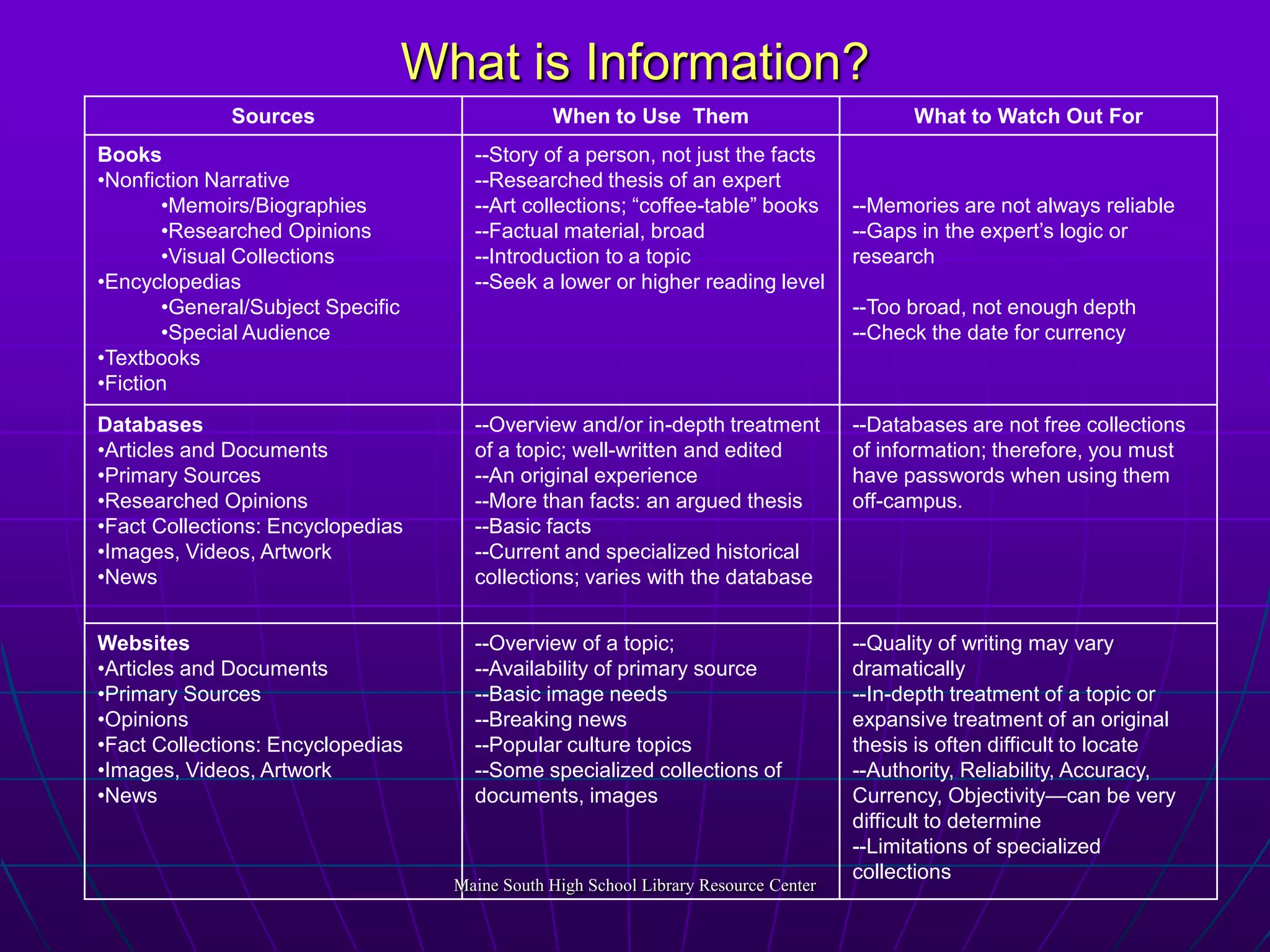
What is Information?Maine South High School Library Resource Center
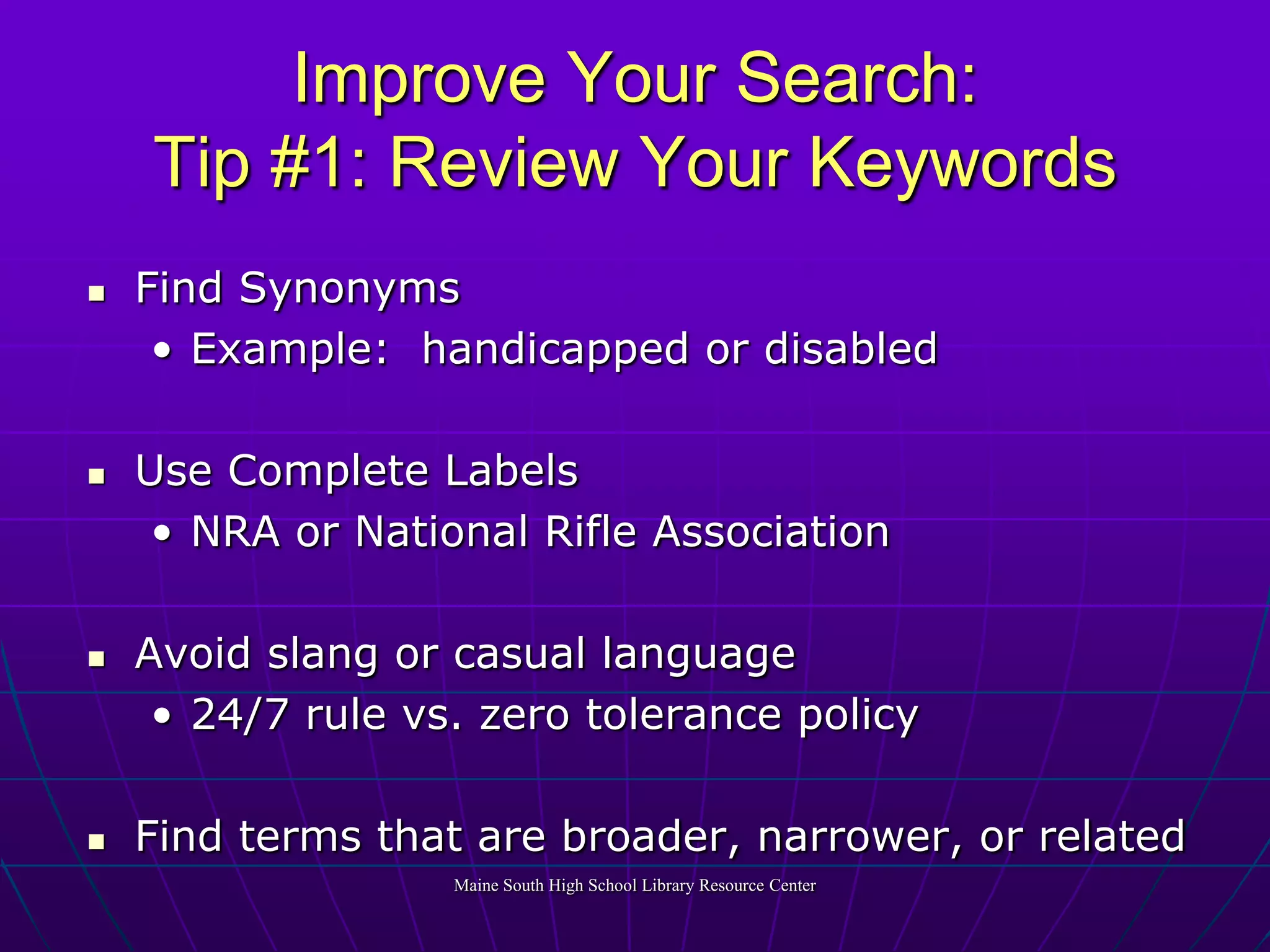
Improve Your Search:Tip #1: Review Your KeywordsFind SynonymsExample:  handicapped or disabledUse Complete LabelsNRA or National Rifle AssociationAvoid slang or casual language24/7 rule vs. zero tolerance policyFind terms that are broader, narrower, or relatedMaine South High School Library Resource Center
Improve Your Search:Tip #2: Search StringUse “Quotes” for exact phrase
AND or + to require all search terms
NOT to exclude a search term
Combine terms -- Boolean
“Steroids” and “Football” not “Baseball”
Natural language
Subject Headings vs. KeywordsMaine South High School Library Resource Center
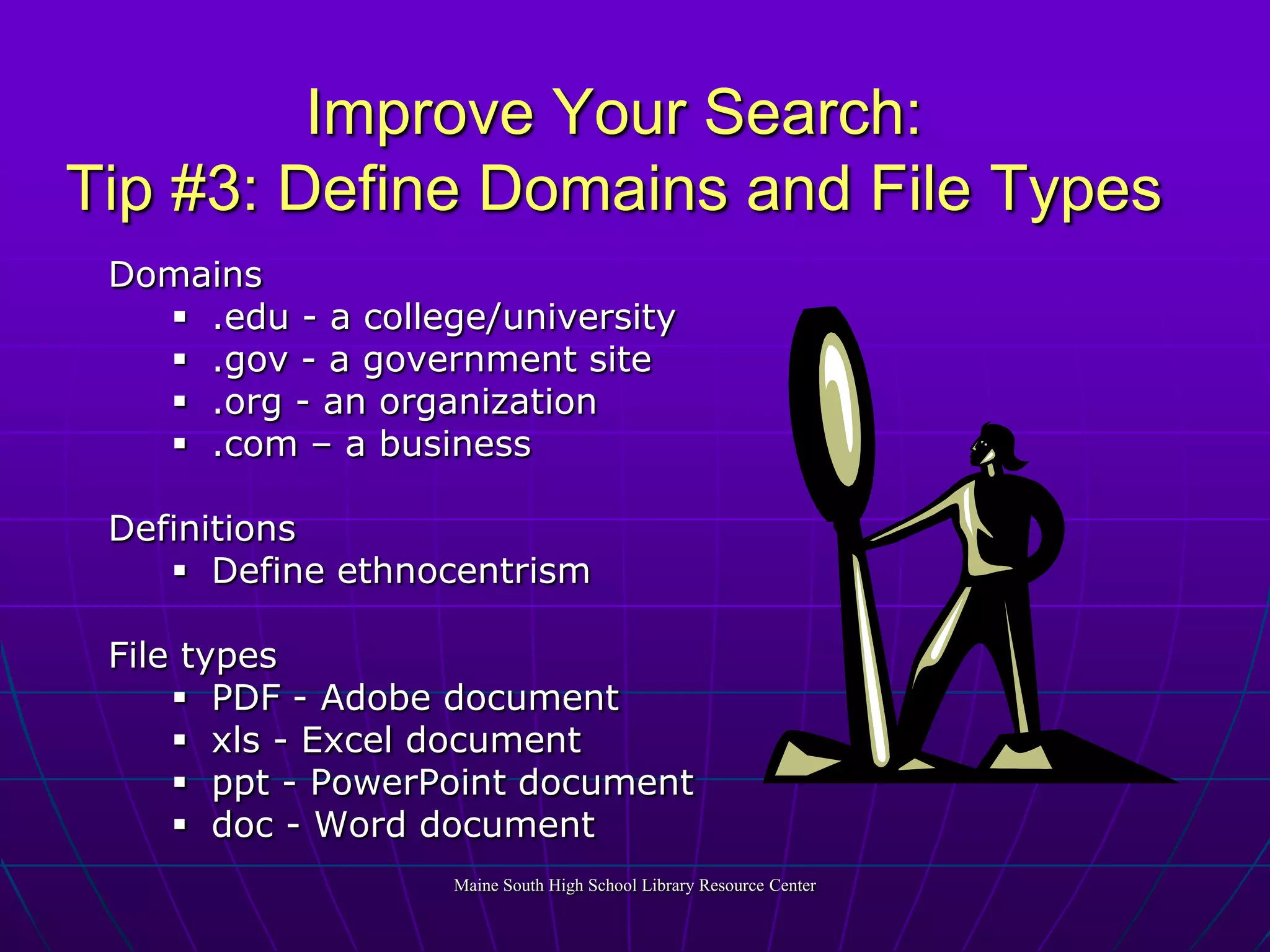
Improve Your Search:Tip #3: Define Domains and File TypesDomains.edu - a college/university
.gov - a government site
.org - an organization

What's the Problem?

  • 1.
    What’s the Problem?Define,Locate, Analyze, Synthesize, and Evaluate Your Research ProblemMaine South High School Library Resource CenterMaine Township High School District #207Park Ridge, IllinoisRose Retrum and Naomi Mellendorf, Librarians
  • 2.
    What’s Your Strategy?Whatdo we know?What do we need to know?What’s our Plan?Maine South High School Library Resource Center
  • 3.
    What is Information?MaineSouth High School Library Resource Center
  • 4.
    Improve Your Search:Tip#1: Review Your KeywordsFind SynonymsExample: handicapped or disabledUse Complete LabelsNRA or National Rifle AssociationAvoid slang or casual language24/7 rule vs. zero tolerance policyFind terms that are broader, narrower, or relatedMaine South High School Library Resource Center
  • 5.
    Improve Your Search:Tip#2: Search StringUse “Quotes” for exact phrase
  • 6.
    AND or +to require all search terms
  • 7.
    NOT to excludea search term
  • 8.
  • 9.
  • 10.
  • 11.
    Subject Headings vs.KeywordsMaine South High School Library Resource Center
  • 12.
    Improve Your Search:Tip#3: Define Domains and File TypesDomains.edu - a college/university
  • 13.
    .gov - agovernment site
  • 14.
    .org - anorganization
  • 15.
    .com – abusinessDefinitionsDefine ethnocentrismFile typesPDF - Adobe document
  • 16.
    xls - Exceldocument
  • 17.
  • 18.
    doc - WorddocumentMaine South High School Library Resource Center
  • 19.
    Improve Your Search:Tip#4: Try Different ResourcesDatabasesBooks (Online Catalog)“Invisible” WebInfomine
  • 20.
    IPL (Internet PublicLibrary) and LII (Librarians’ Internet Index)
  • 21.
  • 22.
  • 23.
    WebPath Express (throughOnline Catalog)Other: Audio, Video, Podcasts, Blogs, Wikis, etc.Maine South High School Library Resource Center
  • 24.
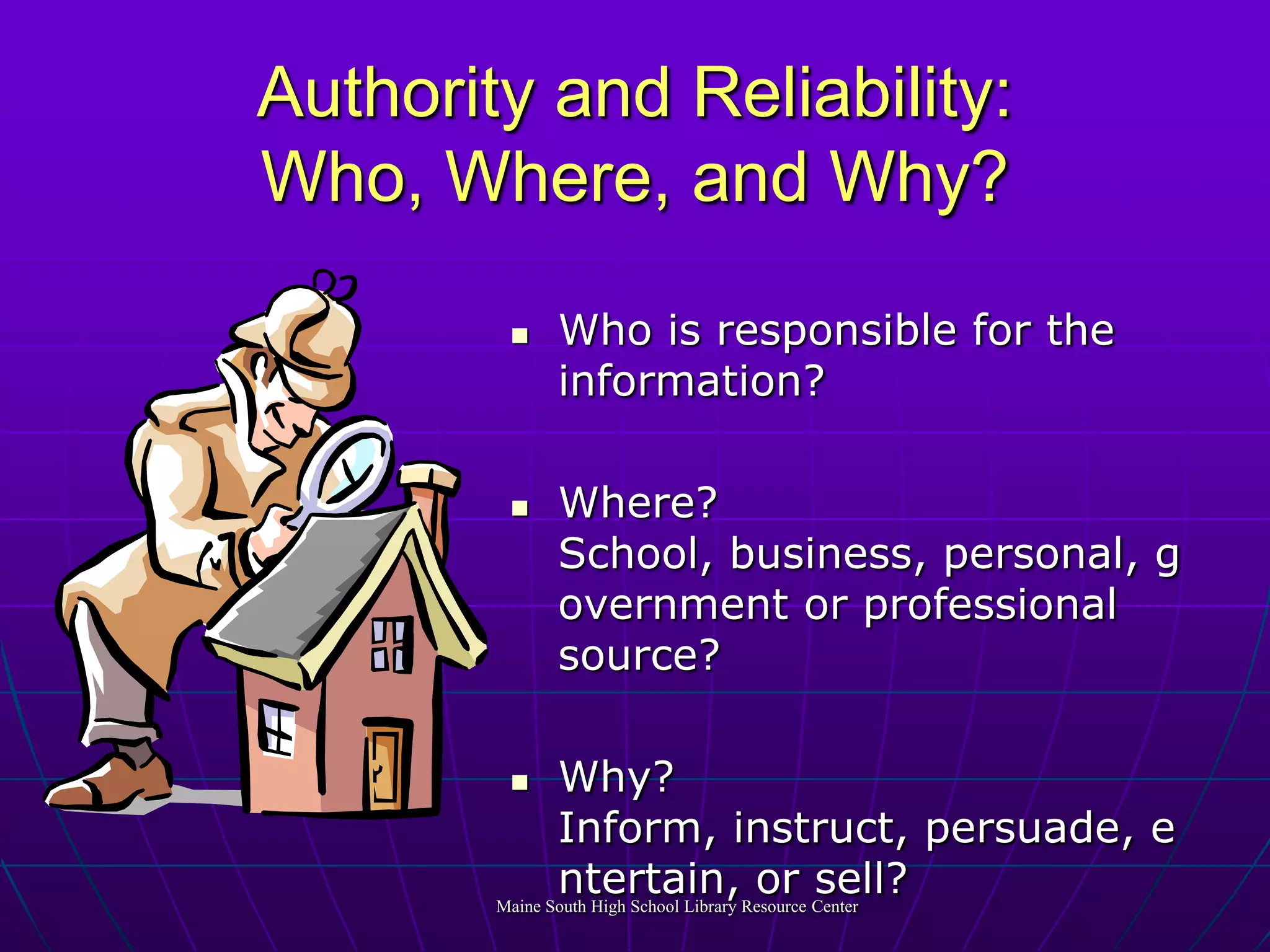
    Authority and Reliability:Who, Where, and Why?Who is responsible for the information?Where? School, business, personal, government or professional source?Why? Inform, instruct, persuade, entertain, or sell?Maine South High School Library Resource Center
  • 25.
    AccuracySpelling or grammarmistakes?Clear writing, edited and fact-checked? Is the visual information clearly labeled, easy to read, and informative?Maine South High School Library Resource Center
  • 26.
    Objectivity: a VirtualSoapbox?Is the information objective or subjective, fact or opinion?Does it reflect bias? How?Is a balance of perspectives represented?Maine South High School Library Resource Center
  • 27.
    Currency: Timeliness How currentare the sources, copyright dates, and links (websites)?Does the currency of information matter with the particular topic?Maine South High School Library Resource Center
  • 28.
    Relevancy and CoverageIsthe information useful to your research?Is the information too broad or too narrow to answer your question or solve your problem?Maine South High School Library Resource Center
  • 29.
    Stop, Look, andListenStop before you put your final project togetherLook at your informationListen to each otherMaine South High School Library Resource Center
  • 30.
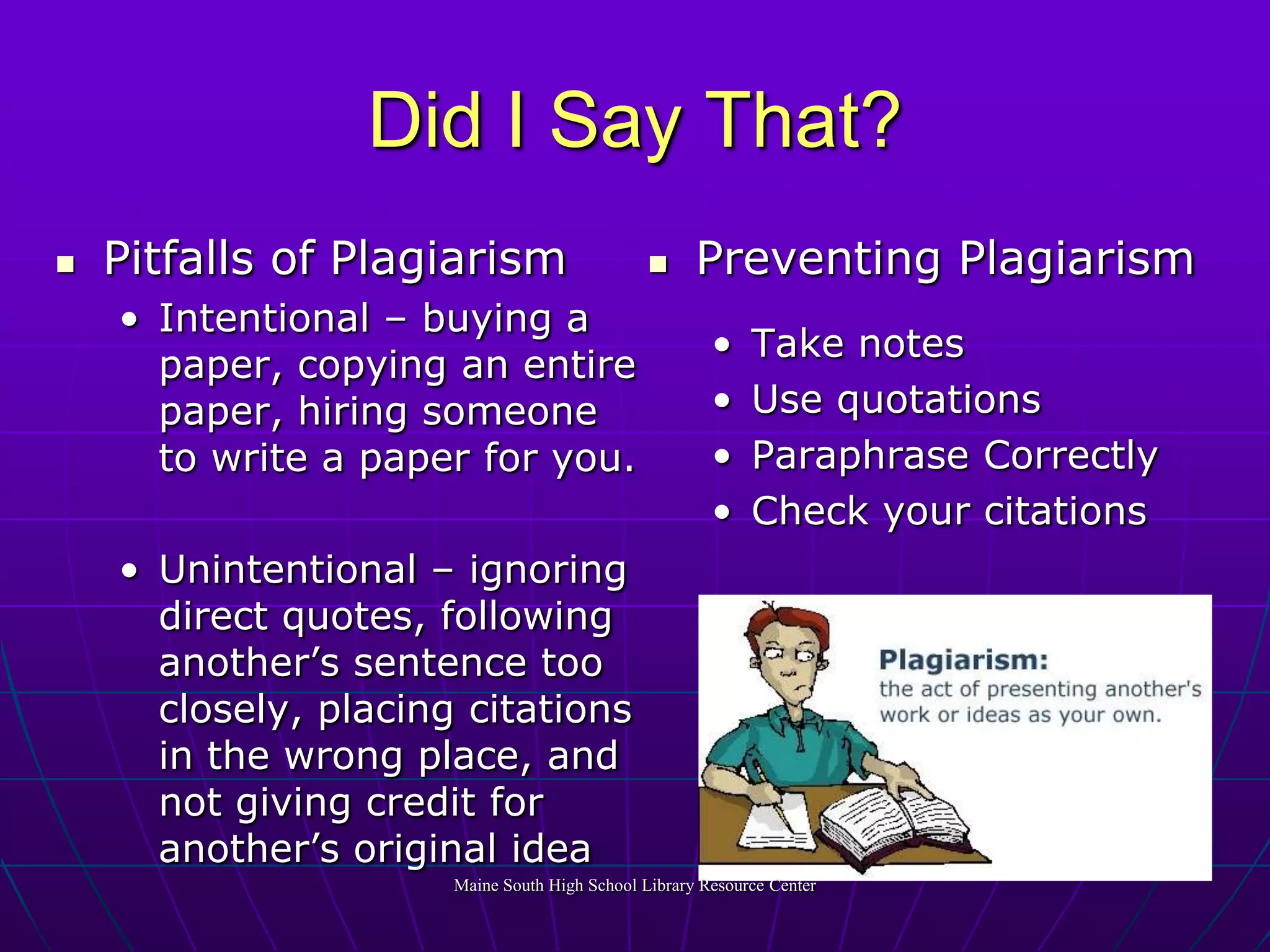
    Did I SayThat?Pitfalls of PlagiarismIntentional – buying a paper, copying an entire paper, hiring someone to write a paper for you.Unintentional – ignoring direct quotes, following another’s sentence too closely, placing citations in the wrong place, and not giving credit for another’s original ideaPreventing PlagiarismTake notesUse quotationsParaphrase CorrectlyCheck your citationsMaine South High School Library Resource Center

Editor's Notes

  • #2 Your teacher have invited us here today to help you begin thinking about the research process for the problem you have just been given. We are going to throw a lot of information your way. Some of it may be things you already know, and some of what we are sharing with you are common sense ways to solve problems like the one you are addressing today or ones that you will face in the future.
  • #3 The beginning of good research always starts with defining the problem or the issue. Always take the time to clearly determine what information you already know and what you need to know. This may seem like such a logical step but many of us jump right into research without really thinking about what we are looking for. Only after you have charted and discussed what you know and what you need to research are to ready to develop a plan of action.
  • #14 Once your group spends a good amount of time collecting information and before anyone starts putting the final product together you need to take a time out. This is a very important part of the research process. Why? It’s time to analyze your information. Go back to your original notes. Were you successful in finding all the information you thought you needed? Do you have information that is not relevant that you can disregard?Can you draw conclusions based on the information you have found?Have you examined the information for accuracy? Are there conflicting facts that need to be resolved? Are there holes in your research? Does your research make sense to you? Can you explain it and discuss it intelligently with your group? Finally, the a key step to good problem solving is to listen to each other’s contributions. Remember you have not all looked at the same material. Take the time to share your new found knowledge with your group. As a contributing group member you are responsible to bring back to the group the most valuable information you were able to find. After your group discussion do you feel ready to move forward or do you need more information, or different information? As a group are you finding holes in your research? Now is the time to reexamine your search strategies, organize your information and draw conclusions from you research.
  • #15 Ugly things can happen when you plagiarize. You can get a zero on a paper, you can loose credit for a course and in extreme cases universities have actually expelled students for plagiarism. Sometimes we plagiarize without really meaning to. That is not an excuse. Learn the rules now and never worry about this again. Rule #1, if you are unsure, cite it! Rule #2, if you are just changing a few words in a sentence or change the order of the sentence it is not “in your own words”, cite it! Rule #3, if you use too much of another person’s ideas, even if you cite it can be considered plagiarizing. In our technology rich world, taking music, images, charts, graphs, and video from websites that do not give you permission is also a form of plagiarizing. Here are so easy tips to prevent plagiarism: Always take down the bibliographic info firstImmediately put quotes around any direct quotesIf you are reading something make comments as you interpret what you are reading and use those as your original ideas in your project. Before you quote, begin the sentence with the author’s name of title of the article. Before you paraphrase begin the sentence with the authors name or the title of the article. After reading an article write a brief summary in your own words making it impossible for you to plagiarize.