

Presenting Spatial Data
What’s So Spatial About it?
Putting Yourself in My Place:

Space, Place and Pattern
!

25 February 2014
No Lecture Next Week 4 March
Will see you on 11 March
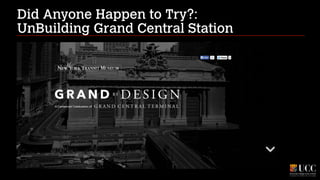
Did Anyone Happen to Try?:
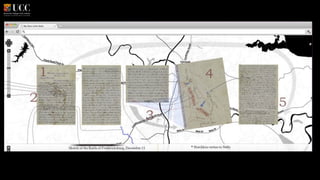
UnBuilding Grand Central Station
So … browsing the gallery:
!

"Visual Complexity"
Visual Complexity
Good Examples??
Inspiring Ideas??
!

Complexity?
Patterns?
Aethetics versus Clarity
Can you visualise too much?
What complications does the move into the visual realm
introduce?
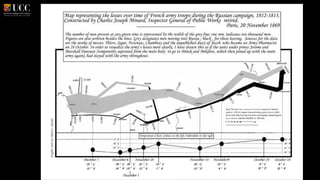
Minard x 2
New is Cool …but old classics rule!
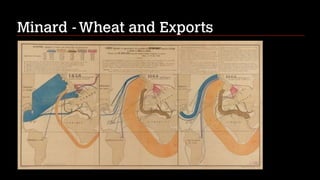
Minard - Wheat and Exports
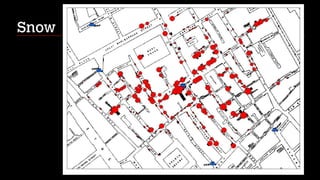
Snow
"Digitization makes the most traditional forms of humanistic
scholarship more necessary, not less.

But the differences mean that we need to reinvent, not
reaffirm, the way we engage with the humanities."
Can We Understand Place without Space
‣

Need a wee bit of
background in Geospace
!

‣
‣
‣
‣
‣
‣

More than GIS
Geovisualisation?
Geoparsing?
Georeference
Geoparse
Geotag

‣
‣
‣
‣
‣
‣

Geocode
Geolocate
GPS
GIS
Projection
Geovisualisation
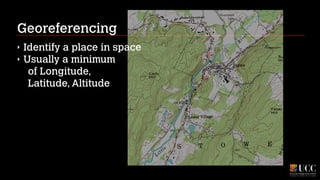
Georeferencing
‣
‣

Identify a place in space
Usually a minimum 

of Longitude, 

Latitude, Altitude
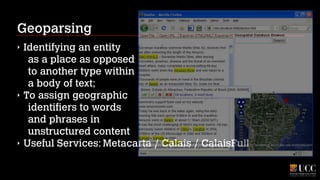
Geoparsing
‣

‣

‣

Identifying an entity

as a place as opposed

to another type within

a body of text;
To assign geographic

identifiers to words

and phrases in

unstructured content
Useful Services: Metacarta / Calais / CalaisFull
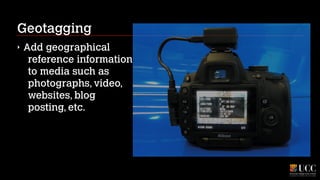
Geotagging
‣

Add geographical

reference information

to media such as

photographs, video,

websites, blog

posting, etc.
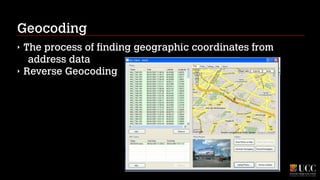
Geocoding
‣
‣

The process of finding geographic coordinates from
address data
Reverse Geocoding
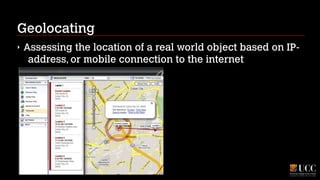
Geolocating
‣

Assessing the location of a real world object based on IPaddress, or mobile connection to the internet
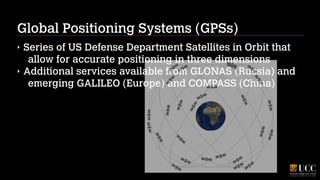
Global Positioning Systems (GPSs)
‣
‣

Series of US Defense Department Satellites in Orbit that
allow for accurate positioning in three dimensions
Additional services available from GLONAS (Russia) and
emerging GALILEO (Europe) and COMPASS (China)
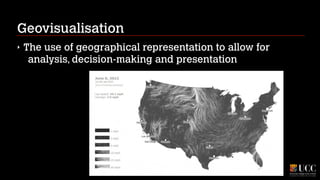
Geovisualisation
‣

The use of geographical representation to allow for
analysis, decision-making and presentation
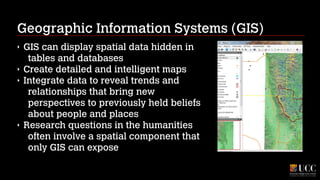
Geographic Information Systems (GIS)
‣
‣
‣

‣

GIS can display spatial data hidden in

tables and databases
Create detailed and intelligent maps
Integrate data to reveal trends and

relationships that bring new

perspectives to previously held beliefs

about people and places
Research questions in the humanities

often involve a spatial component that

only GIS can expose
Geospatial Data Standards
‣
‣
‣
‣
‣

KML
GML
GeoRSS
GPSX
Boundary File/Shapefile
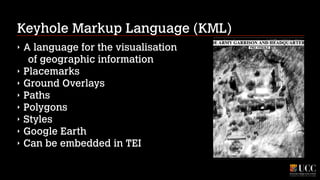
Keyhole Markup Language (KML)
‣
‣
‣
‣
‣
‣
‣
‣

A language for the visualisation

of geographic information
Placemarks
Ground Overlays
Paths
Polygons
Styles
Google Earth
Can be embedded in TEI
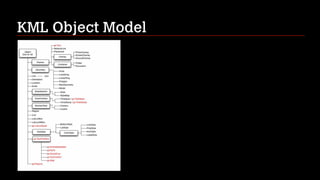
KML Object Model
Geographic Markup Langauge (GML)
‣
‣

Adopted by the Open Geospatial Consortium (OGC)
Can be embedded in TEI
GML
‣
‣
‣
‣
‣
‣
‣
‣

Feature
Geometry
Coordinate Reference
System
Topology
Time
Dynamic feature Coverage
Unit of measure
Directions

‣
‣

Observations
Map presentation styling
rules
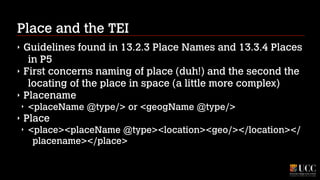
Place and the TEI
‣
‣
‣

Guidelines found in 13.2.3 Place Names and 13.3.4 Places
in P5
First concerns naming of place (duh!) and the second the
locating of the place in space (a little more complex)
Placename
‣

‣

<placeName @type/> or <geogName @type/>

Place
‣

<place><placeName @type><location><geo/></location></
placename></place>
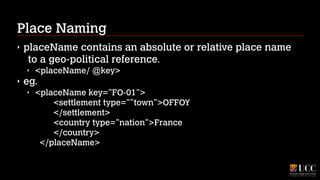
Place Naming
‣

placeName contains an absolute or relative place name
to a geo-political reference.
‣

‣

<placeName/ @key>

eg.
‣

<placeName key=”FO-01”>

<settlement type=””town”>OFFOY

</settlement>

<country type=”nation”>France

</country>

</placeName>
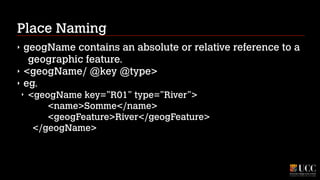
Place Naming
‣
‣
‣

geogName contains an absolute or relative reference to a
geographic feature.
<geogName/ @key @type>
eg.
‣

<geogName key=”R01” type=”River”>

<name>Somme</name>

<geogFeature>River</geogFeature>

</geogName>
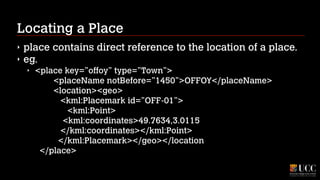
Locating a Place
‣
‣

place contains direct reference to the location of a place.
eg.
‣

<place key=”offoy” type=”Town”>

<placeName notBefore=”1450”>OFFOY</placeName>

<location><geo>

<kml:Placemark id=”OFF-01”>

<kml:Point>

<kml:coordinates>49.7634,3.0115

</kml:coordinates></kml:Point>

</kml:Placemark></geo></location

</place>
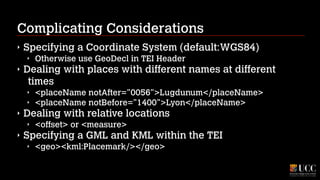
Complicating Considerations
‣

Specifying a Coordinate System (default:WGS84)
‣

‣

Dealing with places with different names at different
times
‣
‣

‣

<placeName notAfter="0056">Lugdunum</placeName>
<placeName notBefore="1400">Lyon</placeName>

Dealing with relative locations
‣

‣

Otherwise use GeoDecl in TEI Header

<offset> or <measure>

Specifying a GML and KML within the TEI
‣

<geo><kml:Placemark/></geo>
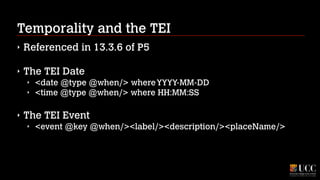
Temporality and the TEI
‣

Referenced in 13.3.6 of P5
!

‣

The TEI Date
‣
‣

<date @type @when/> where YYYY-MM-DD
<time @type @when/> where HH:MM:SS

!

‣

The TEI Event
‣

<event @key @when/><label/><description/><placeName/>
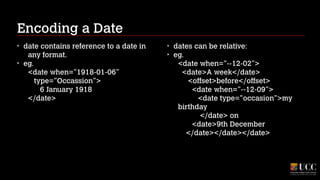
Encoding a Date
‣
‣

date contains reference to a date in
any format.
eg. 

<date when=”1918-01-06”

type=”Occassion”>

6 January 1918

</date>
!
!
!
!
!

‣
‣

dates can be relative:
eg. 

<date when="--12-02">

<date>A week</date>

<offset>before</offset>

<date when="--12-09">

<date type="occasion">my
birthday

</date> on

<date>9th December

</date></date></date>
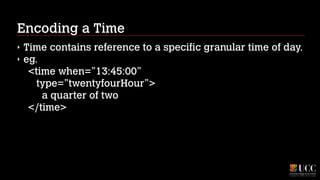
Encoding a Time
‣
‣

Time contains reference to a specific granular time of day.
eg. 

<time when=”13:45:00”

type=”twentyfourHour”>

a quarter of two

</time>
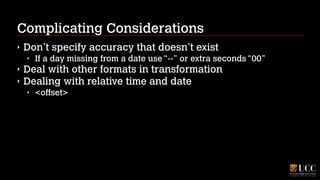
Complicating Considerations
‣

Don’t specify accuracy that doesn’t exist
‣

‣
‣

If a day missing from a date use “--” or extra seconds “00”

Deal with other formats in transformation
Dealing with relative time and date
‣

<offset>
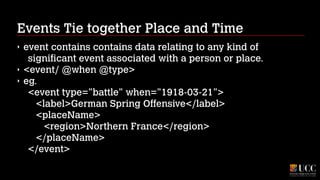
Events Tie together Place and Time
‣
‣
‣

event contains contains data relating to any kind of
significant event associated with a person or place.
<event/ @when @type>
eg. 

<event type="battle" when="1918-03-21">

<label>German Spring Offensive</label>

<placeName>

<region>Northern France</region>

</placeName>

</event>
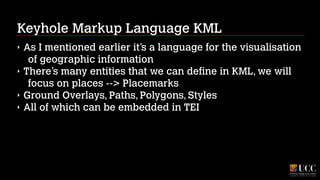
Keyhole Markup Language KML
‣
‣
‣
‣

As I mentioned earlier it’s a language for the visualisation
of geographic information
There’s many entities that we can define in KML, we will
focus on places --> Placemarks
Ground Overlays, Paths, Polygons, Styles
All of which can be embedded in TEI
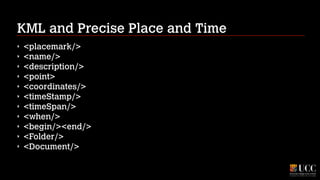
KML and Precise Place and Time
‣
‣
‣
‣
‣
‣
‣
‣
‣
‣
‣

<placemark/>
<name/>
<description/>
<point>
<coordinates/>
<timeStamp/>
<timeSpan/>
<when/>
<begin/><end/>
<Folder/>
<Document/>
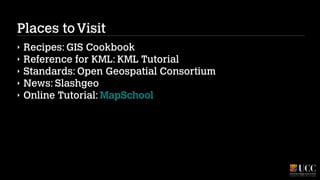
Places to Visit
‣
‣
‣
‣
‣

Recipes: GIS Cookbook
Reference for KML: KML Tutorial
Standards: Open Geospatial Consortium
News: Slashgeo
Online Tutorial: MapSchool
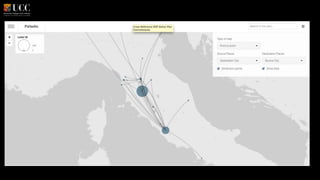
How to Use Palladio
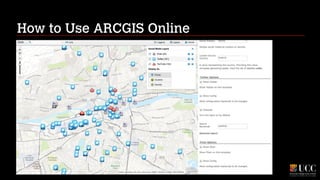
How to Use ARCGIS Online
for Next Lecture (11 March): 

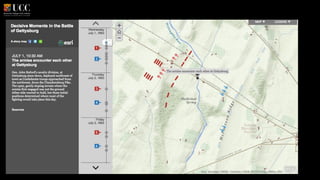
Presenting Complex Data Objects
Please take a look at:
!

How Collaboration Works and How it Can Fail
DH Contribution to Topic Modeling
Thank You
shawn.day@ucc.ie @iridium

Presenting Spatial Data: Whats so spatial about spatial?

  • 1.
    Presenting Spatial Data What’sSo Spatial About it? Putting Yourself in My Place:
 Space, Place and Pattern ! 25 February 2014
  • 2.
    No Lecture NextWeek 4 March Will see you on 11 March
  • 3.
    Did Anyone Happento Try?: UnBuilding Grand Central Station
  • 4.
    So … browsingthe gallery: ! "Visual Complexity"
  • 5.
    Visual Complexity Good Examples?? InspiringIdeas?? ! Complexity? Patterns? Aethetics versus Clarity Can you visualise too much? What complications does the move into the visual realm introduce?
  • 6.
    Minard x 2 Newis Cool …but old classics rule!
  • 8.
    Minard - Wheatand Exports
  • 9.
  • 10.
    "Digitization makes themost traditional forms of humanistic scholarship more necessary, not less.
 But the differences mean that we need to reinvent, not reaffirm, the way we engage with the humanities."
  • 11.
    Can We UnderstandPlace without Space ‣ Need a wee bit of background in Geospace ! ‣ ‣ ‣ ‣ ‣ ‣ More than GIS Geovisualisation? Geoparsing? Georeference Geoparse Geotag ‣ ‣ ‣ ‣ ‣ ‣ Geocode Geolocate GPS GIS Projection Geovisualisation
  • 12.
    Georeferencing ‣ ‣ Identify a placein space Usually a minimum 
 of Longitude, 
 Latitude, Altitude
  • 13.
    Geoparsing ‣ ‣ ‣ Identifying an entity
 asa place as opposed
 to another type within
 a body of text; To assign geographic
 identifiers to words
 and phrases in
 unstructured content Useful Services: Metacarta / Calais / CalaisFull
  • 14.
    Geotagging ‣ Add geographical
 reference information
 tomedia such as
 photographs, video,
 websites, blog
 posting, etc.
  • 15.
    Geocoding ‣ ‣ The process offinding geographic coordinates from address data Reverse Geocoding
  • 16.
    Geolocating ‣ Assessing the locationof a real world object based on IPaddress, or mobile connection to the internet
  • 17.
    Global Positioning Systems(GPSs) ‣ ‣ Series of US Defense Department Satellites in Orbit that allow for accurate positioning in three dimensions Additional services available from GLONAS (Russia) and emerging GALILEO (Europe) and COMPASS (China)
  • 18.
    Geovisualisation ‣ The use ofgeographical representation to allow for analysis, decision-making and presentation
  • 19.
    Geographic Information Systems(GIS) ‣ ‣ ‣ ‣ GIS can display spatial data hidden in
 tables and databases Create detailed and intelligent maps Integrate data to reveal trends and
 relationships that bring new
 perspectives to previously held beliefs
 about people and places Research questions in the humanities
 often involve a spatial component that
 only GIS can expose
  • 20.
  • 21.
    Keyhole Markup Language(KML) ‣ ‣ ‣ ‣ ‣ ‣ ‣ ‣ A language for the visualisation
 of geographic information Placemarks Ground Overlays Paths Polygons Styles Google Earth Can be embedded in TEI
  • 22.
  • 23.
    Geographic Markup Langauge(GML) ‣ ‣ Adopted by the Open Geospatial Consortium (OGC) Can be embedded in TEI
  • 24.
    GML ‣ ‣ ‣ ‣ ‣ ‣ ‣ ‣ Feature Geometry Coordinate Reference System Topology Time Dynamic featureCoverage Unit of measure Directions ‣ ‣ Observations Map presentation styling rules
  • 25.
    Place and theTEI ‣ ‣ ‣ Guidelines found in 13.2.3 Place Names and 13.3.4 Places in P5 First concerns naming of place (duh!) and the second the locating of the place in space (a little more complex) Placename ‣ ‣ <placeName @type/> or <geogName @type/> Place ‣ <place><placeName @type><location><geo/></location></ placename></place>
  • 26.
    Place Naming ‣ placeName containsan absolute or relative place name to a geo-political reference. ‣ ‣ <placeName/ @key> eg. ‣ <placeName key=”FO-01”>
 <settlement type=””town”>OFFOY
 </settlement>
 <country type=”nation”>France
 </country>
 </placeName>
  • 27.
    Place Naming ‣ ‣ ‣ geogName containsan absolute or relative reference to a geographic feature. <geogName/ @key @type> eg. ‣ <geogName key=”R01” type=”River”>
 <name>Somme</name>
 <geogFeature>River</geogFeature>
 </geogName>
  • 28.
    Locating a Place ‣ ‣ placecontains direct reference to the location of a place. eg. ‣ <place key=”offoy” type=”Town”>
 <placeName notBefore=”1450”>OFFOY</placeName>
 <location><geo>
 <kml:Placemark id=”OFF-01”>
 <kml:Point>
 <kml:coordinates>49.7634,3.0115
 </kml:coordinates></kml:Point>
 </kml:Placemark></geo></location
 </place>
  • 29.
    Complicating Considerations ‣ Specifying aCoordinate System (default:WGS84) ‣ ‣ Dealing with places with different names at different times ‣ ‣ ‣ <placeName notAfter="0056">Lugdunum</placeName> <placeName notBefore="1400">Lyon</placeName> Dealing with relative locations ‣ ‣ Otherwise use GeoDecl in TEI Header <offset> or <measure> Specifying a GML and KML within the TEI ‣ <geo><kml:Placemark/></geo>
  • 30.
    Temporality and theTEI ‣ Referenced in 13.3.6 of P5 ! ‣ The TEI Date ‣ ‣ <date @type @when/> where YYYY-MM-DD <time @type @when/> where HH:MM:SS ! ‣ The TEI Event ‣ <event @key @when/><label/><description/><placeName/>
  • 31.
    Encoding a Date ‣ ‣ datecontains reference to a date in any format. eg. 
 <date when=”1918-01-06”
 type=”Occassion”>
 6 January 1918
 </date> ! ! ! ! ! ‣ ‣ dates can be relative: eg. 
 <date when="--12-02">
 <date>A week</date>
 <offset>before</offset>
 <date when="--12-09">
 <date type="occasion">my birthday
 </date> on
 <date>9th December
 </date></date></date>
  • 32.
    Encoding a Time ‣ ‣ Timecontains reference to a specific granular time of day. eg. 
 <time when=”13:45:00”
 type=”twentyfourHour”>
 a quarter of two
 </time>
  • 33.
    Complicating Considerations ‣ Don’t specifyaccuracy that doesn’t exist ‣ ‣ ‣ If a day missing from a date use “--” or extra seconds “00” Deal with other formats in transformation Dealing with relative time and date ‣ <offset>
  • 34.
    Events Tie togetherPlace and Time ‣ ‣ ‣ event contains contains data relating to any kind of significant event associated with a person or place. <event/ @when @type> eg. 
 <event type="battle" when="1918-03-21">
 <label>German Spring Offensive</label>
 <placeName>
 <region>Northern France</region>
 </placeName>
 </event>
  • 35.
    Keyhole Markup LanguageKML ‣ ‣ ‣ ‣ As I mentioned earlier it’s a language for the visualisation of geographic information There’s many entities that we can define in KML, we will focus on places --> Placemarks Ground Overlays, Paths, Polygons, Styles All of which can be embedded in TEI
  • 36.
    KML and PrecisePlace and Time ‣ ‣ ‣ ‣ ‣ ‣ ‣ ‣ ‣ ‣ ‣ <placemark/> <name/> <description/> <point> <coordinates/> <timeStamp/> <timeSpan/> <when/> <begin/><end/> <Folder/> <Document/>
  • 37.
    Places to Visit ‣ ‣ ‣ ‣ ‣ Recipes:GIS Cookbook Reference for KML: KML Tutorial Standards: Open Geospatial Consortium News: Slashgeo Online Tutorial: MapSchool
  • 38.
    How to UsePalladio
  • 39.
    How to UseARCGIS Online
  • 42.
    for Next Lecture(11 March): 
 Presenting Complex Data Objects Please take a look at: ! How Collaboration Works and How it Can Fail DH Contribution to Topic Modeling
  • 43.