Social Scholarship and
Collaboration
Can We All Just Work Together?
New Forms of Collaboration in Humanities Research:
Technological Enablers
!

28 January 2014
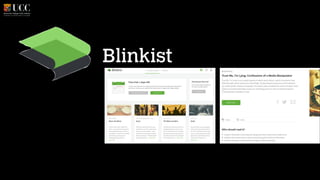
Blinkist
Readings
‣
‣

Spiro : Signs Social Scholarship is Catching On
Friedlander: Asking Questions
"the practice of scholarship in which the
use of social tools is an integral part of
the research and publishing process"
Spiro’s Evidence
‣
‣
‣
‣
‣
‣
‣

Individual commitment by scholars to open access
Development of open access publishing outlets
Availability of tools to support collaboration
Experiments with social peer review
Development of social networks to support open
exchanges of knowledge
Support for collaboration by funding agencies
More broadly, universities are emphasizing community as
key part of graduate education.
Spiro’s Challenges to DS
‣
‣
‣
‣
‣
‣
‣

Lack of awareness of social scholarship
Intellectual property concerns
Skepticism about the quality of electronic-only
publications
Lack of recognition for social scholarship
Lack of time to make work available online
Cultural obstacles
Need for sound economic models for open access
publication
Spiro’s Proposals
‣
‣
‣
‣
‣

Develop tools that enable researchers to what they
already do, but better;
Make social scholarship cool;
Assuage concerns about intellectual property;
Experiment with new models for open access publication;
Make the case that social scholarship is good and good
for you
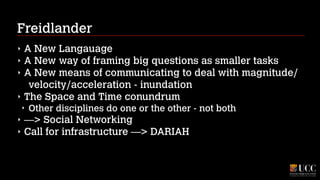
Freidlander
‣
‣
‣
‣

A New Langauage
A New way of framing big questions as smaller tasks
A New means of communicating to deal with magnitude/
velocity/acceleration - inundation
The Space and Time conundrum
‣

‣
‣

Other disciplines do one or the other - not both

—> Social Networking
Call for infrastructure —> DARIAH
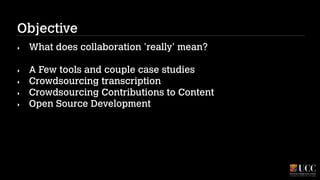
Objective
‣

What does collaboration 'really' mean?
!

‣
‣
‣
‣

A Few tools and couple case studies
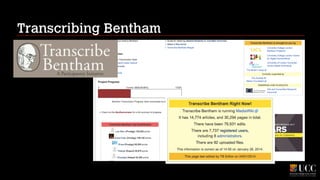
Crowdsourcing transcription
Crowdsourcing Contributions to Content
Open Source Development
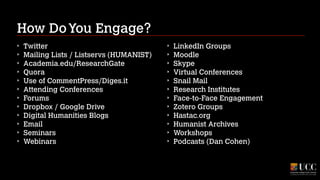
How Do You Engage?
‣
‣
‣
‣
‣
‣
‣
‣
‣
‣
‣
‣

Twitter
Mailing Lists / Listservs (HUMANIST)
Academia.edu/ResearchGate
Quora
Use of CommentPress/Diges.it
Attending Conferences
Forums
Dropbox / Google Drive
Digital Humanities Blogs
Email
Seminars
Webinars

‣
‣
‣
‣
‣
‣
‣
‣
‣
‣
‣
‣

LinkedIn Groups
Moodle
Skype
Virtual Conferences
Snail Mail
Research Institutes
Face-to-Face Engagement
Zotero Groups
Hastac.org
Humanist Archives
Workshops
Podcasts (Dan Cohen)
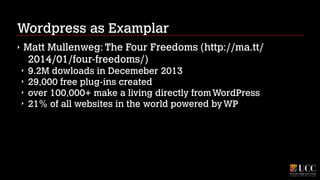
Wordpress as Examplar
‣

Matt Mullenweg: The Four Freedoms (http://ma.tt/
2014/01/four-freedoms/)
‣
‣
‣
‣

9.2M dowloads in Decemeber 2013
29,000 free plug-ins created
over 100,000+ make a living directly from WordPress
21% of all websites in the world powered by WP
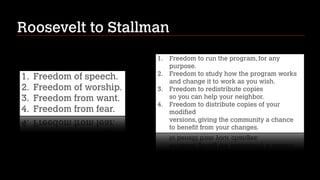
Roosevelt to Stallman
1.

1.
2.
3.
4.

Freedom of speech.
Freedom of worship.
Freedom from want.
Freedom from fear.

2.
3.
4.

Freedom to run the program, for any
purpose.
Freedom to study how the program works

and change it to work as you wish.
Freedom to redistribute copies

so you can help your neighbor.
Freedom to distribute copies of your
modified

versions, giving the community a chance

to benefit from your changes.
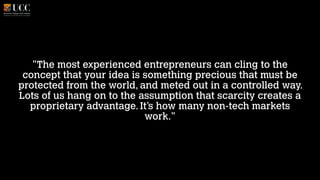
"The most experienced entrepreneurs can cling to the
concept that your idea is something precious that must be
protected from the world, and meted out in a controlled way.
Lots of us hang on to the assumption that scarcity creates a
proprietary advantage. It’s how many non-tech markets
work."
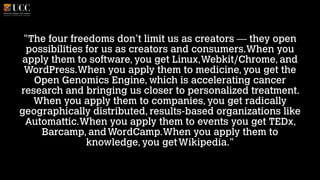
"The four freedoms don’t limit us as creators — they open
possibilities for us as creators and consumers.When you
apply them to software, you get Linux,Webkit/Chrome, and
WordPress.When you apply them to medicine, you get the
Open Genomics Engine, which is accelerating cancer
research and bringing us closer to personalized treatment.
When you apply them to companies, you get radically
geographically distributed, results-based organizations like
Automattic.When you apply them to events you get TEDx,
Barcamp, and WordCamp.When you apply them to
knowledge, you get Wikipedia."
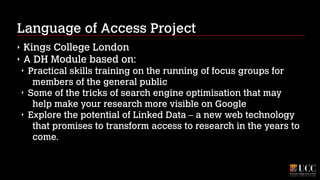
Language of Access Project
‣
‣

Kings College London
A DH Module based on:
‣
‣
‣

Practical skills training on the running of focus groups for
members of the general public
Some of the tricks of search engine optimisation that may
help make your research more visible on Google
Explore the potential of Linked Data – a new web technology
that promises to transform access to research in the years to
come.
HASTAC

(Humanities, Arts, Science and Technology Advanced
Collaboratory)
‣
‣
‣
‣

http://hastac.org
€€€€’s Fellowships
Networks
Visualisation and Topologisation
Collaborating: HubZERO
‣
‣

http://hubzero.org
Modules Include:
‣
‣
‣
‣
‣
‣

Person Services
Resource Management
Issue Tracker
Code or Data Repository
Website/Wiki
Documentation Management
Collaborating: GitHUB
‣
‣

https://github.com/
Modules Include:
‣
‣
‣
‣
‣

Resource Management
Issue Tracker
Code or Data Repository
Website/Wiki
Documentation Management
Collaboration/Project Management:
BaseCamp
‣
‣
‣
‣
‣
‣

https://basecamp.com
Project Management
Integrated Messaging
Resource Management
Scheduling
Document Sharing
Transcribing Bentham
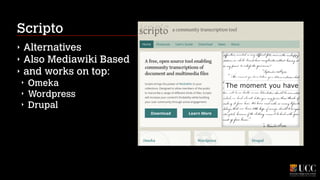
Scripto
‣
‣
‣

Alternatives
Also Mediawiki Based
and works on top:
‣
‣
‣

Omeka
Wordpress
Drupal
Zooniverse
‣

http://zooniverse.org
!

‣
‣
‣
‣

Space, Climate, Nature, Biology
Citizen Scientists = Crowdsourcing
Nearly 1M registered partners
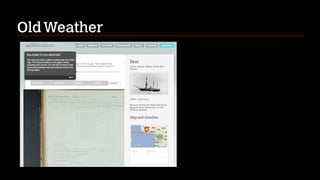
Old Weather
Old Weather
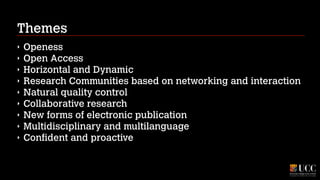
Themes
‣
‣
‣
‣
‣
‣
‣
‣
‣

Openess
Open Access
Horizontal and Dynamic
Research Communities based on networking and interaction
Natural quality control
Collaborative research
New forms of electronic publication
Multidisciplinary and multilanguage
Confident and proactive
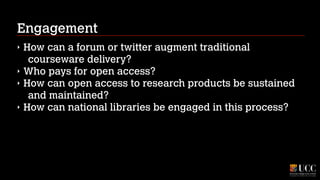
Engagement
‣
‣
‣
‣

How can a forum or twitter augment traditional
courseware delivery?
Who pays for open access?
How can open access to research products be sustained
and maintained?
How can national libraries be engaged in this process?
Next Week: Finding
Please take a look at:
The Europeana Strategic Plan
Thank You
shawn.day@ucc.ie @iridium

New Forms of Collaboration in Humanities Research

  • 1.
    Social Scholarship and Collaboration CanWe All Just Work Together? New Forms of Collaboration in Humanities Research: Technological Enablers ! 28 January 2014
  • 2.
  • 3.
    Readings ‣ ‣ Spiro : SignsSocial Scholarship is Catching On Friedlander: Asking Questions
  • 4.
    "the practice ofscholarship in which the use of social tools is an integral part of the research and publishing process"
  • 5.
    Spiro’s Evidence ‣ ‣ ‣ ‣ ‣ ‣ ‣ Individual commitmentby scholars to open access Development of open access publishing outlets Availability of tools to support collaboration Experiments with social peer review Development of social networks to support open exchanges of knowledge Support for collaboration by funding agencies More broadly, universities are emphasizing community as key part of graduate education.
  • 6.
    Spiro’s Challenges toDS ‣ ‣ ‣ ‣ ‣ ‣ ‣ Lack of awareness of social scholarship Intellectual property concerns Skepticism about the quality of electronic-only publications Lack of recognition for social scholarship Lack of time to make work available online Cultural obstacles Need for sound economic models for open access publication
  • 7.
    Spiro’s Proposals ‣ ‣ ‣ ‣ ‣ Develop toolsthat enable researchers to what they already do, but better; Make social scholarship cool; Assuage concerns about intellectual property; Experiment with new models for open access publication; Make the case that social scholarship is good and good for you
  • 8.
    Freidlander ‣ ‣ ‣ ‣ A New Langauage ANew way of framing big questions as smaller tasks A New means of communicating to deal with magnitude/ velocity/acceleration - inundation The Space and Time conundrum ‣ ‣ ‣ Other disciplines do one or the other - not both —> Social Networking Call for infrastructure —> DARIAH
  • 9.
    Objective ‣ What does collaboration'really' mean? ! ‣ ‣ ‣ ‣ A Few tools and couple case studies Crowdsourcing transcription Crowdsourcing Contributions to Content Open Source Development
  • 10.
    How Do YouEngage? ‣ ‣ ‣ ‣ ‣ ‣ ‣ ‣ ‣ ‣ ‣ ‣ Twitter Mailing Lists / Listservs (HUMANIST) Academia.edu/ResearchGate Quora Use of CommentPress/Diges.it Attending Conferences Forums Dropbox / Google Drive Digital Humanities Blogs Email Seminars Webinars ‣ ‣ ‣ ‣ ‣ ‣ ‣ ‣ ‣ ‣ ‣ ‣ LinkedIn Groups Moodle Skype Virtual Conferences Snail Mail Research Institutes Face-to-Face Engagement Zotero Groups Hastac.org Humanist Archives Workshops Podcasts (Dan Cohen)
  • 11.
    Wordpress as Examplar ‣ MattMullenweg: The Four Freedoms (http://ma.tt/ 2014/01/four-freedoms/) ‣ ‣ ‣ ‣ 9.2M dowloads in Decemeber 2013 29,000 free plug-ins created over 100,000+ make a living directly from WordPress 21% of all websites in the world powered by WP
  • 12.
    Roosevelt to Stallman 1. 1. 2. 3. 4. Freedomof speech. Freedom of worship. Freedom from want. Freedom from fear. 2. 3. 4. Freedom to run the program, for any purpose. Freedom to study how the program works
 and change it to work as you wish. Freedom to redistribute copies
 so you can help your neighbor. Freedom to distribute copies of your modified
 versions, giving the community a chance
 to benefit from your changes.
  • 13.
    "The most experiencedentrepreneurs can cling to the concept that your idea is something precious that must be protected from the world, and meted out in a controlled way. Lots of us hang on to the assumption that scarcity creates a proprietary advantage. It’s how many non-tech markets work."
  • 14.
    "The four freedomsdon’t limit us as creators — they open possibilities for us as creators and consumers.When you apply them to software, you get Linux,Webkit/Chrome, and WordPress.When you apply them to medicine, you get the Open Genomics Engine, which is accelerating cancer research and bringing us closer to personalized treatment. When you apply them to companies, you get radically geographically distributed, results-based organizations like Automattic.When you apply them to events you get TEDx, Barcamp, and WordCamp.When you apply them to knowledge, you get Wikipedia."
  • 15.
    Language of AccessProject ‣ ‣ Kings College London A DH Module based on: ‣ ‣ ‣ Practical skills training on the running of focus groups for members of the general public Some of the tricks of search engine optimisation that may help make your research more visible on Google Explore the potential of Linked Data – a new web technology that promises to transform access to research in the years to come.
  • 16.
    HASTAC
 (Humanities, Arts, Scienceand Technology Advanced Collaboratory) ‣ ‣ ‣ ‣ http://hastac.org €€€€’s Fellowships Networks Visualisation and Topologisation
  • 17.
    Collaborating: HubZERO ‣ ‣ http://hubzero.org Modules Include: ‣ ‣ ‣ ‣ ‣ ‣ PersonServices Resource Management Issue Tracker Code or Data Repository Website/Wiki Documentation Management
  • 18.
    Collaborating: GitHUB ‣ ‣ https://github.com/ Modules Include: ‣ ‣ ‣ ‣ ‣ ResourceManagement Issue Tracker Code or Data Repository Website/Wiki Documentation Management
  • 19.
  • 21.
  • 22.
    Scripto ‣ ‣ ‣ Alternatives Also Mediawiki Based andworks on top: ‣ ‣ ‣ Omeka Wordpress Drupal
  • 23.
    Zooniverse ‣ http://zooniverse.org ! ‣ ‣ ‣ ‣ Space, Climate, Nature,Biology Citizen Scientists = Crowdsourcing Nearly 1M registered partners Old Weather
  • 24.
  • 25.
    Themes ‣ ‣ ‣ ‣ ‣ ‣ ‣ ‣ ‣ Openess Open Access Horizontal andDynamic Research Communities based on networking and interaction Natural quality control Collaborative research New forms of electronic publication Multidisciplinary and multilanguage Confident and proactive
  • 26.
    Engagement ‣ ‣ ‣ ‣ How can aforum or twitter augment traditional courseware delivery? Who pays for open access? How can open access to research products be sustained and maintained? How can national libraries be engaged in this process?
  • 27.
    Next Week: Finding Pleasetake a look at: The Europeana Strategic Plan
  • 28.