NUOVE VISIONI
DELL'INSEGNAMENTO/APPRENDIMENTO
NELLA SCUOLA SECONDARIA
Corso di formazione a cura di Amelia Stancanelli
TERZA UNITÀ FORMATIVA:
METODOLOGIE DIDATTICHE E SAPERI PER LA SCUOLA
Un nuovo approccio nella didattica: la metodologia CLIL
A cura di Alba Graziano
Messina, 11 aprile 2017
1. The Road to a European CLIL
NEED: greater levels of multilingualism are needed for European
integration
from the 1990s: CLIL is considered an effective way to:
 provide greater exposure to L2
 improve general communicative competence
 achieve high degree of language awareness
 accommodate diverse learning styles
 increase learner motivation through greater authenticity
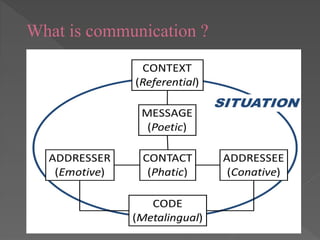
What is communication ?
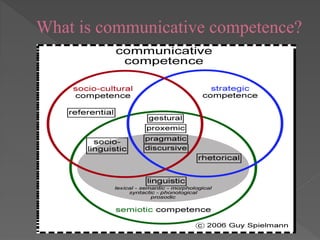
What is communicative competence?
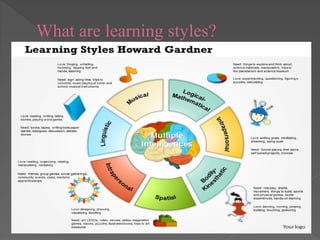
What are learning styles?
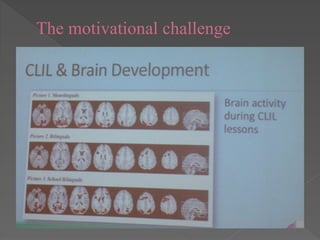
The motivational challenge
2. Defining CLIL
 Content and Language Integrated Learning (CLIL) is a dual-focused
educational approach in which an additional language is used for
the learning and teaching of both content and language. That is, in
the teaching and learning process, there is a focus not only on
content, and not only on language. Each is interwoven, even if the
emphasis is greater on one or the other at a given time.
Coyle , Hood, Marsh (2010: 1)
 [A]chieving this two-fold aim calls for the development of a special
approach to teaching in that the non-language subject is not taught
in a foreign language but with and through a foreign language.
Eurydice (2006: 8)
Which language image behind CLIL?
 A functional and pragmatic
image of languages implies:
 no native speaker perfectionism
 efficiency in communication
 attention to the interlanguage
 communicative grammar
 sociolinguistic perspective
 historical perspective
 textuality awareness
 promoting ELF use (in the case
of English) and translanguaging
Which disciplinary content in CLIL?
 CLIL builds on an enhanced awareness of the
epistemology of each discipline
 At the same time it breaks the disciplinary
barriers, retrieving a more holistic approach to
learning
 As a consequence, interdisciplinary and project
working is favoured
 Co-programming among teachers: the “CLIL
team” should involve not only L2 and non-
language teacher but also more DNL teachers.
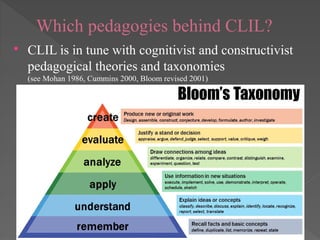
Which pedagogies behind CLIL?
 CLIL is in tune with cognitivist and constructivist
pedagogical theories and taxonomies
(see Mohan 1986, Cummins 2000, Bloom revised 2001)
 It is inevitably a learner-centred approach based
on autonomous and cooperative learning
(no more sage on the stage, but peer education)
 It is completely inscribed in competence teaching
(see European key-competences: particularly the transversal
ones)
 It promotes active, operational and task-based
learning
 It goes very well with ICTs
 It is formal education with open eyes on informal
learning (connectivist approach)
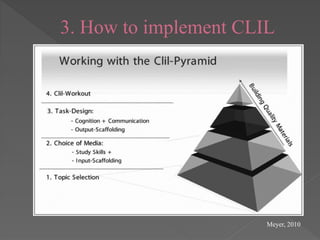
3. How to implement CLIL
Meyer, 2010
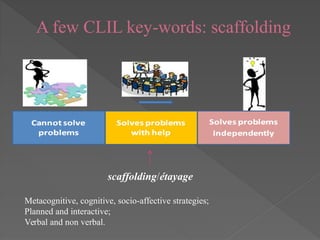
A few CLIL key-words: scaffolding
scaffolding/étayage
Metacognitive, cognitive, socio-affective strategies;
Planned and interactive;
Verbal and non verbal.
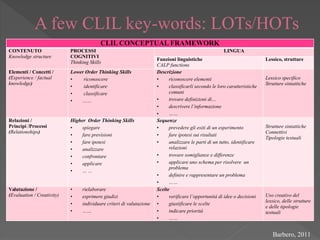
A few CLIL key-words: LOTs/HOTs
CLIL CONCEPTUAL FRAMEWORK
CONTENUTO
Knowledge structure
PROCESSI
COGNITIVI
Thinking Skills
LINGUA
Funzioni linguistiche
CALP functions
Lessico, strutture
Elementi / Concetti /
(Experience / factual
knowledge)
Lower Order Thinking Skills
• riconoscere
• identificare
• classificare
• ……
Descrizione
• riconoscere elementi
• classificarli secondo le loro caratteristiche
comuni
• trovare definizioni di…
• descrivere l’informazione
• ……
Lessico specifico
Strutture sintattiche
Relazioni /
Principi /Processi
(Relationships)
Higher Order Thinking Skills
• spiegare
• fare previsioni
• fare ipotesi
• analizzare
• confrontare
• applicare
• … ...
Sequenze
• prevedere gli esiti di un esperimento
• fare ipotesi sui risultati
• analizzare le parti di un tutto, identificare
relazioni
• trovare somiglianze e differenze
• applicare uno schema per risolvere un
problema
• definire e rappresentare un problema
• ……
Strutture sintattiche
Connettivi
Tipologie testuali
Valutazione /
(Evaluation / Creativity)
• rielaborare
• esprimere giudizi
• individuare criteri di valutazione
• ……
Scelte
• verificare l’opportunità di idee o decisioni
• giustificare le scelte
• indicare priorità
• ……
Uso creativo del
lessico, delle strutture
e delle tipologie
testuali
Barbero, 2011
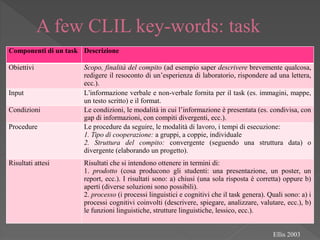
A few CLIL key-words: task
Componenti di un task Descrizione
Obiettivi Scopo, finalità del compito (ad esempio saper descrivere brevemente qualcosa,
redigere il resoconto di un’esperienza di laboratorio, rispondere ad una lettera,
ecc.).
Input L’informazione verbale e non-verbale fornita per il task (es. immagini, mappe,
un testo scritto) e il format.
Condizioni Le condizioni, le modalità in cui l’informazione è presentata (es. condivisa, con
gap di informazioni, con compiti divergenti, ecc.).
Procedure Le procedure da seguire, le modalità di lavoro, i tempi di esecuzione:
1. Tipo di cooperazione: a gruppi, a coppie, individuale
2. Struttura del compito: convergente (seguendo una struttura data) o
divergente (elaborando un progetto).
Risultati attesi Risultati che si intendono ottenere in termini di:
1. prodotto (cosa producono gli studenti: una presentazione, un poster, un
report, ecc.). I risultati sono: a) chiusi (una sola risposta è corretta) oppure b)
aperti (diverse soluzioni sono possibili).
2. processo (i processi linguistici e cognitivi che il task genera). Quali sono: a) i
processi cognitivi coinvolti (descrivere, spiegare, analizzare, valutare, ecc.), b)
le funzioni linguistiche, strutture linguistiche, lessico, ecc.).
Ellis 2003
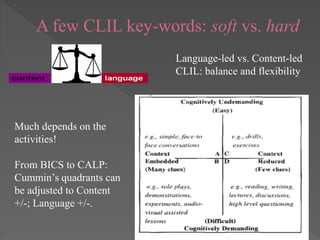
A few CLIL key-words: soft vs. hard
Language-led vs. Content-led
CLIL: balance and flexibility
Much depends on the
activities!
From BICS to CALP:
Cummin’s quadrants can
be adjusted to Content
+/-; Language +/-.
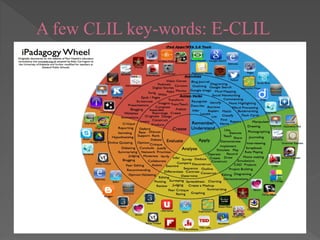
A few CLIL key-words: E-CLIL
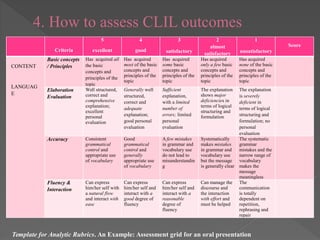
4. How to assess CLIL outcomes
Criteria
5
excellent
4
good
3
satisfactory
2
almost
satisfactory
1
unsatisfactory
Score
CONTENT
LANGUAG
E
Basic concepts
/ Principles
Has acquired all
the basic
concepts and
principles of the
topic
Has acquired
most of the basic
concepts and
principles of the
topic
Has acquired
some basic
concepts and
principles of the
topic
Has acquired
only a few basic
concepts and
principles of the
topic
Has acquired
none of the basic
concepts and
principles of the
topic
Elaboration
Evaluation
Well structured,
correct and
comprehensive
explanation;
excellent
personal
evaluation
Generally well
structured,
correct and
adequate
explanation;
good personal
evaluation
Sufficient
explanation,
with a limited
number of
errors; limited
personal
evaluation
The explanation
shows major
deficiencies in
terms of logical
structuring and
formulation
The explanation
is severely
deficient in
terms of logical
structuring and
formulation; no
personal
evaluation
Accuracy Consistent
grammatical
control and
appropriate use
of vocabulary
Good
grammatical
control and
generally
appropriate use
of vocabulary
A few mistakes
in grammar and
vocabulary use
do not lead to
misunderstandin
g
Systematically
makes mistakes
in grammar and
vocabulary use
but the message
is generally clear
The systematic
grammar
mistakes and the
narrow range of
vocabulary
makes the
message
meaningless
Fluency &
Interaction
Can express
him/her self with
a natural flow
and interact with
ease
Can express
him/her self and
interact with a
good degree of
fluency
Can express
him/her self and
interact with a
reasonable
degree of
fluency
Can manage the
discourse and
the interaction
with effort and
must be helped
The
communication
is totally
dependent on
repetition,
rephrasing and
repair
Template for Analytic Rubrics. An Example: Assessment grid for an oral presentation
5. Does CLIL work or not?
 content knowledge not threatened
 positive effects on subject acquisition
 L2 development evidenced:
 more complex, accurate L2 use
 reading proficiency
 incidental vocabulary acquisition
 pragmatic and discursive competence
 levelling of gender differences in
attitude, achievement
 inclusion
 poorer coverage of subject matter
 slower delivery rate
 difficulty to communicate knowledge in
an effective and student-friendly manner
 frequent use of avoidance strategies (due
to language deficits)
 inability to exhibit best performance
 increased workload and lack of materials
 decrease in students’ overall learning
results
6. What is good CLIL?
 is context-embedded and localised
 is content-driven (rather than content-based)
 has clearly defined learning outcomes for BOTH content and
language
 makes creative use of language as learning tool
 connects learners to language use for different purposes
 develops linguistic confidence and competence and promotes
spontaneity
 promotes operational, authentic and cooperative learning
(also through community learning)
 is enriched by the use of audiovisual aids and ICTs
 is motivating for both teachers and learners
Let’s have a look at a few products!
 Primary and lower secondary school: http://icmontefiascone.it/
 Progetto: Let’s celebrate Europe (see for example: “Mystery Tour round Lake
Bolsena” – primary; “Vino EST EST EST”, “Civita di Bagnoregio” – media)
 Higher secondary school:
 Margherita Donatelli (History, fr.):
https://drive.google.com/open?id=0B1LJiGS2aktsanAyVlczc0xlSnc
 Mariella Gentile (Art history):
https://www.youtube.com/watch?v=w8LiuDEILXU
 Silvana Severino (History): http://padlet.com/silvanasvrn/psrbq6zmar6l
Sul dropbox:
 Laura Riccioni (Geography-Latin)
 Nicoletta Viscillo (Physical Education-Art History, fr.)
 Luigi Mantuano (Philosophy, fr.)
 Anna De Facendis (Law)
7. References
Essential reading is to be found in È tempo di cambiare (2016) and in E-CLIL per
una didattica innovativa (2014).
Updating:
Mohan, B., Leung, C., Slater, T. (2010), Assessing language and content: A
functional perspective, in Testing the Untestable in Language Education, ed. A.
Paran, L. Sercu, Clevedon, Multilingual Matters, pp. 217-240.
Vittoz, M-B.,Damascelli, A.T., Barbero T. (2013), Insegnare secondo la
metodologia CLIL: l’esperienza del Corso di Perfezionamento 20 CFU, AICLU.
Romagnuolo, A. (2016), Training CLIL teachers. An Italian experience, in
Proceedings of ICERI2016 Conference, Seville, pp. 4798-4806.
Cinganotto, L. (2016), CLIL in Italy. A general overview, “Latin American Journal
of Content and Language Integrated Learning”, 9 (2), pp. 374-400.

Graziano presentazione CLIL

  • 1.
    NUOVE VISIONI DELL'INSEGNAMENTO/APPRENDIMENTO NELLA SCUOLASECONDARIA Corso di formazione a cura di Amelia Stancanelli TERZA UNITÀ FORMATIVA: METODOLOGIE DIDATTICHE E SAPERI PER LA SCUOLA Un nuovo approccio nella didattica: la metodologia CLIL A cura di Alba Graziano Messina, 11 aprile 2017
  • 2.
    1. The Roadto a European CLIL NEED: greater levels of multilingualism are needed for European integration from the 1990s: CLIL is considered an effective way to:  provide greater exposure to L2  improve general communicative competence  achieve high degree of language awareness  accommodate diverse learning styles  increase learner motivation through greater authenticity
  • 3.
  • 4.
  • 5.
  • 6.
  • 7.
    2. Defining CLIL Content and Language Integrated Learning (CLIL) is a dual-focused educational approach in which an additional language is used for the learning and teaching of both content and language. That is, in the teaching and learning process, there is a focus not only on content, and not only on language. Each is interwoven, even if the emphasis is greater on one or the other at a given time. Coyle , Hood, Marsh (2010: 1)  [A]chieving this two-fold aim calls for the development of a special approach to teaching in that the non-language subject is not taught in a foreign language but with and through a foreign language. Eurydice (2006: 8)
  • 8.
    Which language imagebehind CLIL?  A functional and pragmatic image of languages implies:  no native speaker perfectionism  efficiency in communication  attention to the interlanguage  communicative grammar  sociolinguistic perspective  historical perspective  textuality awareness  promoting ELF use (in the case of English) and translanguaging
  • 9.
    Which disciplinary contentin CLIL?  CLIL builds on an enhanced awareness of the epistemology of each discipline  At the same time it breaks the disciplinary barriers, retrieving a more holistic approach to learning  As a consequence, interdisciplinary and project working is favoured  Co-programming among teachers: the “CLIL team” should involve not only L2 and non- language teacher but also more DNL teachers.
  • 10.
    Which pedagogies behindCLIL?  CLIL is in tune with cognitivist and constructivist pedagogical theories and taxonomies (see Mohan 1986, Cummins 2000, Bloom revised 2001)
  • 11.
     It isinevitably a learner-centred approach based on autonomous and cooperative learning (no more sage on the stage, but peer education)  It is completely inscribed in competence teaching (see European key-competences: particularly the transversal ones)  It promotes active, operational and task-based learning  It goes very well with ICTs  It is formal education with open eyes on informal learning (connectivist approach)
  • 12.
    3. How toimplement CLIL Meyer, 2010
  • 13.
    A few CLILkey-words: scaffolding scaffolding/étayage Metacognitive, cognitive, socio-affective strategies; Planned and interactive; Verbal and non verbal.
  • 14.
    A few CLILkey-words: LOTs/HOTs CLIL CONCEPTUAL FRAMEWORK CONTENUTO Knowledge structure PROCESSI COGNITIVI Thinking Skills LINGUA Funzioni linguistiche CALP functions Lessico, strutture Elementi / Concetti / (Experience / factual knowledge) Lower Order Thinking Skills • riconoscere • identificare • classificare • …… Descrizione • riconoscere elementi • classificarli secondo le loro caratteristiche comuni • trovare definizioni di… • descrivere l’informazione • …… Lessico specifico Strutture sintattiche Relazioni / Principi /Processi (Relationships) Higher Order Thinking Skills • spiegare • fare previsioni • fare ipotesi • analizzare • confrontare • applicare • … ... Sequenze • prevedere gli esiti di un esperimento • fare ipotesi sui risultati • analizzare le parti di un tutto, identificare relazioni • trovare somiglianze e differenze • applicare uno schema per risolvere un problema • definire e rappresentare un problema • …… Strutture sintattiche Connettivi Tipologie testuali Valutazione / (Evaluation / Creativity) • rielaborare • esprimere giudizi • individuare criteri di valutazione • …… Scelte • verificare l’opportunità di idee o decisioni • giustificare le scelte • indicare priorità • …… Uso creativo del lessico, delle strutture e delle tipologie testuali Barbero, 2011
  • 15.
    A few CLILkey-words: task Componenti di un task Descrizione Obiettivi Scopo, finalità del compito (ad esempio saper descrivere brevemente qualcosa, redigere il resoconto di un’esperienza di laboratorio, rispondere ad una lettera, ecc.). Input L’informazione verbale e non-verbale fornita per il task (es. immagini, mappe, un testo scritto) e il format. Condizioni Le condizioni, le modalità in cui l’informazione è presentata (es. condivisa, con gap di informazioni, con compiti divergenti, ecc.). Procedure Le procedure da seguire, le modalità di lavoro, i tempi di esecuzione: 1. Tipo di cooperazione: a gruppi, a coppie, individuale 2. Struttura del compito: convergente (seguendo una struttura data) o divergente (elaborando un progetto). Risultati attesi Risultati che si intendono ottenere in termini di: 1. prodotto (cosa producono gli studenti: una presentazione, un poster, un report, ecc.). I risultati sono: a) chiusi (una sola risposta è corretta) oppure b) aperti (diverse soluzioni sono possibili). 2. processo (i processi linguistici e cognitivi che il task genera). Quali sono: a) i processi cognitivi coinvolti (descrivere, spiegare, analizzare, valutare, ecc.), b) le funzioni linguistiche, strutture linguistiche, lessico, ecc.). Ellis 2003
  • 16.
    A few CLILkey-words: soft vs. hard Language-led vs. Content-led CLIL: balance and flexibility Much depends on the activities! From BICS to CALP: Cummin’s quadrants can be adjusted to Content +/-; Language +/-.
  • 17.
    A few CLILkey-words: E-CLIL
  • 18.
    4. How toassess CLIL outcomes Criteria 5 excellent 4 good 3 satisfactory 2 almost satisfactory 1 unsatisfactory Score CONTENT LANGUAG E Basic concepts / Principles Has acquired all the basic concepts and principles of the topic Has acquired most of the basic concepts and principles of the topic Has acquired some basic concepts and principles of the topic Has acquired only a few basic concepts and principles of the topic Has acquired none of the basic concepts and principles of the topic Elaboration Evaluation Well structured, correct and comprehensive explanation; excellent personal evaluation Generally well structured, correct and adequate explanation; good personal evaluation Sufficient explanation, with a limited number of errors; limited personal evaluation The explanation shows major deficiencies in terms of logical structuring and formulation The explanation is severely deficient in terms of logical structuring and formulation; no personal evaluation Accuracy Consistent grammatical control and appropriate use of vocabulary Good grammatical control and generally appropriate use of vocabulary A few mistakes in grammar and vocabulary use do not lead to misunderstandin g Systematically makes mistakes in grammar and vocabulary use but the message is generally clear The systematic grammar mistakes and the narrow range of vocabulary makes the message meaningless Fluency & Interaction Can express him/her self with a natural flow and interact with ease Can express him/her self and interact with a good degree of fluency Can express him/her self and interact with a reasonable degree of fluency Can manage the discourse and the interaction with effort and must be helped The communication is totally dependent on repetition, rephrasing and repair Template for Analytic Rubrics. An Example: Assessment grid for an oral presentation
  • 19.
    5. Does CLILwork or not?  content knowledge not threatened  positive effects on subject acquisition  L2 development evidenced:  more complex, accurate L2 use  reading proficiency  incidental vocabulary acquisition  pragmatic and discursive competence  levelling of gender differences in attitude, achievement  inclusion
  • 20.
     poorer coverageof subject matter  slower delivery rate  difficulty to communicate knowledge in an effective and student-friendly manner  frequent use of avoidance strategies (due to language deficits)  inability to exhibit best performance  increased workload and lack of materials  decrease in students’ overall learning results
  • 21.
    6. What isgood CLIL?  is context-embedded and localised  is content-driven (rather than content-based)  has clearly defined learning outcomes for BOTH content and language  makes creative use of language as learning tool  connects learners to language use for different purposes  develops linguistic confidence and competence and promotes spontaneity  promotes operational, authentic and cooperative learning (also through community learning)  is enriched by the use of audiovisual aids and ICTs  is motivating for both teachers and learners
  • 22.
    Let’s have alook at a few products!  Primary and lower secondary school: http://icmontefiascone.it/  Progetto: Let’s celebrate Europe (see for example: “Mystery Tour round Lake Bolsena” – primary; “Vino EST EST EST”, “Civita di Bagnoregio” – media)  Higher secondary school:  Margherita Donatelli (History, fr.): https://drive.google.com/open?id=0B1LJiGS2aktsanAyVlczc0xlSnc  Mariella Gentile (Art history): https://www.youtube.com/watch?v=w8LiuDEILXU  Silvana Severino (History): http://padlet.com/silvanasvrn/psrbq6zmar6l Sul dropbox:  Laura Riccioni (Geography-Latin)  Nicoletta Viscillo (Physical Education-Art History, fr.)  Luigi Mantuano (Philosophy, fr.)  Anna De Facendis (Law)
  • 23.
    7. References Essential readingis to be found in È tempo di cambiare (2016) and in E-CLIL per una didattica innovativa (2014). Updating: Mohan, B., Leung, C., Slater, T. (2010), Assessing language and content: A functional perspective, in Testing the Untestable in Language Education, ed. A. Paran, L. Sercu, Clevedon, Multilingual Matters, pp. 217-240. Vittoz, M-B.,Damascelli, A.T., Barbero T. (2013), Insegnare secondo la metodologia CLIL: l’esperienza del Corso di Perfezionamento 20 CFU, AICLU. Romagnuolo, A. (2016), Training CLIL teachers. An Italian experience, in Proceedings of ICERI2016 Conference, Seville, pp. 4798-4806. Cinganotto, L. (2016), CLIL in Italy. A general overview, “Latin American Journal of Content and Language Integrated Learning”, 9 (2), pp. 374-400.