www.h2.ie
Online Tutoring: Towards a Signature Pedagogy
Michael Hallissy
H2 Learning and Hibernia College tutor
www.h2.ie
INTRODUCTION
www.h2.ie
Presentation
• Teaching Online – a perspective
• The Online Tutorial
• MATL Case-study
• Discussion
www.h2.ie
Introduction
• Founding partner in H2 Learning
– Assist institutions embed digital technologies to enhance teaching, learning
and assessment practices
• Former director the MATL in Hibernia College
– Lead tutor in the Certificate in i-Learning
• Completing EdD in Institute of Education, London
• "Building teacher professionalism in teaching-learning interactions
between online tutors and learners during synchronous tutorials – a case
study from Hibernia College”
www.h2.ie
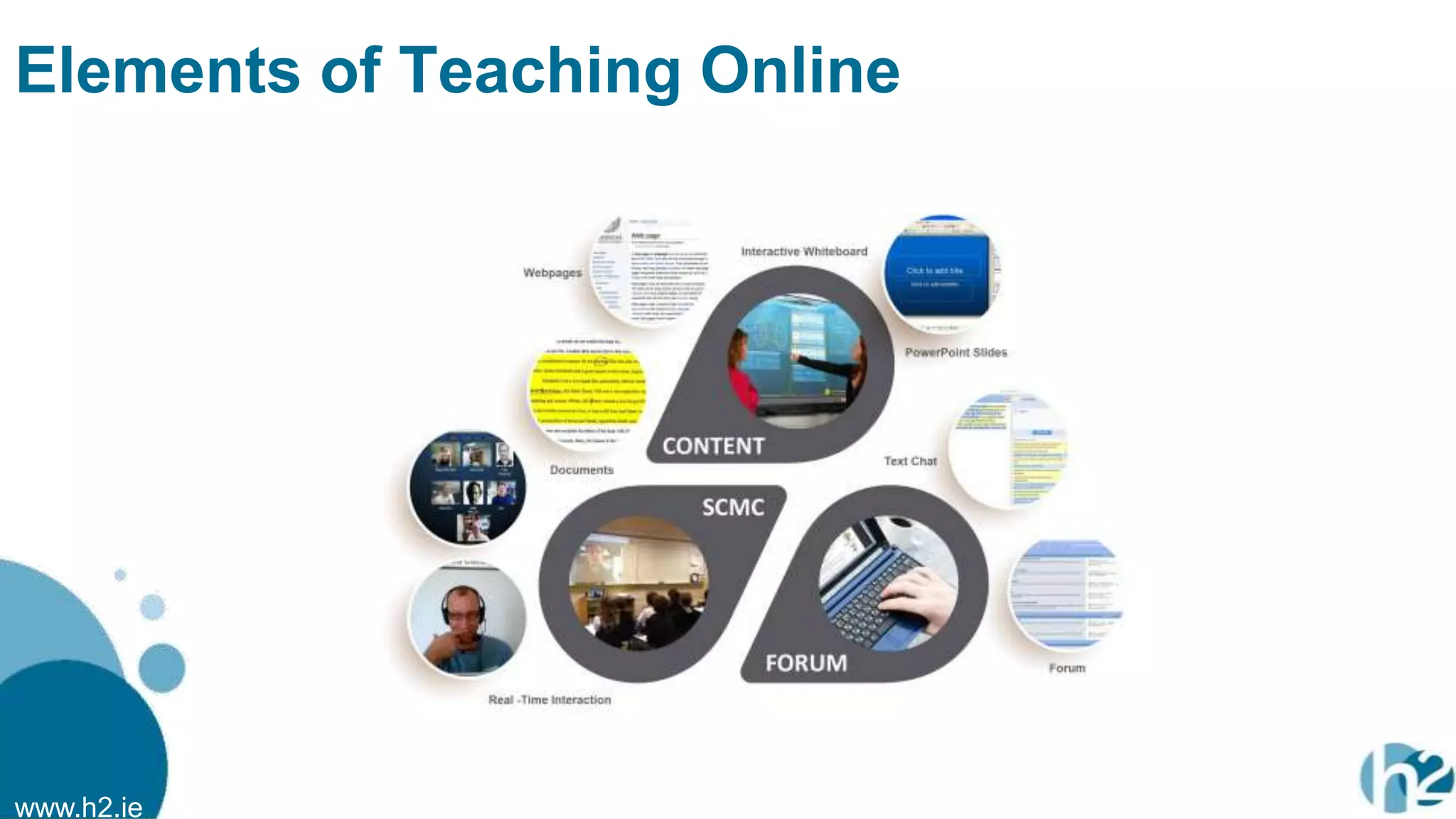
Elements of Teaching Online
www.h2.ie
Some Perspective
• OU noted that “active discussion” has long been one of
the aspects that is difficult to provide in distance education,
with tutorials and summer schools being the usual means of
achieving this” (Mason, 2001; 73)
• Since 1988 significant body of research on discussion and
online courses in HE
– Majority focused on asynchronous technologies – forums particularly.
• But today new options
– Expansion of broadband
– New technologies to support live interaction
www.h2.ie
Technology and what it can do
Today we have:
• Synchronous Computer-mediated conferencing technologies (SCMC)
– AT&T Connect, Adobe Connect, Wimba, Elluminate, Lync etc.
“Computer-mediated conferencing (CMC) is unique
among distance education media because of its ability
to support high levels of responsive, intelligent
interaction between and among faculty and students
while simultaneously providing high levels of freedom of
time and place to engage in this interactivity.”
(Rourke et al., 1999; 50)
www.h2.ie
Synchronous Learning Environments
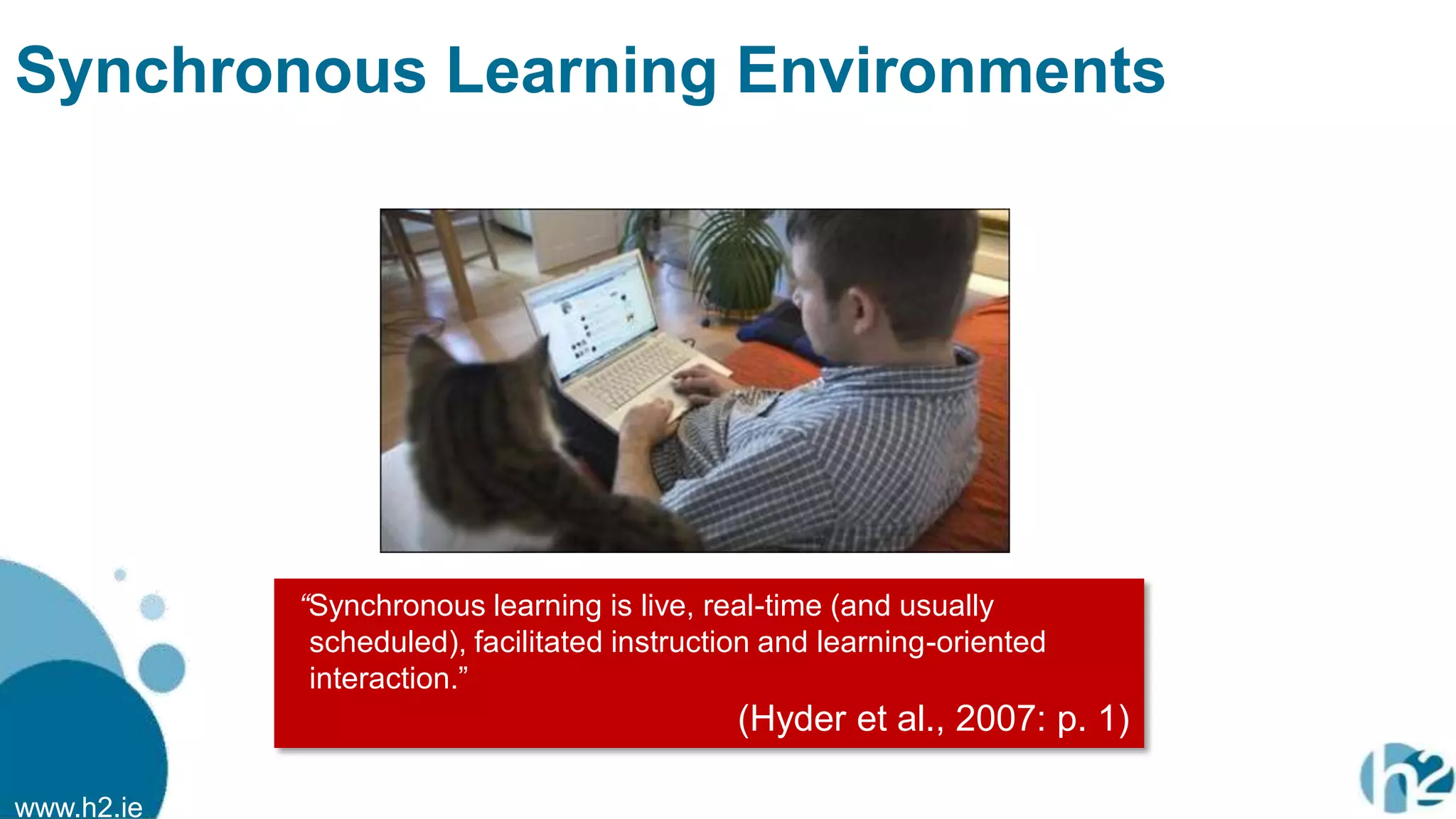
“Synchronous learning is live, real-time (and usually
scheduled), facilitated instruction and learning-oriented
interaction.”
(Hyder et al., 2007: p. 1)
www.h2.ie
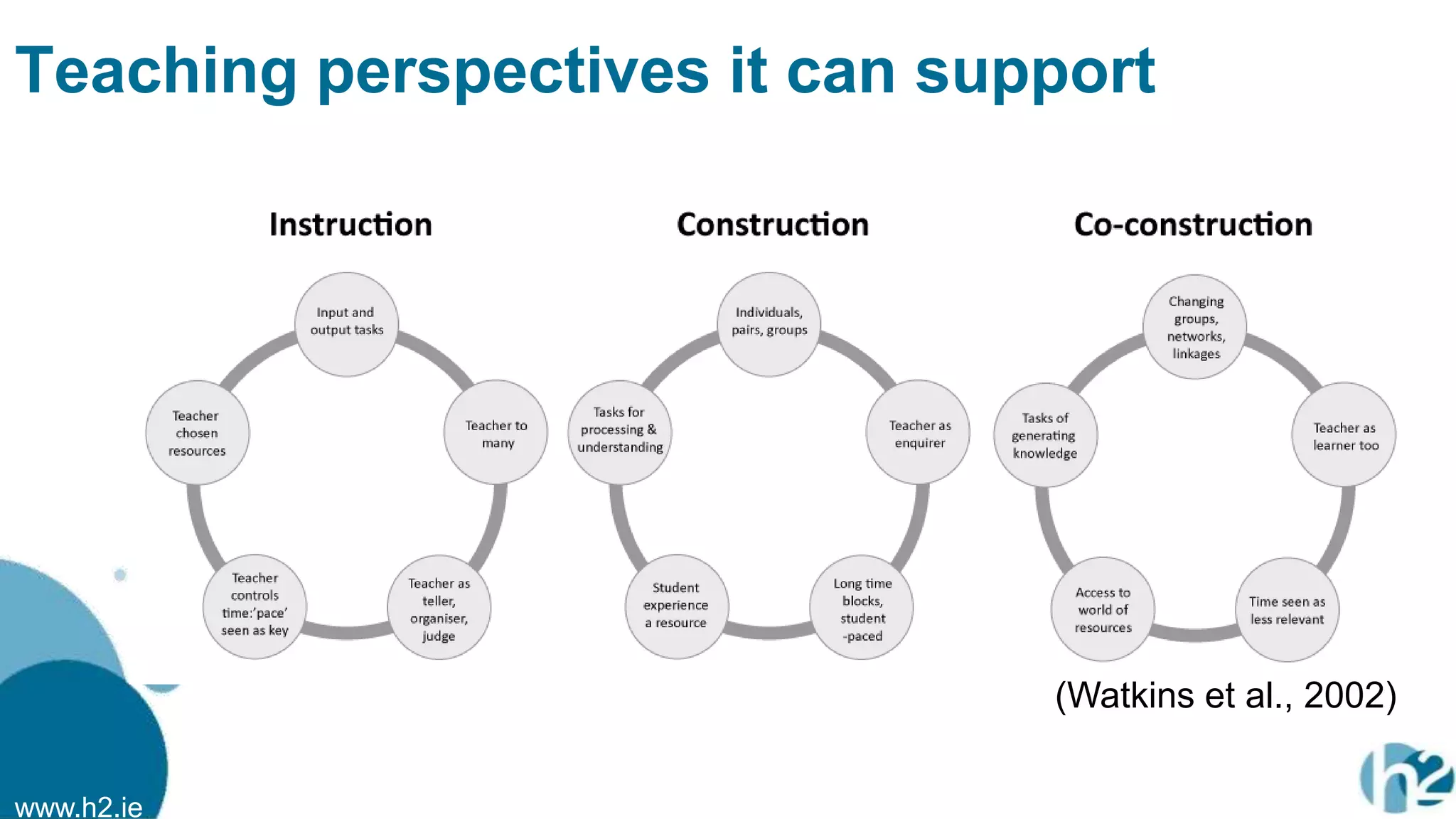
Teaching perspectives it can support
(Watkins et al., 2002)
www.h2.ie
THE ONLINE TUTORIAL
www.h2.ie
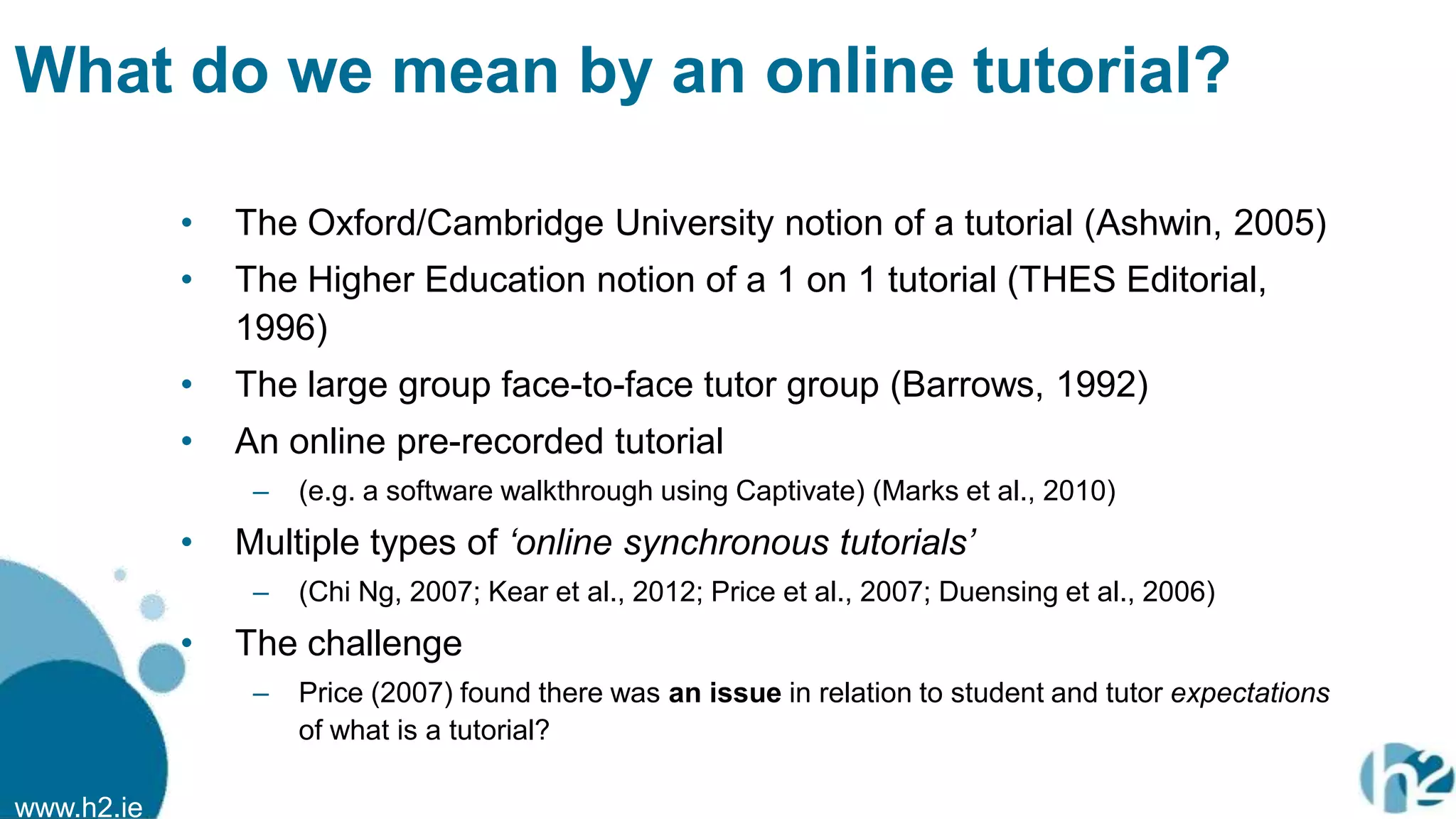
What do we mean by an online tutorial?
• The Oxford/Cambridge University notion of a tutorial (Ashwin, 2005)
• The Higher Education notion of a 1 on 1 tutorial (THES Editorial,
1996)
• The large group face-to-face tutor group (Barrows, 1992)
• An online pre-recorded tutorial
– (e.g. a software walkthrough using Captivate) (Marks et al., 2010)
• Multiple types of „online synchronous tutorials‟
– (Chi Ng, 2007; Kear et al., 2012; Price et al., 2007; Duensing et al., 2006)
• The challenge
– Price (2007) found there was an issue in relation to student and tutor expectations
of what is a tutorial?
www.h2.ie
The Invisible Student Challenge
• Role of the tutor is to support students to become independent
learners and to engage
“In these settings [traditional, didactic educational settings], the
student is expected to know the right answer. He learned a long time
ago that it is best to stay silent if he does not know the answer, or is
unsure of it, for he knows that an admission of not knowing would be
used as evidence of inadequate study or lack of intelligence.”
(Barrows, 1992; p. 22)
www.h2.ie
Interrogation key part of a tutorial
“However, a general structure appears to be that there
will be an interrogation, whether questioning or
discussion, of the work that the student(s) have
completed in preparation for the tutorial.”
(Ashwin, 2009; 633)
www.h2.ie
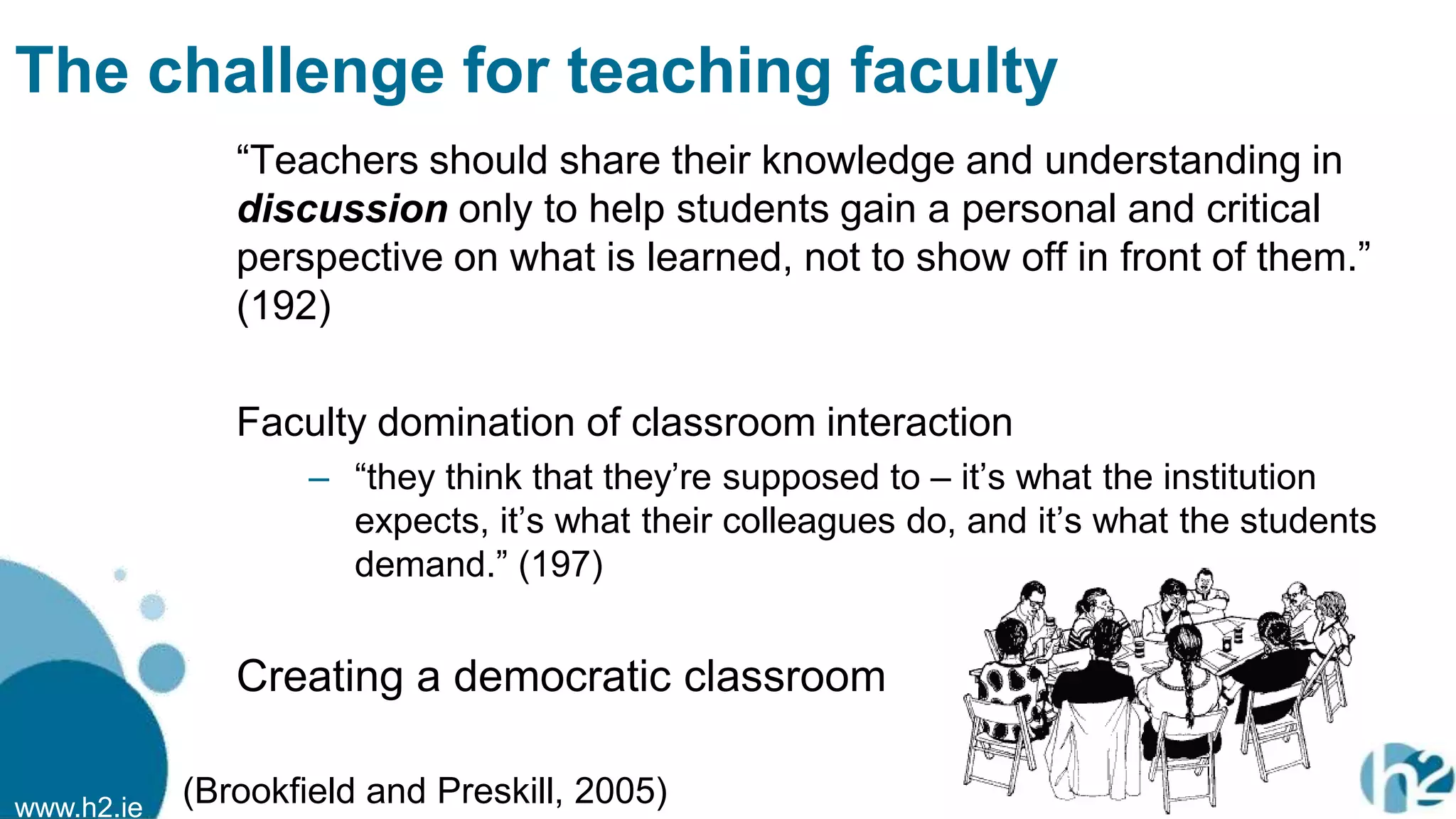
The challenge for teaching faculty
“Teachers should share their knowledge and understanding in
discussion only to help students gain a personal and critical
perspective on what is learned, not to show off in front of them.”
(192)
Faculty domination of classroom interaction
– “they think that they‟re supposed to – it‟s what the institution
expects, it‟s what their colleagues do, and it‟s what the students
demand.” (197)
Creating a democratic classroom
(Brookfield and Preskill, 2005)
www.h2.ie
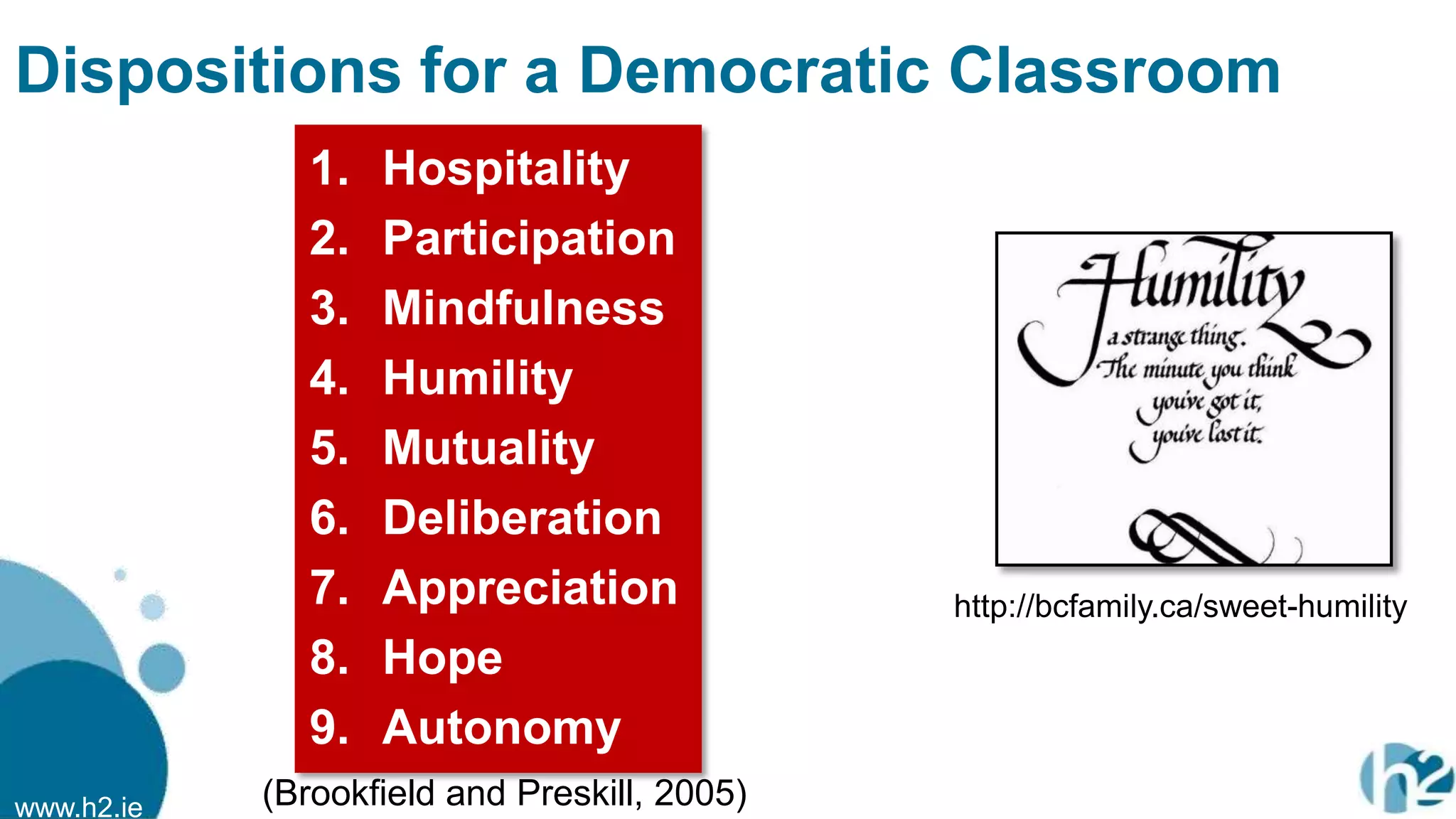
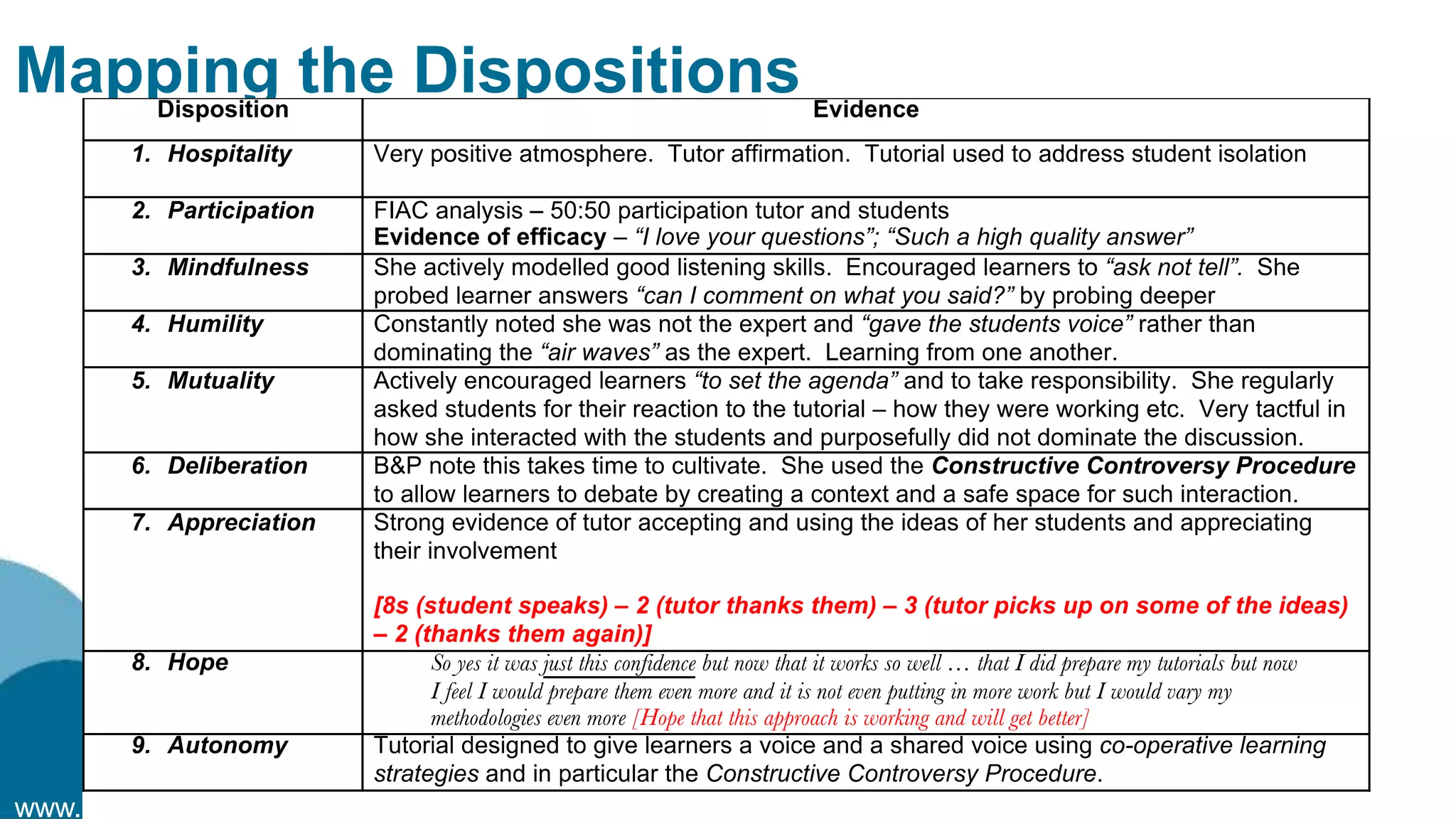
Dispositions for a Democratic Classroom
http://bcfamily.ca/sweet-humility
1. Hospitality
2. Participation
3. Mindfulness
4. Humility
5. Mutuality
6. Deliberation
7. Appreciation
8. Hope
9. Autonomy
(Brookfield and Preskill, 2005)
www.h2.ie
MATL CASE-STUDY
www.h2.ie
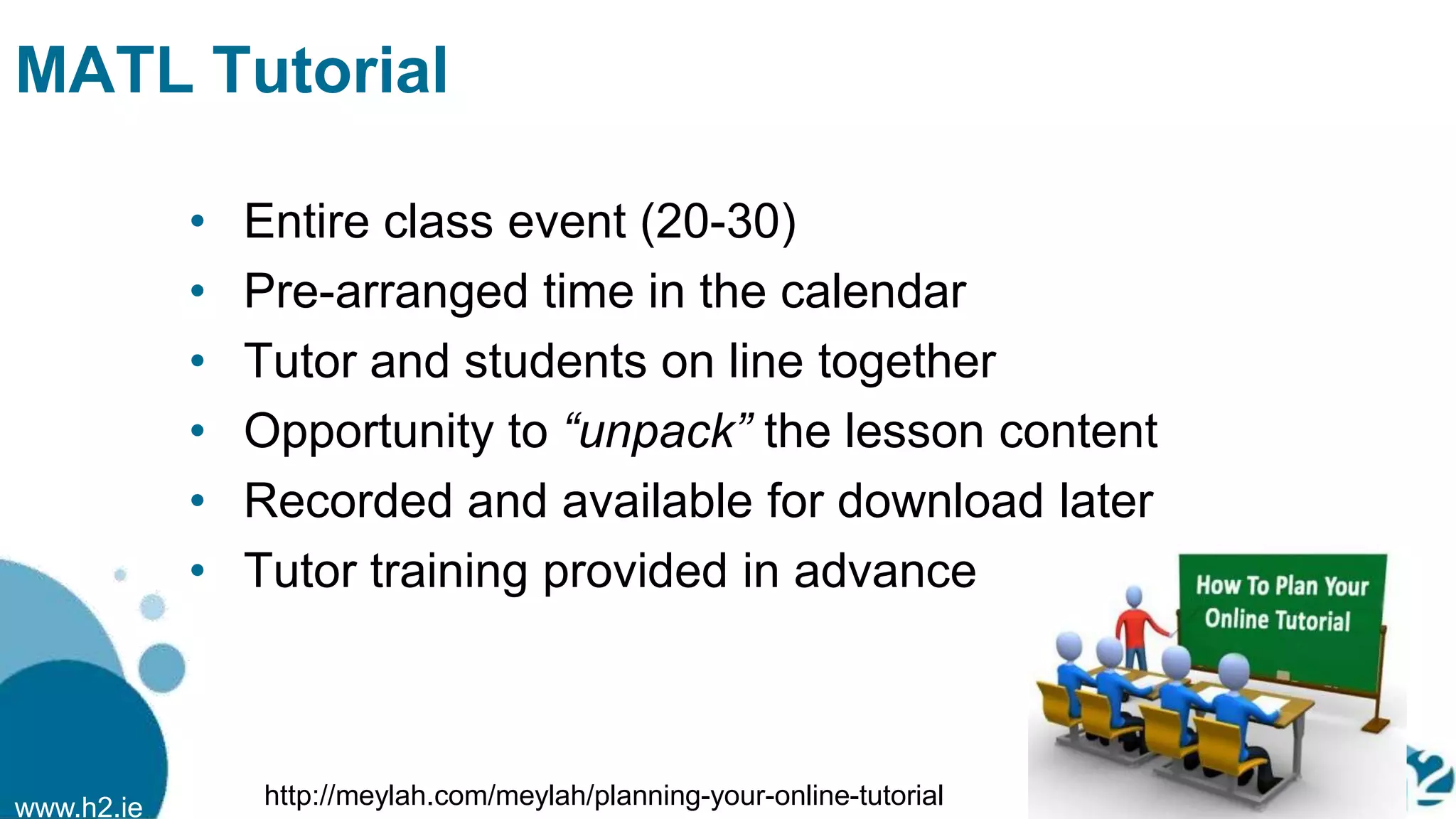
MATL Tutorial
• Entire class event (20-30)
• Pre-arranged time in the calendar
• Tutor and students on line together
• Opportunity to “unpack” the lesson content
• Recorded and available for download later
• Tutor training provided in advance
http://meylah.com/meylah/planning-your-online-tutorial
www.h2.ie
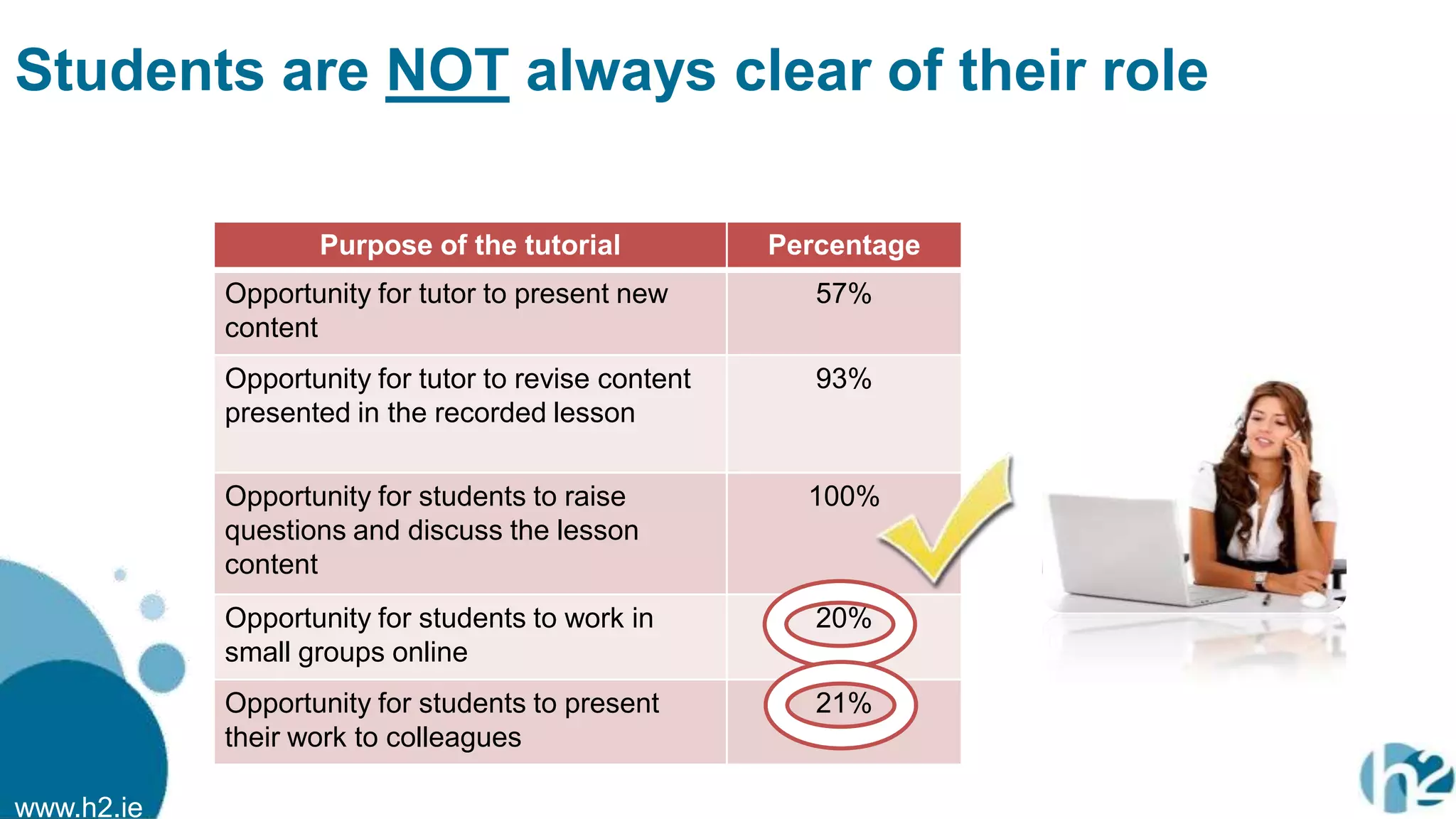
Students are NOT always clear of their role
Purpose of the tutorial Percentage
Opportunity for tutor to present new
content
57%
Opportunity for tutor to revise content
presented in the recorded lesson
93%
Opportunity for students to raise
questions and discuss the lesson
content
100%
Opportunity for students to work in
small groups online
20%
Opportunity for students to present
their work to colleagues
21%
www.h2.ie
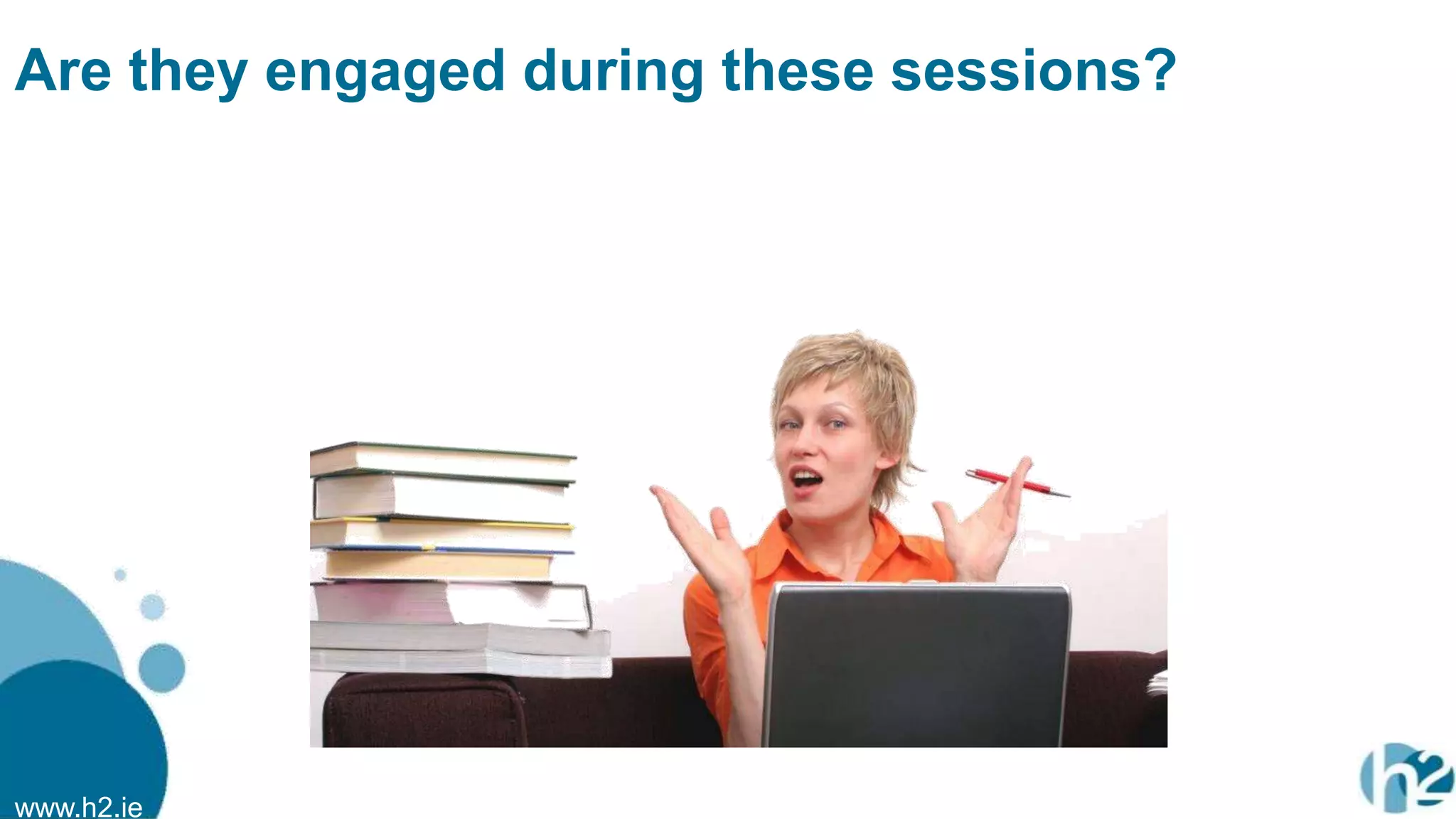
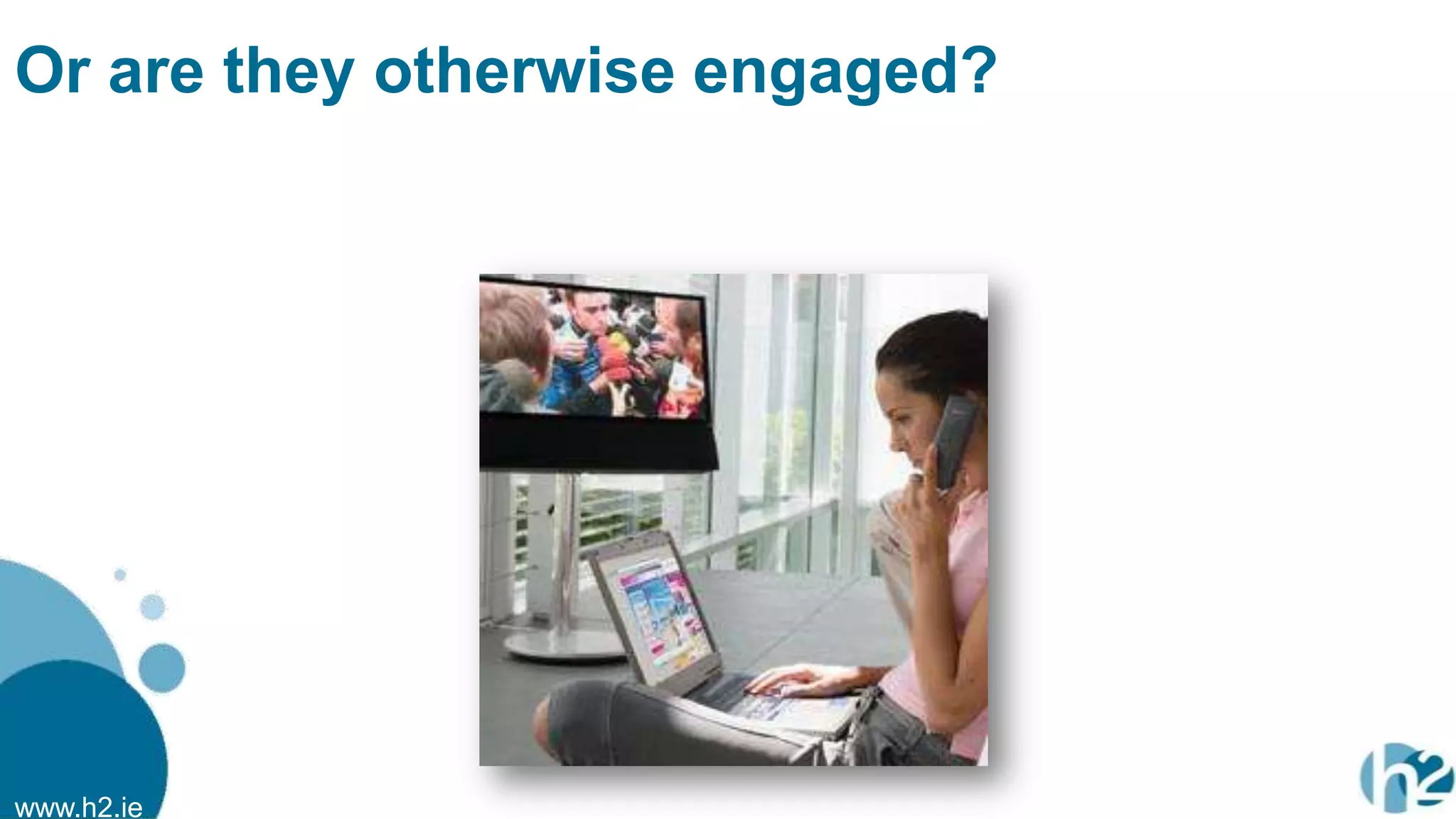
Are they engaged during these sessions?
www.h2.ie
Or are they otherwise engaged?
www.h2.ie
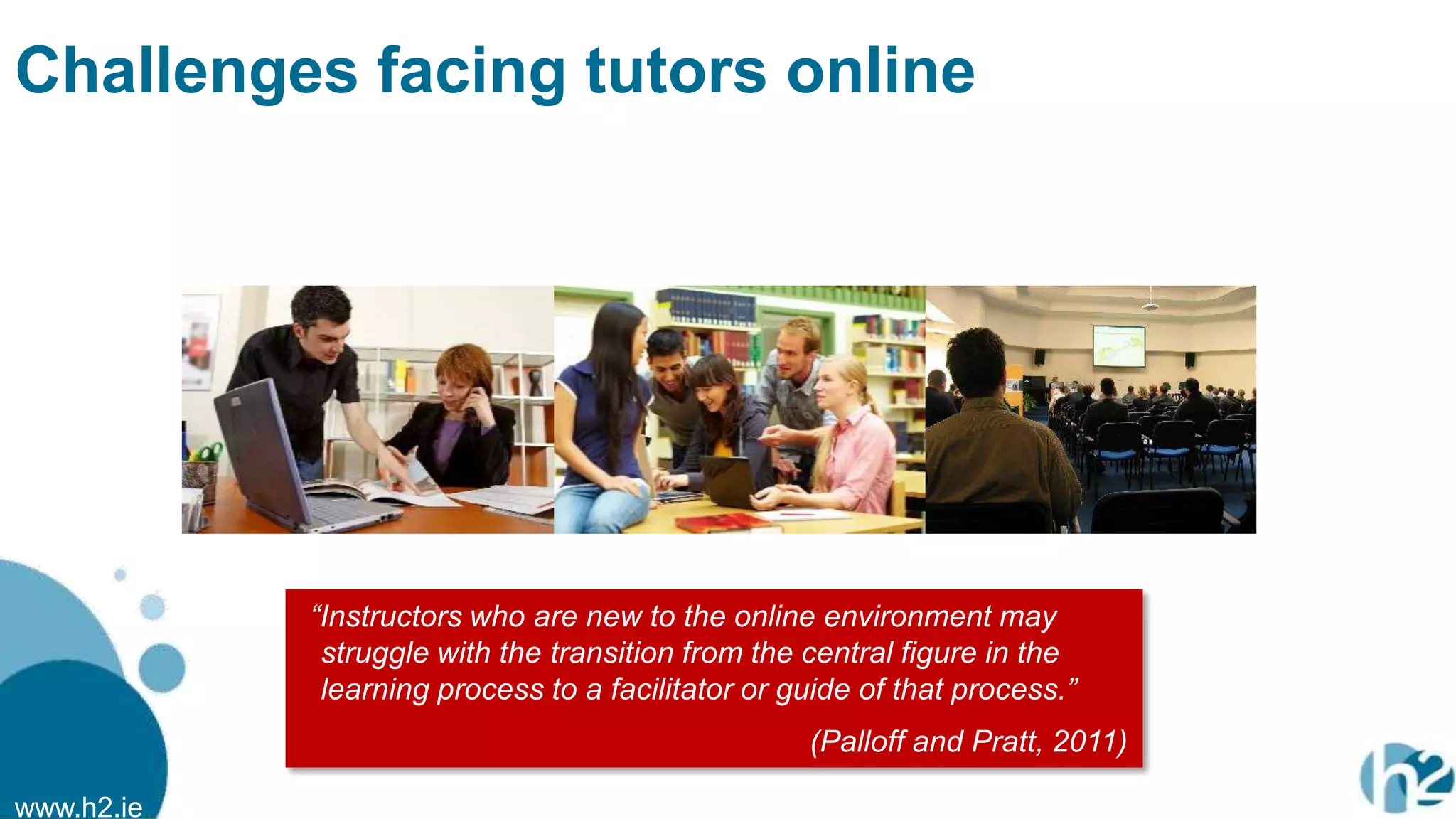
Challenges facing tutors online
“Instructors who are new to the online environment may
struggle with the transition from the central figure in the
learning process to a facilitator or guide of that process.”
(Palloff and Pratt, 2011)
www.h2.ie
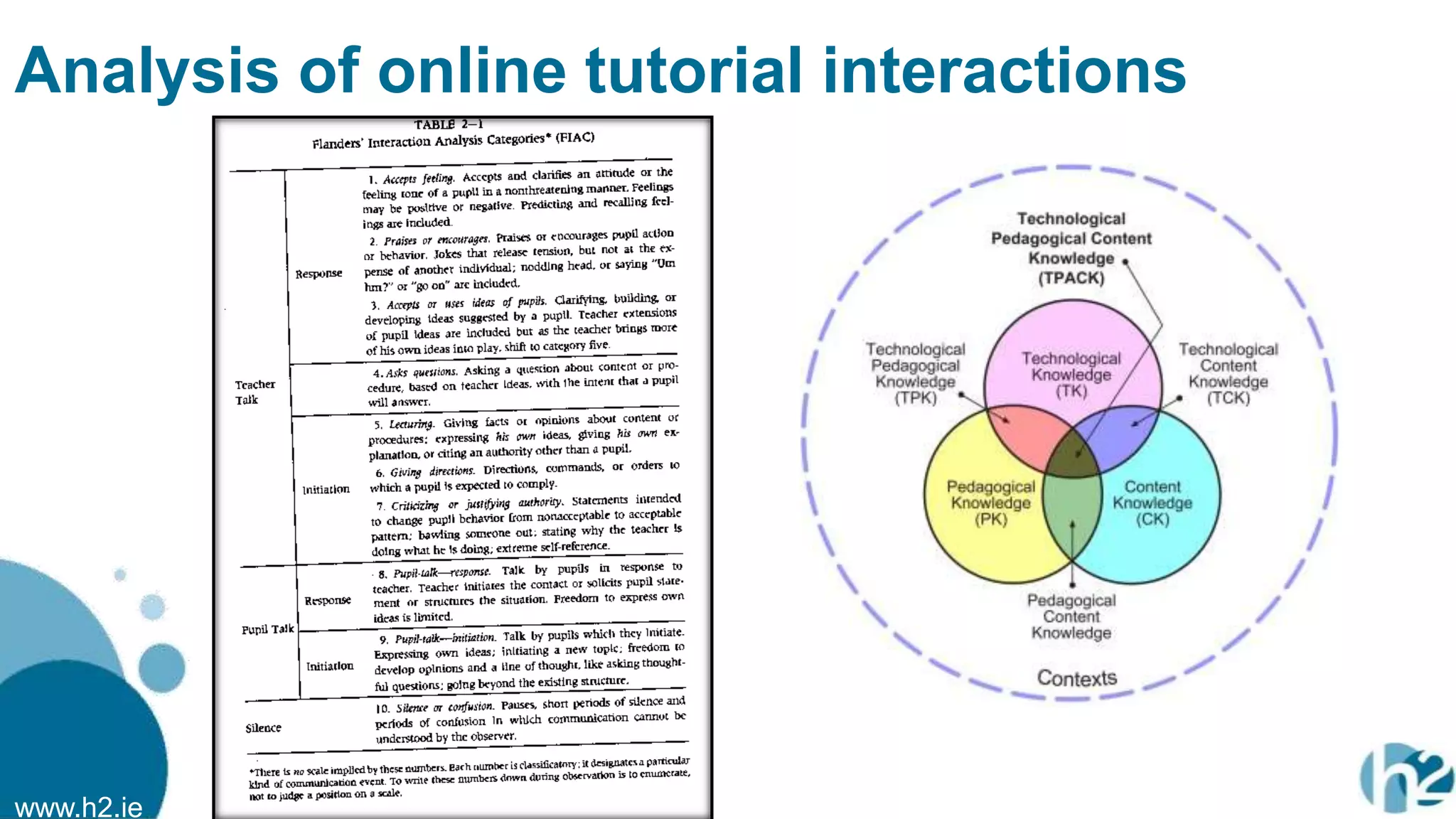
Analysis of online tutorial interactions
www.h2.ie
A Tutor Perspective
“I suppose the official purpose of the tutorials is to
expand on the lecture and maybe I do see a
slightly differently [nervous laughter again]
purpose. I didn‟t intend it but it is what has
emerged and I now see they have a huge
purpose in breaking down the isolation of the
students and building a community of
learners. You know helping the students in that
community [develop] perspective taking,
problem solving … but just seeing different
points of view, sharing of ideas”
Tutor View
“I don‟t like the sound of my
own voice too much of it
[nervous laughter] so I love to
give voice to others and to
build up the team and that
everybody in the classroom is
teaching, like using all the
resources in the classroom,
that it is not just one teacher
but everybody has
something to teach and to
share and to try and draw
that ”
Tutor View
www.h2.ie
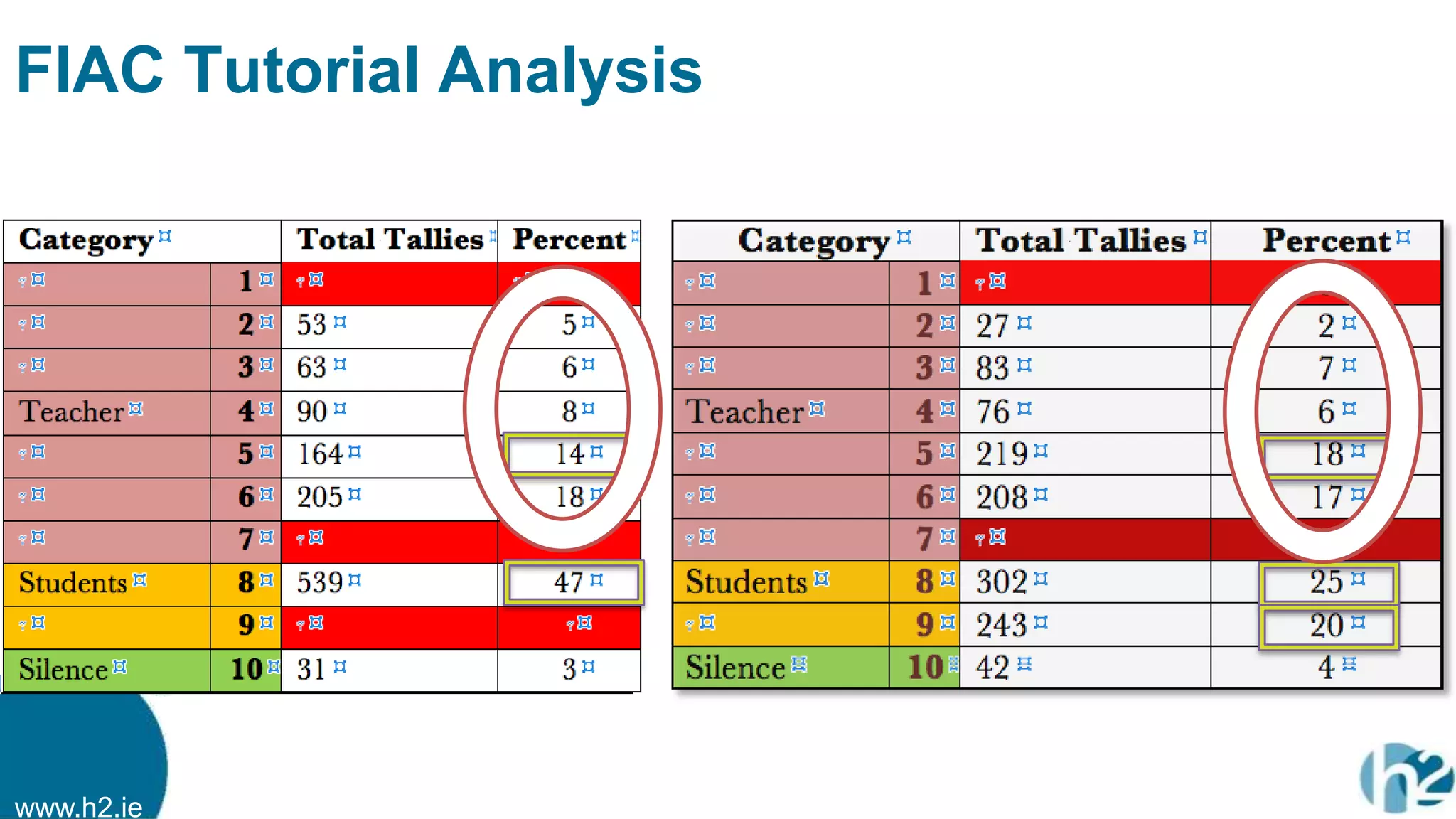
FIAC Tutorial Analysis
www.h2.ie
Mapping the Dispositions
www.h2.ie
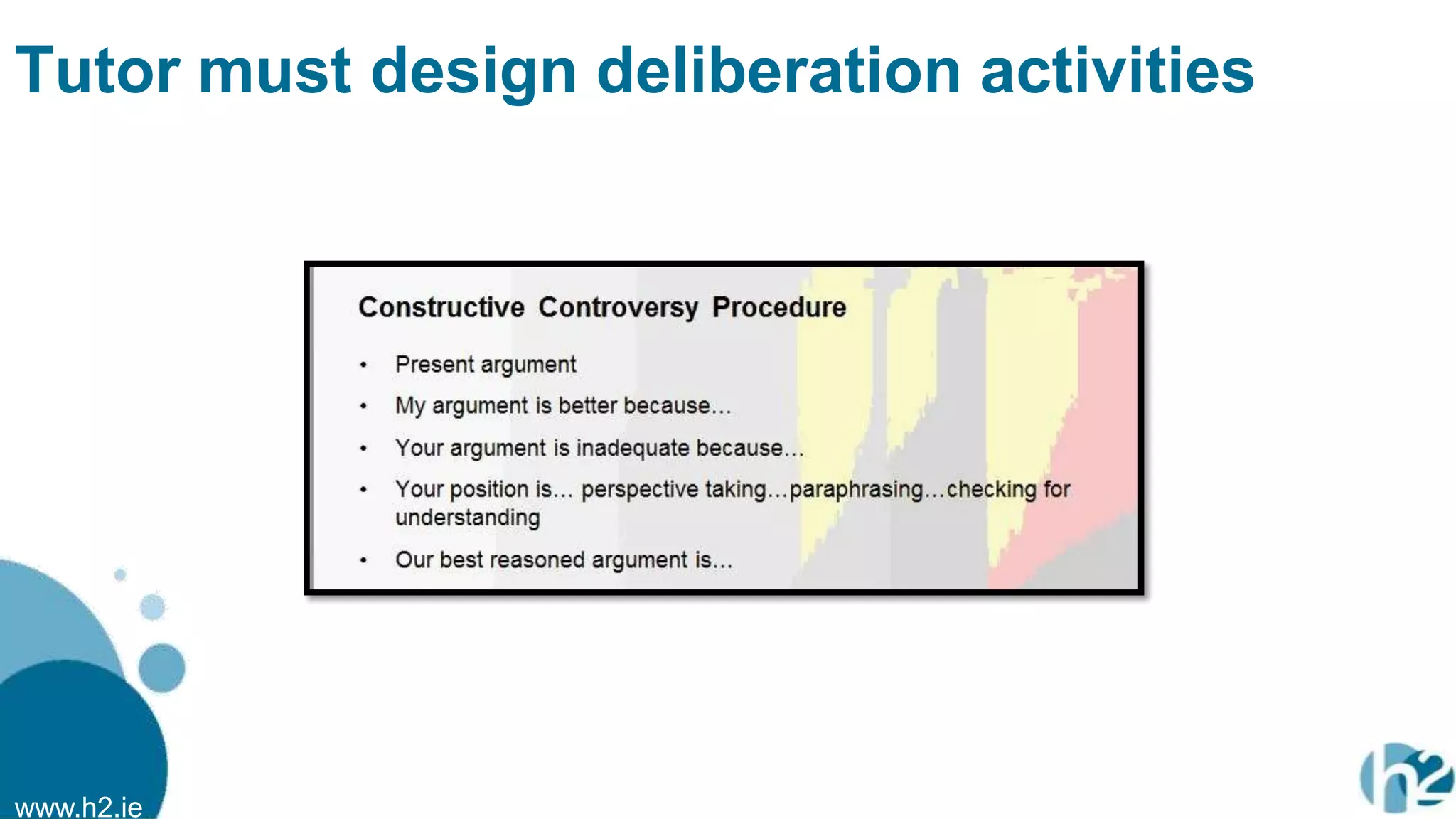
Tutor must design deliberation activities
www.h2.ie
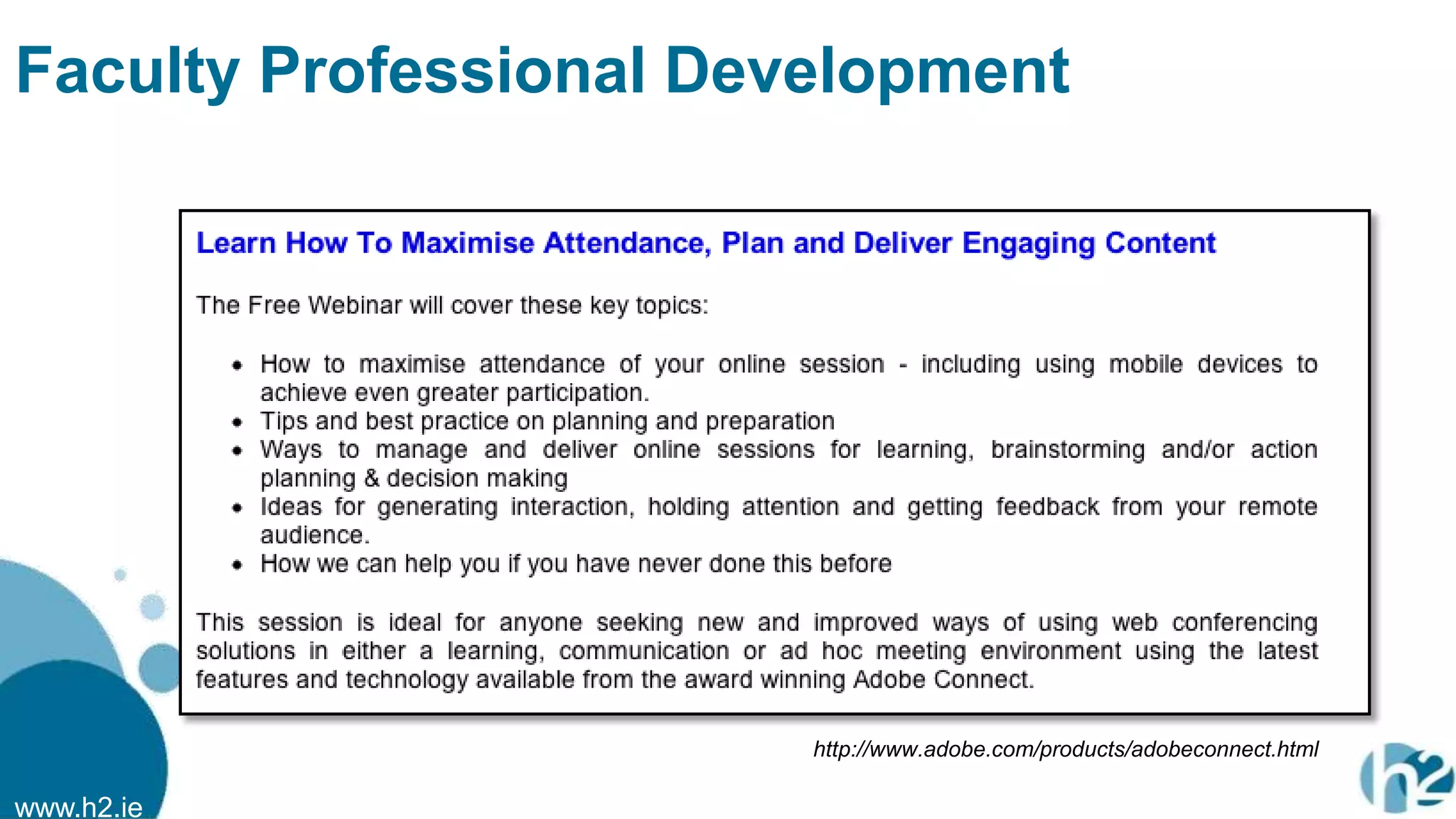
Faculty Professional Development
http://www.adobe.com/products/adobeconnect.html
www.h2.ie
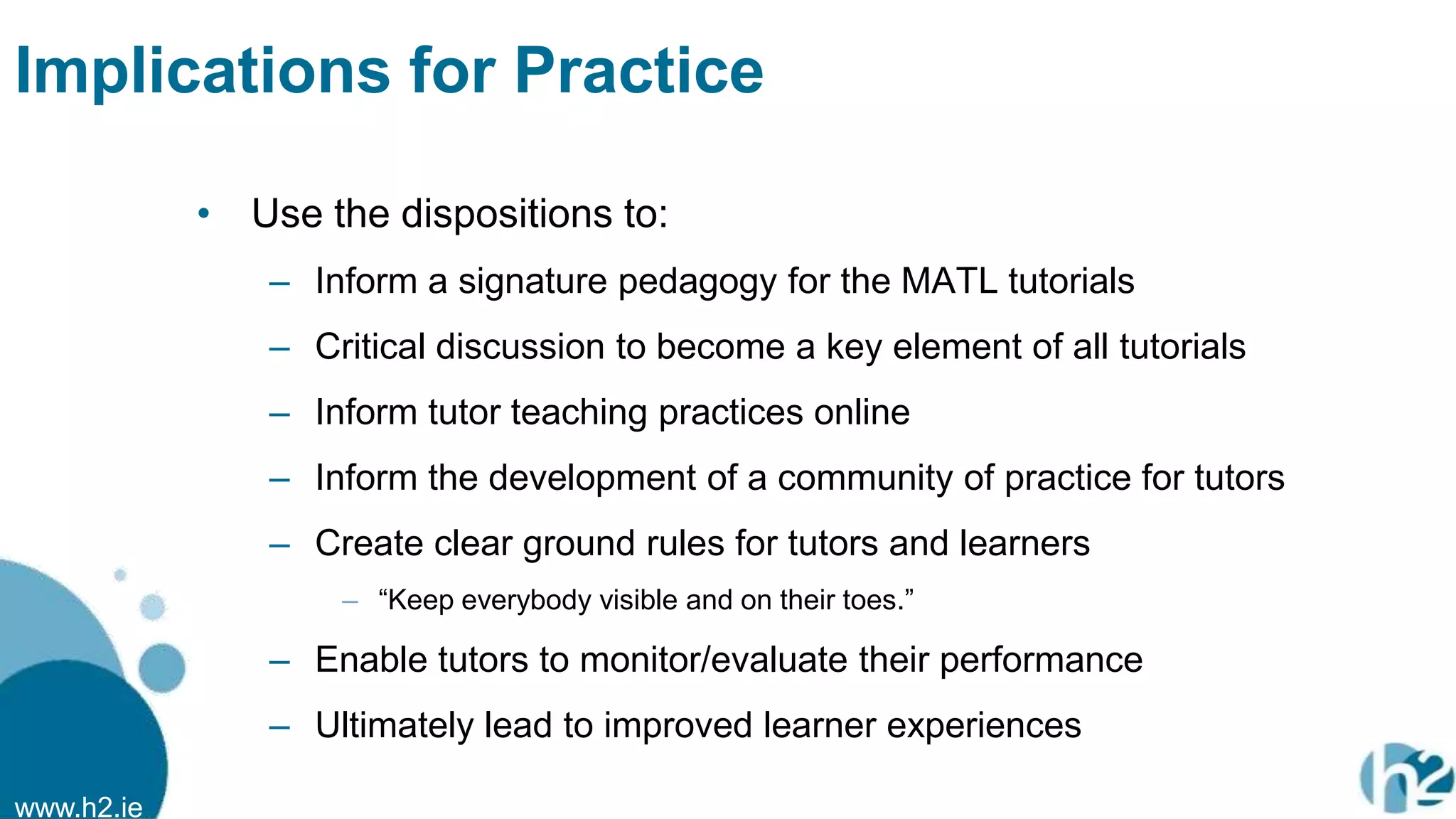
Implications for Practice
• Use the dispositions to:
– Inform a signature pedagogy for the MATL tutorials
– Critical discussion to become a key element of all tutorials
– Inform tutor teaching practices online
– Inform the development of a community of practice for tutors
– Create clear ground rules for tutors and learners
– “Keep everybody visible and on their toes.”
– Enable tutors to monitor/evaluate their performance
– Ultimately lead to improved learner experiences
www.h2.ie
Notion of a Signature Pedagogy
• Observing, analysing, and documenting how teaching and
learning occurred in a range of settings
• What are the forms of interaction that leap to mind when we
think of the MATL tutorial – is it critical discussion?
“They are the forms of instruction that leap to mind when we first
think about the preparation of members of particular professions –
for example in law, the quasi-Socratic interactions so vividly
portrayed in Paper Chase.”
(Shulman, 2005; p. 52)
www.h2.ie
Final Word
• Onus on the institution to develop the appropriate
signature pedagogy to ensure students do well.
• This will differ between institutions.
“Signature pedagogy is ultimately associated with the performance of
the students. If they are not doing well then the signature pedagogy
isn’t appropriate.” [emphasis added]
(Shulman, 2005; p.56)
www.h2.ie
Discussion
http://ff6w.primaryblogger.co.uk/discussion-text-sentence-builder/
www.h2.ie
Thank You
Michael Hallissy
H2 Learning
www.h2.ie
mhallissy@h2.ie
www.h2.ie
References
• Ashwin, P. (2005). 'Variation in students‟ experiences of the „Oxford Tutorial''. Higher
Education, 50, 631–644.
• Ashwin, P. (2009). Analysing Teaching-Learning Interactions in Higher Education:
Accounting for Sturcture and Agency. New York: Continuum.
• Barrows, H. S. (1992). The Tutorial Process. (Revised Ed.). Springfield, IL: Southern Illinois
University School of Medicine.
• Brookfield, S. and Preskill, S. (2005). Discussion as a way of teaching. (Vol. Second). San
Francisco: Jossey-Bass.
• Chi Ng, K. (2007). 'Replacing Face-to-Face Tutorials by Synchronous Online Technologies:
Challenges and Pedagogical Implications'. [Online]. International Review of Research in
Open and Distance Learning, 8 (1), 1-15. Available at:
http://www.irrodl.org/index.php/irrodl/article/view/335/764. [Last accessed September 1
2011].
• Duensing, A., Stickler, U., Batstone, C. and Heins, B. (2006, July 2006). Face-to-face and
online interactions - is a task a task? Paper presented at the Crossing Frontiers: Languages
and the International Dimension Conference. Cardiff University.
• Finkelstein, J. (2006). Learning in Real Time: Synchronous Teaching and Learning Online.
San Francisco, CA: Jossey-Bass.
www.h2.ie
References
• Hyder, K., Kwinn, A., Miazga, R. and Murray, M. (2007). Synchronous e-Learning. Santa
Rosa, CA: The eLearning Guild.
• Kear, K., Chetwynd, F., Williams, J. and Donelan, H. (2012). 'Web conferencing for
synchronous online tutorials: Perspectives of tutors using a new medium'. Computers &
Education, 58, 953-963.
• Laurillard, D. (2002). Rethinking University Teaching: A conversational framework for the
effective use of learning technologies. (Second Ed.). London and New York: Routledge
Falmer.
• Laurillard, D. (2012). Teaching as a Design Science. Building Pedagogical Patters for
Learning and Technology. New York and London: Routledge.
• Mason, R. (2001). 'Effective facilitation of online learning: the Open University
experience'. In J. Stephenson (Ed.), Teaching and learning online: New pedagogies for
new technologies. London: Kogan Page.
• Marks, L., Jackson, M., Marks, D. and Wilcox, D. (2010). Impact of an online tutorial on
postgraduate students‟ literature research skills. [Online]. Available at:
www.gla.ac.uk/media/media_148359_en.pdf. [Last accessed June 10 2012].
www.h2.ie
References
• Palloff, R. M. and Pratt, K. (2011). The Excellent Online Instructor. San Francisco, CA:
Jossey-Bass.
• Price, L., Richadson, J. T. E. and Jelfs, A. (2007). 'Face-to-face versus online tutoring
support in distance education'. Studies in Higher Education, 32 (1), 1-20.
• Rourke, L., Anderson, T., Garrison, R. D. and Archer, W. (1999). 'Assessing Social
Presence in Asynchronous Text-based Computer Conferencing'. Journal of Distance
Education, 14 (2), 50-71.
• Shulman, L. S. (2005). 'Signature pedagogies in the professions'. Daedalus,
(Summer), 52-59.
• THES Editorial. (1996). Tutorial system on the way out. [Online]. Available at:
http://www.timeshighereducation.co.uk/story.asp?storyCode=93627&sectioncode=26.
[Last accessed June 18th 2012].
• Watkins, C., Carnell, E., Lodge, C., Wagner P. and Whalley C. (2002). 'Effective
Learning'. Institute of Education International Network for School Improvement
Research Matters Series (17).

Online tutoring towards a signature pedagogy

  • 1.
    www.h2.ie Online Tutoring: Towardsa Signature Pedagogy Michael Hallissy H2 Learning and Hibernia College tutor
  • 2.
  • 3.
    www.h2.ie Presentation • Teaching Online– a perspective • The Online Tutorial • MATL Case-study • Discussion
  • 4.
    www.h2.ie Introduction • Founding partnerin H2 Learning – Assist institutions embed digital technologies to enhance teaching, learning and assessment practices • Former director the MATL in Hibernia College – Lead tutor in the Certificate in i-Learning • Completing EdD in Institute of Education, London • "Building teacher professionalism in teaching-learning interactions between online tutors and learners during synchronous tutorials – a case study from Hibernia College”
  • 5.
  • 6.
    www.h2.ie Some Perspective • OUnoted that “active discussion” has long been one of the aspects that is difficult to provide in distance education, with tutorials and summer schools being the usual means of achieving this” (Mason, 2001; 73) • Since 1988 significant body of research on discussion and online courses in HE – Majority focused on asynchronous technologies – forums particularly. • But today new options – Expansion of broadband – New technologies to support live interaction
  • 7.
    www.h2.ie Technology and whatit can do Today we have: • Synchronous Computer-mediated conferencing technologies (SCMC) – AT&T Connect, Adobe Connect, Wimba, Elluminate, Lync etc. “Computer-mediated conferencing (CMC) is unique among distance education media because of its ability to support high levels of responsive, intelligent interaction between and among faculty and students while simultaneously providing high levels of freedom of time and place to engage in this interactivity.” (Rourke et al., 1999; 50)
  • 8.
    www.h2.ie Synchronous Learning Environments “Synchronouslearning is live, real-time (and usually scheduled), facilitated instruction and learning-oriented interaction.” (Hyder et al., 2007: p. 1)
  • 9.
    www.h2.ie Teaching perspectives itcan support (Watkins et al., 2002)
  • 10.
  • 11.
    www.h2.ie What do wemean by an online tutorial? • The Oxford/Cambridge University notion of a tutorial (Ashwin, 2005) • The Higher Education notion of a 1 on 1 tutorial (THES Editorial, 1996) • The large group face-to-face tutor group (Barrows, 1992) • An online pre-recorded tutorial – (e.g. a software walkthrough using Captivate) (Marks et al., 2010) • Multiple types of „online synchronous tutorials‟ – (Chi Ng, 2007; Kear et al., 2012; Price et al., 2007; Duensing et al., 2006) • The challenge – Price (2007) found there was an issue in relation to student and tutor expectations of what is a tutorial?
  • 12.
    www.h2.ie The Invisible StudentChallenge • Role of the tutor is to support students to become independent learners and to engage “In these settings [traditional, didactic educational settings], the student is expected to know the right answer. He learned a long time ago that it is best to stay silent if he does not know the answer, or is unsure of it, for he knows that an admission of not knowing would be used as evidence of inadequate study or lack of intelligence.” (Barrows, 1992; p. 22)
  • 13.
    www.h2.ie Interrogation key partof a tutorial “However, a general structure appears to be that there will be an interrogation, whether questioning or discussion, of the work that the student(s) have completed in preparation for the tutorial.” (Ashwin, 2009; 633)
  • 14.
    www.h2.ie The challenge forteaching faculty “Teachers should share their knowledge and understanding in discussion only to help students gain a personal and critical perspective on what is learned, not to show off in front of them.” (192) Faculty domination of classroom interaction – “they think that they‟re supposed to – it‟s what the institution expects, it‟s what their colleagues do, and it‟s what the students demand.” (197) Creating a democratic classroom (Brookfield and Preskill, 2005)
  • 15.
    www.h2.ie Dispositions for aDemocratic Classroom http://bcfamily.ca/sweet-humility 1. Hospitality 2. Participation 3. Mindfulness 4. Humility 5. Mutuality 6. Deliberation 7. Appreciation 8. Hope 9. Autonomy (Brookfield and Preskill, 2005)
  • 16.
  • 17.
    www.h2.ie MATL Tutorial • Entireclass event (20-30) • Pre-arranged time in the calendar • Tutor and students on line together • Opportunity to “unpack” the lesson content • Recorded and available for download later • Tutor training provided in advance http://meylah.com/meylah/planning-your-online-tutorial
  • 18.
    www.h2.ie Students are NOTalways clear of their role Purpose of the tutorial Percentage Opportunity for tutor to present new content 57% Opportunity for tutor to revise content presented in the recorded lesson 93% Opportunity for students to raise questions and discuss the lesson content 100% Opportunity for students to work in small groups online 20% Opportunity for students to present their work to colleagues 21%
  • 19.
    www.h2.ie Are they engagedduring these sessions?
  • 20.
    www.h2.ie Or are theyotherwise engaged?
  • 21.
    www.h2.ie Challenges facing tutorsonline “Instructors who are new to the online environment may struggle with the transition from the central figure in the learning process to a facilitator or guide of that process.” (Palloff and Pratt, 2011)
  • 22.
    www.h2.ie Analysis of onlinetutorial interactions
  • 23.
    www.h2.ie A Tutor Perspective “Isuppose the official purpose of the tutorials is to expand on the lecture and maybe I do see a slightly differently [nervous laughter again] purpose. I didn‟t intend it but it is what has emerged and I now see they have a huge purpose in breaking down the isolation of the students and building a community of learners. You know helping the students in that community [develop] perspective taking, problem solving … but just seeing different points of view, sharing of ideas” Tutor View “I don‟t like the sound of my own voice too much of it [nervous laughter] so I love to give voice to others and to build up the team and that everybody in the classroom is teaching, like using all the resources in the classroom, that it is not just one teacher but everybody has something to teach and to share and to try and draw that ” Tutor View
  • 24.
  • 25.
  • 26.
    www.h2.ie Tutor must designdeliberation activities
  • 27.
  • 28.
    www.h2.ie Implications for Practice •Use the dispositions to: – Inform a signature pedagogy for the MATL tutorials – Critical discussion to become a key element of all tutorials – Inform tutor teaching practices online – Inform the development of a community of practice for tutors – Create clear ground rules for tutors and learners – “Keep everybody visible and on their toes.” – Enable tutors to monitor/evaluate their performance – Ultimately lead to improved learner experiences
  • 29.
    www.h2.ie Notion of aSignature Pedagogy • Observing, analysing, and documenting how teaching and learning occurred in a range of settings • What are the forms of interaction that leap to mind when we think of the MATL tutorial – is it critical discussion? “They are the forms of instruction that leap to mind when we first think about the preparation of members of particular professions – for example in law, the quasi-Socratic interactions so vividly portrayed in Paper Chase.” (Shulman, 2005; p. 52)
  • 30.
    www.h2.ie Final Word • Onuson the institution to develop the appropriate signature pedagogy to ensure students do well. • This will differ between institutions. “Signature pedagogy is ultimately associated with the performance of the students. If they are not doing well then the signature pedagogy isn’t appropriate.” [emphasis added] (Shulman, 2005; p.56)
  • 31.
  • 32.
    www.h2.ie Thank You Michael Hallissy H2Learning www.h2.ie mhallissy@h2.ie
  • 33.
    www.h2.ie References • Ashwin, P.(2005). 'Variation in students‟ experiences of the „Oxford Tutorial''. Higher Education, 50, 631–644. • Ashwin, P. (2009). Analysing Teaching-Learning Interactions in Higher Education: Accounting for Sturcture and Agency. New York: Continuum. • Barrows, H. S. (1992). The Tutorial Process. (Revised Ed.). Springfield, IL: Southern Illinois University School of Medicine. • Brookfield, S. and Preskill, S. (2005). Discussion as a way of teaching. (Vol. Second). San Francisco: Jossey-Bass. • Chi Ng, K. (2007). 'Replacing Face-to-Face Tutorials by Synchronous Online Technologies: Challenges and Pedagogical Implications'. [Online]. International Review of Research in Open and Distance Learning, 8 (1), 1-15. Available at: http://www.irrodl.org/index.php/irrodl/article/view/335/764. [Last accessed September 1 2011]. • Duensing, A., Stickler, U., Batstone, C. and Heins, B. (2006, July 2006). Face-to-face and online interactions - is a task a task? Paper presented at the Crossing Frontiers: Languages and the International Dimension Conference. Cardiff University. • Finkelstein, J. (2006). Learning in Real Time: Synchronous Teaching and Learning Online. San Francisco, CA: Jossey-Bass.
  • 34.
    www.h2.ie References • Hyder, K.,Kwinn, A., Miazga, R. and Murray, M. (2007). Synchronous e-Learning. Santa Rosa, CA: The eLearning Guild. • Kear, K., Chetwynd, F., Williams, J. and Donelan, H. (2012). 'Web conferencing for synchronous online tutorials: Perspectives of tutors using a new medium'. Computers & Education, 58, 953-963. • Laurillard, D. (2002). Rethinking University Teaching: A conversational framework for the effective use of learning technologies. (Second Ed.). London and New York: Routledge Falmer. • Laurillard, D. (2012). Teaching as a Design Science. Building Pedagogical Patters for Learning and Technology. New York and London: Routledge. • Mason, R. (2001). 'Effective facilitation of online learning: the Open University experience'. In J. Stephenson (Ed.), Teaching and learning online: New pedagogies for new technologies. London: Kogan Page. • Marks, L., Jackson, M., Marks, D. and Wilcox, D. (2010). Impact of an online tutorial on postgraduate students‟ literature research skills. [Online]. Available at: www.gla.ac.uk/media/media_148359_en.pdf. [Last accessed June 10 2012].
  • 35.
    www.h2.ie References • Palloff, R.M. and Pratt, K. (2011). The Excellent Online Instructor. San Francisco, CA: Jossey-Bass. • Price, L., Richadson, J. T. E. and Jelfs, A. (2007). 'Face-to-face versus online tutoring support in distance education'. Studies in Higher Education, 32 (1), 1-20. • Rourke, L., Anderson, T., Garrison, R. D. and Archer, W. (1999). 'Assessing Social Presence in Asynchronous Text-based Computer Conferencing'. Journal of Distance Education, 14 (2), 50-71. • Shulman, L. S. (2005). 'Signature pedagogies in the professions'. Daedalus, (Summer), 52-59. • THES Editorial. (1996). Tutorial system on the way out. [Online]. Available at: http://www.timeshighereducation.co.uk/story.asp?storyCode=93627&sectioncode=26. [Last accessed June 18th 2012]. • Watkins, C., Carnell, E., Lodge, C., Wagner P. and Whalley C. (2002). 'Effective Learning'. Institute of Education International Network for School Improvement Research Matters Series (17).

Editor's Notes

  • #6 Moore’s notion of interaction Interaction with contentInteraction with tutorInteraction with peers
  • #7 Learning at a distance has been around since 1890s1st online OU Course 1988 (Mason, 2001)
  • #8 Key point is that the technology or the medium is not going to determine the quality of learningOkay you select a good product/tool but it is how you use it that counts – the lecturer is key in using the tool“The claims made for the educational value of CMC rest on the assumption that students learn effectively through discussion and collaboration” (Laurillard, 2002; 147)She notes that “the properties of a medium do not determine the quality of learning that takes place” (Ibid;147)
  • #9 research around online learning highlights the need for students to be actively engaged in creating their own knowledge (Salmon, 2008; Hrastinski, 2009; van Alst and Hill, 2001)
  • #12 Price et al. (2007), in a study conducted in the Open University, found that there was an issue in relation to student and tutor expectations of what constituted an ‘online tutorial’. It appears that the expectations, particularly those of the students, did not match those of the tutors and these were based primarily on student experiences in face-to-face tutorials within the OU or elsewhere.
  • #13 The tutor typically adopts three roles –modelling, coaching and fading so that ultimately they can support the learners to become independent learners
  • #15 Role of the teacher as a “discussion leader”They note that teachers that are democratically inclined often remain silent.If tutor is too enthusiastic the students “slip easily into the role of passive audience” (194)
  • #22 The active construction of knowledge by learners through a process of real-time give-and-take is well-served in a live online setting (Finkelstein, 2006)The notion of Collaboration - "Collaboration is a key element to the success of an online learning environment (Conrad and Donaldson, 2004)No matter what technology we employ, it is still the human experience that is most important. Students learn from teacheres, their peers, and knowledge experts. No one learns from a computer" (Kimura, 2002)
  • #23 Mixture of methods – FIAC and TPACK
  • #27 a small-group discussion format designed to help students get the most out of an issue or case study by assigning them "positions" in terms of the issue presented by the case, asking them to generate arguments in favour of that position, then forcing them to argue against that position, and finally asking them to synthesize what they have learned into a position upon which both sides could most likely agree. http://ctl.utexas.edu/teaching-resources/teach-your-course/facilitate-with-intention/constructive-controversy/
  • #31 Notion of Context