HERE to Stay? Findings from the HERE Project 2008 - 2011 Ed Foster, Nottingham Trent University
HERE Project Higher Education: Retention & Engagement 2007 NAO report Staying the Course 2008 Public Accounts Committee HEFCE’s response  “ The UK is justly proud of its record in achieving higher estimated graduation rates than most other OECD countries. This is a timely report and we will be studying its recommendations carefully. We are pleased it acknowledges that the comparatively high level of retention has been achieved and maintained during a period when higher education has been opened up to both increased numbers and a greater diversity of students.”
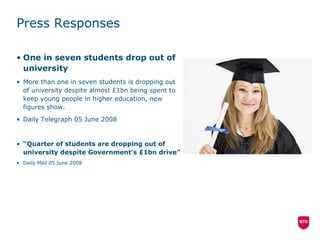
Press Responses One in seven students drop out of university  More than one in seven students is dropping out of university despite almost £1bn being spent to keep young people in higher education, new figures show.  Daily Telegraph 05 June 2008 “ Quarter of students are dropping out of university despite Government's £1bn drive” Daily Mail 05 June 2008
What Works? Student Retention & Success PHF & HEFCE Managed by HEA & Action on Access 7 projects Bradford, Bournemouth & NTU What practice works? Not setting out to prove a particular practice worked, but tested two hypotheses What impact does student doubting have on retention & success? What impact do programme teams have on retention & success?
‘ Doubt is not a pleasant condition, but certainty is an absurd one’ Voltaire
Doubting Defined as having doubts about the course/ university  serious enough to consider leaving How many students are doubters in the literature? 21% Rickinson and Rutherford (1995)  –  39% Sodexo (2010) Glamorgan  –  26% rising to 40%  Doubting as a cause of withdrawal Gradual accumulation of doubts Ozga and Sukhnandan (1998) Differences between doubters and leavers Internal factors - Mackie (2001), ability to adapt - Roberts et al (2003) But UK progression is good NAO (2007) suggests that progression to yr 2 is approx 90% Our work is therefore also about engagement
Engagement Kuh et al  (2008) describe student engagement as  “the quality of effort students themselves devote to educationally purposeful activities that contribute directly to desired outcomes and the effort institutions devote to using effective educational practices”. ‘ Student engagement in educationally purposeful activities during the first year of college had a positive, statistically significant effect on persistence, even after controlling for background characteristics, other college, experiences during the first year, academic achievement and financial aid.’  (Kuh et al, 2008, p551) Astin (1985)  - engagement (involvement) along a continuum Hardy and Bryson  (2010) student engagement  - belonging, emotional engagement
Methodology Welcome Week Surveys & Student Transition Surveys (2009 & 2011) to all first year undergraduates (online) Student focus groups with doubters and non doubters Analysis of persistence Interviews with programmes– what do programmes do best to support retention? Student survey Case studies of 10 programmes across the three institutions
Key Findings
Finding a)  Approximately one third of first year students have experienced doubts sufficiently strong to make them consider withdrawing at some point during the first year.
Finding b)  Doubters are more likely to leave than non-doubters 483 students granted us permission to monitor their persistence 182 doubters 301 non-doubter Tested Dec 2009 - Overall progression better than institutional benchmarks Implications Links to other UK research & supports Ozga & Sukhnandan’s model Withdrawal not due to a sudden shock
Finding c)  Doubters reported a poorer quality experience than students who have not doubted  Measured 17 student experience factors For example  ‘my subject is interesting’ Tested both the importance and actual experience of a factor In most instances importance was higher than the actual experience Exceptions – social, peer & family support Average gap for non-doubters = 12% Average gap for doubters = 29% Tested seriousness in 2011, more serious doubts = poorer experience Factor analysis grouped the Student Experience Factors into 3 variables Academic Experience Variables Support, Resources and Future Goals Student Lifestyle Strongest link between academic experience and likelihood of early withdrawal
Poorer quality experience continued Doubters reported: Less likely to understand the differences between FE & HE Less likely to have had difference explained Less likely to find pre-arrival course accurate Finding course less enjoyable Fewer friends Less likely to feel that they belonged Studies harder to cope with At UoB scored lower grades Feeling less confident to ask for help Overall gave an impression of being far less well engaged with their peers, their course and their university Evidence about UCAS tariff was inconclusive “ I don’t seem very involved  with the University to be honest  …  probably if I see my tutor on the road,  he wouldn’t recognise me” .
Finding d)  Students usually report more than one reason for doubting Doubting appears to become a state of mind Been looking for differences between doubters who stayed & doubters who left The main difference was that doubters who left reported a more negative experience overall
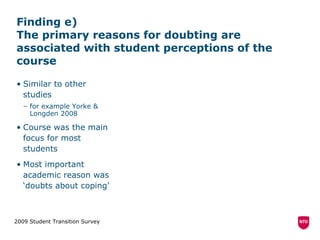
Finding e)  The primary reasons for doubting are associated with student perceptions of the course Similar to other studies for example Yorke & Longden 2008 Course was the main focus for most students Most important academic reason was ‘doubts about coping’ 2009 Student Transition Survey
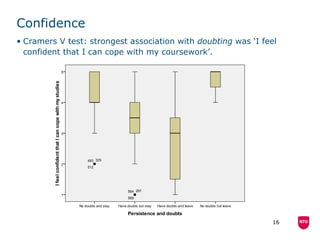
Confidence Cramers V test: strongest association with  doubting  was ‘I feel confident that I can cope with my coursework’.
Finding f)  There were four main reasons cited by doubters for staying ‘ Support from friends and family’ ‘ Adapting to course/ university’ ‘ Determination/ internal factors’ ‘ Future goals/ employment’ Impact of friends & family undervalued by students In 2009, open question  Friends & family most important (friends at university) In 2011, when asked to choose from options Personal determination Future goals & employment Then friends & family
Finding g)  The primary times for considering leaving are immediately before and after Christmas Weather, tiredness & January blues will play a factor, but Also key times around first assessments & feedback Relatively few of our respondents stated that they had doubts before arriving at University
Finding h)  Students reported different degrees of doubting
Finding i)  Some student groups appear more likely to doubt than others  Students are more likely to be doubters if they are in the following groups Female – but less likely to actually leave Prior US studies suggest that female students suffer a dip in confidence during the first year not recovered until the second Male doubters were far more likely to leave Student with disabilities – also more likely to leave Part-time students – more likely to leave Accommodation (living in private halls more likely to doubt)
Key Recommendations
Key Recommendations
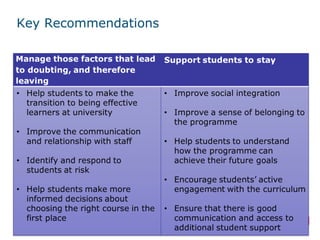
Manage those factors that lead to doubting, and therefore leaving
Recommendation 1)  Help students to make the transition to being effective learners at university Formative feedback Confidence Strongest association with feedback followed by supportive peers & relationship with tutors Understand differences between FE & HE Doubters less likely to understand the differences At NTU, implementing Student Tutorial Initiative from 2011 “ At the beginning of the course I was a bit  overwhelmed by the amount of people who were  clearly very smart … After completing my first few assignments  I convinced myself I hadn’t done very well, but I got good  marks throughout the year as well as very detailed  feedback so I was able to improve my work”  (NTU doubter)
Recommendation 1)  Help students to make the transition to being effective learners at university Peer support PAL at BU was often mentioned by doubters as beneficial Differentiation within the cohort For 2/3 of learners, the experience appears to be a positive one For 1/3 – less engaged, less clear about what is happening Do we design additional support into the curriculum for these students? Understanding of assessment Doubters less likely to report that assessment is as they expected
Recommendation 2) Improve the communication and relationship with staff Positive staff student relationships Communication with Students A shared responsibility to communicate to students “ I see him quite often even if I just  bump into him and he asks me if everything is going OK.  If I’ve got any problems I always go and see him …  so it’s been good”
Recommendation 3) Identify and respond to students at risk  Monitor and review institutional and programme level data as part of annual quality assurance processes Monitor ‘at risk’ times Monitor engagement not just attendance Informal contacts between staff and students Respond to students at risk
Recommendation 4) Help students make more informed decisions about choosing the right course in the first place Use of Open Days & other communication channels Matching students to the course
Support students to stay
Recommendation 5)  Improve social integration  Doubters perceived their courses to be less friendly & friendship important reason to stay Pre-arrival activities including social networking Stepping Stones to HE at Bournemouth Students who used the service were far less likely to be doubters than those who used facebook etc “ I was not sure if university was for me. I disliked earlier education … and, although my course is satisfactory enough, I don't LOVE it. I think my good friends in halls/good friends in my seminar group/social life have kept me here.”
Recommendation 5)  Improve social integration  Programme induction NTU Welcome Week feedback (2007) students main priority for course induction is making friends Welcome Week Survey 2011, main place to make friends is in course induction Group work (particularly field trips) Peer support Again PAL featured strongly, students found peer led ice breakers and other activities beneficial “ I’ve never been so homesick as I was that weekend  … but what it did do was really pulled [together] our friendships … because we were feeling a little bit out of our depth … when you came back after,  then you really felt that you knew all the people” (BU student)
Recommendation 6) Improve a sense of belonging to the programme Developing good relationships with peers Developing a good working relationship with tutors Developing a sense of community within the programme Sense of belonging to the wider university community
Recommendation 7) Foster motivation and help students understand how the programme can help achieve their future goals Relationships with staff & behavioural expectations Preparation for future roles Real work experience, field work and placements
Recommendation 8) Encourage students’ active engagement with the curriculum Encourage active learning Teaching to engage first year students Varied learning experiences
Recommendation 9) Ensure that there is good communication and access to additional student support Raise student awareness of the services available Ensure that programme teams know how to refer students to professional and specialist support
Conclusions
Conclusions Doubting is an important factor concerning persistence Doubters are more likely to leave early Warning signs are there & can be managed Doubters are less engaged, more disconnected from their peers, programme & university Seem to be less able to understand the differences Doubting is primarily related to the experience of the programme Strongly suggest that institutional responses are therefore focused on the curriculum and the programme first Other factors are very important to particular groups Overall strategy Manage the factors that lead to doubting Support doubters
Using the HERE Project NTU  Sarah Lawther is working with 6 programme teams this year to explore the themes raised [email_address]   HERE Project toolkit Details the main findings of the HERE project with opportunities to reflect and consider your own practices Available later this term Web resources www.HEREProject.org.uk Will be filled with toolkit and resources over the course of this term

Here Project Student Writing in Transition Symposium 2011

  • 1.
    HERE to Stay?Findings from the HERE Project 2008 - 2011 Ed Foster, Nottingham Trent University
  • 2.
    HERE Project HigherEducation: Retention & Engagement 2007 NAO report Staying the Course 2008 Public Accounts Committee HEFCE’s response “ The UK is justly proud of its record in achieving higher estimated graduation rates than most other OECD countries. This is a timely report and we will be studying its recommendations carefully. We are pleased it acknowledges that the comparatively high level of retention has been achieved and maintained during a period when higher education has been opened up to both increased numbers and a greater diversity of students.”
  • 3.
    Press Responses Onein seven students drop out of university More than one in seven students is dropping out of university despite almost £1bn being spent to keep young people in higher education, new figures show. Daily Telegraph 05 June 2008 “ Quarter of students are dropping out of university despite Government's £1bn drive” Daily Mail 05 June 2008
  • 4.
    What Works? StudentRetention & Success PHF & HEFCE Managed by HEA & Action on Access 7 projects Bradford, Bournemouth & NTU What practice works? Not setting out to prove a particular practice worked, but tested two hypotheses What impact does student doubting have on retention & success? What impact do programme teams have on retention & success?
  • 5.
    ‘ Doubt isnot a pleasant condition, but certainty is an absurd one’ Voltaire
  • 6.
    Doubting Defined ashaving doubts about the course/ university serious enough to consider leaving How many students are doubters in the literature? 21% Rickinson and Rutherford (1995) – 39% Sodexo (2010) Glamorgan – 26% rising to 40% Doubting as a cause of withdrawal Gradual accumulation of doubts Ozga and Sukhnandan (1998) Differences between doubters and leavers Internal factors - Mackie (2001), ability to adapt - Roberts et al (2003) But UK progression is good NAO (2007) suggests that progression to yr 2 is approx 90% Our work is therefore also about engagement
  • 7.
    Engagement Kuh etal (2008) describe student engagement as “the quality of effort students themselves devote to educationally purposeful activities that contribute directly to desired outcomes and the effort institutions devote to using effective educational practices”. ‘ Student engagement in educationally purposeful activities during the first year of college had a positive, statistically significant effect on persistence, even after controlling for background characteristics, other college, experiences during the first year, academic achievement and financial aid.’ (Kuh et al, 2008, p551) Astin (1985) - engagement (involvement) along a continuum Hardy and Bryson (2010) student engagement - belonging, emotional engagement
  • 8.
    Methodology Welcome WeekSurveys & Student Transition Surveys (2009 & 2011) to all first year undergraduates (online) Student focus groups with doubters and non doubters Analysis of persistence Interviews with programmes– what do programmes do best to support retention? Student survey Case studies of 10 programmes across the three institutions
  • 9.
  • 10.
    Finding a) Approximately one third of first year students have experienced doubts sufficiently strong to make them consider withdrawing at some point during the first year.
  • 11.
    Finding b) Doubters are more likely to leave than non-doubters 483 students granted us permission to monitor their persistence 182 doubters 301 non-doubter Tested Dec 2009 - Overall progression better than institutional benchmarks Implications Links to other UK research & supports Ozga & Sukhnandan’s model Withdrawal not due to a sudden shock
  • 12.
    Finding c) Doubters reported a poorer quality experience than students who have not doubted Measured 17 student experience factors For example ‘my subject is interesting’ Tested both the importance and actual experience of a factor In most instances importance was higher than the actual experience Exceptions – social, peer & family support Average gap for non-doubters = 12% Average gap for doubters = 29% Tested seriousness in 2011, more serious doubts = poorer experience Factor analysis grouped the Student Experience Factors into 3 variables Academic Experience Variables Support, Resources and Future Goals Student Lifestyle Strongest link between academic experience and likelihood of early withdrawal
  • 13.
    Poorer quality experiencecontinued Doubters reported: Less likely to understand the differences between FE & HE Less likely to have had difference explained Less likely to find pre-arrival course accurate Finding course less enjoyable Fewer friends Less likely to feel that they belonged Studies harder to cope with At UoB scored lower grades Feeling less confident to ask for help Overall gave an impression of being far less well engaged with their peers, their course and their university Evidence about UCAS tariff was inconclusive “ I don’t seem very involved with the University to be honest … probably if I see my tutor on the road, he wouldn’t recognise me” .
  • 14.
    Finding d) Students usually report more than one reason for doubting Doubting appears to become a state of mind Been looking for differences between doubters who stayed & doubters who left The main difference was that doubters who left reported a more negative experience overall
  • 15.
    Finding e) The primary reasons for doubting are associated with student perceptions of the course Similar to other studies for example Yorke & Longden 2008 Course was the main focus for most students Most important academic reason was ‘doubts about coping’ 2009 Student Transition Survey
  • 16.
    Confidence Cramers Vtest: strongest association with doubting was ‘I feel confident that I can cope with my coursework’.
  • 17.
    Finding f) There were four main reasons cited by doubters for staying ‘ Support from friends and family’ ‘ Adapting to course/ university’ ‘ Determination/ internal factors’ ‘ Future goals/ employment’ Impact of friends & family undervalued by students In 2009, open question Friends & family most important (friends at university) In 2011, when asked to choose from options Personal determination Future goals & employment Then friends & family
  • 18.
    Finding g) The primary times for considering leaving are immediately before and after Christmas Weather, tiredness & January blues will play a factor, but Also key times around first assessments & feedback Relatively few of our respondents stated that they had doubts before arriving at University
  • 19.
    Finding h) Students reported different degrees of doubting
  • 20.
    Finding i) Some student groups appear more likely to doubt than others Students are more likely to be doubters if they are in the following groups Female – but less likely to actually leave Prior US studies suggest that female students suffer a dip in confidence during the first year not recovered until the second Male doubters were far more likely to leave Student with disabilities – also more likely to leave Part-time students – more likely to leave Accommodation (living in private halls more likely to doubt)
  • 21.
  • 22.
  • 23.
    Manage those factorsthat lead to doubting, and therefore leaving
  • 24.
    Recommendation 1) Help students to make the transition to being effective learners at university Formative feedback Confidence Strongest association with feedback followed by supportive peers & relationship with tutors Understand differences between FE & HE Doubters less likely to understand the differences At NTU, implementing Student Tutorial Initiative from 2011 “ At the beginning of the course I was a bit overwhelmed by the amount of people who were clearly very smart … After completing my first few assignments I convinced myself I hadn’t done very well, but I got good marks throughout the year as well as very detailed feedback so I was able to improve my work” (NTU doubter)
  • 25.
    Recommendation 1) Help students to make the transition to being effective learners at university Peer support PAL at BU was often mentioned by doubters as beneficial Differentiation within the cohort For 2/3 of learners, the experience appears to be a positive one For 1/3 – less engaged, less clear about what is happening Do we design additional support into the curriculum for these students? Understanding of assessment Doubters less likely to report that assessment is as they expected
  • 26.
    Recommendation 2) Improvethe communication and relationship with staff Positive staff student relationships Communication with Students A shared responsibility to communicate to students “ I see him quite often even if I just bump into him and he asks me if everything is going OK. If I’ve got any problems I always go and see him … so it’s been good”
  • 27.
    Recommendation 3) Identifyand respond to students at risk Monitor and review institutional and programme level data as part of annual quality assurance processes Monitor ‘at risk’ times Monitor engagement not just attendance Informal contacts between staff and students Respond to students at risk
  • 28.
    Recommendation 4) Helpstudents make more informed decisions about choosing the right course in the first place Use of Open Days & other communication channels Matching students to the course
  • 29.
  • 30.
    Recommendation 5) Improve social integration Doubters perceived their courses to be less friendly & friendship important reason to stay Pre-arrival activities including social networking Stepping Stones to HE at Bournemouth Students who used the service were far less likely to be doubters than those who used facebook etc “ I was not sure if university was for me. I disliked earlier education … and, although my course is satisfactory enough, I don't LOVE it. I think my good friends in halls/good friends in my seminar group/social life have kept me here.”
  • 31.
    Recommendation 5) Improve social integration Programme induction NTU Welcome Week feedback (2007) students main priority for course induction is making friends Welcome Week Survey 2011, main place to make friends is in course induction Group work (particularly field trips) Peer support Again PAL featured strongly, students found peer led ice breakers and other activities beneficial “ I’ve never been so homesick as I was that weekend … but what it did do was really pulled [together] our friendships … because we were feeling a little bit out of our depth … when you came back after, then you really felt that you knew all the people” (BU student)
  • 32.
    Recommendation 6) Improvea sense of belonging to the programme Developing good relationships with peers Developing a good working relationship with tutors Developing a sense of community within the programme Sense of belonging to the wider university community
  • 33.
    Recommendation 7) Fostermotivation and help students understand how the programme can help achieve their future goals Relationships with staff & behavioural expectations Preparation for future roles Real work experience, field work and placements
  • 34.
    Recommendation 8) Encouragestudents’ active engagement with the curriculum Encourage active learning Teaching to engage first year students Varied learning experiences
  • 35.
    Recommendation 9) Ensurethat there is good communication and access to additional student support Raise student awareness of the services available Ensure that programme teams know how to refer students to professional and specialist support
  • 36.
  • 37.
    Conclusions Doubting isan important factor concerning persistence Doubters are more likely to leave early Warning signs are there & can be managed Doubters are less engaged, more disconnected from their peers, programme & university Seem to be less able to understand the differences Doubting is primarily related to the experience of the programme Strongly suggest that institutional responses are therefore focused on the curriculum and the programme first Other factors are very important to particular groups Overall strategy Manage the factors that lead to doubting Support doubters
  • 38.
    Using the HEREProject NTU Sarah Lawther is working with 6 programme teams this year to explore the themes raised [email_address] HERE Project toolkit Details the main findings of the HERE project with opportunities to reflect and consider your own practices Available later this term Web resources www.HEREProject.org.uk Will be filled with toolkit and resources over the course of this term

Editor's Notes

  • #9 All first year undergraduates May 2009 Limitations Voluntary responses May not be accessing students not engaged with university NEXT TIME – UCAS TARRIF, WHAT DOES GET STUDENTS ENGAGED ETC. Talk about changes…ask more quantiative questions and explore where we need further information – when they doubted,
  • #11 At NTU, most had decided to stay
  • #12 Small number of non-doubters who withdrew