Future role of teachers
S G Deshmukh
ABV-Indian Institute of Information Technology &
Management Gwalior
FDP on Promoting Quality in Higher Technical Education
18 Jan 2016
Speaking points..
Imperatives
About teaching & teacher
Various trends
– Collaboration
– Open Learn
– Social Media
– Implications
Closing remarks..
2
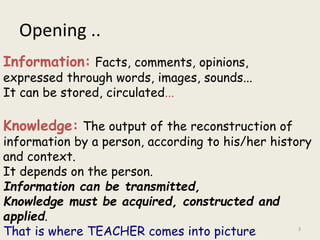
Opening ..
3
Information: Facts, comments, opinions,
expressed through words, images, sounds...
It can be stored, circulated...
Knowledge: The output of the reconstruction of
information by a person, according to his/her history
and context.
It depends on the person.
Information can be transmitted,
Knowledge must be acquired, constructed and
applied.
That is where TEACHER comes into picture
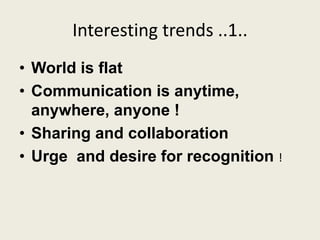
Interesting trends ..1..
• World is flat
• Communication is anytime,
anywhere, anyone !
• Sharing and collaboration
• Urge and desire for recognition !
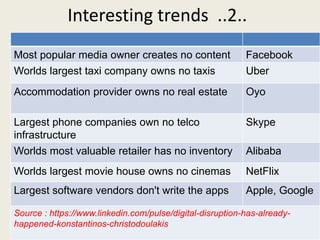
Interesting trends ..2..
Most popular media owner creates no content Facebook
Worlds largest taxi company owns no taxis Uber
Accommodation provider owns no real estate Oyo
Largest phone companies own no telco
infrastructure
Skype
Worlds most valuable retailer has no inventory Alibaba
Worlds largest movie house owns no cinemas NetFlix
Largest software vendors don't write the apps Apple, Google
Source : https://www.linkedin.com/pulse/digital-disruption-has-already-
happened-konstantinos-christodoulakis
• You may find the following talk by Salman
Khan of Khan Academy interesting :
• http://www.ted.com/talks/salman_khan_let_s
_use_video_to_reinvent_education?%a0
6
15
7
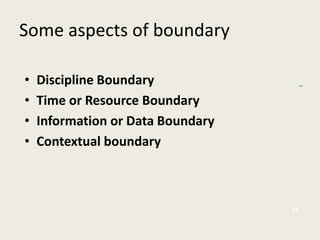
Some aspects of boundary
• Discipline Boundary
• Time or Resource Boundary
• Information or Data Boundary
• Contextual boundary
Digital disruption..
• “Today, almost in every field, there is a
disruptive digital innovation which has helped
collapse the distribution and delivery
channel”:examples:
Flipkart,/Snapdeal/Amazon, Netflix etc.
– Vinayak Garg (Entrepreneur, at a session Infotsav,
IIITMG, Oct 2015)
8
Basic assumptions challenged?
• Teacher to student ratio;
• Space?
• Sacrosanct class room teaching, and restricted
class room interaction; and
• Emphasis on single medium (such as black
board): Today the medium is laced with multi-
media based content!!
9
Forces responsible for digital disruption
• Social media
• Mobile
• AI & Robotics
• Cloud computing
• Knowledge
• Implication: Teacher to assume digital
competency !!
10
Is he/she a teacher?
• Fundamental assumptions being challenged
• Are we better than Google?
• If yes, how? If no, why?
11
Comment..
• “Everything is connected to everything else “
• Connected world view
– Enabled by intrinsic desire to be “connected”
– Enabled by teaching ?
– Enabled by IT
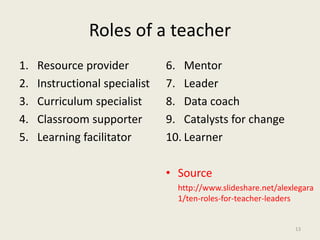
Roles of a teacher
1. Resource provider
2. Instructional specialist
3. Curriculum specialist
4. Classroom supporter
5. Learning facilitator
6. Mentor
7. Leader
8. Data coach
9. Catalysts for change
10. Learner
• Source
http://www.slideshare.net/alexlegara
1/ten-roles-for-teacher-leaders
13
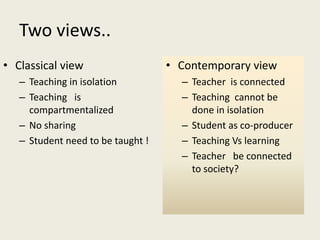
Two views..
• Classical view
– Teaching in isolation
– Teaching is
compartmentalized
– No sharing
– Student need to be taught !
• Contemporary view
– Teacher is connected
– Teaching cannot be
done in isolation
– Student as co-producer
– Teaching Vs learning
– Teacher be connected
to society?
Connecting with oneself
• Identify your strengths
• Leverage these strengths
• Develop your teaching philosophy
• Develop your glossary
• Develop/use appropriate methodology
• Internalize teaching (one must absorb deeply
into the process so that the topic becomes
part of his genetic code or DNA )
Future teacher as a Connected
Teacher
Various trends..
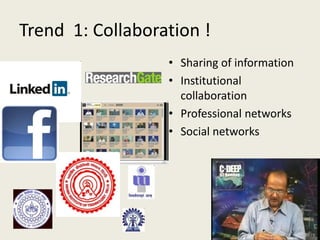
Trend 1: Collaboration !
• Sharing of information
• Institutional
collaboration
• Professional networks
• Social networks
Implications
• Sharing of information/Knowledge made easy
• “Open source” paradigm
• You must collaborate
• Your collaborator may be anywhere in the
globe!
• Be comfortable with power & influence of
social media !
• “Teaching 2.0 “ ?
Trend 2: OpenLearn
• OpenLearn is funded by the William and Flora Hewlett
foundation.
• OpenLearn – supports sites:
- the LearningSpace – a supported open learning
site for learners; and
- the LabSpace – a supported community
building site for creators
http://www.open.edu/openlearn/
Mooc movment
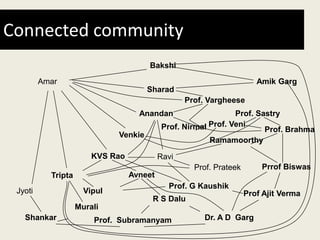
Connected community
Amar Amik Garg
Bakshi
KVS Rao
Sharad
Tripta
Anandan Prof. Sastry
Venkie
Prof Ajit Verma
Prof. Brahma
Prrof Biswas
Prof. G Kaushik
Dr. A D Garg
Ravi
R S Dalu
Avneet
Vipul
Prof. Vargheese
Ramamoorthy
Murali
Prof. Nirmal
Prof. Prateek
Jyoti
Shankar Prof. Subramanyam
Prof. Veni
Trend 3: Social media
• Social media are tools for social interaction using
Web-based and mobile technologies (Wikipedia).
• These technologies, often referred to as Web 2.0
or social software, provide services that support
users in generating and publishing their own
content.
• The social interactions developed as a result of
this activity can support engagement with
communities of practice through networking and
other co-operative and collaborative practices.
Digital media..
• Formal dialogues : skype, google+
• Informal interactions: google chats, facebook
• Documentation: Dropbox, google drive ,
Mendeley, Zetero
• Space for reflection: 750words.com, blogs
• Engaging with community: researchgate,
academia, LinkedIn
• Keeping informed about
conferences/developments : RSS feeds, podcasts,
webinar
Example: Blogs
Blogs are a great way to share information
–Test your ideas out with a wide audience
–Learn from others
–Form new relationships
–Build / manage your online personal brand
23
Characteristics of CT
• Connected teacher is IT savvy
• Connected teacher spend more time online
compared to an average teacher
• Connected teacher responds positively to
criticism
• Connected teacher is positively engaged with
the topic
• Connected teacher is also a Contended
teacher
24
• https://www.imsglobal.org/article/what-
disruptive-innovation-education
25
Insights..
• Education is a complex services paradigm in which quality is
difficult to define. Disruption in the education space requires
better service orientation and close contact with customer
• The next phase will be to come out of the current era of
massification into more real world relevant and personalized
educational pathways. , thanks to Mooc and other open
platforms available
• The “disruptive technology” will promote diversity. Diversity in
terms of delivery models and blending of high touch with
personalized self-service. , Flipped class rooms etc. will be in
vogue
26
Models for transformation
• The integrity model: very similar to original,
as complete as possible, study as the
original;
• The essence model: source material cut
back, keep essential features, text into
shorter blocks;
• The remix model: source material is starting
point, redesigned for web delivery.
Lane (2006) ‘From Pillar to Post: …’
http://kn.open.ac.uk/public/document.cfm?documentid=9724
Multiple roles of future teacher..
• As a connected person
• As a facilitator
• As a mentor/coach
• As a co-producer of knowledge
• As a learner
• As a good citizen
28
Closing remarks..
• To be effective teacher , one must be able
connect research with
• Oneself
• Institute
• Society
• In contemporary world, teacher must also be
connected . For this digital disruptive forces
offer an interesting scope
29
References
Bozalek V, N’gambi D & Gachago D (in press) Emerging Technologies in South African HEIs: Institutional
enables and constraints
Eysenbach G (2011) Can Tweets Predict Citations? Metrics of Social Impact Based on Twitter and Correlation
with Traditional Metrics of Scientific Impact. Journal of Medical Internet Research 13(4). Available at:
http://www.jmir.org/2011/4/e123
Priem J (2012) Toward a Second Revolution: altmetrics, total-impact, and the decoupled journal.
Presented at Purdue University, 14 February 2012. Available at:
https://docs.google.com/present/view?id=ddfg787c_362f465q2g5
Surowieki J (2004) The wisdom of crowds. Why the many are smarter than the few and how collective wisdom
shapes business, economies, societies and nations. New York: Doubleday
Thorin SE (2003) Global changes in scholarly communication. In SC Hsianghoo, PWT Poon and C McNaught
(eds) eLearning and Digital Publishing. Dordrecht: Springer. Available at
http://www.springerlink.com/content/w873x131171x2421/
Waldrop M (2008) Science 2.0: Great new tool, or great risk? Scientific American. Available at:
http://www.scientificamerican.com/article.cfm?id=science-2-point-0-great-new-tool-or-great-risk
Thank you
deshmukh.sg@gmail.com
31

Future role-of-a-teacher-fdp

  • 1.
    Future role ofteachers S G Deshmukh ABV-Indian Institute of Information Technology & Management Gwalior FDP on Promoting Quality in Higher Technical Education 18 Jan 2016
  • 2.
    Speaking points.. Imperatives About teaching& teacher Various trends – Collaboration – Open Learn – Social Media – Implications Closing remarks.. 2
  • 3.
    Opening .. 3 Information: Facts,comments, opinions, expressed through words, images, sounds... It can be stored, circulated... Knowledge: The output of the reconstruction of information by a person, according to his/her history and context. It depends on the person. Information can be transmitted, Knowledge must be acquired, constructed and applied. That is where TEACHER comes into picture
  • 4.
    Interesting trends ..1.. •World is flat • Communication is anytime, anywhere, anyone ! • Sharing and collaboration • Urge and desire for recognition !
  • 5.
    Interesting trends ..2.. Mostpopular media owner creates no content Facebook Worlds largest taxi company owns no taxis Uber Accommodation provider owns no real estate Oyo Largest phone companies own no telco infrastructure Skype Worlds most valuable retailer has no inventory Alibaba Worlds largest movie house owns no cinemas NetFlix Largest software vendors don't write the apps Apple, Google Source : https://www.linkedin.com/pulse/digital-disruption-has-already- happened-konstantinos-christodoulakis
  • 6.
    • You mayfind the following talk by Salman Khan of Khan Academy interesting : • http://www.ted.com/talks/salman_khan_let_s _use_video_to_reinvent_education?%a0 6
  • 7.
    15 7 Some aspects ofboundary • Discipline Boundary • Time or Resource Boundary • Information or Data Boundary • Contextual boundary
  • 8.
    Digital disruption.. • “Today,almost in every field, there is a disruptive digital innovation which has helped collapse the distribution and delivery channel”:examples: Flipkart,/Snapdeal/Amazon, Netflix etc. – Vinayak Garg (Entrepreneur, at a session Infotsav, IIITMG, Oct 2015) 8
  • 9.
    Basic assumptions challenged? •Teacher to student ratio; • Space? • Sacrosanct class room teaching, and restricted class room interaction; and • Emphasis on single medium (such as black board): Today the medium is laced with multi- media based content!! 9
  • 10.
    Forces responsible fordigital disruption • Social media • Mobile • AI & Robotics • Cloud computing • Knowledge • Implication: Teacher to assume digital competency !! 10
  • 11.
    Is he/she ateacher? • Fundamental assumptions being challenged • Are we better than Google? • If yes, how? If no, why? 11
  • 12.
    Comment.. • “Everything isconnected to everything else “ • Connected world view – Enabled by intrinsic desire to be “connected” – Enabled by teaching ? – Enabled by IT
  • 13.
    Roles of ateacher 1. Resource provider 2. Instructional specialist 3. Curriculum specialist 4. Classroom supporter 5. Learning facilitator 6. Mentor 7. Leader 8. Data coach 9. Catalysts for change 10. Learner • Source http://www.slideshare.net/alexlegara 1/ten-roles-for-teacher-leaders 13
  • 14.
    Two views.. • Classicalview – Teaching in isolation – Teaching is compartmentalized – No sharing – Student need to be taught ! • Contemporary view – Teacher is connected – Teaching cannot be done in isolation – Student as co-producer – Teaching Vs learning – Teacher be connected to society?
  • 15.
    Connecting with oneself •Identify your strengths • Leverage these strengths • Develop your teaching philosophy • Develop your glossary • Develop/use appropriate methodology • Internalize teaching (one must absorb deeply into the process so that the topic becomes part of his genetic code or DNA )
  • 16.
    Future teacher asa Connected Teacher Various trends..
  • 17.
    Trend 1: Collaboration! • Sharing of information • Institutional collaboration • Professional networks • Social networks
  • 18.
    Implications • Sharing ofinformation/Knowledge made easy • “Open source” paradigm • You must collaborate • Your collaborator may be anywhere in the globe! • Be comfortable with power & influence of social media ! • “Teaching 2.0 “ ?
  • 19.
    Trend 2: OpenLearn •OpenLearn is funded by the William and Flora Hewlett foundation. • OpenLearn – supports sites: - the LearningSpace – a supported open learning site for learners; and - the LabSpace – a supported community building site for creators http://www.open.edu/openlearn/ Mooc movment
  • 20.
    Connected community Amar AmikGarg Bakshi KVS Rao Sharad Tripta Anandan Prof. Sastry Venkie Prof Ajit Verma Prof. Brahma Prrof Biswas Prof. G Kaushik Dr. A D Garg Ravi R S Dalu Avneet Vipul Prof. Vargheese Ramamoorthy Murali Prof. Nirmal Prof. Prateek Jyoti Shankar Prof. Subramanyam Prof. Veni
  • 21.
    Trend 3: Socialmedia • Social media are tools for social interaction using Web-based and mobile technologies (Wikipedia). • These technologies, often referred to as Web 2.0 or social software, provide services that support users in generating and publishing their own content. • The social interactions developed as a result of this activity can support engagement with communities of practice through networking and other co-operative and collaborative practices.
  • 22.
    Digital media.. • Formaldialogues : skype, google+ • Informal interactions: google chats, facebook • Documentation: Dropbox, google drive , Mendeley, Zetero • Space for reflection: 750words.com, blogs • Engaging with community: researchgate, academia, LinkedIn • Keeping informed about conferences/developments : RSS feeds, podcasts, webinar
  • 23.
    Example: Blogs Blogs area great way to share information –Test your ideas out with a wide audience –Learn from others –Form new relationships –Build / manage your online personal brand 23
  • 24.
    Characteristics of CT •Connected teacher is IT savvy • Connected teacher spend more time online compared to an average teacher • Connected teacher responds positively to criticism • Connected teacher is positively engaged with the topic • Connected teacher is also a Contended teacher 24
  • 25.
  • 26.
    Insights.. • Education isa complex services paradigm in which quality is difficult to define. Disruption in the education space requires better service orientation and close contact with customer • The next phase will be to come out of the current era of massification into more real world relevant and personalized educational pathways. , thanks to Mooc and other open platforms available • The “disruptive technology” will promote diversity. Diversity in terms of delivery models and blending of high touch with personalized self-service. , Flipped class rooms etc. will be in vogue 26
  • 27.
    Models for transformation •The integrity model: very similar to original, as complete as possible, study as the original; • The essence model: source material cut back, keep essential features, text into shorter blocks; • The remix model: source material is starting point, redesigned for web delivery. Lane (2006) ‘From Pillar to Post: …’ http://kn.open.ac.uk/public/document.cfm?documentid=9724
  • 28.
    Multiple roles offuture teacher.. • As a connected person • As a facilitator • As a mentor/coach • As a co-producer of knowledge • As a learner • As a good citizen 28
  • 29.
    Closing remarks.. • Tobe effective teacher , one must be able connect research with • Oneself • Institute • Society • In contemporary world, teacher must also be connected . For this digital disruptive forces offer an interesting scope 29
  • 30.
    References Bozalek V, N’gambiD & Gachago D (in press) Emerging Technologies in South African HEIs: Institutional enables and constraints Eysenbach G (2011) Can Tweets Predict Citations? Metrics of Social Impact Based on Twitter and Correlation with Traditional Metrics of Scientific Impact. Journal of Medical Internet Research 13(4). Available at: http://www.jmir.org/2011/4/e123 Priem J (2012) Toward a Second Revolution: altmetrics, total-impact, and the decoupled journal. Presented at Purdue University, 14 February 2012. Available at: https://docs.google.com/present/view?id=ddfg787c_362f465q2g5 Surowieki J (2004) The wisdom of crowds. Why the many are smarter than the few and how collective wisdom shapes business, economies, societies and nations. New York: Doubleday Thorin SE (2003) Global changes in scholarly communication. In SC Hsianghoo, PWT Poon and C McNaught (eds) eLearning and Digital Publishing. Dordrecht: Springer. Available at http://www.springerlink.com/content/w873x131171x2421/ Waldrop M (2008) Science 2.0: Great new tool, or great risk? Scientific American. Available at: http://www.scientificamerican.com/article.cfm?id=science-2-point-0-great-new-tool-or-great-risk
  • 31.