CATHOLIC UNIVERSITY OF EASTERN
AFRICA.
Faculty of Arts and Social Sciences.
SPO101: Introduction to Political Science.
Room TH 04.
Lecture 2
Instructor: Mr. Omondi Okwany.
January-April 2017
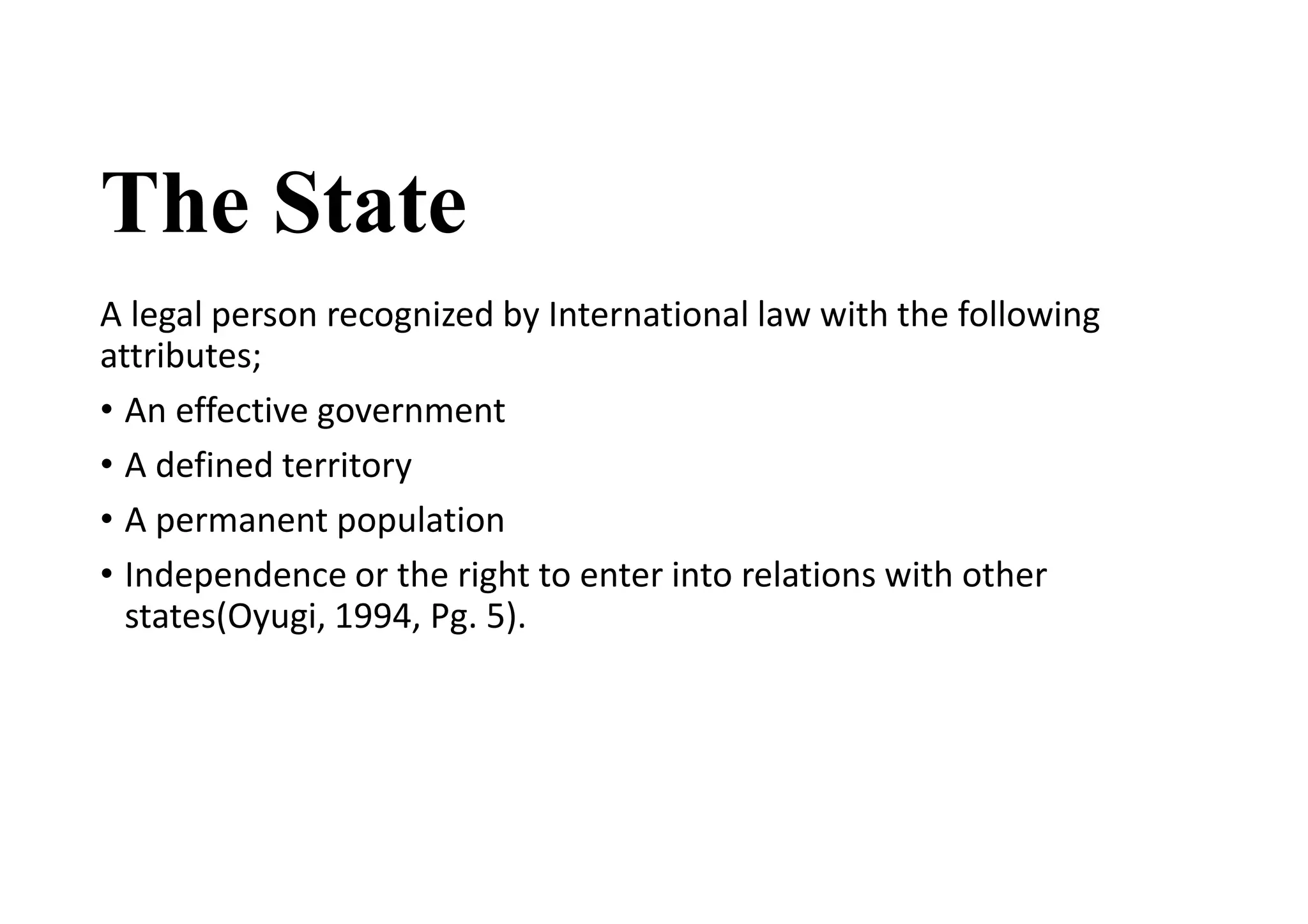
The State
A legal person recognized by International law with the following
attributes;
• An effective government
• A defined territory
• A permanent population
• Independence or the right to enter into relations with other
states(Oyugi, 1994, Pg. 5).
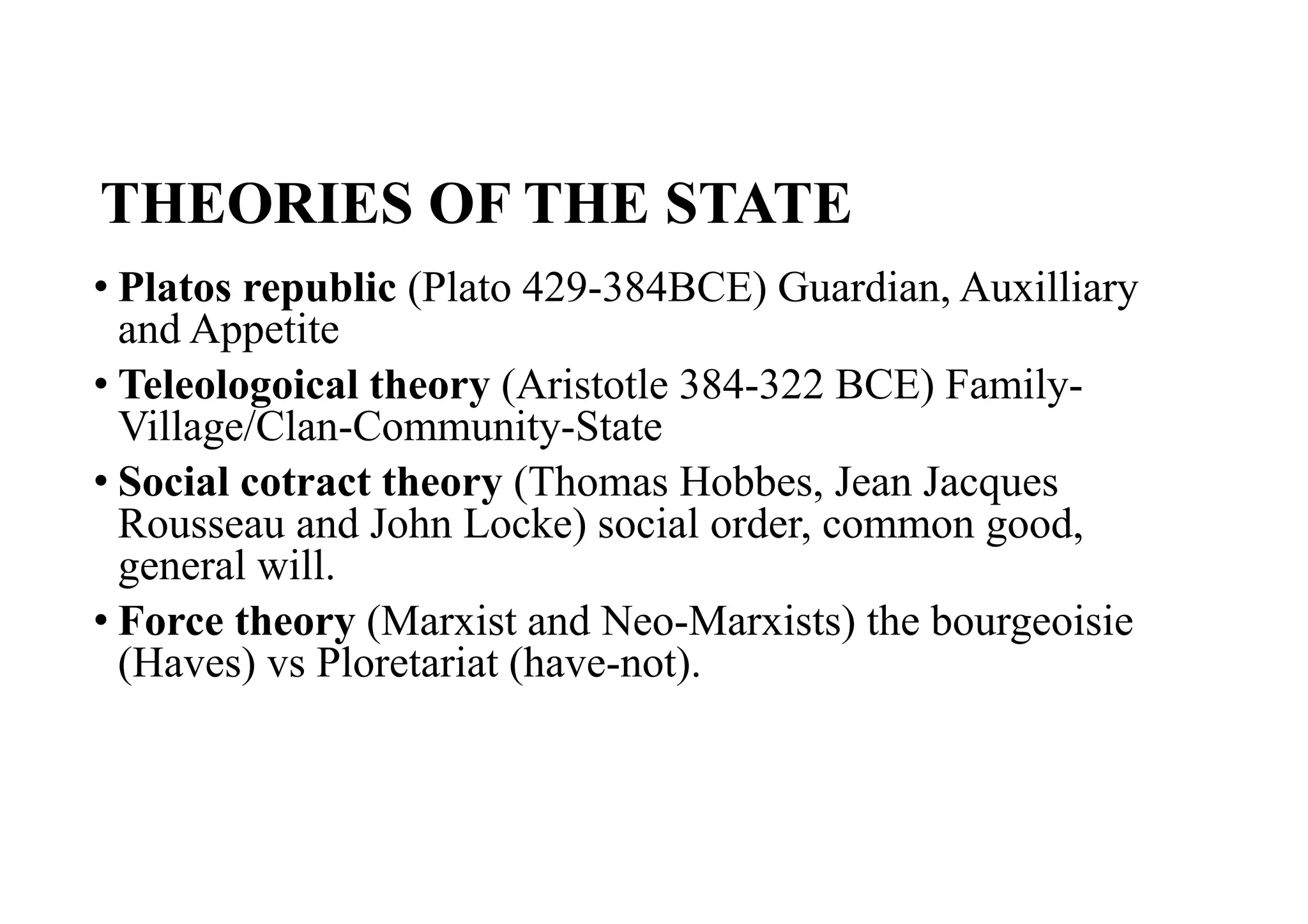
THEORIES OF THE STATE
• Platos republic (Plato 429-384BCE) Guardian, Auxilliary
and Appetite
• Teleologoical theory (Aristotle 384-322 BCE) Family-
Village/Clan-Community-State
• Social cotract theory (Thomas Hobbes, Jean Jacques
Rousseau and John Locke) social order, common good,
general will.
• Force theory (Marxist and Neo-Marxists) the bourgeoisie
(Haves) vs Ploretariat (have-not).
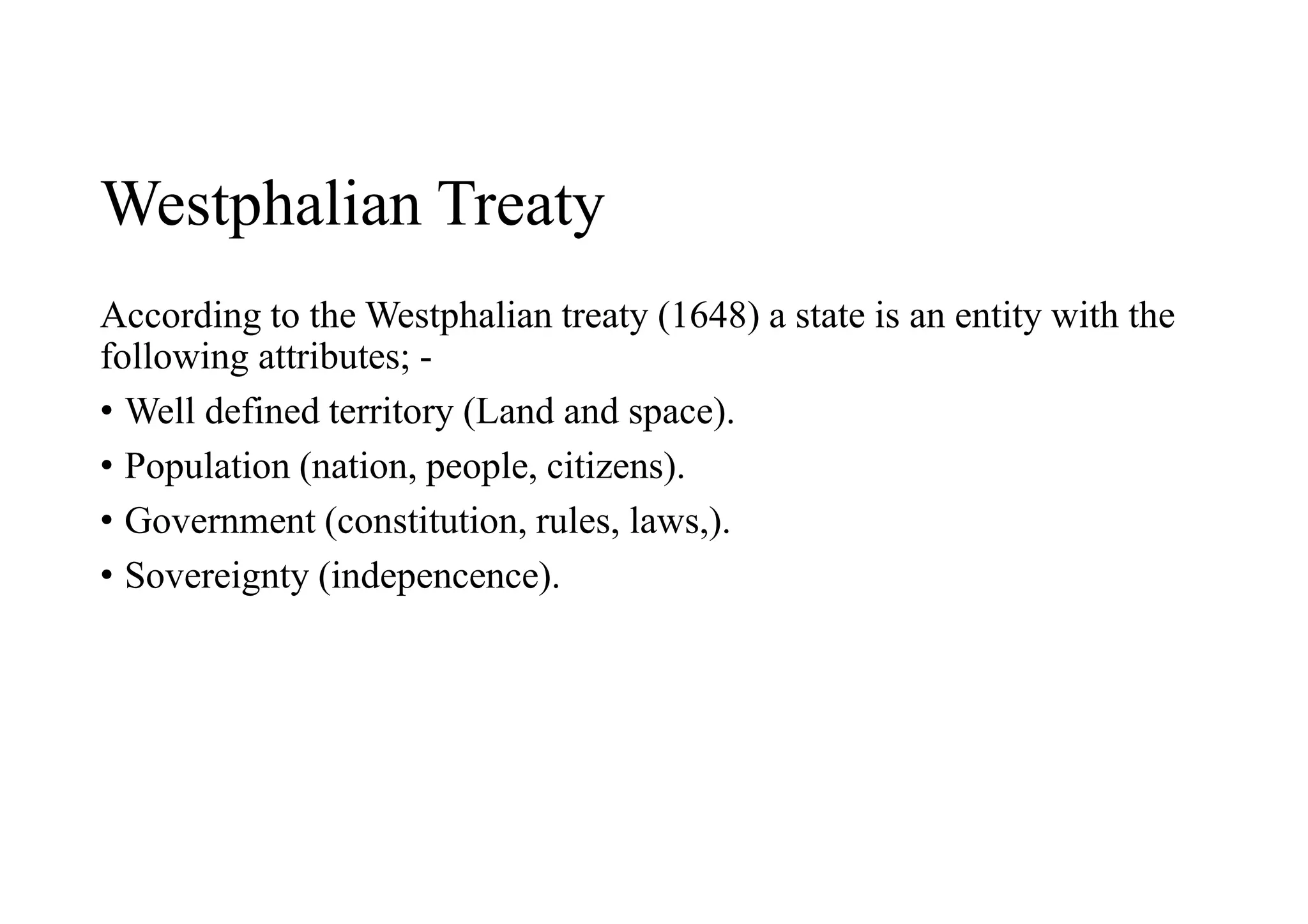
Westphalian Treaty
According to the Westphalian treaty (1648) a state is an entity with the
following attributes; -
• Well defined territory (Land and space).
• Population (nation, people, citizens).
• Government (constitution, rules, laws,).
• Sovereignty (indepencence).
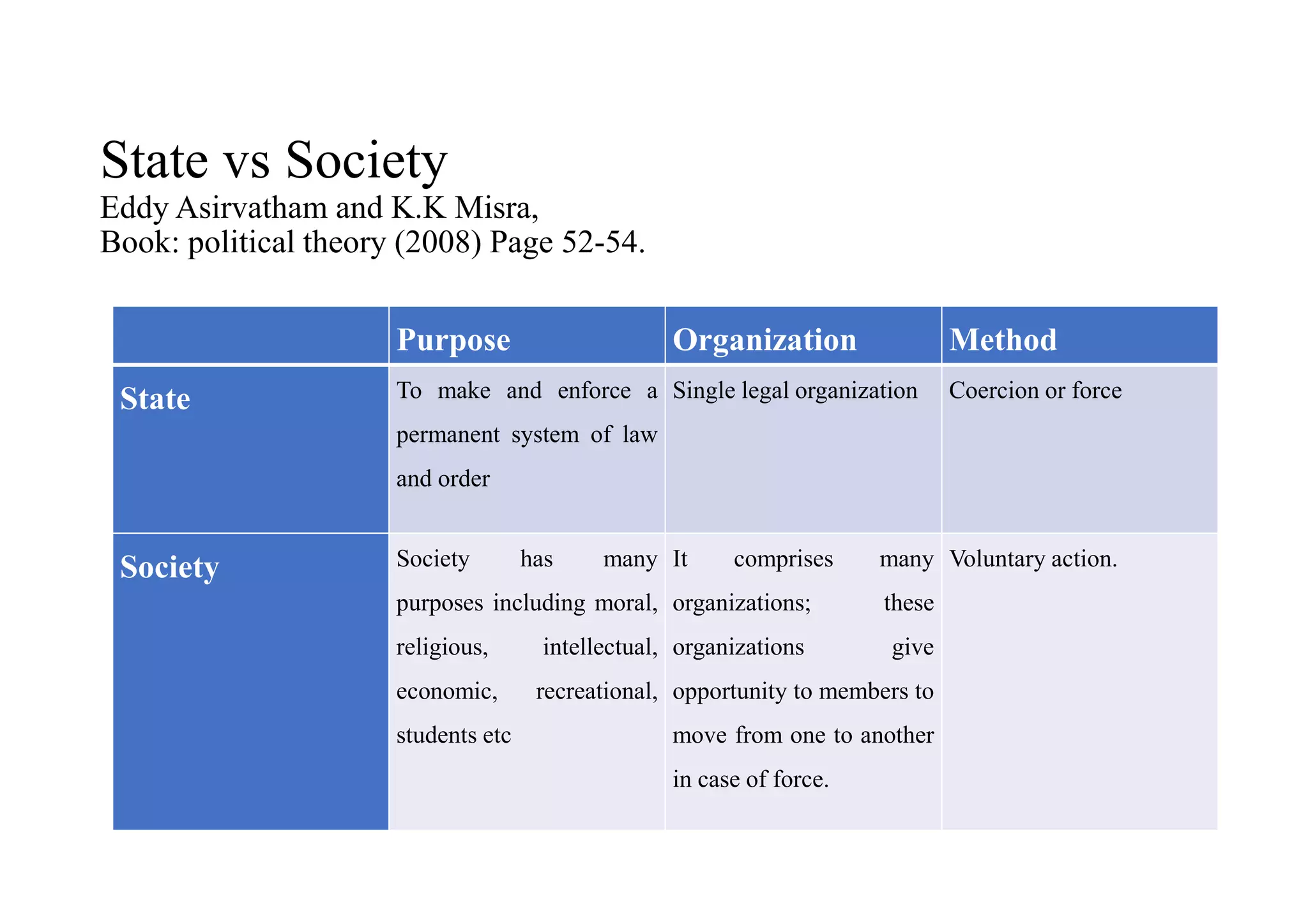
State vs Society
Eddy Asirvatham and K.K Misra,
Book: political theory (2008) Page 52-54.
Purpose Organization Method
State To make and enforce a
permanent system of law
and order
Single legal organization Coercion or force
Society Society has many
purposes including moral,
religious, intellectual,
economic, recreational,
students etc
It comprises many
organizations; these
organizations give
opportunity to members to
move from one to another
in case of force.
Voluntary action.
Reference
• Asirvatham, E., & Misra, K. (2008). Political Theory, New Delhi, S.
Chand and.(chapter 4).
• Easton, D. (1953). The political system: Knopf New York.
• Sinclair, T. A. (1962). Aristotle the politics: Penguin Books.

What is the State?

  • 1.
    CATHOLIC UNIVERSITY OFEASTERN AFRICA. Faculty of Arts and Social Sciences. SPO101: Introduction to Political Science. Room TH 04. Lecture 2 Instructor: Mr. Omondi Okwany. January-April 2017
  • 2.
    The State A legalperson recognized by International law with the following attributes; • An effective government • A defined territory • A permanent population • Independence or the right to enter into relations with other states(Oyugi, 1994, Pg. 5).
  • 3.
    THEORIES OF THESTATE • Platos republic (Plato 429-384BCE) Guardian, Auxilliary and Appetite • Teleologoical theory (Aristotle 384-322 BCE) Family- Village/Clan-Community-State • Social cotract theory (Thomas Hobbes, Jean Jacques Rousseau and John Locke) social order, common good, general will. • Force theory (Marxist and Neo-Marxists) the bourgeoisie (Haves) vs Ploretariat (have-not).
  • 4.
    Westphalian Treaty According tothe Westphalian treaty (1648) a state is an entity with the following attributes; - • Well defined territory (Land and space). • Population (nation, people, citizens). • Government (constitution, rules, laws,). • Sovereignty (indepencence).
  • 5.
    State vs Society EddyAsirvatham and K.K Misra, Book: political theory (2008) Page 52-54. Purpose Organization Method State To make and enforce a permanent system of law and order Single legal organization Coercion or force Society Society has many purposes including moral, religious, intellectual, economic, recreational, students etc It comprises many organizations; these organizations give opportunity to members to move from one to another in case of force. Voluntary action.
  • 6.
    Reference • Asirvatham, E.,& Misra, K. (2008). Political Theory, New Delhi, S. Chand and.(chapter 4). • Easton, D. (1953). The political system: Knopf New York. • Sinclair, T. A. (1962). Aristotle the politics: Penguin Books.