OUR SHARED NILE: A source of water,
food and energy for all.
Presented
At
At the Kenya Metrological Department (Climate change
secretariate)
Presenter: Omondi Okwany
Contact: cliffmode2006@gmail.com
The Nile and its tributraries
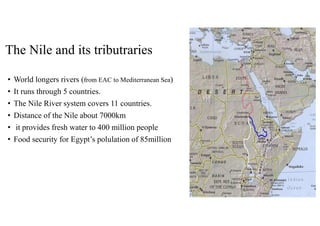
• World longers rivers (from EAC to Mediterranean Sea)
• It runs through 5 countries.
• The Nile River system covers 11 countries.
• Distance of the Nile about 7000km
• it provides fresh water to 400 million people
• Food security for Egypt’s polulation of 85million
Politics of the Nile
• Water security
• Nile river System and basin (11 countries)
• Cooperative Framework Agreement (CFA) (2007)
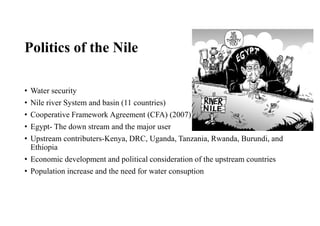
• Egypt- The down stream and the major user
• Upstream contributers-Kenya, DRC, Uganda, Tanzania, Rwanda, Burundi, and
Ethiopia
• Economic development and political consideration of the upstream countries
• Population increase and the need for water consuption
Conflict
• 1959 sudan-egypt treaty of the nile.
• Economic developments
• Increase of water scarcity
• Human interference in water supply
• Demand for Energy (electricity Uganda and Ethiopia)
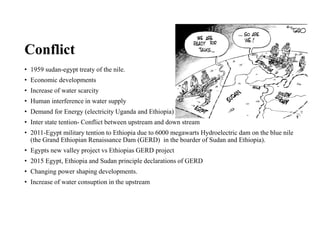
• Inter state tention- Conflict between upstream and down stream
• 2011-Egypt military tention to Ethiopia due to 6000 megawarts Hydroelectric dam on the blue nile
(the Grand Ethiopian Renaissance Dam (GERD) in the boarder of Sudan and Ethiopia).
• Egypts new valley project vs Ethiopias GERD project
• 2015 Egypt, Ethiopia and Sudan principle declarations of GERD
• Changing power shaping developments.
• Increase of water consuption in the upstream
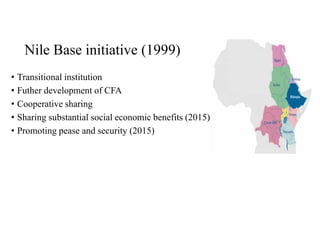
Nile Base initiative (1999)
• Transitional institution
• Futher development of CFA
• Cooperative sharing
• Sharing substantial social economic benefits (2015)
• Promoting pease and security (2015)
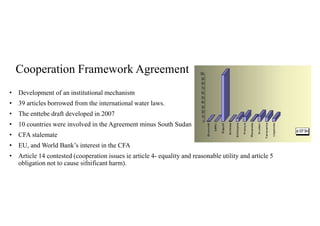
Cooperation Framework Agreement
• Development of an institutional mechanism
• 39 articles borrowed from the international water laws.
• The enttebe draft developed in 2007
• 10 countries were involved in the Agreement minus South Sudan
• CFA stalemate
• EU, and World Bank’s interest in the CFA
• Article 14 contested (cooperation issues ie article 4- equality and reasonable utility and article 5
obligation not to cause sifnificant harm).
CFA’s 15 Principles
• Water security
• Social economic value of water
• Water as finite and vulnerable resource
• Peaceful resolution of disputes
• environmental Impact Assessment (EIA)
• Information sharing
• Community interest
• Information concerning planed measures
• Protection and conservation
• Cooperation
• Sustainable development
• Subsidiarity(protection planed and implemented at the lower level)
• Equity and reasonable utility
• Prevention of significant harm
• The use of water within territory
Reference
• Abdalla, I. H. (1971). The 1959 Nile Waters Agreement in Sudanese-Egyptian
Relations. Middle Eastern Studies, 7(3), 329-341.
• Mekonnen, D. Z. (2010). The Nile Basin Cooperative Framework Agreement
negotiations and the adoption of a ‘water security’paradigm: Flight into obscurity
or a logical cul-de-sac? European Journal of International Law, 21(2), 421-440.
• Metawie, A. F., & Sector, N. W. (2004). Lessons Learnt From Cooperation in the
Nile Basin. Paper presented at the Fourth Biennial Rosenberg International Forum
on Water Policy. Retrieved from http://rosenberg. ucanr. org/forum4. cfm.
• Mulat, A. G., & Moges, S. A. (2014). Assessment of the impact of the Grand
Ethiopian Renaissance Dam on the performance of the High Aswan Dam. Journal
of Water Resource and Protection, 2014.
• Waterbury, J., & Whittington, D. (1998). Playing chicken on the Nile? The
implications of microdam development in the Ethiopian highlands and Egypt's
New Valley Project. Paper presented at the Natural Resources Forum.

OUR SHARED NILE

  • 1.
    OUR SHARED NILE:A source of water, food and energy for all. Presented At At the Kenya Metrological Department (Climate change secretariate) Presenter: Omondi Okwany Contact: cliffmode2006@gmail.com
  • 2.
    The Nile andits tributraries • World longers rivers (from EAC to Mediterranean Sea) • It runs through 5 countries. • The Nile River system covers 11 countries. • Distance of the Nile about 7000km • it provides fresh water to 400 million people • Food security for Egypt’s polulation of 85million
  • 3.
    Politics of theNile • Water security • Nile river System and basin (11 countries) • Cooperative Framework Agreement (CFA) (2007) • Egypt- The down stream and the major user • Upstream contributers-Kenya, DRC, Uganda, Tanzania, Rwanda, Burundi, and Ethiopia • Economic development and political consideration of the upstream countries • Population increase and the need for water consuption
  • 4.
    Conflict • 1959 sudan-egypttreaty of the nile. • Economic developments • Increase of water scarcity • Human interference in water supply • Demand for Energy (electricity Uganda and Ethiopia) • Inter state tention- Conflict between upstream and down stream • 2011-Egypt military tention to Ethiopia due to 6000 megawarts Hydroelectric dam on the blue nile (the Grand Ethiopian Renaissance Dam (GERD) in the boarder of Sudan and Ethiopia). • Egypts new valley project vs Ethiopias GERD project • 2015 Egypt, Ethiopia and Sudan principle declarations of GERD • Changing power shaping developments. • Increase of water consuption in the upstream
  • 5.
    Nile Base initiative(1999) • Transitional institution • Futher development of CFA • Cooperative sharing • Sharing substantial social economic benefits (2015) • Promoting pease and security (2015)
  • 6.
    Cooperation Framework Agreement •Development of an institutional mechanism • 39 articles borrowed from the international water laws. • The enttebe draft developed in 2007 • 10 countries were involved in the Agreement minus South Sudan • CFA stalemate • EU, and World Bank’s interest in the CFA • Article 14 contested (cooperation issues ie article 4- equality and reasonable utility and article 5 obligation not to cause sifnificant harm).
  • 7.
    CFA’s 15 Principles •Water security • Social economic value of water • Water as finite and vulnerable resource • Peaceful resolution of disputes • environmental Impact Assessment (EIA) • Information sharing • Community interest • Information concerning planed measures • Protection and conservation • Cooperation • Sustainable development • Subsidiarity(protection planed and implemented at the lower level) • Equity and reasonable utility • Prevention of significant harm • The use of water within territory
  • 8.
    Reference • Abdalla, I.H. (1971). The 1959 Nile Waters Agreement in Sudanese-Egyptian Relations. Middle Eastern Studies, 7(3), 329-341. • Mekonnen, D. Z. (2010). The Nile Basin Cooperative Framework Agreement negotiations and the adoption of a ‘water security’paradigm: Flight into obscurity or a logical cul-de-sac? European Journal of International Law, 21(2), 421-440. • Metawie, A. F., & Sector, N. W. (2004). Lessons Learnt From Cooperation in the Nile Basin. Paper presented at the Fourth Biennial Rosenberg International Forum on Water Policy. Retrieved from http://rosenberg. ucanr. org/forum4. cfm. • Mulat, A. G., & Moges, S. A. (2014). Assessment of the impact of the Grand Ethiopian Renaissance Dam on the performance of the High Aswan Dam. Journal of Water Resource and Protection, 2014. • Waterbury, J., & Whittington, D. (1998). Playing chicken on the Nile? The implications of microdam development in the Ethiopian highlands and Egypt's New Valley Project. Paper presented at the Natural Resources Forum.