MODULE II: STATE AND SOCIETY
 The modern term “state” is
derived from the word “status”.
 Latin word status meaning
‘condition’
 It was Niccolo Machiavelli ( 1469 –
1527) who first used the term
“state” in his writings.
 His important work is titled as
“Prince”.
• The state is the most universal and most
powerful of all social institutions. The state is a
natural institution.
• Aristotle said man is a social animal and by
nature he is a political being. To him, to live in
the state and to be a man were identical.
• The state is the highest form of human
association. It is necessary because it comes
into existence out of the basic needs of life. It
continues to remain for the sake of good life
• Woodrow Wilson, “State is a people organized
for law within a definite territory.”
• Aristotle defined the state as a “union of
families and villages having for its end a perfect
and self – sufficing life by which it meant a
happy and good life”.
• Burgess defines the state as “a particular
portion of mankind viewed as an organized
unit.”
According to Sidgwick. “State is a combination or
association of persons in the form of government
and governed and united together into a politically
organized people of a definite territory.”
According to Garner, “State is a community of
people live in a definite form of territory free of
external control and possessing an organized
government to which people show habitual
agreement.
Prof. Laski defines “state as a territorial society
divided into government and subjects whose
relationships are determined by the exercise of
supreme coercive power.”
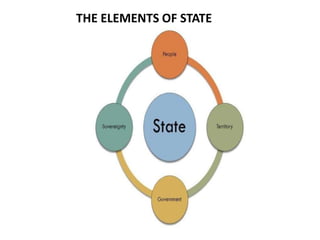
THE ELEMENTS OF STATE
Population is essential for the state. Greek thinkers were of the
view that the population should neither be too big nor too
small. According to Plato the ideal number would be 5040.
According to Aristotle, the number should be neither too large
nor too small. It should be large enough to be self sufficing and
small enough to be well governed.
Greek thinkers like Plato and Aristotle thinking on the
number was based on small city – states like Athens and
Sparta. Modern states vary in population. India has a
population of 140.76 Crores people according to 2021
census.
Territory: There can be no state without a fixed territory. People
need territory to live and organize themselves socially and
politically. It may be remembered that the territory of the state
includes land, water and air – space. The modern states differ in
their sizes. Territory is necessary for citizenship. As in the case of
population, no definite size with regard to extent of area of the
state can be fixed. There are small and big states.
Prof. Elliott “territorial sovereignty or the Superiority of state
overall within its boundaries and complete freedom from external
control has been a fundamental principle of the modern state life”.
India has an area of 32,87,263 sq. km. Approximately India
occupies 2.4% of the global area.
Government : Government is the third element of the state. There can
be no state without government. Government is the working agency of
the state. It is the political organization of the state. Prof. Appadorai
defined government as the agency through which the force of the State
is formulated, expressed and realized. According to C.F. Strong, in order
to make and enforce laws the state must have highest authority. This is
called the Government.
sovereignty: The fourth essential element of the state is sovereignty.
The word ”sovereignty” means supreme and final legal authority above
and beyond which no legal power exists Sovereignty has two aspects : 1)
Internal sovereignty 2) External sovereignty
Internal sovereignty means that the State is supreme over all its
citizens, and associations.
External sovereignty means that the state is independent and
free from foreign or outside control.
STATE AND SOCIETY :
State and Society The society consists of a large number of
individuals, families, group and institutions. The early
political thinkers considered both state and society as one.
State is a part of society but is not a form of society.
Society is a wider concept as compared to the state. The state
covers only an aspect of the society whereas society includes all
social relationships and social institutions. The society is much
older than the state and it does not contain the four elements of
the state. State is highly organised and comprises sovereignty but
society may be unorganized and does not possess sovereignty.
Nature of the State
1. IDEALIST THEORY OF STATE
Plato and Aristotle are considered as the founders of the Idealist
Theory of State. They opined that man by nature is a political
animal and it is through state that man can develop their
personalities and get best out of them by being part of the state.
They did not differentiate between the state and the society.
Immanuel Kant is regarded as the father of the Idealist theory and has
expressed about it in the book ‘metaphysical first principles of theory
and law’ in 1976. Hegel considered it as an ethical institution.
According to this theory,
1. State is an ethical institution.
2. State is the best friend of the people.
3. State has its own personality and indent will.
4. Man is the social animal.
5. State creates and protects the rights of the state.
2. MARXIST THEORY OF STATE
According to traditional Marxists, the state is controlled by the
dominant economic class and used as an instrument of exploitation
and as an agency of class coercion. The State promotes and protects
the interests of few rich sections at the cost of the labour class. The
State exploits the economic weaker section since its origin to its
various phases of development. Marxist State has certain features:
1. State is an instrument of exploitation at the hands of economically
dominant class.
2. State was formed to protect the private property of economically
dominant class.
3. State was considered as the symbol of injustice.
However, there are neo-Marxists like Max Weber who rejected the class
theory of Marx and emphasised on the independence of State power.
He opined that State has its own resources and have full control over
the legitimate source of force and do not serve the private interests. He
further opined that the Bureaucracy is an
organisation maintained by the State that monitors, formulates and
implements the state policies. The State cannot be said to have served
the class interests.
Similarly, according to Antonio Gramsci, institutions, beliefs and social
relations in the society like family, school, church and other groups in
the society play an important role in creating consent that encourages
capitalism. The use of force is required only when the consent does not
work.
LIBERAL THEORY OF STATE
The Liberal theory emphasises on the privileges and rights of the
individuals. The restrictions by the government curb the personality
and rights of the individuals and limit their growth. So, it advocates
limited state. The state is liberal if it acknowledges the behaviours,
attitudes and opinions of the individual. Some of the features of the
Liberal Theory of State:
1. It advocates the rights and liberty of the individuals.
2. The state should be accountable to the people and is a limited
state.
3. There are different groups and organisation and they coexist
with each other.
4. The liberal state is accountable to all groups and rights and
liberty of the people.
THEORIES OF ORIGIN OF STATE
1. Theory of Divine Origin:
The state was created by God and people had no role in its
creation. The King was considered as the representation of God
and they had the divine right over the people.
2. The Force Theory:
It came as a result of forced subjection by the strong over the
weak. Two groups, one supported this theory as State as a powerful
entity and the other emphasised on individual’s freedom and limited
state action. Theologians, individualists and socialists criticised this
theory.
3. Social Contract Theory:
The state is the outcome of contract among the people. There is a
contract between the people and the ruler. The people have
surrendered their few freedoms to the authority in exchange of the
protection of their rights. Hobbes, Locke and Rousseau are the major
exponent of the Social Contract Theory.
4. Evolutionary Theory:
According to the Evolutionary Theory of the Origin of the State,
State is the product of history. It was formed by social evolution. This
theory tells us that the state was formed as a result of several social
circumstances and it reached its present form through the process of
evolution
Five factors are responsible for affecting the Evolutionary theory of
State.
• Kinship
• Religion
• War and force
• Property and Rise of Economy classes
• Consciousness of Politics

STATE.pptx

  • 1.
    MODULE II: STATEAND SOCIETY
  • 2.
     The modernterm “state” is derived from the word “status”.  Latin word status meaning ‘condition’  It was Niccolo Machiavelli ( 1469 – 1527) who first used the term “state” in his writings.  His important work is titled as “Prince”.
  • 3.
    • The stateis the most universal and most powerful of all social institutions. The state is a natural institution. • Aristotle said man is a social animal and by nature he is a political being. To him, to live in the state and to be a man were identical. • The state is the highest form of human association. It is necessary because it comes into existence out of the basic needs of life. It continues to remain for the sake of good life
  • 4.
    • Woodrow Wilson,“State is a people organized for law within a definite territory.” • Aristotle defined the state as a “union of families and villages having for its end a perfect and self – sufficing life by which it meant a happy and good life”. • Burgess defines the state as “a particular portion of mankind viewed as an organized unit.”
  • 5.
    According to Sidgwick.“State is a combination or association of persons in the form of government and governed and united together into a politically organized people of a definite territory.” According to Garner, “State is a community of people live in a definite form of territory free of external control and possessing an organized government to which people show habitual agreement. Prof. Laski defines “state as a territorial society divided into government and subjects whose relationships are determined by the exercise of supreme coercive power.”
  • 6.
  • 7.
    Population is essentialfor the state. Greek thinkers were of the view that the population should neither be too big nor too small. According to Plato the ideal number would be 5040. According to Aristotle, the number should be neither too large nor too small. It should be large enough to be self sufficing and small enough to be well governed. Greek thinkers like Plato and Aristotle thinking on the number was based on small city – states like Athens and Sparta. Modern states vary in population. India has a population of 140.76 Crores people according to 2021 census.
  • 8.
    Territory: There canbe no state without a fixed territory. People need territory to live and organize themselves socially and politically. It may be remembered that the territory of the state includes land, water and air – space. The modern states differ in their sizes. Territory is necessary for citizenship. As in the case of population, no definite size with regard to extent of area of the state can be fixed. There are small and big states. Prof. Elliott “territorial sovereignty or the Superiority of state overall within its boundaries and complete freedom from external control has been a fundamental principle of the modern state life”. India has an area of 32,87,263 sq. km. Approximately India occupies 2.4% of the global area.
  • 9.
    Government : Governmentis the third element of the state. There can be no state without government. Government is the working agency of the state. It is the political organization of the state. Prof. Appadorai defined government as the agency through which the force of the State is formulated, expressed and realized. According to C.F. Strong, in order to make and enforce laws the state must have highest authority. This is called the Government. sovereignty: The fourth essential element of the state is sovereignty. The word ”sovereignty” means supreme and final legal authority above and beyond which no legal power exists Sovereignty has two aspects : 1) Internal sovereignty 2) External sovereignty
  • 10.
    Internal sovereignty meansthat the State is supreme over all its citizens, and associations. External sovereignty means that the state is independent and free from foreign or outside control. STATE AND SOCIETY : State and Society The society consists of a large number of individuals, families, group and institutions. The early political thinkers considered both state and society as one. State is a part of society but is not a form of society.
  • 11.
    Society is awider concept as compared to the state. The state covers only an aspect of the society whereas society includes all social relationships and social institutions. The society is much older than the state and it does not contain the four elements of the state. State is highly organised and comprises sovereignty but society may be unorganized and does not possess sovereignty. Nature of the State 1. IDEALIST THEORY OF STATE Plato and Aristotle are considered as the founders of the Idealist Theory of State. They opined that man by nature is a political animal and it is through state that man can develop their personalities and get best out of them by being part of the state.
  • 12.
    They did notdifferentiate between the state and the society. Immanuel Kant is regarded as the father of the Idealist theory and has expressed about it in the book ‘metaphysical first principles of theory and law’ in 1976. Hegel considered it as an ethical institution. According to this theory, 1. State is an ethical institution. 2. State is the best friend of the people. 3. State has its own personality and indent will. 4. Man is the social animal. 5. State creates and protects the rights of the state.
  • 13.
    2. MARXIST THEORYOF STATE According to traditional Marxists, the state is controlled by the dominant economic class and used as an instrument of exploitation and as an agency of class coercion. The State promotes and protects the interests of few rich sections at the cost of the labour class. The State exploits the economic weaker section since its origin to its various phases of development. Marxist State has certain features: 1. State is an instrument of exploitation at the hands of economically dominant class. 2. State was formed to protect the private property of economically dominant class. 3. State was considered as the symbol of injustice.
  • 14.
    However, there areneo-Marxists like Max Weber who rejected the class theory of Marx and emphasised on the independence of State power. He opined that State has its own resources and have full control over the legitimate source of force and do not serve the private interests. He further opined that the Bureaucracy is an organisation maintained by the State that monitors, formulates and implements the state policies. The State cannot be said to have served the class interests. Similarly, according to Antonio Gramsci, institutions, beliefs and social relations in the society like family, school, church and other groups in the society play an important role in creating consent that encourages capitalism. The use of force is required only when the consent does not work.
  • 15.
    LIBERAL THEORY OFSTATE The Liberal theory emphasises on the privileges and rights of the individuals. The restrictions by the government curb the personality and rights of the individuals and limit their growth. So, it advocates limited state. The state is liberal if it acknowledges the behaviours, attitudes and opinions of the individual. Some of the features of the Liberal Theory of State: 1. It advocates the rights and liberty of the individuals. 2. The state should be accountable to the people and is a limited state. 3. There are different groups and organisation and they coexist with each other. 4. The liberal state is accountable to all groups and rights and liberty of the people.
  • 16.
    THEORIES OF ORIGINOF STATE 1. Theory of Divine Origin: The state was created by God and people had no role in its creation. The King was considered as the representation of God and they had the divine right over the people. 2. The Force Theory: It came as a result of forced subjection by the strong over the weak. Two groups, one supported this theory as State as a powerful entity and the other emphasised on individual’s freedom and limited state action. Theologians, individualists and socialists criticised this theory.
  • 17.
    3. Social ContractTheory: The state is the outcome of contract among the people. There is a contract between the people and the ruler. The people have surrendered their few freedoms to the authority in exchange of the protection of their rights. Hobbes, Locke and Rousseau are the major exponent of the Social Contract Theory. 4. Evolutionary Theory: According to the Evolutionary Theory of the Origin of the State, State is the product of history. It was formed by social evolution. This theory tells us that the state was formed as a result of several social circumstances and it reached its present form through the process of evolution
  • 18.
    Five factors areresponsible for affecting the Evolutionary theory of State. • Kinship • Religion • War and force • Property and Rise of Economy classes • Consciousness of Politics