 DR.MOMINA SAJJAD
PROFESSION: OPTOMETRIST
SOVEREIGNTY AND ITS
TYPES.
SOVEREIGNTY
 JEAN BODIN (1530-1596)
• French jurist and natural law philosopher.
• Lived during a time of religious turmoil in France.
• Among the first philosophers to attempt technical discussion
of Sovereignty.
 What is a State?
•“ The State is a lawful
government with a
sovereign power, of
different households and
their common affairs.”
•Hence, today we speak about the
elements of state:
1.Territory.
2.People.
3.Government.
4.Sovereign.
•Of these, the sovereign endows the
state with its identity.
 What is Sovereignty?
• “ Sovereignty is an
absolute and
perpetual power that
is the greatest power
to command.”
 Types Of Sovereignty.
1.Titular and Actual.
2.Legal and Political.
3.De facto and De jure.
4.Popular.
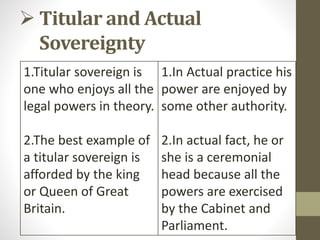
 Titular and Actual
Sovereignty
1.Titular sovereign is
one who enjoys all the
legal powers in theory.
2.The best example of
a titular sovereign is
afforded by the king
or Queen of Great
Britain.
1.In Actual practice his
power are enjoyed by
some other authority.
2.In actual fact, he or
she is a ceremonial
head because all the
powers are exercised
by the Cabinet and
Parliament.
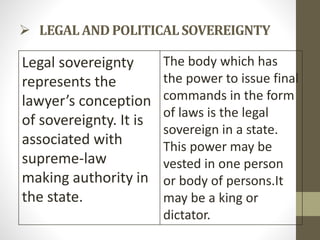
 LEGAL ANDPOLITICALSOVEREIGNTY
Legal sovereignty
represents the
lawyer’s conception
of sovereignty. It is
associated with
supreme-law
making authority in
the state.
The body which has
the power to issue final
commands in the form
of laws is the legal
sovereign in a state.
This power may be
vested in one person
or body of persons.It
may be a king or
dictator.
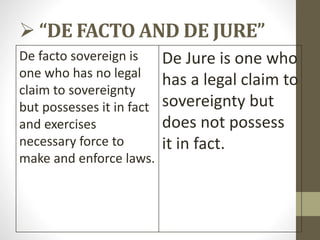
 “DE FACTO AND DE JURE”
De facto sovereign is
one who has no legal
claim to sovereignty
but possesses it in fact
and exercises
necessary force to
make and enforce laws.
De Jure is one who
has a legal claim to
sovereignty but
does not possess
it in fact.
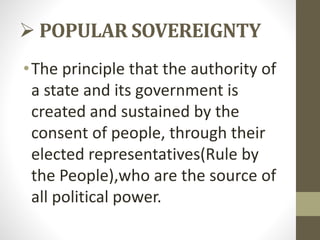
 POPULAR SOVEREIGNTY
•The principle that the authority of
a state and its government is
created and sustained by the
consent of people, through their
elected representatives(Rule by
the People),who are the source of
all political power.

Sovereignty

  • 1.
     DR.MOMINA SAJJAD PROFESSION:OPTOMETRIST SOVEREIGNTY AND ITS TYPES.
  • 2.
  • 3.
     JEAN BODIN(1530-1596) • French jurist and natural law philosopher. • Lived during a time of religious turmoil in France. • Among the first philosophers to attempt technical discussion of Sovereignty.
  • 4.
     What isa State? •“ The State is a lawful government with a sovereign power, of different households and their common affairs.”
  • 5.
    •Hence, today wespeak about the elements of state: 1.Territory. 2.People. 3.Government. 4.Sovereign. •Of these, the sovereign endows the state with its identity.
  • 6.
     What isSovereignty? • “ Sovereignty is an absolute and perpetual power that is the greatest power to command.”
  • 7.
     Types OfSovereignty. 1.Titular and Actual. 2.Legal and Political. 3.De facto and De jure. 4.Popular.
  • 8.
     Titular andActual Sovereignty 1.Titular sovereign is one who enjoys all the legal powers in theory. 2.The best example of a titular sovereign is afforded by the king or Queen of Great Britain. 1.In Actual practice his power are enjoyed by some other authority. 2.In actual fact, he or she is a ceremonial head because all the powers are exercised by the Cabinet and Parliament.
  • 9.
     LEGAL ANDPOLITICALSOVEREIGNTY Legalsovereignty represents the lawyer’s conception of sovereignty. It is associated with supreme-law making authority in the state. The body which has the power to issue final commands in the form of laws is the legal sovereign in a state. This power may be vested in one person or body of persons.It may be a king or dictator.
  • 10.
     “DE FACTOAND DE JURE” De facto sovereign is one who has no legal claim to sovereignty but possesses it in fact and exercises necessary force to make and enforce laws. De Jure is one who has a legal claim to sovereignty but does not possess it in fact.
  • 11.
     POPULAR SOVEREIGNTY •Theprinciple that the authority of a state and its government is created and sustained by the consent of people, through their elected representatives(Rule by the People),who are the source of all political power.