When to stop TKI in CMLWhen to stop TKI in CML
Three situationsThree situations
 When they don’t workWhen they don’t work
 When they are too toxicWhen they are too toxic
 When they appear to have affected a cureWhen they appear to have affected a cure
Three situationsThree situations
 When they don’t workWhen they don’t work
 When they are too toxicWhen they are too toxic
 When they appear to have affected a cureWhen they appear to have affected a cure
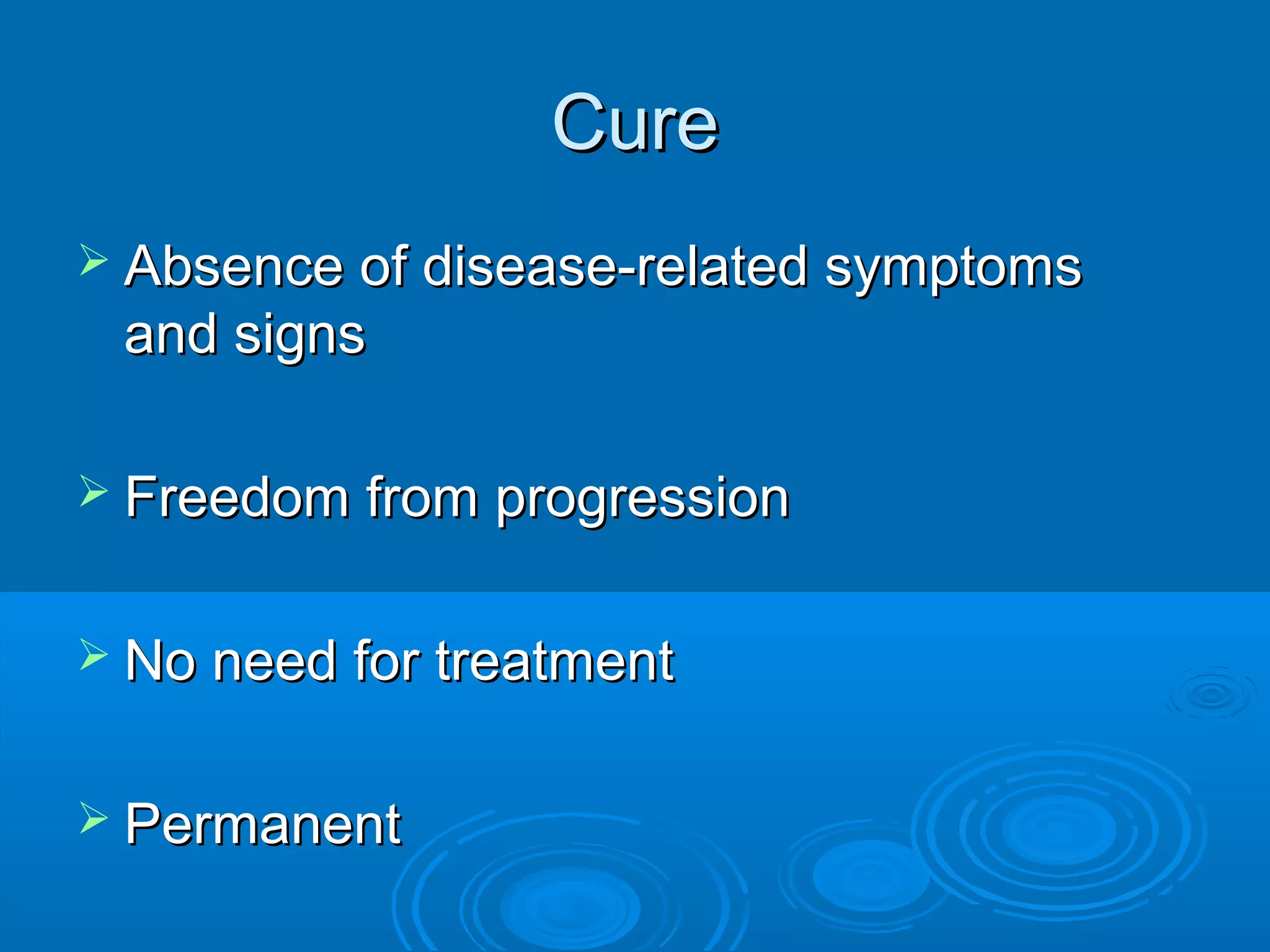
CML is cured by alloSCT by eradicationCML is cured by alloSCT by eradication
CML clones via the GVL effect……right?CML clones via the GVL effect……right?
Gratwohl Haem 2006 91:513; Sekhri Leuk Res 2009 33:1291.
Latest reported relapse
at 24 years post-
allograft
CureCure
 Absence of disease-related symptomsAbsence of disease-related symptoms
and signsand signs
 Freedom from progressionFreedom from progression
 No need for treatmentNo need for treatment

 PermanentPermanent
CMRCMR
 Complete Molecular ResponseComplete Molecular Response

No detectable BCR-ABL mRNANo detectable BCR-ABL mRNA

RQ-PCR method with sensitivityRQ-PCR method with sensitivity ≥4.5-log≥4.5-log

Confirmed on two consecutive measurementsConfirmed on two consecutive measurements
 Undetectable MRD (UMRD)Undetectable MRD (UMRD)
 Molecular Undetectable Leukaemia (MUL)Molecular Undetectable Leukaemia (MUL)
 Treatment free remissionTreatment free remission
Branford Clin Cancer Res 2007 13:7080
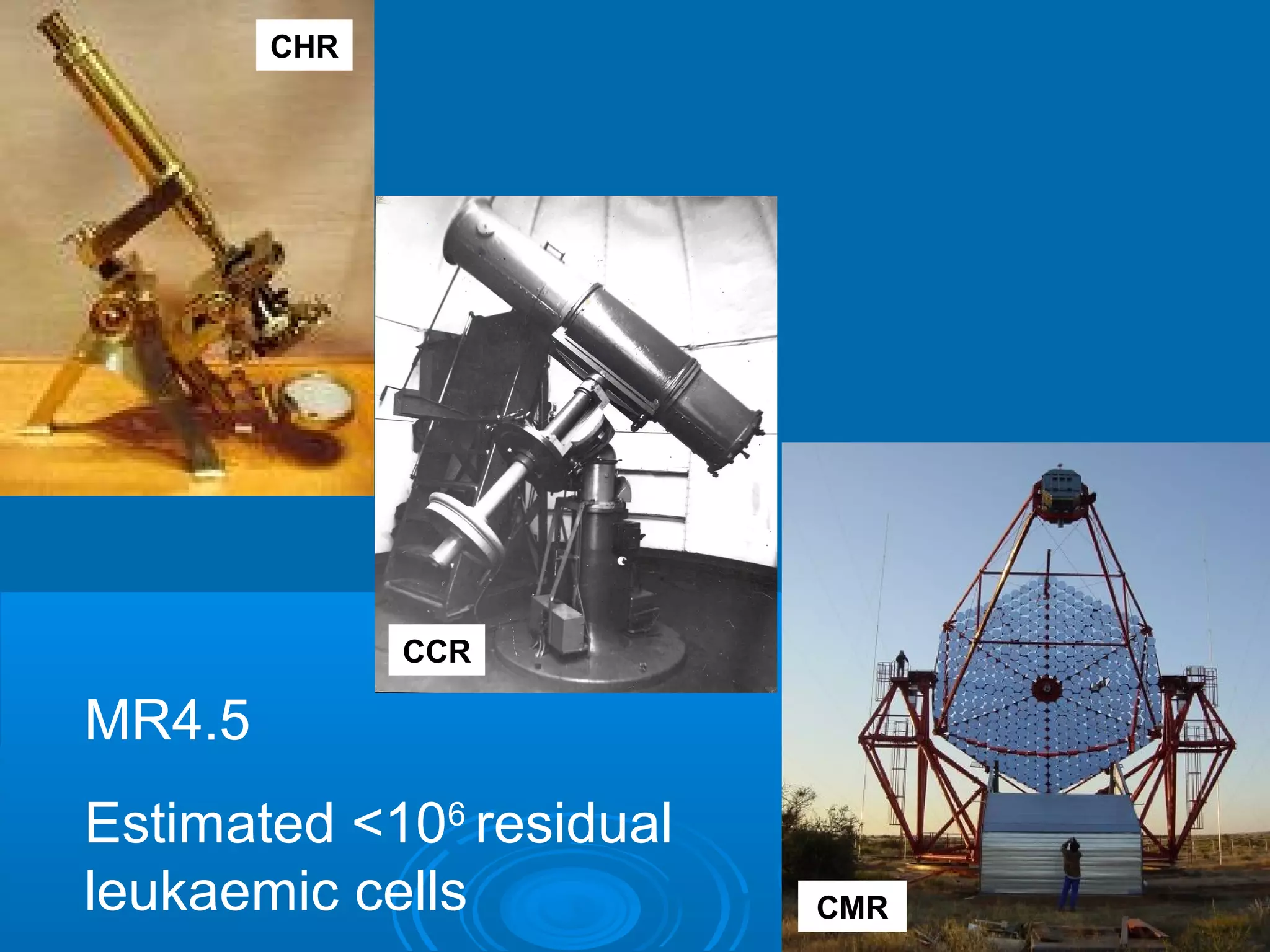
CHR
CCR
CMR
MR4.5
Estimated <106
residual
leukaemic cells
Less is betterLess is better
 Mutations occur stochastically – fewerMutations occur stochastically – fewer
cells means fewer opportunitiescells means fewer opportunities
 CML LSCs have increased ROS andCML LSCs have increased ROS and
increased mutation rateincreased mutation rate
 Imatinib does not correct ROS-inducedImatinib does not correct ROS-induced
mutagenesis in the most primitive CMLmutagenesis in the most primitive CML
cells (mouse model)cells (mouse model)
Bolton-Gillespie Blood 2013 121:4175
AllograftingAllografting
 Achievement of UMRD required for EFSAchievement of UMRD required for EFS

Relapse risk: UMRD 5%Relapse risk: UMRD 5%

detectable MRD 70%detectable MRD 70%
 Rate of unstable UMRD is lower than inRate of unstable UMRD is lower than in
imatinib-treated patientsimatinib-treated patients
 BCR-ABL DNA not detected in 8/9BCR-ABL DNA not detected in 8/9
patients in long-term remissionpatients in long-term remission
Radich Blood 1995 85:2632; Mughal BJH 2001 115:569;
Lange Leukemia 2005 19:1262; Simoes Blood 2010 116:1329
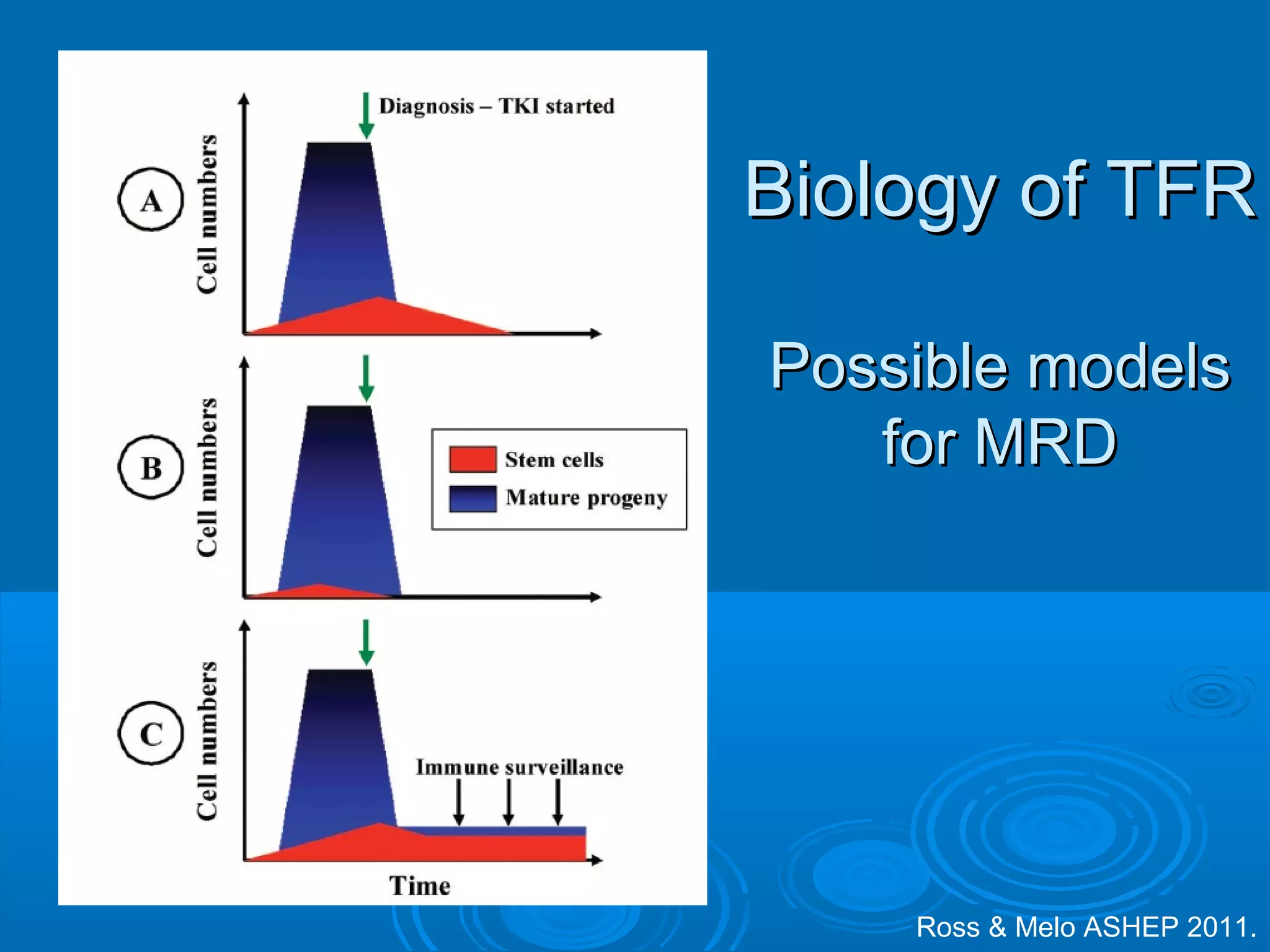
Ross & Melo ASHEP 2011.
Biology of TFRBiology of TFR
Possible modelsPossible models
for MRDfor MRD
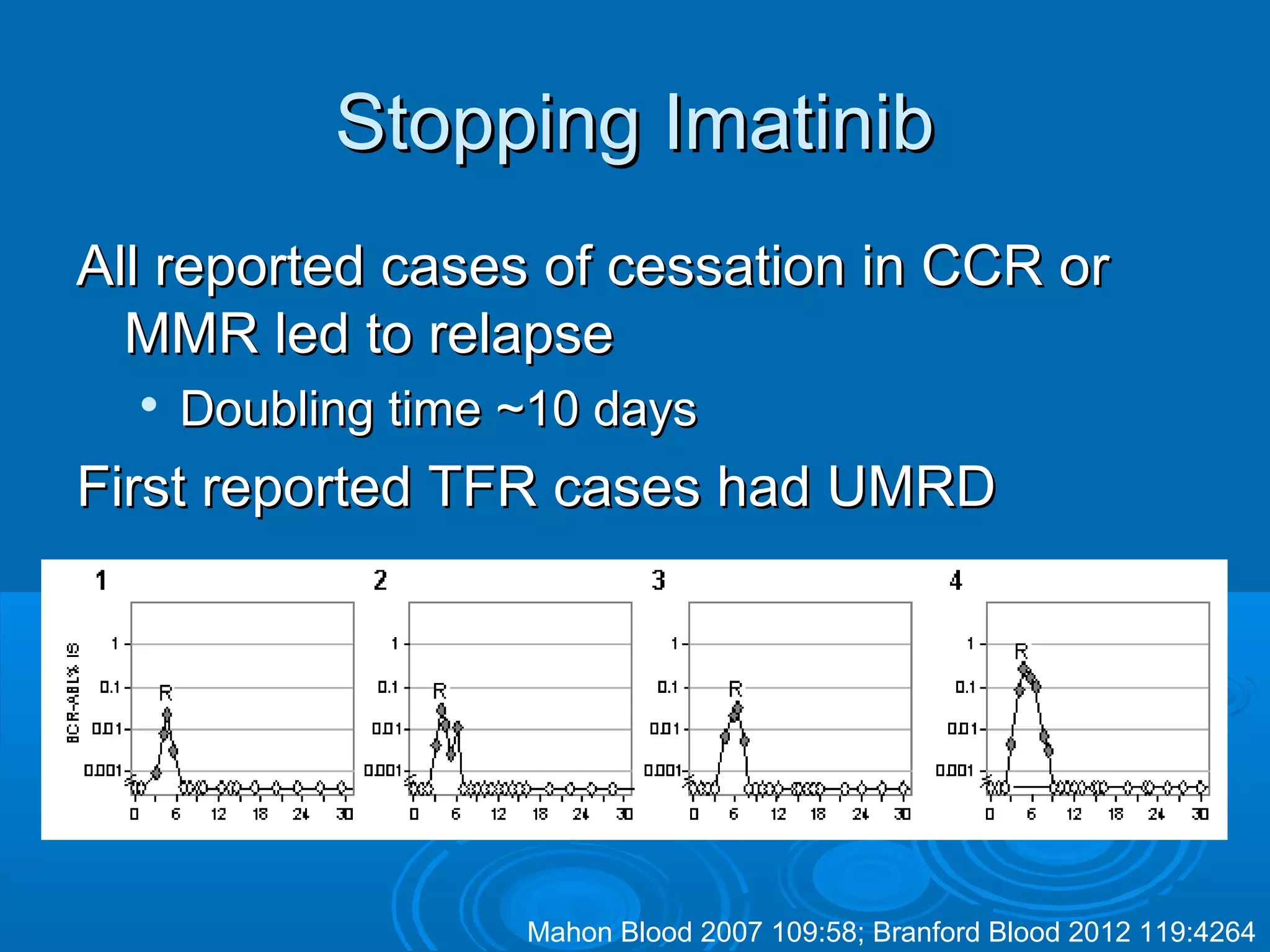
Stopping ImatinibStopping Imatinib
All reported cases of cessation in CCR orAll reported cases of cessation in CCR or
MMR led to relapseMMR led to relapse

Doubling timeDoubling time ~~10 days10 days
First reported TFR cases had UMRDFirst reported TFR cases had UMRD
Mahon Blood 2007 109:58; Branford Blood 2012 119:4264
ALLG CML8 studyALLG CML8 study
clinical outlineclinical outline
 Clinical trial of withdrawing imatinib from chronicClinical trial of withdrawing imatinib from chronic
phase CML patients with sustained undetectablephase CML patients with sustained undetectable
BCR-ABL by RQ-PCR for at least two yearsBCR-ABL by RQ-PCR for at least two years
 Close RQ-PCR monitoring for two yearsClose RQ-PCR monitoring for two years
 Completed accrual of 40 patients:Completed accrual of 40 patients:
21 patients received IFN before imatinib21 patients received IFN before imatinib
19 patients received imatinib in early CP19 patients received imatinib in early CP
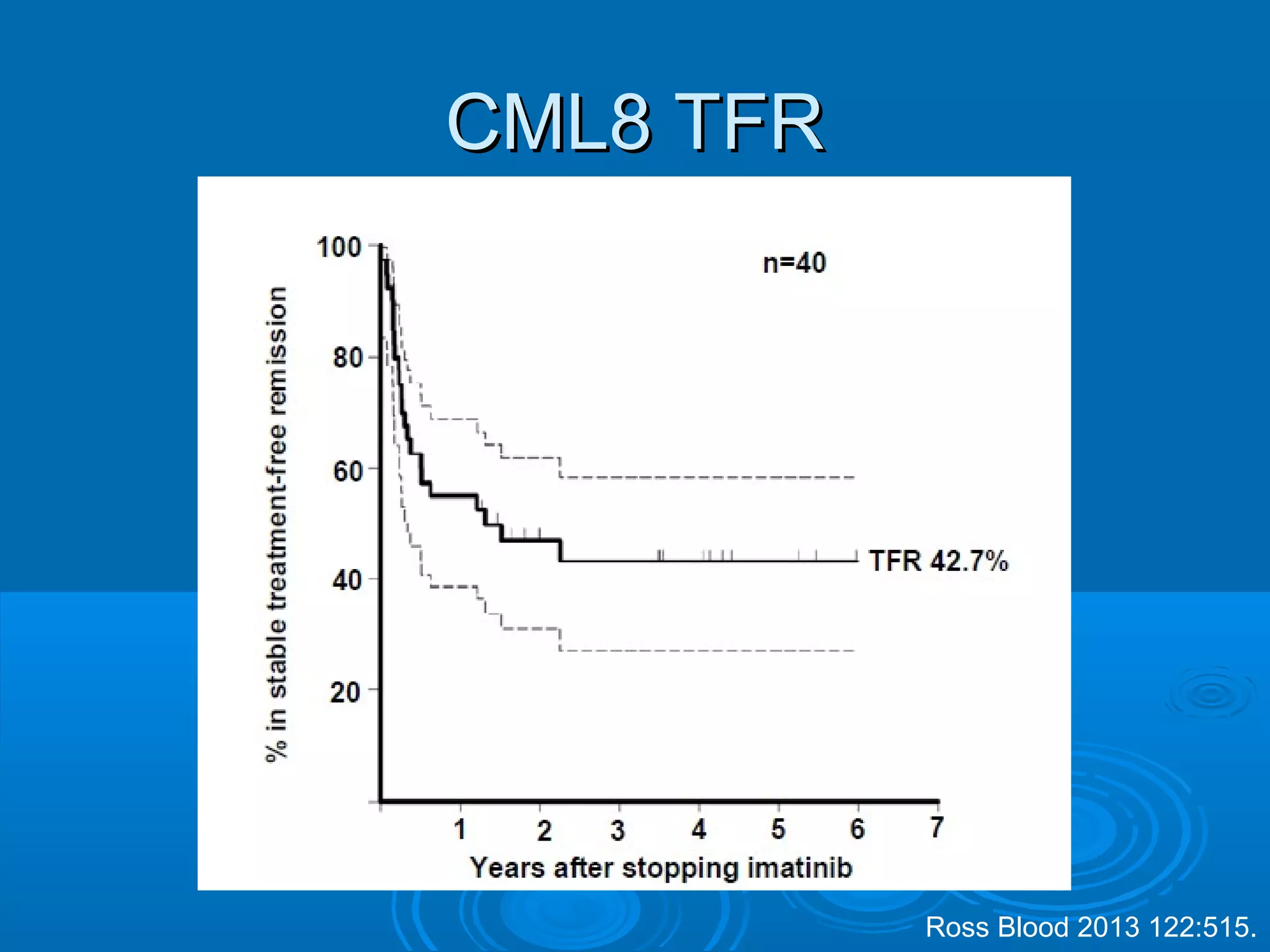
Ross Blood 2013 122:515.
RelapseRelapse
 Defined as:Defined as:

Loss of MMR (BCR-ABLLoss of MMR (BCR-ABLISIS
>0.1%)>0.1%)
• OROR

Any two consecutive positive resultsAny two consecutive positive results
 Imatinib re-commenced at previous doseImatinib re-commenced at previous dose
Patients (n=40)Patients (n=40)
 Male sex 48%Male sex 48%
 Median age 61 yearsMedian age 61 years
 Median interval (months)Median interval (months)

Imatinib prior to study entryImatinib prior to study entry 70 (44-108)70 (44-108)

Time to UMRDTime to UMRD 32 (3-73)32 (3-73)

UMRD prior to study entryUMRD prior to study entry 36 (24-82)36 (24-82)

Follow-upFollow-up 40 (12-72)40 (12-72)
CML8 TFRCML8 TFR
Ross Blood 2013 122:515.
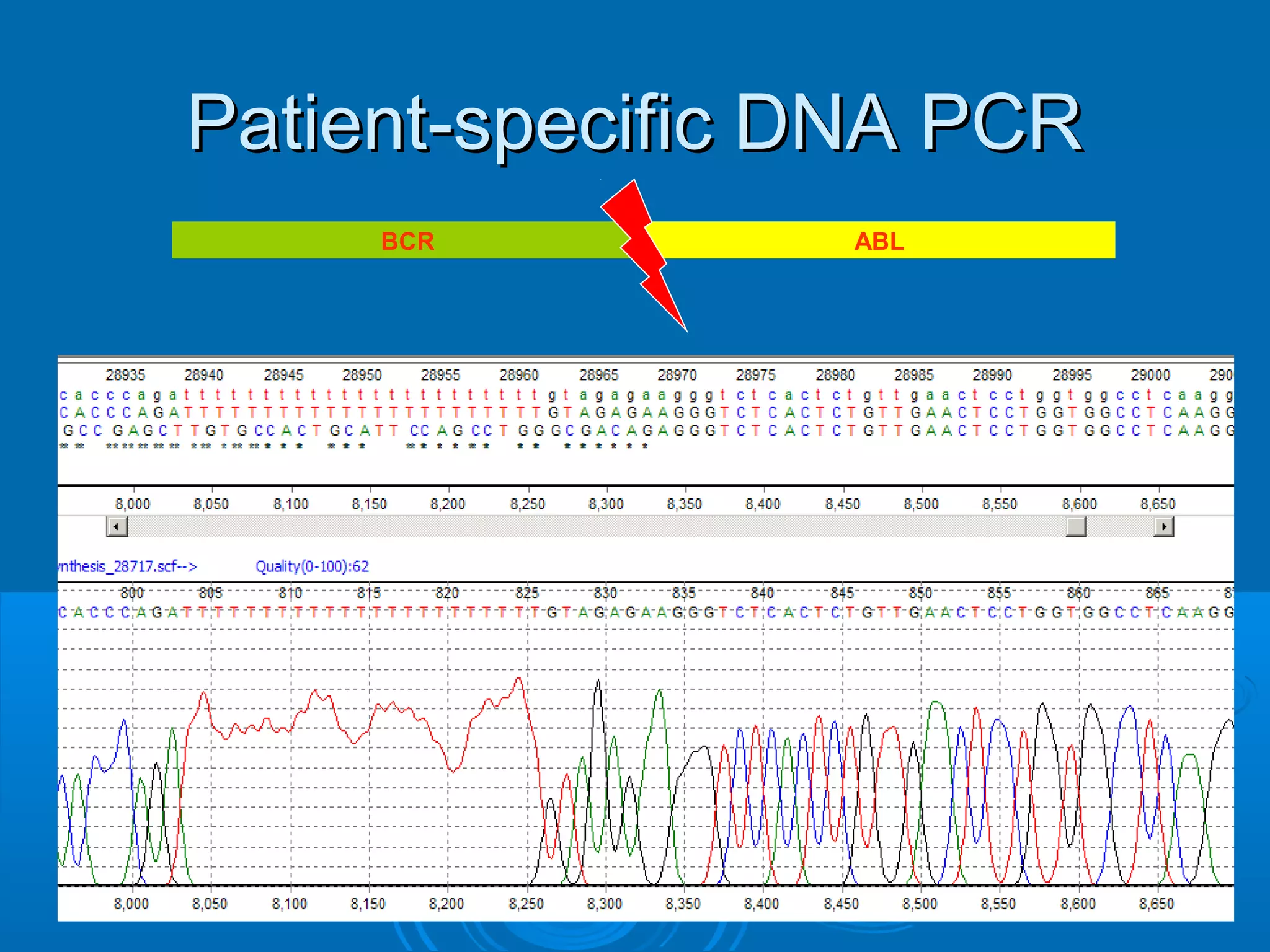
Patient-specific DNA PCRPatient-specific DNA PCR
BCR ABL
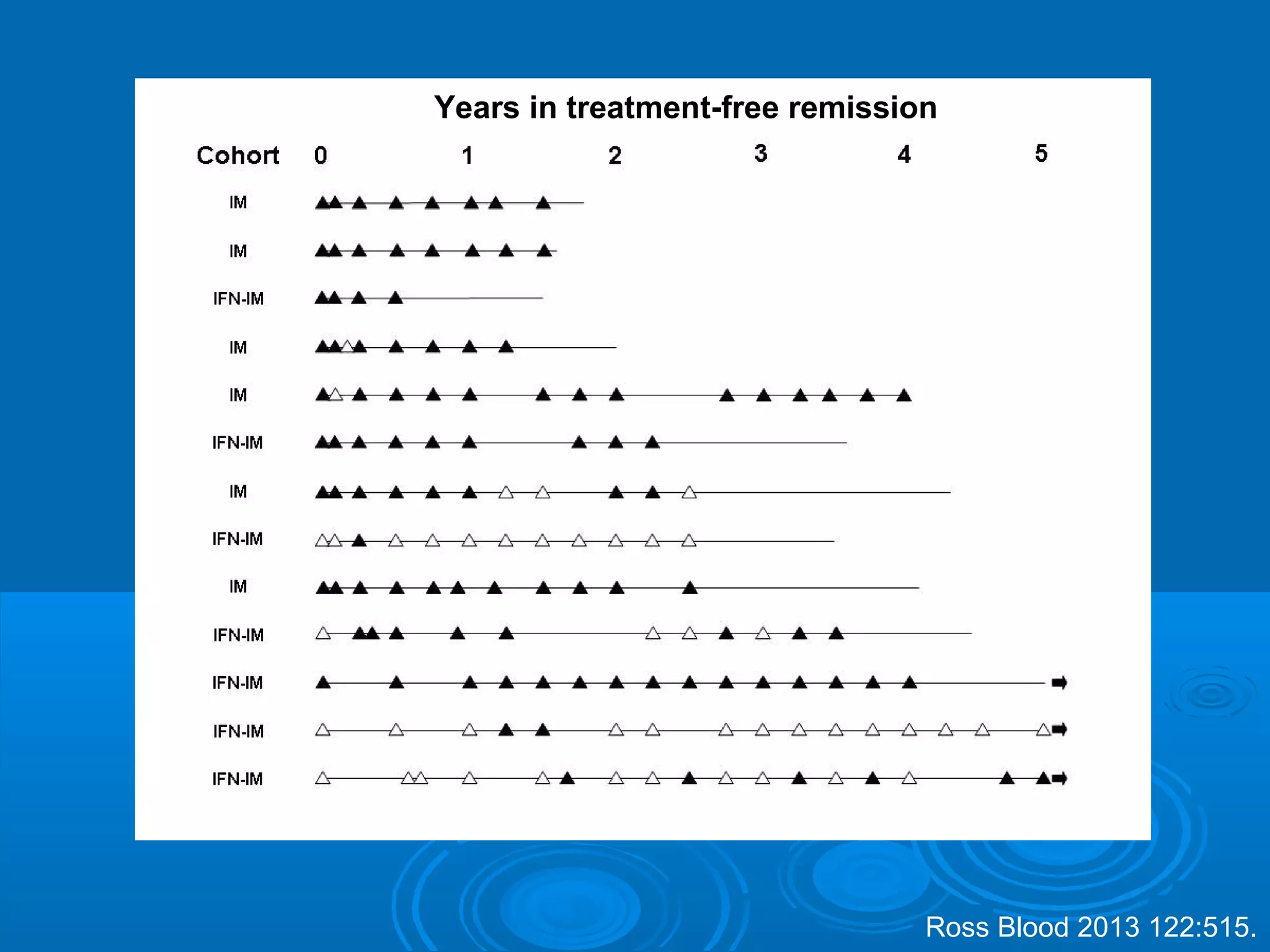
Years in treatment-free remission
Ross Blood 2013 122:515.
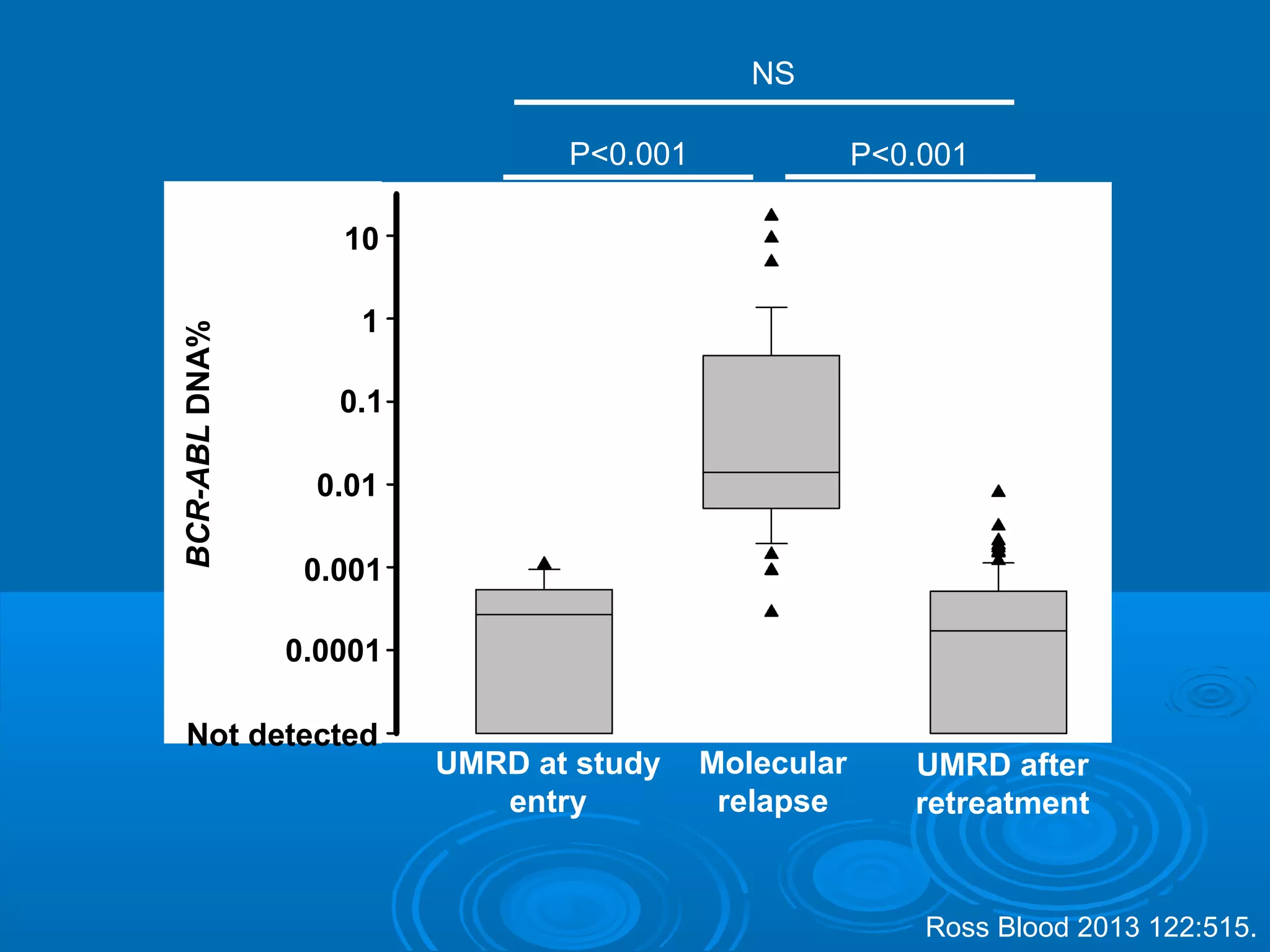
P<0.001P<0.001
10
0.1
0.001
1
0.01
BCR-ABLDNA%
Not detected
0.0001
UMRD at study
entry
Molecular
relapse
UMRD after
retreatment
NS
Ross Blood 2013 122:515.
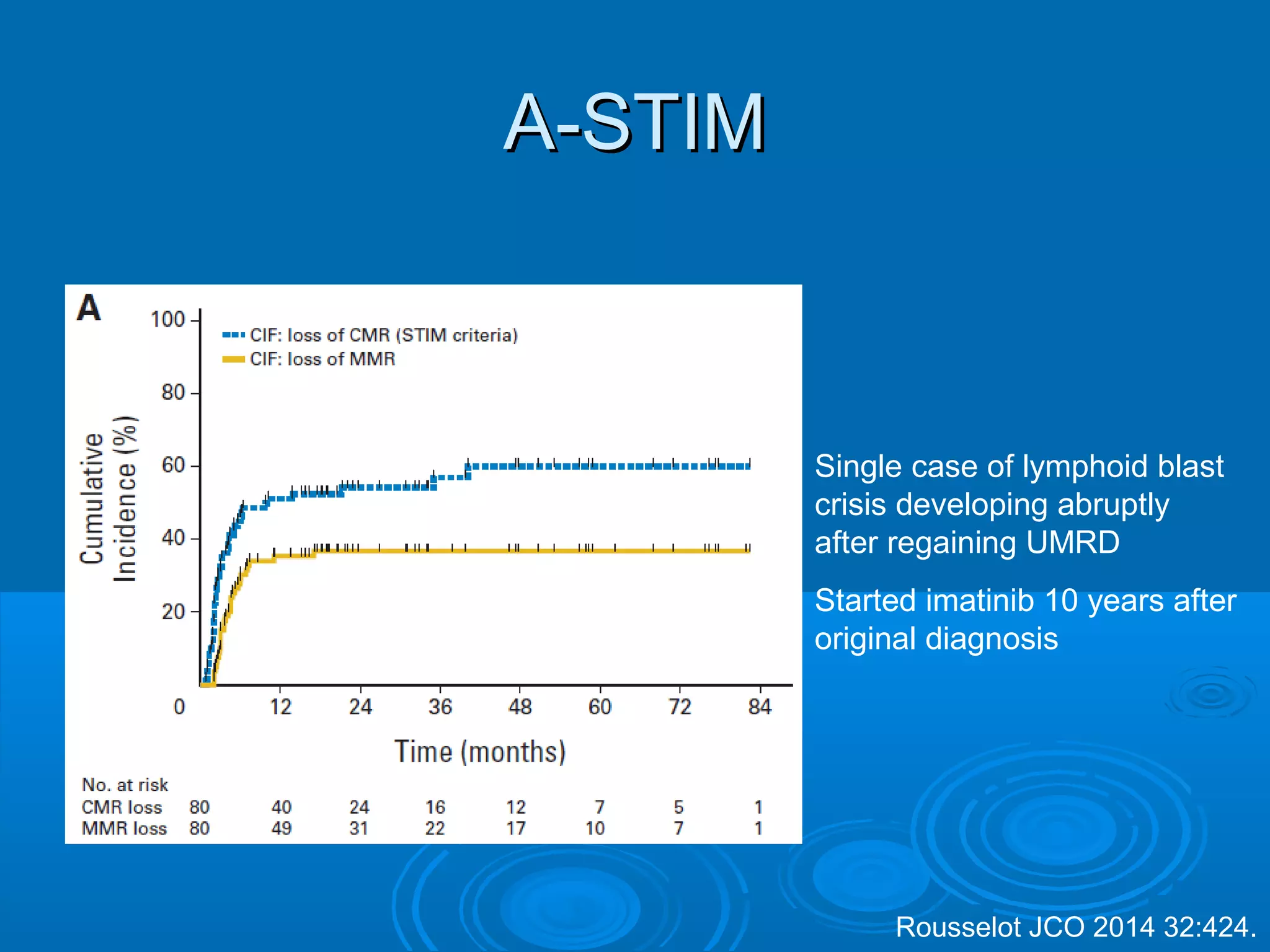
A-STIMA-STIM
Single case of lymphoid blast
crisis developing abruptly
after regaining UMRD
Started imatinib 10 years after
original diagnosis
Rousselot JCO 2014 32:424.
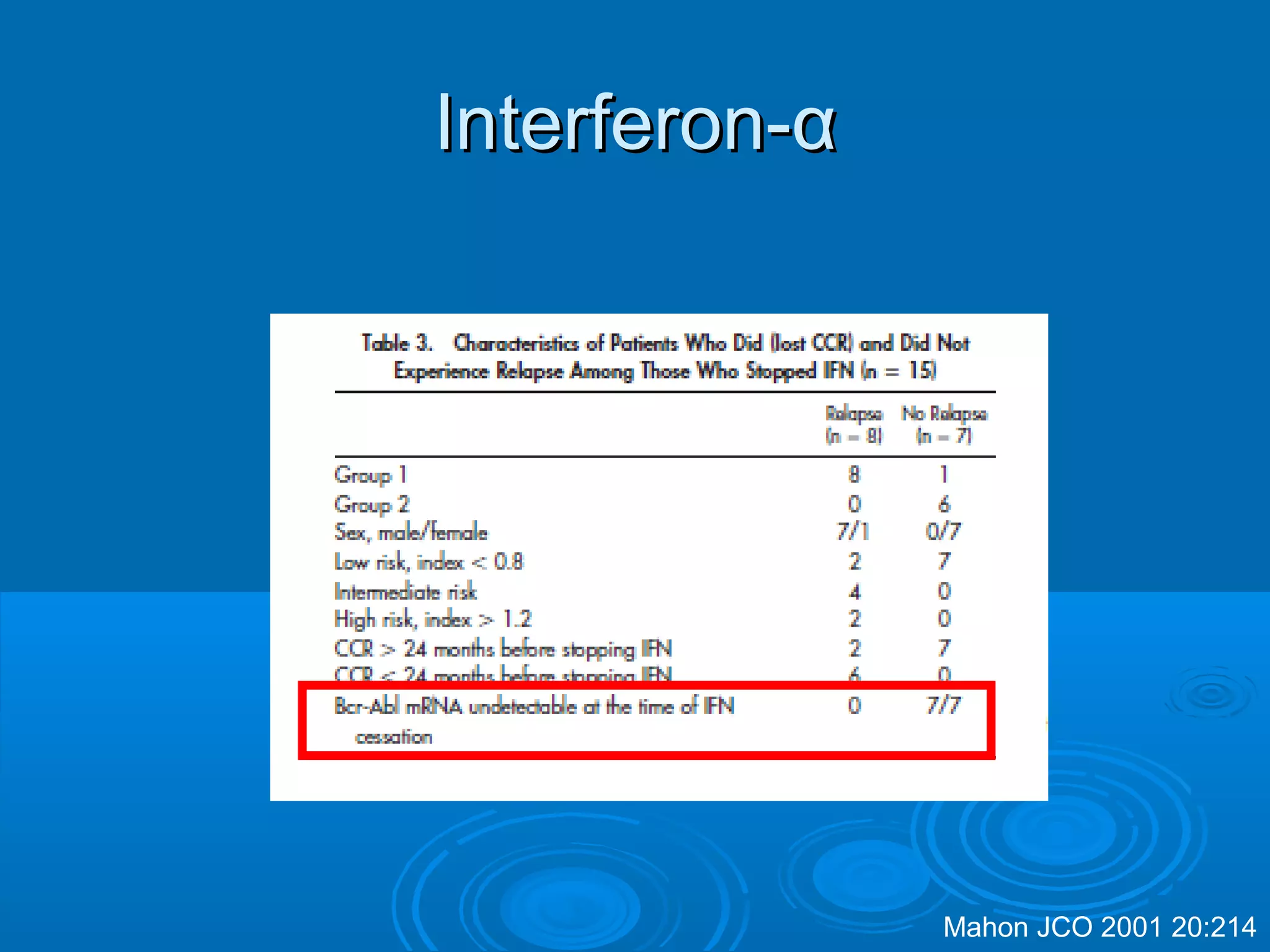
Interferon-Interferon-αα
Mahon JCO 2001 20:214
Stopping of 2G TKIStopping of 2G TKI
 ENESTopENESTop

MR4.5 after second-line nilotinibMR4.5 after second-line nilotinib

One year nilotinib ‘consolidation’ then stop if MRDOne year nilotinib ‘consolidation’ then stop if MRD
criteria metcriteria met
 ENESTfreedomENESTfreedom

MR4.5 after first-line nilotinib (ENESTnd)MR4.5 after first-line nilotinib (ENESTnd)

Similar designSimilar design
 EuroSKI registryEuroSKI registry
Question #1Question #1
 What MRD threshold is good enough toWhat MRD threshold is good enough to
achieve TFR?achieve TFR?

UMRD is arbitrary and varies from test to testUMRD is arbitrary and varies from test to test

MR4.5 being tested in prospective trialsMR4.5 being tested in prospective trials

Probably also depends onProbably also depends on speedspeed andand durationduration ofof
MRMR
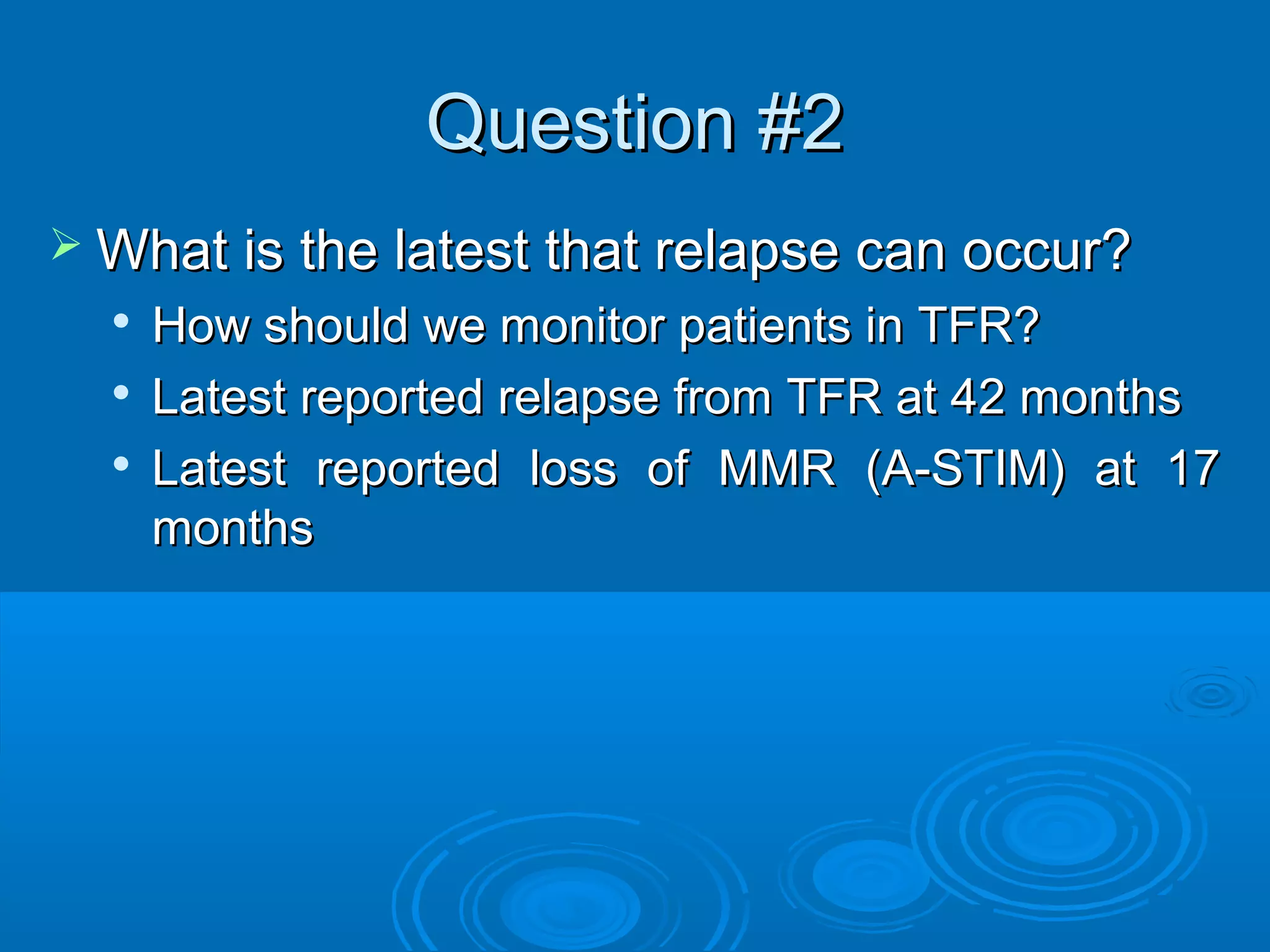
Question #2Question #2
 What is the latest that relapse can occur?What is the latest that relapse can occur?

How should we monitor patients in TFR?How should we monitor patients in TFR?

Latest reported relapse from TFR at 42 monthsLatest reported relapse from TFR at 42 months

Latest reported loss of MMR (A-STIM) at 17Latest reported loss of MMR (A-STIM) at 17
monthsmonths
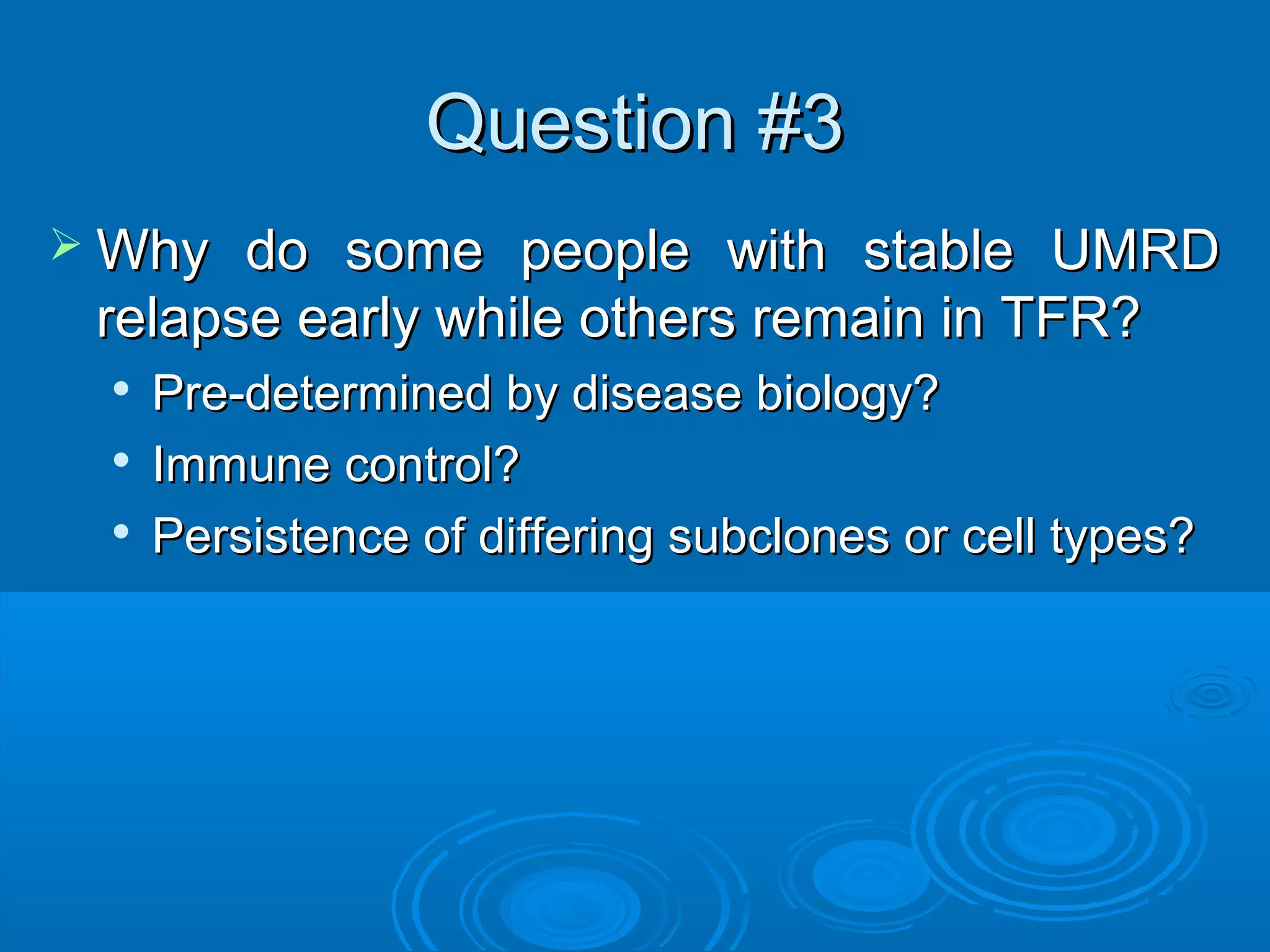
Question #3Question #3
 Why do some people with stable UMRDWhy do some people with stable UMRD
relapse early while others remain in TFR?relapse early while others remain in TFR?

Pre-determined by disease biology?Pre-determined by disease biology?

Immune control?Immune control?

Persistence of differing subclones or cell types?Persistence of differing subclones or cell types?
ConclusionsConclusions
 Some patients appear to be ‘cured’ withSome patients appear to be ‘cured’ with
follow-up of >5 years after stopping imatinibfollow-up of >5 years after stopping imatinib
 TFR after imatinib is often (or always)TFR after imatinib is often (or always)
associated with detectable MRD by highlyassociated with detectable MRD by highly
sensitive BCR-ABL DNA PCRsensitive BCR-ABL DNA PCR
Thank you.Thank you.
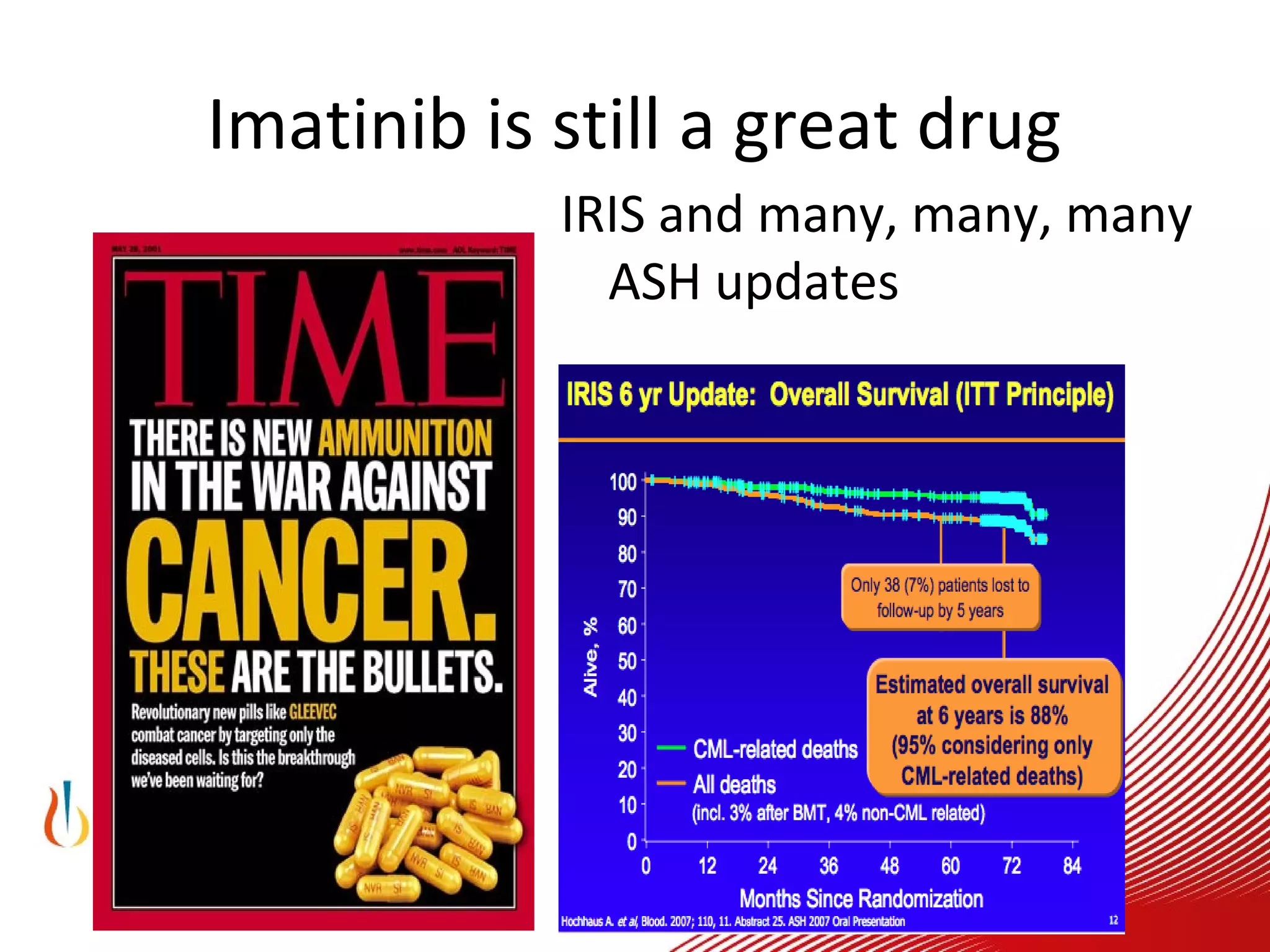
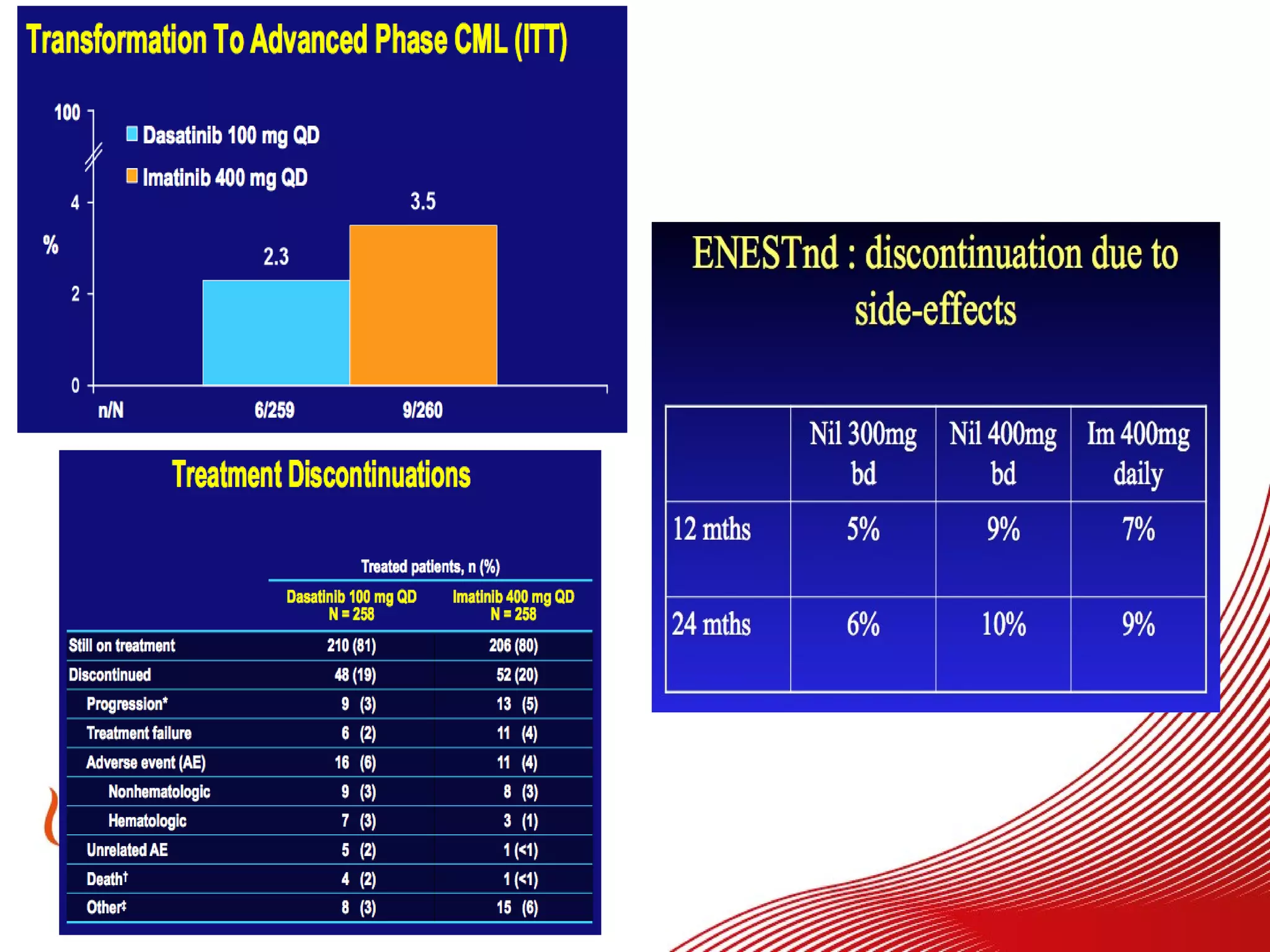
Imatinib is still a great drug
IRIS and many, many, many
ASH updates
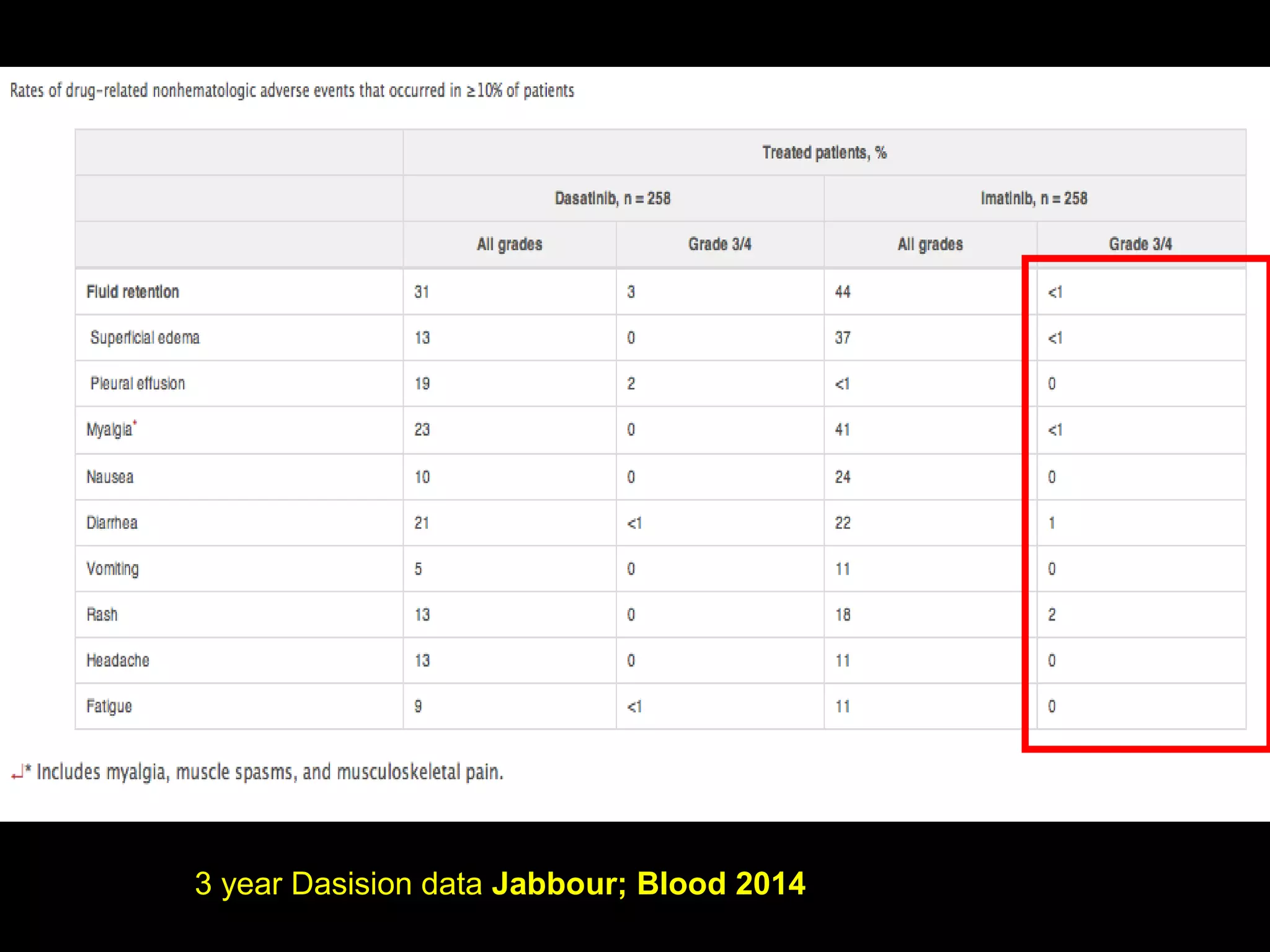
3 year Dasision data Jabbour; Blood 2014
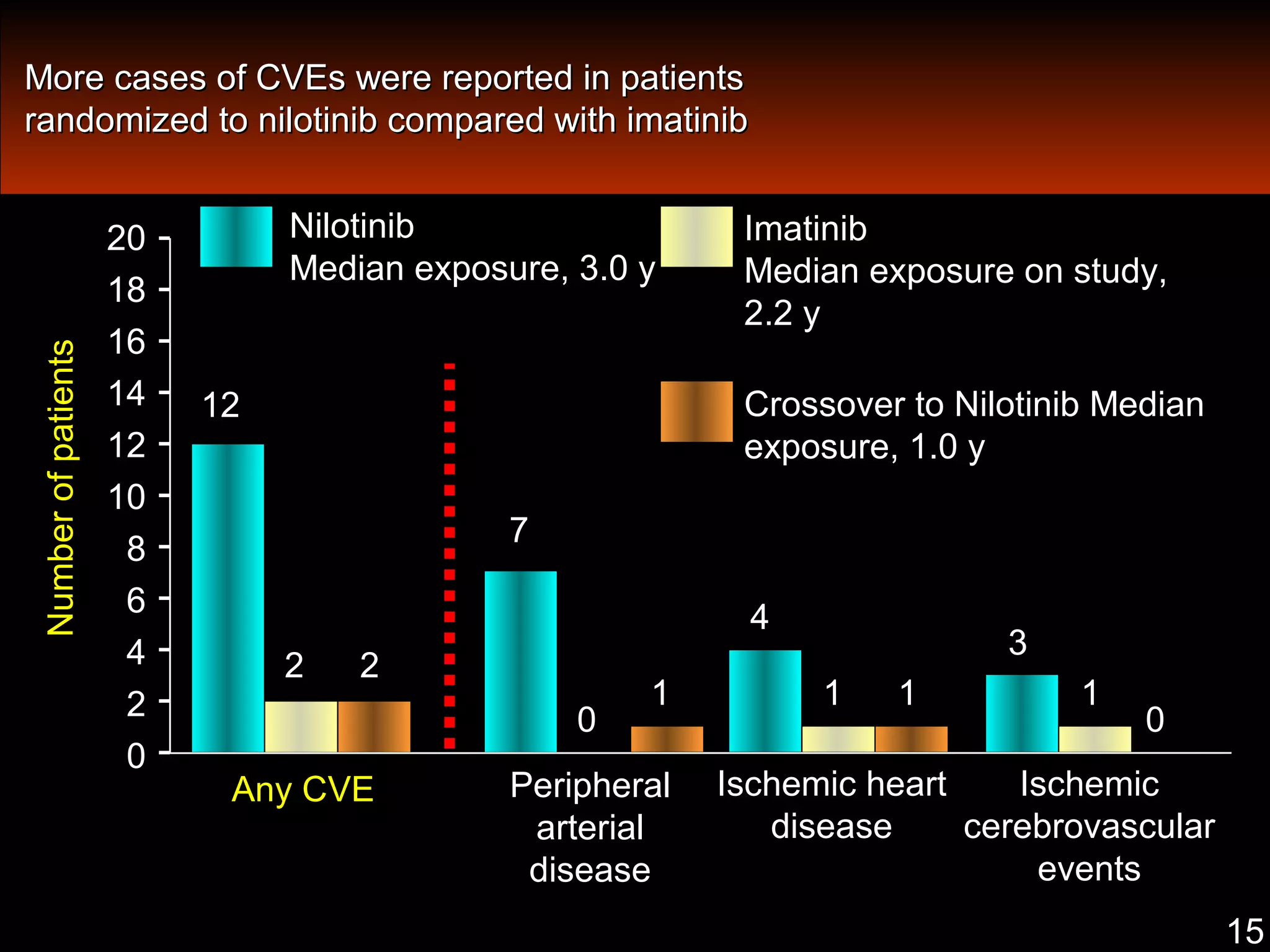
Ischemic heartIschemic heart
diseasedisease
IschemicIschemic
cerebrovascularcerebrovascular
eventsevents
PeripheralPeripheral
arterialarterial
diseasedisease
2020
1818
1010
22
00
1616
88
66
44
1414
1212
NumberofpatientsNumberofpatients
Cardiovascular events (CVE) by 36 months (safety population)Cardiovascular events (CVE) by 36 months (safety population)
Any CVEAny CVE
NilotinibNilotinib
Median exposure, 3.0 yMedian exposure, 3.0 y
ImatinibImatinib
Median exposure on study,Median exposure on study,
2.2 y2.2 y
Crossover to Nilotinib MedianCrossover to Nilotinib Median
exposure, 1.0 yexposure, 1.0 y
1212
22 22
77
44
00
1111 11
00
11
33
1515
More cases of CVEs were reported in patientsMore cases of CVEs were reported in patients
randomized to nilotinib compared with imatinibrandomized to nilotinib compared with imatinib
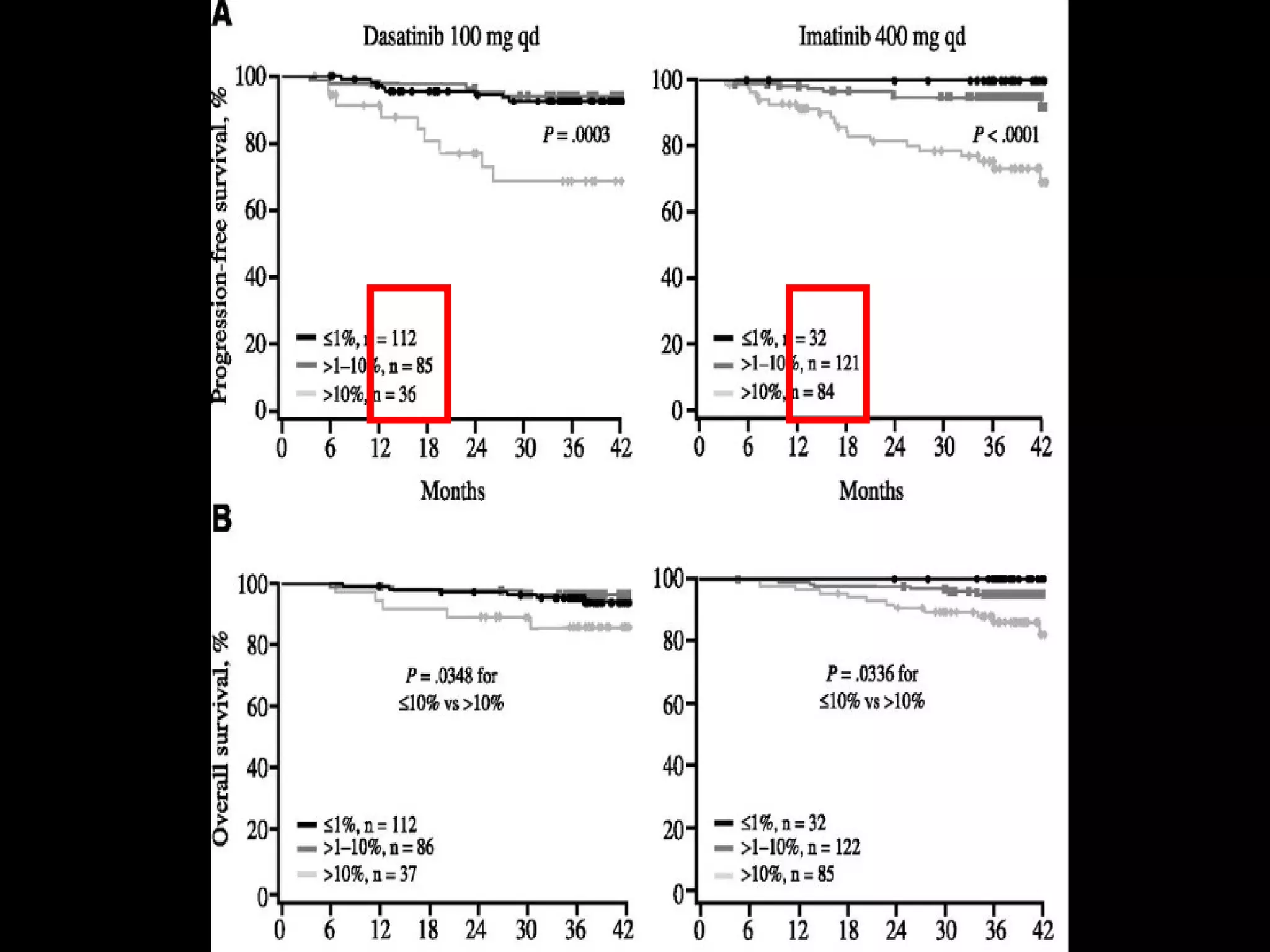
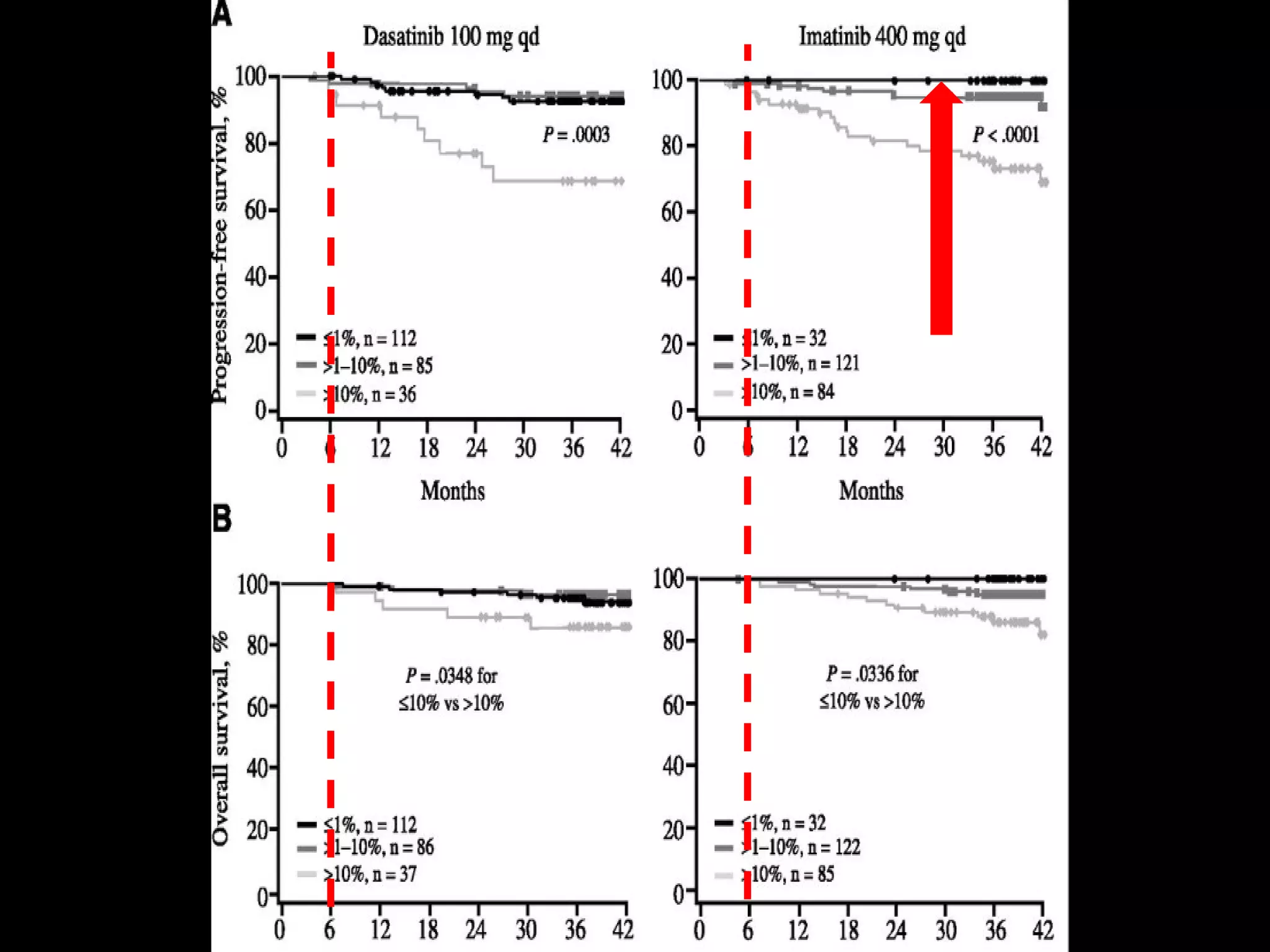
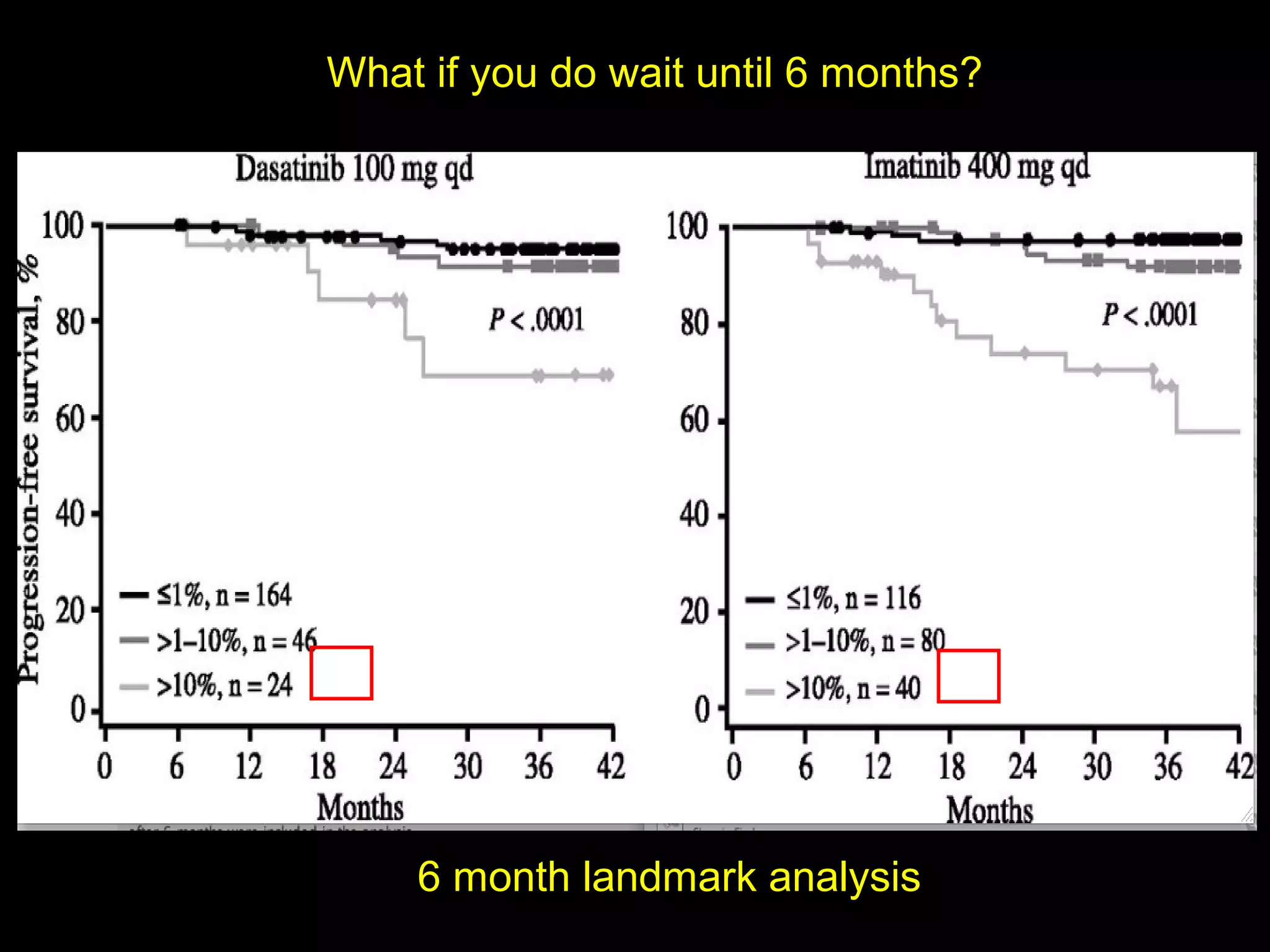
What if you do wait until 6 months?
6 month landmark analysis
37 85
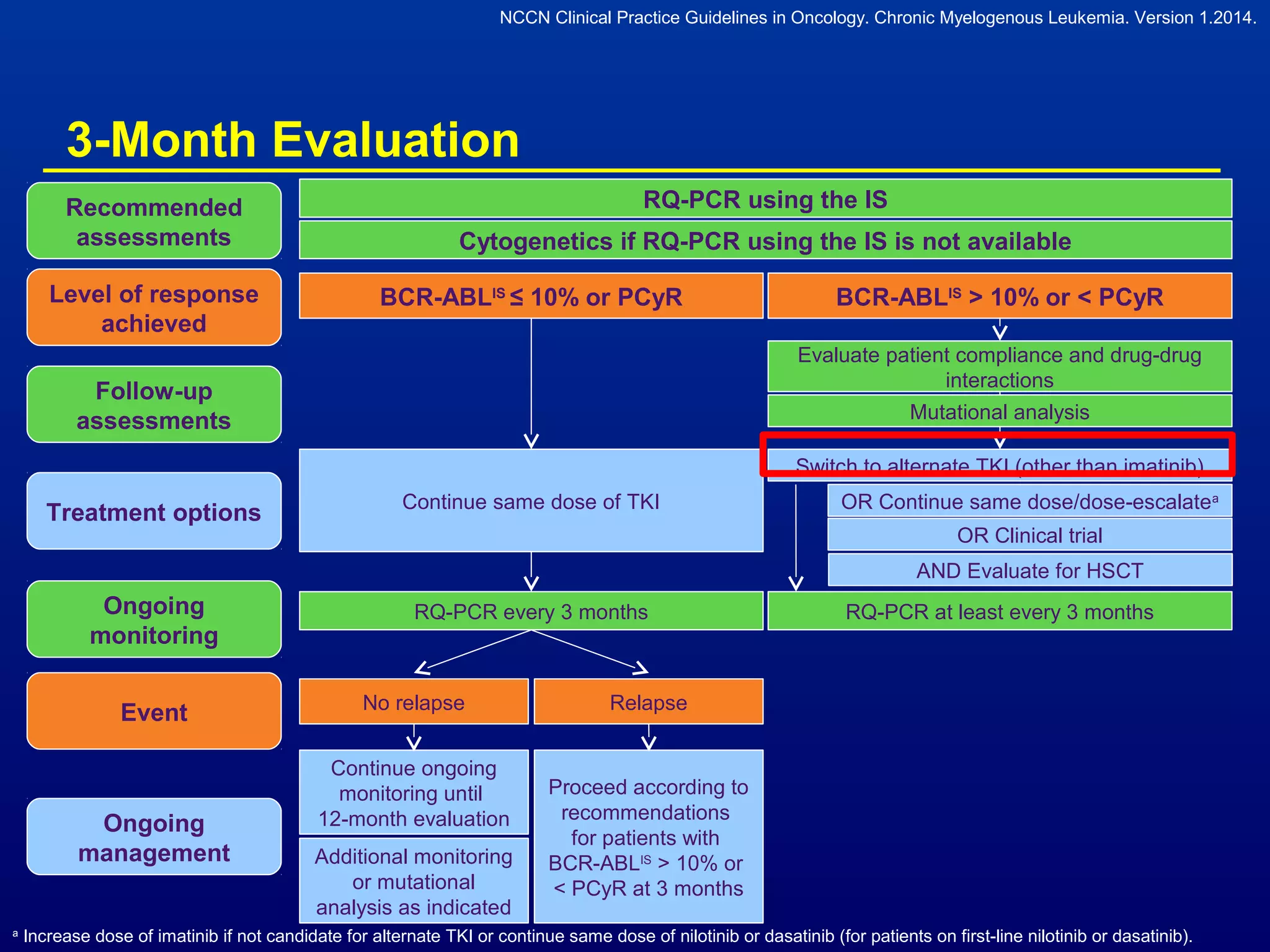
3-Month Evaluation
Recommended
assessments
Level of response
achieved
Follow-up
assessments
Treatment options
Ongoing
monitoring
Ongoing
management
Cytogenetics if RQ-PCR using the IS is not available
BCR-ABLIS
≤ 10% or PCyR BCR-ABLIS
> 10% or < PCyR
Continue same dose of TKI
Evaluate patient compliance and drug-drug
interactions
RQ-PCR every 3 months RQ-PCR at least every 3 months
Switch to alternate TKI (other than imatinib)
OR Continue same dose/dose-escalatea
Continue ongoing
monitoring until
12-month evaluation
Proceed according to
recommendations
for patients with
BCR-ABLIS
> 10% or
< PCyR at 3 months
RelapseNo relapse
Event
RQ-PCR using the IS
OR Clinical trial
Additional monitoring
or mutational
analysis as indicated
Mutational analysis
NCCN Clinical Practice Guidelines in Oncology. Chronic Myelogenous Leukemia. Version 1.2014.
a
Increase dose of imatinib if not candidate for alternate TKI or continue same dose of nilotinib or dasatinib (for patients on first-line nilotinib or dasatinib).
AND Evaluate for HSCT
OPTIMAL WARNING FAILURE
BASELINE NA -HIGH RISK,
-CCA/Ph+
(Major route)
NA
3 mo Ph+ ≤ 35% and/or
BCR-ABL ≤ 10%
Ph + 36-95% and/or
BCR-ABL ≥ 10%
No CHR and/or
Ph + > 95%
6 mo Ph+ 0 and/or
BCR-ABL < 1%
Ph + 1-35% and/or
BCR-ABL 1-10%
Ph + > 35% and/or
BCR-ABL > 10%
12 mo BCR-ABL≤ 0.1% BCR-ABL 0.1-1 % Ph + ≥ 1%, and/or
BCR-ABL > 1%
24 mo BCR-ABL ≤ 0.1% BCR-ABL 0.1-1% BCR-ABL > 1%
EUROPEAN LEUKEMIANET 2013
RESPONSE TO TREATMENT FIRSTLINE
Baccarani M et al, Blood. 2013 Jun 26. [Epub ahead of print].Yellow = cytogenetic response
00
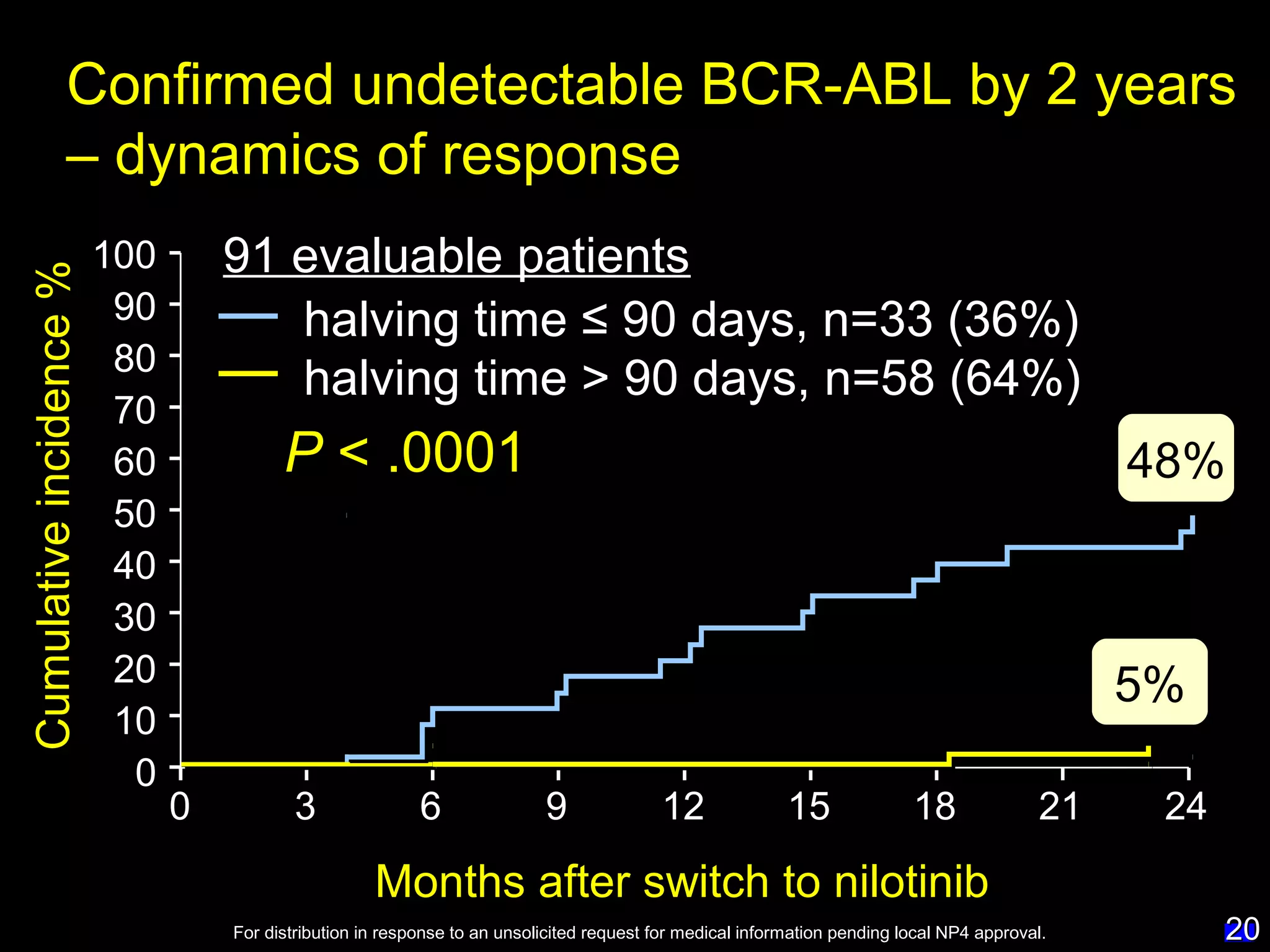
halving time > 90 days, n=58 (64%)halving time > 90 days, n=58 (64%)
halving time ≤ 90 days, n=33 (36%)halving time ≤ 90 days, n=33 (36%)
PP < .0001< .0001
100100
9090
5050
1010
00
66 1212 1818 242433 99 1515 2121
8080
4040
3030
2020
7070
6060
Confirmed undetectable BCR-ABL by 2 yearsConfirmed undetectable BCR-ABL by 2 years
– dynamics of response– dynamics of response
48%
5%
Months after switch to nilotinibMonths after switch to nilotinib
91 evaluable patients91 evaluable patients
Cumulativeincidence%Cumulativeincidence%
2020For distribution in response to an unsolicited request for medical information pending local NP4 approval.

When to stop TKI in Chronic Myelogenous Leukemia?

  • 1.
    When to stopTKI in CMLWhen to stop TKI in CML
  • 3.
  • 4.
    Three situationsThree situations When they don’t workWhen they don’t work  When they are too toxicWhen they are too toxic  When they appear to have affected a cureWhen they appear to have affected a cure
  • 5.
    Three situationsThree situations When they don’t workWhen they don’t work  When they are too toxicWhen they are too toxic  When they appear to have affected a cureWhen they appear to have affected a cure
  • 6.
    CML is curedby alloSCT by eradicationCML is cured by alloSCT by eradication CML clones via the GVL effect……right?CML clones via the GVL effect……right? Gratwohl Haem 2006 91:513; Sekhri Leuk Res 2009 33:1291. Latest reported relapse at 24 years post- allograft
  • 7.
    CureCure  Absence ofdisease-related symptomsAbsence of disease-related symptoms and signsand signs  Freedom from progressionFreedom from progression  No need for treatmentNo need for treatment  PermanentPermanent
  • 8.
    CMRCMR  Complete MolecularResponseComplete Molecular Response  No detectable BCR-ABL mRNANo detectable BCR-ABL mRNA  RQ-PCR method with sensitivityRQ-PCR method with sensitivity ≥4.5-log≥4.5-log  Confirmed on two consecutive measurementsConfirmed on two consecutive measurements  Undetectable MRD (UMRD)Undetectable MRD (UMRD)  Molecular Undetectable Leukaemia (MUL)Molecular Undetectable Leukaemia (MUL)  Treatment free remissionTreatment free remission Branford Clin Cancer Res 2007 13:7080
  • 9.
  • 10.
    Less is betterLessis better  Mutations occur stochastically – fewerMutations occur stochastically – fewer cells means fewer opportunitiescells means fewer opportunities  CML LSCs have increased ROS andCML LSCs have increased ROS and increased mutation rateincreased mutation rate  Imatinib does not correct ROS-inducedImatinib does not correct ROS-induced mutagenesis in the most primitive CMLmutagenesis in the most primitive CML cells (mouse model)cells (mouse model) Bolton-Gillespie Blood 2013 121:4175
  • 11.
    AllograftingAllografting  Achievement ofUMRD required for EFSAchievement of UMRD required for EFS  Relapse risk: UMRD 5%Relapse risk: UMRD 5%  detectable MRD 70%detectable MRD 70%  Rate of unstable UMRD is lower than inRate of unstable UMRD is lower than in imatinib-treated patientsimatinib-treated patients  BCR-ABL DNA not detected in 8/9BCR-ABL DNA not detected in 8/9 patients in long-term remissionpatients in long-term remission Radich Blood 1995 85:2632; Mughal BJH 2001 115:569; Lange Leukemia 2005 19:1262; Simoes Blood 2010 116:1329
  • 12.
    Ross & MeloASHEP 2011. Biology of TFRBiology of TFR Possible modelsPossible models for MRDfor MRD
  • 13.
    Stopping ImatinibStopping Imatinib Allreported cases of cessation in CCR orAll reported cases of cessation in CCR or MMR led to relapseMMR led to relapse  Doubling timeDoubling time ~~10 days10 days First reported TFR cases had UMRDFirst reported TFR cases had UMRD Mahon Blood 2007 109:58; Branford Blood 2012 119:4264
  • 14.
    ALLG CML8 studyALLGCML8 study clinical outlineclinical outline  Clinical trial of withdrawing imatinib from chronicClinical trial of withdrawing imatinib from chronic phase CML patients with sustained undetectablephase CML patients with sustained undetectable BCR-ABL by RQ-PCR for at least two yearsBCR-ABL by RQ-PCR for at least two years  Close RQ-PCR monitoring for two yearsClose RQ-PCR monitoring for two years  Completed accrual of 40 patients:Completed accrual of 40 patients: 21 patients received IFN before imatinib21 patients received IFN before imatinib 19 patients received imatinib in early CP19 patients received imatinib in early CP Ross Blood 2013 122:515.
  • 15.
    RelapseRelapse  Defined as:Definedas:  Loss of MMR (BCR-ABLLoss of MMR (BCR-ABLISIS >0.1%)>0.1%) • OROR  Any two consecutive positive resultsAny two consecutive positive results  Imatinib re-commenced at previous doseImatinib re-commenced at previous dose
  • 16.
    Patients (n=40)Patients (n=40) Male sex 48%Male sex 48%  Median age 61 yearsMedian age 61 years  Median interval (months)Median interval (months)  Imatinib prior to study entryImatinib prior to study entry 70 (44-108)70 (44-108)  Time to UMRDTime to UMRD 32 (3-73)32 (3-73)  UMRD prior to study entryUMRD prior to study entry 36 (24-82)36 (24-82)  Follow-upFollow-up 40 (12-72)40 (12-72)
  • 17.
    CML8 TFRCML8 TFR RossBlood 2013 122:515.
  • 18.
  • 19.
    Years in treatment-freeremission Ross Blood 2013 122:515.
  • 20.
    P<0.001P<0.001 10 0.1 0.001 1 0.01 BCR-ABLDNA% Not detected 0.0001 UMRD atstudy entry Molecular relapse UMRD after retreatment NS Ross Blood 2013 122:515.
  • 21.
    A-STIMA-STIM Single case oflymphoid blast crisis developing abruptly after regaining UMRD Started imatinib 10 years after original diagnosis Rousselot JCO 2014 32:424.
  • 22.
  • 23.
    Stopping of 2GTKIStopping of 2G TKI  ENESTopENESTop  MR4.5 after second-line nilotinibMR4.5 after second-line nilotinib  One year nilotinib ‘consolidation’ then stop if MRDOne year nilotinib ‘consolidation’ then stop if MRD criteria metcriteria met  ENESTfreedomENESTfreedom  MR4.5 after first-line nilotinib (ENESTnd)MR4.5 after first-line nilotinib (ENESTnd)  Similar designSimilar design  EuroSKI registryEuroSKI registry
  • 24.
    Question #1Question #1 What MRD threshold is good enough toWhat MRD threshold is good enough to achieve TFR?achieve TFR?  UMRD is arbitrary and varies from test to testUMRD is arbitrary and varies from test to test  MR4.5 being tested in prospective trialsMR4.5 being tested in prospective trials  Probably also depends onProbably also depends on speedspeed andand durationduration ofof MRMR
  • 27.
    Question #2Question #2 What is the latest that relapse can occur?What is the latest that relapse can occur?  How should we monitor patients in TFR?How should we monitor patients in TFR?  Latest reported relapse from TFR at 42 monthsLatest reported relapse from TFR at 42 months  Latest reported loss of MMR (A-STIM) at 17Latest reported loss of MMR (A-STIM) at 17 monthsmonths
  • 28.
    Question #3Question #3 Why do some people with stable UMRDWhy do some people with stable UMRD relapse early while others remain in TFR?relapse early while others remain in TFR?  Pre-determined by disease biology?Pre-determined by disease biology?  Immune control?Immune control?  Persistence of differing subclones or cell types?Persistence of differing subclones or cell types?
  • 29.
    ConclusionsConclusions  Some patientsappear to be ‘cured’ withSome patients appear to be ‘cured’ with follow-up of >5 years after stopping imatinibfollow-up of >5 years after stopping imatinib  TFR after imatinib is often (or always)TFR after imatinib is often (or always) associated with detectable MRD by highlyassociated with detectable MRD by highly sensitive BCR-ABL DNA PCRsensitive BCR-ABL DNA PCR
  • 30.
  • 31.
    Imatinib is stilla great drug IRIS and many, many, many ASH updates
  • 32.
    3 year Dasisiondata Jabbour; Blood 2014
  • 34.
    Ischemic heartIschemic heart diseasedisease IschemicIschemic cerebrovascularcerebrovascular eventsevents PeripheralPeripheral arterialarterial diseasedisease 2020 1818 1010 22 00 1616 88 66 44 1414 1212 NumberofpatientsNumberofpatients Cardiovascularevents (CVE) by 36 months (safety population)Cardiovascular events (CVE) by 36 months (safety population) Any CVEAny CVE NilotinibNilotinib Median exposure, 3.0 yMedian exposure, 3.0 y ImatinibImatinib Median exposure on study,Median exposure on study, 2.2 y2.2 y Crossover to Nilotinib MedianCrossover to Nilotinib Median exposure, 1.0 yexposure, 1.0 y 1212 22 22 77 44 00 1111 11 00 11 33 1515 More cases of CVEs were reported in patientsMore cases of CVEs were reported in patients randomized to nilotinib compared with imatinibrandomized to nilotinib compared with imatinib
  • 37.
    What if youdo wait until 6 months? 6 month landmark analysis 37 85
  • 39.
    3-Month Evaluation Recommended assessments Level ofresponse achieved Follow-up assessments Treatment options Ongoing monitoring Ongoing management Cytogenetics if RQ-PCR using the IS is not available BCR-ABLIS ≤ 10% or PCyR BCR-ABLIS > 10% or < PCyR Continue same dose of TKI Evaluate patient compliance and drug-drug interactions RQ-PCR every 3 months RQ-PCR at least every 3 months Switch to alternate TKI (other than imatinib) OR Continue same dose/dose-escalatea Continue ongoing monitoring until 12-month evaluation Proceed according to recommendations for patients with BCR-ABLIS > 10% or < PCyR at 3 months RelapseNo relapse Event RQ-PCR using the IS OR Clinical trial Additional monitoring or mutational analysis as indicated Mutational analysis NCCN Clinical Practice Guidelines in Oncology. Chronic Myelogenous Leukemia. Version 1.2014. a Increase dose of imatinib if not candidate for alternate TKI or continue same dose of nilotinib or dasatinib (for patients on first-line nilotinib or dasatinib). AND Evaluate for HSCT
  • 40.
    OPTIMAL WARNING FAILURE BASELINENA -HIGH RISK, -CCA/Ph+ (Major route) NA 3 mo Ph+ ≤ 35% and/or BCR-ABL ≤ 10% Ph + 36-95% and/or BCR-ABL ≥ 10% No CHR and/or Ph + > 95% 6 mo Ph+ 0 and/or BCR-ABL < 1% Ph + 1-35% and/or BCR-ABL 1-10% Ph + > 35% and/or BCR-ABL > 10% 12 mo BCR-ABL≤ 0.1% BCR-ABL 0.1-1 % Ph + ≥ 1%, and/or BCR-ABL > 1% 24 mo BCR-ABL ≤ 0.1% BCR-ABL 0.1-1% BCR-ABL > 1% EUROPEAN LEUKEMIANET 2013 RESPONSE TO TREATMENT FIRSTLINE Baccarani M et al, Blood. 2013 Jun 26. [Epub ahead of print].Yellow = cytogenetic response
  • 41.
    00 halving time >90 days, n=58 (64%)halving time > 90 days, n=58 (64%) halving time ≤ 90 days, n=33 (36%)halving time ≤ 90 days, n=33 (36%) PP < .0001< .0001 100100 9090 5050 1010 00 66 1212 1818 242433 99 1515 2121 8080 4040 3030 2020 7070 6060 Confirmed undetectable BCR-ABL by 2 yearsConfirmed undetectable BCR-ABL by 2 years – dynamics of response– dynamics of response 48% 5% Months after switch to nilotinibMonths after switch to nilotinib 91 evaluable patients91 evaluable patients Cumulativeincidence%Cumulativeincidence% 2020For distribution in response to an unsolicited request for medical information pending local NP4 approval.