What is the care value base?  The care value base is a range of standards for health and social care. It is designed to guide the practice of professionals working in this area. The overall aim of the standards is to improve clients' quality of life, by ensuring that each person gets the care that is most appropriate for them as an individual. The care value base offers guidance, and sets standards, in three main areas of health and social care: Fostering (which means supporting and encouraging) equality and diversity  Fostering people's rights and responsibilities  Maintaining confidentiality of information
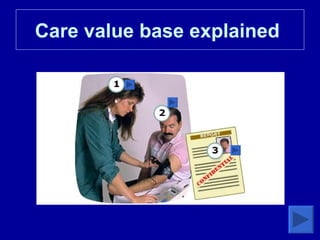
Care value base explained
Care value base explained  1 Fostering equality and diversity This is recognising and supporting people's  individual needs . It involves: Giving everyone the  same quality of care and support , but not treating everyone in the same way  Respecting and supporting the diversity of people's  experiences ,  lifestyles  and  backgrounds
Care value base explained  2 Fostering rights and responsibilities This means supporting a client's  right to choose  their own  lifestyle  AND helping them to  accept their responsibilities . So your client has the  right  to eat unhealthy food, but you need to tell them about the health risks so they can take  responsibility  for their choice .
Care value base explained  3 Confidentiality of information This means that any information clients give you is  private and confidential , whether it is: Verbal   Written   Electronic  (on a computer) You need to be aware of what you  say  to other carers and clients and also who has  access  to client files.
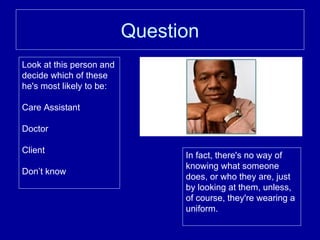
Question Look at this person and decide which of these he's most likely to be: Care Assistant Doctor Client Don’t know In fact, there's no way of knowing what someone does, or who they are, just by looking at them, unless, of course, they're wearing a uniform.
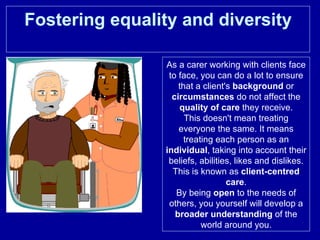
Fostering equality and diversity As a carer working with clients face to face, you can do a lot to ensure that a client's  background  or  circumstances  do not affect the  quality of care  they receive. This doesn't mean treating everyone the same. It means treating each person as an  individual , taking into account their beliefs, abilities, likes and dislikes. This is known as  client-centred care . By being  open  to the needs of others, you yourself will develop a  broader understanding  of the world around you.
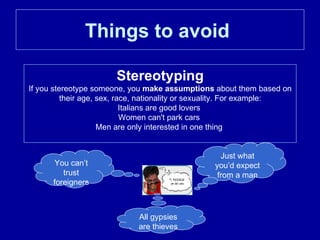
Things to avoid   Stereotyping If you stereotype someone, you  make assumptions  about them based on their age, sex, race, nationality or sexuality. For example: Italians are good lovers  Women can't park cars  Men are only interested in one thing  You can’t trust foreigners Just what you’d expect from a man All gypsies are thieves
Prejudice This means liking or disliking someone not because of  who they are , but because of  how you feel  about their lifestyle or background. Carers have a responsibility to ensure that prejudice  doesn't  affect the  quality of care  given to clients.
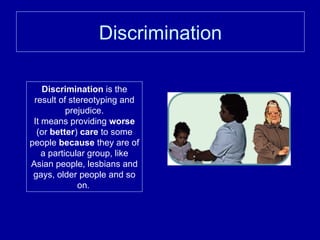
Discrimination Discrimination  is the result of stereotyping and prejudice. It means providing  worse  (or  better )  care  to some people  because  they are of a particular group, like Asian people, lesbians and gays, older people and so on .
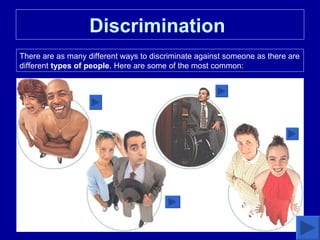
Discrimination   There are as many different ways to discriminate against someone as there are different  types of people . Here are some of the most common:
Race Discrimination This means treating someone differently because of the  colour of their skin  or their  racial background . For example, care workers may spend time chatting to someone from their own racial background, but ignore clients they see as 'foreigners'
Sex Discrimination This means treating someone differently because they are  male  or  female . For example, medical staff may explain things in more detail to a man than to a woman
Age Discrimination This means being treated less favourably because of your  age . For example, someone may be refused certain treatments or operations because they are thought to be too old to make it worthwhile.
Disability Discrimination Disability discrimination This means being treated less favourably because of a  disability . For example, wheelchair users may have difficulty gaining access to a health centre that does not have electric doors.
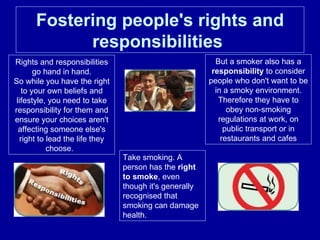
Fostering people's rights and responsibilities   Rights and responsibilities go hand in hand. So while you have the right to your own beliefs and lifestyle, you need to take responsibility for them and ensure your choices aren't affecting someone else's right to lead the life they choose.  Take smoking. A person has the  right to smoke , even though it's generally recognised that smoking can damage health.  But a smoker also has a  responsibility  to consider people who don't want to be in a smoky environment. Therefore they have to obey non-smoking regulations at work, on public transport or in restaurants and cafes
Examples of Rights and Responsibilities Rights and responsibilities are often laid down in  legislation ,  codes of practice  and  policy documents . As a carer, you need to make sure that your clients are  aware  of their rights and responsibilities in care settings. Clients have a right to: Not be discriminated against  Confidentiality  Their own beliefs and values Clients have a responsibility to: Not discriminate against others  Respect the confidentiality of others  Do no harm to others
Confidentiality   Maintaining confidentiality of information is an important part of caring. You need to think carefully  before  you talk about your  colleagues  and  clients , and ask yourself whether this person really  needs  to know what you're about to tell them. It's just common sense really! You wouldn't expect a tutor to discuss  your  exam results with anyone but  you , and you should treat your client's  personal details  in the same way. But of course there are times when you need to  share  confidential information, for example when a client may be a danger to themselves or others.
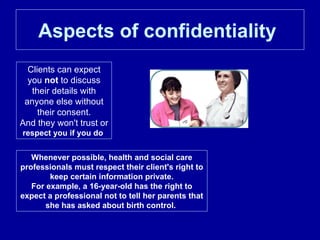
Aspects of confidentiality   Clients can expect you  not  to discuss their details with anyone else without their consent. And they won't trust or  respect you if you do  Whenever possible, health and social care professionals must respect their client's right to keep certain information private. For example, a 16-year-old has the right to expect a professional not to tell her parents that she has asked about birth control.
Data Protection There are also  legal requirements  to keep personal records confidential. The  1998 Data Protection Act  states that data has to be  secure ,  accurate  and that it can only be used for  limited purposes .
Maintaining confidentiality   Confidentiality affects  everyone  in health and social care settings. So how can  you  ensure you don't pass on confidential information to anyone who isn't entitled to it?
Maintaining confidentiality   Confidential information stored on a  computer  can include personal details and medical history. But using individual passwords will allow only certain people access t o your files. Medical notes  may be stored in a filing cabinet. So you need to check that all filing cabinets can be locked and that you know who has access to the keys
Maintaining confidentiality   Don't  talk  about clients' and colleagues' personal details in public places. And think about who else is in the room before you talk about confidential information over the telephone.  Your  work diary  might contain information on clients' progress, recurring problems and future appointments. Think about who has access to your room and decide how to keep the diary private.
Quiz Client details may be stored in a  _____, which should be kept  ____ at all times. A diary, file or care plan may contain  ________ information about clients, and access needs to be  _____ to those who need it. If you're talking about a client or colleague on the telephone, then make sure you're not  ______.  And try to avoid talking about people in public   places, because you never know who may be  _______ .  Overheard, locked, filing cabinet, restricted, listening, confidential.
Summary The  care value base  was developed to improve clients'  quality of life  by  setting standards  and  guiding professional practice  in health and social care.  Fostering equality and diversity  means recognising that each person has their own individual needs. It also means working to meet those needs.  Fostering rights and responsibilities  recognises people's rights, but also stresses that we all have responsibilities towards others.  The need to maintain  confidentiality of client information  protect the client's right to have personal information kept private.

What Is The Care Value Base

  • 1.
    What is thecare value base? The care value base is a range of standards for health and social care. It is designed to guide the practice of professionals working in this area. The overall aim of the standards is to improve clients' quality of life, by ensuring that each person gets the care that is most appropriate for them as an individual. The care value base offers guidance, and sets standards, in three main areas of health and social care: Fostering (which means supporting and encouraging) equality and diversity Fostering people's rights and responsibilities Maintaining confidentiality of information
  • 2.
    Care value baseexplained
  • 3.
    Care value baseexplained 1 Fostering equality and diversity This is recognising and supporting people's individual needs . It involves: Giving everyone the same quality of care and support , but not treating everyone in the same way Respecting and supporting the diversity of people's experiences , lifestyles and backgrounds
  • 4.
    Care value baseexplained 2 Fostering rights and responsibilities This means supporting a client's right to choose their own lifestyle AND helping them to accept their responsibilities . So your client has the right to eat unhealthy food, but you need to tell them about the health risks so they can take responsibility for their choice .
  • 5.
    Care value baseexplained 3 Confidentiality of information This means that any information clients give you is private and confidential , whether it is: Verbal Written Electronic (on a computer) You need to be aware of what you say to other carers and clients and also who has access to client files.
  • 6.
    Question Look atthis person and decide which of these he's most likely to be: Care Assistant Doctor Client Don’t know In fact, there's no way of knowing what someone does, or who they are, just by looking at them, unless, of course, they're wearing a uniform.
  • 7.
    Fostering equality anddiversity As a carer working with clients face to face, you can do a lot to ensure that a client's background or circumstances do not affect the quality of care they receive. This doesn't mean treating everyone the same. It means treating each person as an individual , taking into account their beliefs, abilities, likes and dislikes. This is known as client-centred care . By being open to the needs of others, you yourself will develop a broader understanding of the world around you.
  • 8.
    Things to avoid Stereotyping If you stereotype someone, you make assumptions about them based on their age, sex, race, nationality or sexuality. For example: Italians are good lovers Women can't park cars Men are only interested in one thing You can’t trust foreigners Just what you’d expect from a man All gypsies are thieves
  • 9.
    Prejudice This meansliking or disliking someone not because of who they are , but because of how you feel about their lifestyle or background. Carers have a responsibility to ensure that prejudice doesn't affect the quality of care given to clients.
  • 10.
    Discrimination Discrimination is the result of stereotyping and prejudice. It means providing worse (or better ) care to some people because they are of a particular group, like Asian people, lesbians and gays, older people and so on .
  • 11.
    Discrimination There are as many different ways to discriminate against someone as there are different types of people . Here are some of the most common:
  • 12.
    Race Discrimination Thismeans treating someone differently because of the colour of their skin or their racial background . For example, care workers may spend time chatting to someone from their own racial background, but ignore clients they see as 'foreigners'
  • 13.
    Sex Discrimination Thismeans treating someone differently because they are male or female . For example, medical staff may explain things in more detail to a man than to a woman
  • 14.
    Age Discrimination Thismeans being treated less favourably because of your age . For example, someone may be refused certain treatments or operations because they are thought to be too old to make it worthwhile.
  • 15.
    Disability Discrimination Disabilitydiscrimination This means being treated less favourably because of a disability . For example, wheelchair users may have difficulty gaining access to a health centre that does not have electric doors.
  • 16.
    Fostering people's rightsand responsibilities Rights and responsibilities go hand in hand. So while you have the right to your own beliefs and lifestyle, you need to take responsibility for them and ensure your choices aren't affecting someone else's right to lead the life they choose. Take smoking. A person has the right to smoke , even though it's generally recognised that smoking can damage health. But a smoker also has a responsibility to consider people who don't want to be in a smoky environment. Therefore they have to obey non-smoking regulations at work, on public transport or in restaurants and cafes
  • 17.
    Examples of Rightsand Responsibilities Rights and responsibilities are often laid down in legislation , codes of practice and policy documents . As a carer, you need to make sure that your clients are aware of their rights and responsibilities in care settings. Clients have a right to: Not be discriminated against Confidentiality Their own beliefs and values Clients have a responsibility to: Not discriminate against others Respect the confidentiality of others Do no harm to others
  • 18.
    Confidentiality Maintaining confidentiality of information is an important part of caring. You need to think carefully before you talk about your colleagues and clients , and ask yourself whether this person really needs to know what you're about to tell them. It's just common sense really! You wouldn't expect a tutor to discuss your exam results with anyone but you , and you should treat your client's personal details in the same way. But of course there are times when you need to share confidential information, for example when a client may be a danger to themselves or others.
  • 19.
    Aspects of confidentiality Clients can expect you not to discuss their details with anyone else without their consent. And they won't trust or respect you if you do Whenever possible, health and social care professionals must respect their client's right to keep certain information private. For example, a 16-year-old has the right to expect a professional not to tell her parents that she has asked about birth control.
  • 20.
    Data Protection Thereare also legal requirements to keep personal records confidential. The 1998 Data Protection Act states that data has to be secure , accurate and that it can only be used for limited purposes .
  • 21.
    Maintaining confidentiality Confidentiality affects everyone in health and social care settings. So how can you ensure you don't pass on confidential information to anyone who isn't entitled to it?
  • 22.
    Maintaining confidentiality Confidential information stored on a computer can include personal details and medical history. But using individual passwords will allow only certain people access t o your files. Medical notes may be stored in a filing cabinet. So you need to check that all filing cabinets can be locked and that you know who has access to the keys
  • 23.
    Maintaining confidentiality Don't talk about clients' and colleagues' personal details in public places. And think about who else is in the room before you talk about confidential information over the telephone. Your work diary might contain information on clients' progress, recurring problems and future appointments. Think about who has access to your room and decide how to keep the diary private.
  • 24.
    Quiz Client detailsmay be stored in a _____, which should be kept ____ at all times. A diary, file or care plan may contain ________ information about clients, and access needs to be _____ to those who need it. If you're talking about a client or colleague on the telephone, then make sure you're not ______. And try to avoid talking about people in public places, because you never know who may be _______ . Overheard, locked, filing cabinet, restricted, listening, confidential.
  • 25.
    Summary The care value base was developed to improve clients' quality of life by setting standards and guiding professional practice in health and social care. Fostering equality and diversity means recognising that each person has their own individual needs. It also means working to meet those needs. Fostering rights and responsibilities recognises people's rights, but also stresses that we all have responsibilities towards others. The need to maintain confidentiality of client information protect the client's right to have personal information kept private.