The CARE CERTIFICATE
1
Understand your role
Standard
2
Learning outcomes
The worker will:
1.1 Understand their own role
1.2 Work in ways that have been agreed with
their employer
1.3 Understand working relationships in health and
social care
1.4 Work in partnership with others.
Standard
3
Tasks, behaviours and standards of work
The duties and responsibilities that are part of your role will
be listed in your job description.
Your role is likely to include:
 Providing care and support
 Working as part of a team
 Contributing to activities
 Respecting confidentiality
Your work must always be carried out in agreed ways and
must keep to regulations.
Regulations
are rules that come from legislation or laws. The legislation establishes the general ‘laws of the land’.
Regulations provide the specific ways in which those laws are interpreted and applied.
4
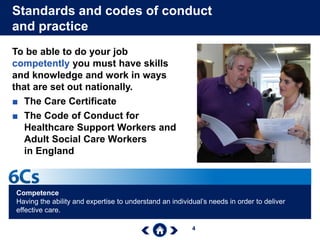
Standards and codes of conduct
and practice
To be able to do your job
competently you must have skills
and knowledge and work in ways
that are set out nationally.
■ The Care Certificate
■ The Code of Conduct for
Healthcare Support Workers and
Adult Social Care Workers
in England
Competence
Having the ability and expertise to understand an individual’s needs in order to deliver
effective care.
5
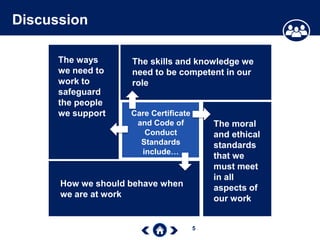
Discussion
The skills and knowledge we
need to be competent in our
role
How we should behave when
we are at work
Care Certificate
and Code of
Conduct
Standards
include…
The moral
and ethical
standards
that we
must meet
in all
aspects of
our work
The ways
we need to
work to
safeguard
the people
we support
6
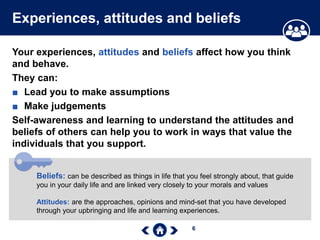
Experiences, attitudes and beliefs
Your experiences, attitudes and beliefs affect how you think
and behave.
They can:
■ Lead you to make assumptions
■ Make judgements
Self-awareness and learning to understand the attitudes and
beliefs of others can help you to work in ways that value the
individuals that you support.
Beliefs: can be described as things in life that you feel strongly about, that guide
you in your daily life and are linked very closely to your morals and values
Attitudes: are the approaches, opinions and mind-set that you have developed
through your upbringing and life and learning experiences.
7
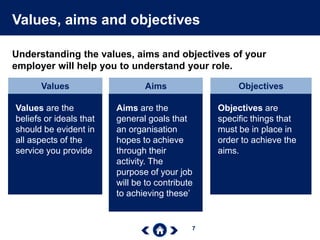
Values, aims and objectives
Understanding the values, aims and objectives of your
employer will help you to understand your role.
Values
Values are the
beliefs or ideals that
should be evident in
all aspects of the
service you provide
Aims
Aims are the
general goals that
an organisation
hopes to achieve
through their
activity. The
purpose of your job
will be to contribute
to achieving these’
Objectives
Objectives are
specific things that
must be in place in
order to achieve the
aims.
8
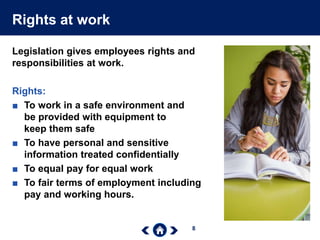
Rights at work
Legislation gives employees rights and
responsibilities at work.
Rights:
■ To work in a safe environment and
be provided with equipment to
keep them safe
■ To have personal and sensitive
information treated confidentially
■ To equal pay for equal work
■ To fair terms of employment including
pay and working hours.
9
Responsibilities at work
Protected characteristics
The Equality Act 2010 identifies nine protected characteristics or groups that are
protected under equalities law.
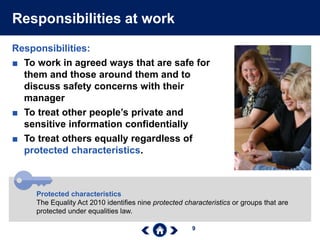
Responsibilities:
■ To work in agreed ways that are safe for
them and those around them and to
discuss safety concerns with their
manager
■ To treat other people’s private and
sensitive information confidentially
■ To treat others equally regardless of
protected characteristics.
10
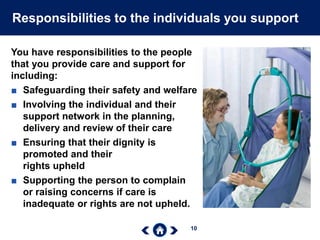
Responsibilities to the individuals you support
You have responsibilities to the people
that you provide care and support for
including:
■ Safeguarding their safety and welfare
■ Involving the individual and their
support network in the planning,
delivery and review of their care
■ Ensuring that their dignity is
promoted and their
rights upheld
■ Supporting the person to complain
or raising concerns if care is
inadequate or rights are not upheld.
11
Agreed ways of working
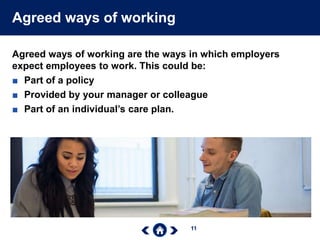
Agreed ways of working are the ways in which employers
expect employees to work. This could be:
■ Part of a policy
■ Provided by your manager or colleague
■ Part of an individual’s care plan.
12
Reporting errors - discussion
Mistakes sometimes happen and it is important to be honest
and identify when errors have been made.
■ What action should
be taken?
■ Why is it important to be
honest and admit when
errors have been made?
■ What are the potential
consequences of not
reporting a mistake?
13
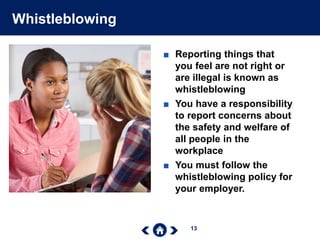
Whistleblowing
■ Reporting things that
you feel are not right or
are illegal is known as
whistleblowing
■ You have a responsibility
to report concerns about
the safety and welfare of
all people in the
workplace
■ You must follow the
whistleblowing policy for
your employer.
14
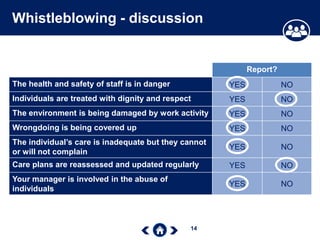
Whistleblowing - discussion
Report?
The health and safety of staff is in danger YES NO
Individuals are treated with dignity and respect YES NO
The environment is being damaged by work activity YES NO
Wrongdoing is being covered up YES NO
The individual’s care is inadequate but they cannot
or will not complain
YES NO
Care plans are reassessed and updated regularly YES NO
Your manager is involved in the abuse of
individuals
YES NO
15
Working in partnership
In your role you will be working with people in a variety of
roles. This is known as ‘partnership working.’
Working relationships fall into four groups:
■ Individuals and their friends and family
■ Your colleagues and managers
■ People from other workplaces, including advocates.
■ Volunteers and community groups.
Advocate
Is a trusted, independent person who can speak and act for the individual. They can
advise on matters such as benefits and can ensure that the individual’s voice is heard in
care planning meetings, making sure that decisions are made in the interests of the
individual. The role of advocates and advocacy services are made more important with
the Care Act 2014.
16
Effective partnership working
The effectiveness of partnership working affects the quality of
care delivery. Skills and values necessary for it to be effective
include:
■ Communication
■ Record keeping
■ Trust
■ Respect
Conflicts and disagreements can
affect the quality of care provided.
Seek advice from managers and
colleagues who have the experience
to help and advise you.
Working well in partnership
• Good quality care
• Meets all the individual’s needs
Failings in partnership working
• Poor standard of care
• Often identified as a factor when
things go wrong.
17
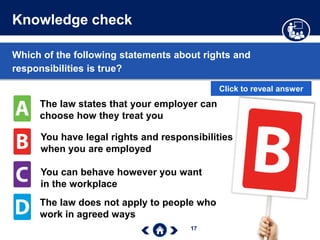
Knowledge check
The law states that your employer can
choose how they treat you
You have legal rights and responsibilities
when you are employed
You can behave however you want
in the workplace
The law does not apply to people who
work in agreed ways
Which of the following statements about rights and
responsibilities is true?
Click to reveal answer
18
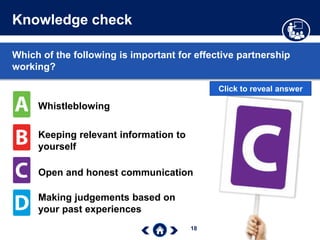
Knowledge check
Which of the following is important for effective partnership
working?
Whistleblowing
Keeping relevant information to
yourself
Open and honest communication
Making judgements based on
your past experiences
Click to reveal answer
19
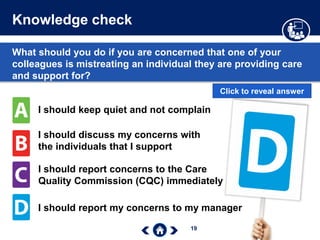
Knowledge check
What should you do if you are concerned that one of your
colleagues is mistreating an individual they are providing care
and support for?
I should keep quiet and not complain
I should discuss my concerns with
the individuals that I support
I should report concerns to the Care
Quality Commission (CQC) immediately
I should report my concerns to my manager
Click to reveal answer

Skills for-care-presentation-web-version-standard-1

  • 1.
  • 2.
    2 Learning outcomes The workerwill: 1.1 Understand their own role 1.2 Work in ways that have been agreed with their employer 1.3 Understand working relationships in health and social care 1.4 Work in partnership with others. Standard
  • 3.
    3 Tasks, behaviours andstandards of work The duties and responsibilities that are part of your role will be listed in your job description. Your role is likely to include:  Providing care and support  Working as part of a team  Contributing to activities  Respecting confidentiality Your work must always be carried out in agreed ways and must keep to regulations. Regulations are rules that come from legislation or laws. The legislation establishes the general ‘laws of the land’. Regulations provide the specific ways in which those laws are interpreted and applied.
  • 4.
    4 Standards and codesof conduct and practice To be able to do your job competently you must have skills and knowledge and work in ways that are set out nationally. ■ The Care Certificate ■ The Code of Conduct for Healthcare Support Workers and Adult Social Care Workers in England Competence Having the ability and expertise to understand an individual’s needs in order to deliver effective care.
  • 5.
    5 Discussion The skills andknowledge we need to be competent in our role How we should behave when we are at work Care Certificate and Code of Conduct Standards include… The moral and ethical standards that we must meet in all aspects of our work The ways we need to work to safeguard the people we support
  • 6.
    6 Experiences, attitudes andbeliefs Your experiences, attitudes and beliefs affect how you think and behave. They can: ■ Lead you to make assumptions ■ Make judgements Self-awareness and learning to understand the attitudes and beliefs of others can help you to work in ways that value the individuals that you support. Beliefs: can be described as things in life that you feel strongly about, that guide you in your daily life and are linked very closely to your morals and values Attitudes: are the approaches, opinions and mind-set that you have developed through your upbringing and life and learning experiences.
  • 7.
    7 Values, aims andobjectives Understanding the values, aims and objectives of your employer will help you to understand your role. Values Values are the beliefs or ideals that should be evident in all aspects of the service you provide Aims Aims are the general goals that an organisation hopes to achieve through their activity. The purpose of your job will be to contribute to achieving these’ Objectives Objectives are specific things that must be in place in order to achieve the aims.
  • 8.
    8 Rights at work Legislationgives employees rights and responsibilities at work. Rights: ■ To work in a safe environment and be provided with equipment to keep them safe ■ To have personal and sensitive information treated confidentially ■ To equal pay for equal work ■ To fair terms of employment including pay and working hours.
  • 9.
    9 Responsibilities at work Protectedcharacteristics The Equality Act 2010 identifies nine protected characteristics or groups that are protected under equalities law. Responsibilities: ■ To work in agreed ways that are safe for them and those around them and to discuss safety concerns with their manager ■ To treat other people’s private and sensitive information confidentially ■ To treat others equally regardless of protected characteristics.
  • 10.
    10 Responsibilities to theindividuals you support You have responsibilities to the people that you provide care and support for including: ■ Safeguarding their safety and welfare ■ Involving the individual and their support network in the planning, delivery and review of their care ■ Ensuring that their dignity is promoted and their rights upheld ■ Supporting the person to complain or raising concerns if care is inadequate or rights are not upheld.
  • 11.
    11 Agreed ways ofworking Agreed ways of working are the ways in which employers expect employees to work. This could be: ■ Part of a policy ■ Provided by your manager or colleague ■ Part of an individual’s care plan.
  • 12.
    12 Reporting errors -discussion Mistakes sometimes happen and it is important to be honest and identify when errors have been made. ■ What action should be taken? ■ Why is it important to be honest and admit when errors have been made? ■ What are the potential consequences of not reporting a mistake?
  • 13.
    13 Whistleblowing ■ Reporting thingsthat you feel are not right or are illegal is known as whistleblowing ■ You have a responsibility to report concerns about the safety and welfare of all people in the workplace ■ You must follow the whistleblowing policy for your employer.
  • 14.
    14 Whistleblowing - discussion Report? Thehealth and safety of staff is in danger YES NO Individuals are treated with dignity and respect YES NO The environment is being damaged by work activity YES NO Wrongdoing is being covered up YES NO The individual’s care is inadequate but they cannot or will not complain YES NO Care plans are reassessed and updated regularly YES NO Your manager is involved in the abuse of individuals YES NO
  • 15.
    15 Working in partnership Inyour role you will be working with people in a variety of roles. This is known as ‘partnership working.’ Working relationships fall into four groups: ■ Individuals and their friends and family ■ Your colleagues and managers ■ People from other workplaces, including advocates. ■ Volunteers and community groups. Advocate Is a trusted, independent person who can speak and act for the individual. They can advise on matters such as benefits and can ensure that the individual’s voice is heard in care planning meetings, making sure that decisions are made in the interests of the individual. The role of advocates and advocacy services are made more important with the Care Act 2014.
  • 16.
    16 Effective partnership working Theeffectiveness of partnership working affects the quality of care delivery. Skills and values necessary for it to be effective include: ■ Communication ■ Record keeping ■ Trust ■ Respect Conflicts and disagreements can affect the quality of care provided. Seek advice from managers and colleagues who have the experience to help and advise you. Working well in partnership • Good quality care • Meets all the individual’s needs Failings in partnership working • Poor standard of care • Often identified as a factor when things go wrong.
  • 17.
    17 Knowledge check The lawstates that your employer can choose how they treat you You have legal rights and responsibilities when you are employed You can behave however you want in the workplace The law does not apply to people who work in agreed ways Which of the following statements about rights and responsibilities is true? Click to reveal answer
  • 18.
    18 Knowledge check Which ofthe following is important for effective partnership working? Whistleblowing Keeping relevant information to yourself Open and honest communication Making judgements based on your past experiences Click to reveal answer
  • 19.
    19 Knowledge check What shouldyou do if you are concerned that one of your colleagues is mistreating an individual they are providing care and support for? I should keep quiet and not complain I should discuss my concerns with the individuals that I support I should report concerns to the Care Quality Commission (CQC) immediately I should report my concerns to my manager Click to reveal answer

Editor's Notes

  • #4 Providing care and support, working in a person centred way, communicating well, building relationships and promoting equality and diversity. Working as part of a team, being a supportive team member and developing your skills to improve your work. Contributing to activities in a safe way, keeping and filing clear records, keeping to regulations, following the agreed way of working. Respecting confidentiality by not discussing any personal information on individuals or staff with unauthorised people, and storing records securely.
  • #5 The Care Certificate is the shared health and social care training, which must be completed and assessed, before new health care support workers or adult social care workers can work out of their supervisor’s line of sight in any workplace. The 15 standards can be found here: www.skillsforhealth.org.uk/projects/item/24-care-certificate www.skillsforcare.org.uk/Standards/Care-Certificate/Care-Certificate.aspx The Code of Conduct for Healthcare Support Workers and Adult Social Care Workers in England has the moral and ethical standards expected of all health and social care workers. The Code can be found here: www.skillsforcare.org.uk/Document-library/Standards/National-minimumtraining-standard-and-code/CodeofConduct.pdf www.skillsforhealth.org.uk/code-of-conduct
  • #6 QUESTION What are included in The Care Certificate and Code of Conduct Standards
  • #7 QUESTION What things can influence your experiences, attitudes and beliefs? Answers could include: Your background, upbringing, relationships, education, the media, attitudes of your friends and family
  • #9 The Health & Safety at Work etc. Act sets out the rights and responsibilities of the employee in the workplace. Employees’ have the right to: Work in an environment that is safe Be provided, free of charge, with the equipment they need to keep them safe at work. Employees have the responsibility to work in agreed ways that are safe for them, for others in the workplace and for the people they support. If you have concerns about safety in your workplace you must talk to your manager. You can find more information about the Health & Safety at Work etc. Act 1974 here: www.hse.gov.uk/legislation/hswa.htm The Data Protection Act protects people’s rights to confidentiality. It restricts how personal and sensitive information can be used, stored and passed on. It applies to employees information and to how they share the information of others. You can find more information about the Data Protection Act here: www.gov.uk/data-protection/the-data-protection-act The Equality Act 2010 gives all people in the UK the right to be treated fairly and afforded equality of opportunity. This means that people must be paid ‘equal pay for equal work.’ You can find more information about the Equality Act 2010 here: www.gov.uk/equality-act-2010-guidance Protected There are many pieces of legislation that set out what are considered to be fair terms of employment including pay and hours of work. You can find out more about working contracts and conditions here: www.gov.uk/employment-contracts-and-conditions/overview
  • #11 You have responsibilities to the people that you provide care and support for including: Safeguarding their safety and welfare by ensuring their care plan is followed and that care is provided in agreed, safe ways Involving the individual and their support network in the planning, delivery and review of their care to ensure that it meets their needs Ensuring that care is delivered in ways that promote their dignity and upholds their rights Supporting the person to complain or raising concerns if care is inadequate or rights are not upheld.
  • #13 QUESTION Ask the group to think of a mistake they have made or offer a scenario. What action should be taken? Why is it important to be honest and admit when errors have been made? What are the potential consequences of not reporting a mistake? Suggested Activity Ask worker/s to think of a mistake they have made or give a scenario. Scenario 1 A meal containing meat is given to a vegetarian. They don’t eat it. What action should be taken? The meal should be replaced with something the person can eat – the individual’s welfare is the top priority and they should not be allowed to go hungry. The mistake should be reported (in line with the agreed ways of working) Why is it important to be honest and admit when errors have been made? If a worker does not admit the mistake the individual may miss a meal. This standard of care would not be acceptable. What are the potential consequences of not reporting a mistake? In this scenario the individual may be hungry A complaint could be made Not eating could affect the effectiveness of medication which has to be taken with or after food. Not reporting may mean that similar incidents happen in the future. If it happens repeatedly to the same person they could become malnourished. If an unsuitable meal were given to an individual with allergies it could have serious consequences Scenario 2 An individual tells a worker that they have been experiencing severe headaches everyday an hour after they have taken their medication. The worker forgets to make a note of this in the individual’s care plan What action should be taken? The worker must tell their supervisor as soon as possible. Why is it important to be honest and admit when errors have been made? The individual is experiencing pain which may be avoidable if medication is changed The headaches could be a sign of a more serious problem What are the potential consequences of not reporting a mistake? The individual will continue to experience pain- this is not an acceptable level of care if pain could be avoided The individual may become reluctant to take their medication which could affect other aspects of their health The individual’s care plan will not be up to date
  • #15 QUESTION: Ask group to decide whether each should be reported as a concern – yes/no answers Alternative suggestion: This could be printed out as a handout and given to the group to circle their answers
  • #16 Question Think about some of the people who are involved in providing support to an individual. Suggested answers: The person The person’s family and friends Colleagues doing the same or similar jobs Managers and supervisors People who do other jobs such as nurses, GPs, physiotherapists, social workers, dieticians People who work for charitable organisations Religious groups Special interest, recreational and support groups.
  • #17 The effectiveness of partnership working affects the quality of care delivery. Skills and values necessary for it to be effective include: Communication – choosing appropriate ways of communicating, language and avoiding jargon. Workers may need to use interpreters, communication aids etc. to communicate effectively Record keeping – information must be understandable, accessible and shared with those who need to know and up to date Trust – Workers must build working relationships based on trust as this helps to promote openness and honesty and so that everyone is confident that they can rely on the people that they are working with Respect – Workers must always work in ways that promote respect. All those involved in partnership working play a valuable part in planning and providing care. Respecting the part that each person has to play helps to promote effective partnership working.
  • #18 QUESTION: Ask group question then to answer A,B,C or D Trainer should ask class why they chose the correct answer.
  • #19 QUESTION: Ask group question then to answer A,B,C or D Trainer should ask class why they chose the correct answer.
  • #20 QUESTION: Ask group question then to answer A,B,C or D Trainer should ask class why they chose the correct answer. Feedback – Answers to Q&A’s A – Agreeing a PDP is part of an ongoing process of learning and development to improve your skills and knowledge which may be informed by you reflecting on your own practice. B – Feedback from others can be helpful in developing your skills and knowledge but it is not part of reflection on your own work. C – Giving constructive feedback to others can help them to improve the ways in which they work but it is not part of reflecting on your own work. D – Reflection is a form of learning and development in which workers think about what they have done in the past. By thinking about how they could have done things differently to get a different result, they can learn from past experiences and improve the ways in which they work.