The Care Value Base
The Care Value Base
• A set of 7 principles to help care
workers give the standard of care
client’s need.
• Care values are based on ideas
about human rights.
• Care workers should ‘act in the best
interest of the service user’
• They must value them as
individuals
• Treat them in a way we would like
to be treated ourselves
• Care workers show they ‘value’
each individual by applying the care
values.
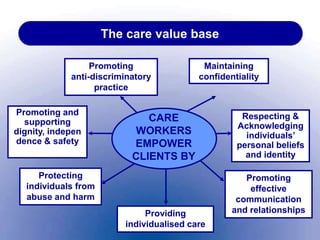
The care value base
CARE
WORKERS
EMPOWER
CLIENTS BY
Promoting
anti-discriminatory
practice
Maintaining
confidentiality
Promoting and
supporting
dignity, indepen
dence & safety
Respecting &
Acknowledging
individuals’
personal beliefs
and identity
Protecting
individuals from
abuse and harm
Providing
individualised care
Promoting
effective
communication
and relationships
The Care Value Base
• Care work is about improving a client’s
quality of life by meeting their PIES
needs. The CVB ensures that this
happens.
• Care workers do this by empowering
their clients (by giving them the ability to
do something for themselves).
1. Promoting anti-discriminatory practice
• What does this mean?
• Care workers must be
seen to treat all
clients in the same
way no matter what
differences there are.
• They must make sure
they do not
discriminate against
anyone.
1. Promoting anti-discriminatory practice
• How can you do this?
• Allowing people to be
different & not
discriminating against
anyone.
• Aware of how
discrimination can
happen.
• Understanding
prejudice, stereotypin
g & labelling & their
effects.
• Using politically
correct language.
1. Promoting anti-discriminatory practice
• Why is it important?
• It promotes trust &
respect between client
& practitioner.
• It shows that the
practitioner cares and
fully accepts the
client.
• The practitioner will
also challenge
discrimination they
witness from other
people.
2. Maintaining confidentiality
• What does this
mean?
• An appropriate
protection of
personal and private
information about
clients.
2. Maintaining confidentiality
• How can you do
this?
• Keeping records
safe & secure
• Pass information
on, on a need to
know basis
• Follow policies &
procedures
2. Maintaining confidentiality
• Why is it important?
• It is vital to successful
care giving to keep
information provided by
the client confidential.
• It ensures that clients
trust the care provider
which is important when
they need to discuss
personal issues.
• However there may be
times that this
information would need
to be shared.
The Data Protection Act
• The Data Protection Act (1998) protects
personal information that we have to
give.
• It also allows us to see information
about ourselves. It is very important to
record information accurately.
When, if ever, should
health, social care and
early years workers reveal
to others information about
the personal problems that
clients reveal to them in
confidence?
Disclosing information
• There are occasions when information is passed on
without a person’s permission. This is known as a
‘disclosure’.
• There are three main occasions when this should
happen:
• 1. What they reveal involves them breaking the
law or planning to do so
• 2. They tell you that they intend to harm
themselves or another person
• 3. They reveal information that can be used to
protect another person from harm
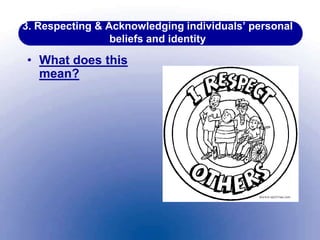
3. Respecting & Acknowledging individuals’ personal
beliefs and identity
• What does this
mean?
3. Respecting & Acknowledging individuals’
personal beliefs and identity
• How can you do
this?
3. Respecting & Acknowledging individuals’
personal beliefs and identity
• Why is it
important?
4. Promoting effective communication and
relationships
• What does this
mean?
4. Promoting effective communication and
relationships
• How can you do
this?
4. Promoting effective communication and
relationships
• Why is it
important?
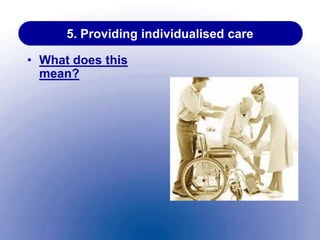
5. Providing individualised care
• What does this
mean?
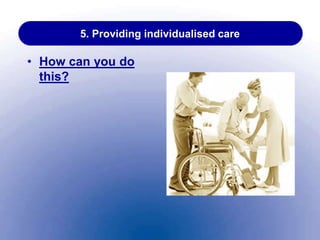
5. Providing individualised care
• How can you do
this?
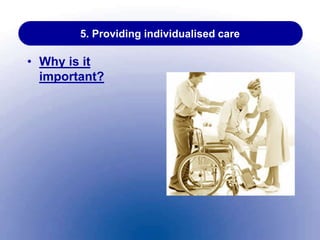
5. Providing individualised care
• Why is it
important?
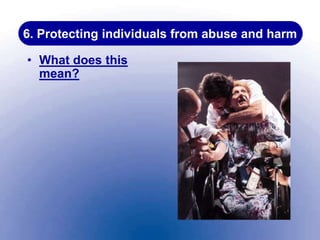
6. Protecting individuals from abuse and harm
• What does this
mean?
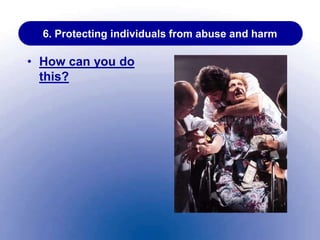
6. Protecting individuals from abuse and harm
• How can you do
this?
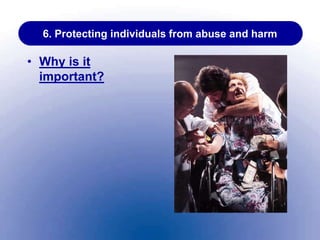
6. Protecting individuals from abuse and harm
• Why is it
important?
7. Promoting and supporting
dignity, independence & safety
• What does this
mean?
7. Promoting and supporting
dignity, independence & safety
• How can you do
this?
7. Promoting and supporting
dignity, independence & safety
• Why is it
important?
References

Care value base

  • 1.
  • 2.
    The Care ValueBase • A set of 7 principles to help care workers give the standard of care client’s need. • Care values are based on ideas about human rights. • Care workers should ‘act in the best interest of the service user’ • They must value them as individuals • Treat them in a way we would like to be treated ourselves • Care workers show they ‘value’ each individual by applying the care values.
  • 3.
    The care valuebase CARE WORKERS EMPOWER CLIENTS BY Promoting anti-discriminatory practice Maintaining confidentiality Promoting and supporting dignity, indepen dence & safety Respecting & Acknowledging individuals’ personal beliefs and identity Protecting individuals from abuse and harm Providing individualised care Promoting effective communication and relationships
  • 4.
    The Care ValueBase • Care work is about improving a client’s quality of life by meeting their PIES needs. The CVB ensures that this happens. • Care workers do this by empowering their clients (by giving them the ability to do something for themselves).
  • 5.
    1. Promoting anti-discriminatorypractice • What does this mean? • Care workers must be seen to treat all clients in the same way no matter what differences there are. • They must make sure they do not discriminate against anyone.
  • 6.
    1. Promoting anti-discriminatorypractice • How can you do this? • Allowing people to be different & not discriminating against anyone. • Aware of how discrimination can happen. • Understanding prejudice, stereotypin g & labelling & their effects. • Using politically correct language.
  • 7.
    1. Promoting anti-discriminatorypractice • Why is it important? • It promotes trust & respect between client & practitioner. • It shows that the practitioner cares and fully accepts the client. • The practitioner will also challenge discrimination they witness from other people.
  • 8.
    2. Maintaining confidentiality •What does this mean? • An appropriate protection of personal and private information about clients.
  • 9.
    2. Maintaining confidentiality •How can you do this? • Keeping records safe & secure • Pass information on, on a need to know basis • Follow policies & procedures
  • 10.
    2. Maintaining confidentiality •Why is it important? • It is vital to successful care giving to keep information provided by the client confidential. • It ensures that clients trust the care provider which is important when they need to discuss personal issues. • However there may be times that this information would need to be shared.
  • 11.
    The Data ProtectionAct • The Data Protection Act (1998) protects personal information that we have to give. • It also allows us to see information about ourselves. It is very important to record information accurately.
  • 12.
    When, if ever,should health, social care and early years workers reveal to others information about the personal problems that clients reveal to them in confidence?
  • 13.
    Disclosing information • Thereare occasions when information is passed on without a person’s permission. This is known as a ‘disclosure’. • There are three main occasions when this should happen: • 1. What they reveal involves them breaking the law or planning to do so • 2. They tell you that they intend to harm themselves or another person • 3. They reveal information that can be used to protect another person from harm
  • 14.
    3. Respecting &Acknowledging individuals’ personal beliefs and identity • What does this mean?
  • 15.
    3. Respecting &Acknowledging individuals’ personal beliefs and identity • How can you do this?
  • 16.
    3. Respecting &Acknowledging individuals’ personal beliefs and identity • Why is it important?
  • 17.
    4. Promoting effectivecommunication and relationships • What does this mean?
  • 18.
    4. Promoting effectivecommunication and relationships • How can you do this?
  • 19.
    4. Promoting effectivecommunication and relationships • Why is it important?
  • 20.
    5. Providing individualisedcare • What does this mean?
  • 21.
    5. Providing individualisedcare • How can you do this?
  • 22.
    5. Providing individualisedcare • Why is it important?
  • 23.
    6. Protecting individualsfrom abuse and harm • What does this mean?
  • 24.
    6. Protecting individualsfrom abuse and harm • How can you do this?
  • 25.
    6. Protecting individualsfrom abuse and harm • Why is it important?
  • 26.
    7. Promoting andsupporting dignity, independence & safety • What does this mean?
  • 27.
    7. Promoting andsupporting dignity, independence & safety • How can you do this?
  • 28.
    7. Promoting andsupporting dignity, independence & safety • Why is it important?
  • 29.