



What Is PLM and Why Is It
Important?
Ask Us Questions
LinkedIn Group:
Innoslate Users
@innoslate
Steven H. Dam, Ph.D., ESEP
President and Founder
steven.dam@specinnovations.com
Expert Systems Engineering
Professionals Certificate
Participated in the development of
C4ISR and the DoDAF
Agenda
• What is PLM?
• How Can MBSE Help?
• How Can I Improve My PLM Practices?
What Is Product Lifecycle
Management (PLM)?
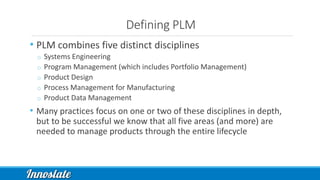
Defining PLM
• PLM combines five distinct disciplines
o Systems Engineering
o Program Management (which includes Portfolio Management)
o Product Design
o Process Management for Manufacturing
o Product Data Management
• Many practices focus on one or two of these disciplines in depth,
but to be successful we know that all five areas (and more) are
needed to manage products through the entire lifecycle
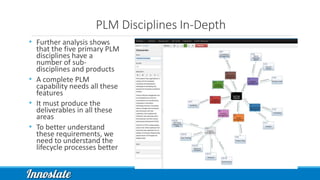
PLM Disciplines In-Depth
• Further analysis shows
that the five primary PLM
disciplines have a
number of sub-
disciplines and products
• A complete PLM
capability needs all these
features
• It must produce the
deliverables in all these
areas
• To better understand
these requirements, we
need to understand the
lifecycle processes better
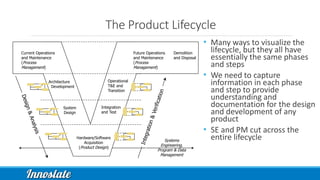
The Product Lifecycle
• Many ways to visualize the
lifecycle, but they all have
essentially the same phases
and steps
• We need to capture
information in each phase
and step to provide
understanding and
documentation for the design
and development of any
product
• SE and PM cut across the
entire lifecycle
Architecture
Development
System
Design
Hardware/Software
Acquisition
(Product Design)
Integration
and Test
Operational
T&E and
Transition
Future Operations
and Maintenance
(Process
Management)
Demolition
and Disposal
Systems
Engineering,
Program & Data
Management
Current Operations
and Maintenance
(Process
Management)
Requirements
Analysis
Functional Analysis
and Allocation
Synthesis
System Analysis and
Control
Best Use:
Architecture
Development
(To-Be)
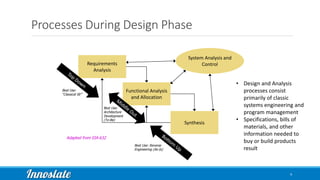
Processes During Design Phase
9
Best Use:
“Classical SE”
Best Use: Reverse
Engineering (As-Is)
Adapted from EIA-632
• Design and Analysis
processes consist
primarily of classic
systems engineering and
program management
• Specifications, bills of
materials, and other
information needed to
buy or build products
result
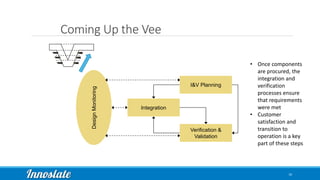
Coming Up the Vee
10
I&V Planning
Integration
Verification &
Validation
DesignMonitoring
• Once components
are procured, the
integration and
verification
processes ensure
that requirements
were met
• Customer
satisfaction and
transition to
operation is a key
part of these steps
How Can Model-Based Systems
Engineering (MBSE) Help?
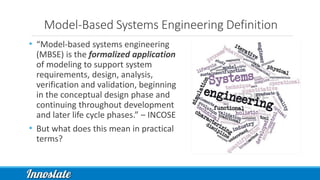
Model-Based Systems Engineering Definition
• “Model-based systems engineering
(MBSE) is the formalized application
of modeling to support system
requirements, design, analysis,
verification and validation, beginning
in the conceptual design phase and
continuing throughout development
and later life cycle phases.” – INCOSE
• But what does this mean in practical
terms?
What Is MBSE?
• Disciplines include, but are not limited to:
o Requirements Analysis and Management
o Functional Analysis and Allocation
o Physical Architecture Modeling (from block diagrams to CAD)
o Verification and Validation (including simulation)
• In other words all aspects of systems engineering and program
management
o Both SE and PM attempt to optimize cost, schedule, and performance – one
for the system, the other for the program
• The main difference between SE and MBSE is the use of modern
software tools to capture data in a repository and convert this data
into information through analyses and visualization
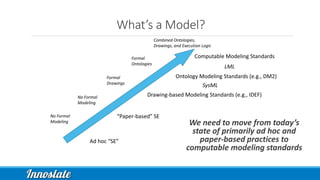
What’s a Model?
We need to move from today’s
state of primarily ad hoc and
paper-based practices to
computable modeling standards
“Paper-based” SE
Drawing-based Modeling Standards (e.g., IDEF)
Computable Modeling Standards
Ad hoc “SE”
No Formal
Modeling
No Formal
Modeling
Formal
Drawings
Formal
Ontologies
Combined Ontologies,
Drawings, and Execution Logic
Ontology Modeling Standards (e.g., DM2)
LML
SysML
Benefits of Models
• Models provide traceability in many dimensions
• Models can be automatically validated using simulation and rule
checkers
• Models can be interrogated
• Models can be reused
• Models can be easily changed
Clearly, PLM relies on models to be effective … MBSE provides a
means for developing and managing those models
How Can I Improve My PLM
Practices?
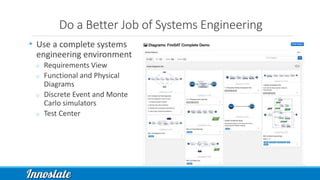
Do a Better Job of Systems Engineering
• Use a complete systems
engineering environment
o Requirements View
o Functional and Physical
Diagrams
o Discrete Event and Monte
Carlo simulators
o Test Center
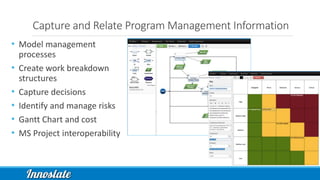
Capture and Relate Program Management Information
• Model management
processes
• Create work breakdown
structures
• Capture decisions
• Identify and manage risks
• Gantt Chart and cost
• MS Project interoperability
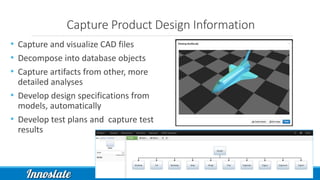
Capture Product Design Information
• Capture and visualize CAD files
• Decompose into database objects
• Capture artifacts from other, more
detailed analyses
• Develop design specifications from
models, automatically
• Develop test plans and capture test
results
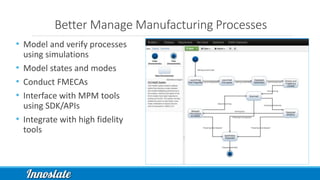
Better Manage Manufacturing Processes
• Model and verify processes
using simulations
• Model states and modes
• Conduct FMECAs
• Interface with MPM tools
using SDK/APIs
• Integrate with high fidelity
tools
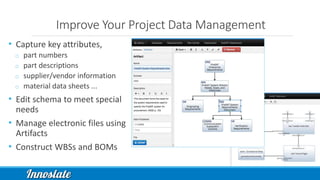
Improve Your Project Data Management
• Capture key attributes,
o part numbers
o part descriptions
o supplier/vendor information
o material data sheets ...
• Edit schema to meet special
needs
• Manage electronic files using
Artifacts
• Construct WBSs and BOMs
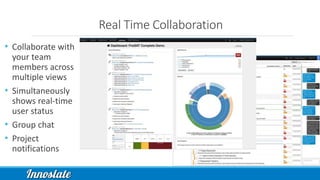
Real Time Collaboration
• Collaborate with
your team
members across
multiple views
• Simultaneously
shows real-time
user status
• Group chat
• Project
notifications
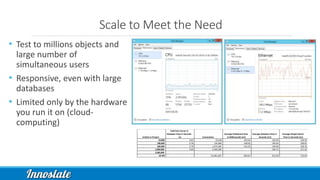
Scale to Meet the Need
• Test to millions objects and
large number of
simultaneous users
• Responsive, even with large
databases
• Limited only by the hardware
you run it on (cloud-
computing)
Entities in Project
Cold Start Server in
Database View in Seconds
(s) Connections
Average Dashboard View
in Milliseconds (ms)
Average Database View in
Seconds (ms)
Average Simple Search
Time in Seconds (ms)
10,000 0.63 33,540 102.04 250.50 234.54
100,000 0.78 334,980 108.60 294.84 260.81
500,000 0.78 1,674,180 156.26 240.00 260.39
1,000,000 0.69 3,348,180 204.71 211.22
2,000,000
10 Mil 33,481,282 600.81 812.00 533.69
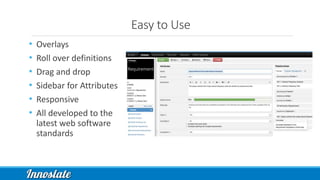
Easy to Use
• Overlays
• Roll over definitions
• Drag and drop
• Sidebar for Attributes
• Responsive
• All developed to the
latest web software
standards
Live Demonstration
Questions and Answers:
ENTER YOUR QUESTION IN THE GOTOWEBINAR CONTROL PANEL
Next Webinar
DoD Architecture Framework 2.0
2:30 pm EST Thursday, August 24th
Summary
• PLM is critical for you to develop and manage your products
throughout their lifecycles
• MBSE provides a formalized methodology for conducting PLM
• Innoslate® provides all the features you need to perform PLM

What Is PLM and Why Is It Important

  • 1.
    What Is PLMand Why Is It Important?
  • 2.
    Ask Us Questions LinkedInGroup: Innoslate Users @innoslate
  • 3.
    Steven H. Dam,Ph.D., ESEP President and Founder steven.dam@specinnovations.com Expert Systems Engineering Professionals Certificate Participated in the development of C4ISR and the DoDAF
  • 4.
    Agenda • What isPLM? • How Can MBSE Help? • How Can I Improve My PLM Practices?
  • 5.
    What Is ProductLifecycle Management (PLM)?
  • 6.
    Defining PLM • PLMcombines five distinct disciplines o Systems Engineering o Program Management (which includes Portfolio Management) o Product Design o Process Management for Manufacturing o Product Data Management • Many practices focus on one or two of these disciplines in depth, but to be successful we know that all five areas (and more) are needed to manage products through the entire lifecycle
  • 7.
    PLM Disciplines In-Depth •Further analysis shows that the five primary PLM disciplines have a number of sub- disciplines and products • A complete PLM capability needs all these features • It must produce the deliverables in all these areas • To better understand these requirements, we need to understand the lifecycle processes better
  • 8.
    The Product Lifecycle •Many ways to visualize the lifecycle, but they all have essentially the same phases and steps • We need to capture information in each phase and step to provide understanding and documentation for the design and development of any product • SE and PM cut across the entire lifecycle Architecture Development System Design Hardware/Software Acquisition (Product Design) Integration and Test Operational T&E and Transition Future Operations and Maintenance (Process Management) Demolition and Disposal Systems Engineering, Program & Data Management Current Operations and Maintenance (Process Management)
  • 9.
    Requirements Analysis Functional Analysis and Allocation Synthesis SystemAnalysis and Control Best Use: Architecture Development (To-Be) Processes During Design Phase 9 Best Use: “Classical SE” Best Use: Reverse Engineering (As-Is) Adapted from EIA-632 • Design and Analysis processes consist primarily of classic systems engineering and program management • Specifications, bills of materials, and other information needed to buy or build products result
  • 10.
    Coming Up theVee 10 I&V Planning Integration Verification & Validation DesignMonitoring • Once components are procured, the integration and verification processes ensure that requirements were met • Customer satisfaction and transition to operation is a key part of these steps
  • 11.
    How Can Model-BasedSystems Engineering (MBSE) Help?
  • 12.
    Model-Based Systems EngineeringDefinition • “Model-based systems engineering (MBSE) is the formalized application of modeling to support system requirements, design, analysis, verification and validation, beginning in the conceptual design phase and continuing throughout development and later life cycle phases.” – INCOSE • But what does this mean in practical terms?
  • 13.
    What Is MBSE? •Disciplines include, but are not limited to: o Requirements Analysis and Management o Functional Analysis and Allocation o Physical Architecture Modeling (from block diagrams to CAD) o Verification and Validation (including simulation) • In other words all aspects of systems engineering and program management o Both SE and PM attempt to optimize cost, schedule, and performance – one for the system, the other for the program • The main difference between SE and MBSE is the use of modern software tools to capture data in a repository and convert this data into information through analyses and visualization
  • 14.
    What’s a Model? Weneed to move from today’s state of primarily ad hoc and paper-based practices to computable modeling standards “Paper-based” SE Drawing-based Modeling Standards (e.g., IDEF) Computable Modeling Standards Ad hoc “SE” No Formal Modeling No Formal Modeling Formal Drawings Formal Ontologies Combined Ontologies, Drawings, and Execution Logic Ontology Modeling Standards (e.g., DM2) LML SysML
  • 15.
    Benefits of Models •Models provide traceability in many dimensions • Models can be automatically validated using simulation and rule checkers • Models can be interrogated • Models can be reused • Models can be easily changed Clearly, PLM relies on models to be effective … MBSE provides a means for developing and managing those models
  • 16.
    How Can IImprove My PLM Practices?
  • 17.
    Do a BetterJob of Systems Engineering • Use a complete systems engineering environment o Requirements View o Functional and Physical Diagrams o Discrete Event and Monte Carlo simulators o Test Center
  • 18.
    Capture and RelateProgram Management Information • Model management processes • Create work breakdown structures • Capture decisions • Identify and manage risks • Gantt Chart and cost • MS Project interoperability
  • 19.
    Capture Product DesignInformation • Capture and visualize CAD files • Decompose into database objects • Capture artifacts from other, more detailed analyses • Develop design specifications from models, automatically • Develop test plans and capture test results
  • 20.
    Better Manage ManufacturingProcesses • Model and verify processes using simulations • Model states and modes • Conduct FMECAs • Interface with MPM tools using SDK/APIs • Integrate with high fidelity tools
  • 21.
    Improve Your ProjectData Management • Capture key attributes, o part numbers o part descriptions o supplier/vendor information o material data sheets ... • Edit schema to meet special needs • Manage electronic files using Artifacts • Construct WBSs and BOMs
  • 22.
    Real Time Collaboration •Collaborate with your team members across multiple views • Simultaneously shows real-time user status • Group chat • Project notifications
  • 23.
    Scale to Meetthe Need • Test to millions objects and large number of simultaneous users • Responsive, even with large databases • Limited only by the hardware you run it on (cloud- computing) Entities in Project Cold Start Server in Database View in Seconds (s) Connections Average Dashboard View in Milliseconds (ms) Average Database View in Seconds (ms) Average Simple Search Time in Seconds (ms) 10,000 0.63 33,540 102.04 250.50 234.54 100,000 0.78 334,980 108.60 294.84 260.81 500,000 0.78 1,674,180 156.26 240.00 260.39 1,000,000 0.69 3,348,180 204.71 211.22 2,000,000 10 Mil 33,481,282 600.81 812.00 533.69
  • 24.
    Easy to Use •Overlays • Roll over definitions • Drag and drop • Sidebar for Attributes • Responsive • All developed to the latest web software standards
  • 25.
  • 26.
    Questions and Answers: ENTERYOUR QUESTION IN THE GOTOWEBINAR CONTROL PANEL
  • 27.
    Next Webinar DoD ArchitectureFramework 2.0 2:30 pm EST Thursday, August 24th
  • 28.
    Summary • PLM iscritical for you to develop and manage your products throughout their lifecycles • MBSE provides a formalized methodology for conducting PLM • Innoslate® provides all the features you need to perform PLM

Editor's Notes

  • #5 20 minutes 1-3, 30 minutes 4, and 10 minutes 5