

An MBSE Approach to
Portfolio Management
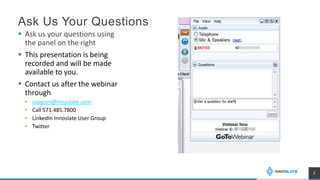
Ask Us Your Questions
 Ask us your questions using
the panel on the right
 This presentation is being
recorded and will be made
available to you.
 Contact us after the webinar
through
• support@Innoslate.com
• Call 571.485.7800
• LinkedIn Innoslate User Group
• Twitter
2
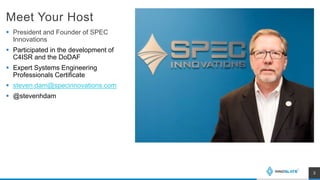
Meet Your Host
 President and Founder of SPEC
Innovations
 Participated in the development of
C4ISR and the DoDAF
 Expert Systems Engineering
Professionals Certificate
 steven.dam@specinnovations.com
 @stevenhdam
3
Agenda
 Background on SPEC Innovations and Innoslate®
 What is Portfolio Management?
 LML Overview
 Innoslate Overview
 Specific Support for Section 836
 Q&A
4
 SPEC Innovations provides software, training, and consulting to the
defense and aerospace industries and the intelligence community.
 Our flagship software product, Innoslate is the first cloud-native,
model-based systems engineering software solution made solely in
the United States of America.
About Us
We are the experts in
systems engineering.
5
 Our engineers built Innoslate to help systems engineers develop
full lifecycle solutions to complex systems of systems.
 Innoslate software supports Requirements Management,
Modeling and Simulation, Verification and Validation, and more in
one seamless package.
What is Portfolio Management?
 According to the Project Management Institute (PMI): “Portfolio management ensures that an
organization can leverage its project selection and execution success. It refers to the
centralized management of one or more project portfolios to achieve strategic
objectives. Our research has shown that portfolio management is a way to bridge the gap
between strategy and implementation.”
 This is often called Project Portfolio Management (PPM) to differentiate it from investment
portfolio management
 This definition leaves us with a lot of questions
• How do we know when we have achieved the strategic objectives?
• What information is needed to be captured and curated in each project portfolio to make key
decisions?
• How can we know what’s going on in each project and how the projects affect one another?
• …
 So, we need some way to collect the right information and relate that information so that we
can see impacts and make decisions (i.e., an ontology)
 We have been doing this in Model-Based Systems Engineering (MBSE) for decades
6
So, let’s look at a MBSE ontology that might help us with PPM: the Lifecycle Modeling Language (LML)
LML Overview
7
LML Overview
 Lifecycle Modeling Language (LML) is an open-source standard managed
by the non-profit Lifecycle Modeling Organization (LMO)
 LML has 12 primary classes and 8 defined subclasses of information
 LML mandates only 3 diagram types, but encourages many other views of
the information
 In 2014, the committee released version 1.1 of the standard with extensions
for SysML
 No modifications to the LML specification have been made since 2014,
since it was determined to keep LML as simple as possible and allow users
to extend the ontology as needed
8
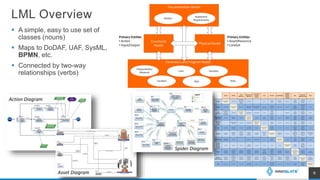
LML Overview
 A simple, easy to use set of
classes (nouns)
 Maps to DoDAF, UAF, SysML,
BPMN, etc.
 Connected by two-way
relationships (verbs)
9
Documentation Model
Parametric and Program Model
Functional
Model
Physical Model
Primary Entities
• Asset/Resource
• Conduit
Primary Entities
• Action
• Input/Output
Statement/
Requirements
Cost
Time
Characteristic/
Measure
Location
Artifact
Risk
Decision
Action Artifact
Asset
(Resource)
Characteristic
(Measure)
Connection
(Conduit,
Logical)
Cost Decision Input/Output
Location
(Orbital,
Physical,
Virtual)
Risk
Statement
(Requirement)
Time
Action
decomposed by*
related to*
references
(consumes)
performed by
(produces)
(seizes)
specified by - incurs
enables
results in
generates
receives
located at
causes
mitigates
resolves
(satisfies)
traced from
(verifies)
occurs
Artifact referenced by
decomposed by*
related to*
referenced by
referenced by
specified by
defines protocol for
referenced by
incurs
referenced by
enables
referenced by
results in
referenced by located at
causes
mitigates
referenced by
resolves
referenced by
(satisfies)
source of
traced from
(verifies)
occurs
Asset
(Resource)
(consumed by)
performs
(produced by)
(seized by)
references
decomposed by*
orbited by*
related to*
specified by connected by incurs
enables
made
responds to
results in
- located at
causes
mitigates
resolves
(satisfies)
traced from
(verifies)
occurs
Characteristic
(Measure)
specifies
references
specifies
specifies
decomposed by*
related to*
specified by*
specifies
incurs
specifies
enables
results in
specifies
specifies
located at
specifies
causes
mitigates
resolves
specifies
(satisfies)
spacifies
traced from
(verifies)
occurs
specifies
Connection
(Conduit,
Logical)
-
defined protocol by
references
connects to specified by
decomposed by*
joined by*
related to*
incurs
enables
results in
transfers located at
causes
mitigates
resolves
(satisfies)
traced from
(verifies)
occurs
Cost incurred by
incurred by
references
incurred by
incurred by
specified by
incurred by
decomposed by*
related to*
enables
incurred by
results in
incurred by located at
causes
incurred by
mitigates
resolves
incurred by
(satisfies)
traced from
(verifies)
occurs
Decision
enabled by
result of
enabled by
references
result of
enabled by
made by
responded by
result of
enabled by
result of
specified by
enabled by
result of
enabled by
incurs
result of
decomposed by*
related to*
enabled by
result of
located at
causes
enabled by
mitigated by
result of
resolves
alternative
enabled by
traced from
result of
date resolved by
decision due
occurs
Input/Output
generated by
received by
references - specified by transferred by incurs
enables
results in
decomposed by*
related to*
located at
causes
mitigates
resolves
(satisfies)
traced from
(verifies)
occurs
Location
(Orbital,
Physical,
Logical)
locates locates locates
locates
specified by
locates locates locates locates
decomposed by*
related to*
locates
mitigates
locates
(satisfies)
traced from
(verifies)
occurs
Risk
caused by
mitigated by
resolved by
caused by
mitigated by
references
resolved by
caused by
mitigated by
resolved by
caused by
mitigated by
resolved by
specified by
caused by
mitigated by
resolved by
caused by
incurs
mitigated by
resolved by
caused by
enables
mitigated by
results in
resolved by
caused by
mitigated by
resolved by
located at
mitigated by
caused by*
decomposed by*
related to*
resolved by*
caused by
mitigated by
resolved by
occurs
mitigated by
Statement
(Requirement)
(satisfied by)
traced to
(verified by)
references
(satisified by)
sourced by
traced to
(verified by)
(satisified by)
traced to
(verified by)
(satisified by)
specified by
traced to
(verified by)
(satisified by)
traced to
(verified by)
incurs
(satisified by)
traced to
(verified by)
alternative of
enables
traced to
results in
(satisified by)
traced to
(verified by)
located at
(satisfied by)
traced to
(verified by)
causes
mitigates
resolves
decomposed by*
traced to*
related to*
occurs
(satisified by)
(verified by)
Time occurred by occurred by occurred by
occurred by
specified by
occurred by occurred by
date resolves
decided by
occurred by
occurred by occurred by
occurred by
mitigates
occurred by
(satisfies)
(verifies)
decomposed by*
related to*
Action Diagram
Asset Diagram
Spider Diagram
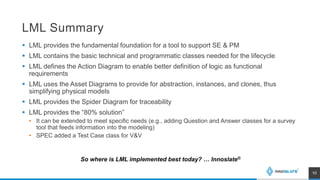
LML Summary
 LML provides the fundamental foundation for a tool to support SE & PM
 LML contains the basic technical and programmatic classes needed for the lifecycle
 LML defines the Action Diagram to enable better definition of logic as functional
requirements
 LML uses the Asset Diagrams to provide for abstraction, instances, and clones, thus
simplifying physical models
 LML provides the Spider Diagram for traceability
 LML provides the “80% solution”
• It can be extended to meet specific needs (e.g., adding Question and Answer classes for a survey
tool that feeds information into the modeling)
• SPEC added a Test Case class for V&V
10
So where is LML implemented best today? … Innoslate®
Innoslate®forPortfolioManagement
11
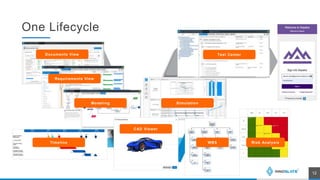
One Lifecycle
Documents View
Requirements View
Modeling Simulation
Risk Analysis
Timeline WBS
CAD Viewer
Test Center
12
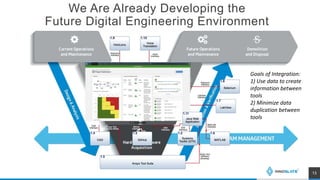
We Are Already Developing the
Future Digital Engineering Environment
13
Goals of Integration:
1) Use data to create
information between
tools
2) Minimize data
duplication between
tools
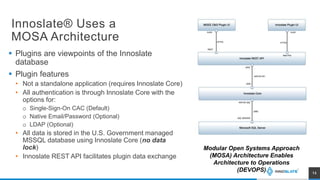
Innoslate® Uses a
MOSA Architecture
 Plugins are viewpoints of the Innoslate
database
 Plugin features
• Not a standalone application (requires Innoslate Core)
• All authentication is through Innoslate Core with the
options for:
o Single-Sign-On CAC (Default)
o Native Email/Password (Optional)
o LDAP (Optional)
• All data is stored in the U.S. Government managed
MSSQL database using Innoslate Core (no data
lock)
• Innoslate REST API facilitates plugin data exchange
14
Modular Open Systems Approach
(MOSA) Architecture Enables
Architecture to Operations
(DEVOPS)
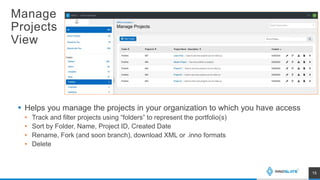
Manage
Projects
View
 Helps you manage the projects in your organization to which you have access
• Track and filter projects using “folders” to represent the portfolio(s)
• Sort by Folder, Name, Project ID, Created Date
• Rename, Fork (and soon branch), download XML or .inno formats
• Delete
15
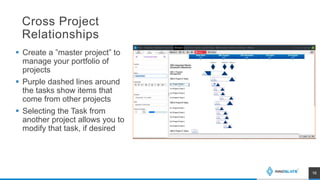
Cross Project
Relationships
 Create a ”master project” to
manage your portfolio of
projects
 Purple dashed lines around
the tasks show items that
come from other projects
 Selecting the Task from
another project allows you to
modify that task, if desired
16
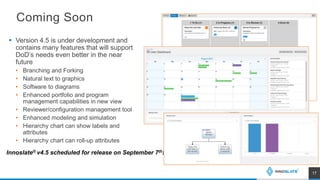
Coming Soon
 Version 4.5 is under development and
contains many features that will support
DoD’s needs even better in the near
future
• Branching and Forking
• Natural text to graphics
• Software to diagrams
• Enhanced portfolio and program
management capabilities in new view
• Reviewer/configuration management tool
• Enhanced modeling and simulation
• Hierarchy chart can show labels and
attributes
• Hierarchy chart can roll-up attributes
17
Innoslate® v4.5 scheduled for release on September 7th!
SpecificSupportfor
Section836oftheNationalDefense
AuthorizationActforFY2021
 Digital modernization of analytical and decision support
processes for managing and overseeing Department of Defense
acquisition programs. (a) DIGITAL DATA MANAGEMENT AND
ANALYTICS CAPABILITIES & (b) PORTFOLIO MANAGEMENT
18
The projects in our portfolios will contain the digital data management and analytics in subsection (a)
SEC. 836 – IN
GENERAL
 “integrate all aspects of the defense acquisition system, including the development
of capability requirements, research, design, development, testing, evaluation,
acquisition, management, operations, and sustainment of systems”
• LML forms the basis of a common language DoD can use across the lifecycle
• Innoslate® has been used in all phases of the acquisition lifecycle
• Innoslate® can be extended to meet specific needs of different domains
 “facilitate the management and analysis of all relevant data generated during the
development of capability requirements, research, design, development, testing,
evaluation, acquisition, operations, and sustainment of systems”
• Innoslate® capture all data as direct elements of information or Artifacts
• Once data is captured within Innoslate® analytical tools, such as discrete event and Monte Carlo
simulation, as well as Natural Language Processing (NLP – a branch of AI), support the analysis of
the data
19
SEC. 836 – IN
GENERAL (continued)
 “enable the use of such data to inform further development, acquisition,
management and oversight of such systems, including portfolio
management”
• Innoslate® is currently developing enhanced portfolio and program management
support, including Kanban boards and enhanced EVMS
• Innoslate® already supports model-based reviews
 “include software capabilities to collect, transport, organize, manage, make
available, and analyze relevant data throughout the life cycle of defense
acquisition programs, including any data needed to support individual and
portfolio management of acquisition programs”
• Innoslate® collects data via its Import Analyzer and Artifacts for file uploads
• Cross project relationships enable both sharing of information and redaction
• Innoslate®’s XML has an XSD to better enable transport of data along with REST and
Java APIs for interoperability with other DoD tools
20
SEC. 836 –
REQUIREMENTS
 “be accessible to, and useable by, individuals throughout the Department of
Defense”
• Innoslate® is currently available via the Naval and Air Force Systems Engineering
Resource Centers (NSERC/AFSERC) on NIPRNET and SIPRNET
• Innoslate® is available at the TS/SCI level via the IC Marketplace (IC-ITE)
 “enable the development, use, curation, and maintenance of original form
and real-time digital systems”
• Innoslate® REST and Java APIs enable real-time access to information across DoD
• Innoslate® can support the development and curation of information from any source
• Innoslate®’s MOSA architecture means that data is accessible directly from the MS SQL
Server database as well
21
SEC. 836 –
REQUIREMENTS
(continued)
 “improved data management and sharing processes”
• Built-in commenting configuration management features enable data management
• Innoslate® was designed as a cloud-native, collaborative tool designed to support data
management and sharing
 “timely, high-quality, transparent, and actionable analyses”
• Innoslate® provides views of the information (dashboards) for all different users only
governed by the data and the rules for the view
 “analytical models and simulations”
• Innoslate® provides built-in discrete event and Monte Carlo simulation for integrated
functional/physically constrained models
• Many of Innoslate®’s models have diagnostics to identify potential problems before they
become issues
22
SEC. 836 – ENABLING DATA
INFRASTRUCTURE, TOOLS, AND
PROCESSES
 “move supporting processes and the data associated with such processes from
analog to digital format, including planning and reporting processes”
• Import Analyzer provides a means to ingest data from any sources into Innoslate®
• Document View provides a means to author any type of document and output to MS Word for
final formatting and publication
• Processes can be modeled using Action Diagram and verified via simulators
 “make new and legacy data more accessible to, and usable by, appropriate
employees and contractors (at any tier)”
• LML provides a common language that is easily understandable by any level or background of
stakeholder
• Innoslate® provides access to the information as needed via collaboration features
• Innoslate® provides a round-tip with MS Excel for those who still need to use spreadsheets to
do their jobs
23
SEC. 836 – ENABLING DATA
INFRASTRUCTURE, TOOLS, AND
PROCESSES (continued)
 “modernize the query, collection, storage, retrieval, reporting, and analysis
capabilities for stakeholders within the Department”
• Innoslate® was designed to support the query, collections, etc. of large amounts of information
• Innoslate® provides enhanced search capabilities to aid in these processes
 “automate data collection and storage to minimize or eliminate manual data entry
or manual reporting”
• Innoslate®’s Import Analyzer supports the translation of information from MS Word, MS Excel,
and other tools
• The Import Analyzer identifies hierarchies and automatically creates the appropriate
relationships between information
• Research in translating text to diagrams has been developed and will be deployed in the near
future
24
SEC. 836 – ENABLING DATA
INFRASTRUCTURE, TOOLS, AND
PROCESSES (continued)
 “enable employees and other appropriate users to access data from all relevant
data sources”
• Innoslate® is currently supporting CAC, SAML, and OAUTH access technologies
• CAC enablement is currently available on NSERC/AFSERC
 “modernize existing enterprise information systems to enable interoperability
consistent with technical best practices”
• Innoslate®’s Intelligence View analyzes the entire database for 68 best practices (heuristics)
developed by US Naval Postgraduate School (NPS) research
• Innoslate®’s quality checker automatically analyzes requirements against 6 of 8 quality factors
 “provide capabilities and platforms to enable continuous development and
integration of software using public and private sector best practices”
• Innoslate® has been integrated with GitHub and is exploring integrations with Jira, Selenium,
and GitLab
25
SEC. 836 – PORTFOLIO MANAGEMENT
 “establish capabilities for robust, effective, and data-driven portfolio management”
• Innoslate® is implementing enhanced PM capabilities via the new PM view
• The new PM View will contain:
o Kanban Boards (all user definable)
o Calendar View
o Reviewer/CM Dashboards
o Timelines (based on enhanced Gantt Chart and Kanban Boards)
• Additional portfolio management-specific views may be developed upon DoD’s request
o SPEC Innovations has a long history of adding capabilities to Innoslate® based on suggestions from
users (see Feature Request dashboard widget and Contact Us page of the Innoslate website)
• Enhancements to simulators will provide additional diagram and reporting options
• Future release: Enhanced Earned Value Management (tracking schedule, cost, quality, and
work) is being developed based on research done at George Mason University
26
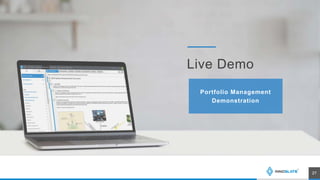
Live Demo
Portfolio Management
Demonstration
27
Bottom-Line
 The Lifecycle Modeling Language (LML) provides an open standard
ontology and diagram framework that enables more effective
communications to all stakeholders in the acquisition process
 Innoslate® implements and extends LML to provide a web-based solution
used today on NIPRNET, SIPRNET, and IC-ITE
 Innoslate® has proven easier to learn and adopt than any other tool
available today in the program management and systems engineering
domains
 Innoslate® is built on a modular open systems approach (MOSA)
architecture and can be easily integrated with other modern tools
28
Questions and
Answers
Use the panel on the right to ask your questions
29
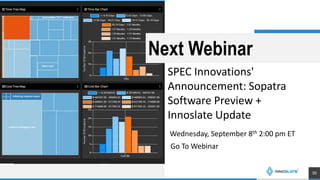
Next Webinar
SPEC Innovations'
Announcement: Sopatra
Software Preview +
Innoslate Update
Wednesday, September 8th 2:00 pm ET
Go To Webinar
30
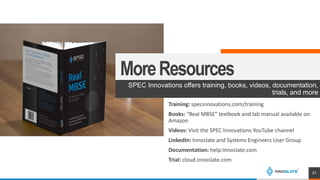
MoreResources
SPEC Innovations offers training, books, videos, documentation,
trials, and more
31
Training: specinnovations.com/training
Books: “Real MBSE” textbook and lab manual available on
Amazon
Videos: Visit the SPEC Innovations YouTube channel
LinkedIn: Innoslate and Systems Engineers User Group
Documentation: help.Innoslate.com
Trial: cloud.Innoslate.com
32
Thank you!
Visit cloud.innoslate.com for a trial.
SPEC Innovations
@Innoslate
Innoslate User Group
Innoslate.com/blog
571.485.7800
innoslate.com

A Model-Based Systems Engineering Approach to Portfolio Management

  • 1.
    An MBSE Approachto Portfolio Management
  • 2.
    Ask Us YourQuestions  Ask us your questions using the panel on the right  This presentation is being recorded and will be made available to you.  Contact us after the webinar through • support@Innoslate.com • Call 571.485.7800 • LinkedIn Innoslate User Group • Twitter 2
  • 3.
    Meet Your Host President and Founder of SPEC Innovations  Participated in the development of C4ISR and the DoDAF  Expert Systems Engineering Professionals Certificate  steven.dam@specinnovations.com  @stevenhdam 3
  • 4.
    Agenda  Background onSPEC Innovations and Innoslate®  What is Portfolio Management?  LML Overview  Innoslate Overview  Specific Support for Section 836  Q&A 4
  • 5.
     SPEC Innovationsprovides software, training, and consulting to the defense and aerospace industries and the intelligence community.  Our flagship software product, Innoslate is the first cloud-native, model-based systems engineering software solution made solely in the United States of America. About Us We are the experts in systems engineering. 5  Our engineers built Innoslate to help systems engineers develop full lifecycle solutions to complex systems of systems.  Innoslate software supports Requirements Management, Modeling and Simulation, Verification and Validation, and more in one seamless package.
  • 6.
    What is PortfolioManagement?  According to the Project Management Institute (PMI): “Portfolio management ensures that an organization can leverage its project selection and execution success. It refers to the centralized management of one or more project portfolios to achieve strategic objectives. Our research has shown that portfolio management is a way to bridge the gap between strategy and implementation.”  This is often called Project Portfolio Management (PPM) to differentiate it from investment portfolio management  This definition leaves us with a lot of questions • How do we know when we have achieved the strategic objectives? • What information is needed to be captured and curated in each project portfolio to make key decisions? • How can we know what’s going on in each project and how the projects affect one another? • …  So, we need some way to collect the right information and relate that information so that we can see impacts and make decisions (i.e., an ontology)  We have been doing this in Model-Based Systems Engineering (MBSE) for decades 6 So, let’s look at a MBSE ontology that might help us with PPM: the Lifecycle Modeling Language (LML)
  • 7.
  • 8.
    LML Overview  LifecycleModeling Language (LML) is an open-source standard managed by the non-profit Lifecycle Modeling Organization (LMO)  LML has 12 primary classes and 8 defined subclasses of information  LML mandates only 3 diagram types, but encourages many other views of the information  In 2014, the committee released version 1.1 of the standard with extensions for SysML  No modifications to the LML specification have been made since 2014, since it was determined to keep LML as simple as possible and allow users to extend the ontology as needed 8
  • 9.
    LML Overview  Asimple, easy to use set of classes (nouns)  Maps to DoDAF, UAF, SysML, BPMN, etc.  Connected by two-way relationships (verbs) 9 Documentation Model Parametric and Program Model Functional Model Physical Model Primary Entities • Asset/Resource • Conduit Primary Entities • Action • Input/Output Statement/ Requirements Cost Time Characteristic/ Measure Location Artifact Risk Decision Action Artifact Asset (Resource) Characteristic (Measure) Connection (Conduit, Logical) Cost Decision Input/Output Location (Orbital, Physical, Virtual) Risk Statement (Requirement) Time Action decomposed by* related to* references (consumes) performed by (produces) (seizes) specified by - incurs enables results in generates receives located at causes mitigates resolves (satisfies) traced from (verifies) occurs Artifact referenced by decomposed by* related to* referenced by referenced by specified by defines protocol for referenced by incurs referenced by enables referenced by results in referenced by located at causes mitigates referenced by resolves referenced by (satisfies) source of traced from (verifies) occurs Asset (Resource) (consumed by) performs (produced by) (seized by) references decomposed by* orbited by* related to* specified by connected by incurs enables made responds to results in - located at causes mitigates resolves (satisfies) traced from (verifies) occurs Characteristic (Measure) specifies references specifies specifies decomposed by* related to* specified by* specifies incurs specifies enables results in specifies specifies located at specifies causes mitigates resolves specifies (satisfies) spacifies traced from (verifies) occurs specifies Connection (Conduit, Logical) - defined protocol by references connects to specified by decomposed by* joined by* related to* incurs enables results in transfers located at causes mitigates resolves (satisfies) traced from (verifies) occurs Cost incurred by incurred by references incurred by incurred by specified by incurred by decomposed by* related to* enables incurred by results in incurred by located at causes incurred by mitigates resolves incurred by (satisfies) traced from (verifies) occurs Decision enabled by result of enabled by references result of enabled by made by responded by result of enabled by result of specified by enabled by result of enabled by incurs result of decomposed by* related to* enabled by result of located at causes enabled by mitigated by result of resolves alternative enabled by traced from result of date resolved by decision due occurs Input/Output generated by received by references - specified by transferred by incurs enables results in decomposed by* related to* located at causes mitigates resolves (satisfies) traced from (verifies) occurs Location (Orbital, Physical, Logical) locates locates locates locates specified by locates locates locates locates decomposed by* related to* locates mitigates locates (satisfies) traced from (verifies) occurs Risk caused by mitigated by resolved by caused by mitigated by references resolved by caused by mitigated by resolved by caused by mitigated by resolved by specified by caused by mitigated by resolved by caused by incurs mitigated by resolved by caused by enables mitigated by results in resolved by caused by mitigated by resolved by located at mitigated by caused by* decomposed by* related to* resolved by* caused by mitigated by resolved by occurs mitigated by Statement (Requirement) (satisfied by) traced to (verified by) references (satisified by) sourced by traced to (verified by) (satisified by) traced to (verified by) (satisified by) specified by traced to (verified by) (satisified by) traced to (verified by) incurs (satisified by) traced to (verified by) alternative of enables traced to results in (satisified by) traced to (verified by) located at (satisfied by) traced to (verified by) causes mitigates resolves decomposed by* traced to* related to* occurs (satisified by) (verified by) Time occurred by occurred by occurred by occurred by specified by occurred by occurred by date resolves decided by occurred by occurred by occurred by occurred by mitigates occurred by (satisfies) (verifies) decomposed by* related to* Action Diagram Asset Diagram Spider Diagram
  • 10.
    LML Summary  LMLprovides the fundamental foundation for a tool to support SE & PM  LML contains the basic technical and programmatic classes needed for the lifecycle  LML defines the Action Diagram to enable better definition of logic as functional requirements  LML uses the Asset Diagrams to provide for abstraction, instances, and clones, thus simplifying physical models  LML provides the Spider Diagram for traceability  LML provides the “80% solution” • It can be extended to meet specific needs (e.g., adding Question and Answer classes for a survey tool that feeds information into the modeling) • SPEC added a Test Case class for V&V 10 So where is LML implemented best today? … Innoslate®
  • 11.
  • 12.
    One Lifecycle Documents View RequirementsView Modeling Simulation Risk Analysis Timeline WBS CAD Viewer Test Center 12
  • 13.
    We Are AlreadyDeveloping the Future Digital Engineering Environment 13 Goals of Integration: 1) Use data to create information between tools 2) Minimize data duplication between tools
  • 14.
    Innoslate® Uses a MOSAArchitecture  Plugins are viewpoints of the Innoslate database  Plugin features • Not a standalone application (requires Innoslate Core) • All authentication is through Innoslate Core with the options for: o Single-Sign-On CAC (Default) o Native Email/Password (Optional) o LDAP (Optional) • All data is stored in the U.S. Government managed MSSQL database using Innoslate Core (no data lock) • Innoslate REST API facilitates plugin data exchange 14 Modular Open Systems Approach (MOSA) Architecture Enables Architecture to Operations (DEVOPS)
  • 15.
    Manage Projects View  Helps youmanage the projects in your organization to which you have access • Track and filter projects using “folders” to represent the portfolio(s) • Sort by Folder, Name, Project ID, Created Date • Rename, Fork (and soon branch), download XML or .inno formats • Delete 15
  • 16.
    Cross Project Relationships  Createa ”master project” to manage your portfolio of projects  Purple dashed lines around the tasks show items that come from other projects  Selecting the Task from another project allows you to modify that task, if desired 16
  • 17.
    Coming Soon  Version4.5 is under development and contains many features that will support DoD’s needs even better in the near future • Branching and Forking • Natural text to graphics • Software to diagrams • Enhanced portfolio and program management capabilities in new view • Reviewer/configuration management tool • Enhanced modeling and simulation • Hierarchy chart can show labels and attributes • Hierarchy chart can roll-up attributes 17 Innoslate® v4.5 scheduled for release on September 7th!
  • 18.
    SpecificSupportfor Section836oftheNationalDefense AuthorizationActforFY2021  Digital modernizationof analytical and decision support processes for managing and overseeing Department of Defense acquisition programs. (a) DIGITAL DATA MANAGEMENT AND ANALYTICS CAPABILITIES & (b) PORTFOLIO MANAGEMENT 18 The projects in our portfolios will contain the digital data management and analytics in subsection (a)
  • 19.
    SEC. 836 –IN GENERAL  “integrate all aspects of the defense acquisition system, including the development of capability requirements, research, design, development, testing, evaluation, acquisition, management, operations, and sustainment of systems” • LML forms the basis of a common language DoD can use across the lifecycle • Innoslate® has been used in all phases of the acquisition lifecycle • Innoslate® can be extended to meet specific needs of different domains  “facilitate the management and analysis of all relevant data generated during the development of capability requirements, research, design, development, testing, evaluation, acquisition, operations, and sustainment of systems” • Innoslate® capture all data as direct elements of information or Artifacts • Once data is captured within Innoslate® analytical tools, such as discrete event and Monte Carlo simulation, as well as Natural Language Processing (NLP – a branch of AI), support the analysis of the data 19
  • 20.
    SEC. 836 –IN GENERAL (continued)  “enable the use of such data to inform further development, acquisition, management and oversight of such systems, including portfolio management” • Innoslate® is currently developing enhanced portfolio and program management support, including Kanban boards and enhanced EVMS • Innoslate® already supports model-based reviews  “include software capabilities to collect, transport, organize, manage, make available, and analyze relevant data throughout the life cycle of defense acquisition programs, including any data needed to support individual and portfolio management of acquisition programs” • Innoslate® collects data via its Import Analyzer and Artifacts for file uploads • Cross project relationships enable both sharing of information and redaction • Innoslate®’s XML has an XSD to better enable transport of data along with REST and Java APIs for interoperability with other DoD tools 20
  • 21.
    SEC. 836 – REQUIREMENTS “be accessible to, and useable by, individuals throughout the Department of Defense” • Innoslate® is currently available via the Naval and Air Force Systems Engineering Resource Centers (NSERC/AFSERC) on NIPRNET and SIPRNET • Innoslate® is available at the TS/SCI level via the IC Marketplace (IC-ITE)  “enable the development, use, curation, and maintenance of original form and real-time digital systems” • Innoslate® REST and Java APIs enable real-time access to information across DoD • Innoslate® can support the development and curation of information from any source • Innoslate®’s MOSA architecture means that data is accessible directly from the MS SQL Server database as well 21
  • 22.
    SEC. 836 – REQUIREMENTS (continued) “improved data management and sharing processes” • Built-in commenting configuration management features enable data management • Innoslate® was designed as a cloud-native, collaborative tool designed to support data management and sharing  “timely, high-quality, transparent, and actionable analyses” • Innoslate® provides views of the information (dashboards) for all different users only governed by the data and the rules for the view  “analytical models and simulations” • Innoslate® provides built-in discrete event and Monte Carlo simulation for integrated functional/physically constrained models • Many of Innoslate®’s models have diagnostics to identify potential problems before they become issues 22
  • 23.
    SEC. 836 –ENABLING DATA INFRASTRUCTURE, TOOLS, AND PROCESSES  “move supporting processes and the data associated with such processes from analog to digital format, including planning and reporting processes” • Import Analyzer provides a means to ingest data from any sources into Innoslate® • Document View provides a means to author any type of document and output to MS Word for final formatting and publication • Processes can be modeled using Action Diagram and verified via simulators  “make new and legacy data more accessible to, and usable by, appropriate employees and contractors (at any tier)” • LML provides a common language that is easily understandable by any level or background of stakeholder • Innoslate® provides access to the information as needed via collaboration features • Innoslate® provides a round-tip with MS Excel for those who still need to use spreadsheets to do their jobs 23
  • 24.
    SEC. 836 –ENABLING DATA INFRASTRUCTURE, TOOLS, AND PROCESSES (continued)  “modernize the query, collection, storage, retrieval, reporting, and analysis capabilities for stakeholders within the Department” • Innoslate® was designed to support the query, collections, etc. of large amounts of information • Innoslate® provides enhanced search capabilities to aid in these processes  “automate data collection and storage to minimize or eliminate manual data entry or manual reporting” • Innoslate®’s Import Analyzer supports the translation of information from MS Word, MS Excel, and other tools • The Import Analyzer identifies hierarchies and automatically creates the appropriate relationships between information • Research in translating text to diagrams has been developed and will be deployed in the near future 24
  • 25.
    SEC. 836 –ENABLING DATA INFRASTRUCTURE, TOOLS, AND PROCESSES (continued)  “enable employees and other appropriate users to access data from all relevant data sources” • Innoslate® is currently supporting CAC, SAML, and OAUTH access technologies • CAC enablement is currently available on NSERC/AFSERC  “modernize existing enterprise information systems to enable interoperability consistent with technical best practices” • Innoslate®’s Intelligence View analyzes the entire database for 68 best practices (heuristics) developed by US Naval Postgraduate School (NPS) research • Innoslate®’s quality checker automatically analyzes requirements against 6 of 8 quality factors  “provide capabilities and platforms to enable continuous development and integration of software using public and private sector best practices” • Innoslate® has been integrated with GitHub and is exploring integrations with Jira, Selenium, and GitLab 25
  • 26.
    SEC. 836 –PORTFOLIO MANAGEMENT  “establish capabilities for robust, effective, and data-driven portfolio management” • Innoslate® is implementing enhanced PM capabilities via the new PM view • The new PM View will contain: o Kanban Boards (all user definable) o Calendar View o Reviewer/CM Dashboards o Timelines (based on enhanced Gantt Chart and Kanban Boards) • Additional portfolio management-specific views may be developed upon DoD’s request o SPEC Innovations has a long history of adding capabilities to Innoslate® based on suggestions from users (see Feature Request dashboard widget and Contact Us page of the Innoslate website) • Enhancements to simulators will provide additional diagram and reporting options • Future release: Enhanced Earned Value Management (tracking schedule, cost, quality, and work) is being developed based on research done at George Mason University 26
  • 27.
  • 28.
    Bottom-Line  The LifecycleModeling Language (LML) provides an open standard ontology and diagram framework that enables more effective communications to all stakeholders in the acquisition process  Innoslate® implements and extends LML to provide a web-based solution used today on NIPRNET, SIPRNET, and IC-ITE  Innoslate® has proven easier to learn and adopt than any other tool available today in the program management and systems engineering domains  Innoslate® is built on a modular open systems approach (MOSA) architecture and can be easily integrated with other modern tools 28
  • 29.
    Questions and Answers Use thepanel on the right to ask your questions 29
  • 30.
    Next Webinar SPEC Innovations' Announcement:Sopatra Software Preview + Innoslate Update Wednesday, September 8th 2:00 pm ET Go To Webinar 30
  • 31.
    MoreResources SPEC Innovations offerstraining, books, videos, documentation, trials, and more 31 Training: specinnovations.com/training Books: “Real MBSE” textbook and lab manual available on Amazon Videos: Visit the SPEC Innovations YouTube channel LinkedIn: Innoslate and Systems Engineers User Group Documentation: help.Innoslate.com Trial: cloud.Innoslate.com
  • 32.
    32 Thank you! Visit cloud.innoslate.comfor a trial. SPEC Innovations @Innoslate Innoslate User Group Innoslate.com/blog 571.485.7800 innoslate.com

Editor's Notes

  • #13 Innoslate encompasses the entire lifecycle