


0 5 . S e p t emb e r 2 0 1 4 
D o c k l a n d H amb u r g
Stephan Roth :: sr@oose.de 
 Since 2012: Trainer, Consultant, and Coach 
with oose Innovative Informatik eG 
 Prior: Plath GmbH, German Air Force 
 Main spheres of activity: Systems 
Engineering, MBSE (SysML), Analysis and 
Design with UML, Software Architecture, 
Software Craftsmanship, and Clean Code 
 Member of GfSE e.V. and INCOSE 
@_StephanRoth 
xing.to/sr 
google.com/+StephanRoth
About oose… 
 Founded in 1998 by Bernd Oestereich 
 Today owned by the employee 
 Trainings, consulting, and coaching 
in the domain of: 
 Software Engineering and Development 
 Systems Engineering 
 Organisational Development 
 Member of GfSE e.V., INCOSE, 
Object Management Group (OMG) 
 Co-Author of UML, SysML, and BPMN
1 A World In Motion 
2 Systems Engineering 
Key success factor MBSE 3 
Case study: Small Satellite 4 
Outlook 5
1 
Mastering the challenges of the future 
A World In Motion
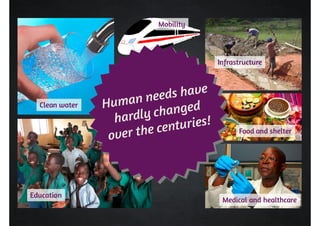
Clean water 
Education 
Mobility 
Infrastructure 
Food and shelter 
Medical and healthcare
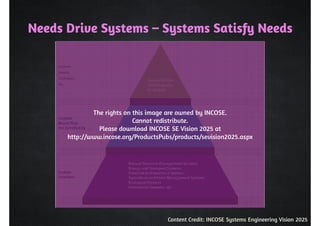
Needs Drive Systems – Systems Satisfy Needs 
The rights on this image are owned by INCOSE. 
Cannot redistribute. 
Please download INCOSE SE Vision 2025 at 
http://www.incose.org/ProductsPubs/products/sevision2025.aspx 
Content Credit: INCOSE Systems Engineering Vision 2025
Global Trends Shape The System Environment 
The rights on this image are owned by INCOSE. 
Cannot redistribute. 
Please download INCOSE SE Vision 2025 at 
http://www.incose.org/ProductsPubs/products/sevisi 
on2025.aspx 
Content Credit: INCOSE Systems Engineering Vision 2025
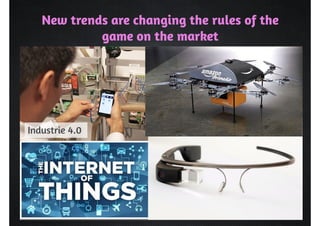
New trends are changing the rules of the 
game on the market 
Industrie 4.0
2 
Building the systems of tomorrow with 
Systems Engineering
Systems Engineering – A (long) definition 
Systems Engineering is an interdisciplinary approach and means to enable the 
realization of successful systems. It focuses on defining customer needs and required 
functionality early in the development cycle, documenting requirements, then 
proceeding with design synthesis and system validation while considering the complete 
problem: 
Source: INCOSE Website – What is Systems Engineering? 
 Operations 
 Cost  Schedule 
 Performance 
 Training  Support 
 Test 
 Disposal 
 Manufacturing 
Systems Engineering integrates all the disciplines and specialty groups into a team effort 
forming a structured development process that proceeds from concept to production to 
operation. Systems Engineering considers both the business and the technical needs of 
all customers with the goal of providing a quality product that meets the user needs.
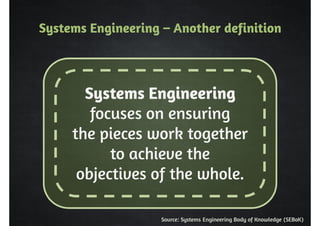
Systems Engineering – Another definition 
Systems Engineering 
focuses on ensuring 
the pieces work together 
to achieve the 
objectives of the whole. 
Source: Systems Engineering Body of Knowledge (SEBoK)
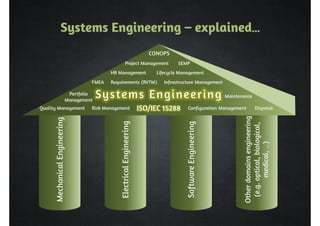
Systems Engineering – explained… 
Other domains engineering 
(e.g. optical, biological, 
medical, …) 
SEMP 
Lifecycle Management 
Requirements (RVTM) Infrastructure Management 
Software Engineering 
Project Management 
HR Management 
Electrical Engineering 
Mechanical Engineering 
CONOPS 
FMEA 
Sys tems Engineer ing 
Portfolio 
Management 
Quality Management Risk Management 
Maintenance 
ISO/IEC 15288 Configuration Management Disposal
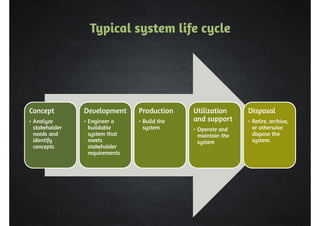
Typical system life cycle 
Concept 
• Analyze 
stakeholder 
needs and 
identify 
concepts 
Development 
• Engineer a 
buildable 
system that 
meets 
stakeholder 
requirements 
Production 
• Build the 
system 
Utilization 
and support 
• Operate and 
maintain the 
system 
Disposal 
• Retire, archive, 
or otherwise 
dispose the 
system.
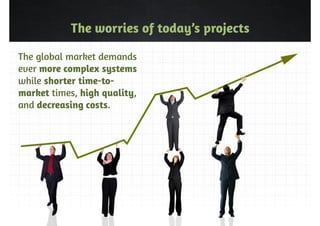
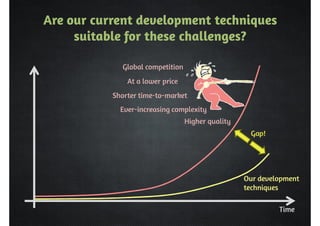
The worries of today’s projects 
The global market demands 
ever more complex systems 
while shorter time-to-market 
times, high quality, 
and decreasing costs.
Are our current development techniques 
suitable for these challenges? 
SShhoorrtteerr ttiimmee--ttoo--mmaarrkkeett 
Ever-iinnccrreeaassiinngg ccoommpplleexxiittyy 
HHiigghheerr qquuaalliittyy 
GGlloobbaall ccoommppeettiittiioonn 
AAtt aa lloowweerr pprriiccee 
Our development 
techniques 
TTiimmee 
Gap!
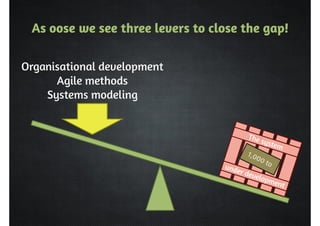
As oose we see three levers to close the gap! 
Organisational development 
Agile methods 
Systems modeling
3 
Modeling helps to cope with complexity 
Key success factor MBSE
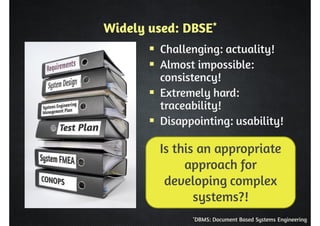
Widely used: DBSE* 
 Challenging: actuality! 
 Almost impossible: 
consistency! 
 Extremely hard: 
traceability! 
 Disappointing: usability! 
Is this an appropriate 
approach for 
developing complex 
systems?! 
*DBMS: Document Based Systems Engineering
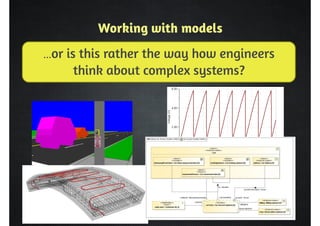
Working with models 
…or is this rather the way how engineers 
think about complex systems?
Model-based Systems Engineering 
Model-based Systems Engineering (MBSE) 
is the formalized application of modeling to 
support system requirements, design, 
analysis, verification and validation 
activities beginning in the conceptual 
design phase and continuing throughout 
development and later life cycle phases. 
Source: INCOSE Systems Engineering Vision 2020
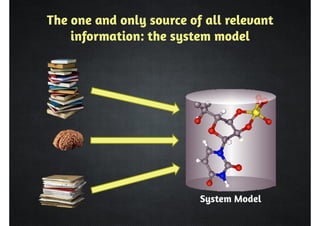
The one and only source of all relevant 
information: the system model 
System Model
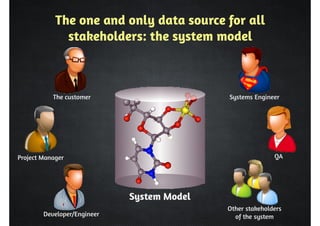
The one and only data source for all 
stakeholders: the system model 
Project Manager QA 
System Model 
Systems Engineer 
The customer 
Developer/Engineer 
Other stakeholders 
of the system
OMG Systems Modeling Language 
SysML is designed to provide simple but 
powerful constructs for modeling a wide range 
of systems engineering problems. It is 
particularly effective in specifying 
requirements, structure, behavior, allocations, 
and constraints on system properties to 
support engineering analysis. 
Source: OMG SysML™ 1.3 specification
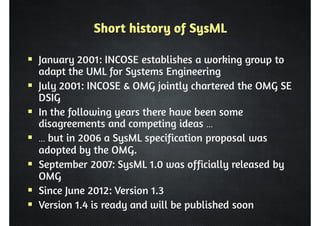
Short history of SysML 
 January 2001: INCOSE establishes a working group to 
adapt the UML for Systems Engineering 
 July 2001: INCOSE  OMG jointly chartered the OMG SE 
DSIG 
 In the following years there have been some 
disagreements and competing ideas … 
 … but in 2006 a SysML specification proposal was 
adopted by the OMG. 
 September 2007: SysML 1.0 was officially released by 
OMG 
 Since June 2012: Version 1.3 
 Version 1.4 is ready and will be published soon
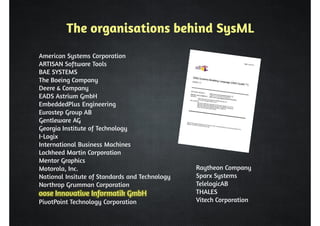
The organisations behind SysML 
American Systems Corporation 
ARTISAN Software Tools 
BAE SYSTEMS 
The Boeing Company 
Deere  Company 
EADS Astrium GmbH 
EmbeddedPlus Engineering 
Eurostep Group AB 
Gentleware AG 
Georgia Institute of Technology 
I-Logix 
International Business Machines 
Lockheed Martin Corporation 
Mentor Graphics 
Motorola, Inc. 
National Insitute of Standards and Technology 
Northrop Grumman Corporation 
oose Innovative Informatik GmbH 
PivotPoint Technology Corporation 
Raytheon Company 
Sparx Systems 
TelelogicAB 
THALES 
Vitech Corporation
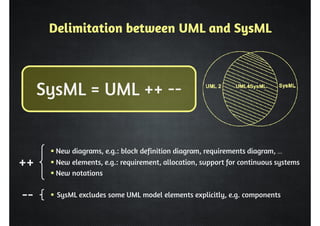
Delimitation between UML and SysML 
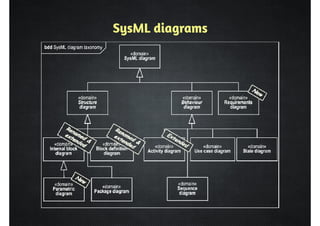
 New diagrams, e.g.: block definition diagram, requirements diagram, … 
 New elements, e.g.: requirement, allocation, support for continuous systems 
 New notations 
 SysML excludes some UML model elements explicitly, e.g. components 
++ 
-- 
SysML = UML ++ --
SysML diagrams
Case study 
Small Satellite 
4
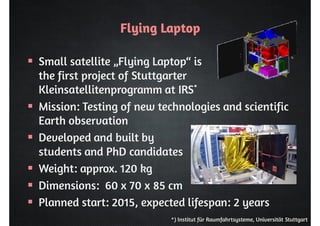
Flying Laptop 
 Small satellite „Flying Laptop“ is 
the first project of Stuttgarter 
Kleinsatellitenprogramm at IRS* 
 Mission: Testing of new technologies and scientific 
Earth observation 
 Developed and built by 
students and PhD candidates 
 Weight: approx. 120 kg 
 Dimensions: 60 x 70 x 85 cm 
 Planned start: 2015, expected lifespan: 2 years 
*) Institut für Raumfahrtsysteme, Universität Stuttgart
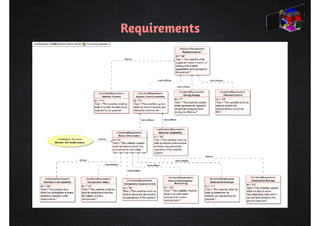
Requirements
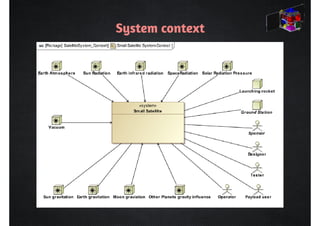
System context
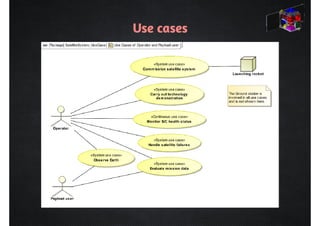
Use cases
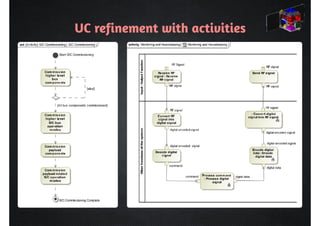
UC refinement with activities
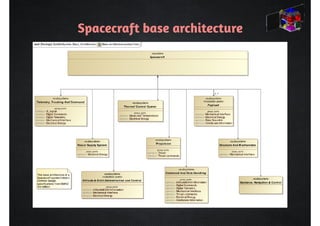
Spacecraft base architecture
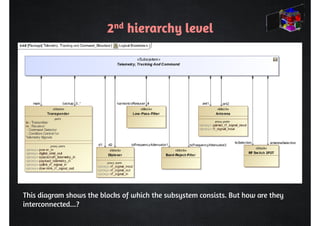
2nd hierarchy level 
This diagram shows the blocks of which the subsystem consists. But how are they 
interconnected...?
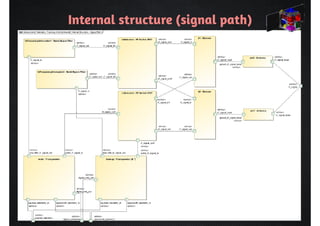
Internal structure (signal path)
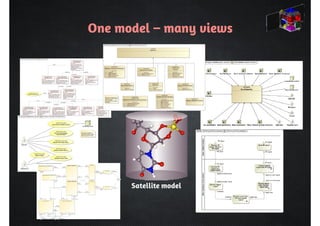
One model – many views 
Satellite model
The future of MBSE 
Outlook 
5
INCOSE Vision 2025 
Formal systems modeling is standard practice 
for specifying, analyzing, designing, and 
verifying systems, and is fully integrated with 
other engineering models. System models are 
adapted to the application domain, and 
include a broad spectrum of models for 
representing all aspects of systems. 
Source: INCOSE Vision 2025 (June 2014), page 24
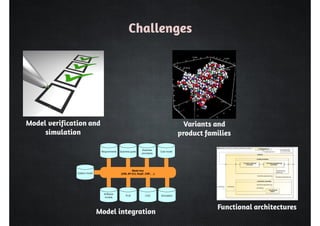
Challenges 
Variants and 
product families 
Model integration 
Functional architectures 
Model verification and 
simulation
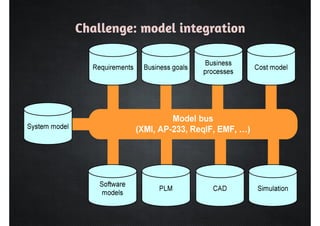
Challenge: model integration
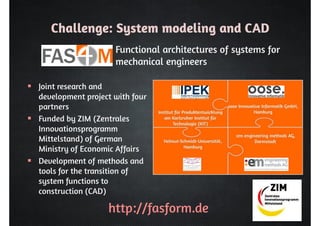
Challenge: System modeling and CAD 
Functional architectures of systems for 
mechanical engineers 
http://fasform.de 
 Joint research and 
development project with four 
partners 
 Funded by ZIM (Zentrales 
Innovationsprogramm 
Mittelstand) of German 
Ministry of Economic Affairs 
 Development of methods and 
tools for the transition of 
system functions to 
construction (CAD)
Conclusion 
 Systems Engineering as an interdisciplinary 
approach to develop complex products will 
strongly gain in importance 
 The document-based approaches from the 
industrial age are no longer suitable in the 
era of ever-increasing complexity 
 MBSE is a key success factor of modern 
Systems Engineering
Conference: Tag des Systems Engineering 
The top-event of the 
German Systems Engineering Community! 
12. – 14. November 2014 in Bremen 
www.tdse.org
Still have 
questions? 
Give it to me!
Thank you 
for paying attention!

A World In Motion

  • 1.
    0 5 .S e p t emb e r 2 0 1 4 D o c k l a n d H amb u r g
  • 2.
    Stephan Roth ::sr@oose.de Since 2012: Trainer, Consultant, and Coach with oose Innovative Informatik eG Prior: Plath GmbH, German Air Force Main spheres of activity: Systems Engineering, MBSE (SysML), Analysis and Design with UML, Software Architecture, Software Craftsmanship, and Clean Code Member of GfSE e.V. and INCOSE @_StephanRoth xing.to/sr google.com/+StephanRoth
  • 3.
    About oose… Founded in 1998 by Bernd Oestereich Today owned by the employee Trainings, consulting, and coaching in the domain of: Software Engineering and Development Systems Engineering Organisational Development Member of GfSE e.V., INCOSE, Object Management Group (OMG) Co-Author of UML, SysML, and BPMN
  • 4.
    1 A WorldIn Motion 2 Systems Engineering Key success factor MBSE 3 Case study: Small Satellite 4 Outlook 5
  • 5.
    1 Mastering thechallenges of the future A World In Motion
  • 6.
    Clean water Education Mobility Infrastructure Food and shelter Medical and healthcare
  • 7.
    Needs Drive Systems– Systems Satisfy Needs The rights on this image are owned by INCOSE. Cannot redistribute. Please download INCOSE SE Vision 2025 at http://www.incose.org/ProductsPubs/products/sevision2025.aspx Content Credit: INCOSE Systems Engineering Vision 2025
  • 8.
    Global Trends ShapeThe System Environment The rights on this image are owned by INCOSE. Cannot redistribute. Please download INCOSE SE Vision 2025 at http://www.incose.org/ProductsPubs/products/sevisi on2025.aspx Content Credit: INCOSE Systems Engineering Vision 2025
  • 9.
    New trends arechanging the rules of the game on the market Industrie 4.0
  • 10.
    2 Building thesystems of tomorrow with Systems Engineering
  • 11.
    Systems Engineering –A (long) definition Systems Engineering is an interdisciplinary approach and means to enable the realization of successful systems. It focuses on defining customer needs and required functionality early in the development cycle, documenting requirements, then proceeding with design synthesis and system validation while considering the complete problem: Source: INCOSE Website – What is Systems Engineering? Operations Cost Schedule Performance Training Support Test Disposal Manufacturing Systems Engineering integrates all the disciplines and specialty groups into a team effort forming a structured development process that proceeds from concept to production to operation. Systems Engineering considers both the business and the technical needs of all customers with the goal of providing a quality product that meets the user needs.
  • 12.
    Systems Engineering –Another definition Systems Engineering focuses on ensuring the pieces work together to achieve the objectives of the whole. Source: Systems Engineering Body of Knowledge (SEBoK)
  • 13.
    Systems Engineering –explained… Other domains engineering (e.g. optical, biological, medical, …) SEMP Lifecycle Management Requirements (RVTM) Infrastructure Management Software Engineering Project Management HR Management Electrical Engineering Mechanical Engineering CONOPS FMEA Sys tems Engineer ing Portfolio Management Quality Management Risk Management Maintenance ISO/IEC 15288 Configuration Management Disposal
  • 14.
    Typical system lifecycle Concept • Analyze stakeholder needs and identify concepts Development • Engineer a buildable system that meets stakeholder requirements Production • Build the system Utilization and support • Operate and maintain the system Disposal • Retire, archive, or otherwise dispose the system.
  • 15.
    The worries oftoday’s projects The global market demands ever more complex systems while shorter time-to-market times, high quality, and decreasing costs.
  • 16.
    Are our currentdevelopment techniques suitable for these challenges? SShhoorrtteerr ttiimmee--ttoo--mmaarrkkeett Ever-iinnccrreeaassiinngg ccoommpplleexxiittyy HHiigghheerr qquuaalliittyy GGlloobbaall ccoommppeettiittiioonn AAtt aa lloowweerr pprriiccee Our development techniques TTiimmee Gap!
  • 17.
    As oose wesee three levers to close the gap! Organisational development Agile methods Systems modeling
  • 18.
    3 Modeling helpsto cope with complexity Key success factor MBSE
  • 19.
    Widely used: DBSE* Challenging: actuality! Almost impossible: consistency! Extremely hard: traceability! Disappointing: usability! Is this an appropriate approach for developing complex systems?! *DBMS: Document Based Systems Engineering
  • 20.
    Working with models …or is this rather the way how engineers think about complex systems?
  • 21.
    Model-based Systems Engineering Model-based Systems Engineering (MBSE) is the formalized application of modeling to support system requirements, design, analysis, verification and validation activities beginning in the conceptual design phase and continuing throughout development and later life cycle phases. Source: INCOSE Systems Engineering Vision 2020
  • 22.
    The one andonly source of all relevant information: the system model System Model
  • 23.
    The one andonly data source for all stakeholders: the system model Project Manager QA System Model Systems Engineer The customer Developer/Engineer Other stakeholders of the system
  • 24.
    OMG Systems ModelingLanguage SysML is designed to provide simple but powerful constructs for modeling a wide range of systems engineering problems. It is particularly effective in specifying requirements, structure, behavior, allocations, and constraints on system properties to support engineering analysis. Source: OMG SysML™ 1.3 specification
  • 25.
    Short history ofSysML January 2001: INCOSE establishes a working group to adapt the UML for Systems Engineering July 2001: INCOSE OMG jointly chartered the OMG SE DSIG In the following years there have been some disagreements and competing ideas … … but in 2006 a SysML specification proposal was adopted by the OMG. September 2007: SysML 1.0 was officially released by OMG Since June 2012: Version 1.3 Version 1.4 is ready and will be published soon
  • 26.
    The organisations behindSysML American Systems Corporation ARTISAN Software Tools BAE SYSTEMS The Boeing Company Deere Company EADS Astrium GmbH EmbeddedPlus Engineering Eurostep Group AB Gentleware AG Georgia Institute of Technology I-Logix International Business Machines Lockheed Martin Corporation Mentor Graphics Motorola, Inc. National Insitute of Standards and Technology Northrop Grumman Corporation oose Innovative Informatik GmbH PivotPoint Technology Corporation Raytheon Company Sparx Systems TelelogicAB THALES Vitech Corporation
  • 27.
    Delimitation between UMLand SysML New diagrams, e.g.: block definition diagram, requirements diagram, … New elements, e.g.: requirement, allocation, support for continuous systems New notations SysML excludes some UML model elements explicitly, e.g. components ++ -- SysML = UML ++ --
  • 28.
  • 29.
    Case study SmallSatellite 4
  • 30.
    Flying Laptop Small satellite „Flying Laptop“ is the first project of Stuttgarter Kleinsatellitenprogramm at IRS* Mission: Testing of new technologies and scientific Earth observation Developed and built by students and PhD candidates Weight: approx. 120 kg Dimensions: 60 x 70 x 85 cm Planned start: 2015, expected lifespan: 2 years *) Institut für Raumfahrtsysteme, Universität Stuttgart
  • 31.
  • 32.
  • 33.
  • 34.
  • 35.
  • 36.
    2nd hierarchy level This diagram shows the blocks of which the subsystem consists. But how are they interconnected...?
  • 37.
  • 38.
    One model –many views Satellite model
  • 39.
    The future ofMBSE Outlook 5
  • 40.
    INCOSE Vision 2025 Formal systems modeling is standard practice for specifying, analyzing, designing, and verifying systems, and is fully integrated with other engineering models. System models are adapted to the application domain, and include a broad spectrum of models for representing all aspects of systems. Source: INCOSE Vision 2025 (June 2014), page 24
  • 41.
    Challenges Variants and product families Model integration Functional architectures Model verification and simulation
  • 42.
  • 43.
    Challenge: System modelingand CAD Functional architectures of systems for mechanical engineers http://fasform.de Joint research and development project with four partners Funded by ZIM (Zentrales Innovationsprogramm Mittelstand) of German Ministry of Economic Affairs Development of methods and tools for the transition of system functions to construction (CAD)
  • 44.
    Conclusion SystemsEngineering as an interdisciplinary approach to develop complex products will strongly gain in importance The document-based approaches from the industrial age are no longer suitable in the era of ever-increasing complexity MBSE is a key success factor of modern Systems Engineering
  • 45.
    Conference: Tag desSystems Engineering The top-event of the German Systems Engineering Community! 12. – 14. November 2014 in Bremen www.tdse.org
  • 46.
    Still have questions? Give it to me!
  • 47.
    Thank you forpaying attention!