What is “Mindfulness”?
Many “meditations” as there are many sports
Definition and History
 Mindfulness-Based Stress Reduction (MBSR) and Chronic Pain (Jon Kabat
Zinn, 1982)
 Active self-regulation skills that patients could practice by themselves to
help them cope with medical conditions—chronic pain foremost (10-8 Wk)
 Mindfulness= “to pay attention on purpose in the present moment
nonjudgmentally. “
 "Mindfulness is the awareness that emerges through paying attention on
purpose, in the present moment, with compassion, and open-hearted
curiosity."
What is it and to what has science tried
to apply it in studies?
 way of knowing and befriending one's own mind and
body and experience
 “coming to terms with things as they are.” (J. Kabat Zinn)
 cancer, heart disease, diabetes, brain injuries,
fibromyalgia, HIV/Aids, Parkinson’s, organ transplants,
psoriasis, irritable bowel syndrome, and tinnitus.
 attention-deficit hyperactivity disorder, depression,
anxiety, obsessive-compulsive disorder, personality
disorders, substance abuse, and autism.
Range of Studies….approaching
20,000
 In a meta-analysis of meditation programs, psychological stress, and
well-being in the March 2014 issue of the Journal of the American
Medical Association, Internal Medicine, Madhav Goyal, a Johns
Hopkins assistant professor of medicine, and his colleagues
identified a staggering 18,753 citations
 “High Quality”: 47 randomized controlled trials with 3,515
participants
 Try, but sticking with it
 MBSR: 8 weeks
 “Plasticity” = Changes ion the brain with repetition of experience
and gaining of skills
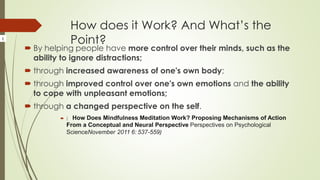
How does it Work? And What’s the
Point?
 By helping people have more control over their minds, such as the
ability to ignore distractions;
 through increased awareness of one's own body;
 through improved control over one's own emotions and the ability
to cope with unpleasant emotions;
 through a changed perspective on the self.
 ( How Does Mindfulness Meditation Work? Proposing Mechanisms of Action
From a Conceptual and Neural Perspective Perspectives on Psychological
ScienceNovember 2011 6: 537-559)
(
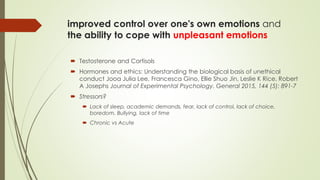
improved control over one's own emotions and
the ability to cope with unpleasant emotions
 Testosterone and Cortisols
 Hormones and ethics: Understanding the biological basis of unethical
conduct Jooa Julia Lee, Francesca Gino, Ellie Shuo Jin, Leslie K Rice, Robert
A Josephs Journal of Experimental Psychology. General 2015, 144 (5): 891-7
 Stressors?
 Lack of sleep, academic demands, fear, lack of control, lack of choice,
boredom. Bullying, lack of time
 Chronic vs Acute
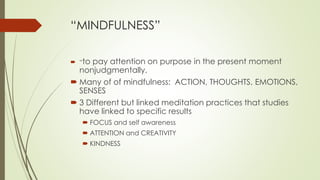
“MINDFULNESS”
 “to pay attention on purpose in the present moment
nonjudgmentally.
 Many of of mindfulness: ACTION, THOUGHTS, EMOTIONS,
SENSES
 3 Different but linked meditation practices that studies
have linked to specific results
 FOCUS and self awareness
 ATTENTION and CREATIVITY
 KINDNESS

What is Mindfulness

  • 1.
    What is “Mindfulness”? Many“meditations” as there are many sports
  • 2.
    Definition and History Mindfulness-Based Stress Reduction (MBSR) and Chronic Pain (Jon Kabat Zinn, 1982)  Active self-regulation skills that patients could practice by themselves to help them cope with medical conditions—chronic pain foremost (10-8 Wk)  Mindfulness= “to pay attention on purpose in the present moment nonjudgmentally. “  "Mindfulness is the awareness that emerges through paying attention on purpose, in the present moment, with compassion, and open-hearted curiosity."
  • 3.
    What is itand to what has science tried to apply it in studies?  way of knowing and befriending one's own mind and body and experience  “coming to terms with things as they are.” (J. Kabat Zinn)  cancer, heart disease, diabetes, brain injuries, fibromyalgia, HIV/Aids, Parkinson’s, organ transplants, psoriasis, irritable bowel syndrome, and tinnitus.  attention-deficit hyperactivity disorder, depression, anxiety, obsessive-compulsive disorder, personality disorders, substance abuse, and autism.
  • 4.
    Range of Studies….approaching 20,000 In a meta-analysis of meditation programs, psychological stress, and well-being in the March 2014 issue of the Journal of the American Medical Association, Internal Medicine, Madhav Goyal, a Johns Hopkins assistant professor of medicine, and his colleagues identified a staggering 18,753 citations  “High Quality”: 47 randomized controlled trials with 3,515 participants  Try, but sticking with it  MBSR: 8 weeks  “Plasticity” = Changes ion the brain with repetition of experience and gaining of skills
  • 5.
    How does itWork? And What’s the Point?  By helping people have more control over their minds, such as the ability to ignore distractions;  through increased awareness of one's own body;  through improved control over one's own emotions and the ability to cope with unpleasant emotions;  through a changed perspective on the self.  ( How Does Mindfulness Meditation Work? Proposing Mechanisms of Action From a Conceptual and Neural Perspective Perspectives on Psychological ScienceNovember 2011 6: 537-559) (
  • 6.
    improved control overone's own emotions and the ability to cope with unpleasant emotions  Testosterone and Cortisols  Hormones and ethics: Understanding the biological basis of unethical conduct Jooa Julia Lee, Francesca Gino, Ellie Shuo Jin, Leslie K Rice, Robert A Josephs Journal of Experimental Psychology. General 2015, 144 (5): 891-7  Stressors?  Lack of sleep, academic demands, fear, lack of control, lack of choice, boredom. Bullying, lack of time  Chronic vs Acute
  • 7.
    “MINDFULNESS”  “to payattention on purpose in the present moment nonjudgmentally.  Many of of mindfulness: ACTION, THOUGHTS, EMOTIONS, SENSES  3 Different but linked meditation practices that studies have linked to specific results  FOCUS and self awareness  ATTENTION and CREATIVITY  KINDNESS