Mindfulness
Based Stress
Reduction
Derived from the Humanistic
Perspective
Stephanie Brinkerhoff-Riley
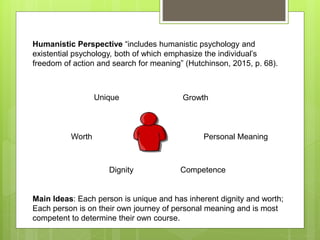
Humanistic Perspective “includes humanistic psychology and
existential psychology, both of which emphasize the individual’s
freedom of action and search for meaning” (Hutchinson, 2015, p. 68).
Unique Growth
Personal Meaning
CompetenceDignity
Worth
Main Ideas: Each person is unique and has inherent dignity and worth;
Each person is on their own journey of personal meaning and is most
competent to determine their own course.
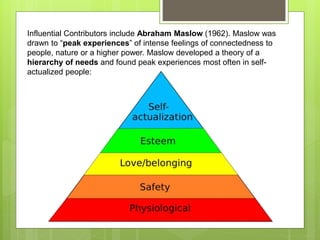
Influential Contributors include Abraham Maslow (1962). Maslow was
drawn to “peak experiences” of intense feelings of connectedness to
people, nature or a higher power. Maslow developed a theory of a
hierarchy of needs and found peak experiences most often in self-
actualized people:
Maslow created the term “positive psychology” which is the root of the
strengths perspective. It is the scientific study of people’s strengths and virtues
and promotes optimal functioning of individuals and communities. Positive
psychologists argue the best way to avoid the development of mental illness is
to promote human strength and competence.
Carl Rogers (1951) “was interested in the capacity of humans to change in
therapeutic relationships” and came to believe “humans have vast internal
resources for self-understanding and self-directed behavior”(Hutchinson, 2015,
p. 69). He emphasized the dignity and worth of the individual and developed
the core conditions of the therapeutic process: empathy, warmth and
genuineness.
Martin Seligman (1998) who helped develop the concept of “learned
helplessness” has also worked to develop the idea of “learned optimism.”
He and others believed characteristics which promote well-being and buffer
against mental illness include optimism, courage, hope, perseverance,
honesty, work ethic and interpersonal skills (Hutchinson, 2015, p. 69).
Humanism developed after WWII and was a rejection of Existential
Psychology which advocates suffering as a necessary part of human
growth.
Humanism flourished in the 1960s and 70s as western and eastern
worldviews were merging in the trends of yoga, meditation, individual
exploration, egalitarian concepts and spirituality. Hope is a function of
western culture, while balance, compassion and harmony stem from eastern
thinking.
The social justice aspect of humanism includes the capabilities approach.
This approach focuses on human agency and people’s ability to follow
accomplish goals they value. The main tenet is society and social
arrangements should support and expand individual capabilities.
(Hutchinson, 2015)
Humanism
Major Assumptions
 Human condition does not have to include suffering
 Humans are most connected to other people, their environment and
higher power when basic needs are met
 Each person has inherent value and self-worth and is best able to
determine what is best for them (individual client)
 Therapeutic relationship must include empathy, warmth and
genuineness, and the purpose of the relationship is to promote optimal
functioning by maximizing the individual’s strengths (role of therapist)
 Promoting well-being and avoiding mental illness means promoting
characteristics of optimism and resiliency
 Society should aim to support and promote individual self-determination
(system involvement in change process)
 People are capable of solving their own problems and achieving goals
they value when appropriately supported
 Works with diverse individuals and with diverse client issues
(Hutchinson, 2015)
Mindfulness
Mindfulness is “the awareness that emerges through paying attention on
purpose, in the present moment, and nonjudgmentally to the unfolding of the
experience moment by moment” (Kabat-Zinn, 2003, p. 145). It is the heart of
Buddhist meditation and at the core of the teachings of the Buddha which is
known as “dharma.” Dharma carries the meaning of lawfulness or “the way
things are,” which is similar to the Chinese notion of Tao (Kabat-Zinn, 2003,
p. 145).
The Buddha used his mind, body and own experiences to develop a
comprehensive view of human nature and a way to treat what he considered
its fundamental disease of greed, aversion (hatred) and ignorance
(unawareness).
The dharma is universal in terms of its description of the mind, emotion and
suffering, and the potential release of suffering based on the practice of
methods to refine various aspects of mind and heart through mindful
attention. The result is “a sense of openhearted, friendly presence and
interest” (Kabat-Zinn, 2003, p. 145).
Buddhist traditions emphasize simple and effective ways to cultivate and refine
the practice of mindfulness, which is the fundamental attention stance
underlying all streams of Buddhist meditative practice: Theravada, Mahayana
(Zen) and Vajrayana.
The idea is the untrained mind can significantly contribute to human suffering,
one’s own and others. Meditation can reduce suffering and bring a sense of
calm and clarity to the mind, while opening the heart and refining attention and
action.
Mindfulness Based Stress Reduction (MBSR) was developed by John
Kabat-Zinn in 1979 at the University of Massachusetts Medical School as a
way to help patients deal with their stress, pain and illness. Like Humanism
itself, it is a blending of eastern and western thought. In this case, western
medicine and eastern tools to reduce suffering. It is “based on the premise that
enhancing the capacity to be mindful- that is, to attend to the present moment
experience in a receptive manner- will, over time, reduce the identification with
self-focused thoughts and emotions that can lead to poorer mental health”
(Shapiro, Brown & Biegel, 2007, p. 106).
MSRB
The Expanding Family Life Cycle
Spirituality is a fundamental resource throughout the life cycle and can be a
“powerful resource” for people who have “lost their way, are feeling despair,
or are suffering from oppression, racism, poverty, and trauma” (McGoldrick,
Preto & Carter, 2016, p. 156)
Social workers should explore spirituality as a source of strength with their
clients. The Joint Commission on the Accreditation of Healthcare
Organizations requires spiritual assessments of mental health and
substance abuse patients (JCAHO, 2008)
MSRB can blend seamlessly into any existing spiritual framework due to its
detachment from eastern religion. The MSRB training can lack any
references to the dharma or Buddhism. However, where clients are seeking
a spiritual framework, MSRB can be a start to that exploration. Slowing
down the mind to contemplate purpose is a great way to begin the
paradigm shift from self-centeredness to service of others which is the
fundamental concept of any religion.
Key Concepts/Techniques
 Intervention free of any real association with Buddhism
 Goal is not to make people good at meditation
 Purpose is to give people tools to explore the connection between mind
and body and to face, explore and relieve suffering associated with their
diagnosed condition or in general
 Typically an 8 week course which includes information about the purpose
of the program, reading materials, guided meditation and encouragement
for daily meditation on patient’s own time
 Promotes assumption of responsibility for own well-being
 Mindfulness Based Cognitive Therapy, mindfulness within dilectical
behavior therapy, Mindfulness Based Relapse Prevention, Mindfulness
Based Childbirth and Parenting, Mindfulness Based Eating Awareness
Training, Mindfulness Based Elder Care (Kabat-Zinn, 2011)
 Used in prisons to reduce recidivism (Samuelson et al., 2007)
 Cornerstone of teaching self-care to patients and caregivers (Shapiro,
Brown & Biegel, 2007)
Examples
Assessment
Individual/Group: Intake survey related to anxiety, stress, rumination, positive
affect, self-compassion, mindfulness and individual goals/values
Family/Community: Evaluate what institutions/agencies/social supports are
lacking for optimal support of individual self-determination (capabilities approach
and strengths approach)
Intervention
Individual/Group: 8 week mindfulness training with explanation, reading
materials, guided meditation and instructions for self-practice plus therapeutic
relationship for optimal awareness of self-determination
Family: Educate family on resources and advocate for services
Community: Educate with consensus building on new supports for residents
(macro practice model)
Evaluation
Individual/Group: Exit survey related to same markers
Family: Evaluate whether family received adequate services; group of
individuals with potentially different goals/values
Community: Evaluate whether community more conducive to supporting
Individual self-determination and whether more resources are available
Results
 Stress leads to increased depression, emotional exhaustion, anxiety,
psychosocial isolation, decreased job satisfaction, reduced self-esteem,
disrupted personal relationships, substance abuse and loneliness
(Shapiro, Biegel & Brown, 2007)
 EEG, fMRI and PET studies of brains of those who practice meditation
show a range of stable patterns of brain activity which are not consistent in
those who do not meditate
 Significant increases in left-sided activation in the anterior cortical area
after 8 week course (Right-sided activation is associated with negative
emotional expression) and increased antibodies which endured through a
4 month follow-up (Kabat-Zinn, 2003)
 Skin clearing in Psoriasis study (Kabat-Zinn, 2003)
 Reduced hostility and mood disturbance with increased self-esteem in
correctional facility study (Samuelson et al., 2007)
 Improvements related to positive affect, anxiety, perceived stress,
rumination, self-compassion and mindfulness (Shapiro, Biegel & Brown,
2007)
Strengths and Weaknesses
Strengths:
 Uses Strengths Perspective
 Aligns with NASW Code of Ethics: Dignity, value, self-determination
 Social Justice Component
 Begins where the client is
 Empowering the client to take responsibility for own well-being
 Cultivates Optimism and the reduction of individual suffering
 Can be used with a wide range of people and issues
Weaknesses
 Concepts vague and difficult to understand, teach
 Testability and empirical support lacking
 Difficult to use for more severe mental illness
 May not seem helpful to those with a constellation of barriers and/or
learned helplessness
References
Hutchison, E. (2015). Dimensions of human behavior: Person and
environment (5th ed.). Thousand Oaks, CA: Sage Publications, Inc.
Kabat-Zinn, J. (2003). Mindfulness-based interventions in context: Past,
Present, and Future. American Psychological Association, 10(2), 144-156.
doi: 10.1093/clipsy/bpg016
Kabat-Zinn, J. (2011). Some reflections on the origins of MBSR, skillful
means, and the trouble with maps. Contemporary Buddhism, 12(1), 281-306.
doi: 10.1080/14639947.2011.564844
McGoldrick, M., Preto, N., & Carter, B. (2015). The Expanding Family Life
Cycle (5th ed.). New York, NY: Pearson.
Samuelson, M., Carmody, J., Kabat-Zinn, J. & Bratt, M. (2007). Mindfulness-
based stress reduction in Massachusetts correctional facilities. The Prison
Journal, 87(2), 254-268. doi: 10.1177/0032885507303753
Shapiro, S., Brown, K. & Biegel, G. (2007). Teaching self-care to caregivers:
Effects of mindfulness-based stress reduction on the mental health of
therapists in training. Training and Education in Professional Psychology,
1(2), 105-115. doi: 10.1037/1931-3918.1.2.105

Mindfulness Based Stress Reduction Presentation

  • 1.
    Mindfulness Based Stress Reduction Derived fromthe Humanistic Perspective Stephanie Brinkerhoff-Riley
  • 2.
    Humanistic Perspective “includeshumanistic psychology and existential psychology, both of which emphasize the individual’s freedom of action and search for meaning” (Hutchinson, 2015, p. 68). Unique Growth Personal Meaning CompetenceDignity Worth Main Ideas: Each person is unique and has inherent dignity and worth; Each person is on their own journey of personal meaning and is most competent to determine their own course.
  • 3.
    Influential Contributors includeAbraham Maslow (1962). Maslow was drawn to “peak experiences” of intense feelings of connectedness to people, nature or a higher power. Maslow developed a theory of a hierarchy of needs and found peak experiences most often in self- actualized people:
  • 4.
    Maslow created theterm “positive psychology” which is the root of the strengths perspective. It is the scientific study of people’s strengths and virtues and promotes optimal functioning of individuals and communities. Positive psychologists argue the best way to avoid the development of mental illness is to promote human strength and competence. Carl Rogers (1951) “was interested in the capacity of humans to change in therapeutic relationships” and came to believe “humans have vast internal resources for self-understanding and self-directed behavior”(Hutchinson, 2015, p. 69). He emphasized the dignity and worth of the individual and developed the core conditions of the therapeutic process: empathy, warmth and genuineness. Martin Seligman (1998) who helped develop the concept of “learned helplessness” has also worked to develop the idea of “learned optimism.” He and others believed characteristics which promote well-being and buffer against mental illness include optimism, courage, hope, perseverance, honesty, work ethic and interpersonal skills (Hutchinson, 2015, p. 69).
  • 5.
    Humanism developed afterWWII and was a rejection of Existential Psychology which advocates suffering as a necessary part of human growth. Humanism flourished in the 1960s and 70s as western and eastern worldviews were merging in the trends of yoga, meditation, individual exploration, egalitarian concepts and spirituality. Hope is a function of western culture, while balance, compassion and harmony stem from eastern thinking. The social justice aspect of humanism includes the capabilities approach. This approach focuses on human agency and people’s ability to follow accomplish goals they value. The main tenet is society and social arrangements should support and expand individual capabilities. (Hutchinson, 2015) Humanism
  • 6.
    Major Assumptions  Humancondition does not have to include suffering  Humans are most connected to other people, their environment and higher power when basic needs are met  Each person has inherent value and self-worth and is best able to determine what is best for them (individual client)  Therapeutic relationship must include empathy, warmth and genuineness, and the purpose of the relationship is to promote optimal functioning by maximizing the individual’s strengths (role of therapist)  Promoting well-being and avoiding mental illness means promoting characteristics of optimism and resiliency  Society should aim to support and promote individual self-determination (system involvement in change process)  People are capable of solving their own problems and achieving goals they value when appropriately supported  Works with diverse individuals and with diverse client issues (Hutchinson, 2015)
  • 7.
    Mindfulness Mindfulness is “theawareness that emerges through paying attention on purpose, in the present moment, and nonjudgmentally to the unfolding of the experience moment by moment” (Kabat-Zinn, 2003, p. 145). It is the heart of Buddhist meditation and at the core of the teachings of the Buddha which is known as “dharma.” Dharma carries the meaning of lawfulness or “the way things are,” which is similar to the Chinese notion of Tao (Kabat-Zinn, 2003, p. 145). The Buddha used his mind, body and own experiences to develop a comprehensive view of human nature and a way to treat what he considered its fundamental disease of greed, aversion (hatred) and ignorance (unawareness). The dharma is universal in terms of its description of the mind, emotion and suffering, and the potential release of suffering based on the practice of methods to refine various aspects of mind and heart through mindful attention. The result is “a sense of openhearted, friendly presence and interest” (Kabat-Zinn, 2003, p. 145).
  • 8.
    Buddhist traditions emphasizesimple and effective ways to cultivate and refine the practice of mindfulness, which is the fundamental attention stance underlying all streams of Buddhist meditative practice: Theravada, Mahayana (Zen) and Vajrayana. The idea is the untrained mind can significantly contribute to human suffering, one’s own and others. Meditation can reduce suffering and bring a sense of calm and clarity to the mind, while opening the heart and refining attention and action. Mindfulness Based Stress Reduction (MBSR) was developed by John Kabat-Zinn in 1979 at the University of Massachusetts Medical School as a way to help patients deal with their stress, pain and illness. Like Humanism itself, it is a blending of eastern and western thought. In this case, western medicine and eastern tools to reduce suffering. It is “based on the premise that enhancing the capacity to be mindful- that is, to attend to the present moment experience in a receptive manner- will, over time, reduce the identification with self-focused thoughts and emotions that can lead to poorer mental health” (Shapiro, Brown & Biegel, 2007, p. 106). MSRB
  • 9.
    The Expanding FamilyLife Cycle Spirituality is a fundamental resource throughout the life cycle and can be a “powerful resource” for people who have “lost their way, are feeling despair, or are suffering from oppression, racism, poverty, and trauma” (McGoldrick, Preto & Carter, 2016, p. 156) Social workers should explore spirituality as a source of strength with their clients. The Joint Commission on the Accreditation of Healthcare Organizations requires spiritual assessments of mental health and substance abuse patients (JCAHO, 2008) MSRB can blend seamlessly into any existing spiritual framework due to its detachment from eastern religion. The MSRB training can lack any references to the dharma or Buddhism. However, where clients are seeking a spiritual framework, MSRB can be a start to that exploration. Slowing down the mind to contemplate purpose is a great way to begin the paradigm shift from self-centeredness to service of others which is the fundamental concept of any religion.
  • 10.
    Key Concepts/Techniques  Interventionfree of any real association with Buddhism  Goal is not to make people good at meditation  Purpose is to give people tools to explore the connection between mind and body and to face, explore and relieve suffering associated with their diagnosed condition or in general  Typically an 8 week course which includes information about the purpose of the program, reading materials, guided meditation and encouragement for daily meditation on patient’s own time  Promotes assumption of responsibility for own well-being  Mindfulness Based Cognitive Therapy, mindfulness within dilectical behavior therapy, Mindfulness Based Relapse Prevention, Mindfulness Based Childbirth and Parenting, Mindfulness Based Eating Awareness Training, Mindfulness Based Elder Care (Kabat-Zinn, 2011)  Used in prisons to reduce recidivism (Samuelson et al., 2007)  Cornerstone of teaching self-care to patients and caregivers (Shapiro, Brown & Biegel, 2007)
  • 11.
    Examples Assessment Individual/Group: Intake surveyrelated to anxiety, stress, rumination, positive affect, self-compassion, mindfulness and individual goals/values Family/Community: Evaluate what institutions/agencies/social supports are lacking for optimal support of individual self-determination (capabilities approach and strengths approach) Intervention Individual/Group: 8 week mindfulness training with explanation, reading materials, guided meditation and instructions for self-practice plus therapeutic relationship for optimal awareness of self-determination Family: Educate family on resources and advocate for services Community: Educate with consensus building on new supports for residents (macro practice model) Evaluation Individual/Group: Exit survey related to same markers Family: Evaluate whether family received adequate services; group of individuals with potentially different goals/values Community: Evaluate whether community more conducive to supporting Individual self-determination and whether more resources are available
  • 12.
    Results  Stress leadsto increased depression, emotional exhaustion, anxiety, psychosocial isolation, decreased job satisfaction, reduced self-esteem, disrupted personal relationships, substance abuse and loneliness (Shapiro, Biegel & Brown, 2007)  EEG, fMRI and PET studies of brains of those who practice meditation show a range of stable patterns of brain activity which are not consistent in those who do not meditate  Significant increases in left-sided activation in the anterior cortical area after 8 week course (Right-sided activation is associated with negative emotional expression) and increased antibodies which endured through a 4 month follow-up (Kabat-Zinn, 2003)  Skin clearing in Psoriasis study (Kabat-Zinn, 2003)  Reduced hostility and mood disturbance with increased self-esteem in correctional facility study (Samuelson et al., 2007)  Improvements related to positive affect, anxiety, perceived stress, rumination, self-compassion and mindfulness (Shapiro, Biegel & Brown, 2007)
  • 13.
    Strengths and Weaknesses Strengths: Uses Strengths Perspective  Aligns with NASW Code of Ethics: Dignity, value, self-determination  Social Justice Component  Begins where the client is  Empowering the client to take responsibility for own well-being  Cultivates Optimism and the reduction of individual suffering  Can be used with a wide range of people and issues Weaknesses  Concepts vague and difficult to understand, teach  Testability and empirical support lacking  Difficult to use for more severe mental illness  May not seem helpful to those with a constellation of barriers and/or learned helplessness
  • 14.
    References Hutchison, E. (2015).Dimensions of human behavior: Person and environment (5th ed.). Thousand Oaks, CA: Sage Publications, Inc. Kabat-Zinn, J. (2003). Mindfulness-based interventions in context: Past, Present, and Future. American Psychological Association, 10(2), 144-156. doi: 10.1093/clipsy/bpg016 Kabat-Zinn, J. (2011). Some reflections on the origins of MBSR, skillful means, and the trouble with maps. Contemporary Buddhism, 12(1), 281-306. doi: 10.1080/14639947.2011.564844 McGoldrick, M., Preto, N., & Carter, B. (2015). The Expanding Family Life Cycle (5th ed.). New York, NY: Pearson. Samuelson, M., Carmody, J., Kabat-Zinn, J. & Bratt, M. (2007). Mindfulness- based stress reduction in Massachusetts correctional facilities. The Prison Journal, 87(2), 254-268. doi: 10.1177/0032885507303753 Shapiro, S., Brown, K. & Biegel, G. (2007). Teaching self-care to caregivers: Effects of mindfulness-based stress reduction on the mental health of therapists in training. Training and Education in Professional Psychology, 1(2), 105-115. doi: 10.1037/1931-3918.1.2.105