MINDFUL MENTAL TRAINING
PUBLIC PRESENTATION
© Mindful Mental Training Inc.
Session Outline
•Defining Mindfulness
•Science
•Practice
© Mindful Mental Training Inc.
The Science
•Mindfulness Research Monthly
https://goamra.org/
•Center for Investigating Healthy
Minds:
http://richardjdavidson.com/res
earch/
© Mindful Mental Training Inc.
3 Themes Driving The Science
•Neuroplasticity
•Epigenetics
•Mind – Body interactions
© Mindful Mental Training Inc.
The Science
•After 8-weeks of MBSR
•Structural changes to the brain
•Correlation between improved
immune response to changes seen
in fMRI
•Down-regulation of pro-inflammation
gene expression
© Mindful Mental Training Inc.
• Paying attention, on purpose, in the present
moment, non-judgmentally.
• Mindful Awareness involves developing a deeper
capacity for understanding yourself, this includes
your automatic habitual reactions, and how these
reactions have on yourself and other people in
your life.
What is Mindfulness?
© Mindful Mental Training Inc.
•A religion, but a form of mental
rehearsal.
•Does not take a lot of time, but it
requires commitment and practice.
•Just focusing on our breath or yoga,
but the cultivation of present moment
awareness.
Mindfulness is not:
(Williams & Penman, 2011)
© Mindful Mental Training Inc.
Risks vs Benefits of Mindfulness
Risks
• Can be triggering for
untreated past trauma.
• Often not as effective with
more acute conditions (i.e.
mental health).
© Mindful Mental Training Inc.
Benefits
• Measures for anxiety and
depression all decrease with
sustained regular practice
• Reduce effects of chronic
pain and stress (i.e.
hypertension).
• Meditation shown to be
effective in relieving effects
drug and alcohol
dependence.
(Williams & Penman, 2011)
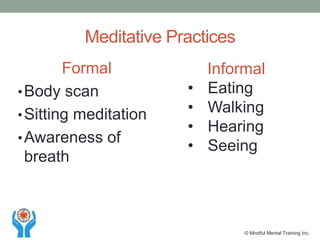
Meditative Practices
© Mindful Mental Training Inc.
Formal
•Body scan
•Sitting meditation
•Awareness of
breath
Informal
• Eating
• Walking
• Hearing
• Seeing
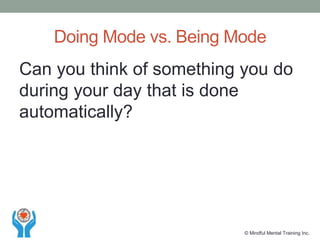
Can you think of something you do
during your day that is done
automatically?
Doing Mode vs. Being Mode
© Mindful Mental Training Inc.
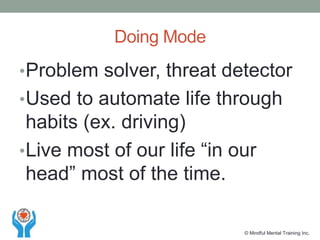
•Problem solver, threat detector
•Used to automate life through
habits (ex. driving)
•Live most of our life “in our
head” most of the time.
Doing Mode
© Mindful Mental Training Inc.
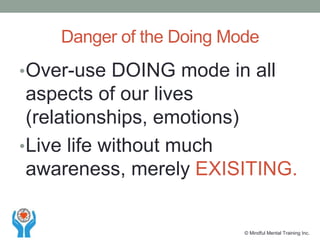
•Over-use DOING mode in all
aspects of our lives
(relationships, emotions)
•Live life without much
awareness, merely EXISITING.
Danger of the Doing Mode
© Mindful Mental Training Inc.
•Mindful awareness arises when
we pay attention,
on Purpose In the Present
Moment.
Without Needless Defense or
Judgment.
Being Mode
© Mindful Mental Training Inc.
•To look at things as they ARE,
not what they SHOULD BE, or
what we WISH IT TO BE.
•View things through a lens of
compassion and unconditional
acceptance
Being Mode
© Mindful Mental Training Inc.
Practice: Awareness of Breath Meditation
© Mindful Mental Training Inc.
Inquiry
© Mindful Mental Training Inc.
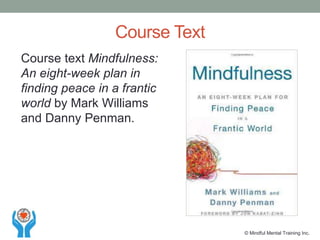
Course text Mindfulness:
An eight-week plan in
finding peace in a frantic
world by Mark Williams
and Danny Penman.
Course Text
© Mindful Mental Training Inc.
• Williams M. & Penman D. (2011). Mindfulness: An
eight-week plan for finding peace in a frantic
world. New York: Rodale Books.
Reference
© Mindful Mental Training Inc.
Reference: Online Mindfulness
• Aikens K., Astin J., Pelletier K., Levanovich K., Baase C.,
Park Y., & Bodnar C. (2014). Mindfulness goes to work:
Impact of an online workplace intervention. Journal of
Occupational and Environmental Medicine, 56(7), 721-
731. DOI: 10.1097/JOM.0000000000000209
• Krusche A., Cyhlarova E., & Williams M. (2013).
Mindfulness online: an evaluation of the feasibility of a
web-based mindfulness course for stress, anxiety and
depression. BMJ Open. DOI:10.1136/bmjopen-2013-
003498
© Mindful Mental Training Inc.
Neuroplasticity and Epigenetics
• Davidson R., Kabat-Zinn J., Schumacher J., Rosenkranz M.,
Muller D., Santorelli S., Urbanowski F., Harrington A., Bonus K.,
& Sheridan J. (2003). Alterations in brain and immune function
produced by mindfulness meditation. Psychosomatic Medicine,
65, 564-570. DOI: 10.1097/01.PSY.0000077505.67574.E3
• Kaliman, P., Álvarez-López, M. J., Cosín-Tomás, M.,
Rosenkranz, M. A., Lutz, A., & Davidson, R. J. (2014). Rapid
changes in histone deacetylases and inflammatory gene
expression in expert
meditators. Psychoneuroendocrinology, 40, 96–107. PMCID:
PMC4039194
© Mindful Mental Training Inc.

Mindful Mental Training Public Presentation

  • 1.
    MINDFUL MENTAL TRAINING PUBLICPRESENTATION © Mindful Mental Training Inc.
  • 2.
  • 3.
    The Science •Mindfulness ResearchMonthly https://goamra.org/ •Center for Investigating Healthy Minds: http://richardjdavidson.com/res earch/ © Mindful Mental Training Inc.
  • 4.
    3 Themes DrivingThe Science •Neuroplasticity •Epigenetics •Mind – Body interactions © Mindful Mental Training Inc.
  • 5.
    The Science •After 8-weeksof MBSR •Structural changes to the brain •Correlation between improved immune response to changes seen in fMRI •Down-regulation of pro-inflammation gene expression © Mindful Mental Training Inc.
  • 6.
    • Paying attention,on purpose, in the present moment, non-judgmentally. • Mindful Awareness involves developing a deeper capacity for understanding yourself, this includes your automatic habitual reactions, and how these reactions have on yourself and other people in your life. What is Mindfulness? © Mindful Mental Training Inc.
  • 7.
    •A religion, buta form of mental rehearsal. •Does not take a lot of time, but it requires commitment and practice. •Just focusing on our breath or yoga, but the cultivation of present moment awareness. Mindfulness is not: (Williams & Penman, 2011) © Mindful Mental Training Inc.
  • 8.
    Risks vs Benefitsof Mindfulness Risks • Can be triggering for untreated past trauma. • Often not as effective with more acute conditions (i.e. mental health). © Mindful Mental Training Inc. Benefits • Measures for anxiety and depression all decrease with sustained regular practice • Reduce effects of chronic pain and stress (i.e. hypertension). • Meditation shown to be effective in relieving effects drug and alcohol dependence. (Williams & Penman, 2011)
  • 9.
    Meditative Practices © MindfulMental Training Inc. Formal •Body scan •Sitting meditation •Awareness of breath Informal • Eating • Walking • Hearing • Seeing
  • 10.
    Can you thinkof something you do during your day that is done automatically? Doing Mode vs. Being Mode © Mindful Mental Training Inc.
  • 11.
    •Problem solver, threatdetector •Used to automate life through habits (ex. driving) •Live most of our life “in our head” most of the time. Doing Mode © Mindful Mental Training Inc.
  • 12.
    •Over-use DOING modein all aspects of our lives (relationships, emotions) •Live life without much awareness, merely EXISITING. Danger of the Doing Mode © Mindful Mental Training Inc.
  • 13.
    •Mindful awareness ariseswhen we pay attention, on Purpose In the Present Moment. Without Needless Defense or Judgment. Being Mode © Mindful Mental Training Inc.
  • 14.
    •To look atthings as they ARE, not what they SHOULD BE, or what we WISH IT TO BE. •View things through a lens of compassion and unconditional acceptance Being Mode © Mindful Mental Training Inc.
  • 15.
    Practice: Awareness ofBreath Meditation © Mindful Mental Training Inc.
  • 16.
  • 17.
    Course text Mindfulness: Aneight-week plan in finding peace in a frantic world by Mark Williams and Danny Penman. Course Text © Mindful Mental Training Inc.
  • 18.
    • Williams M.& Penman D. (2011). Mindfulness: An eight-week plan for finding peace in a frantic world. New York: Rodale Books. Reference © Mindful Mental Training Inc.
  • 19.
    Reference: Online Mindfulness •Aikens K., Astin J., Pelletier K., Levanovich K., Baase C., Park Y., & Bodnar C. (2014). Mindfulness goes to work: Impact of an online workplace intervention. Journal of Occupational and Environmental Medicine, 56(7), 721- 731. DOI: 10.1097/JOM.0000000000000209 • Krusche A., Cyhlarova E., & Williams M. (2013). Mindfulness online: an evaluation of the feasibility of a web-based mindfulness course for stress, anxiety and depression. BMJ Open. DOI:10.1136/bmjopen-2013- 003498 © Mindful Mental Training Inc.
  • 20.
    Neuroplasticity and Epigenetics •Davidson R., Kabat-Zinn J., Schumacher J., Rosenkranz M., Muller D., Santorelli S., Urbanowski F., Harrington A., Bonus K., & Sheridan J. (2003). Alterations in brain and immune function produced by mindfulness meditation. Psychosomatic Medicine, 65, 564-570. DOI: 10.1097/01.PSY.0000077505.67574.E3 • Kaliman, P., Álvarez-López, M. J., Cosín-Tomás, M., Rosenkranz, M. A., Lutz, A., & Davidson, R. J. (2014). Rapid changes in histone deacetylases and inflammatory gene expression in expert meditators. Psychoneuroendocrinology, 40, 96–107. PMCID: PMC4039194 © Mindful Mental Training Inc.