Principles of Teaching and
Learning
MBBS(Mal),AM(Mal),FRCS(Ed),FRCS(Glasg),FICS(USA),MBA(USA),
Dip Hand Surgery(Eur), Dip MedEd(Dundee), FHEA(UK),
FFST(Ed), FAcadMEd(UK).
Senior Consultant Hand Surgeon
www.handsurgeryedu.com
Dr Vaikunthan Rajaratnam
Learning
a process
produces changes
changes produced are relatively permanent
3 domains of learning (Bloom)
1. Cognitive – To recall, calculate, discuss, analyze, problem solve, etc.
2. Psychomotor – To dance, swim, ski, dive, drive a car, ride a bike, etc.
3. Affective – To like something or someone, love, appreciate, fear,
hate, worship, etc.
Education and Training
• Education has a much broader aim to develop an individual
• training has a narrow aim to increase knowledge and skill in specific
areas.
Plato & Aristotle
• “Is truth and knowledge to be found within us (rationalism) or is it to be
found by using our senses to discover what is outside of ourselves
(empiricism)?”
• As a rationalist, Plato developed the belief that knowledge and truth can
be discovered by self-reflection. Socrates also believed strongly that certain
knowledge was only attainable through reason. He developed the dialectic
method of discovering truth through conversations with fellow citizens
(Monroe, 1925
• Aristotle, the empiricist, suggested that we use our senses to look for truth
and knowledge in the world outside ourselves.
• The Romans emphasized education as vocational training, rather than as
training of the mind for the discovery of truth
Brain & Mind
• The brain is the organ of the mind just as the lungs are the organs for
respiration
• Cognition - sensory motor - ego -memory
Brain and Mind
•Cognition•Ego
•Memory•Senses & Motor
TEMPORO
PARIETEAL
LOBE
HIPPOCAMPUS
PREFRONTAL
CORTEX
DORSOLATERAL
PREFRONTAL
CORTEX
Valcke, M., & De Wever, B. (2006). Information and communication technologies in higher education: evidence-based practices in
medical education. Medical teacher, 28(1), 40–48.
LISON, T., GUNTHER, S., OGORUL, Y., PRETSCHNER, D.P. & WISCHNESKY, M.B. (2004) Vision 2003: Virtual learning units for
medical training and education, International Journal of Medical Information, 73, pp. 165–172.
THE LEARNING PROCESS
• PEOPLE LEARN IN DIFFERENT WAYS
• THE BRAIN PLAYS A ROLE
• BASED ON ASSOCIATIONS
• OCCURS IN CULTURAL AND SOCIAL CONTEXTS
• PEOPLE LEARN IN DIFFERENT WAYS
• PEOPLE THINK ABOUT THEIR OWN LEARNING, AND THEIR FEELINGS
MATTER
Teaching
• PROCESS OF ORGANIZING THE ENVIRONMENT
• F ORGANIZING KNOWLEDGE, INFORMATION, AND ACTIVITIES
• PROCESS OF ORGANIZING PEOPLE
Stimuli Identification Recall Understand
Association
Knowledge
creation
WIIFM
Affective
change
Life change
Brain
Memory
people forget 90% of what they
learn in the classroom after 30 days
and that the majority of forgetting
occurs in the first few hours
Hermann Ebbinghaus
•
Drivers for attention of the Brain
• Fight and Flight
• Food
• Procreation
http://alieninthecaribbean.blogspot.sg/2011/10/2012-survival-kit-fear-and-fighting.html
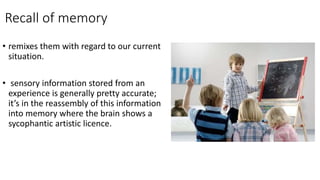
Recall of memory
• remixes them with regard to our current
situation.
• sensory information stored from an
experience is generally pretty accurate;
it’s in the reassembly of this information
into memory where the brain shows a
sycophantic artistic licence.
Strategies to cope with memory and recall
• Bare minimum
“drinking from a fire hose” Sheperd
• Repetition
• Understand – consider the meaning
• Contextualize
• Reflect
• Review
• Mnemonics
• Test
• Emotional
• Practical
• Relevant
• Put in practice
Maximize learner engagement
• “What’s in it for me?”
• Get their attention from the
start – and keep it
• Keep it relevant
• Encourage socializing
• Bring your session to life
• Focus on the learners
Mobile Learning
• the use of personal portable digital
devices to make us smarter wherever
and whenever we are.
• tablets, like pocket devices, are more
intimate, but they’re not immediate
like a pocket device:
Hubbard, Rob (2013-10-10). The Really Useful eLearning Instruction
Manual: Your toolkit for putting elearning into practice
4 C of Mobile learning
•content
•compute
•communicate and
•capture
From Handbook of Mobile Learning by Zane L.Berge and Lin Muilenburg.
Cognitivist Theories:
• Assimilation Theory (Ausubel)
• Attribution Theory (Weiner)
• Cognitive Load Theory (Sweller)
• Cognitive Theory of Multimedia Learning (Mayer)
• Component Display Theory
• Elaboration Theory (Reigeluth)
• Gestalt Psychology (Tolman)
• Mental Models (Johnson-Laird)
• Schema Theory
• Stage Theory of Cognitive Development (Piaget)
Behaviorist Theories
• Classical Conditioning (Pavlov)
• GOMS Model (Card, Moran, and Newell)
• Operant Conditioning (Skinner)
• Social Learning Theory (Bandura)
Constructivism
• Cognitive Apprenticeship (Collins et al.)
• Communities of Practice (Lave and Wenger)
• Discovery Learning (Bruner)
• Social Development Theory (Vygtosky)
• Problem-Based Learning (PBL)
• Situated Learning (Lave)
Humanism
• ARCS Model of Motivational Design (Keller)
• Emotional Intelligence (Goleman)
• Experiential Learning (Kolb)
• Maslow’s Hierarchy of Needs (Maslow)
• Self-Determination Theory (Deci and Ryan)
Design-Based
• ADDIE Model of Instructional Design
• ARCS Model of Motivational Design (Keller)
• Elaboration Theory (Reigeluth)
• Connectivity to information and to others
• 24/7 access to learning resources
• Greater choice over the time, place and pace of study
• Alternative modes of study: distance, blended, work-based,
partially or wholly campus-based
• Knowledge-sharing and co-authoring across multiple
locations
• Opportunities for reflection and planning in personal learning
spaces
• Rapid feedback on formative assessments
• More active learning by means of interactive technologies
and multimedia resources
• Participation in communities of knowledge, inquiry and
learning
• Learning by discovery in virtual worlds
• Development of skills for living and working in a digital age
When did digital learning begin
• October 1999, in a seminar run by a company called CBT Systems
(now SkillSoft). At that time, it was quite an innovation to place the
letter “e” in front of a verb to recognize the fact that here was an
exciting new application of the Internet.
Hubbard, Rob (2013-10-10). The Really Useful eLearning Instruction Manual: Your toolkit for putting
elearning into practice (Kindle Locations 199-201). Wiley. Kindle Edition.
Online learning resources.
• Web articles
• Videos
• Podcasts
• PDF files (useful when a document needs to be printed)
• Slide shows, perhaps with narration so they can stand alone without a
presenter
• Screencasts (simple software demos).
•
Common educational and training strategies
• Exposition
• Instruction
• Guided discovery
• Exploration
Buy or Build
Preparing digital learning project
Classification of Digital Learning Assets
Digital Learning Production roles
Production Process• Gathering Requirements
• High Level Design Specification
• Learning Design
• Visual Design
• Technical Specification
• Prototype/ Walkthrough/ User Testing
• Storyboard/ Interactive Script
• Asset Production
• Graphics and animation
• Audio
• Video
• Programming/ Authoring
• Testing (alpha, beta, gold)
• Final Delivery
• Deployment
• Review/ Evaluation.
Hubbard, Rob (2013-10-10). The Really Useful eLearning Instruction Manual: Your toolkit for putting eLearning into
practice .
What is learning ?
What is learning ?

What is learning ?

  • 1.
    Principles of Teachingand Learning MBBS(Mal),AM(Mal),FRCS(Ed),FRCS(Glasg),FICS(USA),MBA(USA), Dip Hand Surgery(Eur), Dip MedEd(Dundee), FHEA(UK), FFST(Ed), FAcadMEd(UK). Senior Consultant Hand Surgeon www.handsurgeryedu.com Dr Vaikunthan Rajaratnam
  • 2.
    Learning a process produces changes changesproduced are relatively permanent 3 domains of learning (Bloom) 1. Cognitive – To recall, calculate, discuss, analyze, problem solve, etc. 2. Psychomotor – To dance, swim, ski, dive, drive a car, ride a bike, etc. 3. Affective – To like something or someone, love, appreciate, fear, hate, worship, etc.
  • 4.
    Education and Training •Education has a much broader aim to develop an individual • training has a narrow aim to increase knowledge and skill in specific areas.
  • 5.
    Plato & Aristotle •“Is truth and knowledge to be found within us (rationalism) or is it to be found by using our senses to discover what is outside of ourselves (empiricism)?” • As a rationalist, Plato developed the belief that knowledge and truth can be discovered by self-reflection. Socrates also believed strongly that certain knowledge was only attainable through reason. He developed the dialectic method of discovering truth through conversations with fellow citizens (Monroe, 1925 • Aristotle, the empiricist, suggested that we use our senses to look for truth and knowledge in the world outside ourselves. • The Romans emphasized education as vocational training, rather than as training of the mind for the discovery of truth
  • 6.
    Brain & Mind •The brain is the organ of the mind just as the lungs are the organs for respiration • Cognition - sensory motor - ego -memory
  • 7.
    Brain and Mind •Cognition•Ego •Memory•Senses& Motor TEMPORO PARIETEAL LOBE HIPPOCAMPUS PREFRONTAL CORTEX DORSOLATERAL PREFRONTAL CORTEX
  • 8.
    Valcke, M., &De Wever, B. (2006). Information and communication technologies in higher education: evidence-based practices in medical education. Medical teacher, 28(1), 40–48.
  • 9.
    LISON, T., GUNTHER,S., OGORUL, Y., PRETSCHNER, D.P. & WISCHNESKY, M.B. (2004) Vision 2003: Virtual learning units for medical training and education, International Journal of Medical Information, 73, pp. 165–172.
  • 11.
    THE LEARNING PROCESS •PEOPLE LEARN IN DIFFERENT WAYS • THE BRAIN PLAYS A ROLE • BASED ON ASSOCIATIONS • OCCURS IN CULTURAL AND SOCIAL CONTEXTS • PEOPLE LEARN IN DIFFERENT WAYS • PEOPLE THINK ABOUT THEIR OWN LEARNING, AND THEIR FEELINGS MATTER
  • 12.
    Teaching • PROCESS OFORGANIZING THE ENVIRONMENT • F ORGANIZING KNOWLEDGE, INFORMATION, AND ACTIVITIES • PROCESS OF ORGANIZING PEOPLE
  • 13.
    Stimuli Identification RecallUnderstand Association Knowledge creation WIIFM Affective change Life change
  • 14.
  • 15.
    Memory people forget 90%of what they learn in the classroom after 30 days and that the majority of forgetting occurs in the first few hours Hermann Ebbinghaus •
  • 16.
    Drivers for attentionof the Brain • Fight and Flight • Food • Procreation http://alieninthecaribbean.blogspot.sg/2011/10/2012-survival-kit-fear-and-fighting.html
  • 17.
    Recall of memory •remixes them with regard to our current situation. • sensory information stored from an experience is generally pretty accurate; it’s in the reassembly of this information into memory where the brain shows a sycophantic artistic licence.
  • 18.
    Strategies to copewith memory and recall • Bare minimum “drinking from a fire hose” Sheperd • Repetition • Understand – consider the meaning • Contextualize • Reflect • Review • Mnemonics • Test • Emotional • Practical • Relevant • Put in practice
  • 27.
    Maximize learner engagement •“What’s in it for me?” • Get their attention from the start – and keep it • Keep it relevant • Encourage socializing • Bring your session to life • Focus on the learners
  • 28.
    Mobile Learning • theuse of personal portable digital devices to make us smarter wherever and whenever we are. • tablets, like pocket devices, are more intimate, but they’re not immediate like a pocket device: Hubbard, Rob (2013-10-10). The Really Useful eLearning Instruction Manual: Your toolkit for putting elearning into practice
  • 29.
    4 C ofMobile learning •content •compute •communicate and •capture From Handbook of Mobile Learning by Zane L.Berge and Lin Muilenburg.
  • 33.
    Cognitivist Theories: • AssimilationTheory (Ausubel) • Attribution Theory (Weiner) • Cognitive Load Theory (Sweller) • Cognitive Theory of Multimedia Learning (Mayer) • Component Display Theory • Elaboration Theory (Reigeluth) • Gestalt Psychology (Tolman) • Mental Models (Johnson-Laird) • Schema Theory • Stage Theory of Cognitive Development (Piaget)
  • 34.
    Behaviorist Theories • ClassicalConditioning (Pavlov) • GOMS Model (Card, Moran, and Newell) • Operant Conditioning (Skinner) • Social Learning Theory (Bandura)
  • 35.
    Constructivism • Cognitive Apprenticeship(Collins et al.) • Communities of Practice (Lave and Wenger) • Discovery Learning (Bruner) • Social Development Theory (Vygtosky) • Problem-Based Learning (PBL) • Situated Learning (Lave)
  • 36.
    Humanism • ARCS Modelof Motivational Design (Keller) • Emotional Intelligence (Goleman) • Experiential Learning (Kolb) • Maslow’s Hierarchy of Needs (Maslow) • Self-Determination Theory (Deci and Ryan)
  • 37.
    Design-Based • ADDIE Modelof Instructional Design • ARCS Model of Motivational Design (Keller) • Elaboration Theory (Reigeluth)
  • 41.
    • Connectivity toinformation and to others • 24/7 access to learning resources • Greater choice over the time, place and pace of study • Alternative modes of study: distance, blended, work-based, partially or wholly campus-based • Knowledge-sharing and co-authoring across multiple locations • Opportunities for reflection and planning in personal learning spaces • Rapid feedback on formative assessments • More active learning by means of interactive technologies and multimedia resources • Participation in communities of knowledge, inquiry and learning • Learning by discovery in virtual worlds • Development of skills for living and working in a digital age
  • 44.
    When did digitallearning begin • October 1999, in a seminar run by a company called CBT Systems (now SkillSoft). At that time, it was quite an innovation to place the letter “e” in front of a verb to recognize the fact that here was an exciting new application of the Internet. Hubbard, Rob (2013-10-10). The Really Useful eLearning Instruction Manual: Your toolkit for putting elearning into practice (Kindle Locations 199-201). Wiley. Kindle Edition.
  • 45.
    Online learning resources. •Web articles • Videos • Podcasts • PDF files (useful when a document needs to be printed) • Slide shows, perhaps with narration so they can stand alone without a presenter • Screencasts (simple software demos). •
  • 46.
    Common educational andtraining strategies • Exposition • Instruction • Guided discovery • Exploration
  • 48.
  • 49.
  • 50.
  • 51.
  • 52.
    Production Process• GatheringRequirements • High Level Design Specification • Learning Design • Visual Design • Technical Specification • Prototype/ Walkthrough/ User Testing • Storyboard/ Interactive Script • Asset Production • Graphics and animation • Audio • Video • Programming/ Authoring • Testing (alpha, beta, gold) • Final Delivery • Deployment • Review/ Evaluation. Hubbard, Rob (2013-10-10). The Really Useful eLearning Instruction Manual: Your toolkit for putting eLearning into practice .