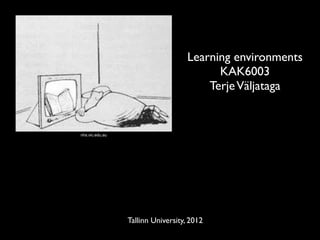
Learning environments
                                          KAK6003
                                        Terje Väljataga


nhs.vic.edu.au


                 Tallinn University, 2012
What is an environment?
What is a learning environment?
What is a virtual learning environment?
The use of technology in education tends to replicate
existing patterns, models and behaviors, where traditional
values, beliefs and practices prevail
environment = web/desktop-based tool or service?
Henry David Thoreau in 1854:
“Our inventions are wont to be pretty toys, which
distract our attention from serious things. They are
but improved means to an unimproved end, an end
which it was already but too easy to arrive at”
Feenberg (2003): “When you choose to use
technology you not simply render your existing way
of life more efficient, you choose a different way of
life”
Technology carries with it certain values, which
challenges and contradicts with traditional values
Tripathi (2006): “Technology transfer without
appropriate cultural transfer is not sufficient”
Technologies not only affect user behaviour, but also
wider social norms and structures
photo: T. Peterseil
photo: T. Peterseil
photo: T. Peterseil
www.shahariaazam.com


                       Personal learning environment
Downes (2007):

“The PLE is a recognition that the ‘one size fits all’
approach of the LMS will not be sufficient to meet the
varied needs of students“
PLE discourse can be interpreted as an expression of a
(Johnson et al., 2006) ...
 • ... desire for greater personal control & ownership of
    technology and learning
 • ... desire for more effective ways of managing
    technological tools, services & various other
    resources
 • ... desire for the integration of technologically
    mediated activities across all aspects of life
 • ... desire for a removal of barriers to the use and
    combination of tools and services
 • ... desire for mediated collaboration and co-creation
Two strands of thinking:
	

   - PLE as a technological solution
	

   - PLE as a broader concept
Downes (2007):

“...the key to understanding the PLE consists not in
understanding a particular type of technology so much as
in understanding the thinking that underlies the
concept...”
Attwell (2007):

“The development of Personal Learning Environments
represents a significant shift in pedagogic approaches to
how we support learning processes”
Moving from...

...a learning environment as an instructional condition,
which is assumed to be created by an instructional
designer

to...
an output of a learning process, designed by students
Moving from...

...a teacher - centered and controlled settings

to...
a learner controlled learning experiences
A potential personal learning environment ...


                          ... is made of all the
                          resources “that an individual
                          is aware of and has access
                          to…at a given point in time
                          in connection with a specific
                          learning project (Fiedler &
                          Pata, 2009)


     photo: S. Anderson
Personal learning contract procedure...


                             ... is a systematic vehicle for
                             driving through one’s learning
                             experience providing a
                             framework for structuring
                             learning activities (Harri-
                             Augstein & Cameron-Webb,
                             1996) and its perceived
                             environment

                             ... is a negotiated agreement
                             about what and how the
                             learner will learn and how that
photo: R. vand der Steeg


                             learning will be measured
                             (Boak, 1998)
Learning contract template


Topic               What is the topic I wish to learn about?


Purpose             What is the purpose of my task? Why do I wish to learn about?


                    What kind of technological, material and human resources do I
Resources
                    need? How can I get access to these?

                    How do I intend to go about learning this particular topic/task?
Strategy
                    What action may be involved and in what order?

                   How will I know when I have completed the task/topic
Outcome evaluation
                   successfully? How shall I judge success?

                    How well did I do? What remains to be learnt? Why? What are
Reflection
                    my strengths and what are my weaknesses? What shall I do next?
BYOD - bring your own device
Potential problems (R. Faas)

- uneven education
- school’s limited budget for IT staff and for supporting a
wide range of devices
- school’s regulations regarding Internet filtering and content
blocking
- schools tend to standardize on technology
- incompatibility, uneven access in terms of platforms
- teachers as unofficial technology support
What does your environment look like?
Assignment (learning environment):
- think of a learning task and fill in the learning contract
template
- map your personal learning environment (can be a
schemes, text, pictures, etc.) according to the learning
task
Thank you for your attention!

           Dr. Terje Väljataga

            Tallinn University
    Centre for Educational Technology
                  Estonia
         terje.valjataga@tlu.ee
         http://terjevaljataga.eu

Kak6003

  • 1.
    Learning environments KAK6003 Terje Väljataga nhs.vic.edu.au Tallinn University, 2012
  • 2.
    What is anenvironment?
  • 3.
    What is alearning environment?
  • 4.
    What is avirtual learning environment?
  • 5.
    The use oftechnology in education tends to replicate existing patterns, models and behaviors, where traditional values, beliefs and practices prevail
  • 6.
  • 8.
    Henry David Thoreauin 1854: “Our inventions are wont to be pretty toys, which distract our attention from serious things. They are but improved means to an unimproved end, an end which it was already but too easy to arrive at”
  • 9.
    Feenberg (2003): “Whenyou choose to use technology you not simply render your existing way of life more efficient, you choose a different way of life” Technology carries with it certain values, which challenges and contradicts with traditional values Tripathi (2006): “Technology transfer without appropriate cultural transfer is not sufficient” Technologies not only affect user behaviour, but also wider social norms and structures
  • 10.
  • 11.
  • 12.
  • 13.
    www.shahariaazam.com Personal learning environment
  • 14.
    Downes (2007): “The PLEis a recognition that the ‘one size fits all’ approach of the LMS will not be sufficient to meet the varied needs of students“
  • 15.
    PLE discourse canbe interpreted as an expression of a (Johnson et al., 2006) ... • ... desire for greater personal control & ownership of technology and learning • ... desire for more effective ways of managing technological tools, services & various other resources • ... desire for the integration of technologically mediated activities across all aspects of life • ... desire for a removal of barriers to the use and combination of tools and services • ... desire for mediated collaboration and co-creation
  • 16.
    Two strands ofthinking: - PLE as a technological solution - PLE as a broader concept
  • 17.
    Downes (2007): “...the keyto understanding the PLE consists not in understanding a particular type of technology so much as in understanding the thinking that underlies the concept...”
  • 18.
    Attwell (2007): “The developmentof Personal Learning Environments represents a significant shift in pedagogic approaches to how we support learning processes”
  • 19.
    Moving from... ...a learningenvironment as an instructional condition, which is assumed to be created by an instructional designer to... an output of a learning process, designed by students
  • 20.
    Moving from... ...a teacher- centered and controlled settings to... a learner controlled learning experiences
  • 21.
    A potential personallearning environment ... ... is made of all the resources “that an individual is aware of and has access to…at a given point in time in connection with a specific learning project (Fiedler & Pata, 2009) photo: S. Anderson
  • 22.
    Personal learning contractprocedure... ... is a systematic vehicle for driving through one’s learning experience providing a framework for structuring learning activities (Harri- Augstein & Cameron-Webb, 1996) and its perceived environment ... is a negotiated agreement about what and how the learner will learn and how that photo: R. vand der Steeg learning will be measured (Boak, 1998)
  • 23.
    Learning contract template Topic What is the topic I wish to learn about? Purpose What is the purpose of my task? Why do I wish to learn about? What kind of technological, material and human resources do I Resources need? How can I get access to these? How do I intend to go about learning this particular topic/task? Strategy What action may be involved and in what order? How will I know when I have completed the task/topic Outcome evaluation successfully? How shall I judge success? How well did I do? What remains to be learnt? Why? What are Reflection my strengths and what are my weaknesses? What shall I do next?
  • 24.
    BYOD - bringyour own device
  • 25.
    Potential problems (R.Faas) - uneven education - school’s limited budget for IT staff and for supporting a wide range of devices - school’s regulations regarding Internet filtering and content blocking - schools tend to standardize on technology - incompatibility, uneven access in terms of platforms - teachers as unofficial technology support
  • 26.
    What does yourenvironment look like?
  • 27.
    Assignment (learning environment): -think of a learning task and fill in the learning contract template - map your personal learning environment (can be a schemes, text, pictures, etc.) according to the learning task
  • 28.
    Thank you foryour attention! Dr. Terje Väljataga Tallinn University Centre for Educational Technology Estonia terje.valjataga@tlu.ee http://terjevaljataga.eu