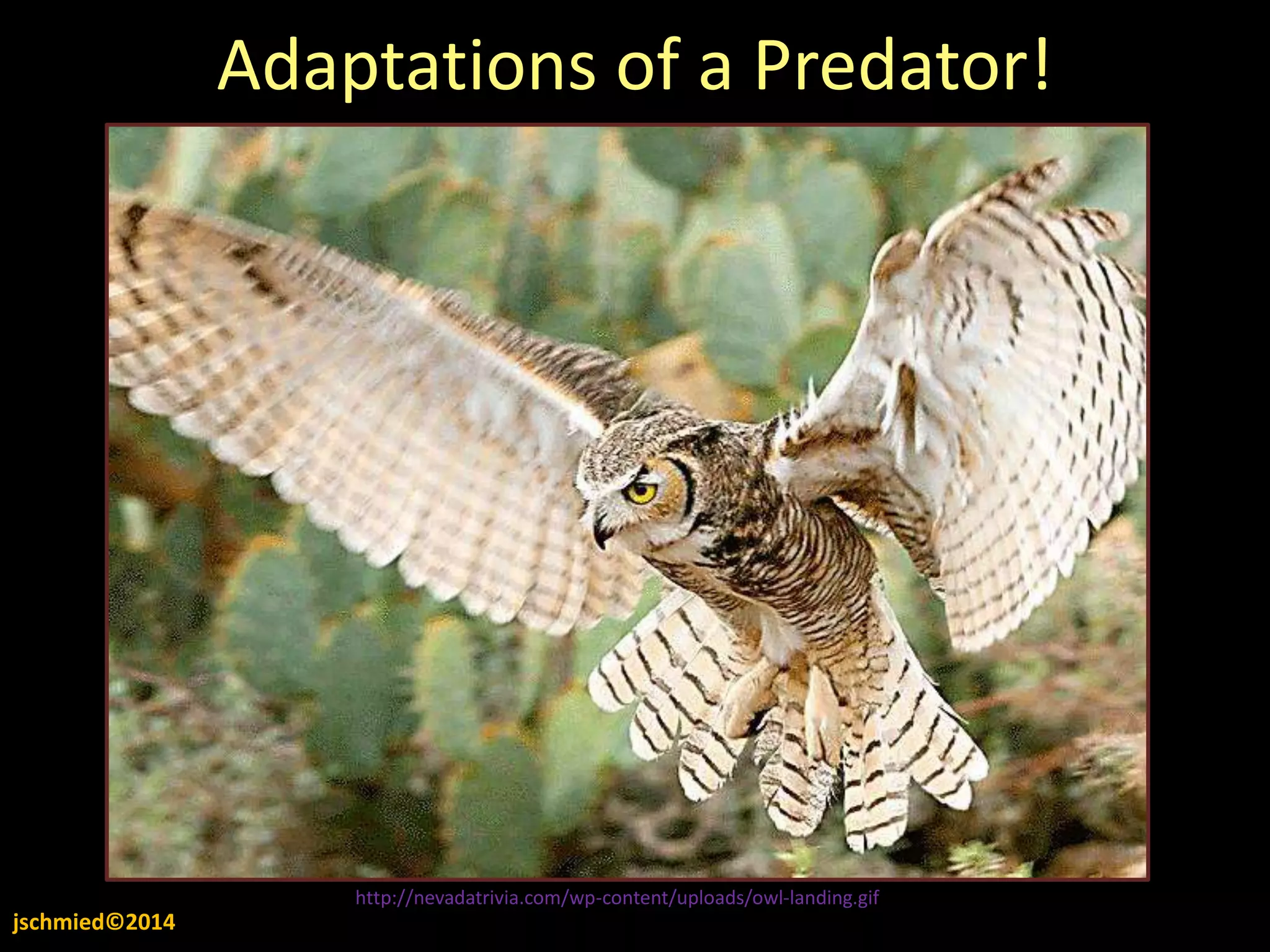
Evolutionary Adaptations of a Predator!
jschmied©2014
What is the Basic Process of Evolution?
The basic theory of evolution is surprisingly simple. It has three key parts:
jschmied©2015
1. It is possible for the DNA of an organism to occasionally change, or mutate.
A mutation changes the DNA of an organism in a way that affects its offspring, either
immediately or several generations down the line.
2. The change brought about by a mutation is either beneficial, harmful or neutral.
• If the change is harmful, then it is not likely the offspring will survive to reproduce, so
the mutation dies out.
• If the change is beneficial, then it is likely that the offspring will do better than other
offspring and so will reproduce more. This is called an Adaptation.
• Through reproduction, the beneficial mutation spreads. The process of culling bad
mutations and spreading good mutations is called natural selection.
3. As mutations occur & spread over long periods of time new species form.
Over the course of many millions of years, the processes of mutation and natural
selection have created every species of life we see in the world today, from the simplest
bacteria to humans and everything in between.
This owl eats small
mammals, small to
medium sized birds,
reptiles, larger
insects, and
amphibians, lizards,
frogs, earthworms,
and insects
What Evolutionary Adaptations make an owl a
good predator?
jschmied©2014
guardiansofgahoole.wikia.com
Evolutionary Adaption #1 : Keen Eyesight
jschmied©2014
Evolutionary Adaption #1 :
Extraordinary eyesight - binocular & night vision
jschmied©2014
Evolutionary Adaption #2 : Twist head 270 degrees
http://www.ctvnews.ca/sci-tech/mystery-revealed-of-how-owls-can-spin-their-heads-1.1138959
jschmied©2014
Evolutionary Adaption #2 : Twist head 270 degrees
http://www.ctvnews.ca/sci-tech/mystery-revealed-of-how-owls-can-spin-their-heads-1.1138959jschmied©2014
Evolutionary Adaption #3 :
Protective Nictating Membrane
jschmied©2014
Evolutionary Adaption #4 : Directional Hearing
jschmied©2014
Evolutionary Adaption #4 : Hearing - is acute
jschmied©2014
Evolutionary
Adaption #5:
Silent Flight
jschmied©2014
Evolutionary Adaption #5 : Silent Flight
jschmied©2014
http://eyes4earth.org/eagle-owl-in-action/
Evolutionary Adaption #6 : Grasping Talons
jschmied©2014
http://www.richmondaudubon.org/PhotosSawwhet1.html
Evolutionary Adaption #6 : Grasping Talons
jschmied©2014
jschmied©2014
Evolutionary Adaption #7 : Hooked Beak
jschmied©2014
Evolutionary Adaption #8 :
Large, Strechy Mouth & Esophagus
All owls are fierce Predators
http://www.environmentalgraffiti.com/news-pictures-owls-their-prey?image=5jschmied©2014
Hunting for Prey – Barn Owl
jschmied©2014 http://www.sandralamarche.com/owlivia/OwlsFoodLodging.htm
http://www.owlpages.com/articles.php?section=owl+physiology&title=Food
Wide Variety of Prey: A Vole.
jschmied©2015
Wide Variety of Prey: A Shrew.
jschmied©2015
jschmied©2015
Wide Variety of Prey: A Lemming.
jschmied©2014
Silent Approach!!
Taking
prey to a
safe perch
jschmied©2014
jschmied©2014
Preps food
to eat!
Head first!
jschmied©2014
http://www.arkive.org/barn-owl/tyto-alba/video-08.html
jschmied©2014
After Digestion –bones & fur come up as a pellet!
http://www.arkive.org/barn-owl/tyto-alba/video-08.html
jschmied©2014
Many other birds use the same process:
http://www.pbase.com/jitams/image/11949764
7
http://1.bp.blogspot.com/_e90BZyiQ-Ro/S5Ss94PTmYI/AAAAAAAAClA/d_-W22BNC2I/s400/Laysan+Albatross+%26+chick+sm.jpg
Belted Kingfisher
Laysan Albatross
Prey Selection Varies by owl & availability
Northern Saw Whet Owl
http://www.ecologyedu.com/ecology_education_resources/owls_of_new_jersey/northern_saw_whet_owl_fact_sheet.html
http://www.owling.com/saw-whet8.htm
jschmied©2014
Prey Selection Varies by owl & availability
Great Horned Owl
http://www.ecologyedu.com/ecology_education_resources/owls_of_new_jersey/great_horned_owl_fact_sheet.html
guardiansofgahoole.wikia.comjschmied©2014
Food Webs – The rest of the story
Food webs are often simplified
A predator’s prey varies with the time of the year,
weather, & available food .
Compare this food web to the data below:
Great Horned Owl’s really eat:
• Over 253 species of prey: Spiders, insects,
crayfish, fish, frogs, salamanders, snakes, turtles,
ducks, herons, pheasants, geese, rabbits, rats,
mice, voles, skunks, opossum, muskrats &
woodchucks.
• Great Horned Owls mostly feed on:
Rabbits, hares, squirrels, rats and muskrats.
• Great Horned Owls prey on other owls
Barred Owls, Barn Owls, Screech Owls,
Saw-whet Owls, but not Snowy Owls.
http://www.ecologyedu.com/ecology_education_resources/owls_of_new_jersey/great_horned_owl_fact_sheet.html
http://mrsmaine.wikispaces.com/Southeast+1
2. I can show & analyze flows of matter
& energy in an ecosystem using an
energy pyramid, food web or matter cycler.
jschmied©2014
Act 78 – Coughing up Clues
Step One: Dissect pellet
Step Two:Organize bones for glue downs
Step Three: Glue Down One Skeleton
on Index Card (draw missing parts)
Step Four: Glue Down rest on Bone Chart
Step Five: Clean Up
Step Six: Get Instructor’s Check Off (both)
Step Seven: Finish all Lab Questions
jschmied©2014
Act 78 – Coughing up Clues Step One - Dissect
jschmied©2014
Act 78 – Coughing up Clues Step Two - Organize
jschmied©2014
Act 78 – Coughing up Clues
Step Three – Glue Down/ Skeleton on Index Card,
Draw missing parts
jschmied©2014
Act 78 – Coughing up Clues
Step Four : Glue Down the rest
jschmied©2014
Act 78 – Coughing up Clues
Step One: Dissect pellet
Step Two:Organize bones for glue downs
Step Three: Glue Down One Skeleton
on Index Card (draw missing parts)
Step Four: Glue Down rest on Bone Chart
Step Five: Clean Up
Step Six: Get Instructor’s Check Off (both)
Step Seven: Finish all Lab Questions
jschmied©2014
jschmied©2014
A Snowy Owl - Silent and Deadly
jschmied©2015jschmied©2015

Owl adaptations & Food Webs present

  • 1.
    Evolutionary Adaptations ofa Predator! jschmied©2014
  • 2.
    What is theBasic Process of Evolution? The basic theory of evolution is surprisingly simple. It has three key parts: jschmied©2015 1. It is possible for the DNA of an organism to occasionally change, or mutate. A mutation changes the DNA of an organism in a way that affects its offspring, either immediately or several generations down the line. 2. The change brought about by a mutation is either beneficial, harmful or neutral. • If the change is harmful, then it is not likely the offspring will survive to reproduce, so the mutation dies out. • If the change is beneficial, then it is likely that the offspring will do better than other offspring and so will reproduce more. This is called an Adaptation. • Through reproduction, the beneficial mutation spreads. The process of culling bad mutations and spreading good mutations is called natural selection. 3. As mutations occur & spread over long periods of time new species form. Over the course of many millions of years, the processes of mutation and natural selection have created every species of life we see in the world today, from the simplest bacteria to humans and everything in between.
  • 3.
    This owl eatssmall mammals, small to medium sized birds, reptiles, larger insects, and amphibians, lizards, frogs, earthworms, and insects What Evolutionary Adaptations make an owl a good predator? jschmied©2014
  • 4.
  • 5.
    Evolutionary Adaption #1: Extraordinary eyesight - binocular & night vision jschmied©2014
  • 6.
    Evolutionary Adaption #2: Twist head 270 degrees http://www.ctvnews.ca/sci-tech/mystery-revealed-of-how-owls-can-spin-their-heads-1.1138959 jschmied©2014
  • 7.
    Evolutionary Adaption #2: Twist head 270 degrees http://www.ctvnews.ca/sci-tech/mystery-revealed-of-how-owls-can-spin-their-heads-1.1138959jschmied©2014
  • 8.
    Evolutionary Adaption #3: Protective Nictating Membrane jschmied©2014
  • 9.
    Evolutionary Adaption #4: Directional Hearing jschmied©2014
  • 10.
    Evolutionary Adaption #4: Hearing - is acute jschmied©2014
  • 11.
  • 12.
    Evolutionary Adaption #5: Silent Flight jschmied©2014
  • 13.
  • 14.
  • 15.
  • 16.
    jschmied©2014 Evolutionary Adaption #8: Large, Strechy Mouth & Esophagus
  • 17.
    All owls arefierce Predators http://www.environmentalgraffiti.com/news-pictures-owls-their-prey?image=5jschmied©2014
  • 18.
    Hunting for Prey– Barn Owl jschmied©2014 http://www.sandralamarche.com/owlivia/OwlsFoodLodging.htm
  • 19.
  • 20.
    Wide Variety ofPrey: A Shrew. jschmied©2015
  • 21.
  • 22.
  • 23.
    Taking prey to a safeperch jschmied©2014
  • 24.
  • 25.
  • 26.
  • 27.
    http://www.arkive.org/barn-owl/tyto-alba/video-08.html jschmied©2014 Many other birdsuse the same process: http://www.pbase.com/jitams/image/11949764 7 http://1.bp.blogspot.com/_e90BZyiQ-Ro/S5Ss94PTmYI/AAAAAAAAClA/d_-W22BNC2I/s400/Laysan+Albatross+%26+chick+sm.jpg Belted Kingfisher Laysan Albatross
  • 28.
    Prey Selection Variesby owl & availability Northern Saw Whet Owl http://www.ecologyedu.com/ecology_education_resources/owls_of_new_jersey/northern_saw_whet_owl_fact_sheet.html http://www.owling.com/saw-whet8.htm jschmied©2014
  • 29.
    Prey Selection Variesby owl & availability Great Horned Owl http://www.ecologyedu.com/ecology_education_resources/owls_of_new_jersey/great_horned_owl_fact_sheet.html guardiansofgahoole.wikia.comjschmied©2014
  • 30.
    Food Webs –The rest of the story Food webs are often simplified A predator’s prey varies with the time of the year, weather, & available food . Compare this food web to the data below: Great Horned Owl’s really eat: • Over 253 species of prey: Spiders, insects, crayfish, fish, frogs, salamanders, snakes, turtles, ducks, herons, pheasants, geese, rabbits, rats, mice, voles, skunks, opossum, muskrats & woodchucks. • Great Horned Owls mostly feed on: Rabbits, hares, squirrels, rats and muskrats. • Great Horned Owls prey on other owls Barred Owls, Barn Owls, Screech Owls, Saw-whet Owls, but not Snowy Owls. http://www.ecologyedu.com/ecology_education_resources/owls_of_new_jersey/great_horned_owl_fact_sheet.html http://mrsmaine.wikispaces.com/Southeast+1 2. I can show & analyze flows of matter & energy in an ecosystem using an energy pyramid, food web or matter cycler. jschmied©2014
  • 31.
    Act 78 –Coughing up Clues Step One: Dissect pellet Step Two:Organize bones for glue downs Step Three: Glue Down One Skeleton on Index Card (draw missing parts) Step Four: Glue Down rest on Bone Chart Step Five: Clean Up Step Six: Get Instructor’s Check Off (both) Step Seven: Finish all Lab Questions jschmied©2014
  • 32.
    Act 78 –Coughing up Clues Step One - Dissect jschmied©2014
  • 33.
    Act 78 –Coughing up Clues Step Two - Organize jschmied©2014
  • 34.
    Act 78 –Coughing up Clues Step Three – Glue Down/ Skeleton on Index Card, Draw missing parts jschmied©2014
  • 35.
    Act 78 –Coughing up Clues Step Four : Glue Down the rest jschmied©2014
  • 36.
    Act 78 –Coughing up Clues Step One: Dissect pellet Step Two:Organize bones for glue downs Step Three: Glue Down One Skeleton on Index Card (draw missing parts) Step Four: Glue Down rest on Bone Chart Step Five: Clean Up Step Six: Get Instructor’s Check Off (both) Step Seven: Finish all Lab Questions jschmied©2014
  • 37.
    jschmied©2014 A Snowy Owl- Silent and Deadly
  • 38.