Evolution
Unit Notes
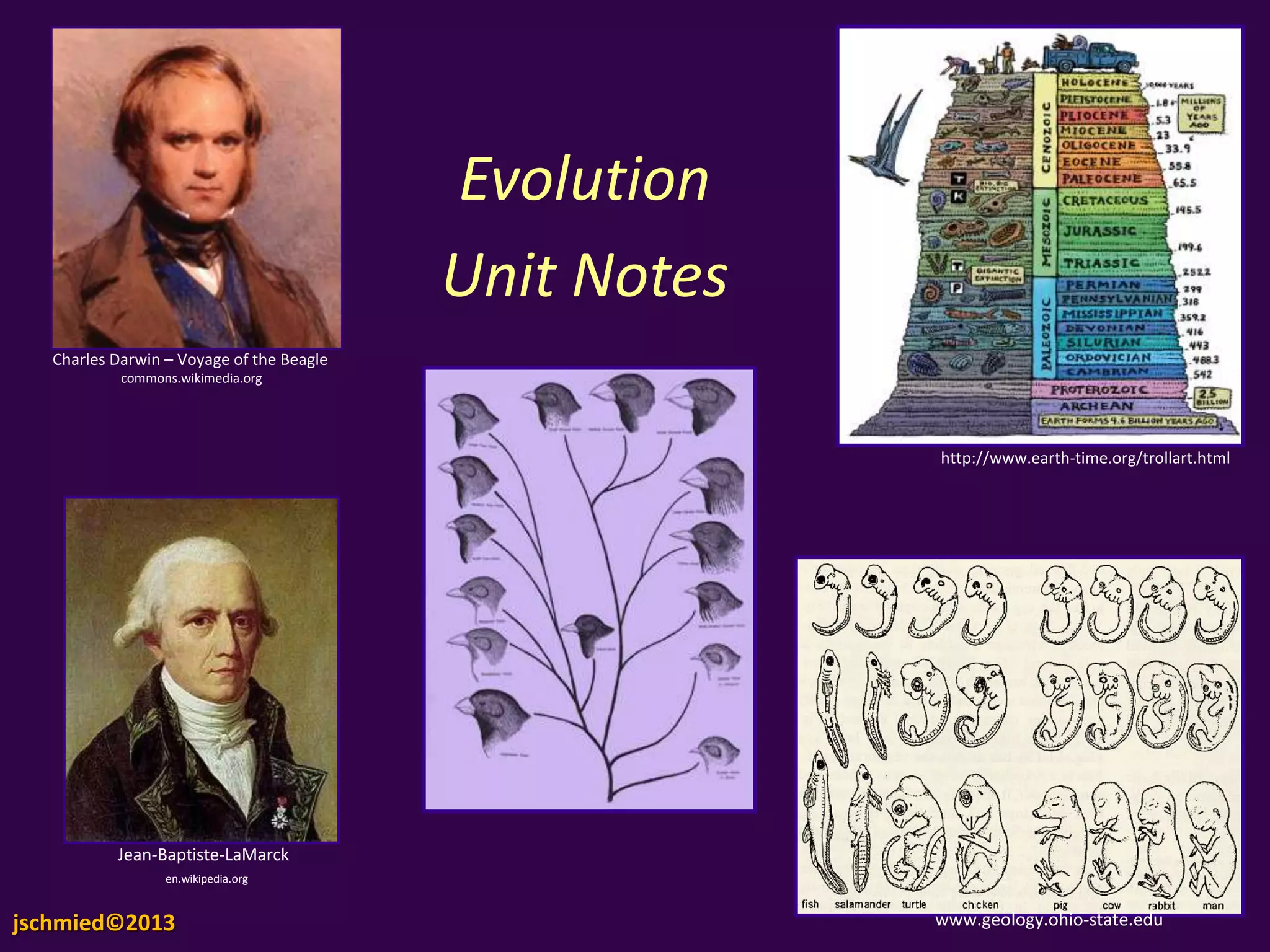
Charles Darwin – Voyage of the Beagle
commons.wikimedia.org
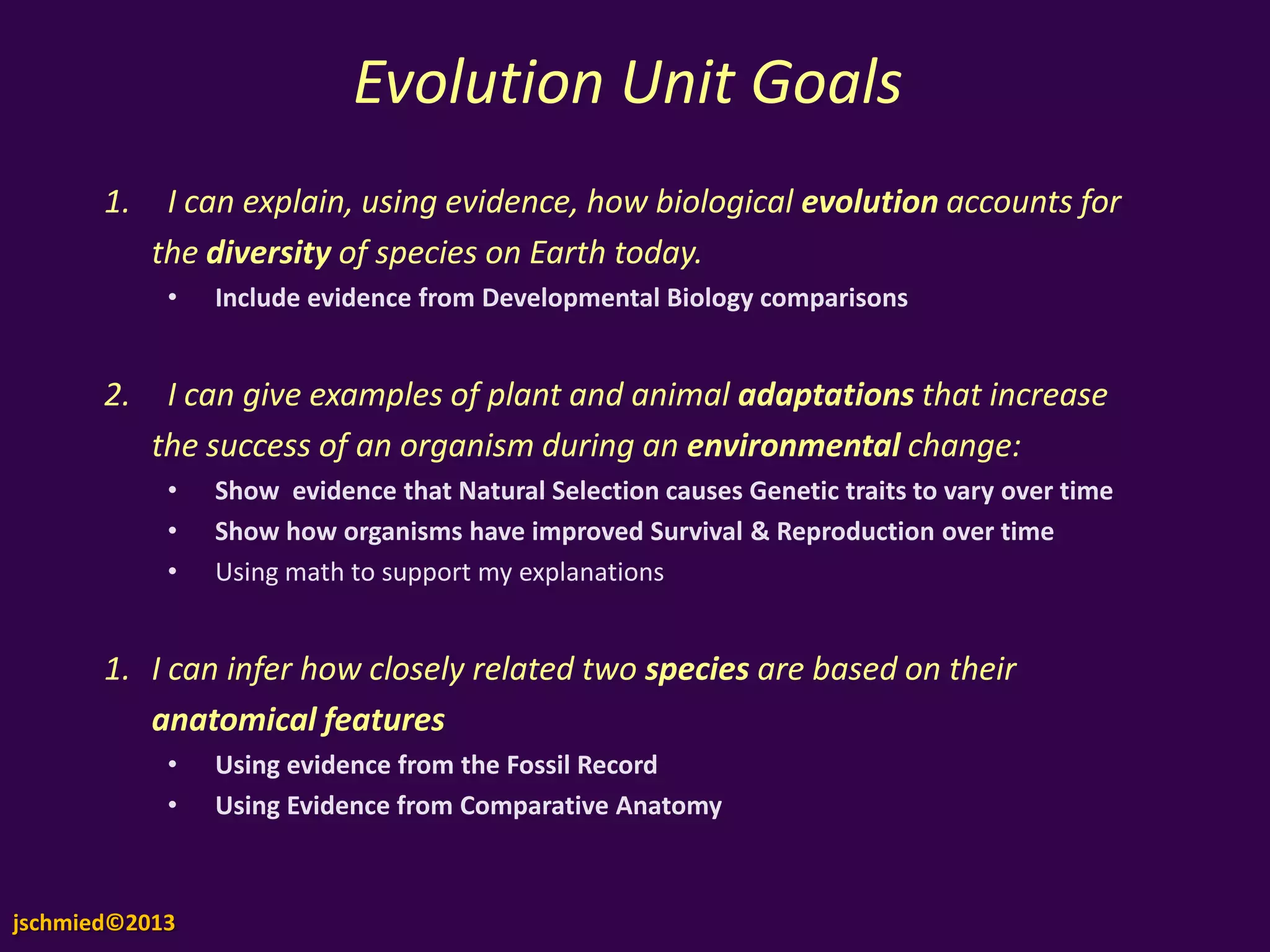
http://www.earth-time.org/trollart.html
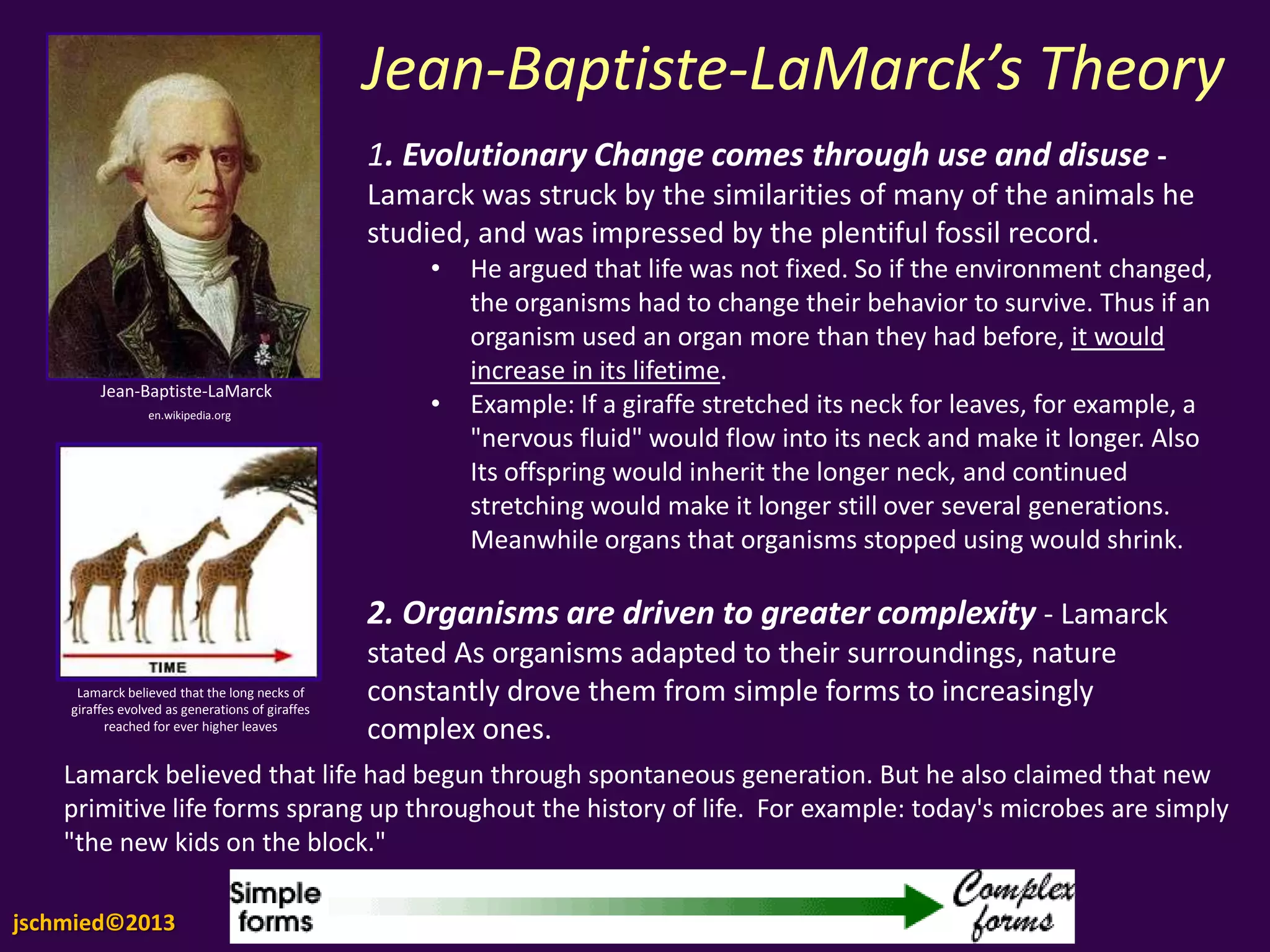
www.geology.ohio-state.edu
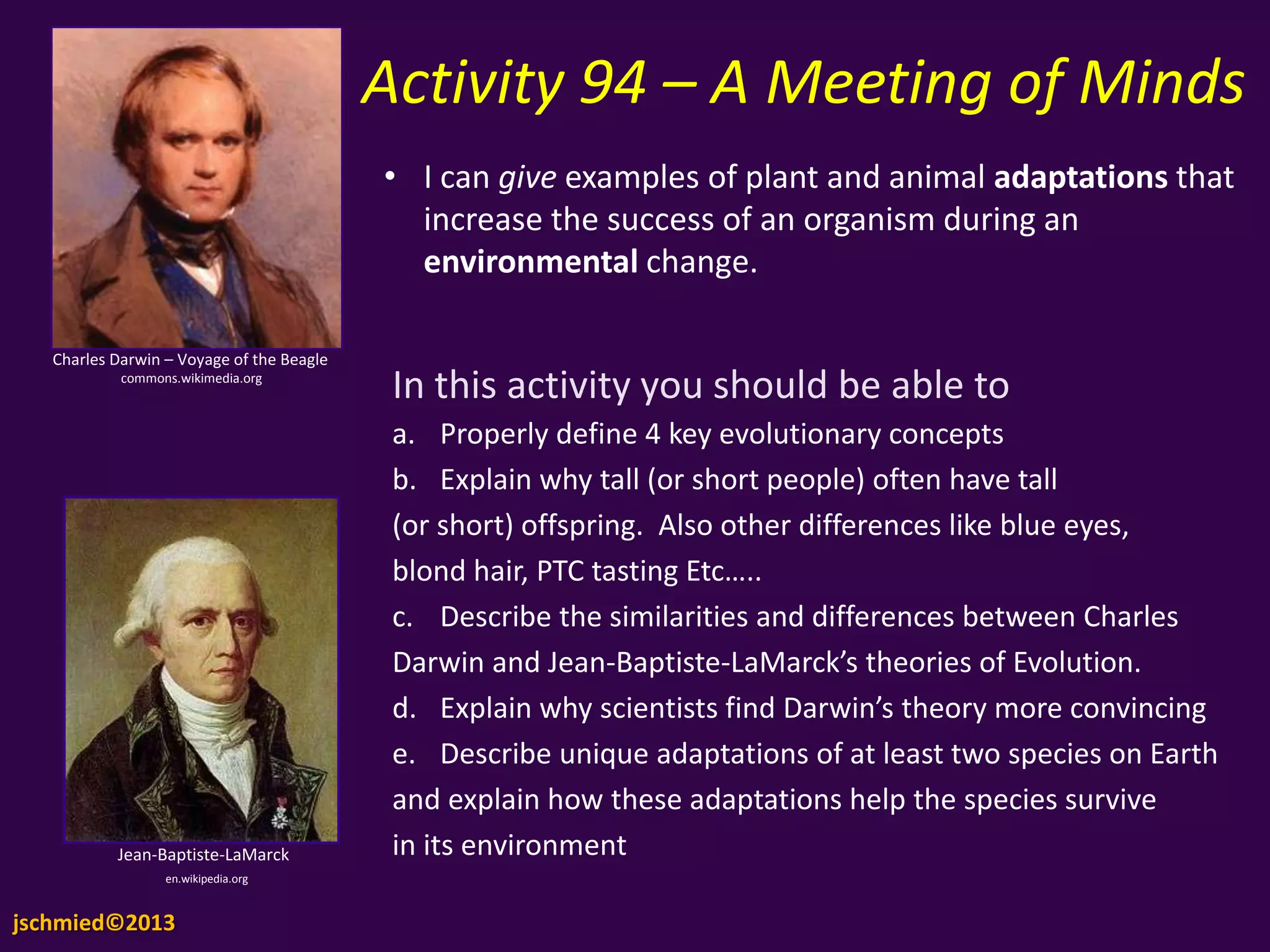
Jean-Baptiste-LaMarck
en.wikipedia.org
jschmied©2013
Evolution Unit
Goals1. I can explain, using evidence, how biological evolution
accounts for the diversity of species on Earth today.
• Include evidence from Developmental Biology comparisons
2. I can give examples of plant and animal adaptations that
increase the success of an organism during an environmental
change:
• Show evidence that Natural Selection causes Genetic traits to vary over
time
• Show how organisms have improved Survival & Reproduction over time
• Using math to support my explanations
1. I can infer how closely related two species are based on their
anatomical features
• Using evidence from the Fossil Record
• Using Evidence from Comparative Anatomy
jschmied©2013
Activity 94 – A Meeting of
Minds
Charles Darwin – Voyage of the Beagle
commons.wikimedia.org
Jean-Baptiste-LaMarck
en.wikipedia.org
• I can give examples of plant and animal adaptations
that increase the success of an organism during an
environmental change.
In this activity you should be able to
a. Properly define 4 key evolutionary concepts
b. Explain why tall (or short people) often have tall
(or short) offspring. Also other differences like blue eyes,
blond hair, PTC tasting Etc…..
c. Describe the similarities and differences between Charles
Darwin and Jean-Baptiste-LaMarck’s theories of Evolution.
d. Explain why scientists find Darwin’s theory more convincin
e. Describe unique adaptations of at least two species on Earth
and explain how these adaptations help the species survive
in its environment
jschmied©2013
Jean-Baptiste-LaMarck’s Theory
Jean-Baptiste-LaMarck
en.wikipedia.org
1. Evolutionary Change comes through use and disuse
- Lamarck was struck by the similarities of many of the
animals he studied, and was impressed by the plentiful
fossil record.
• He argued that life was not fixed. So if the environment
changed, the organisms had to change their behavior to
survive. Thus if an organism used an organ more than they
had before, it would increase in its lifetime.
• Example: If a giraffe stretched its neck for leaves, for
example, a "nervous fluid" would flow into its neck and
make it longer. Also Its offspring would inherit the longer
neck, and continued stretching would make it longer still
over several generations. Meanwhile organs that organisms
stopped using would shrink.2. Organisms are driven to greater complexity -
Lamarck stated As organisms adapted to their
surroundings, nature constantly drove them from simple
forms to increasingly complex ones.
Lamarck believed that life had begun through spontaneous generation. But he also claimed
that new primitive life forms sprang up throughout the history of life. For example: today's
microbes are simply "the new kids on the block."
Lamarck believed that the long necks of
giraffes evolved as generations of giraffes
reached for ever higher leaves
jschmied©2013
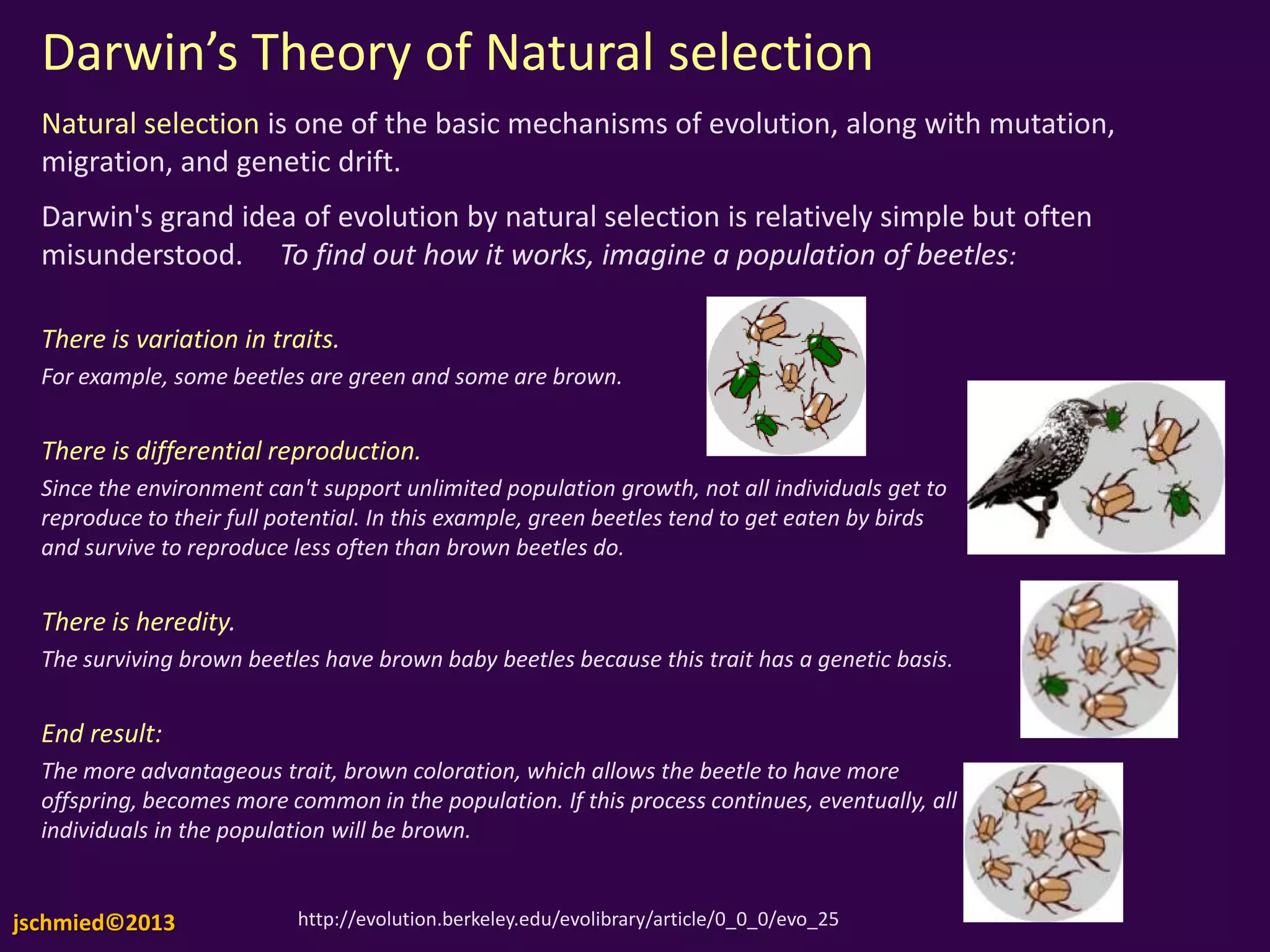
There is variation in traits.
For example, some beetles are green and some are brown.
There is differential reproduction.
Since the environment can't support unlimited population growth, not all individuals get to
reproduce to their full potential. In this example, green beetles tend to get eaten by birds and
survive to reproduce less often than brown beetles do.
There is heredity.
The surviving brown beetles have brown baby beetles because this trait has a genetic basis.
End result:
The more advantageous trait, brown coloration, which allows the beetle to have more
offspring, becomes more common in the population. If this process continues, eventually, all
individuals in the population will be brown.
http://evolution.berkeley.edu/evolibrary/article/0_0_0/evo_25
Darwin’s Theory of Natural selection
Natural selection is one of the basic mechanisms of evolution, along with
mutation, migration, and genetic drift.
Darwin's grand idea of evolution by natural selection is relatively simple but
often misunderstood. To find out how it works, imagine a population of beetles:
jschmied©2013
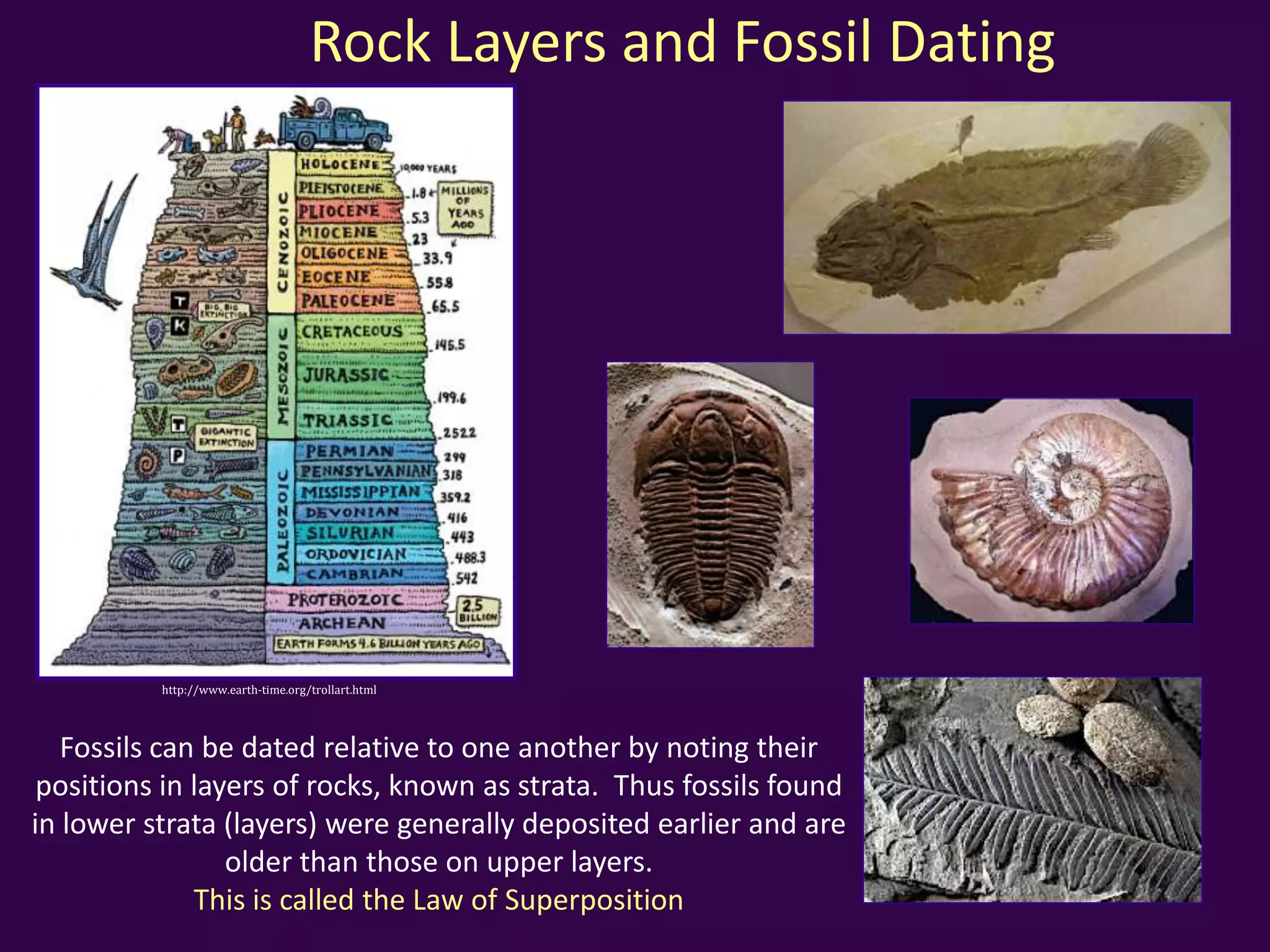
http://www.earth-time.org/trollart.html
Fossils can be dated relative to one another by noting their
positions in layers of rocks, known as strata. Thus fossils
found in lower strata (layers) were generally deposited
earlier and are older than those on upper layers.
This is called the Law of Superposition
Rock Layers and Fossil Dating
Fossil Types for our Core Samples
Ammonit
e
Trilobite
Elrathi kingi
Knightia
Fern
Alethopteris serii
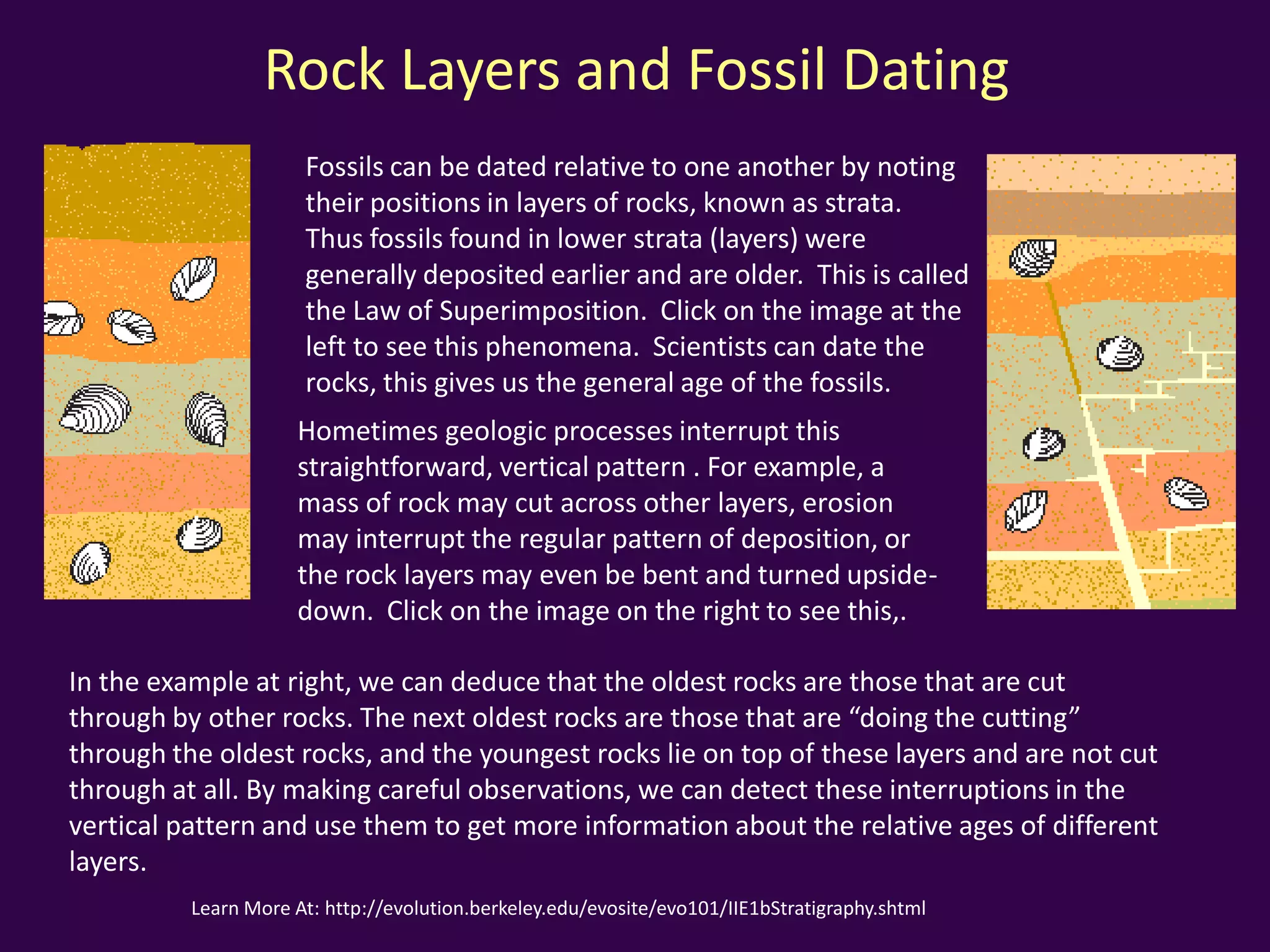
Fossils can be dated relative to one another by
noting their positions in layers of rocks, known as
strata. Thus fossils found in lower strata (layers)
were generally deposited earlier and are older.
This is called the Law of Superposition. Click on
the image at the left to see this phenomena.
Scientists can date the rocks, this gives us the
general age of the fossils.
In the example at right, we can deduce that the oldest rocks are those that are cut
through by other rocks. The next oldest rocks are those that are “doing the
cutting” through the oldest rocks, and the youngest rocks lie on top of these layers
and are not cut through at all. By making careful observations, we can detect these
interruptions in the vertical pattern and use them to get more information about
the relative ages of different layers.
Sometimes geologic processes interrupt this
straightforward, vertical pattern . For
example, a mass of rock may cut across other
layers, erosion may interrupt the regular
pattern of deposition, or the rock layers may
even be bent and turned upside-down. Click on
the image on the right to see this,.
Rock Layers and Fossil Dating
Learn More At: http://evolution.berkeley.edu/evosite/evo101/IIE1bStratigraphy.shtml
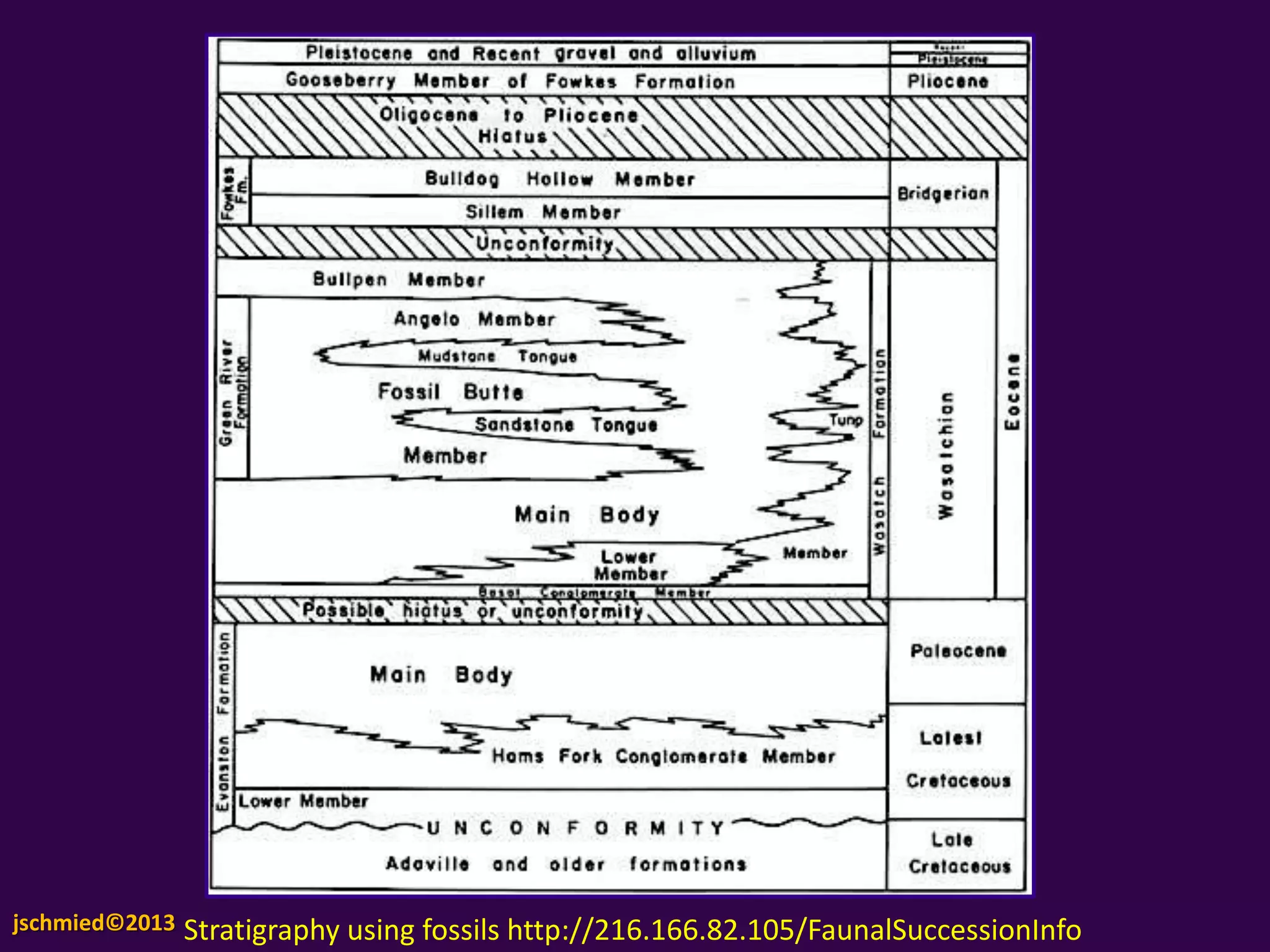
Stratigraphy using fossils http://216.166.82.105/FaunalSuccessionInfojschmied©2013
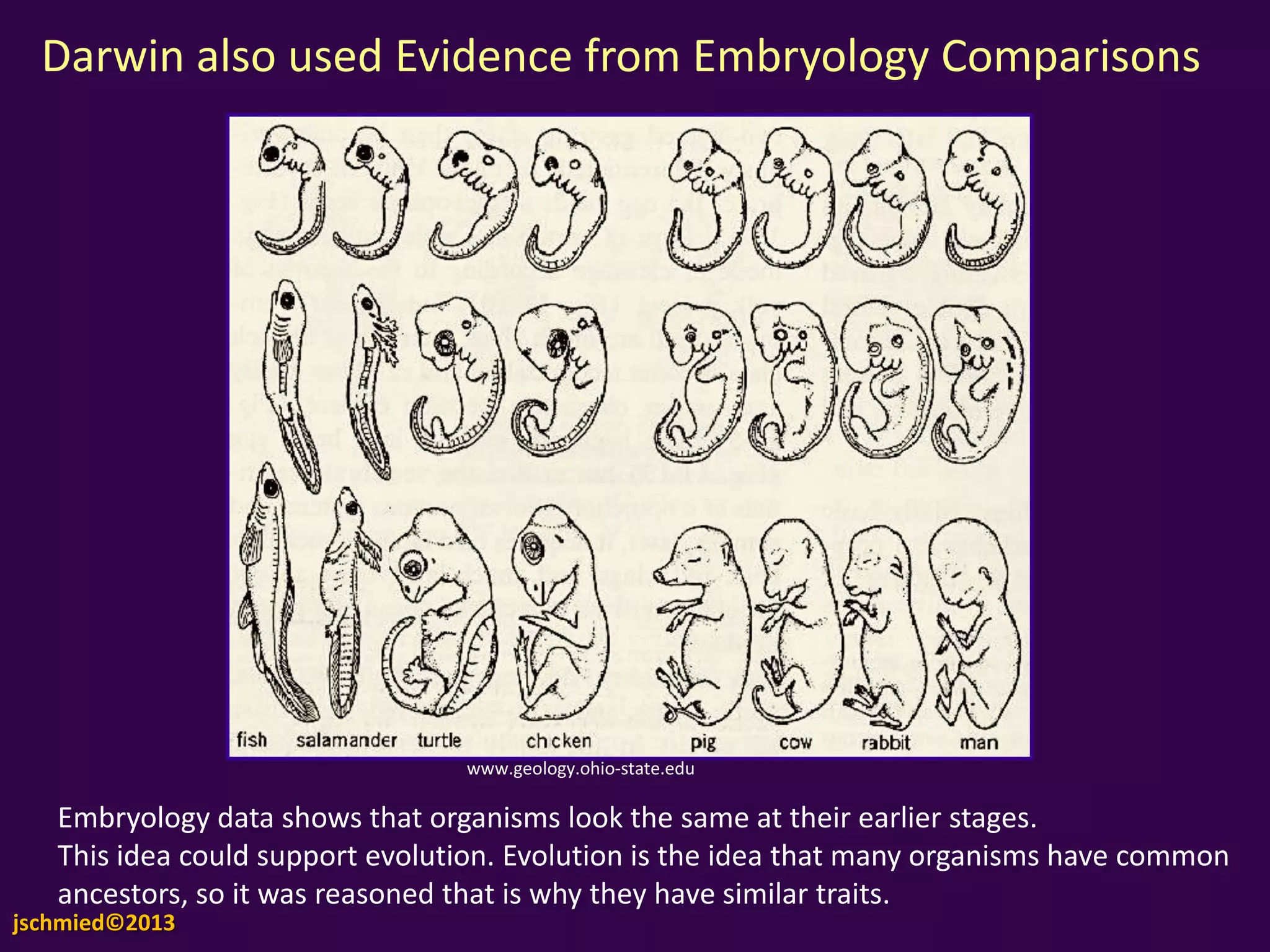
Darwin also used Evidence from Embryology
Comparisons
www.geology.ohio-state.edu
Embryology data shows that organisms look the same at their earlier stages.
This idea could support evolution. Evolution is the idea that many organisms have
common ancestors, so it was reasoned that is why they have similar traits.
jschmied©2013
Mutations:
jschmied©2013
Beneficial Mutations
Genetic variant in cows
produces more milk.
Sickle cell anemia in red
blood cells wards off
malaria.
Harmful Mutations
Heart Disease Mutation
produces high amounts of
heart diseas
Neurological Disorder in
Golden Retrievers caused by
mutation in mitochondrial
DNA
Adaptations:
jschmied©2013
Adaptations:
jschmied©2013
The evolution of
whales!
http://evolution.berkeley.edu
/evolibrary/article/evograms
_03:
jschmied©2013
The evolution of whales
The first thing to notice
on this evogram is that
hippos are the closest
living relatives of
whales, but they are not
the ancestors of whales.
In fact, none of the
individual animals on
the evogram is the direct
ancestor of any other, as
far as we know. That's
why each of them gets
its own branch on the
family tree.
Cool Resource on Evolution!
http://evolution.berkeley.edu/evolibrary/article/evo_01:
jschmied©2013

Evolution unit notes

  • 1.
    Evolution Unit Notes Charles Darwin– Voyage of the Beagle commons.wikimedia.org http://www.earth-time.org/trollart.html www.geology.ohio-state.edu Jean-Baptiste-LaMarck en.wikipedia.org jschmied©2013
  • 2.
    Evolution Unit Goals1. Ican explain, using evidence, how biological evolution accounts for the diversity of species on Earth today. • Include evidence from Developmental Biology comparisons 2. I can give examples of plant and animal adaptations that increase the success of an organism during an environmental change: • Show evidence that Natural Selection causes Genetic traits to vary over time • Show how organisms have improved Survival & Reproduction over time • Using math to support my explanations 1. I can infer how closely related two species are based on their anatomical features • Using evidence from the Fossil Record • Using Evidence from Comparative Anatomy jschmied©2013
  • 3.
    Activity 94 –A Meeting of Minds Charles Darwin – Voyage of the Beagle commons.wikimedia.org Jean-Baptiste-LaMarck en.wikipedia.org • I can give examples of plant and animal adaptations that increase the success of an organism during an environmental change. In this activity you should be able to a. Properly define 4 key evolutionary concepts b. Explain why tall (or short people) often have tall (or short) offspring. Also other differences like blue eyes, blond hair, PTC tasting Etc….. c. Describe the similarities and differences between Charles Darwin and Jean-Baptiste-LaMarck’s theories of Evolution. d. Explain why scientists find Darwin’s theory more convincin e. Describe unique adaptations of at least two species on Earth and explain how these adaptations help the species survive in its environment jschmied©2013
  • 4.
    Jean-Baptiste-LaMarck’s Theory Jean-Baptiste-LaMarck en.wikipedia.org 1. EvolutionaryChange comes through use and disuse - Lamarck was struck by the similarities of many of the animals he studied, and was impressed by the plentiful fossil record. • He argued that life was not fixed. So if the environment changed, the organisms had to change their behavior to survive. Thus if an organism used an organ more than they had before, it would increase in its lifetime. • Example: If a giraffe stretched its neck for leaves, for example, a "nervous fluid" would flow into its neck and make it longer. Also Its offspring would inherit the longer neck, and continued stretching would make it longer still over several generations. Meanwhile organs that organisms stopped using would shrink.2. Organisms are driven to greater complexity - Lamarck stated As organisms adapted to their surroundings, nature constantly drove them from simple forms to increasingly complex ones. Lamarck believed that life had begun through spontaneous generation. But he also claimed that new primitive life forms sprang up throughout the history of life. For example: today's microbes are simply "the new kids on the block." Lamarck believed that the long necks of giraffes evolved as generations of giraffes reached for ever higher leaves jschmied©2013
  • 5.
    There is variationin traits. For example, some beetles are green and some are brown. There is differential reproduction. Since the environment can't support unlimited population growth, not all individuals get to reproduce to their full potential. In this example, green beetles tend to get eaten by birds and survive to reproduce less often than brown beetles do. There is heredity. The surviving brown beetles have brown baby beetles because this trait has a genetic basis. End result: The more advantageous trait, brown coloration, which allows the beetle to have more offspring, becomes more common in the population. If this process continues, eventually, all individuals in the population will be brown. http://evolution.berkeley.edu/evolibrary/article/0_0_0/evo_25 Darwin’s Theory of Natural selection Natural selection is one of the basic mechanisms of evolution, along with mutation, migration, and genetic drift. Darwin's grand idea of evolution by natural selection is relatively simple but often misunderstood. To find out how it works, imagine a population of beetles: jschmied©2013
  • 6.
    http://www.earth-time.org/trollart.html Fossils can bedated relative to one another by noting their positions in layers of rocks, known as strata. Thus fossils found in lower strata (layers) were generally deposited earlier and are older than those on upper layers. This is called the Law of Superposition Rock Layers and Fossil Dating
  • 7.
    Fossil Types forour Core Samples Ammonit e Trilobite Elrathi kingi Knightia Fern Alethopteris serii
  • 8.
    Fossils can bedated relative to one another by noting their positions in layers of rocks, known as strata. Thus fossils found in lower strata (layers) were generally deposited earlier and are older. This is called the Law of Superposition. Click on the image at the left to see this phenomena. Scientists can date the rocks, this gives us the general age of the fossils. In the example at right, we can deduce that the oldest rocks are those that are cut through by other rocks. The next oldest rocks are those that are “doing the cutting” through the oldest rocks, and the youngest rocks lie on top of these layers and are not cut through at all. By making careful observations, we can detect these interruptions in the vertical pattern and use them to get more information about the relative ages of different layers. Sometimes geologic processes interrupt this straightforward, vertical pattern . For example, a mass of rock may cut across other layers, erosion may interrupt the regular pattern of deposition, or the rock layers may even be bent and turned upside-down. Click on the image on the right to see this,. Rock Layers and Fossil Dating Learn More At: http://evolution.berkeley.edu/evosite/evo101/IIE1bStratigraphy.shtml
  • 9.
    Stratigraphy using fossilshttp://216.166.82.105/FaunalSuccessionInfojschmied©2013
  • 10.
    Darwin also usedEvidence from Embryology Comparisons www.geology.ohio-state.edu Embryology data shows that organisms look the same at their earlier stages. This idea could support evolution. Evolution is the idea that many organisms have common ancestors, so it was reasoned that is why they have similar traits. jschmied©2013
  • 11.
    Mutations: jschmied©2013 Beneficial Mutations Genetic variantin cows produces more milk. Sickle cell anemia in red blood cells wards off malaria. Harmful Mutations Heart Disease Mutation produces high amounts of heart diseas Neurological Disorder in Golden Retrievers caused by mutation in mitochondrial DNA
  • 12.
  • 13.
  • 14.
    The evolution of whales! http://evolution.berkeley.edu /evolibrary/article/evograms _03: jschmied©2013 Theevolution of whales The first thing to notice on this evogram is that hippos are the closest living relatives of whales, but they are not the ancestors of whales. In fact, none of the individual animals on the evogram is the direct ancestor of any other, as far as we know. That's why each of them gets its own branch on the family tree.
  • 15.
    Cool Resource onEvolution! http://evolution.berkeley.edu/evolibrary/article/evo_01: jschmied©2013