What is Fish Culture?
‘Fishing’ is where people catch
fish from a common property
resource. This may be with or
without licenses.
“Fish culture” is where
people own and look after a
stock of fish. This might
involve regular stocking,
fertilization and feeding,
protection from predators
and disease, and taking care
of the environment.
What is Fish Culture?
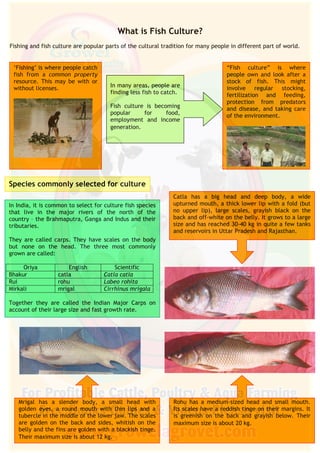
In India, it is common to select for culture fish species
that live in the major rivers of the north of the
country – the Brahmaputra, Ganga and Indus and their
tributaries.
They are called carps. They have scales on the body
but none on the head. The three most commonly
grown are called:
Oriya English Scientific
Bhakur catla Catla catla
Rui rohu Labeo rohita
Mirkali mrigal Cirrhinus mrigala
Together they are called the Indian Major Carps on
account of their large size and fast growth rate.
Species commonly selected for culture
Rohu has a medium-sized head and small mouth.
Its scales have a reddish tinge on their margins. It
is greenish on the back and grayish below. Their
maximum size is about 20 kg.
Mrigal has a slender body, a small head with
golden eyes, a round mouth with thin lips and a
tubercle in the middle of the lower jaw. The scales
are golden on the back and sides, whitish on the
belly and the fins are golden with a blackish tinge.
Their maximum size is about 12 kg.
In many areas, people are
finding less fish to catch.
Fish culture is becoming
popular for food,
employment and income
generation.
Catla has a big head and deep body, a wide
upturned mouth, a thick lower lip with a fold (but
no upper lip), large scales, grayish black on the
back and off-white on the belly. It grows to a large
size and has reached 30-40 kg in quite a few tanks
and reservoirs in Uttar Pradesh and Rajasthan.
Fishing and fish culture are popular parts of the cultural tradition for many people in different part of world.
2
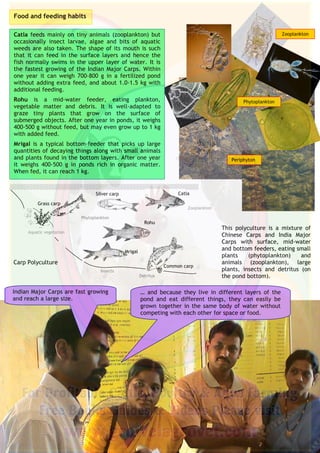
Catla feeds mainly on tiny animals (zooplankton) but
occasionally insect larvae, algae and bits of aquatic
weeds are also taken. The shape of its mouth is such
that it can feed in the surface layers and hence the
fish normally swims in the upper layer of water. It is
the fastest growing of the Indian Major Carps. Within
one year it can weigh 700-800 g in a fertilized pond
without adding extra feed, and about 1.0-1.5 kg with
additional feeding.
Rohu is a mid-water feeder, eating plankton,
vegetable matter and debris. It is well-adapted to
graze tiny plants that grow on the surface of
submerged objects. After one year in ponds, it weighs
400-500 g without feed, but may even grow up to 1 kg
with added feed.
Mrigal is a typical bottom-feeder that picks up large
quantities of decaying things along with small animals
and plants found in the bottom layers. After one year
it weighs 400-500 g in ponds rich in organic matter.
When fed, it can reach 1 kg.
Food and feeding habits
Indian Major Carps are fast growing
and reach a large size.
… and because they live in different layers of the
pond and eat different things, they can easily be
grown together in the same body of water without
competing with each other for space or food.
Zooplankton
Phytoplankton
Periphyton
Carp Polyculture
Grass carp
Silver carp
Common carp
Detritus
Zooplankton
Phytoplankton
Insects
Mrigal
Catla
Rohu
Aquatic vegetation
This polyculture is a mixture of
Chinese Carps and India Major
Carps with surface, mid-water
and bottom feeders, eating small
plants (phytoplankton) and
animals (zooplankton), large
plants, insects and detritus (on
the pond bottom).
3
Actions Jan Feb Mar Apr May Jun Jul Aug Sep Oct Nov Dec
Promoting fingerling supply
Planning Develop nursing
network
Hatchery Condition
broodstock
Spawning
Nursing Seed to SHGs
with nursing
ponds
Fingerling
transport
Fingerlings to
SHGs for raising
Raising fish
Fish raising Raising fish Raising fish
Water and soil
You will need to think of the things about the soil and
water which affect the fish. Very cloudy waters should be
avoided. Fertile soils or water that gets nutrients from
fields or settlements can often support fish growth.
Overhanging trees that shade out the sun and drop leaves
are often not good.
You will need to learn more about water quality and know
about things called dissolved oxygen, pH, Hardness,
Salinity (which you can read more about later in this
series of guidelines).
Seasonal ponds – are often more available
than perennial ponds. They dry up
completely making it easy to harvest fish and
to control predators and problems. But they
should be able to produce a crop of fish
before the water dries up.
The water in this pond may be clean and
well-oxygenated, but with so many plants
there may be predators. Moreover, it would
be difficult to net fish from this pond.
You will need to think about where the water will come
from and if it is good for growing fish. Will it remain all
year or will it dry up?
Perennial ponds – are often used by many people. Fish
culture may conflict with water use for irrigation, washing
or even drinking. They often are a home to large
predators which will eat seed and fry and they may be
difficult and expensive to fish, due to their size or depth.
Aquaculture has to fit with the rains.
It is good to begin planning early – building or
clearing what you need from January. In a
hatchery spawning takes place when the rains
come in July-August. Nursery ponds are prepared
to receive fish seed. Eventually fish of around 150
mm - called fingerling are ready to stock seasonal
or perennial ponds to grow to a size where they
can be sold.
What happens throughout the aquaculture year?
3
So - what is fish culture?
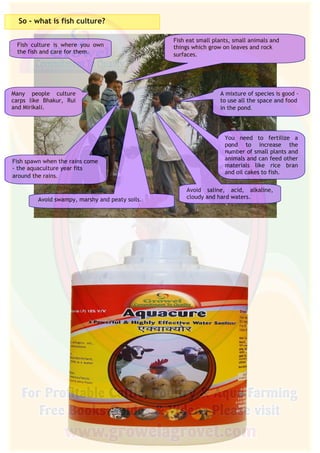
Fish culture is where you own
the fish and care for them.
Many people culture
carps like Bhakur, Rui
and Mirikali.
Fish spawn when the rains come
- the aquaculture year fits
around the rains.
Fish eat small plants, small animals and
things which grow on leaves and rock
surfaces.
A mixture of species is good -
to use all the space and food
in the pond.
You need to fertilize a
pond to increase the
number of small plants and
animals and can feed other
materials like rice bran
and oil cakes to fish.
Avoid saline, acid, alkaline,
cloudy and hard waters.Avoid swampy, marshy and peaty soils.
What is Fish Culture ?

What is Fish Culture ?

  • 1.
    What is FishCulture?
  • 2.
    ‘Fishing’ is wherepeople catch fish from a common property resource. This may be with or without licenses. “Fish culture” is where people own and look after a stock of fish. This might involve regular stocking, fertilization and feeding, protection from predators and disease, and taking care of the environment. What is Fish Culture? In India, it is common to select for culture fish species that live in the major rivers of the north of the country – the Brahmaputra, Ganga and Indus and their tributaries. They are called carps. They have scales on the body but none on the head. The three most commonly grown are called: Oriya English Scientific Bhakur catla Catla catla Rui rohu Labeo rohita Mirkali mrigal Cirrhinus mrigala Together they are called the Indian Major Carps on account of their large size and fast growth rate. Species commonly selected for culture Rohu has a medium-sized head and small mouth. Its scales have a reddish tinge on their margins. It is greenish on the back and grayish below. Their maximum size is about 20 kg. Mrigal has a slender body, a small head with golden eyes, a round mouth with thin lips and a tubercle in the middle of the lower jaw. The scales are golden on the back and sides, whitish on the belly and the fins are golden with a blackish tinge. Their maximum size is about 12 kg. In many areas, people are finding less fish to catch. Fish culture is becoming popular for food, employment and income generation. Catla has a big head and deep body, a wide upturned mouth, a thick lower lip with a fold (but no upper lip), large scales, grayish black on the back and off-white on the belly. It grows to a large size and has reached 30-40 kg in quite a few tanks and reservoirs in Uttar Pradesh and Rajasthan. Fishing and fish culture are popular parts of the cultural tradition for many people in different part of world.
  • 3.
    2 Catla feeds mainlyon tiny animals (zooplankton) but occasionally insect larvae, algae and bits of aquatic weeds are also taken. The shape of its mouth is such that it can feed in the surface layers and hence the fish normally swims in the upper layer of water. It is the fastest growing of the Indian Major Carps. Within one year it can weigh 700-800 g in a fertilized pond without adding extra feed, and about 1.0-1.5 kg with additional feeding. Rohu is a mid-water feeder, eating plankton, vegetable matter and debris. It is well-adapted to graze tiny plants that grow on the surface of submerged objects. After one year in ponds, it weighs 400-500 g without feed, but may even grow up to 1 kg with added feed. Mrigal is a typical bottom-feeder that picks up large quantities of decaying things along with small animals and plants found in the bottom layers. After one year it weighs 400-500 g in ponds rich in organic matter. When fed, it can reach 1 kg. Food and feeding habits Indian Major Carps are fast growing and reach a large size. … and because they live in different layers of the pond and eat different things, they can easily be grown together in the same body of water without competing with each other for space or food. Zooplankton Phytoplankton Periphyton Carp Polyculture Grass carp Silver carp Common carp Detritus Zooplankton Phytoplankton Insects Mrigal Catla Rohu Aquatic vegetation This polyculture is a mixture of Chinese Carps and India Major Carps with surface, mid-water and bottom feeders, eating small plants (phytoplankton) and animals (zooplankton), large plants, insects and detritus (on the pond bottom).
  • 4.
    3 Actions Jan FebMar Apr May Jun Jul Aug Sep Oct Nov Dec Promoting fingerling supply Planning Develop nursing network Hatchery Condition broodstock Spawning Nursing Seed to SHGs with nursing ponds Fingerling transport Fingerlings to SHGs for raising Raising fish Fish raising Raising fish Raising fish Water and soil You will need to think of the things about the soil and water which affect the fish. Very cloudy waters should be avoided. Fertile soils or water that gets nutrients from fields or settlements can often support fish growth. Overhanging trees that shade out the sun and drop leaves are often not good. You will need to learn more about water quality and know about things called dissolved oxygen, pH, Hardness, Salinity (which you can read more about later in this series of guidelines). Seasonal ponds – are often more available than perennial ponds. They dry up completely making it easy to harvest fish and to control predators and problems. But they should be able to produce a crop of fish before the water dries up. The water in this pond may be clean and well-oxygenated, but with so many plants there may be predators. Moreover, it would be difficult to net fish from this pond. You will need to think about where the water will come from and if it is good for growing fish. Will it remain all year or will it dry up? Perennial ponds – are often used by many people. Fish culture may conflict with water use for irrigation, washing or even drinking. They often are a home to large predators which will eat seed and fry and they may be difficult and expensive to fish, due to their size or depth. Aquaculture has to fit with the rains. It is good to begin planning early – building or clearing what you need from January. In a hatchery spawning takes place when the rains come in July-August. Nursery ponds are prepared to receive fish seed. Eventually fish of around 150 mm - called fingerling are ready to stock seasonal or perennial ponds to grow to a size where they can be sold. What happens throughout the aquaculture year?
  • 5.
    3 So - whatis fish culture? Fish culture is where you own the fish and care for them. Many people culture carps like Bhakur, Rui and Mirikali. Fish spawn when the rains come - the aquaculture year fits around the rains. Fish eat small plants, small animals and things which grow on leaves and rock surfaces. A mixture of species is good - to use all the space and food in the pond. You need to fertilize a pond to increase the number of small plants and animals and can feed other materials like rice bran and oil cakes to fish. Avoid saline, acid, alkaline, cloudy and hard waters.Avoid swampy, marshy and peaty soils.