What is Discrete Mathematics?
(Summary)
Discrete Mathematics is a collection of branches of mathematics that involves discrete elements using algebra
and arithmetic. This is a tool being used to improve reasoning and problem-solving capabilities. It involves
distinct values; i.e. between any two points, there are several number of points.
Discrete Mathematics is not a name of any particular branch of mathematics, like number theory, algebra,
calculus, etc. Rather, it describes a set of branches of mathematics that all have in common the feature that
they are “discrete” rather than “continuous”. The members of this set generally include logic and Boolean
algebra, set theory, relations and functions, sequences and series (or “sums”), algorithms and theory of
computation, number theory, matrix theory, induction and recursion, counting and discrete probability, graph
theory (including trees).
Discrete Mathematics is a collection of mathematical branches that involves discrete elements using algebra
and arithmetic. It is more and more being applied in the practical grounds of mathematics and computer
science. This is a tool being used to improve reasoning and problem-solving capabilities.
It involves distinct values; i.e. between any two points, there are several number of points. For instance, in case of a finite set of objects, the
role can be defined as a list of ordered pairs consisting of these objects, and can be presented as a comprehensive list of those pairs.
Topics in Discrete Mathematics
Though there are an indefinite number of branches in Discrete Mathematics, generally the following topics are always covered in any study
related to this branch-
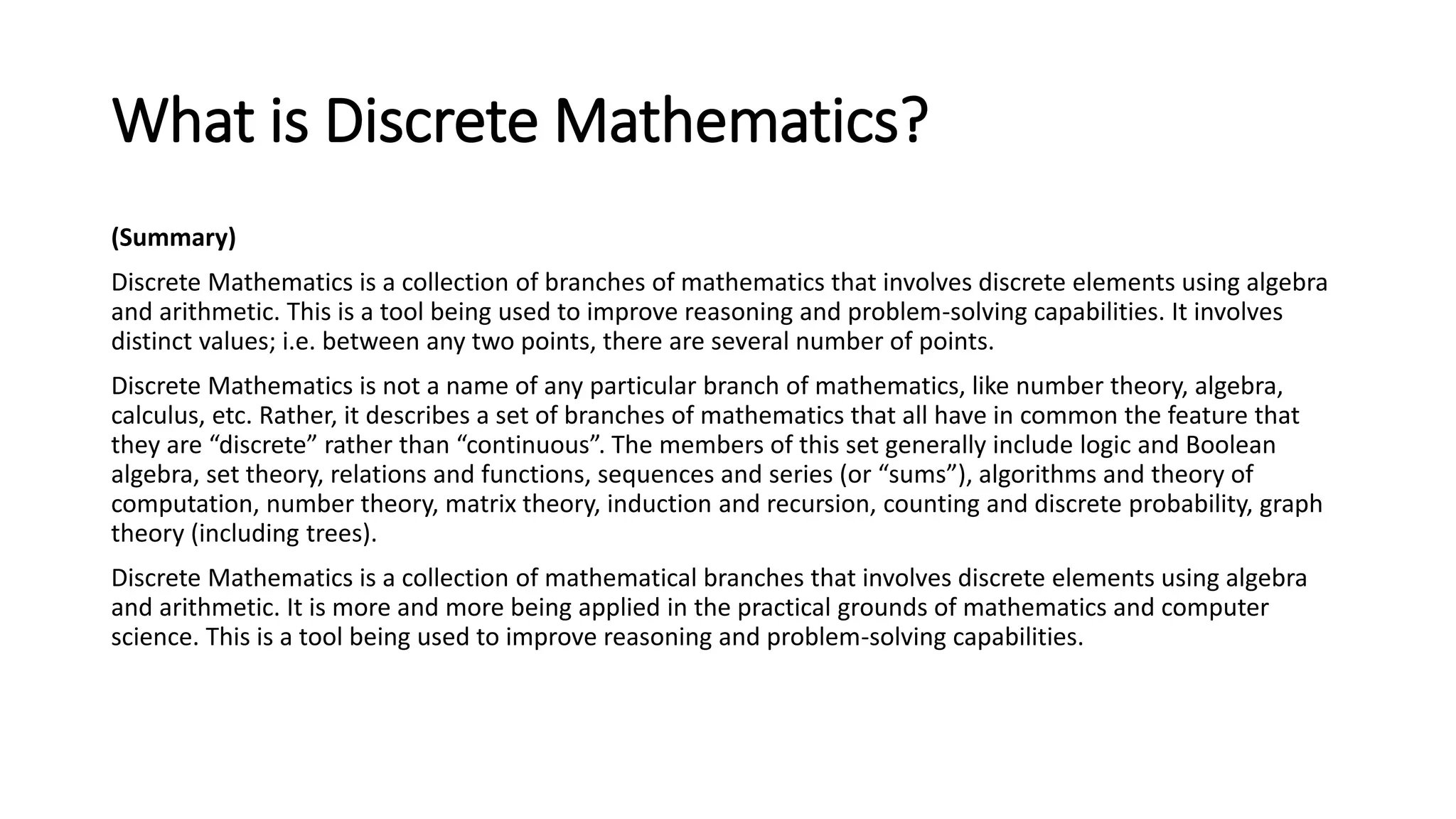
• Sets, Relations and Functions
• Mathematical Logic
• Group theory
• Counting Theory
• Probability
• Mathematical Induction and Recurrence Relations
• Graph Theory
• Trees
• Boolean Algebra
Sets:
The concept of sets had been introduced by the German mathematician. A set is an unordered assembly of different types of elements. We
can draw a set explicitly by listing its elements using set bracket. If the order of the set elements is changed or any element of a set is repeated,
it does not make any changes in the set.
Relations:
The relationship between the different elements of the sets is another crucial things to come. Relations may exist between the elements of the
same set or between the elements of two or more sets.
Functions:
A Function is assigned to each element of a set, just one element of a related set. Functions have various application in various fields such as,
representing the computational complexity of algorithms, study of sequences and strings, counting objects, and many others.
Propositional Logic:
Propositional logic takes concern in statements to which the truth values, “true” and “false”, can be allocated. The objective is to examine
these statements either individually or in a composite manner.
Predicate Logic:
Predicate Logic deals with predicates i.e. propositions containing variables.
Rules of Inference:
Rules of Inference are used to deduce new statements from the statements whose truth we already
know.
Counting Theory:
Counting mainly encompasses fundamental counting rule, and the permutation and the
combination rule.
Probability:
Probability simply means finding the chances of occurrence of an event. In Mathematics, it is the
study of random processes and their outcomes. The laws of probability have an extensive
applicability in a range of fields like weather forecasting, genetics, opinion polls, stock markets etc.
Recurrence Relation
• Recurrence relation is the process of finding the terms of a sequence in a recursive manner.
Key Points
• Discrete Mathematics is a collection of mathematical branches that involves discrete elements
using algebra and arithmetic.
• It is majorly applied in the practical grounds of mathematics and computer science.
• This is a tool being used to improve reasoning and problem-solving capabilities.
• It involves distinct values; i.e. between any two points, there are several number of points
• A set is an unordered assembly of different types of elements.
Published by Brainware University

What is discrete mathematics

  • 1.
    What is DiscreteMathematics? (Summary) Discrete Mathematics is a collection of branches of mathematics that involves discrete elements using algebra and arithmetic. This is a tool being used to improve reasoning and problem-solving capabilities. It involves distinct values; i.e. between any two points, there are several number of points. Discrete Mathematics is not a name of any particular branch of mathematics, like number theory, algebra, calculus, etc. Rather, it describes a set of branches of mathematics that all have in common the feature that they are “discrete” rather than “continuous”. The members of this set generally include logic and Boolean algebra, set theory, relations and functions, sequences and series (or “sums”), algorithms and theory of computation, number theory, matrix theory, induction and recursion, counting and discrete probability, graph theory (including trees). Discrete Mathematics is a collection of mathematical branches that involves discrete elements using algebra and arithmetic. It is more and more being applied in the practical grounds of mathematics and computer science. This is a tool being used to improve reasoning and problem-solving capabilities.
  • 3.
    It involves distinctvalues; i.e. between any two points, there are several number of points. For instance, in case of a finite set of objects, the role can be defined as a list of ordered pairs consisting of these objects, and can be presented as a comprehensive list of those pairs. Topics in Discrete Mathematics Though there are an indefinite number of branches in Discrete Mathematics, generally the following topics are always covered in any study related to this branch- • Sets, Relations and Functions • Mathematical Logic • Group theory • Counting Theory • Probability • Mathematical Induction and Recurrence Relations • Graph Theory • Trees • Boolean Algebra
  • 4.
    Sets: The concept ofsets had been introduced by the German mathematician. A set is an unordered assembly of different types of elements. We can draw a set explicitly by listing its elements using set bracket. If the order of the set elements is changed or any element of a set is repeated, it does not make any changes in the set. Relations: The relationship between the different elements of the sets is another crucial things to come. Relations may exist between the elements of the same set or between the elements of two or more sets. Functions: A Function is assigned to each element of a set, just one element of a related set. Functions have various application in various fields such as, representing the computational complexity of algorithms, study of sequences and strings, counting objects, and many others. Propositional Logic: Propositional logic takes concern in statements to which the truth values, “true” and “false”, can be allocated. The objective is to examine these statements either individually or in a composite manner. Predicate Logic: Predicate Logic deals with predicates i.e. propositions containing variables.
  • 5.
    Rules of Inference: Rulesof Inference are used to deduce new statements from the statements whose truth we already know. Counting Theory: Counting mainly encompasses fundamental counting rule, and the permutation and the combination rule. Probability: Probability simply means finding the chances of occurrence of an event. In Mathematics, it is the study of random processes and their outcomes. The laws of probability have an extensive applicability in a range of fields like weather forecasting, genetics, opinion polls, stock markets etc. Recurrence Relation • Recurrence relation is the process of finding the terms of a sequence in a recursive manner.
  • 6.
    Key Points • DiscreteMathematics is a collection of mathematical branches that involves discrete elements using algebra and arithmetic. • It is majorly applied in the practical grounds of mathematics and computer science. • This is a tool being used to improve reasoning and problem-solving capabilities. • It involves distinct values; i.e. between any two points, there are several number of points • A set is an unordered assembly of different types of elements. Published by Brainware University