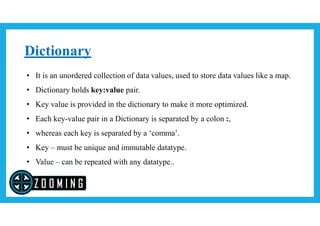
A dictionary in Python is an unordered collection of key-value pairs where keys must be unique and immutable. It allows storing and accessing data values using keys. Keys can be of any immutable data type while values can be of any data type. Dictionaries can be created using curly braces {} or the dict() constructor and elements can be added, accessed, updated, or removed using keys. Common dictionary methods include copy(), clear(), pop(), get(), keys(), items(), and update().

![Dictionary - Create
# Creating an empty Dictionary
Dict = {}
# Creating a Dictionary with Integer Keys
Dict = {1: 'Zooming', 2: 'For', 3: 'Zooming’}
# Creating a Dictionary with Mixed keys
Dict = {'Name': 'Zooming', 1: [1, 2, 3, 4]}
# Creating a Dictionary with dict() method
Dict = dict({1: 'Zooming', 2: 'For', 3:'Zooming’})
# Creating a Dictionary with each item as a Pair
Dict = dict([(1, 'Zooming'), (2, 'For')])](https://image.slidesharecdn.com/6-191007101805/85/Python-Dictionary-3-320.jpg)
![Dictionary – Adding element
# Creating an empty Dictionary
Dict = {}
# Adding elements one at a time
Dict[0] = 'Zooming'
Dict[2] = 'For'
Dict[3] = 1
# Adding set of values
# to a single Key
Dict['Value_set'] = 2, 3, 4
# Updating existing Key's Value
Dict[2] = 'Welcome’
# Adding Nested Key value to Dictionary
Dict[5] = {'Nested' :{'1' : 'Life', '2' : 'Zooming’}}](https://image.slidesharecdn.com/6-191007101805/85/Python-Dictionary-4-320.jpg)
![Dictionary – Accessing element
# Creating a Dictionary
Dict = {1: 'Zooming', 'name': 'For', 3: 'Zooming'}
# accessing a element using key
print("Acessing a element using key:")
print(Dict['name'])
# accessing a element using key
print("Acessing a element using key:")
print(Dict[1])
# accessing a element using get()
# method
print("Acessing a element using get:")
print(Dict.get(3))](https://image.slidesharecdn.com/6-191007101805/85/Python-Dictionary-5-320.jpg)
![Dictionary – Removing element
Dict = { 5 : 'Welcome', 6 : 'To', 7 : 'Geeks’,
'A' : {1 : 'Geeks', 2 : 'For', 3 : 'Geeks'},
'B' : {1 : 'Geeks', 2 : 'Life'}}
print("Initial Dictionary: ")
print(Dict)
# Deleting a Key value
del Dict[6]
# Deleting a Key from Nested Dictionary
del Dict['A'][2]
# Deleting a Key using pop()
Dict.pop(5)
# Deleting entire Dictionary
Dict.clear()](https://image.slidesharecdn.com/6-191007101805/85/Python-Dictionary-6-320.jpg)
![METHODS DESCRIPTION
copy() They copy() method returns a shallow copy of the dictionary.
clear() The clear() method removes all items from the dictionary.
pop() Removes and returns an element from a dictionary having the given key.
popitem() Removes the arbitrary key-value pair from the dictionary and returns it as tuple.
get() It is a conventional method to access a value for a key.
dictionary_name.values() returns a list of all the values available in a given dictionary.
str() Produces a printable string representation of a dictionary.
update() Adds dictionary dict2’s key-values pairs to dict
setdefault() Set dict[key]=default if key is not already in dict
keys() Returns list of dictionary dict’s keys
items() Returns a list of dict’s (key, value) tuple pairs
has_key() Returns true if key in dictionary dict, false otherwise
fromkeys() Create a new dictionary with keys from seq and values set to value.
type() Returns the type of the passed variable.
cmp() Compares elements of both dict.](https://image.slidesharecdn.com/6-191007101805/85/Python-Dictionary-7-320.jpg)


